May 5th, 2021
GRI and SASB Reporting Standards Working
Together
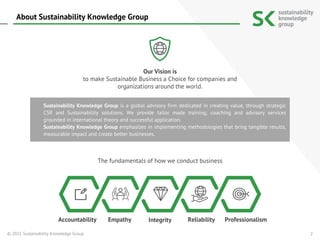
About Sustainability Knowledge Group
Our Vision is
to make Sustainable Business a Choice for companies and
organizations around the world.
Sustainability Knowledge Group is a global advisory firm dedicated in creating value, through strategic
CSR and Sustainability solutions. We provide tailor made training, coaching and advisory services
grounded in international theory and successful application.
Sustainability Knowledge Group emphasizes in implementing methodologies that bring tangible results,
measurable impact and create better businesses.
The fundamentals of how we conduct business
Reliability Professionalism
Empathy
Accountability Integrity
2
© 2021 Sustainability Knowledge Group
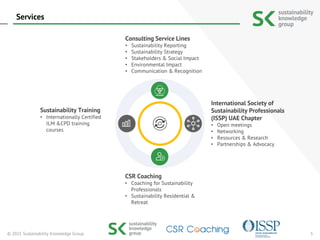
Services
CSR Coaching
• Coaching for Sustainability
Professionals
• Sustainability Residential &
Retreat
Consulting Service Lines
• Sustainability Reporting
• Sustainability Strategy
• Stakeholders & Social Impact
• Environmental Impact
• Communication & Recognition
International Society of
Sustainability Professionals
(ISSP) UAE Chapter
• Open meetings
• Networking
• Resources & Research
• Partnerships & Advocacy
Sustainability Training
• Internationally Certified
ILM &CPD training
courses
3
© 2021 Sustainability Knowledge Group
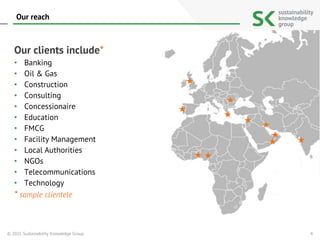
Our clients include*
• Banking
• Oil & Gas
• Construction
• Consulting
• Concessionaire
• Education
• FMCG
• Facility Management
• Local Authorities
• NGOs
• Telecommunications
• Technology
* sample clientele
Our reach
4
© 2021 Sustainability Knowledge Group
GRI and SASB Reporting Standards Working
Together
5
6
In recent years, the sustainability disclosure landscape has become complex for
companies, yet 96% of the world’s largest 250 companies (G250) report on their
sustainability performance. A wide range of stakeholders – including investors,
companies, policymakers, regulators, NGOs, and civil society – use corporate
sustainability reports to inform a wide range of decisions. With the increase in
sustainability reporting, there is an increasing global push for improving disclosures
and enhancing clarity, compatibility, and transparency.
Standards such as the Global Reporting Initiative (GRI) Standards and the Sustainability
Accounting Standards Board (SASB) Standards which dominate the sustainability
disclosure landscape, help ensure that companies report high-quality information to
their stakeholders.
Using the GRI and SASB Standards
Sustainability frameworks differ from sustainability standards, yet both complement
each other as the standards make frameworks actionable. The frameworks
provide principle-based guidance on how information is organized, prepared and the
general topics covered, while the standards provide specific, detailed and replicable
requirements for what to report for each topic, including metrics.
GRI and SASB are standards for disclosing sustainability information.
The GRI standards focus on the company’s ESG impacts on sustainable development,
which concern a wide range of stakeholders, including investors. Thus, each set of
standards complement each other and do not act as a substitute for each other.
© 2021 Sustainability Knowledge Group
GRI and SASB Reporting Standards Working Together
7
SASB standards focus on environmental, social, and corporate governance (ESG)
issues that are expected to have a financially material impact on the company (financial
condition, operating performance, or risk profile) mainly catering to investors.
In July 2020, GRI and SASB announced a collaborative workplan, which aims to:
•Provide clarity on the application of their reporting standards
•Help to understand how the sustainability performance data they provide is used
•Help consumers of sustainability data understand the similarities and differences in the
information generated from these standards.
•Help companies and investors successfully use the GRI and SASB standards to provide
the depth and breadth of disclosure that many stakeholders require
A Practical Guide Using GRI and SASB Standards
In April 2021, a practical guide to sustainability reporting using the GRI and SASB
standards was released. “A Practical Guide to Sustainability Reporting Using GRI and
SASB Standards” shows how companies use the two sets of standards together and
explore companies’ experiences using the two sets of standards together to meet their
reporting needs. The Guide was based on extensive interviews with four global
companies who are all long-term GRI reporters who are now also reporting according to
SASB.
© 2021 Sustainability Knowledge Group
GRI and SASB Reporting Standards Working Together
8
“This joint research demonstrates how companies successfully use the GRI and SASB
Standards to provide the depth and breadth of disclosure that their many stakeholders,
including investors, require. The GRI and SASB Standards have unique and complementary
roles within a global and comprehensive corporate reporting system. Our progress towards
this system is abetted by developing a common language and practical insights, as offered
by this joint paper.” Janine Guillot, CEO of SASB
How the GRI and SASB Standards work together
Businesses can use GRI and SASB Standards to meet the needs of their target audience.
There is no single recommended method for using the two sets of standards together.
Companies use different reporting processes, for example:
•Publish separate GRI and SASB tables of disclosures within the same integrated report.
•Publish a combined GRI and SASB content index
Why report against both the GRI Standards and the SASB Standards?
The Guide revealed several reasons for companies to use the GRI and SASB standards
together, including:
•Pioneering transparency: helps companies anticipate changing stakeholder
expectations and anticipate data requests through transparency.
•A holistic picture: provide comprehensive picture of the company’s performance, which
brings sustainability and financial information together
© 2021 Sustainability Knowledge Group
GRI and SASB Reporting Standards Working Together
9
•Meeting the needs of investors: meets the needs of a wide range of stakeholders,
including investors.
•Business value: provides key insights into the long-term value of a business, its
durability, and the creation of growth opportunities.
Global Reporting Initiative (GRI) is the independent, international organization that
helps businesses and other organizations take responsibility for their impacts, by
providing the global common language to report those impacts. The GRI Standards, are
the world’s most widely used standards for sustainability reporting.
The Sustainability Accounting Standards Board (SASB) connects businesses and
investors on the financial impacts of sustainability. SASB Standards enable businesses
around the world to identify, manage, and communicate financially material
sustainability information to investors. SASB Standards are industry-specific and are
designed to be decision-useful for investors and cost-effective for companies.
© 2021 Sustainability Knowledge Group
GRI and SASB Reporting Standards Working Together
10
© 2021 Sustainability Knowledge Group
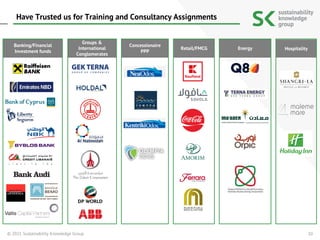
Have Trusted us for Training and Consultancy Assignments
Banking/Financial
Investment funds
Groups &
International
Conglomerates
Concessionaire
PPP
Retail/FMCG Energy Hospitality
11
© 2021 Sustainability Knowledge Group
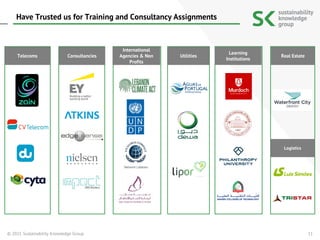
Have Trusted us for Training and Consultancy Assignments
Telecoms Consultancies
International
Agencies & Non
Profits
Utilities
Learning
Institutions
Real Estate
Logistics
United Kingdom
85 Great Portland Street,
First Floor, W1W 7LT,
London, UK
Cyprus
Vasili Michailidi 9,
CY-3026, Limassol, Cyprus
United Arab Emirates
Jumeirah Business Centre
(JBC), Jumeirah Lake
Towers (JLT), Dubai, UAE
Contact:
Email: contact@sustainabilityknowledgegroup.com
Tel.: +44 (0)20 32392990

GRI and SASB Reporting Standards: Working Together

  • 1.
    May 5th, 2021 GRIand SASB Reporting Standards Working Together
  • 2.
    About Sustainability KnowledgeGroup Our Vision is to make Sustainable Business a Choice for companies and organizations around the world. Sustainability Knowledge Group is a global advisory firm dedicated in creating value, through strategic CSR and Sustainability solutions. We provide tailor made training, coaching and advisory services grounded in international theory and successful application. Sustainability Knowledge Group emphasizes in implementing methodologies that bring tangible results, measurable impact and create better businesses. The fundamentals of how we conduct business Reliability Professionalism Empathy Accountability Integrity 2 © 2021 Sustainability Knowledge Group
  • 3.
    Services CSR Coaching • Coachingfor Sustainability Professionals • Sustainability Residential & Retreat Consulting Service Lines • Sustainability Reporting • Sustainability Strategy • Stakeholders & Social Impact • Environmental Impact • Communication & Recognition International Society of Sustainability Professionals (ISSP) UAE Chapter • Open meetings • Networking • Resources & Research • Partnerships & Advocacy Sustainability Training • Internationally Certified ILM &CPD training courses 3 © 2021 Sustainability Knowledge Group
  • 4.
    Our clients include* •Banking • Oil & Gas • Construction • Consulting • Concessionaire • Education • FMCG • Facility Management • Local Authorities • NGOs • Telecommunications • Technology * sample clientele Our reach 4 © 2021 Sustainability Knowledge Group
  • 5.
    GRI and SASBReporting Standards Working Together 5
  • 6.
    6 In recent years,the sustainability disclosure landscape has become complex for companies, yet 96% of the world’s largest 250 companies (G250) report on their sustainability performance. A wide range of stakeholders – including investors, companies, policymakers, regulators, NGOs, and civil society – use corporate sustainability reports to inform a wide range of decisions. With the increase in sustainability reporting, there is an increasing global push for improving disclosures and enhancing clarity, compatibility, and transparency. Standards such as the Global Reporting Initiative (GRI) Standards and the Sustainability Accounting Standards Board (SASB) Standards which dominate the sustainability disclosure landscape, help ensure that companies report high-quality information to their stakeholders. Using the GRI and SASB Standards Sustainability frameworks differ from sustainability standards, yet both complement each other as the standards make frameworks actionable. The frameworks provide principle-based guidance on how information is organized, prepared and the general topics covered, while the standards provide specific, detailed and replicable requirements for what to report for each topic, including metrics. GRI and SASB are standards for disclosing sustainability information. The GRI standards focus on the company’s ESG impacts on sustainable development, which concern a wide range of stakeholders, including investors. Thus, each set of standards complement each other and do not act as a substitute for each other. © 2021 Sustainability Knowledge Group GRI and SASB Reporting Standards Working Together
  • 7.
    7 SASB standards focuson environmental, social, and corporate governance (ESG) issues that are expected to have a financially material impact on the company (financial condition, operating performance, or risk profile) mainly catering to investors. In July 2020, GRI and SASB announced a collaborative workplan, which aims to: •Provide clarity on the application of their reporting standards •Help to understand how the sustainability performance data they provide is used •Help consumers of sustainability data understand the similarities and differences in the information generated from these standards. •Help companies and investors successfully use the GRI and SASB standards to provide the depth and breadth of disclosure that many stakeholders require A Practical Guide Using GRI and SASB Standards In April 2021, a practical guide to sustainability reporting using the GRI and SASB standards was released. “A Practical Guide to Sustainability Reporting Using GRI and SASB Standards” shows how companies use the two sets of standards together and explore companies’ experiences using the two sets of standards together to meet their reporting needs. The Guide was based on extensive interviews with four global companies who are all long-term GRI reporters who are now also reporting according to SASB. © 2021 Sustainability Knowledge Group GRI and SASB Reporting Standards Working Together
  • 8.
    8 “This joint researchdemonstrates how companies successfully use the GRI and SASB Standards to provide the depth and breadth of disclosure that their many stakeholders, including investors, require. The GRI and SASB Standards have unique and complementary roles within a global and comprehensive corporate reporting system. Our progress towards this system is abetted by developing a common language and practical insights, as offered by this joint paper.” Janine Guillot, CEO of SASB How the GRI and SASB Standards work together Businesses can use GRI and SASB Standards to meet the needs of their target audience. There is no single recommended method for using the two sets of standards together. Companies use different reporting processes, for example: •Publish separate GRI and SASB tables of disclosures within the same integrated report. •Publish a combined GRI and SASB content index Why report against both the GRI Standards and the SASB Standards? The Guide revealed several reasons for companies to use the GRI and SASB standards together, including: •Pioneering transparency: helps companies anticipate changing stakeholder expectations and anticipate data requests through transparency. •A holistic picture: provide comprehensive picture of the company’s performance, which brings sustainability and financial information together © 2021 Sustainability Knowledge Group GRI and SASB Reporting Standards Working Together
  • 9.
    9 •Meeting the needsof investors: meets the needs of a wide range of stakeholders, including investors. •Business value: provides key insights into the long-term value of a business, its durability, and the creation of growth opportunities. Global Reporting Initiative (GRI) is the independent, international organization that helps businesses and other organizations take responsibility for their impacts, by providing the global common language to report those impacts. The GRI Standards, are the world’s most widely used standards for sustainability reporting. The Sustainability Accounting Standards Board (SASB) connects businesses and investors on the financial impacts of sustainability. SASB Standards enable businesses around the world to identify, manage, and communicate financially material sustainability information to investors. SASB Standards are industry-specific and are designed to be decision-useful for investors and cost-effective for companies. © 2021 Sustainability Knowledge Group GRI and SASB Reporting Standards Working Together
  • 10.
    10 © 2021 SustainabilityKnowledge Group Have Trusted us for Training and Consultancy Assignments Banking/Financial Investment funds Groups & International Conglomerates Concessionaire PPP Retail/FMCG Energy Hospitality
  • 11.
    11 © 2021 SustainabilityKnowledge Group Have Trusted us for Training and Consultancy Assignments Telecoms Consultancies International Agencies & Non Profits Utilities Learning Institutions Real Estate Logistics
  • 12.
    United Kingdom 85 GreatPortland Street, First Floor, W1W 7LT, London, UK Cyprus Vasili Michailidi 9, CY-3026, Limassol, Cyprus United Arab Emirates Jumeirah Business Centre (JBC), Jumeirah Lake Towers (JLT), Dubai, UAE Contact: Email: contact@sustainabilityknowledgegroup.com Tel.: +44 (0)20 32392990