
Blockchain and Distributed
Ledger Technologies: An EU
Policy Perspective
ITU Workshop on "Security aspects of blockchain"
21 March 2017
Benoit Abeloos, EC, DG CNECT, Startups and
Innovation Unit, benoit.abeloos@ec.europa.eu
Agenda
• Digital Single Market - ICT Standards priorities
• Blockchain and financial markets
• European Parliament contributions
• The FinTech Task Force
• Application areas for blockchain
• EU initiatives
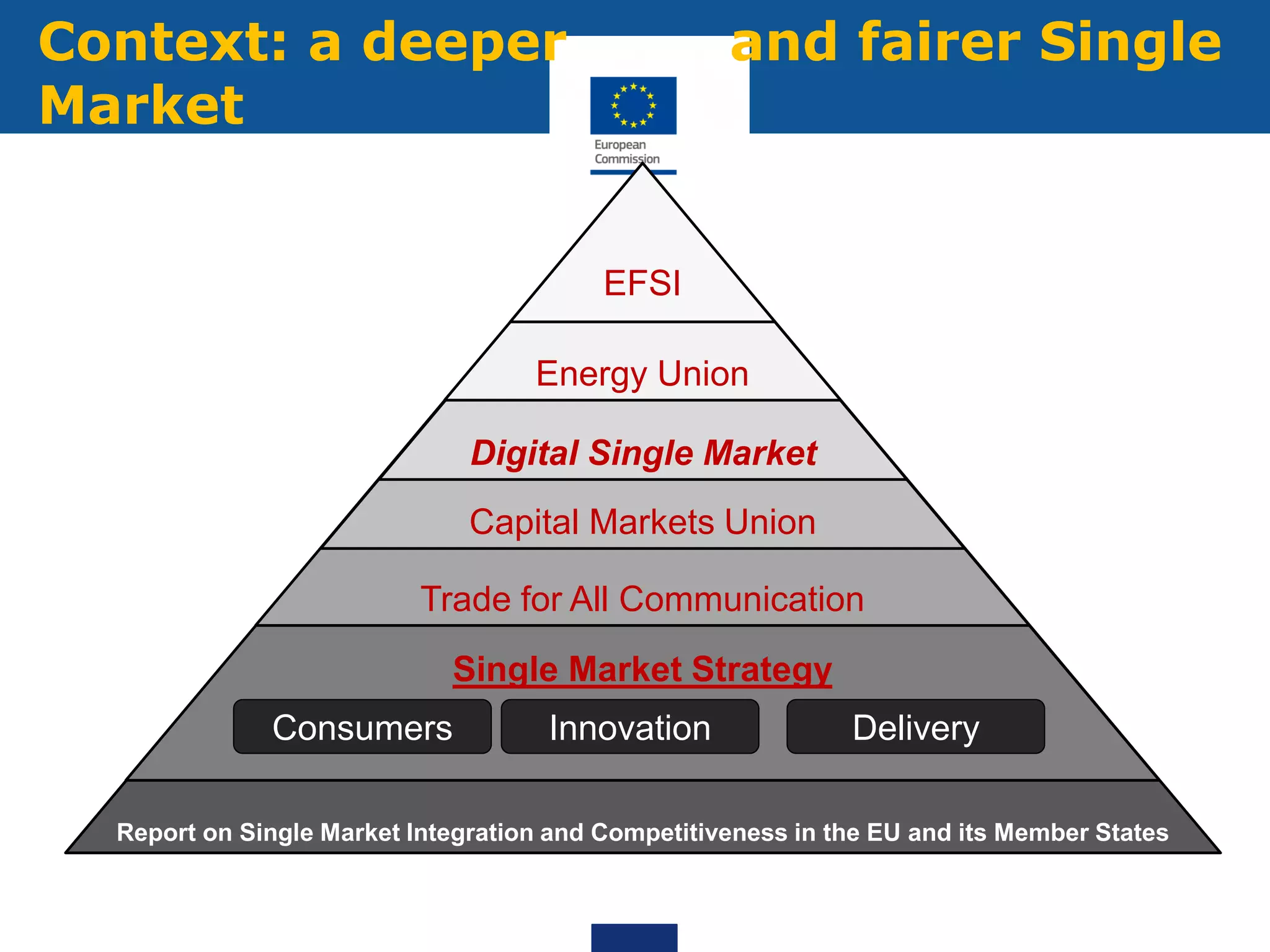
Report on Single Market Integration and Competitiveness in the EU and its Member States
Context: a deeper and fairer Single
Market
Single Market Strategy
Trade for All Communication
Capital Markets Union
Digital Single Market
Energy Union
EFSI
Consumers Innovation Delivery
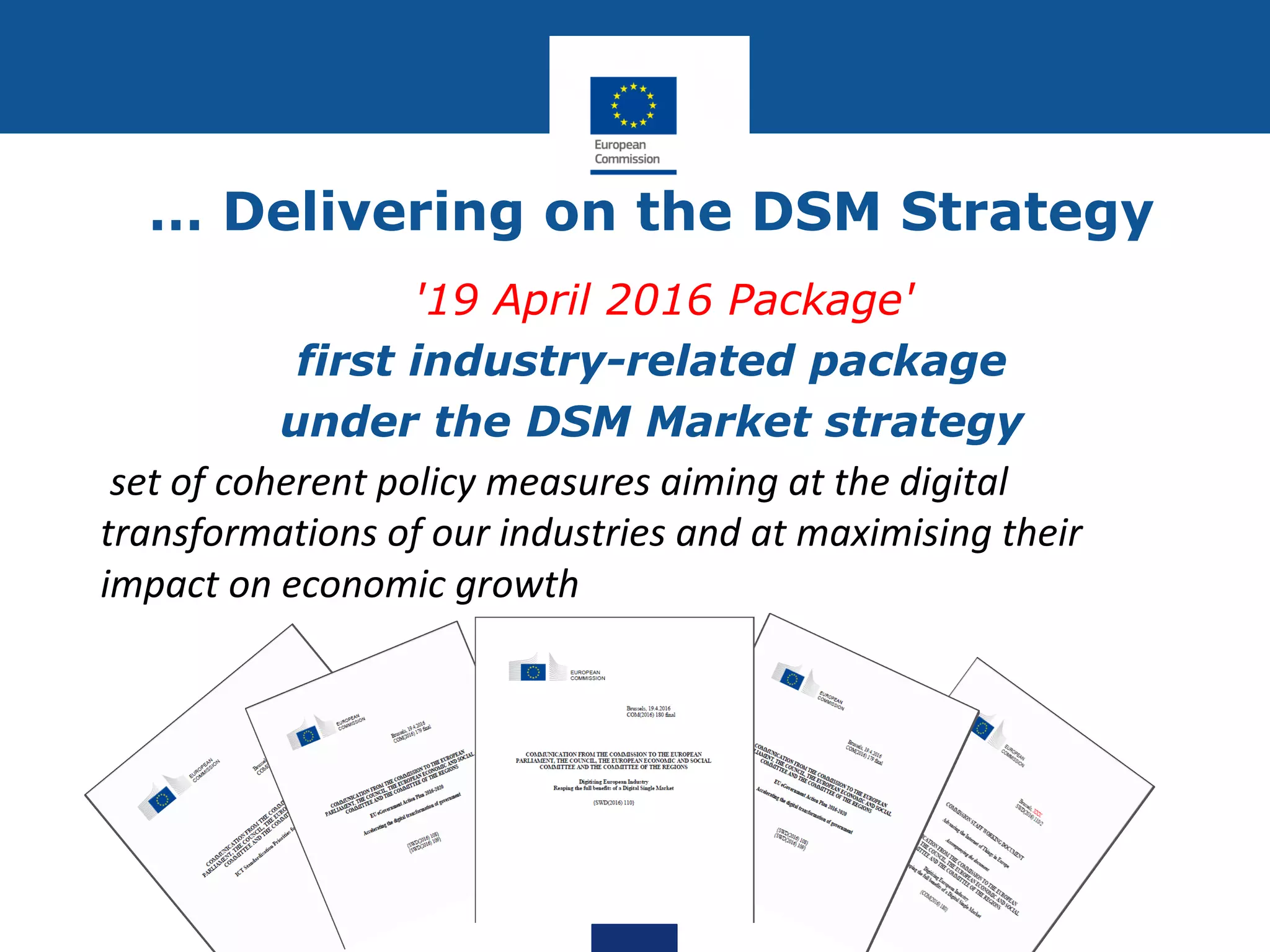
… Delivering on the DSM Strategy
'19 April 2016 Package'
first industry-related package
under the DSM Market strategy
set of coherent policy measures aiming at the digital
transformations of our industries and at maximising their
impact on economic growth
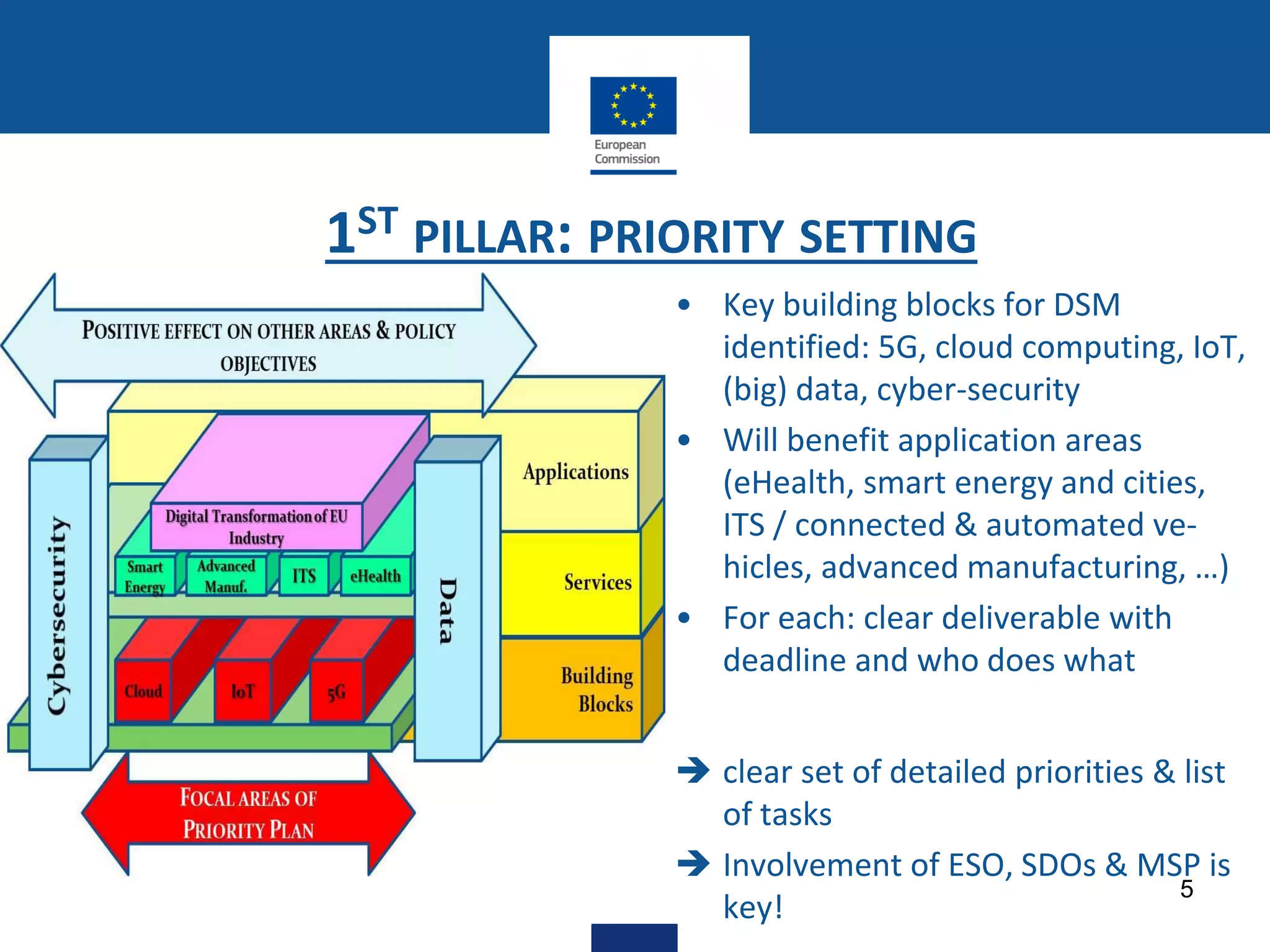
1ST PILLAR: PRIORITY SETTING
• Key building blocks for DSM
identified: 5G, cloud computing, IoT,
(big) data, cyber-security
• Will benefit application areas
(eHealth, smart energy and cities,
ITS / connected & automated ve-
hicles, advanced manufacturing, …)
• For each: clear deliverable with
deadline and who does what
 clear set of detailed priorities & list
of tasks
 Involvement of ESO, SDOs & MSP is
key!
5
Blockchain: where did it start?
• With virtual currencies and their disruptive
potential on financial markets
• Bitcoin was introduced on 31 October 2008 by
Satoshi Nakamoto, never identified
• Released as open sources software, based on
distributed ledger technology
• Many other virtual currencies launched since then
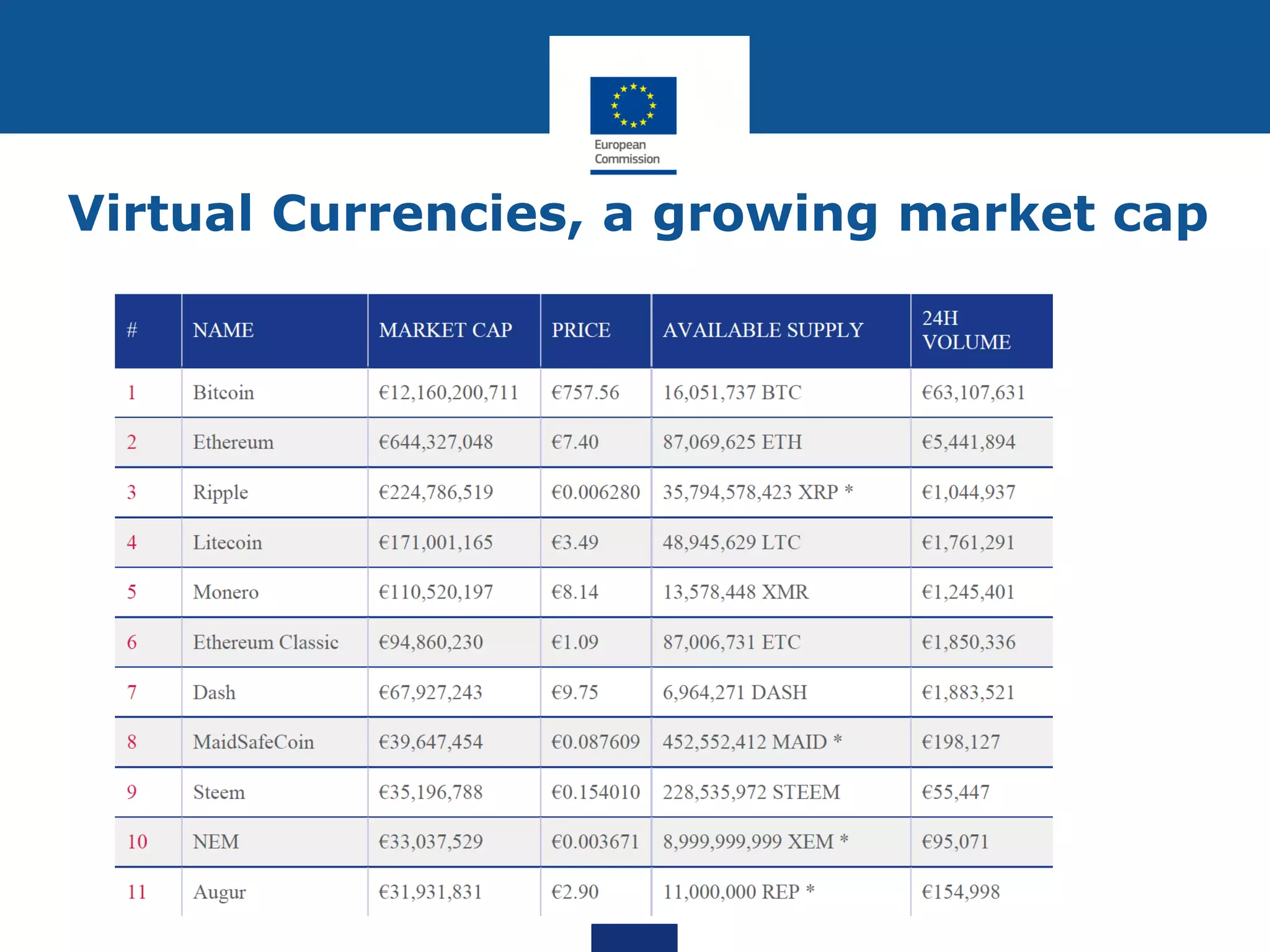
• Total market cap in billion€
Virtual Currencies, a growing market cap
European Parliament resolution of
26 May 2016 on virtual currencies
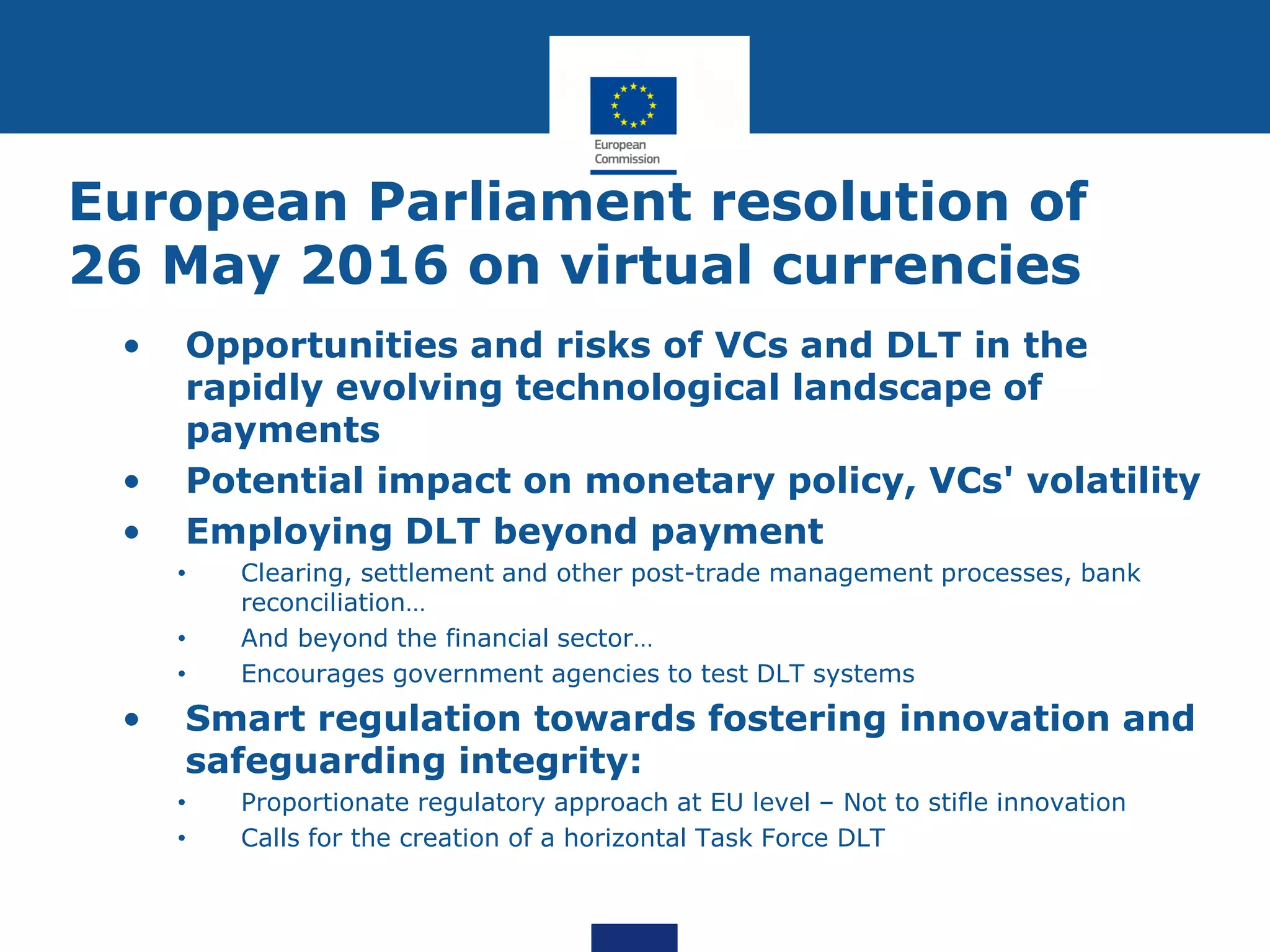
• Opportunities and risks of VCs and DLT in the
rapidly evolving technological landscape of
payments
• Potential impact on monetary policy, VCs' volatility
• Employing DLT beyond payment
• Clearing, settlement and other post-trade management processes, bank
reconciliation…
• And beyond the financial sector…
• Encourages government agencies to test DLT systems
• Smart regulation towards fostering innovation and
safeguarding integrity:
• Proportionate regulatory approach at EU level – Not to stifle innovation
• Calls for the creation of a horizontal Task Force DLT
EU Parliament draft report on the influence of
technology on the future of the financial sector
• Which technologies? DLT, Artificial Intelligence, and Cloud
• Drawing an EU framework for FinTech
• Draw up a Fintech action plan
• Legislation in the financial domain should be proportionate and
according to
• The innovation principle
• Same service and risk, same rule.
• Technological neutrality
• Recommends controlled experimentation by authorities
• RegTech potential to alleviate compliance processes
European Supervisory Authorities
• European Central Bank
• Adopting existing standards
• European Bank Authority
• Prudential regulation and supervision across the
European banking sector
• To perform these tasks, the EBA can produce a number of regulatory
and non regulatory documents including binding Technical
Standards, Guidelines, Recommendations, Opinions and ad-hoc or
regular reports
• European Securities and Market Authority (ESMA)
• is issuing guidelines and technical standards which
should be followed by the industry
• European Insurance and Occupational Pensions Authority
• developing technical standards to implement different
legislations related to the insurance sector
EP draft report (2)
• Cyber security and ICT risks
• Need for end-to-end security across the whole
financial services
• ESAs to regularly review operational standards
• Need for information sharing between ESAs and
market participants
• Concerns about unlawful use of blockchain, for
example through bitcoins
• Need for better education and awareness for
citizens and businesses
FinTech task Force
• Work Stream on blockchain
• Creation of a blockchain observatory (beyond FS)
• Work Stream on interoperability and standards
• FinTech included in the ICT standards rolling plan
• Need for a cartography of FinTech standards
• Need for cooperation between stakeholders
• SDOs (ISO TC68, ISO TC307, ITU, ETSI,…)
• European Supervisory Authorities (EBA, ESMA, EIOPA)
• Banks, Insurances
• New players (payment, RegTech, lending, financing, etc…)
• Need for coordinating EU initiatives
• Launch of a public consultation
• https://ec.europa.eu/digital-single-market/en/blog/european-commission-
sets-internal-task-force-financial-technology
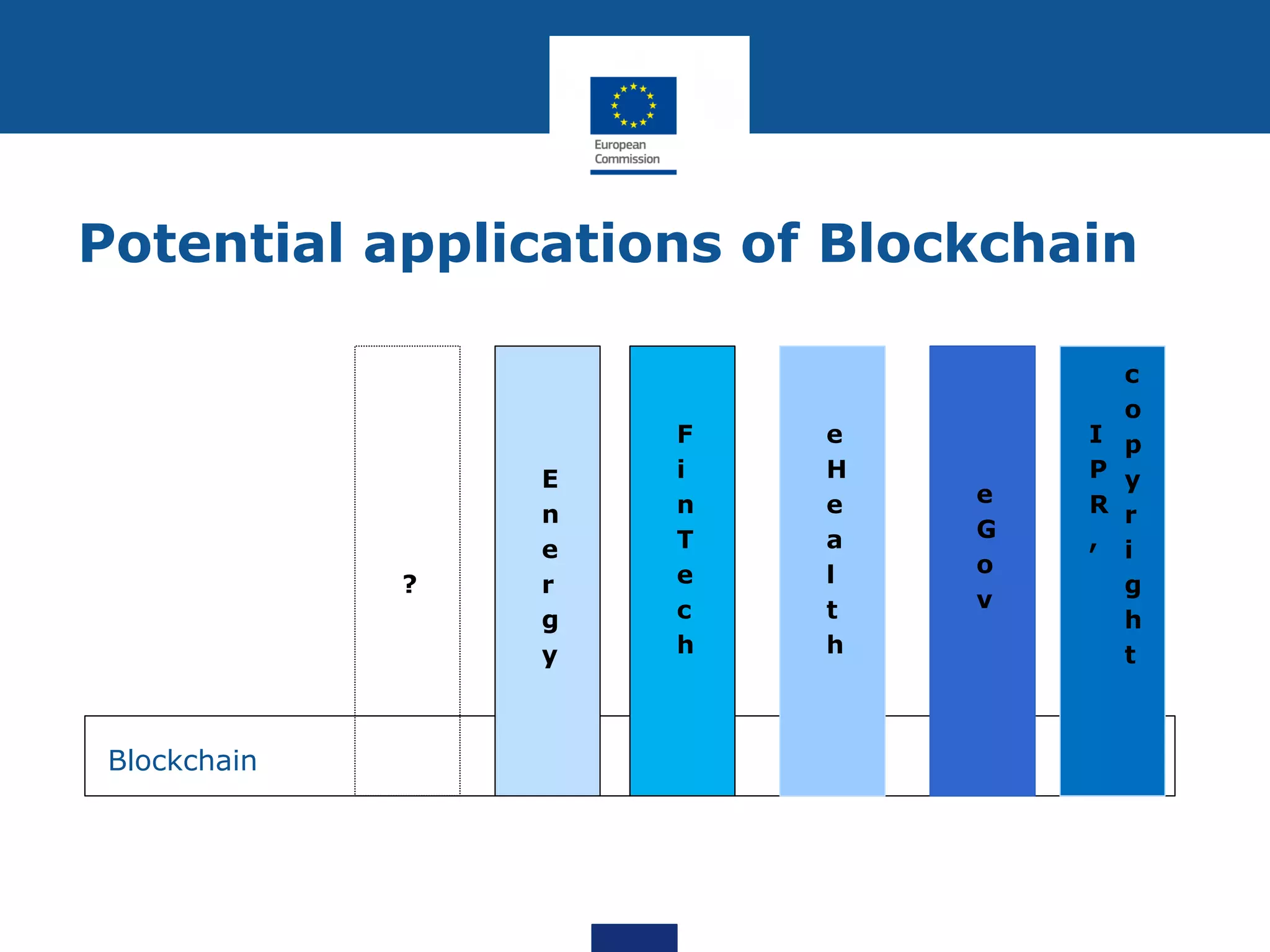
Potential applications of Blockchain
Blockchain
F
i
n
T
e
c
h
e
H
e
a
l
t
h
e
G
o
v
I
P
R
,
c
o
p
y
r
i
g
h
t
E
n
e
r
g
y
?
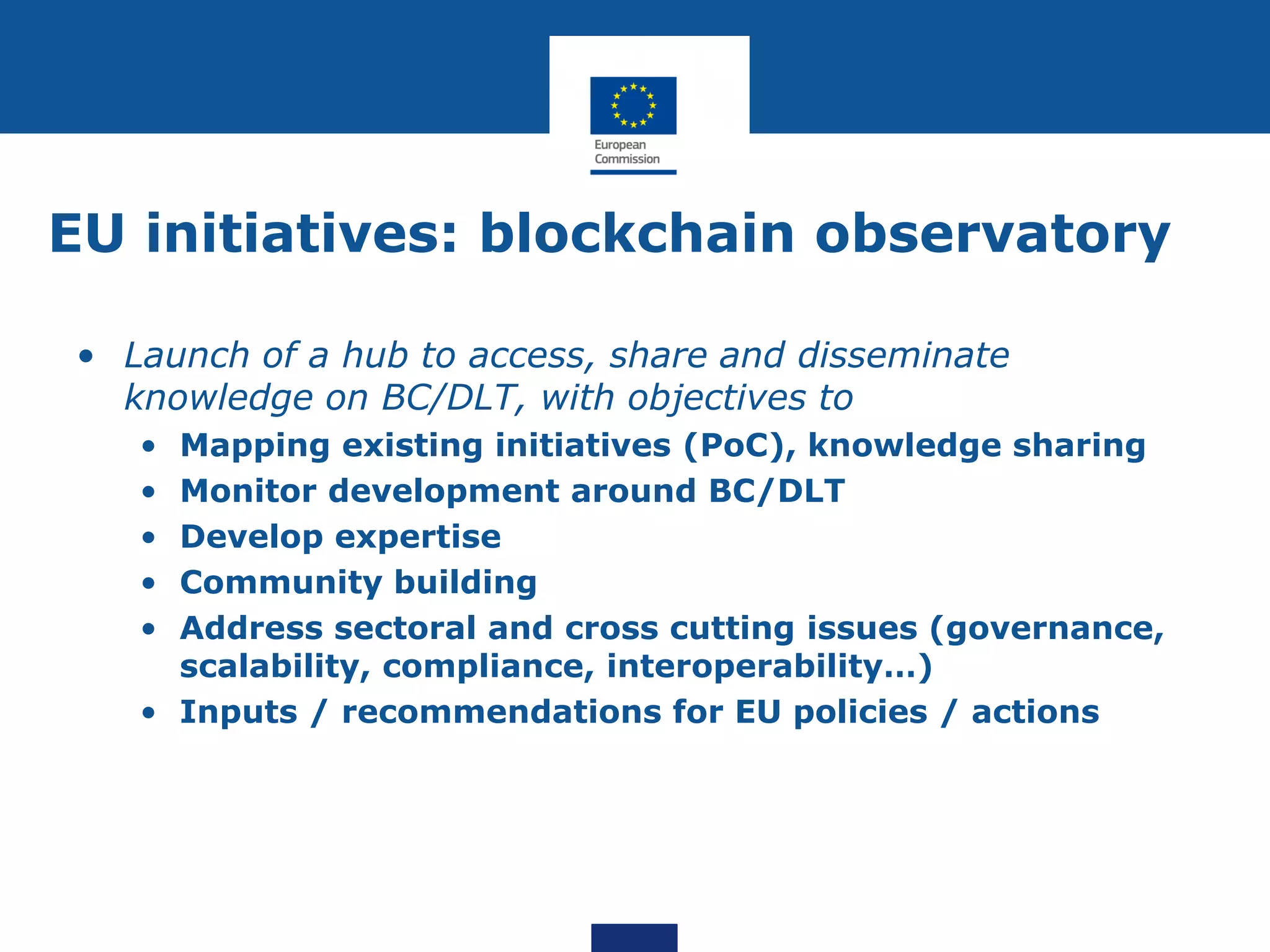
EU initiatives: blockchain observatory
• Launch of a hub to access, share and disseminate
knowledge on BC/DLT, with objectives to
• Mapping existing initiatives (PoC), knowledge sharing
• Monitor development around BC/DLT
• Develop expertise
• Community building
• Address sectoral and cross cutting issues (governance,
scalability, compliance, interoperability…)
• Inputs / recommendations for EU policies / actions
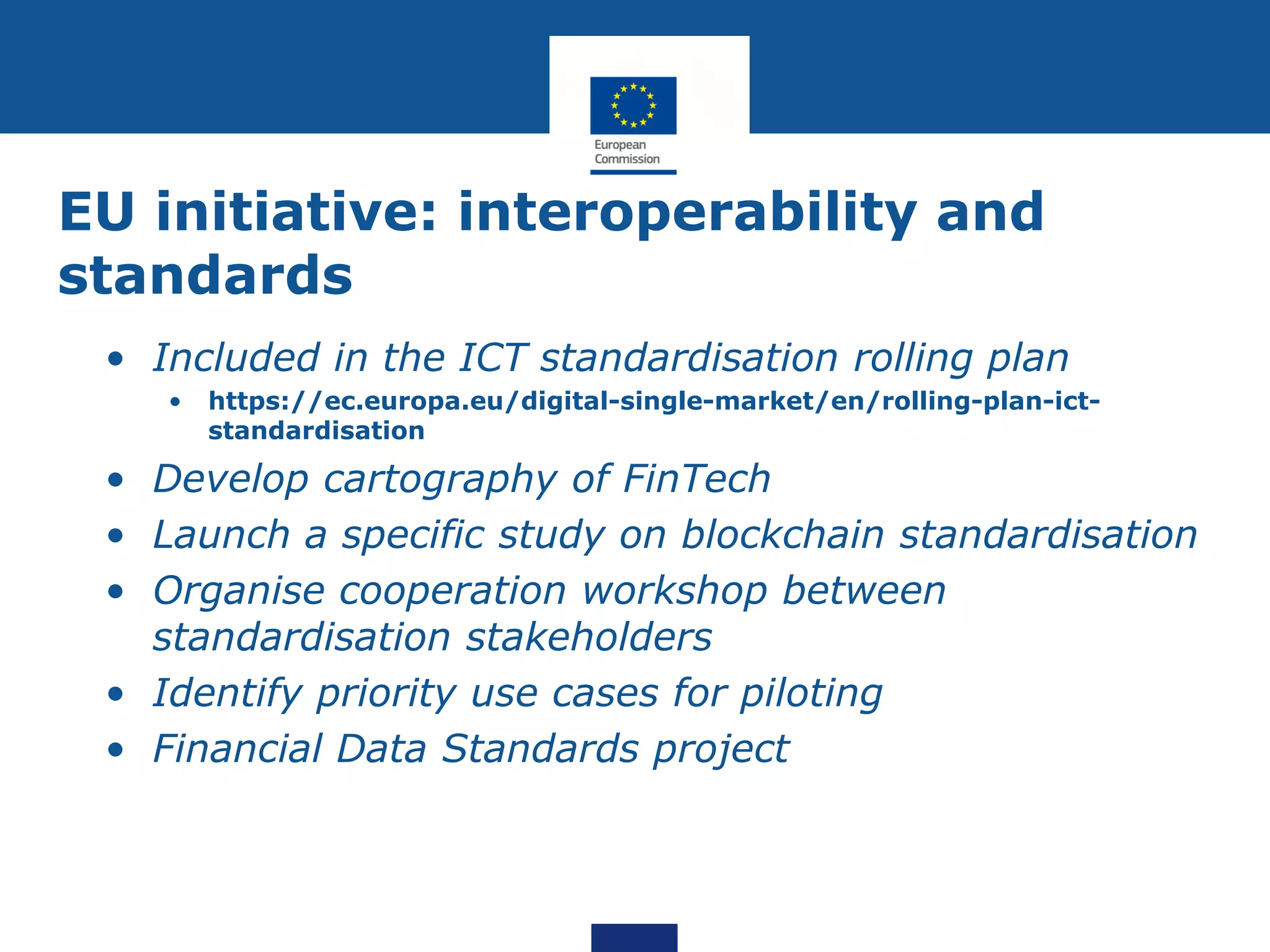
EU initiative: interoperability and
standards
• Included in the ICT standardisation rolling plan
• https://ec.europa.eu/digital-single-market/en/rolling-plan-ict-
standardisation
• Develop cartography of FinTech
• Launch a specific study on blockchain standardisation
• Organise cooperation workshop between
standardisation stakeholders
• Identify priority use cases for piloting
• Financial Data Standards project
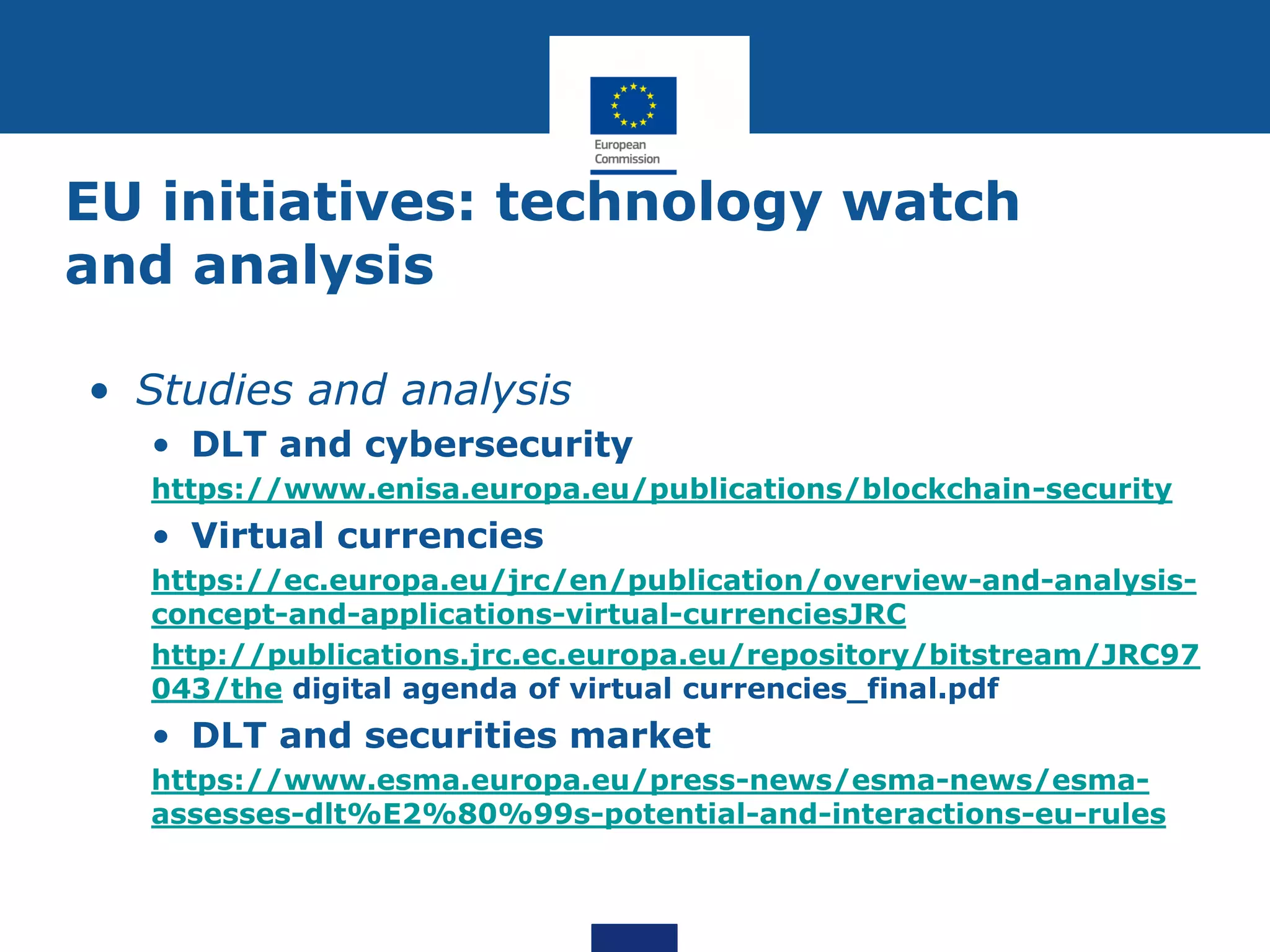
EU initiatives: technology watch
and analysis
• Studies and analysis
• DLT and cybersecurity
https://www.enisa.europa.eu/publications/blockchain-security
• Virtual currencies
https://ec.europa.eu/jrc/en/publication/overview-and-analysis-
concept-and-applications-virtual-currenciesJRC
http://publications.jrc.ec.europa.eu/repository/bitstream/JRC97
043/the digital agenda of virtual currencies_final.pdf
• DLT and securities market
https://www.esma.europa.eu/press-news/esma-news/esma-
assesses-dlt%E2%80%99s-potential-and-interactions-eu-rules
EU Initiatives: piloting, research
and innovation
• Pilot a DLT-based European Financial
Transparency Gateway
• H2020 Research and Innovation Projects:
• Decode – distributed and privacy-aware architecture for
decentralised data governance and federated identities
• My Health My Data – eHealth, eHR
benoit.abeloos@ec.europa.eu

Blockchain and Distributed Ledger Technologies: An EU Policy Perspective

  • 1.
    Blockchain and Distributed LedgerTechnologies: An EU Policy Perspective ITU Workshop on "Security aspects of blockchain" 21 March 2017 Benoit Abeloos, EC, DG CNECT, Startups and Innovation Unit, benoit.abeloos@ec.europa.eu
  • 2.
    Agenda • Digital SingleMarket - ICT Standards priorities • Blockchain and financial markets • European Parliament contributions • The FinTech Task Force • Application areas for blockchain • EU initiatives
  • 3.
    Report on SingleMarket Integration and Competitiveness in the EU and its Member States Context: a deeper and fairer Single Market Single Market Strategy Trade for All Communication Capital Markets Union Digital Single Market Energy Union EFSI Consumers Innovation Delivery
  • 4.
    … Delivering onthe DSM Strategy '19 April 2016 Package' first industry-related package under the DSM Market strategy set of coherent policy measures aiming at the digital transformations of our industries and at maximising their impact on economic growth
  • 5.
    1ST PILLAR: PRIORITYSETTING • Key building blocks for DSM identified: 5G, cloud computing, IoT, (big) data, cyber-security • Will benefit application areas (eHealth, smart energy and cities, ITS / connected & automated ve- hicles, advanced manufacturing, …) • For each: clear deliverable with deadline and who does what  clear set of detailed priorities & list of tasks  Involvement of ESO, SDOs & MSP is key! 5
  • 6.
    Blockchain: where didit start? • With virtual currencies and their disruptive potential on financial markets • Bitcoin was introduced on 31 October 2008 by Satoshi Nakamoto, never identified • Released as open sources software, based on distributed ledger technology • Many other virtual currencies launched since then • Total market cap in billion€
  • 7.
    Virtual Currencies, agrowing market cap
  • 8.
    European Parliament resolutionof 26 May 2016 on virtual currencies • Opportunities and risks of VCs and DLT in the rapidly evolving technological landscape of payments • Potential impact on monetary policy, VCs' volatility • Employing DLT beyond payment • Clearing, settlement and other post-trade management processes, bank reconciliation… • And beyond the financial sector… • Encourages government agencies to test DLT systems • Smart regulation towards fostering innovation and safeguarding integrity: • Proportionate regulatory approach at EU level – Not to stifle innovation • Calls for the creation of a horizontal Task Force DLT
  • 9.
    EU Parliament draftreport on the influence of technology on the future of the financial sector • Which technologies? DLT, Artificial Intelligence, and Cloud • Drawing an EU framework for FinTech • Draw up a Fintech action plan • Legislation in the financial domain should be proportionate and according to • The innovation principle • Same service and risk, same rule. • Technological neutrality • Recommends controlled experimentation by authorities • RegTech potential to alleviate compliance processes
  • 10.
    European Supervisory Authorities •European Central Bank • Adopting existing standards • European Bank Authority • Prudential regulation and supervision across the European banking sector • To perform these tasks, the EBA can produce a number of regulatory and non regulatory documents including binding Technical Standards, Guidelines, Recommendations, Opinions and ad-hoc or regular reports • European Securities and Market Authority (ESMA) • is issuing guidelines and technical standards which should be followed by the industry • European Insurance and Occupational Pensions Authority • developing technical standards to implement different legislations related to the insurance sector
  • 11.
    EP draft report(2) • Cyber security and ICT risks • Need for end-to-end security across the whole financial services • ESAs to regularly review operational standards • Need for information sharing between ESAs and market participants • Concerns about unlawful use of blockchain, for example through bitcoins • Need for better education and awareness for citizens and businesses
  • 12.
    FinTech task Force •Work Stream on blockchain • Creation of a blockchain observatory (beyond FS) • Work Stream on interoperability and standards • FinTech included in the ICT standards rolling plan • Need for a cartography of FinTech standards • Need for cooperation between stakeholders • SDOs (ISO TC68, ISO TC307, ITU, ETSI,…) • European Supervisory Authorities (EBA, ESMA, EIOPA) • Banks, Insurances • New players (payment, RegTech, lending, financing, etc…) • Need for coordinating EU initiatives • Launch of a public consultation • https://ec.europa.eu/digital-single-market/en/blog/european-commission- sets-internal-task-force-financial-technology
  • 13.
    Potential applications ofBlockchain Blockchain F i n T e c h e H e a l t h e G o v I P R , c o p y r i g h t E n e r g y ?
  • 14.
    EU initiatives: blockchainobservatory • Launch of a hub to access, share and disseminate knowledge on BC/DLT, with objectives to • Mapping existing initiatives (PoC), knowledge sharing • Monitor development around BC/DLT • Develop expertise • Community building • Address sectoral and cross cutting issues (governance, scalability, compliance, interoperability…) • Inputs / recommendations for EU policies / actions
  • 15.
    EU initiative: interoperabilityand standards • Included in the ICT standardisation rolling plan • https://ec.europa.eu/digital-single-market/en/rolling-plan-ict- standardisation • Develop cartography of FinTech • Launch a specific study on blockchain standardisation • Organise cooperation workshop between standardisation stakeholders • Identify priority use cases for piloting • Financial Data Standards project
  • 16.
    EU initiatives: technologywatch and analysis • Studies and analysis • DLT and cybersecurity https://www.enisa.europa.eu/publications/blockchain-security • Virtual currencies https://ec.europa.eu/jrc/en/publication/overview-and-analysis- concept-and-applications-virtual-currenciesJRC http://publications.jrc.ec.europa.eu/repository/bitstream/JRC97 043/the digital agenda of virtual currencies_final.pdf • DLT and securities market https://www.esma.europa.eu/press-news/esma-news/esma- assesses-dlt%E2%80%99s-potential-and-interactions-eu-rules
  • 17.
    EU Initiatives: piloting,research and innovation • Pilot a DLT-based European Financial Transparency Gateway • H2020 Research and Innovation Projects: • Decode – distributed and privacy-aware architecture for decentralised data governance and federated identities • My Health My Data – eHealth, eHR
  • 18.