Fintech
Week 5
Dr Drago Indjic
QMUL
16 November 2019
Reminder
• ~2/3 into an experiment, to be replicated at Warwick and Cass
• Slides (and recordings) made available post module
• https://www.slideshare.net/dindjic
• Still no questions (or essays) received (yet)
• dindjic@london.edu or indjicd@regents.ac.uk
• My social network policies
• LinkedIn: invite accepted only following e.g. supervised project, internship etc
• Twitter: open to all to (un)follow @dindjic. WeChat (of course).
Syllabus
1. Digital Transformation of Financial Services
2. Regulation: law, (community, platforms)
3. Identity: Customers, Citizens, Privacy
4. PayTech: Money, Payments
5. Blockchain: Coins, Tokens and Contracts
6. WealthTech: Personal Services
7. Infrastructure: Services, business, wholesale
8. Innovation: Entrepreneurship and Strategy
Payments: Money and PayTech
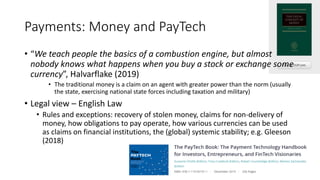
• “We teach people the basics of a combustion engine, but almost
nobody knows what happens when you buy a stock or exchange some
currency”, Halvarflake (2019)
• The traditional money is a claim on an agent with greater power than the norm (usually
the state, exercising national state forces including taxation and military)
• Legal view – English Law
• Rules and exceptions: recovery of stolen money, claims for non-delivery of
money, how obligations to pay operate, how various currencies can be used
as claims on financial institutions, the (global) systemic stability; e.g. Gleeson
(2018)
Money Narrative
• Top 40th movie quote: “Show me the money”, Tom Cruise (1996)
• Szabo (2002): humans used collectables as money for at least 75,000
years, starting with small objects that were rare in nature and whose
circulation could be controlled.
• “Good collectable” are hard to forge (“un-forgeable costliness”), secure from
loss/theft (wearable, hide-able), and usually make easier to assess relative
value.
Law and Economics of Money
• Chicago School of Law and Economics critique, Grey (2019)
• Economic scarcity orthodoxy: “There’s no such thing as a free lunch”
• “Which Peter should be robbed in order to pay Paul”
• Legislators “have to be explicit about how they intend to rob Paul.”
• Exceptions: intangibles, including tradeable information, IP … money
• Tradeable legal obligations (contracts) or debts
• All financial instruments, including “money”+ negotiable contractual rights
• Private: settled by the tendering of the obligation of a third party (i.e. cash)
• Public: extinguished when the holder tenders them to obtain relief from any legal liability
incurred via fees, fines, and/or taxes
Moneyness
• “Money is not just a “thing”, it is a malleable legaltech that can be
made to serve varying interests and stakeholders, depending on its
design and use”, Grey (2019)
• Today’s money is centrally governed and dematerialised, but trust in
institutions and money has diminished.
• Approaching Bitcoin metaphors: “Internet of Money”, “Programmable money”
• You can create your own blockchain tokens next week
• “Anyone can create money, the challenge is to get it accepted”,
Hyman Minskey
• Central bank (“Level 1”) vs payments (“Level 2”) money
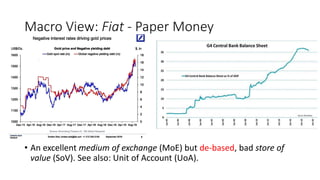
Macro View: Fiat - Paper Money
• An excellent medium of exchange (MoE) but de-based, bad store of
value (SoV). See also: Unit of Account (UoA).
Micro View: “Medium of Exchange”
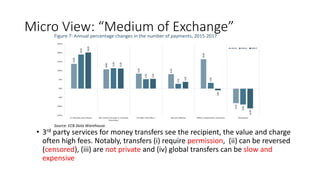
• 3rd party services for money transfers see the recipient, the value and charge
often high fees. Notably, transfers (i) require permission, (ii) can be reversed
(censored), (iii) are not private and (iv) global transfers can be slow and
expensive
Retail Money
• EMVCo = ISO 8583 (since 1987) duopoly
• Visa (1973): 780 pages long technical specification: 2bn cards; 2m ATM,
VisaNet @ 24 ktps; MasterCard: 319 pages long technical specification
• Technologies: [cash] – [cheque] - card – QR – Wallet - Account
Payment Rails
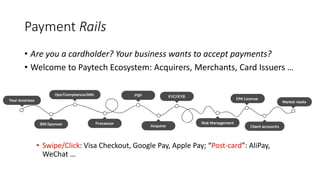
• Are you a cardholder? Your business wants to accept payments?
• Welcome to Paytech Ecosystem: Acquirers, Merchants, Card Issuers …
• Swipe/Click: Visa Checkout, Google Pay, Apple Pay; “Post-card”: AliPay,
WeChat …
Card
• Contactless
• EMVCo “chipped” card touches merchant’s smart phone, which is equipped with the
v(irtual) Point Of Sale app. Merchant’s app reads the 16-digit card Primary Account
Number, sends payment order to Payment Service Processor and merchant receives the
payment authorization (or not).
• De-materialised: secure payment app using NFC
• Fintech app emulates EMVCo chip and creates EMV transaction for the NFC reader: the
user interface to initiate a mobile payment to a trusted Wallet Service Provider (WSP),
and a Tokenization Service Provider (TSP) that replaces the PAN with a payment token
(DPAN).
• Oligopoly of MDES (Mastercard Digital Enablement Service) and VISA’s Token System
(VTS) is being challenged globally
Tokenization
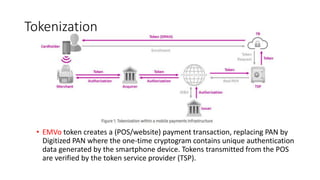
• EMVo token creates a (POS/website) payment transaction, replacing PAN by
Digitized PAN where the one-time cryptogram contains unique authentication
data generated by the smartphone device. Tokens transmitted from the POS
are verified by the token service provider (TSP).
Quick Response Code
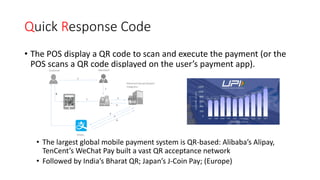
• The POS display a QR code to scan and execute the payment (or the
POS scans a QR code displayed on the user’s payment app).
• The largest global mobile payment system is QR-based: Alibaba’s Alipay,
TenCent’s WeChat Pay built a vast QR acceptance network
• Followed by India’s Bharat QR; Japan’s J-Coin Pay; (Europe)
A2A and Direct Debit
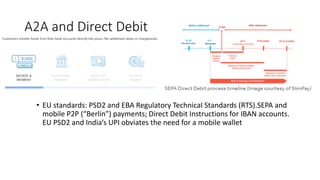
• EU standards: PSD2 and EBA Regulatory Technical Standards (RTS).SEPA and
mobile P2P (“Berlin”) payments; Direct Debit Instructions for IBAN accounts.
EU PSD2 and India’s UPI obviates the need for a mobile wallet
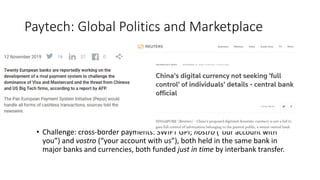
• Challenge: cross-border payments: SWIFT GPI; nostro (“our account with
you”) and vostro (“your account with us”), both held in the same bank in
major banks and currencies, both funded just in time by interbank transfer.
Paytech: Global Politics and Marketplace
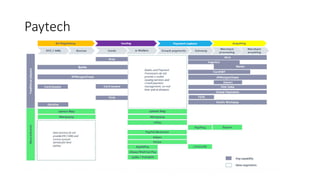
Paytech
• .
LegalTech Light
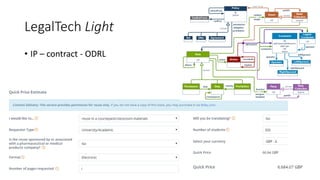
• IP – contract - ODRL
Un-Banking
• Money – wallet - account – bank
• Hoarding: stash, moneybag, #DeFi
• “Sensitive” words and expressions in commerce: 135 in the UK
• Banking, audit, charity …
• Physical forms of money are still used – #inclusion
• USD $100 or CHF 1000 notes vs UK WW2 experience; BIS; Swift
• Digital forms are stored in banks
• Central banking reserves, Swift messaged
• KYC, AML, tracability … tourist’s payments in China

Indjic fintech week 5

  • 1.
    Fintech Week 5 Dr DragoIndjic QMUL 16 November 2019
  • 2.
    Reminder • ~2/3 intoan experiment, to be replicated at Warwick and Cass • Slides (and recordings) made available post module • https://www.slideshare.net/dindjic • Still no questions (or essays) received (yet) • dindjic@london.edu or indjicd@regents.ac.uk • My social network policies • LinkedIn: invite accepted only following e.g. supervised project, internship etc • Twitter: open to all to (un)follow @dindjic. WeChat (of course).
  • 3.
    Syllabus 1. Digital Transformationof Financial Services 2. Regulation: law, (community, platforms) 3. Identity: Customers, Citizens, Privacy 4. PayTech: Money, Payments 5. Blockchain: Coins, Tokens and Contracts 6. WealthTech: Personal Services 7. Infrastructure: Services, business, wholesale 8. Innovation: Entrepreneurship and Strategy
  • 4.
    Payments: Money andPayTech • “We teach people the basics of a combustion engine, but almost nobody knows what happens when you buy a stock or exchange some currency”, Halvarflake (2019) • The traditional money is a claim on an agent with greater power than the norm (usually the state, exercising national state forces including taxation and military) • Legal view – English Law • Rules and exceptions: recovery of stolen money, claims for non-delivery of money, how obligations to pay operate, how various currencies can be used as claims on financial institutions, the (global) systemic stability; e.g. Gleeson (2018)
  • 5.
    Money Narrative • Top40th movie quote: “Show me the money”, Tom Cruise (1996) • Szabo (2002): humans used collectables as money for at least 75,000 years, starting with small objects that were rare in nature and whose circulation could be controlled. • “Good collectable” are hard to forge (“un-forgeable costliness”), secure from loss/theft (wearable, hide-able), and usually make easier to assess relative value.
  • 6.
    Law and Economicsof Money • Chicago School of Law and Economics critique, Grey (2019) • Economic scarcity orthodoxy: “There’s no such thing as a free lunch” • “Which Peter should be robbed in order to pay Paul” • Legislators “have to be explicit about how they intend to rob Paul.” • Exceptions: intangibles, including tradeable information, IP … money • Tradeable legal obligations (contracts) or debts • All financial instruments, including “money”+ negotiable contractual rights • Private: settled by the tendering of the obligation of a third party (i.e. cash) • Public: extinguished when the holder tenders them to obtain relief from any legal liability incurred via fees, fines, and/or taxes
  • 7.
    Moneyness • “Money isnot just a “thing”, it is a malleable legaltech that can be made to serve varying interests and stakeholders, depending on its design and use”, Grey (2019) • Today’s money is centrally governed and dematerialised, but trust in institutions and money has diminished. • Approaching Bitcoin metaphors: “Internet of Money”, “Programmable money” • You can create your own blockchain tokens next week • “Anyone can create money, the challenge is to get it accepted”, Hyman Minskey • Central bank (“Level 1”) vs payments (“Level 2”) money
  • 8.
    Macro View: Fiat- Paper Money • An excellent medium of exchange (MoE) but de-based, bad store of value (SoV). See also: Unit of Account (UoA).
  • 9.
    Micro View: “Mediumof Exchange” • 3rd party services for money transfers see the recipient, the value and charge often high fees. Notably, transfers (i) require permission, (ii) can be reversed (censored), (iii) are not private and (iv) global transfers can be slow and expensive
  • 10.
    Retail Money • EMVCo= ISO 8583 (since 1987) duopoly • Visa (1973): 780 pages long technical specification: 2bn cards; 2m ATM, VisaNet @ 24 ktps; MasterCard: 319 pages long technical specification • Technologies: [cash] – [cheque] - card – QR – Wallet - Account
  • 11.
    Payment Rails • Areyou a cardholder? Your business wants to accept payments? • Welcome to Paytech Ecosystem: Acquirers, Merchants, Card Issuers … • Swipe/Click: Visa Checkout, Google Pay, Apple Pay; “Post-card”: AliPay, WeChat …
  • 12.
    Card • Contactless • EMVCo“chipped” card touches merchant’s smart phone, which is equipped with the v(irtual) Point Of Sale app. Merchant’s app reads the 16-digit card Primary Account Number, sends payment order to Payment Service Processor and merchant receives the payment authorization (or not). • De-materialised: secure payment app using NFC • Fintech app emulates EMVCo chip and creates EMV transaction for the NFC reader: the user interface to initiate a mobile payment to a trusted Wallet Service Provider (WSP), and a Tokenization Service Provider (TSP) that replaces the PAN with a payment token (DPAN). • Oligopoly of MDES (Mastercard Digital Enablement Service) and VISA’s Token System (VTS) is being challenged globally
  • 13.
    Tokenization • EMVo tokencreates a (POS/website) payment transaction, replacing PAN by Digitized PAN where the one-time cryptogram contains unique authentication data generated by the smartphone device. Tokens transmitted from the POS are verified by the token service provider (TSP).
  • 14.
    Quick Response Code •The POS display a QR code to scan and execute the payment (or the POS scans a QR code displayed on the user’s payment app). • The largest global mobile payment system is QR-based: Alibaba’s Alipay, TenCent’s WeChat Pay built a vast QR acceptance network • Followed by India’s Bharat QR; Japan’s J-Coin Pay; (Europe)
  • 15.
    A2A and DirectDebit • EU standards: PSD2 and EBA Regulatory Technical Standards (RTS).SEPA and mobile P2P (“Berlin”) payments; Direct Debit Instructions for IBAN accounts. EU PSD2 and India’s UPI obviates the need for a mobile wallet
  • 16.
    • Challenge: cross-borderpayments: SWIFT GPI; nostro (“our account with you”) and vostro (“your account with us”), both held in the same bank in major banks and currencies, both funded just in time by interbank transfer. Paytech: Global Politics and Marketplace
  • 17.
  • 18.
    LegalTech Light • IP– contract - ODRL
  • 19.
    Un-Banking • Money –wallet - account – bank • Hoarding: stash, moneybag, #DeFi • “Sensitive” words and expressions in commerce: 135 in the UK • Banking, audit, charity … • Physical forms of money are still used – #inclusion • USD $100 or CHF 1000 notes vs UK WW2 experience; BIS; Swift • Digital forms are stored in banks • Central banking reserves, Swift messaged • KYC, AML, tracability … tourist’s payments in China