MAIN FINDINGS
17 January 2020
The Tokenisation of Assets
and Potential Implications
for Financial Markets
2
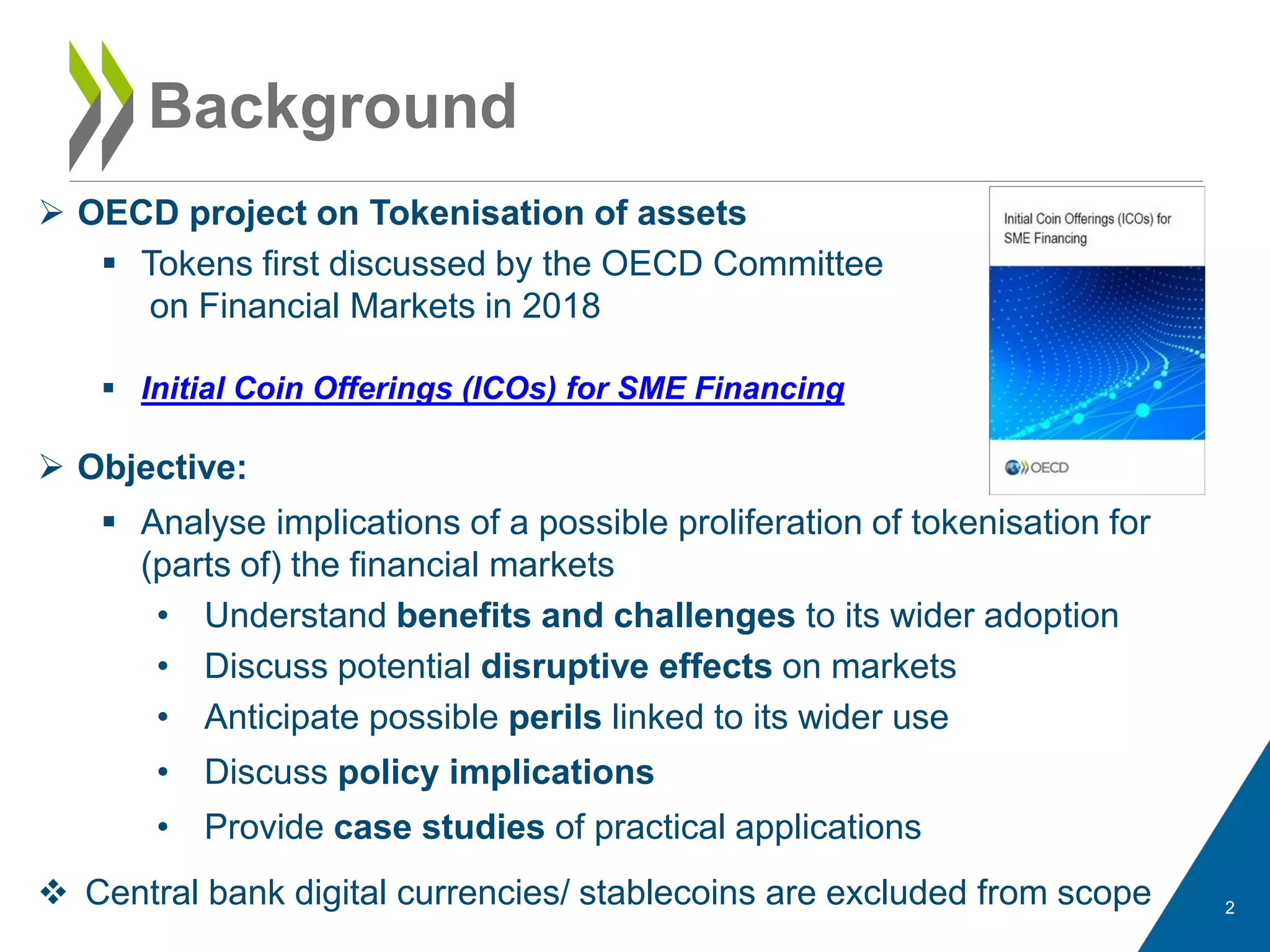
 OECD project on Tokenisation of assets
 Tokens first discussed by the OECD Committee
on Financial Markets in 2018
 Initial Coin Offerings (ICOs) for SME Financing
Background
 Objective:
 Analyse implications of a possible proliferation of tokenisation for
(parts of) the financial markets
• Understand benefits and challenges to its wider adoption
• Discuss potential disruptive effects on markets
• Anticipate possible perils linked to its wider use
• Discuss policy implications
• Provide case studies of practical applications
 Central bank digital currencies/ stablecoins are excluded from scope
PART I.
WHAT IS IT &
IS IT AS GOOD AS IT SOUNDS ?
3
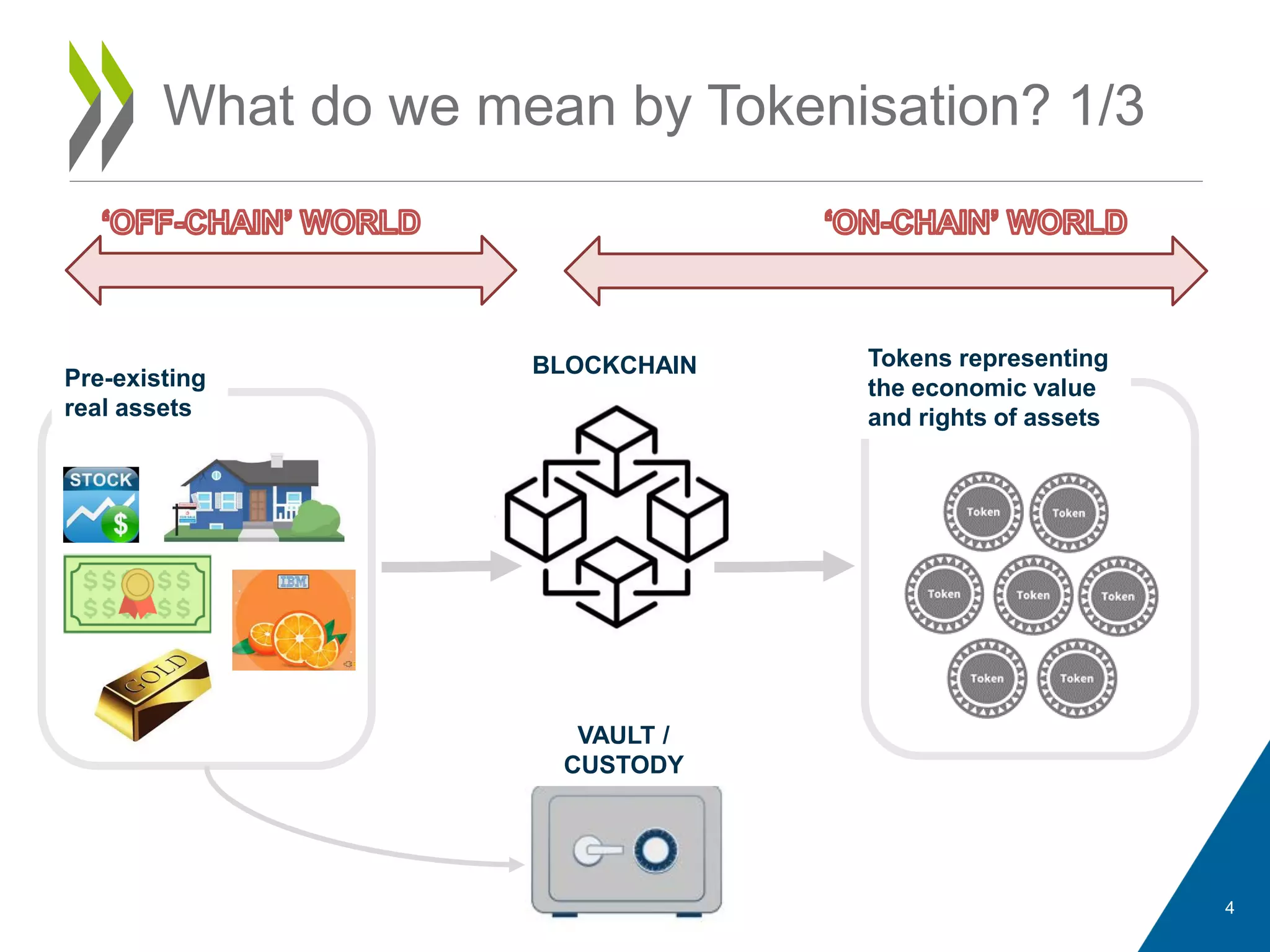
What do we mean by Tokenisation? 1/3
4
Pre-existing
real assets
Tokens representing
the economic value
and rights of assets
BLOCKCHAIN
VAULT /
CUSTODY
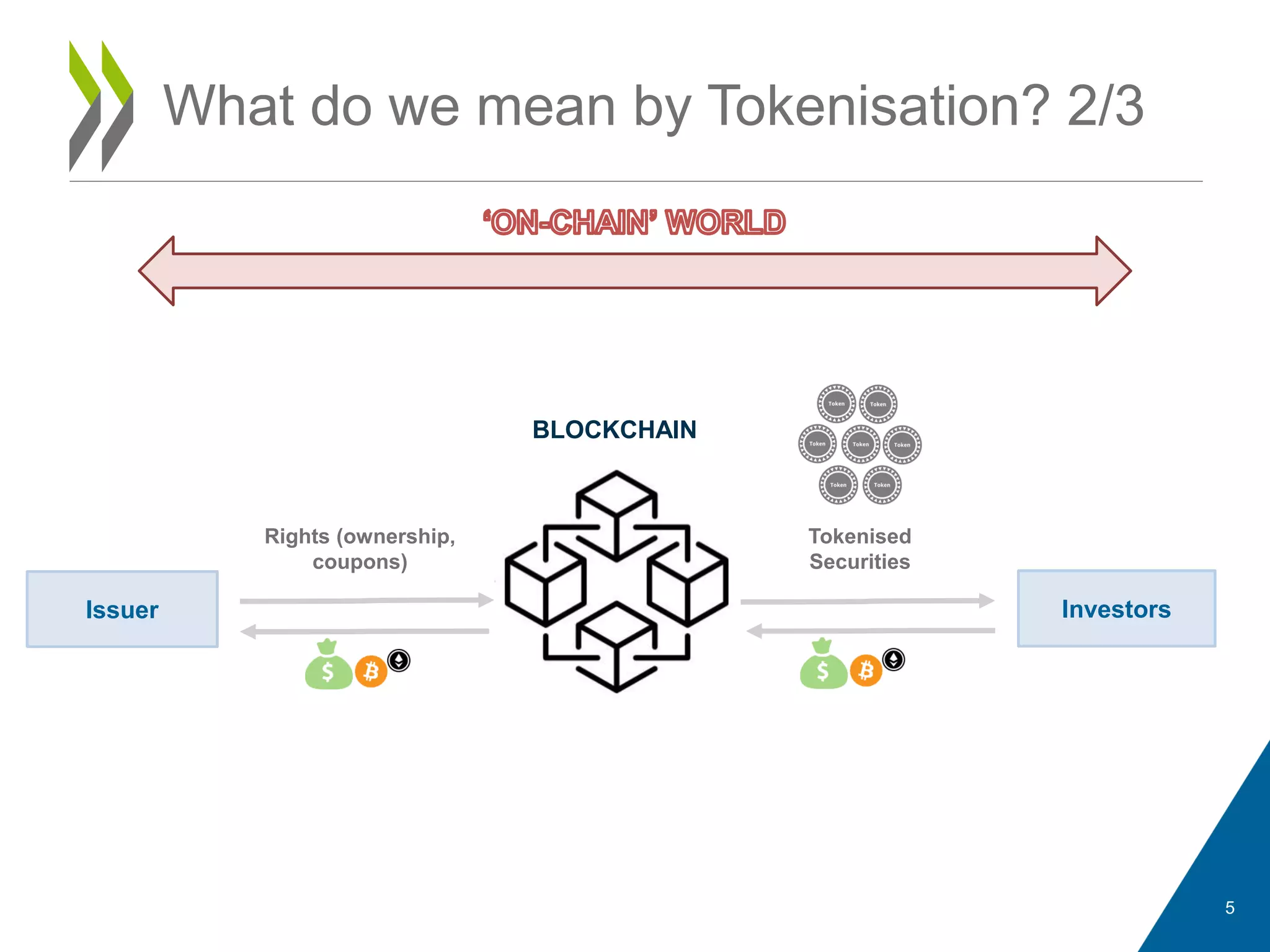
What do we mean by Tokenisation? 2/3
5
BLOCKCHAIN
Issuer Investors
Rights (ownership,
coupons)
Tokenised
Securities
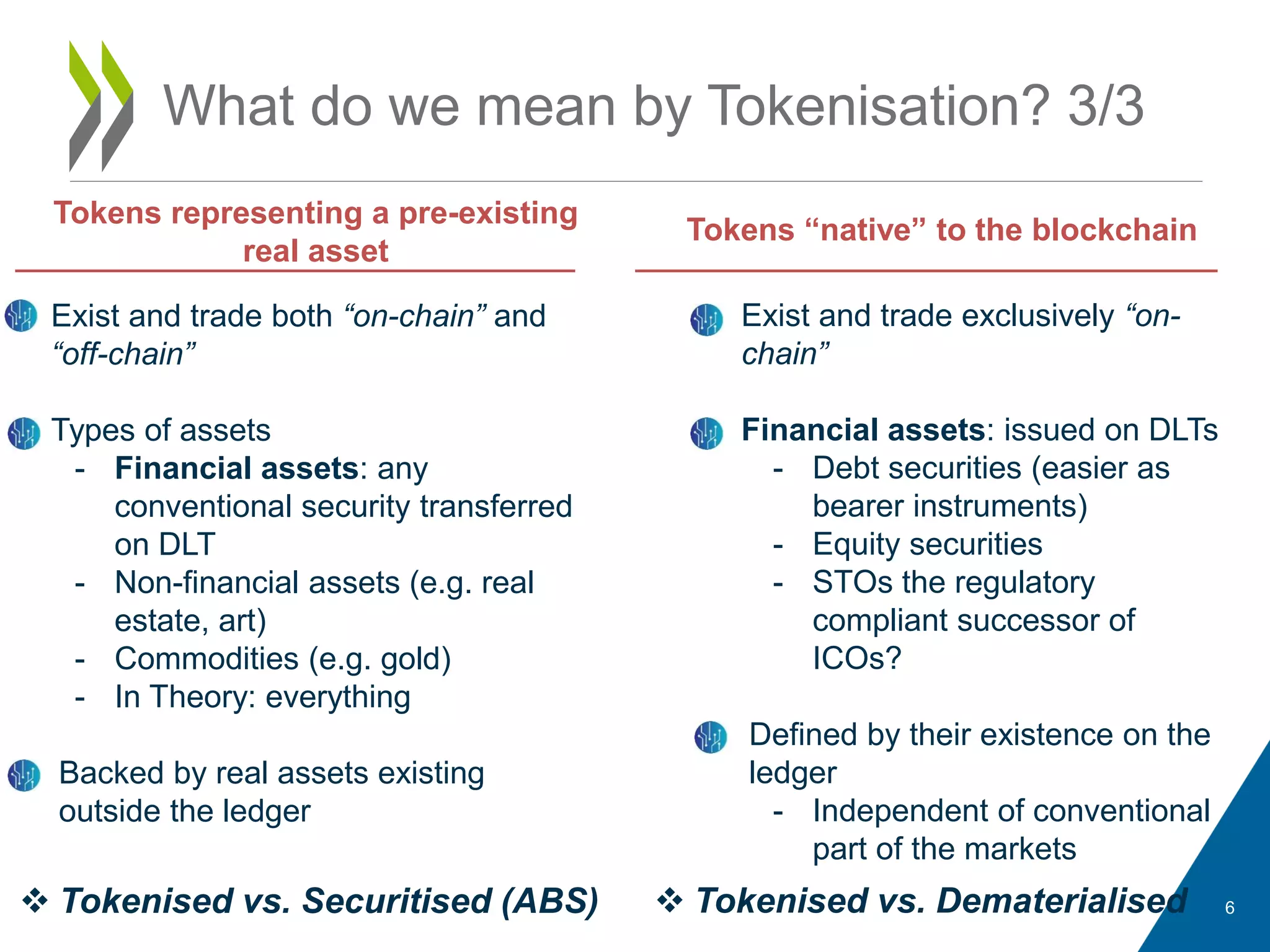
What do we mean by Tokenisation? 3/3
6
 Exist and trade both “on-chain” and
“off-chain”
 Types of assets
- Financial assets: any
conventional security transferred
on DLT
- Non-financial assets (e.g. real
estate, art)
- Commodities (e.g. gold)
- In Theory: everything
 Backed by real assets existing
outside the ledger
Tokens representing a pre-existing
real asset
Tokens “native” to the blockchain
 Exist and trade exclusively “on-
chain”
 Financial assets: issued on DLTs
- Debt securities (easier as
bearer instruments)
- Equity securities
- STOs the regulatory
compliant successor of
ICOs?
 Defined by their existence on the
ledger
- Independent of conventional
part of the markets
 Tokenised vs. Securitised (ABS)  Tokenised vs. Dematerialised
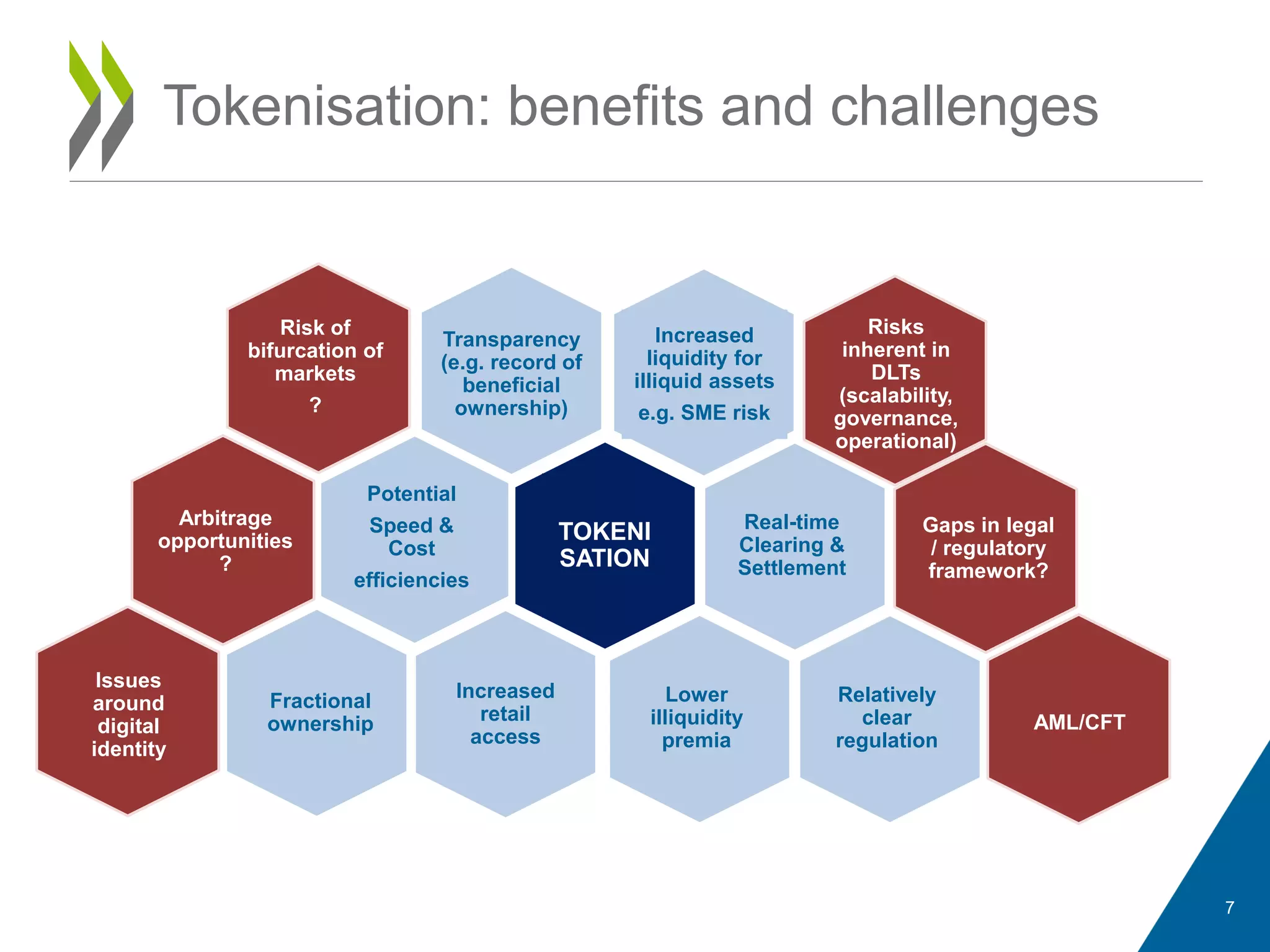
Tokenisation: benefits and challenges
7
TOKENI
SATION
Transparency
(e.g. record of
beneficial
ownership)
Real-time
Clearing &
Settlement
Fractional
ownership
Lower
illiquidity
premia
Increased
retail
access
Relatively
clear
regulation
Potential
Speed &
Cost
efficiencies
Increased
liquidity for
illiquid assets
e.g. SME risk
Risk of
bifurcation of
markets
?
Gaps in legal
/ regulatory
framework?
Arbitrage
opportunities
?
Risks
inherent in
DLTs
(scalability,
governance,
operational)
Issues
around
digital
identity
AML/CFT
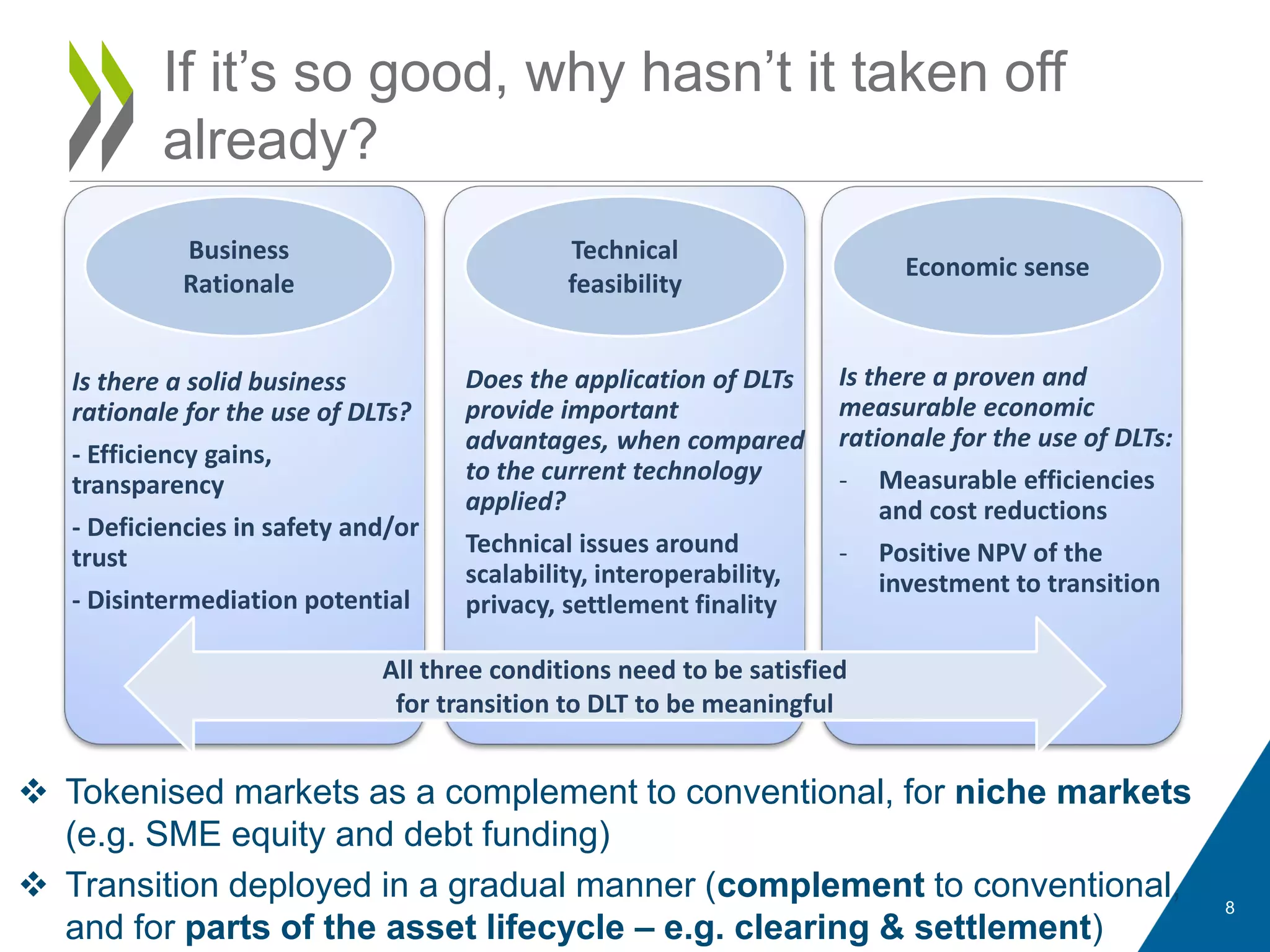
If it’s so good, why hasn’t it taken off
already?
8
Business
Rationale
Technical
feasibility
Economic sense
Does the application of DLTs
provide important
advantages, when compared
to the current technology
applied?
Technical issues around
scalability, interoperability,
privacy, settlement finality
Is there a proven and
measurable economic
rationale for the use of DLTs:
- Measurable efficiencies
and cost reductions
- Positive NPV of the
investment to transition
All three conditions need to be satisfied
for transition to DLT to be meaningful
Is there a solid business
rationale for the use of DLTs?
- Efficiency gains,
transparency
- Deficiencies in safety and/or
trust
- Disintermediation potential
 Tokenised markets as a complement to conventional, for niche markets
(e.g. SME equity and debt funding)
 Transition deployed in a gradual manner (complement to conventional,
and for parts of the asset lifecycle – e.g. clearing & settlement)
PART II.
HOW COULD TOKENISATION
AFFECT FINANCIAL MARKETS
9
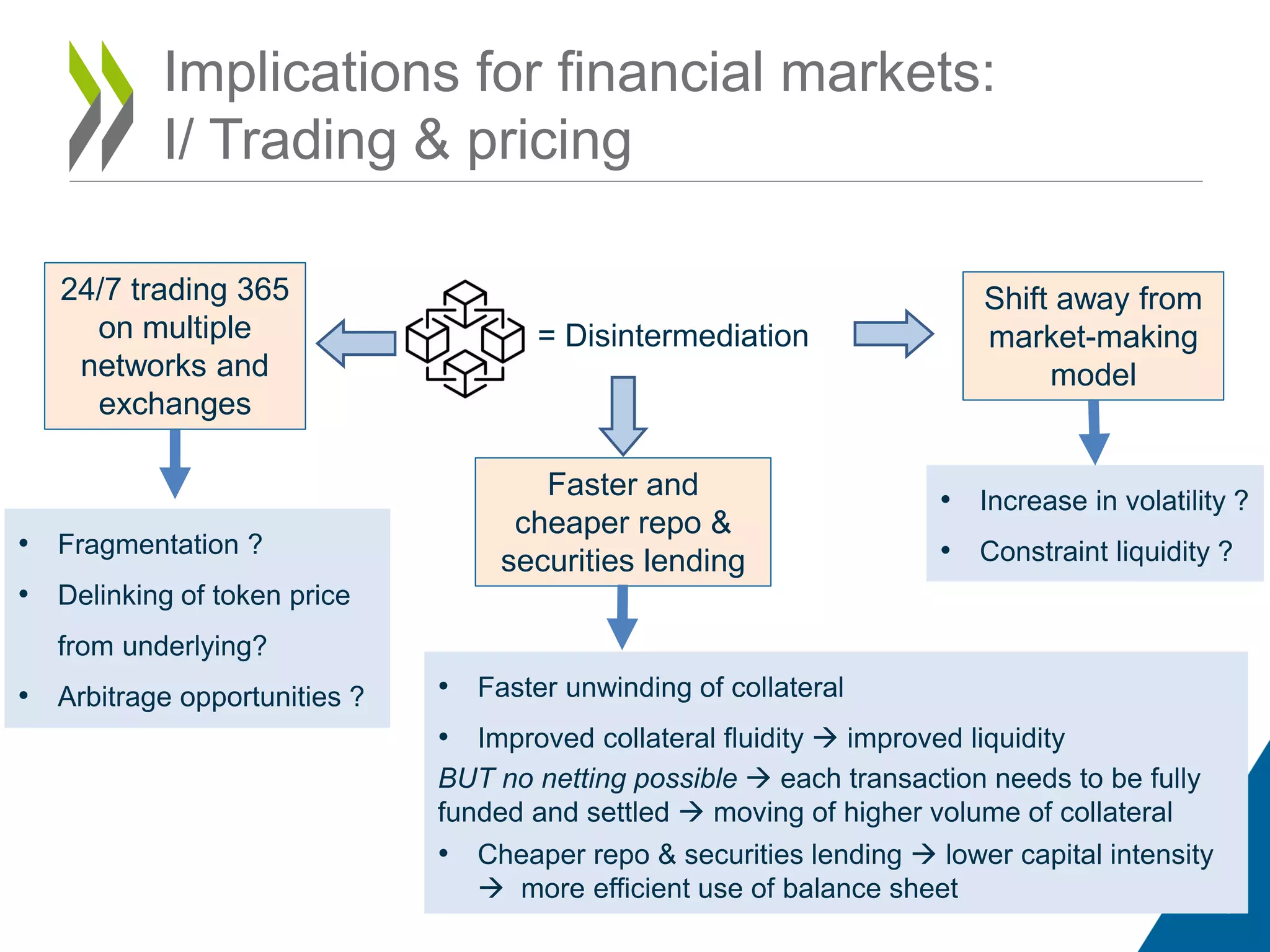
Implications for financial markets:
I/ Trading & pricing
7
= Disintermediation
Shift away from
market-making
model
• Increase in volatility ?
• Constraint liquidity ?
Faster and
cheaper repo &
securities lending
• Faster unwinding of collateral
• Improved collateral fluidity  improved liquidity
BUT no netting possible  each transaction needs to be fully
funded and settled  moving of higher volume of collateral
• Cheaper repo & securities lending  lower capital intensity
 more efficient use of balance sheet
24/7 trading 365
on multiple
networks and
exchanges
• Fragmentation ?
• Delinking of token price
from underlying?
• Arbitrage opportunities ?
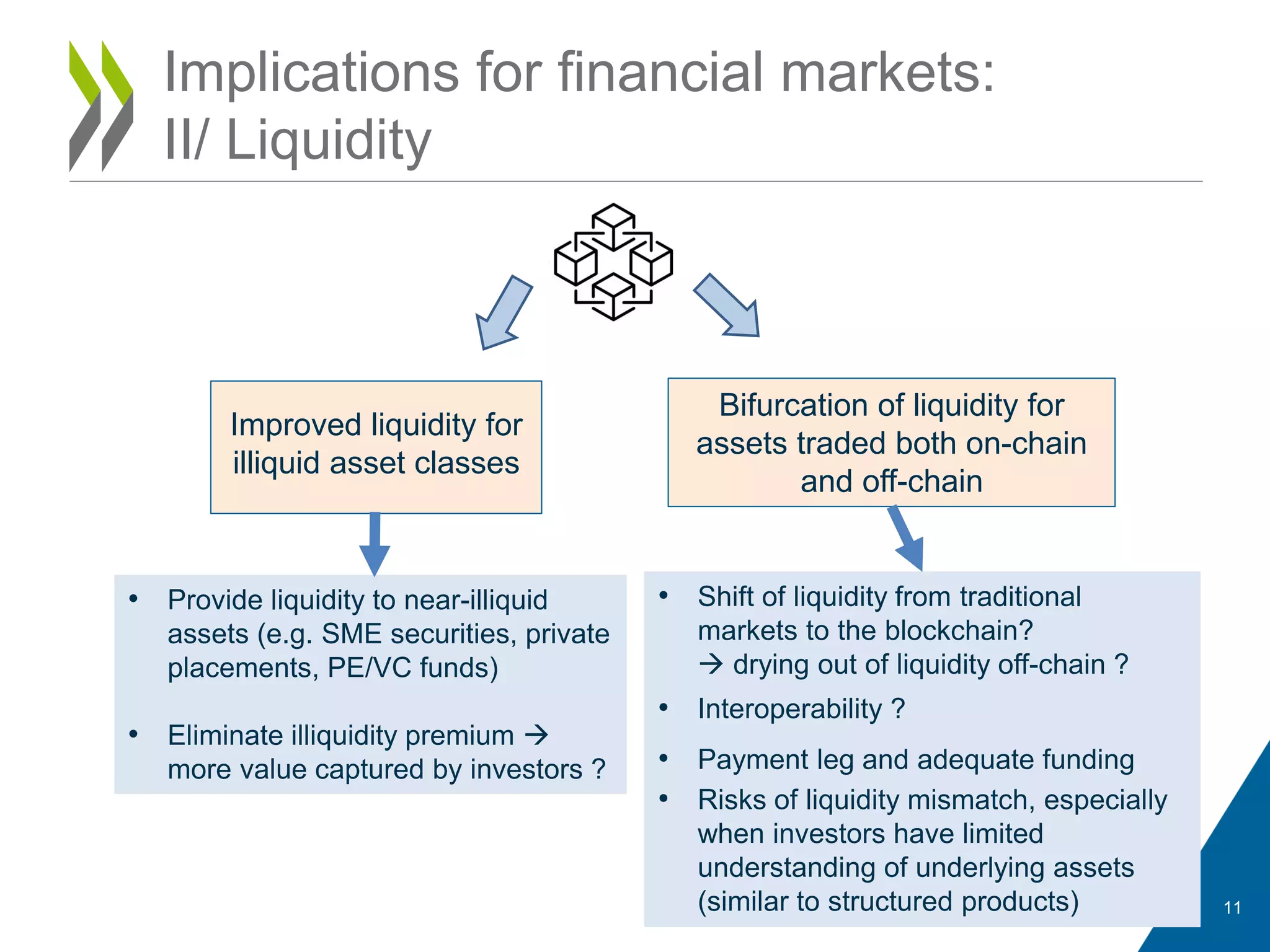
Implications for financial markets:
II/ Liquidity
11
Bifurcation of liquidity for
assets traded both on-chain
and off-chain
• Shift of liquidity from traditional
markets to the blockchain?
 drying out of liquidity off-chain ?
• Interoperability ?
• Payment leg and adequate funding
• Risks of liquidity mismatch, especially
when investors have limited
understanding of underlying assets
(similar to structured products)
Improved liquidity for
illiquid asset classes
• Provide liquidity to near-illiquid
assets (e.g. SME securities, private
placements, PE/VC funds)
• Eliminate illiquidity premium 
more value captured by investors ?
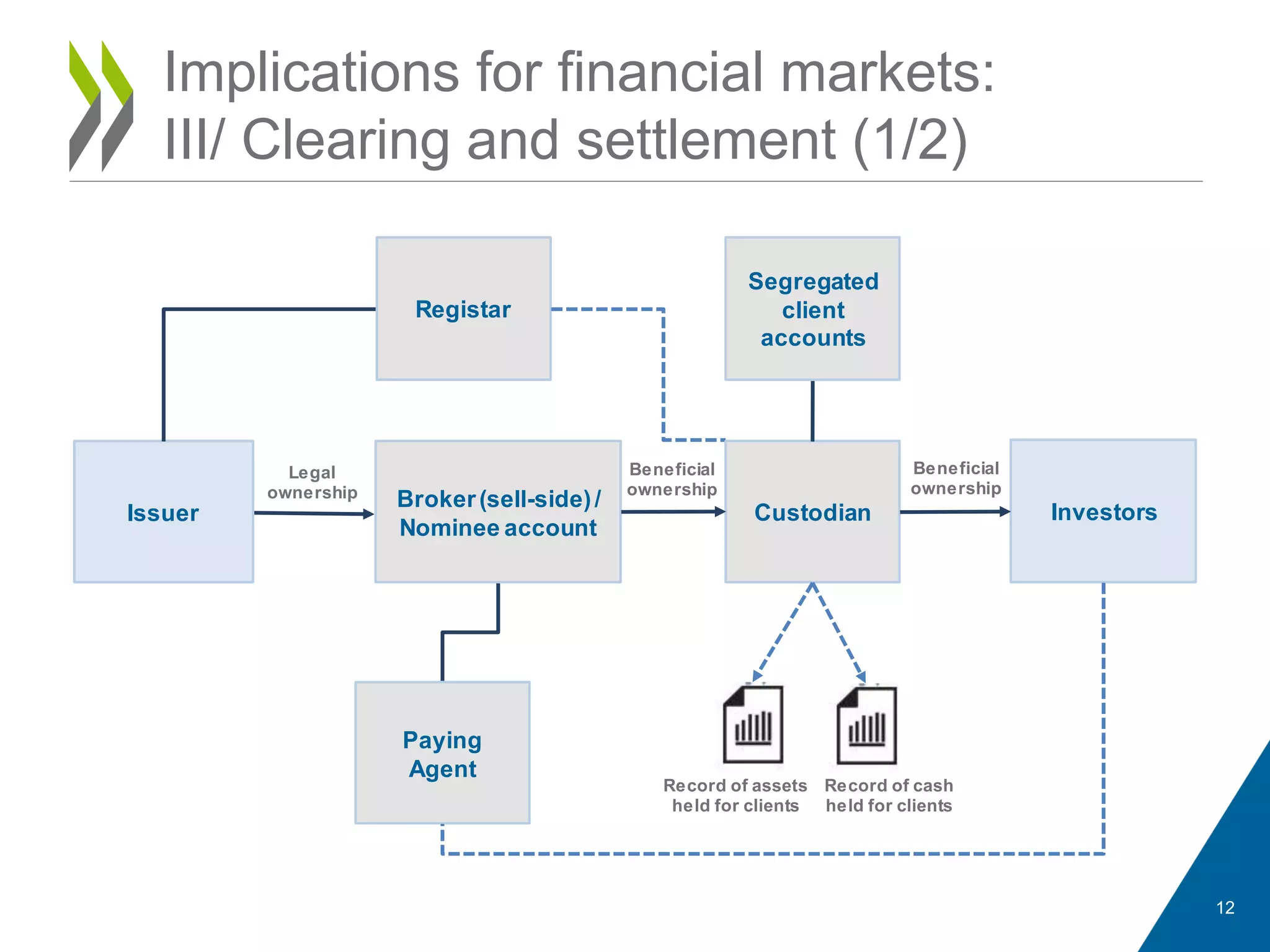
Implications for financial markets:
III/ Clearing and settlement (1/2)
Issuer
Broker(sell-side)/
Nominee account
Paying
Agent
Legal
ownership
Beneficial
ownership
Registar
InvestorsCustodian
Segregated
client
accounts
Beneficial
ownership
Record of assets
held for clients
Record of cash
held for clients
12
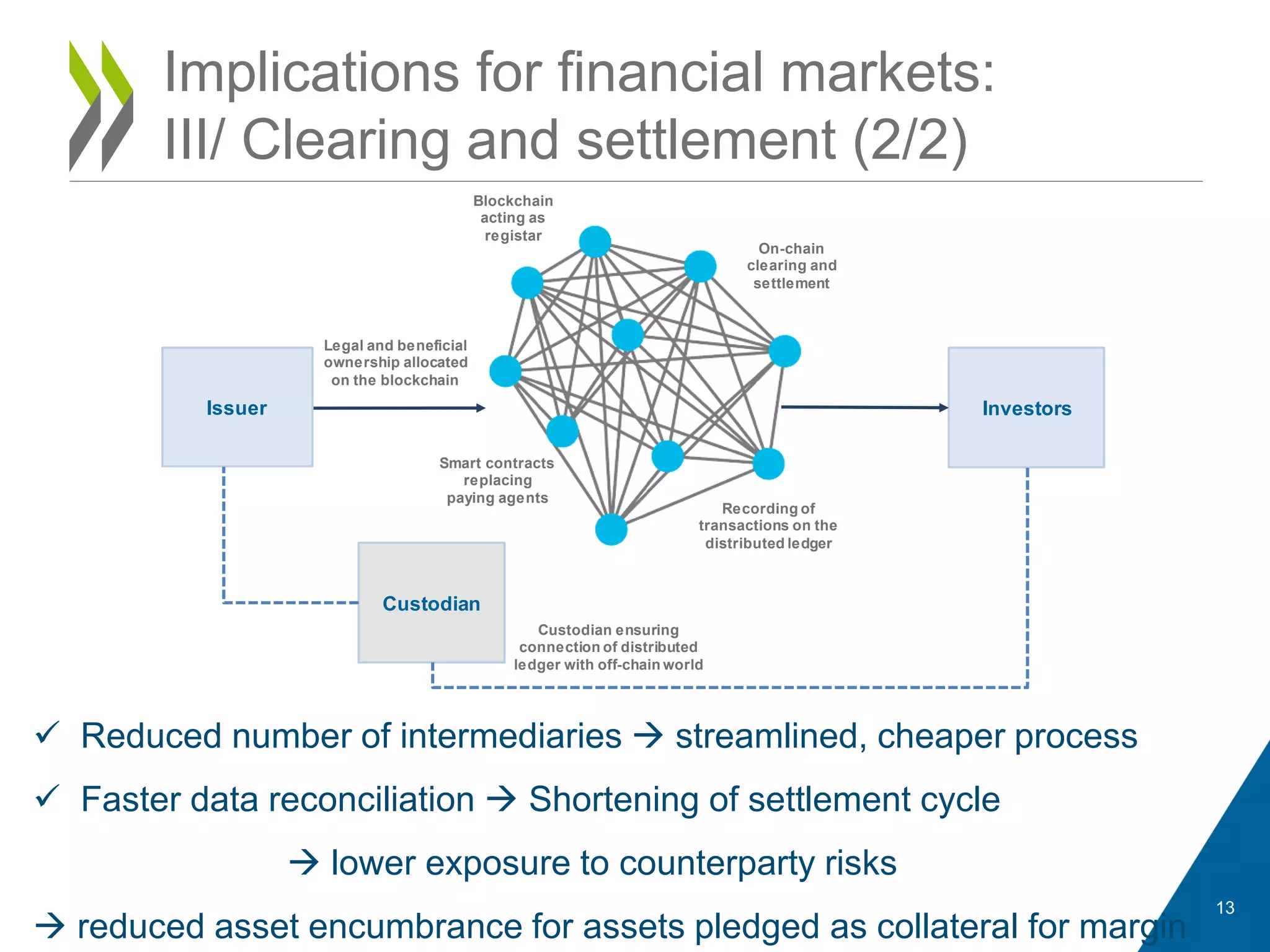
Implications for financial markets:
III/ Clearing and settlement (2/2)
Issuer Investors
Custodian
Recording of
transactions on the
distributed ledger
Legal and beneficial
ownership allocated
on the blockchain
Custodian ensuring
connection of distributed
ledger with off-chain world
Blockchain
acting as
registar
On-chain
clearing and
settlement
Smart contracts
replacing
paying agents
 Reduced number of intermediaries  streamlined, cheaper process
 Faster data reconciliation  Shortening of settlement cycle
 lower exposure to counterparty risks
 reduced asset encumbrance for assets pledged as collateral for margin
13
14
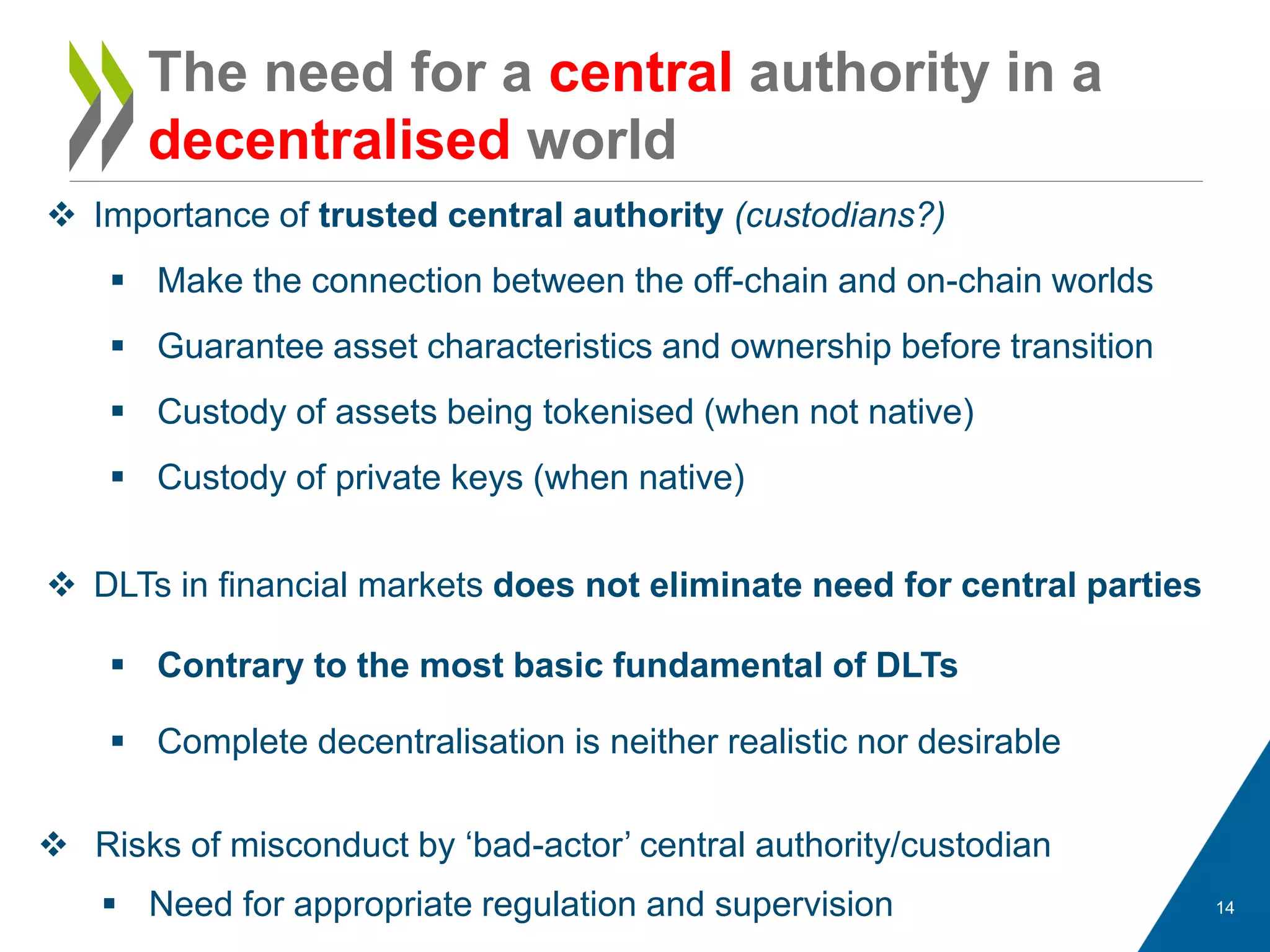
 Importance of trusted central authority (custodians?)
 Make the connection between the off-chain and on-chain worlds
 Guarantee asset characteristics and ownership before transition
 Custody of assets being tokenised (when not native)
 Custody of private keys (when native)
The need for a central authority in a
decentralised world
 DLTs in financial markets does not eliminate need for central parties
 Contrary to the most basic fundamental of DLTs
 Complete decentralisation is neither realistic nor desirable
 Risks of misconduct by ‘bad-actor’ central authority/custodian
 Need for appropriate regulation and supervision
15
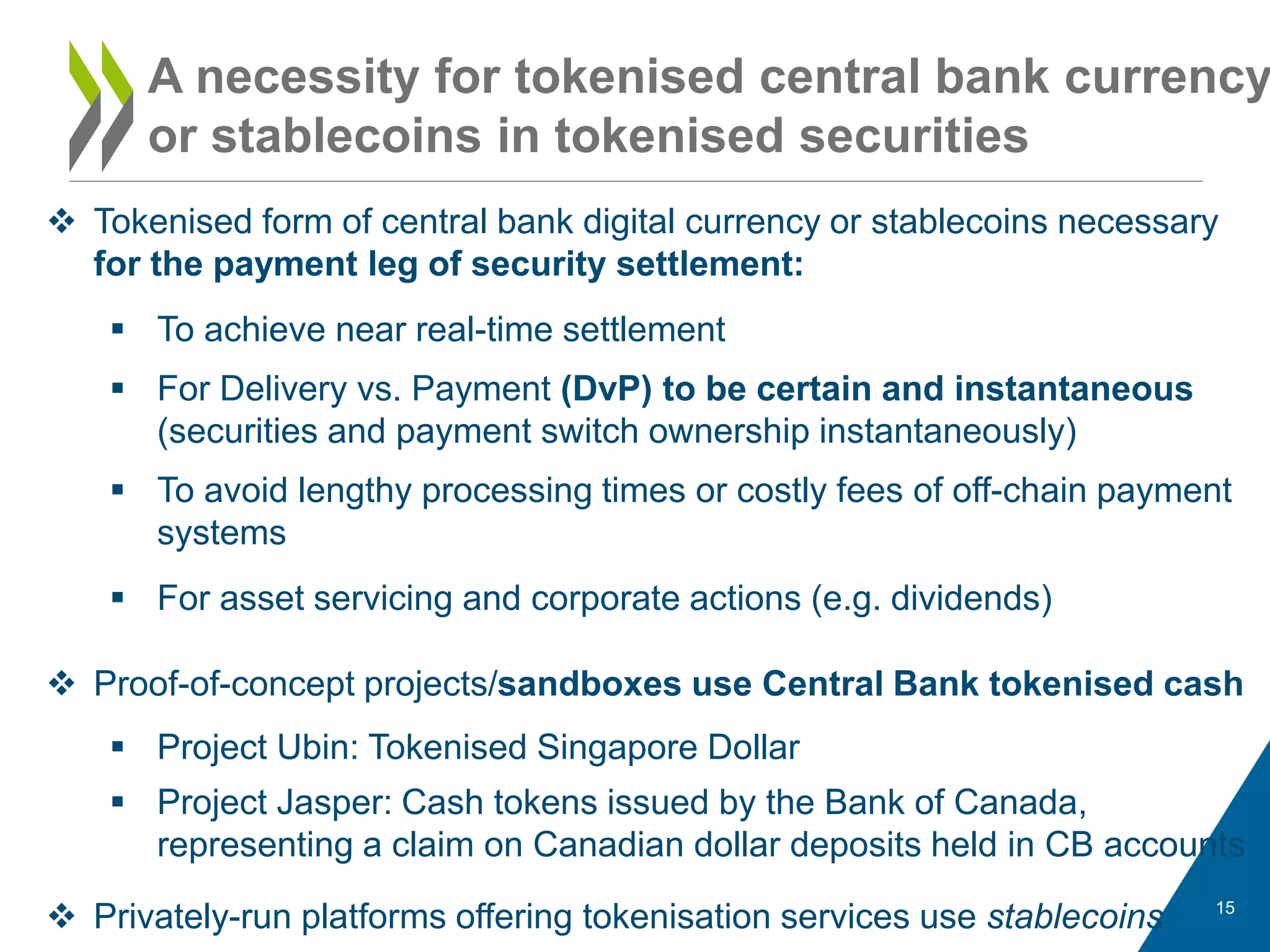
 Tokenised form of central bank digital currency or stablecoins necessary
for the payment leg of security settlement:
 To achieve near real-time settlement
 For Delivery vs. Payment (DvP) to be certain and instantaneous
(securities and payment switch ownership instantaneously)
 To avoid lengthy processing times or costly fees of off-chain payment
systems
 For asset servicing and corporate actions (e.g. dividends)
A necessity for tokenised central bank currency
or stablecoins in tokenised securities
 Proof-of-concept projects/sandboxes use Central Bank tokenised cash
 Project Ubin: Tokenised Singapore Dollar
 Project Jasper: Cash tokens issued by the Bank of Canada,
representing a claim on Canadian dollar deposits held in CB accounts
 Privately-run platforms offering tokenisation services use stablecoins
PART III.
IMPLICATIONS FOR
POLICYMAKERS
16
17
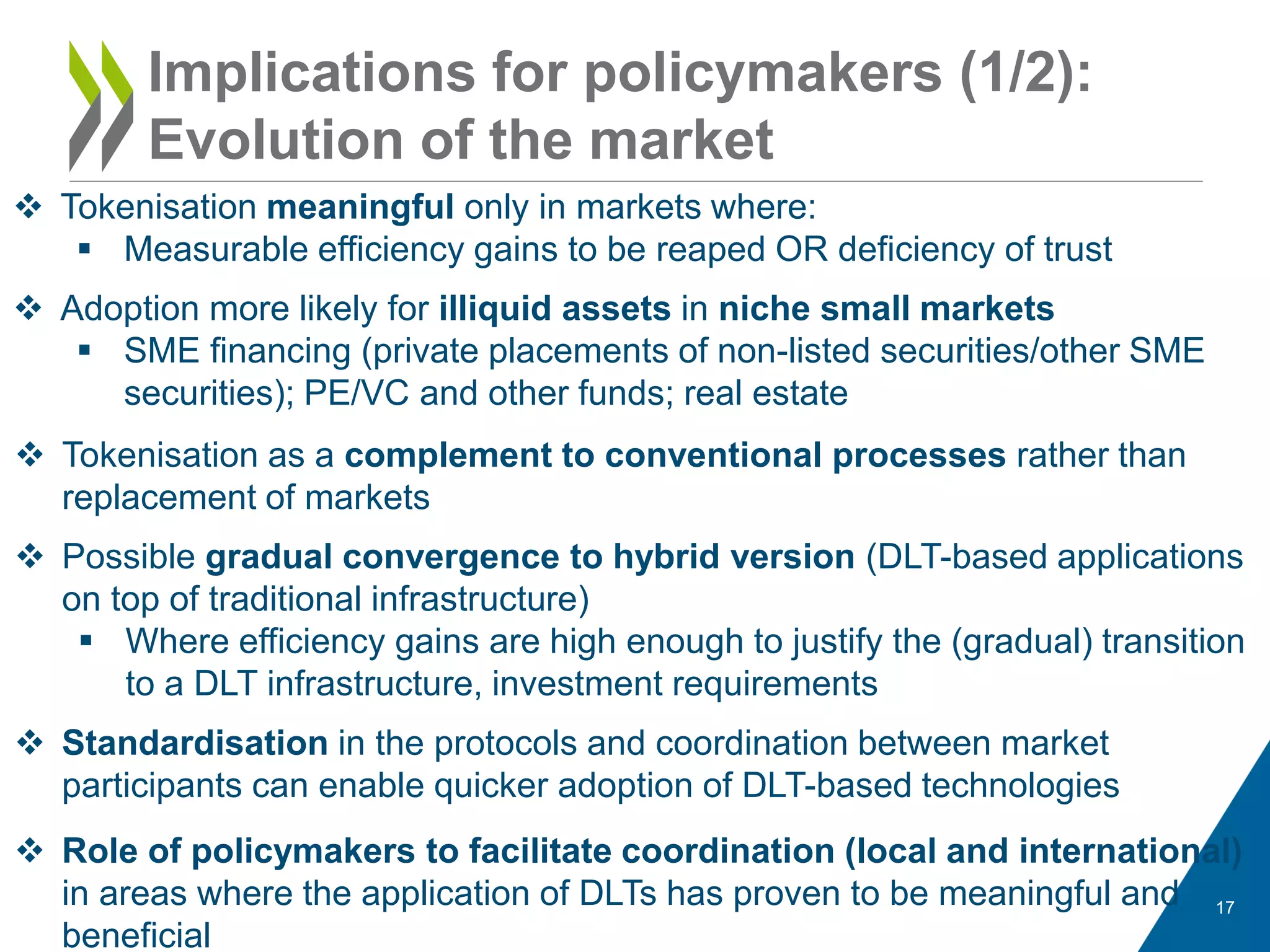
 Tokenisation meaningful only in markets where:
 Measurable efficiency gains to be reaped OR deficiency of trust
 Adoption more likely for illiquid assets in niche small markets
 SME financing (private placements of non-listed securities/other SME
securities); PE/VC and other funds; real estate
Implications for policymakers (1/2):
Evolution of the market
 Tokenisation as a complement to conventional processes rather than
replacement of markets
 Possible gradual convergence to hybrid version (DLT-based applications
on top of traditional infrastructure)
 Where efficiency gains are high enough to justify the (gradual) transition
to a DLT infrastructure, investment requirements
 Standardisation in the protocols and coordination between market
participants can enable quicker adoption of DLT-based technologies
 Role of policymakers to facilitate coordination (local and international)
in areas where the application of DLTs has proven to be meaningful and
beneficial
Implications for policymakers (2/2):
Regulatory environment
18
 Tokenisation merely replacing one digital technology with another:
 Cryptography-enabled dematerialised securities based on a DLT-
enabled networks, instead of electronic book-entries in securities
registries of CSD
 Nothing new for jurisdictions with tech-neutral approach to regulation
 BUT difficult to know with certainty whether tokenisation is fully captured
by the regulatory perimeter –> identify & address potential GAPS
 Existing regulation may need to apply to new actors
 New requirements may be needed to be added (e.g. interoperability
between DLs/ interaction or gateways linking on- and off-chain)
 New risks that may arise from new actors (consumer protection and
market conduct) & application of DLT tech (market integrity; operational)
 AND Tokenised assets that fall within the perimeter of existing frameworks
may not be fully and correctly understood by market participants
 Need for analysis and greater clarity by policymakers
www.oecd.org/finance

The Tokenisation of Assets and Potential Implications for Financial Markets

  • 1.
    MAIN FINDINGS 17 January2020 The Tokenisation of Assets and Potential Implications for Financial Markets
  • 2.
    2  OECD projecton Tokenisation of assets  Tokens first discussed by the OECD Committee on Financial Markets in 2018  Initial Coin Offerings (ICOs) for SME Financing Background  Objective:  Analyse implications of a possible proliferation of tokenisation for (parts of) the financial markets • Understand benefits and challenges to its wider adoption • Discuss potential disruptive effects on markets • Anticipate possible perils linked to its wider use • Discuss policy implications • Provide case studies of practical applications  Central bank digital currencies/ stablecoins are excluded from scope
  • 3.
    PART I. WHAT ISIT & IS IT AS GOOD AS IT SOUNDS ? 3
  • 4.
    What do wemean by Tokenisation? 1/3 4 Pre-existing real assets Tokens representing the economic value and rights of assets BLOCKCHAIN VAULT / CUSTODY
  • 5.
    What do wemean by Tokenisation? 2/3 5 BLOCKCHAIN Issuer Investors Rights (ownership, coupons) Tokenised Securities
  • 6.
    What do wemean by Tokenisation? 3/3 6  Exist and trade both “on-chain” and “off-chain”  Types of assets - Financial assets: any conventional security transferred on DLT - Non-financial assets (e.g. real estate, art) - Commodities (e.g. gold) - In Theory: everything  Backed by real assets existing outside the ledger Tokens representing a pre-existing real asset Tokens “native” to the blockchain  Exist and trade exclusively “on- chain”  Financial assets: issued on DLTs - Debt securities (easier as bearer instruments) - Equity securities - STOs the regulatory compliant successor of ICOs?  Defined by their existence on the ledger - Independent of conventional part of the markets  Tokenised vs. Securitised (ABS)  Tokenised vs. Dematerialised
  • 7.
    Tokenisation: benefits andchallenges 7 TOKENI SATION Transparency (e.g. record of beneficial ownership) Real-time Clearing & Settlement Fractional ownership Lower illiquidity premia Increased retail access Relatively clear regulation Potential Speed & Cost efficiencies Increased liquidity for illiquid assets e.g. SME risk Risk of bifurcation of markets ? Gaps in legal / regulatory framework? Arbitrage opportunities ? Risks inherent in DLTs (scalability, governance, operational) Issues around digital identity AML/CFT
  • 8.
    If it’s sogood, why hasn’t it taken off already? 8 Business Rationale Technical feasibility Economic sense Does the application of DLTs provide important advantages, when compared to the current technology applied? Technical issues around scalability, interoperability, privacy, settlement finality Is there a proven and measurable economic rationale for the use of DLTs: - Measurable efficiencies and cost reductions - Positive NPV of the investment to transition All three conditions need to be satisfied for transition to DLT to be meaningful Is there a solid business rationale for the use of DLTs? - Efficiency gains, transparency - Deficiencies in safety and/or trust - Disintermediation potential  Tokenised markets as a complement to conventional, for niche markets (e.g. SME equity and debt funding)  Transition deployed in a gradual manner (complement to conventional, and for parts of the asset lifecycle – e.g. clearing & settlement)
  • 9.
    PART II. HOW COULDTOKENISATION AFFECT FINANCIAL MARKETS 9
  • 10.
    Implications for financialmarkets: I/ Trading & pricing 7 = Disintermediation Shift away from market-making model • Increase in volatility ? • Constraint liquidity ? Faster and cheaper repo & securities lending • Faster unwinding of collateral • Improved collateral fluidity  improved liquidity BUT no netting possible  each transaction needs to be fully funded and settled  moving of higher volume of collateral • Cheaper repo & securities lending  lower capital intensity  more efficient use of balance sheet 24/7 trading 365 on multiple networks and exchanges • Fragmentation ? • Delinking of token price from underlying? • Arbitrage opportunities ?
  • 11.
    Implications for financialmarkets: II/ Liquidity 11 Bifurcation of liquidity for assets traded both on-chain and off-chain • Shift of liquidity from traditional markets to the blockchain?  drying out of liquidity off-chain ? • Interoperability ? • Payment leg and adequate funding • Risks of liquidity mismatch, especially when investors have limited understanding of underlying assets (similar to structured products) Improved liquidity for illiquid asset classes • Provide liquidity to near-illiquid assets (e.g. SME securities, private placements, PE/VC funds) • Eliminate illiquidity premium  more value captured by investors ?
  • 12.
    Implications for financialmarkets: III/ Clearing and settlement (1/2) Issuer Broker(sell-side)/ Nominee account Paying Agent Legal ownership Beneficial ownership Registar InvestorsCustodian Segregated client accounts Beneficial ownership Record of assets held for clients Record of cash held for clients 12
  • 13.
    Implications for financialmarkets: III/ Clearing and settlement (2/2) Issuer Investors Custodian Recording of transactions on the distributed ledger Legal and beneficial ownership allocated on the blockchain Custodian ensuring connection of distributed ledger with off-chain world Blockchain acting as registar On-chain clearing and settlement Smart contracts replacing paying agents  Reduced number of intermediaries  streamlined, cheaper process  Faster data reconciliation  Shortening of settlement cycle  lower exposure to counterparty risks  reduced asset encumbrance for assets pledged as collateral for margin 13
  • 14.
    14  Importance oftrusted central authority (custodians?)  Make the connection between the off-chain and on-chain worlds  Guarantee asset characteristics and ownership before transition  Custody of assets being tokenised (when not native)  Custody of private keys (when native) The need for a central authority in a decentralised world  DLTs in financial markets does not eliminate need for central parties  Contrary to the most basic fundamental of DLTs  Complete decentralisation is neither realistic nor desirable  Risks of misconduct by ‘bad-actor’ central authority/custodian  Need for appropriate regulation and supervision
  • 15.
    15  Tokenised formof central bank digital currency or stablecoins necessary for the payment leg of security settlement:  To achieve near real-time settlement  For Delivery vs. Payment (DvP) to be certain and instantaneous (securities and payment switch ownership instantaneously)  To avoid lengthy processing times or costly fees of off-chain payment systems  For asset servicing and corporate actions (e.g. dividends) A necessity for tokenised central bank currency or stablecoins in tokenised securities  Proof-of-concept projects/sandboxes use Central Bank tokenised cash  Project Ubin: Tokenised Singapore Dollar  Project Jasper: Cash tokens issued by the Bank of Canada, representing a claim on Canadian dollar deposits held in CB accounts  Privately-run platforms offering tokenisation services use stablecoins
  • 16.
  • 17.
    17  Tokenisation meaningfulonly in markets where:  Measurable efficiency gains to be reaped OR deficiency of trust  Adoption more likely for illiquid assets in niche small markets  SME financing (private placements of non-listed securities/other SME securities); PE/VC and other funds; real estate Implications for policymakers (1/2): Evolution of the market  Tokenisation as a complement to conventional processes rather than replacement of markets  Possible gradual convergence to hybrid version (DLT-based applications on top of traditional infrastructure)  Where efficiency gains are high enough to justify the (gradual) transition to a DLT infrastructure, investment requirements  Standardisation in the protocols and coordination between market participants can enable quicker adoption of DLT-based technologies  Role of policymakers to facilitate coordination (local and international) in areas where the application of DLTs has proven to be meaningful and beneficial
  • 18.
    Implications for policymakers(2/2): Regulatory environment 18  Tokenisation merely replacing one digital technology with another:  Cryptography-enabled dematerialised securities based on a DLT- enabled networks, instead of electronic book-entries in securities registries of CSD  Nothing new for jurisdictions with tech-neutral approach to regulation  BUT difficult to know with certainty whether tokenisation is fully captured by the regulatory perimeter –> identify & address potential GAPS  Existing regulation may need to apply to new actors  New requirements may be needed to be added (e.g. interoperability between DLs/ interaction or gateways linking on- and off-chain)  New risks that may arise from new actors (consumer protection and market conduct) & application of DLT tech (market integrity; operational)  AND Tokenised assets that fall within the perimeter of existing frameworks may not be fully and correctly understood by market participants  Need for analysis and greater clarity by policymakers
  • 19.