International Journal of Innovative Research in Advanced Engineering (IJIRAE) ISSN: 2349-2163
Issue 04, Volume 4 (April 2017) (SPECIAL ISSUE) www.ijirae.com
______________________________________________________________________________________________________
IJIRAE: Impact Factor Value – SJIF: Innospace, Morocco (2016): 3.916 | PIF: 2.469 | Jour Info: 4.085 |
ISRAJIF (2016): 3.715 | Indexcopernicus: (ICV 2015): 47.91
IJIRAE © 2014- 17, All Rights Reserved Page -148
FATIGUE ANALYSIS OF VARIABLE DIFFUSER
1
SHASHI KUMAR R, 2
BHARATH KATTA, 3
LOKESH G. REDDY
1
Asst.Professor, 2
Scientist, 3Assoc.Professor
1,3
Department of Mechanical Engineering, Vemana Institute of Technology,
2
National Trisonic Aerodynamic Facility CSIR-NAL,
Bengaluru, India.
Abstract —This paper presents the life estimation of the diffuser structure. Literature shows that the welds are the source of
failure in case of welded structure; hence the estimation of its life is very critical. There are two kinds of methods for life
estimation stress life approach and strain life approach which have been validated for simple problems. Stress life approach
was identified as appropriate for life estimation of the variable diffuser. There are papers indicating the methodology for
life estimation using commercial software for life prediction. Here, Optistruct- Hyper-Works for pre-processing and solver
and Hyper-View- Hyper-Works for post processing has been used for the indeterminate structure, complex loading and
boundary condition. The mathematical model subjected to the variable pressure contours for a particular Mach No., with
the gimbal joint boundary condition at the test section end and the roller support at the other end. In this paper stress and
fatigue analysis of the variable diffuser has been carried out and life of the variable diffuser has been estimated.
Keywords —fatigue analysis; finite element method; fatigue life.
I. INTRODUCTION
Fatigue is the progressive and localized structural damage that occurs when a material is subjected to cyclic loading.
Mechanical components and structures used in day today life contain notches and geometrical discontinuities in them. For
example, shafts have keyways in them and pressure vessels contain openings for the operational requirements. These notches,
holes, keyways produce stress concentrations in the structure. Notches and keyways can be the region where crack initiation
takes place which leads to crack propagation and finally failure of the structure when the stresses higher than the nominal
value. Therefore predicting fatigue strength of the component is relevant considering design and safety of the component.
Hence fatigue crack initiation life can be estimated based on local stress-strain approach. Wind tunnel is used for aerodynamic
flow simulation around the scaled models for force and moment measurements. Wind tunnel testing is indispensible in the
design phase of any vehicle flying (subsonic to supersonic) for its aerodynamic characterisation. There are two types of wind
tunnels open circuit and closed circuit wind tunnels. In open circuit tunnels the high pressure air stored in the reservoir is
forced on to the model through a nozzle to get the required Mach no and then is let out to the atmosphere with the aid of a
diffuser. Whereas in case of close circuit tunnel the high pressure compressed air is recalculated in a close circuit. Variable
diffuser is one of the components in the wind tunnel circuit. The CSIR-NAL trisonic wind tunnel is more than 50 years old.
The diffuser of the wind tunnel needs to be analyzed for fatigue life. The literature reviews show that the linear static analysis
has to be carried out for the given loads and then wind tunnel runs are to be used for cyclic loading case for fatigue.
II. OBJECTIVES
The main aim of this paper is to carry out linear static analysis of diffuser using HYPERWORKS to find out stress distribution
and the maximum stress in the component. The fatigue life prediction of variable diffuser using Stress life approach is
performed. The results obtained from FEA are validated using the analytical procedure for a hollow tube with internal
pressure. This in turn validates the procedure followed in Hyper Works.
III. FINITE ELEMENT ANALYSES
The finite element method (FEM) is a most versatile numerical technique that can be used to solve virtually any physical
problem which can be mathematically modeled. The method involves dividing the given domain in to sub divisions called
finite elements, deriving mathematical equations for the elements, assembling the element equations, application of suitable
boundary conditions and solving the matrix equation to obtain the unknowns. With the help of FEM it is possible to provide
accurate numerical solutions to any problems and in diverse speed. In the real world, main aim of the finite element analysis is
used to verify the design of a component prior to its manufacturing. The commercial code used for the fatigue analysis of
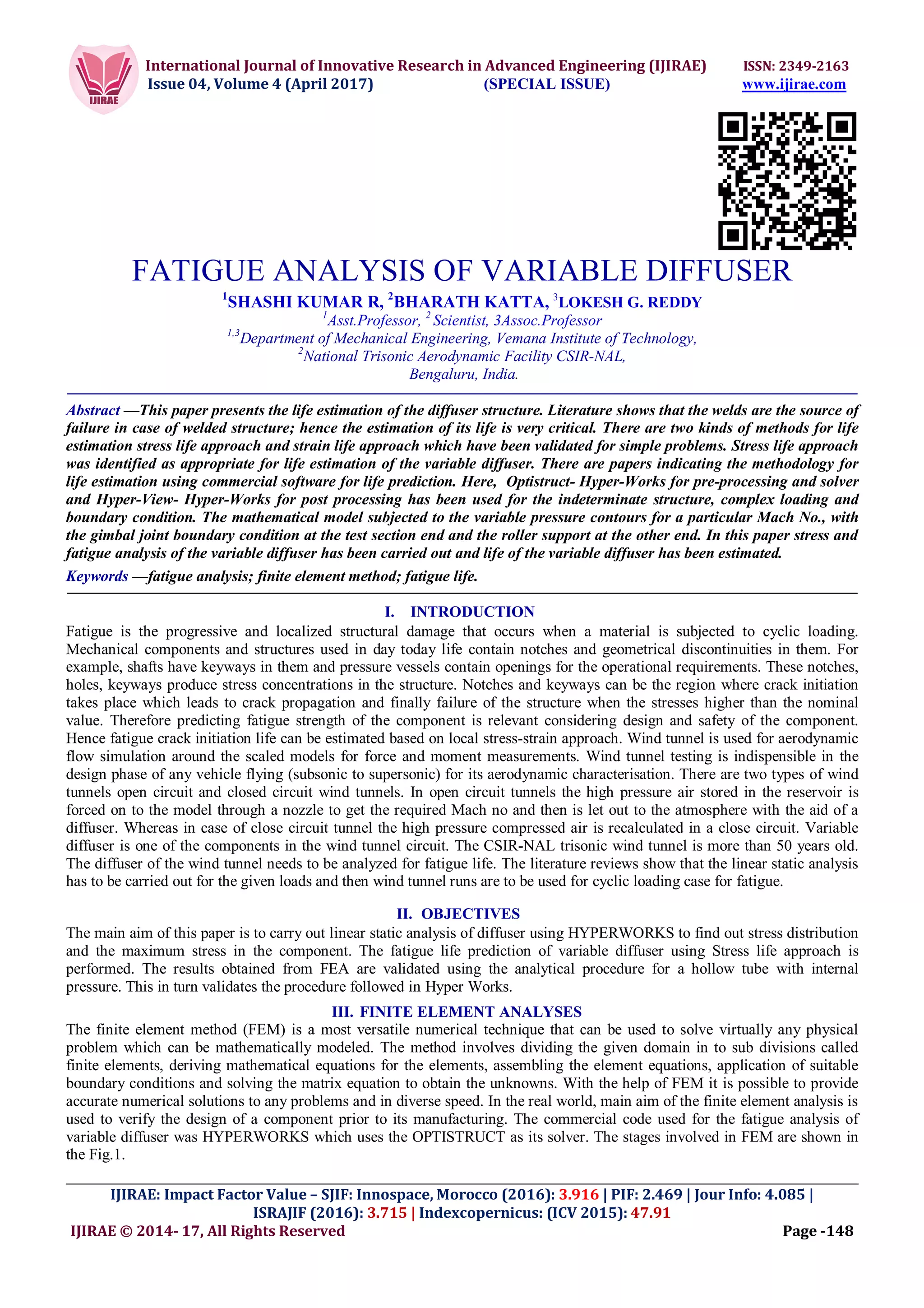
variable diffuser was HYPERWORKS which uses the OPTISTRUCT as its solver. The stages involved in FEM are shown in
the Fig.1.
International Journal of Innovative Research in Advanced Engineering (IJIRAE) ISSN: 2349-2163
Issue 04, Volume 4 (April 2017) (SPECIAL ISSUE) www.ijirae.com
______________________________________________________________________________________________________
IJIRAE: Impact Factor Value – SJIF: Innospace, Morocco (2016): 3.916 | PIF: 2.469 | Jour Info: 4.085 |
ISRAJIF (2016): 3.715 | Indexcopernicus: (ICV 2015): 47.91
IJIRAE © 2014- 17, All Rights Reserved Page -149
Fig.1: Different stages of Finite Element Analysis.
A. GEOMETRICAL CONFIGURATION OF THE VARIABLE DIFFUSER
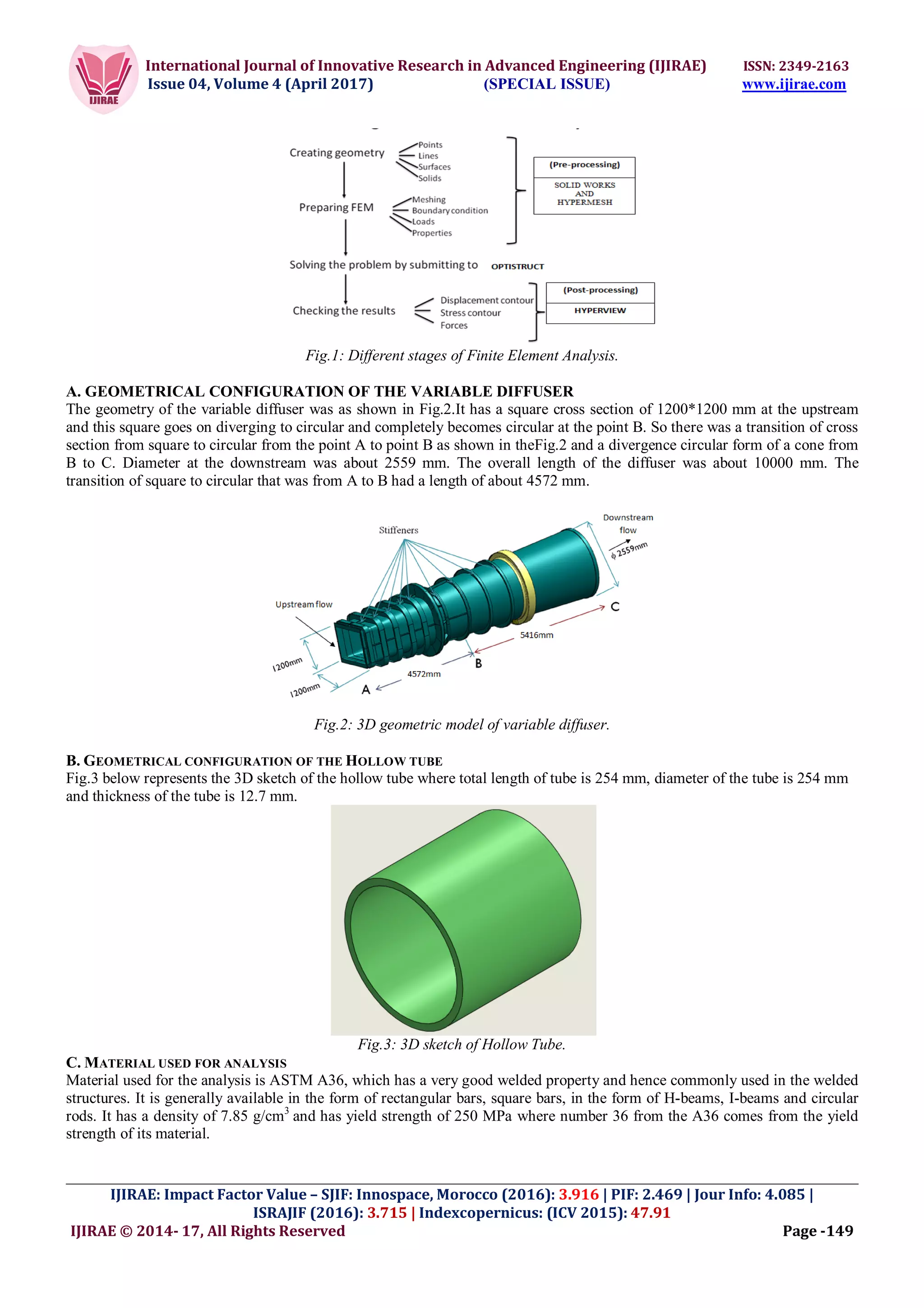
The geometry of the variable diffuser was as shown in Fig.2.It has a square cross section of 1200*1200 mm at the upstream
and this square goes on diverging to circular and completely becomes circular at the point B. So there was a transition of cross
section from square to circular from the point A to point B as shown in theFig.2 and a divergence circular form of a cone from
B to C. Diameter at the downstream was about 2559 mm. The overall length of the diffuser was about 10000 mm. The
transition of square to circular that was from A to B had a length of about 4572 mm.
Fig.2: 3D geometric model of variable diffuser.
B. GEOMETRICAL CONFIGURATION OF THE HOLLOW TUBE
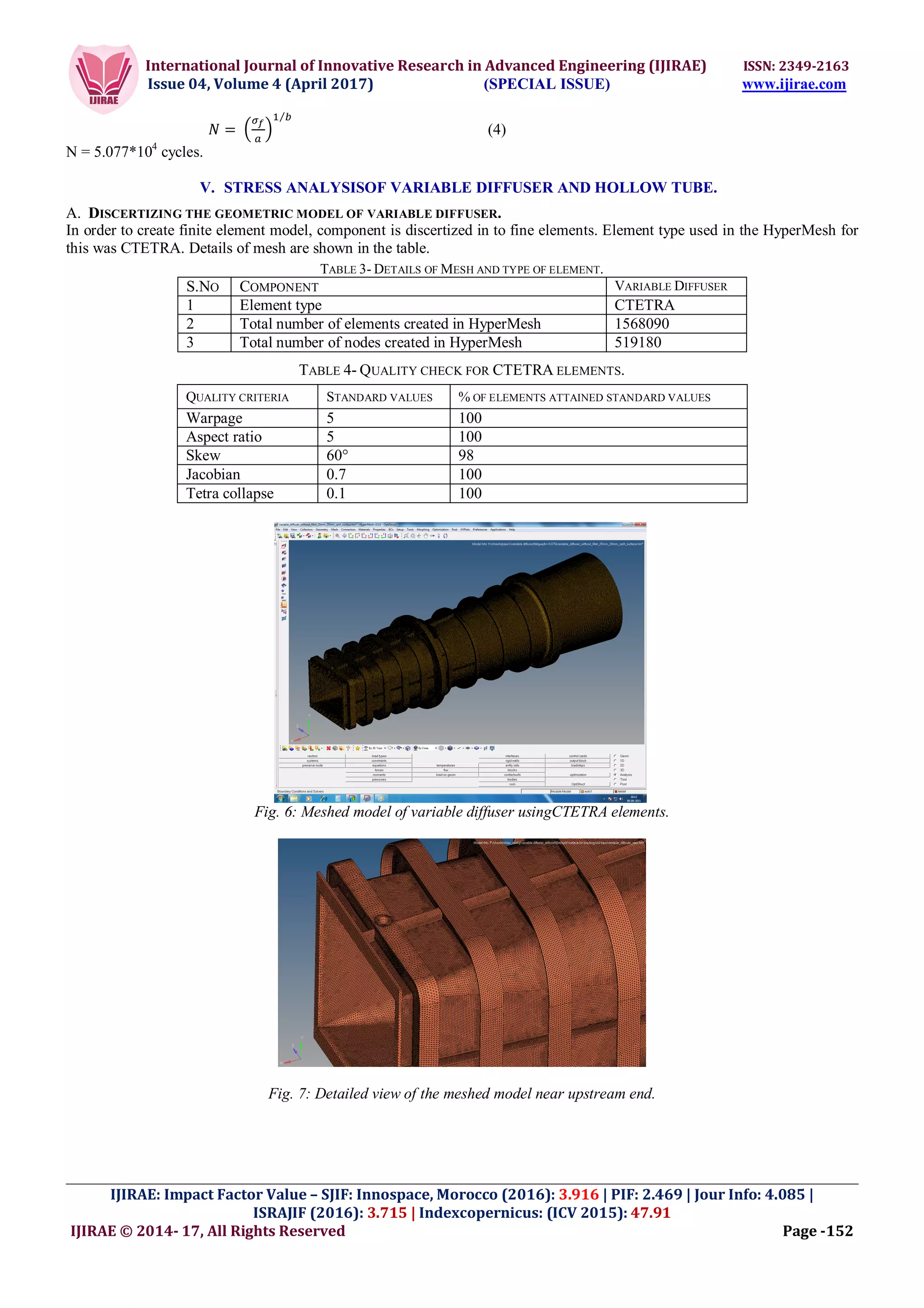
Fig.3 below represents the 3D sketch of the hollow tube where total length of tube is 254 mm, diameter of the tube is 254 mm
and thickness of the tube is 12.7 mm.
Fig.3: 3D sketch of Hollow Tube.
C. MATERIAL USED FOR ANALYSIS
Material used for the analysis is ASTM A36, which has a very good welded property and hence commonly used in the welded
structures. It is generally available in the form of rectangular bars, square bars, in the form of H-beams, I-beams and circular
rods. It has a density of 7.85 g/cm3
and has yield strength of 250 MPa where number 36 from the A36 comes from the yield
strength of its material.
International Journal of Innovative Research in Advanced Engineering (IJIRAE) ISSN: 2349-2163
Issue 04, Volume 4 (April 2017) (SPECIAL ISSUE) www.ijirae.com
______________________________________________________________________________________________________
IJIRAE: Impact Factor Value – SJIF: Innospace, Morocco (2016): 3.916 | PIF: 2.469 | Jour Info: 4.085 |
ISRAJIF (2016): 3.715 | Indexcopernicus: (ICV 2015): 47.91
IJIRAE © 2014- 17, All Rights Reserved Page -150
TABLE 1- MECHANICAL PROPERTIES OF ASTM A36.
MODULUS OF ELASTICITY (E) MPA 200000
TENSILE STRENGTH (UT) MPA 400-550
YIELD STRENGTH (Y) MPA 250
HARDNESS, HB 168
FATIGUE STRENGTH EXPONENT (B) -0.073
POISSON’S RATIO  0.26
IV. DETERMINATION OF FATIGUE LIFE OF HOLLOW TUBE USING ANALYTICAL METHOD.
A. FACTORS AFFECTING FATIGUE LIFE.
It is found that the endurance limit of the component prepared in the laboratory test conditions will be closely controlled and
more often it is unrealistic. Hence various correction factors like surface finish, environment, temperature, reliability etc., need
to be considered for the actual condition. Hence the equation for the correction factors for the endurance limit is given as,[1]
e = Cload* Csize* Csurf* Ctemp* Creliab* ’e (1)
Where, Csurf = surface condition correction factor.
Cload= load correction factor.
Csize = size correction factor.
Ctemp = temperature correction factor.
Creliab = reliability correction factor.
’e = endurance limit of the test specimen.
e = endurance limit of the actual component.
Csurf = A (ut)b
Where ut is ultimate tensile strength, A and b are found from table 2.
TABLE 2- COEFFICIENTS FOR SURFACE MODIFICATION EQUATION.
In this case from table 2 we have considered as Hot rolled condition for the surface and the corresponding value of ‘A’ and ‘b’
for this is, A=57.7 and b= -0.718
Csurf = 0.6217
Cload = 1
Csize = 0.6
Ctemp = 1
Creliab = 1
’e = 0.5 ut
’e = 275 MPa
Substituting all the correction factor values in equation (1)
e = 102.58 MPa
B. Fatigue loading.
Simplest way of loading observed is the constant amplitude loading with sinusoidal stress-time pattern shown in Fig.4 below.
Useful terms required for fatigue life calculations are shown in the Fig.4 with respect to constant amplitude loading.
Fig.4: Constant amplitude loading.
SURFACE FINISH A (MPA) B
GROUND 1.58 -0.085
MACHINED OR COLD-DRAWN 4.51 -0.265
HOT-ROLLED 57.7 -0.718
AS- FORGED 272 -0.995
International Journal of Innovative Research in Advanced Engineering (IJIRAE) ISSN: 2349-2163
Issue 04, Volume 4 (April 2017) (SPECIAL ISSUE) www.ijirae.com
______________________________________________________________________________________________________
IJIRAE: Impact Factor Value – SJIF: Innospace, Morocco (2016): 3.916 | PIF: 2.469 | Jour Info: 4.085 |
ISRAJIF (2016): 3.715 | Indexcopernicus: (ICV 2015): 47.91
IJIRAE © 2014- 17, All Rights Reserved Page -151
Where, m = Mean stress
max minσ + σ
2

max = Maximum stress in the cycle
min = Minimum stress in the cycle
a= Alternating stress
amplitude
r = Range of stress max minσ σ 
R = Stress ratio
A = Amplitude ratio
σ 1
σ 1
a
m
R
R

 

C. FATIGUE LIFE CALCULATIONS
Fatigue life calculation for cylindrical hollow tube is considered for validation.In the case of circular pressurized thin pipes two
types of stresses will be acting one the Hoop stress or circumferential stress and other Axial stress. In case of diffuser axial
stresses are zero and only hoop stresses need to be considered. Hoop stress is calculated by eqn. (2).
H =
	
	
(2)
H = 200 MPa.
From Basquin’s equation, f = aNb
(3)
Where, N is the number of cycles to failure, ‘a’ and ‘b’ are constants,
a = coefficient and represents the value of a at one cycle.
b = slope of log-log S-N curve.
f = applied fatigue stress.
Thus ‘a’ and ‘b’ are found from the equations below.[2]
=	
−1
3
log
( 	 )
b = -0.2237.
=	
( 	 )
a = 2257.76 MPa.
Value of ‘f’ is obtained from the Fig.5 based on the ultimate tensile strength of the material. This is known as fatigue strength
fraction. i.e., f= 0.875.
Fig.5: Fatigue strength fraction (f) for various ultimate tensile strength.
Rewriting equation (3), the number of cycles for failure can be expressed as [2]
max minσ -σ
2

min
max
σ
σ

482 551 620 689 758 827 896 965 1034 1103 1172 1241 1310 1378
σutMPa
International Journal of Innovative Research in Advanced Engineering (IJIRAE) ISSN: 2349-2163
Issue 04, Volume 4 (April 2017) (SPECIAL ISSUE) www.ijirae.com
______________________________________________________________________________________________________
IJIRAE: Impact Factor Value – SJIF: Innospace, Morocco (2016): 3.916 | PIF: 2.469 | Jour Info: 4.085 |
ISRAJIF (2016): 3.715 | Indexcopernicus: (ICV 2015): 47.91
IJIRAE © 2014- 17, All Rights Reserved Page -152
=	
⁄
(4)
N = 5.077*104
cycles.
V. STRESS ANALYSISOF VARIABLE DIFFUSER AND HOLLOW TUBE.
A. DISCERTIZING THE GEOMETRIC MODEL OF VARIABLE DIFFUSER.
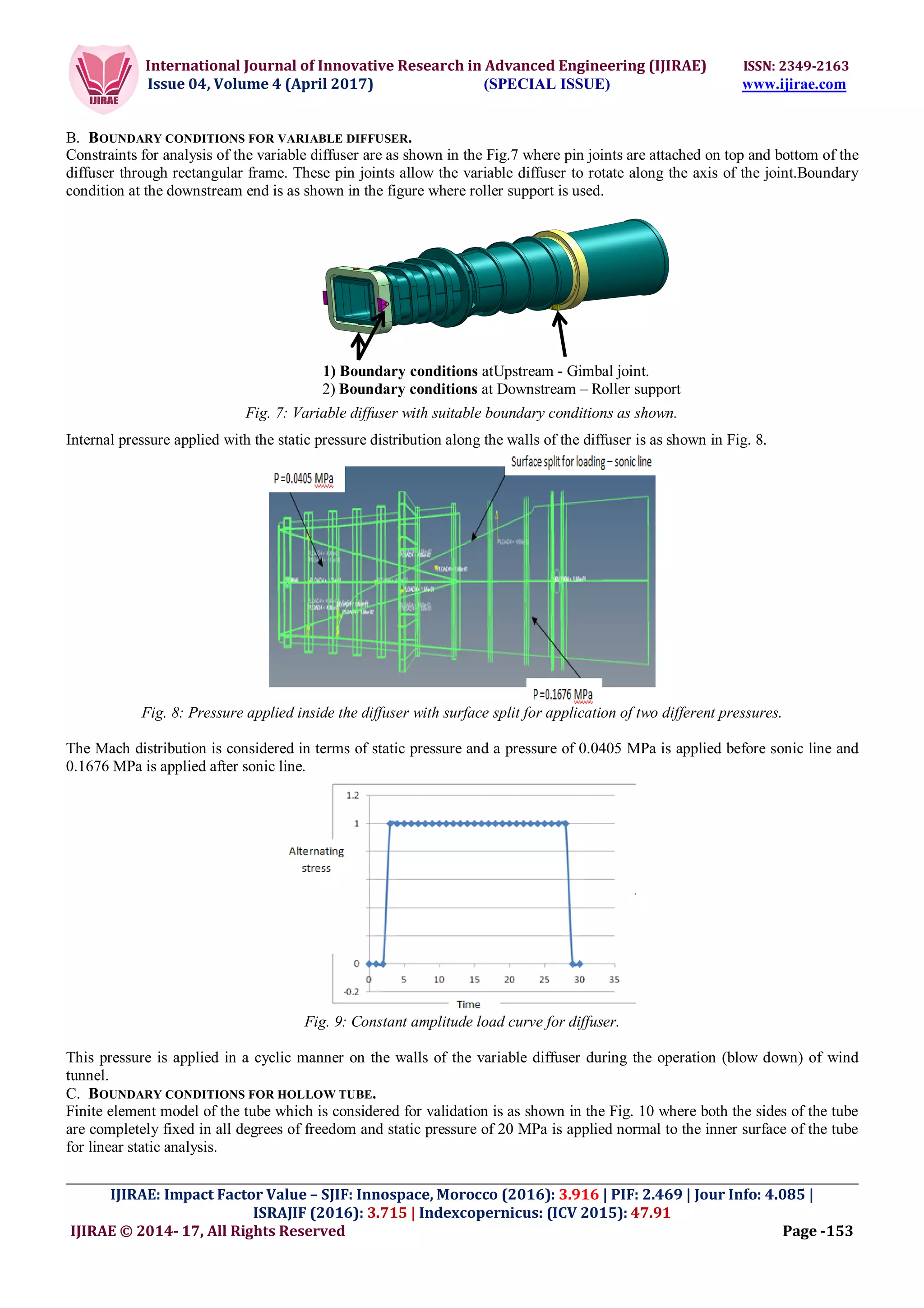
In order to create finite element model, component is discertized in to fine elements. Element type used in the HyperMesh for
this was CTETRA. Details of mesh are shown in the table.
TABLE 3- DETAILS OF MESH AND TYPE OF ELEMENT.
S.NO COMPONENT VARIABLE DIFFUSER
1 Element type CTETRA
2 Total number of elements created in HyperMesh 1568090
3 Total number of nodes created in HyperMesh 519180
TABLE 4- QUALITY CHECK FOR CTETRA ELEMENTS.
Fig. 6: Meshed model of variable diffuser usingCTETRA elements.
Fig. 7: Detailed view of the meshed model near upstream end.
QUALITY CRITERIA STANDARD VALUES % OF ELEMENTS ATTAINED STANDARD VALUES
Warpage 5 100
Aspect ratio 5 100
Skew 60° 98
Jacobian 0.7 100
Tetra collapse 0.1 100
International Journal of Innovative Research in Advanced Engineering (IJIRAE) ISSN: 2349-2163
Issue 04, Volume 4 (April 2017) (SPECIAL ISSUE) www.ijirae.com
______________________________________________________________________________________________________
IJIRAE: Impact Factor Value – SJIF: Innospace, Morocco (2016): 3.916 | PIF: 2.469 | Jour Info: 4.085 |
ISRAJIF (2016): 3.715 | Indexcopernicus: (ICV 2015): 47.91
IJIRAE © 2014- 17, All Rights Reserved Page -153
B. BOUNDARY CONDITIONS FOR VARIABLE DIFFUSER.
Constraints for analysis of the variable diffuser are as shown in the Fig.7 where pin joints are attached on top and bottom of the
diffuser through rectangular frame. These pin joints allow the variable diffuser to rotate along the axis of the joint.Boundary
condition at the downstream end is as shown in the figure where roller support is used.
Fig. 7: Variable diffuser with suitable boundary conditions as shown.
Internal pressure applied with the static pressure distribution along the walls of the diffuser is as shown in Fig. 8.
Fig. 8: Pressure applied inside the diffuser with surface split for application of two different pressures.
The Mach distribution is considered in terms of static pressure and a pressure of 0.0405 MPa is applied before sonic line and
0.1676 MPa is applied after sonic line.
Fig. 9: Constant amplitude load curve for diffuser.
This pressure is applied in a cyclic manner on the walls of the variable diffuser during the operation (blow down) of wind
tunnel.
C. BOUNDARY CONDITIONS FOR HOLLOW TUBE.
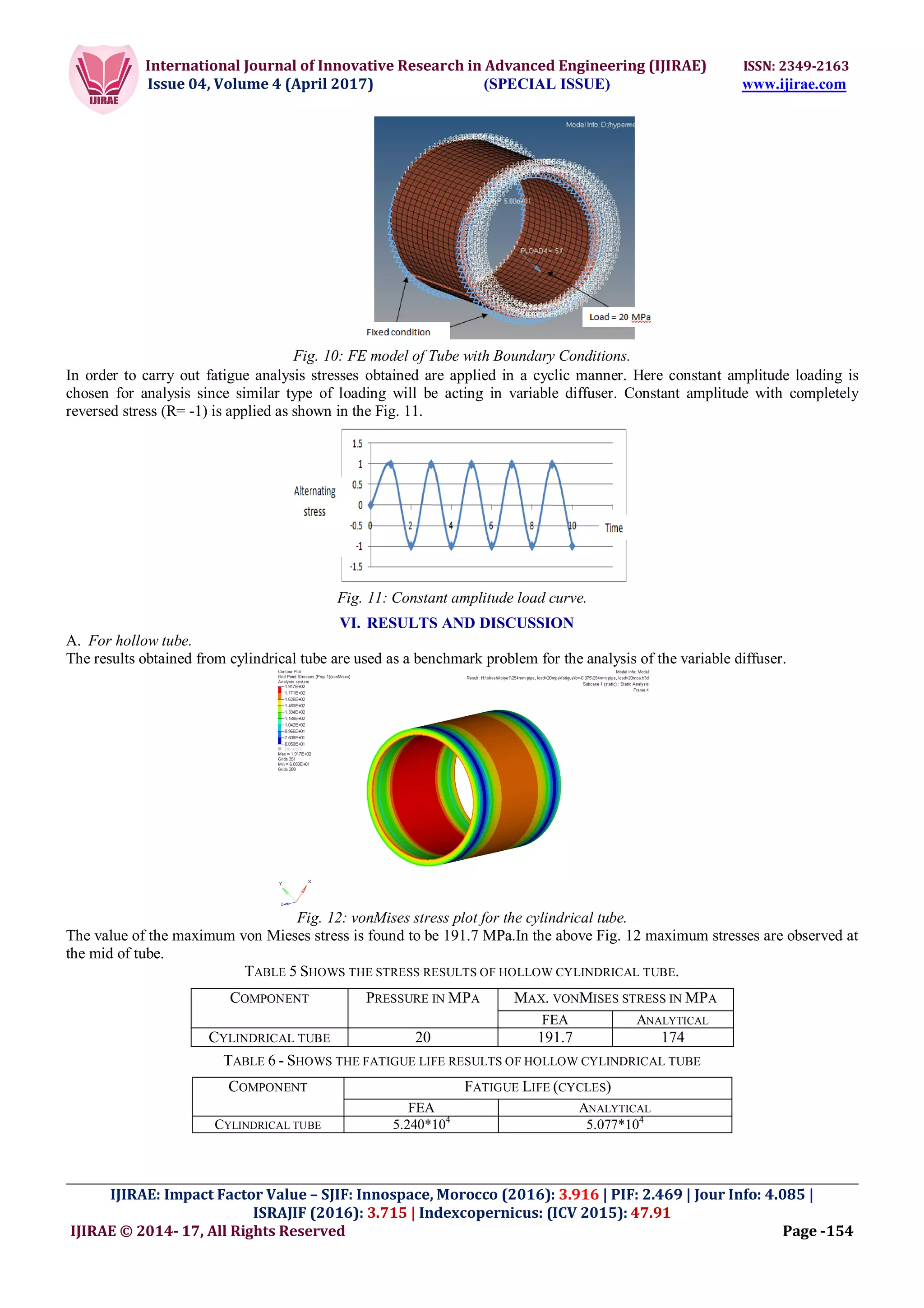
Finite element model of the tube which is considered for validation is as shown in the Fig. 10 where both the sides of the tube
are completely fixed in all degrees of freedom and static pressure of 20 MPa is applied normal to the inner surface of the tube
for linear static analysis.
1) Boundary conditions atUpstream - Gimbal joint.
2) Boundary conditions at Downstream – Roller support
International Journal of Innovative Research in Advanced Engineering (IJIRAE) ISSN: 2349-2163
Issue 04, Volume 4 (April 2017) (SPECIAL ISSUE) www.ijirae.com
______________________________________________________________________________________________________
IJIRAE: Impact Factor Value – SJIF: Innospace, Morocco (2016): 3.916 | PIF: 2.469 | Jour Info: 4.085 |
ISRAJIF (2016): 3.715 | Indexcopernicus: (ICV 2015): 47.91
IJIRAE © 2014- 17, All Rights Reserved Page -154
Fig. 10: FE model of Tube with Boundary Conditions.
In order to carry out fatigue analysis stresses obtained are applied in a cyclic manner. Here constant amplitude loading is
chosen for analysis since similar type of loading will be acting in variable diffuser. Constant amplitude with completely
reversed stress (R= -1) is applied as shown in the Fig. 11.
Fig. 11: Constant amplitude load curve.
VI. RESULTS AND DISCUSSION
A. For hollow tube.
The results obtained from cylindrical tube are used as a benchmark problem for the analysis of the variable diffuser.
Fig. 12: vonMises stress plot for the cylindrical tube.
The value of the maximum von Mieses stress is found to be 191.7 MPa.In the above Fig. 12 maximum stresses are observed at
the mid of tube.
TABLE 5 SHOWS THE STRESS RESULTS OF HOLLOW CYLINDRICAL TUBE.
TABLE 6 - SHOWS THE FATIGUE LIFE RESULTS OF HOLLOW CYLINDRICAL TUBE
COMPONENT PRESSURE IN MPA MAX. VONMISES STRESS IN MPA
FEA ANALYTICAL
CYLINDRICAL TUBE 20 191.7 174
COMPONENT FATIGUE LIFE (CYCLES)
FEA ANALYTICAL
CYLINDRICAL TUBE 5.240*104
5.077*104
International Journal of Innovative Research in Advanced Engineering (IJIRAE) ISSN: 2349-2163
Issue 04, Volume 4 (April 2017) (SPECIAL ISSUE) www.ijirae.com
______________________________________________________________________________________________________
IJIRAE: Impact Factor Value – SJIF: Innospace, Morocco (2016): 3.916 | PIF: 2.469 | Jour Info: 4.085 |
ISRAJIF (2016): 3.715 | Indexcopernicus: (ICV 2015): 47.91
IJIRAE © 2014- 17, All Rights Reserved Page -155
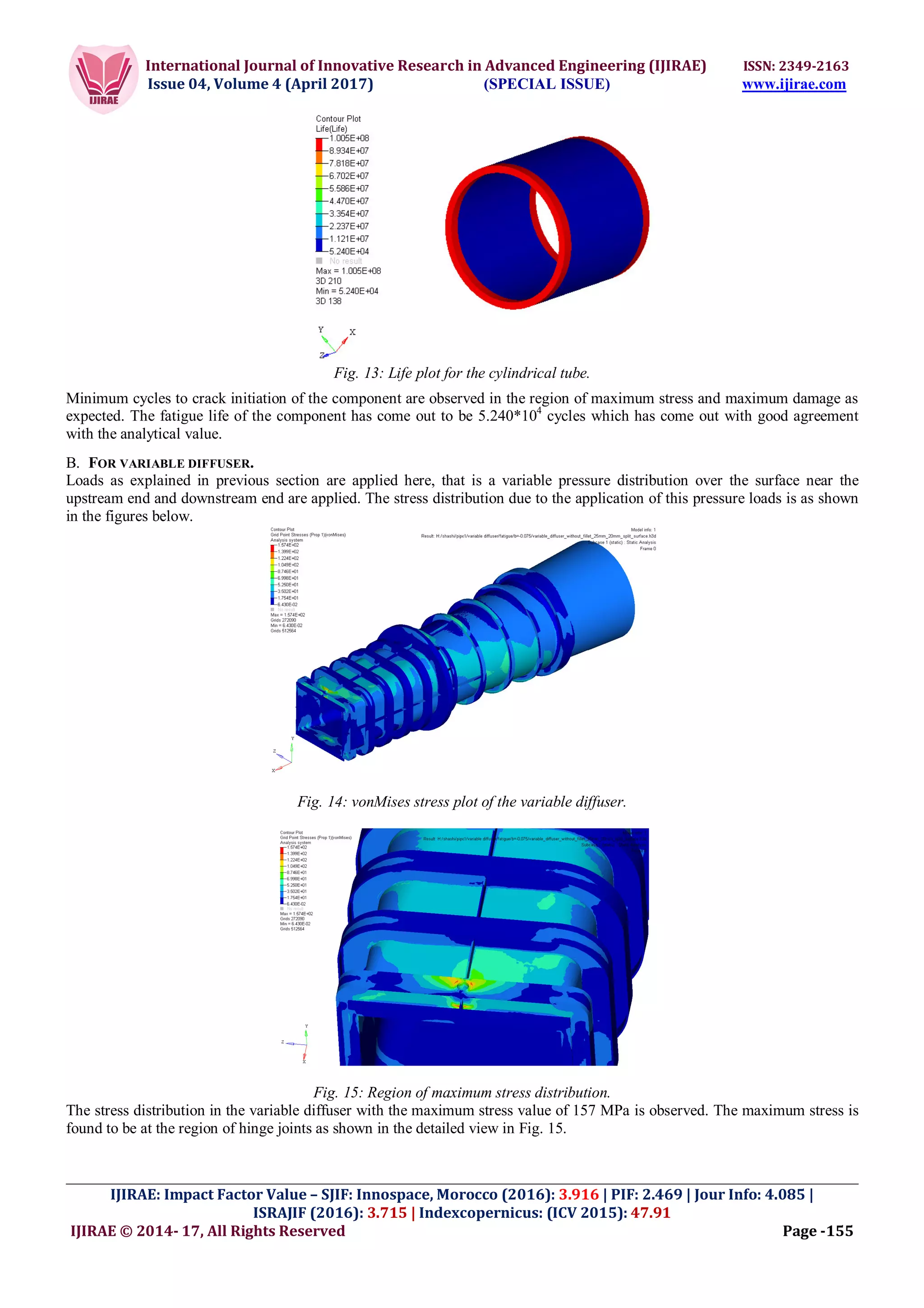
Fig. 13: Life plot for the cylindrical tube.
Minimum cycles to crack initiation of the component are observed in the region of maximum stress and maximum damage as
expected. The fatigue life of the component has come out to be 5.240*104
cycles which has come out with good agreement
with the analytical value.
B. FOR VARIABLE DIFFUSER.
Loads as explained in previous section are applied here, that is a variable pressure distribution over the surface near the
upstream end and downstream end are applied. The stress distribution due to the application of this pressure loads is as shown
in the figures below.
Fig. 14: vonMises stress plot of the variable diffuser.
Fig. 15: Region of maximum stress distribution.
The stress distribution in the variable diffuser with the maximum stress value of 157 MPa is observed. The maximum stress is
found to be at the region of hinge joints as shown in the detailed view in Fig. 15.
International Journal of Innovative Research in Advanced Engineering (IJIRAE) ISSN: 2349-2163
Issue 04, Volume 4 (April 2017) (SPECIAL ISSUE) www.ijirae.com
______________________________________________________________________________________________________
IJIRAE: Impact Factor Value – SJIF: Innospace, Morocco (2016): 3.916 | PIF: 2.469 | Jour Info: 4.085 |
ISRAJIF (2016): 3.715 | Indexcopernicus: (ICV 2015): 47.91
IJIRAE © 2014- 17, All Rights Reserved Page -156
Fig. 16: Region of minimum life at pin hole.
The crack initiation life of the variable diffuser is found to be 4.29*104
cycles. Fig. 16 shows the region of crack initiation,
which is similar to the region of maximum stress distribution. The fatigue life to crack initiation is 104
cycles; hence the
component is in the region of high cycle fatigue of the S-N curve. Relatively other regions than at hinge shows the infinite life
of the component that is more than 106
cycles for the given static pressure distribution case.
TABLE 7- SHOWS THE OUTPUT RESULTS OF HOLLOW CYLINDRICAL TUBE.
VII. CONCLUSIONS
Based on literature the stress life method has been used to find the fatigue life of the components. The verification problem of a
hollow cylindrical tube carried out using finite element analysis (Hyper Works) and by the analytical approach has a result
convergence of around 95%. The stress distribution in the variable diffuser and the maximum stress region acting in the
component is determined for pressure distribution of Mach 3 load case. The maximum stress of 157 MPa is found at the pin
hole and the minimum life to crack initiation is found to be 4.29*104
cycles at the region of pin hole where maximum stress
region is found.
VIII.REFERENCES
[1]. R. A. Gujar, S. V. Bhaskar, “Shaft design under fatigue loading by using modified Goodman method”, Int. J. Engg. Ress.
App. (IJERA) ISSN: 2248-9622, Vol. 3, Issue 4, Jul-Aug 2013, pp.1061-1066.
[2]. Ankit Dhyani, “Fatigue life estimation using Goodman diagram”, International Journal of Aerospace and Mechanical
Engineering,ISSN: 2393-8609,Volume 2 – No.4, June 2015.
[3]. Qasim Bader, Emad Kadum, “Mean stress correction effects on the fatigue life behavior of steel alloys by using stress life
approach theories”, International Journal of Engineering & Technology IJET-IJENS, Vol. 14.
[4]. Mahesh L. Raotole, Prof. D. B. Sadaphale, Prof. J. R.Chaudhari, “Prediction of Fatigue Life of Crank Shaft using S-N
Approach”, International Journal of Emerging Technology and Advanced Engineering, ISSN 2250-2459, ISO 9001:2008
Certified Journal, Volume 3, Issue 2, February 2013.
[5]. Yogesh. B. Dupare, Raju.B.Tirpude and Akshay.Y.Bharadbhunje, “Fatigue analysis in connecting rod using Ansys”,
International Journal of Modern Trends in Engineering, ISSN: 2349-9745, Volume 02, February – 2015.
[6]. Qasim Bader and Emad K. Njim, “Effect of Stress Ratio and V Notch Shape on Fatigue Life in Steel Beam”,
International Journal of Scientific & Engineering Research, ISSN 2229-5518, Volume 5, Issue 6, June-2014.
[7]. A. Chattopadhyay, G. Glinka, M. El-Zein, J. Qian and R. Formas, “Stress analysisand fatigueof welded structures” Doc.
IIW-2201, recommended for publication by Commission XIII “Fatigue of Welded Components and Structure.”
[8]. Tso-Liang Teng and Peng-Hsiang Chang, “Fatigue Crack Initiation Life Prediction for a Flat Plate with a Central Hole”,
journal of C.C.I.T. Vol.32 no.1 Nov. 2003.
COMPONENT PRESSURE DISTRIBUTION
FOR MACH NO.
PRESSURE IN
MPA
MAX. VONMISES
STRESS IN MPA
FATIGUE LIFE
(CYCLE)
FEA FEA
Variable diffuser 3 0.0405-0.1676 157 4.29*104

FATIGUE ANALYSIS OF VARIABLE DIFFUSER

  • 1.
    International Journal ofInnovative Research in Advanced Engineering (IJIRAE) ISSN: 2349-2163 Issue 04, Volume 4 (April 2017) (SPECIAL ISSUE) www.ijirae.com ______________________________________________________________________________________________________ IJIRAE: Impact Factor Value – SJIF: Innospace, Morocco (2016): 3.916 | PIF: 2.469 | Jour Info: 4.085 | ISRAJIF (2016): 3.715 | Indexcopernicus: (ICV 2015): 47.91 IJIRAE © 2014- 17, All Rights Reserved Page -148 FATIGUE ANALYSIS OF VARIABLE DIFFUSER 1 SHASHI KUMAR R, 2 BHARATH KATTA, 3 LOKESH G. REDDY 1 Asst.Professor, 2 Scientist, 3Assoc.Professor 1,3 Department of Mechanical Engineering, Vemana Institute of Technology, 2 National Trisonic Aerodynamic Facility CSIR-NAL, Bengaluru, India. Abstract —This paper presents the life estimation of the diffuser structure. Literature shows that the welds are the source of failure in case of welded structure; hence the estimation of its life is very critical. There are two kinds of methods for life estimation stress life approach and strain life approach which have been validated for simple problems. Stress life approach was identified as appropriate for life estimation of the variable diffuser. There are papers indicating the methodology for life estimation using commercial software for life prediction. Here, Optistruct- Hyper-Works for pre-processing and solver and Hyper-View- Hyper-Works for post processing has been used for the indeterminate structure, complex loading and boundary condition. The mathematical model subjected to the variable pressure contours for a particular Mach No., with the gimbal joint boundary condition at the test section end and the roller support at the other end. In this paper stress and fatigue analysis of the variable diffuser has been carried out and life of the variable diffuser has been estimated. Keywords —fatigue analysis; finite element method; fatigue life. I. INTRODUCTION Fatigue is the progressive and localized structural damage that occurs when a material is subjected to cyclic loading. Mechanical components and structures used in day today life contain notches and geometrical discontinuities in them. For example, shafts have keyways in them and pressure vessels contain openings for the operational requirements. These notches, holes, keyways produce stress concentrations in the structure. Notches and keyways can be the region where crack initiation takes place which leads to crack propagation and finally failure of the structure when the stresses higher than the nominal value. Therefore predicting fatigue strength of the component is relevant considering design and safety of the component. Hence fatigue crack initiation life can be estimated based on local stress-strain approach. Wind tunnel is used for aerodynamic flow simulation around the scaled models for force and moment measurements. Wind tunnel testing is indispensible in the design phase of any vehicle flying (subsonic to supersonic) for its aerodynamic characterisation. There are two types of wind tunnels open circuit and closed circuit wind tunnels. In open circuit tunnels the high pressure air stored in the reservoir is forced on to the model through a nozzle to get the required Mach no and then is let out to the atmosphere with the aid of a diffuser. Whereas in case of close circuit tunnel the high pressure compressed air is recalculated in a close circuit. Variable diffuser is one of the components in the wind tunnel circuit. The CSIR-NAL trisonic wind tunnel is more than 50 years old. The diffuser of the wind tunnel needs to be analyzed for fatigue life. The literature reviews show that the linear static analysis has to be carried out for the given loads and then wind tunnel runs are to be used for cyclic loading case for fatigue. II. OBJECTIVES The main aim of this paper is to carry out linear static analysis of diffuser using HYPERWORKS to find out stress distribution and the maximum stress in the component. The fatigue life prediction of variable diffuser using Stress life approach is performed. The results obtained from FEA are validated using the analytical procedure for a hollow tube with internal pressure. This in turn validates the procedure followed in Hyper Works. III. FINITE ELEMENT ANALYSES The finite element method (FEM) is a most versatile numerical technique that can be used to solve virtually any physical problem which can be mathematically modeled. The method involves dividing the given domain in to sub divisions called finite elements, deriving mathematical equations for the elements, assembling the element equations, application of suitable boundary conditions and solving the matrix equation to obtain the unknowns. With the help of FEM it is possible to provide accurate numerical solutions to any problems and in diverse speed. In the real world, main aim of the finite element analysis is used to verify the design of a component prior to its manufacturing. The commercial code used for the fatigue analysis of variable diffuser was HYPERWORKS which uses the OPTISTRUCT as its solver. The stages involved in FEM are shown in the Fig.1.
  • 2.
    International Journal ofInnovative Research in Advanced Engineering (IJIRAE) ISSN: 2349-2163 Issue 04, Volume 4 (April 2017) (SPECIAL ISSUE) www.ijirae.com ______________________________________________________________________________________________________ IJIRAE: Impact Factor Value – SJIF: Innospace, Morocco (2016): 3.916 | PIF: 2.469 | Jour Info: 4.085 | ISRAJIF (2016): 3.715 | Indexcopernicus: (ICV 2015): 47.91 IJIRAE © 2014- 17, All Rights Reserved Page -149 Fig.1: Different stages of Finite Element Analysis. A. GEOMETRICAL CONFIGURATION OF THE VARIABLE DIFFUSER The geometry of the variable diffuser was as shown in Fig.2.It has a square cross section of 1200*1200 mm at the upstream and this square goes on diverging to circular and completely becomes circular at the point B. So there was a transition of cross section from square to circular from the point A to point B as shown in theFig.2 and a divergence circular form of a cone from B to C. Diameter at the downstream was about 2559 mm. The overall length of the diffuser was about 10000 mm. The transition of square to circular that was from A to B had a length of about 4572 mm. Fig.2: 3D geometric model of variable diffuser. B. GEOMETRICAL CONFIGURATION OF THE HOLLOW TUBE Fig.3 below represents the 3D sketch of the hollow tube where total length of tube is 254 mm, diameter of the tube is 254 mm and thickness of the tube is 12.7 mm. Fig.3: 3D sketch of Hollow Tube. C. MATERIAL USED FOR ANALYSIS Material used for the analysis is ASTM A36, which has a very good welded property and hence commonly used in the welded structures. It is generally available in the form of rectangular bars, square bars, in the form of H-beams, I-beams and circular rods. It has a density of 7.85 g/cm3 and has yield strength of 250 MPa where number 36 from the A36 comes from the yield strength of its material.
  • 3.
    International Journal ofInnovative Research in Advanced Engineering (IJIRAE) ISSN: 2349-2163 Issue 04, Volume 4 (April 2017) (SPECIAL ISSUE) www.ijirae.com ______________________________________________________________________________________________________ IJIRAE: Impact Factor Value – SJIF: Innospace, Morocco (2016): 3.916 | PIF: 2.469 | Jour Info: 4.085 | ISRAJIF (2016): 3.715 | Indexcopernicus: (ICV 2015): 47.91 IJIRAE © 2014- 17, All Rights Reserved Page -150 TABLE 1- MECHANICAL PROPERTIES OF ASTM A36. MODULUS OF ELASTICITY (E) MPA 200000 TENSILE STRENGTH (UT) MPA 400-550 YIELD STRENGTH (Y) MPA 250 HARDNESS, HB 168 FATIGUE STRENGTH EXPONENT (B) -0.073 POISSON’S RATIO  0.26 IV. DETERMINATION OF FATIGUE LIFE OF HOLLOW TUBE USING ANALYTICAL METHOD. A. FACTORS AFFECTING FATIGUE LIFE. It is found that the endurance limit of the component prepared in the laboratory test conditions will be closely controlled and more often it is unrealistic. Hence various correction factors like surface finish, environment, temperature, reliability etc., need to be considered for the actual condition. Hence the equation for the correction factors for the endurance limit is given as,[1] e = Cload* Csize* Csurf* Ctemp* Creliab* ’e (1) Where, Csurf = surface condition correction factor. Cload= load correction factor. Csize = size correction factor. Ctemp = temperature correction factor. Creliab = reliability correction factor. ’e = endurance limit of the test specimen. e = endurance limit of the actual component. Csurf = A (ut)b Where ut is ultimate tensile strength, A and b are found from table 2. TABLE 2- COEFFICIENTS FOR SURFACE MODIFICATION EQUATION. In this case from table 2 we have considered as Hot rolled condition for the surface and the corresponding value of ‘A’ and ‘b’ for this is, A=57.7 and b= -0.718 Csurf = 0.6217 Cload = 1 Csize = 0.6 Ctemp = 1 Creliab = 1 ’e = 0.5 ut ’e = 275 MPa Substituting all the correction factor values in equation (1) e = 102.58 MPa B. Fatigue loading. Simplest way of loading observed is the constant amplitude loading with sinusoidal stress-time pattern shown in Fig.4 below. Useful terms required for fatigue life calculations are shown in the Fig.4 with respect to constant amplitude loading. Fig.4: Constant amplitude loading. SURFACE FINISH A (MPA) B GROUND 1.58 -0.085 MACHINED OR COLD-DRAWN 4.51 -0.265 HOT-ROLLED 57.7 -0.718 AS- FORGED 272 -0.995
  • 4.
    International Journal ofInnovative Research in Advanced Engineering (IJIRAE) ISSN: 2349-2163 Issue 04, Volume 4 (April 2017) (SPECIAL ISSUE) www.ijirae.com ______________________________________________________________________________________________________ IJIRAE: Impact Factor Value – SJIF: Innospace, Morocco (2016): 3.916 | PIF: 2.469 | Jour Info: 4.085 | ISRAJIF (2016): 3.715 | Indexcopernicus: (ICV 2015): 47.91 IJIRAE © 2014- 17, All Rights Reserved Page -151 Where, m = Mean stress max minσ + σ 2  max = Maximum stress in the cycle min = Minimum stress in the cycle a= Alternating stress amplitude r = Range of stress max minσ σ  R = Stress ratio A = Amplitude ratio σ 1 σ 1 a m R R     C. FATIGUE LIFE CALCULATIONS Fatigue life calculation for cylindrical hollow tube is considered for validation.In the case of circular pressurized thin pipes two types of stresses will be acting one the Hoop stress or circumferential stress and other Axial stress. In case of diffuser axial stresses are zero and only hoop stresses need to be considered. Hoop stress is calculated by eqn. (2). H = (2) H = 200 MPa. From Basquin’s equation, f = aNb (3) Where, N is the number of cycles to failure, ‘a’ and ‘b’ are constants, a = coefficient and represents the value of a at one cycle. b = slope of log-log S-N curve. f = applied fatigue stress. Thus ‘a’ and ‘b’ are found from the equations below.[2] = −1 3 log ( ) b = -0.2237. = ( ) a = 2257.76 MPa. Value of ‘f’ is obtained from the Fig.5 based on the ultimate tensile strength of the material. This is known as fatigue strength fraction. i.e., f= 0.875. Fig.5: Fatigue strength fraction (f) for various ultimate tensile strength. Rewriting equation (3), the number of cycles for failure can be expressed as [2] max minσ -σ 2  min max σ σ  482 551 620 689 758 827 896 965 1034 1103 1172 1241 1310 1378 σutMPa
  • 5.
    International Journal ofInnovative Research in Advanced Engineering (IJIRAE) ISSN: 2349-2163 Issue 04, Volume 4 (April 2017) (SPECIAL ISSUE) www.ijirae.com ______________________________________________________________________________________________________ IJIRAE: Impact Factor Value – SJIF: Innospace, Morocco (2016): 3.916 | PIF: 2.469 | Jour Info: 4.085 | ISRAJIF (2016): 3.715 | Indexcopernicus: (ICV 2015): 47.91 IJIRAE © 2014- 17, All Rights Reserved Page -152 = ⁄ (4) N = 5.077*104 cycles. V. STRESS ANALYSISOF VARIABLE DIFFUSER AND HOLLOW TUBE. A. DISCERTIZING THE GEOMETRIC MODEL OF VARIABLE DIFFUSER. In order to create finite element model, component is discertized in to fine elements. Element type used in the HyperMesh for this was CTETRA. Details of mesh are shown in the table. TABLE 3- DETAILS OF MESH AND TYPE OF ELEMENT. S.NO COMPONENT VARIABLE DIFFUSER 1 Element type CTETRA 2 Total number of elements created in HyperMesh 1568090 3 Total number of nodes created in HyperMesh 519180 TABLE 4- QUALITY CHECK FOR CTETRA ELEMENTS. Fig. 6: Meshed model of variable diffuser usingCTETRA elements. Fig. 7: Detailed view of the meshed model near upstream end. QUALITY CRITERIA STANDARD VALUES % OF ELEMENTS ATTAINED STANDARD VALUES Warpage 5 100 Aspect ratio 5 100 Skew 60° 98 Jacobian 0.7 100 Tetra collapse 0.1 100
  • 6.
    International Journal ofInnovative Research in Advanced Engineering (IJIRAE) ISSN: 2349-2163 Issue 04, Volume 4 (April 2017) (SPECIAL ISSUE) www.ijirae.com ______________________________________________________________________________________________________ IJIRAE: Impact Factor Value – SJIF: Innospace, Morocco (2016): 3.916 | PIF: 2.469 | Jour Info: 4.085 | ISRAJIF (2016): 3.715 | Indexcopernicus: (ICV 2015): 47.91 IJIRAE © 2014- 17, All Rights Reserved Page -153 B. BOUNDARY CONDITIONS FOR VARIABLE DIFFUSER. Constraints for analysis of the variable diffuser are as shown in the Fig.7 where pin joints are attached on top and bottom of the diffuser through rectangular frame. These pin joints allow the variable diffuser to rotate along the axis of the joint.Boundary condition at the downstream end is as shown in the figure where roller support is used. Fig. 7: Variable diffuser with suitable boundary conditions as shown. Internal pressure applied with the static pressure distribution along the walls of the diffuser is as shown in Fig. 8. Fig. 8: Pressure applied inside the diffuser with surface split for application of two different pressures. The Mach distribution is considered in terms of static pressure and a pressure of 0.0405 MPa is applied before sonic line and 0.1676 MPa is applied after sonic line. Fig. 9: Constant amplitude load curve for diffuser. This pressure is applied in a cyclic manner on the walls of the variable diffuser during the operation (blow down) of wind tunnel. C. BOUNDARY CONDITIONS FOR HOLLOW TUBE. Finite element model of the tube which is considered for validation is as shown in the Fig. 10 where both the sides of the tube are completely fixed in all degrees of freedom and static pressure of 20 MPa is applied normal to the inner surface of the tube for linear static analysis. 1) Boundary conditions atUpstream - Gimbal joint. 2) Boundary conditions at Downstream – Roller support
  • 7.
    International Journal ofInnovative Research in Advanced Engineering (IJIRAE) ISSN: 2349-2163 Issue 04, Volume 4 (April 2017) (SPECIAL ISSUE) www.ijirae.com ______________________________________________________________________________________________________ IJIRAE: Impact Factor Value – SJIF: Innospace, Morocco (2016): 3.916 | PIF: 2.469 | Jour Info: 4.085 | ISRAJIF (2016): 3.715 | Indexcopernicus: (ICV 2015): 47.91 IJIRAE © 2014- 17, All Rights Reserved Page -154 Fig. 10: FE model of Tube with Boundary Conditions. In order to carry out fatigue analysis stresses obtained are applied in a cyclic manner. Here constant amplitude loading is chosen for analysis since similar type of loading will be acting in variable diffuser. Constant amplitude with completely reversed stress (R= -1) is applied as shown in the Fig. 11. Fig. 11: Constant amplitude load curve. VI. RESULTS AND DISCUSSION A. For hollow tube. The results obtained from cylindrical tube are used as a benchmark problem for the analysis of the variable diffuser. Fig. 12: vonMises stress plot for the cylindrical tube. The value of the maximum von Mieses stress is found to be 191.7 MPa.In the above Fig. 12 maximum stresses are observed at the mid of tube. TABLE 5 SHOWS THE STRESS RESULTS OF HOLLOW CYLINDRICAL TUBE. TABLE 6 - SHOWS THE FATIGUE LIFE RESULTS OF HOLLOW CYLINDRICAL TUBE COMPONENT PRESSURE IN MPA MAX. VONMISES STRESS IN MPA FEA ANALYTICAL CYLINDRICAL TUBE 20 191.7 174 COMPONENT FATIGUE LIFE (CYCLES) FEA ANALYTICAL CYLINDRICAL TUBE 5.240*104 5.077*104
  • 8.
    International Journal ofInnovative Research in Advanced Engineering (IJIRAE) ISSN: 2349-2163 Issue 04, Volume 4 (April 2017) (SPECIAL ISSUE) www.ijirae.com ______________________________________________________________________________________________________ IJIRAE: Impact Factor Value – SJIF: Innospace, Morocco (2016): 3.916 | PIF: 2.469 | Jour Info: 4.085 | ISRAJIF (2016): 3.715 | Indexcopernicus: (ICV 2015): 47.91 IJIRAE © 2014- 17, All Rights Reserved Page -155 Fig. 13: Life plot for the cylindrical tube. Minimum cycles to crack initiation of the component are observed in the region of maximum stress and maximum damage as expected. The fatigue life of the component has come out to be 5.240*104 cycles which has come out with good agreement with the analytical value. B. FOR VARIABLE DIFFUSER. Loads as explained in previous section are applied here, that is a variable pressure distribution over the surface near the upstream end and downstream end are applied. The stress distribution due to the application of this pressure loads is as shown in the figures below. Fig. 14: vonMises stress plot of the variable diffuser. Fig. 15: Region of maximum stress distribution. The stress distribution in the variable diffuser with the maximum stress value of 157 MPa is observed. The maximum stress is found to be at the region of hinge joints as shown in the detailed view in Fig. 15.
  • 9.
    International Journal ofInnovative Research in Advanced Engineering (IJIRAE) ISSN: 2349-2163 Issue 04, Volume 4 (April 2017) (SPECIAL ISSUE) www.ijirae.com ______________________________________________________________________________________________________ IJIRAE: Impact Factor Value – SJIF: Innospace, Morocco (2016): 3.916 | PIF: 2.469 | Jour Info: 4.085 | ISRAJIF (2016): 3.715 | Indexcopernicus: (ICV 2015): 47.91 IJIRAE © 2014- 17, All Rights Reserved Page -156 Fig. 16: Region of minimum life at pin hole. The crack initiation life of the variable diffuser is found to be 4.29*104 cycles. Fig. 16 shows the region of crack initiation, which is similar to the region of maximum stress distribution. The fatigue life to crack initiation is 104 cycles; hence the component is in the region of high cycle fatigue of the S-N curve. Relatively other regions than at hinge shows the infinite life of the component that is more than 106 cycles for the given static pressure distribution case. TABLE 7- SHOWS THE OUTPUT RESULTS OF HOLLOW CYLINDRICAL TUBE. VII. CONCLUSIONS Based on literature the stress life method has been used to find the fatigue life of the components. The verification problem of a hollow cylindrical tube carried out using finite element analysis (Hyper Works) and by the analytical approach has a result convergence of around 95%. The stress distribution in the variable diffuser and the maximum stress region acting in the component is determined for pressure distribution of Mach 3 load case. The maximum stress of 157 MPa is found at the pin hole and the minimum life to crack initiation is found to be 4.29*104 cycles at the region of pin hole where maximum stress region is found. VIII.REFERENCES [1]. R. A. Gujar, S. V. Bhaskar, “Shaft design under fatigue loading by using modified Goodman method”, Int. J. Engg. Ress. App. (IJERA) ISSN: 2248-9622, Vol. 3, Issue 4, Jul-Aug 2013, pp.1061-1066. [2]. Ankit Dhyani, “Fatigue life estimation using Goodman diagram”, International Journal of Aerospace and Mechanical Engineering,ISSN: 2393-8609,Volume 2 – No.4, June 2015. [3]. Qasim Bader, Emad Kadum, “Mean stress correction effects on the fatigue life behavior of steel alloys by using stress life approach theories”, International Journal of Engineering & Technology IJET-IJENS, Vol. 14. [4]. Mahesh L. Raotole, Prof. D. B. Sadaphale, Prof. J. R.Chaudhari, “Prediction of Fatigue Life of Crank Shaft using S-N Approach”, International Journal of Emerging Technology and Advanced Engineering, ISSN 2250-2459, ISO 9001:2008 Certified Journal, Volume 3, Issue 2, February 2013. [5]. Yogesh. B. Dupare, Raju.B.Tirpude and Akshay.Y.Bharadbhunje, “Fatigue analysis in connecting rod using Ansys”, International Journal of Modern Trends in Engineering, ISSN: 2349-9745, Volume 02, February – 2015. [6]. Qasim Bader and Emad K. Njim, “Effect of Stress Ratio and V Notch Shape on Fatigue Life in Steel Beam”, International Journal of Scientific & Engineering Research, ISSN 2229-5518, Volume 5, Issue 6, June-2014. [7]. A. Chattopadhyay, G. Glinka, M. El-Zein, J. Qian and R. Formas, “Stress analysisand fatigueof welded structures” Doc. IIW-2201, recommended for publication by Commission XIII “Fatigue of Welded Components and Structure.” [8]. Tso-Liang Teng and Peng-Hsiang Chang, “Fatigue Crack Initiation Life Prediction for a Flat Plate with a Central Hole”, journal of C.C.I.T. Vol.32 no.1 Nov. 2003. COMPONENT PRESSURE DISTRIBUTION FOR MACH NO. PRESSURE IN MPA MAX. VONMISES STRESS IN MPA FATIGUE LIFE (CYCLE) FEA FEA Variable diffuser 3 0.0405-0.1676 157 4.29*104