11
MucopolysaccharidosisMucopolysaccharidosis
 Genetic disordersGenetic disorders
 Deficiency of enzymes necessary to breakdownDeficiency of enzymes necessary to breakdown
mucopolysaccharides (MPS)mucopolysaccharides (MPS)
 Excessive accumulation of mucopolysaccharides in bodyExcessive accumulation of mucopolysaccharides in body
tissuestissues
 Storage of abnormal quantities of this material in differentStorage of abnormal quantities of this material in different
body tissues is responsible for the symptoms andbody tissues is responsible for the symptoms and
appearance of the diseaseappearance of the disease
22
Clinical manifestationsClinical manifestations
– many serious physical disordersmany serious physical disorders
– Various genetic deformities such as:Various genetic deformities such as:
skeletal deformities (especially of the face)skeletal deformities (especially of the face)
mental retardationmental retardation
decreased life expectancydecreased life expectancy
33
ExamplesExamples
Hurler syndromeHurler syndrome
Scheie syndromeScheie syndrome
Hunter syndromeHunter syndrome
Sanfilippo syndromeSanfilippo syndrome
Morquio diseaseMorquio disease
Maroteaux-Lamy syndromeMaroteaux-Lamy syndrome
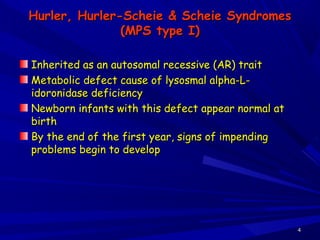
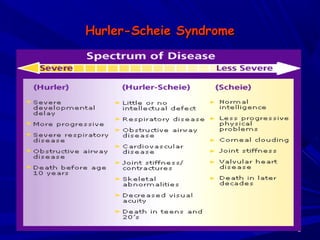
Hurler, Hurler-Scheie & Scheie SyndromesHurler, Hurler-Scheie & Scheie Syndromes
(MPS type I)(MPS type I)
Inherited as an autosomal recessive (AR) traitInherited as an autosomal recessive (AR) trait
Metabolic defect cause of lysosmal alpha-L-Metabolic defect cause of lysosmal alpha-L-
idoronidase deficiencyidoronidase deficiency
Newborn infants with this defect appear normal atNewborn infants with this defect appear normal at
birthbirth
By the end of the first year, signs of impendingBy the end of the first year, signs of impending
problems begin to developproblems begin to develop
44
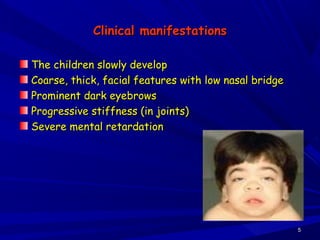
Clinical manifestationsClinical manifestations
The children slowly developThe children slowly develop
Coarse, thick, facial features with low nasal bridgeCoarse, thick, facial features with low nasal bridge
Prominent dark eyebrowsProminent dark eyebrows
Progressive stiffness (in joints)Progressive stiffness (in joints)
Severe mental retardationSevere mental retardation
55
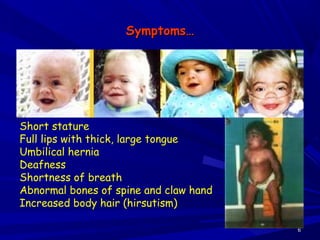
Symptoms…Symptoms…
66
Short stature
Full lips with thick, large tongue
Umbilical hernia
Deafness
Shortness of breath
Abnormal bones of spine and claw hand
Increased body hair (hirsutism)
77
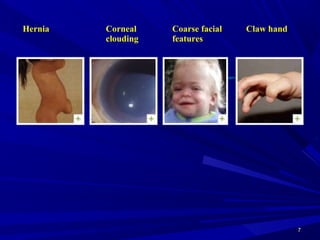
Key Symptom Images
Hernia Corneal
clouding
Coarse facial
features
Claw hand
Hurler-Scheie SyndromeHurler-Scheie Syndrome
88
99
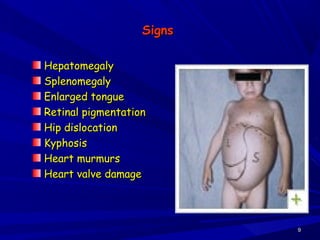
SignsSigns
HepatomegalyHepatomegaly
SplenomegalySplenomegaly
Enlarged tongueEnlarged tongue
Retinal pigmentationRetinal pigmentation
Hip dislocationHip dislocation
KyphosisKyphosis
Heart murmursHeart murmurs
Heart valve damage fromHeart valve damage from
1010
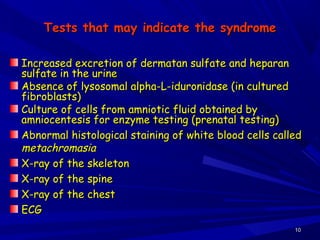
Tests that may indicate the syndromeTests that may indicate the syndrome
Increased excretion of dermatan sulfate and heparanIncreased excretion of dermatan sulfate and heparan
sulfate in the urinesulfate in the urine
Absence of lysosomal alpha-L-iduronidase (in culturedAbsence of lysosomal alpha-L-iduronidase (in cultured
fibroblasts)fibroblasts)
Culture of cells from amniotic fluid obtained byCulture of cells from amniotic fluid obtained by
amniocentesis for enzyme testing (prenatal testing)amniocentesis for enzyme testing (prenatal testing)
Abnormal histological staining of white blood cells calledAbnormal histological staining of white blood cells called
metachromasiametachromasia
X-ray of the skeletonX-ray of the skeleton
X-ray of the spineX-ray of the spine
X-ray of the chestX-ray of the chest
ECGECG
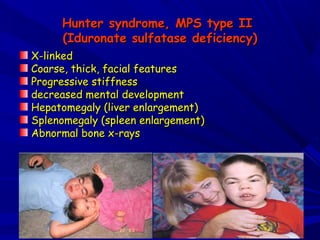
Hunter syndrome, MPS type IIHunter syndrome, MPS type II
(Iduronate sulfatase deficiency)(Iduronate sulfatase deficiency)
X-linkedX-linked
Coarse, thick, facial featuresCoarse, thick, facial features
Progressive stiffnessProgressive stiffness
decreased mental developmentdecreased mental development
Hepatomegaly (liver enlargement)Hepatomegaly (liver enlargement)
Splenomegaly (spleen enlargement)Splenomegaly (spleen enlargement)
Abnormal bone x-raysAbnormal bone x-rays
1111
Sanfilippo syndrome (MPS type III)Sanfilippo syndrome (MPS type III)
an autosomal recessive traitan autosomal recessive trait
It is possibly the most common of theIt is possibly the most common of the
mucopolysaccharide storage diseasesmucopolysaccharide storage diseases
It has a relatively late onset rather than during theIt has a relatively late onset rather than during the
first year of lifefirst year of life
it is characterized by the absence of one of severalit is characterized by the absence of one of several
enzymesenzymes
This substance is called heparan sulfate, and inThis substance is called heparan sulfate, and in
Sanfilippo syndrome, large amounts of it are excretedSanfilippo syndrome, large amounts of it are excreted
in the urinein the urine
1212
Alternative Names of MPS type IIIAlternative Names of MPS type III
Type IIIA:Type IIIA:
heparan-N-sulfatase deficiencyheparan-N-sulfatase deficiency
Type IIIB:Type IIIB:
N-acetyl-glucose aminidase deficiencyN-acetyl-glucose aminidase deficiency
Type IIIC:Type IIIC:
acetyl transferaseacetyl transferase
Type IIID:Type IIID:
N-acetyl glucoseamine 6-sulfatase deficiencyN-acetyl glucoseamine 6-sulfatase deficiency
1313
1414
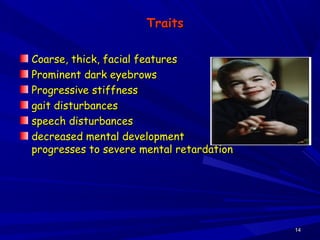
TraitsTraits
Coarse, thick, facial featuresCoarse, thick, facial features
Prominent dark eyebrowsProminent dark eyebrows
Progressive stiffnessProgressive stiffness
gait disturbancesgait disturbances
speech disturbancesspeech disturbances
decreased mental development thatdecreased mental development that
progresses to severe mental retardationprogresses to severe mental retardation
1515
SymptomsSymptoms
May have normal growth during first few years, but finalMay have normal growth during first few years, but final
height is below averageheight is below average
Delayed development followed by deteriorating mentalDelayed development followed by deteriorating mental
statusstatus
Deterioration of gaitDeterioration of gait
Coarse facial featuresCoarse facial features
Full lipsFull lips
Heavy eyebrows that meet in the middle of the face aboveHeavy eyebrows that meet in the middle of the face above
the nosethe nose
DiarrheaDiarrhea
Stiff joints that may not extend fullyStiff joints that may not extend fully
Signs and testsSigns and tests
Hepatomegaly (liver enlargement)Hepatomegaly (liver enlargement)
Splenomegaly (spleen enlargement)Splenomegaly (spleen enlargement)
CorneasCorneas clearclear
Echocardiogram may show thickened heartEchocardiogram may show thickened heart
Abnormal bone x-rays such as thickened skull and ovalAbnormal bone x-rays such as thickened skull and oval
vertebraevertebrae
SeizuresSeizures
Activities of one of the enzymes may be low inActivities of one of the enzymes may be low in
fibroblast skin cellsfibroblast skin cells
Urine may have increased heparan sulfateUrine may have increased heparan sulfate
Abnormal pathological staining character of whiteAbnormal pathological staining character of white
blood cells calledblood cells called metachromasiametachromasia
1616
1717
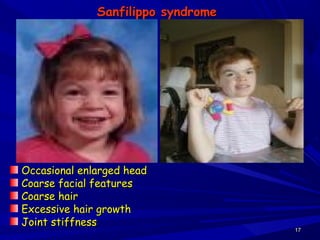
Sanfilippo syndromeSanfilippo syndrome
Occasional enlarged headOccasional enlarged head
Coarse facial featuresCoarse facial features
Coarse hairCoarse hair
Excessive hair growthExcessive hair growth
Joint stiffnessJoint stiffness
1818
SymptomsSymptoms
Severe diarrhea or constipationSevere diarrhea or constipation
Severe hearing lossSevere hearing loss
HyperactivityHyperactivity
Aggressive and destructive behaviorAggressive and destructive behavior
Poor attentionPoor attention
Physical aggressionPhysical aggression
Speech and language delaySpeech and language delay
Sleep disturbanceSleep disturbance
Severe intellectual impairment most often before 6Severe intellectual impairment most often before 6
years of ageyears of age
Mild growth retardationMild growth retardation
Vision impairmentVision impairment
Prenatal diagnosisPrenatal diagnosis
An amniocentesis in the amniotic fluid are thenAn amniocentesis in the amniotic fluid are then
cultured and the enzyme activity in the cells iscultured and the enzyme activity in the cells is
determined.determined.
1919
Morquio syndrome (MPS Type IV)Morquio syndrome (MPS Type IV)
Subtypes:Subtypes: A & BA & B
Type IVA:Type IVA: N-acetyl galactoseamine 6- sulfataseN-acetyl galactoseamine 6- sulfatase
deficiencydeficiency
Type IVB:Type IVB: beta-Galactosidase deficiencybeta-Galactosidase deficiency
2020
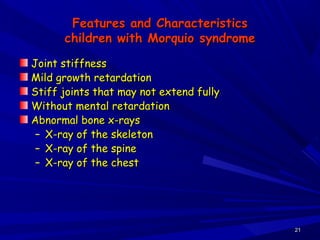
Features and CharacteristicsFeatures and Characteristics
children with Morquio syndromechildren with Morquio syndrome
Joint stiffnessJoint stiffness
Mild growth retardationMild growth retardation
Stiff joints that may not extend fullyStiff joints that may not extend fully
Without mental retardationWithout mental retardation
Abnormal bone x-raysAbnormal bone x-rays
– X-ray of the skeletonX-ray of the skeleton
– X-ray of the spineX-ray of the spine
– X-ray of the chestX-ray of the chest
2121
2222
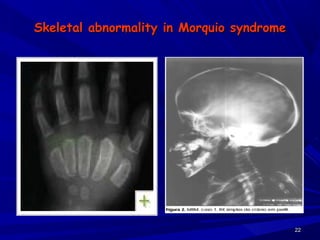
Skeletal abnormality in Morquio syndromeSkeletal abnormality in Morquio syndrome
2323
PreventionPrevention
Genetic counseling: important for prospectiveGenetic counseling: important for prospective
parents with a family history of Morquioparents with a family history of Morquio
syndromesyndrome
Prenatal diagnosisPrenatal diagnosis
An amniocentesis in the amniotic fluid are thenAn amniocentesis in the amniotic fluid are then
cultured and the enzyme activity in the cells iscultured and the enzyme activity in the cells is
determined.determined.
2424
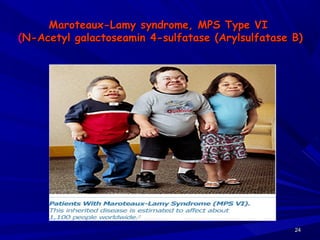
Maroteaux-Lamy syndrome, MPS Type VIMaroteaux-Lamy syndrome, MPS Type VI
((N-Acetyl galactoseamin 4-sulfatase (Arylsulfatase B)N-Acetyl galactoseamin 4-sulfatase (Arylsulfatase B)
2525
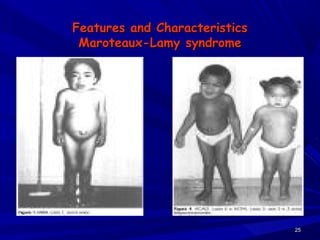
Features and CharacteristicsFeatures and Characteristics
Maroteaux-Lamy syndromeMaroteaux-Lamy syndrome
2626
Treatment of MPSTreatment of MPS
At the present time, there is no cure for MPS disorders.At the present time, there is no cure for MPS disorders.
Enzyme replacement therapy and gene therapy are the twoEnzyme replacement therapy and gene therapy are the two
treatments that researchers have been focusing on totreatments that researchers have been focusing on to
eventually cure MPS diseases.eventually cure MPS diseases.

MPS-ppt

  • 1.
    11 MucopolysaccharidosisMucopolysaccharidosis  Genetic disordersGeneticdisorders  Deficiency of enzymes necessary to breakdownDeficiency of enzymes necessary to breakdown mucopolysaccharides (MPS)mucopolysaccharides (MPS)  Excessive accumulation of mucopolysaccharides in bodyExcessive accumulation of mucopolysaccharides in body tissuestissues  Storage of abnormal quantities of this material in differentStorage of abnormal quantities of this material in different body tissues is responsible for the symptoms andbody tissues is responsible for the symptoms and appearance of the diseaseappearance of the disease
  • 2.
    22 Clinical manifestationsClinical manifestations –many serious physical disordersmany serious physical disorders – Various genetic deformities such as:Various genetic deformities such as: skeletal deformities (especially of the face)skeletal deformities (especially of the face) mental retardationmental retardation decreased life expectancydecreased life expectancy
  • 3.
    33 ExamplesExamples Hurler syndromeHurler syndrome ScheiesyndromeScheie syndrome Hunter syndromeHunter syndrome Sanfilippo syndromeSanfilippo syndrome Morquio diseaseMorquio disease Maroteaux-Lamy syndromeMaroteaux-Lamy syndrome
  • 4.
    Hurler, Hurler-Scheie &Scheie SyndromesHurler, Hurler-Scheie & Scheie Syndromes (MPS type I)(MPS type I) Inherited as an autosomal recessive (AR) traitInherited as an autosomal recessive (AR) trait Metabolic defect cause of lysosmal alpha-L-Metabolic defect cause of lysosmal alpha-L- idoronidase deficiencyidoronidase deficiency Newborn infants with this defect appear normal atNewborn infants with this defect appear normal at birthbirth By the end of the first year, signs of impendingBy the end of the first year, signs of impending problems begin to developproblems begin to develop 44
  • 5.
    Clinical manifestationsClinical manifestations Thechildren slowly developThe children slowly develop Coarse, thick, facial features with low nasal bridgeCoarse, thick, facial features with low nasal bridge Prominent dark eyebrowsProminent dark eyebrows Progressive stiffness (in joints)Progressive stiffness (in joints) Severe mental retardationSevere mental retardation 55
  • 6.
    Symptoms…Symptoms… 66 Short stature Full lipswith thick, large tongue Umbilical hernia Deafness Shortness of breath Abnormal bones of spine and claw hand Increased body hair (hirsutism)
  • 7.
    77 Key Symptom Images HerniaCorneal clouding Coarse facial features Claw hand
  • 8.
  • 9.
    99 SignsSigns HepatomegalyHepatomegaly SplenomegalySplenomegaly Enlarged tongueEnlarged tongue RetinalpigmentationRetinal pigmentation Hip dislocationHip dislocation KyphosisKyphosis Heart murmursHeart murmurs Heart valve damage fromHeart valve damage from
  • 10.
    1010 Tests that mayindicate the syndromeTests that may indicate the syndrome Increased excretion of dermatan sulfate and heparanIncreased excretion of dermatan sulfate and heparan sulfate in the urinesulfate in the urine Absence of lysosomal alpha-L-iduronidase (in culturedAbsence of lysosomal alpha-L-iduronidase (in cultured fibroblasts)fibroblasts) Culture of cells from amniotic fluid obtained byCulture of cells from amniotic fluid obtained by amniocentesis for enzyme testing (prenatal testing)amniocentesis for enzyme testing (prenatal testing) Abnormal histological staining of white blood cells calledAbnormal histological staining of white blood cells called metachromasiametachromasia X-ray of the skeletonX-ray of the skeleton X-ray of the spineX-ray of the spine X-ray of the chestX-ray of the chest ECGECG
  • 11.
    Hunter syndrome, MPStype IIHunter syndrome, MPS type II (Iduronate sulfatase deficiency)(Iduronate sulfatase deficiency) X-linkedX-linked Coarse, thick, facial featuresCoarse, thick, facial features Progressive stiffnessProgressive stiffness decreased mental developmentdecreased mental development Hepatomegaly (liver enlargement)Hepatomegaly (liver enlargement) Splenomegaly (spleen enlargement)Splenomegaly (spleen enlargement) Abnormal bone x-raysAbnormal bone x-rays 1111
  • 12.
    Sanfilippo syndrome (MPStype III)Sanfilippo syndrome (MPS type III) an autosomal recessive traitan autosomal recessive trait It is possibly the most common of theIt is possibly the most common of the mucopolysaccharide storage diseasesmucopolysaccharide storage diseases It has a relatively late onset rather than during theIt has a relatively late onset rather than during the first year of lifefirst year of life it is characterized by the absence of one of severalit is characterized by the absence of one of several enzymesenzymes This substance is called heparan sulfate, and inThis substance is called heparan sulfate, and in Sanfilippo syndrome, large amounts of it are excretedSanfilippo syndrome, large amounts of it are excreted in the urinein the urine 1212
  • 13.
    Alternative Names ofMPS type IIIAlternative Names of MPS type III Type IIIA:Type IIIA: heparan-N-sulfatase deficiencyheparan-N-sulfatase deficiency Type IIIB:Type IIIB: N-acetyl-glucose aminidase deficiencyN-acetyl-glucose aminidase deficiency Type IIIC:Type IIIC: acetyl transferaseacetyl transferase Type IIID:Type IIID: N-acetyl glucoseamine 6-sulfatase deficiencyN-acetyl glucoseamine 6-sulfatase deficiency 1313
  • 14.
    1414 TraitsTraits Coarse, thick, facialfeaturesCoarse, thick, facial features Prominent dark eyebrowsProminent dark eyebrows Progressive stiffnessProgressive stiffness gait disturbancesgait disturbances speech disturbancesspeech disturbances decreased mental development thatdecreased mental development that progresses to severe mental retardationprogresses to severe mental retardation
  • 15.
    1515 SymptomsSymptoms May have normalgrowth during first few years, but finalMay have normal growth during first few years, but final height is below averageheight is below average Delayed development followed by deteriorating mentalDelayed development followed by deteriorating mental statusstatus Deterioration of gaitDeterioration of gait Coarse facial featuresCoarse facial features Full lipsFull lips Heavy eyebrows that meet in the middle of the face aboveHeavy eyebrows that meet in the middle of the face above the nosethe nose DiarrheaDiarrhea Stiff joints that may not extend fullyStiff joints that may not extend fully
  • 16.
    Signs and testsSignsand tests Hepatomegaly (liver enlargement)Hepatomegaly (liver enlargement) Splenomegaly (spleen enlargement)Splenomegaly (spleen enlargement) CorneasCorneas clearclear Echocardiogram may show thickened heartEchocardiogram may show thickened heart Abnormal bone x-rays such as thickened skull and ovalAbnormal bone x-rays such as thickened skull and oval vertebraevertebrae SeizuresSeizures Activities of one of the enzymes may be low inActivities of one of the enzymes may be low in fibroblast skin cellsfibroblast skin cells Urine may have increased heparan sulfateUrine may have increased heparan sulfate Abnormal pathological staining character of whiteAbnormal pathological staining character of white blood cells calledblood cells called metachromasiametachromasia 1616
  • 17.
    1717 Sanfilippo syndromeSanfilippo syndrome Occasionalenlarged headOccasional enlarged head Coarse facial featuresCoarse facial features Coarse hairCoarse hair Excessive hair growthExcessive hair growth Joint stiffnessJoint stiffness
  • 18.
    1818 SymptomsSymptoms Severe diarrhea orconstipationSevere diarrhea or constipation Severe hearing lossSevere hearing loss HyperactivityHyperactivity Aggressive and destructive behaviorAggressive and destructive behavior Poor attentionPoor attention Physical aggressionPhysical aggression Speech and language delaySpeech and language delay Sleep disturbanceSleep disturbance Severe intellectual impairment most often before 6Severe intellectual impairment most often before 6 years of ageyears of age Mild growth retardationMild growth retardation Vision impairmentVision impairment
  • 19.
    Prenatal diagnosisPrenatal diagnosis Anamniocentesis in the amniotic fluid are thenAn amniocentesis in the amniotic fluid are then cultured and the enzyme activity in the cells iscultured and the enzyme activity in the cells is determined.determined. 1919
  • 20.
    Morquio syndrome (MPSType IV)Morquio syndrome (MPS Type IV) Subtypes:Subtypes: A & BA & B Type IVA:Type IVA: N-acetyl galactoseamine 6- sulfataseN-acetyl galactoseamine 6- sulfatase deficiencydeficiency Type IVB:Type IVB: beta-Galactosidase deficiencybeta-Galactosidase deficiency 2020
  • 21.
    Features and CharacteristicsFeaturesand Characteristics children with Morquio syndromechildren with Morquio syndrome Joint stiffnessJoint stiffness Mild growth retardationMild growth retardation Stiff joints that may not extend fullyStiff joints that may not extend fully Without mental retardationWithout mental retardation Abnormal bone x-raysAbnormal bone x-rays – X-ray of the skeletonX-ray of the skeleton – X-ray of the spineX-ray of the spine – X-ray of the chestX-ray of the chest 2121
  • 22.
    2222 Skeletal abnormality inMorquio syndromeSkeletal abnormality in Morquio syndrome
  • 23.
    2323 PreventionPrevention Genetic counseling: importantfor prospectiveGenetic counseling: important for prospective parents with a family history of Morquioparents with a family history of Morquio syndromesyndrome Prenatal diagnosisPrenatal diagnosis An amniocentesis in the amniotic fluid are thenAn amniocentesis in the amniotic fluid are then cultured and the enzyme activity in the cells iscultured and the enzyme activity in the cells is determined.determined.
  • 24.
    2424 Maroteaux-Lamy syndrome, MPSType VIMaroteaux-Lamy syndrome, MPS Type VI ((N-Acetyl galactoseamin 4-sulfatase (Arylsulfatase B)N-Acetyl galactoseamin 4-sulfatase (Arylsulfatase B)
  • 25.
    2525 Features and CharacteristicsFeaturesand Characteristics Maroteaux-Lamy syndromeMaroteaux-Lamy syndrome
  • 26.
    2626 Treatment of MPSTreatmentof MPS At the present time, there is no cure for MPS disorders.At the present time, there is no cure for MPS disorders. Enzyme replacement therapy and gene therapy are the twoEnzyme replacement therapy and gene therapy are the two treatments that researchers have been focusing on totreatments that researchers have been focusing on to eventually cure MPS diseases.eventually cure MPS diseases.