Large Scale Graph Analytics with
DataWorks Summit San Jose
June 13, 2017
P. Taylor Goetz, Hortonworks
@ptgoetz
About Me
• Tech Staff @ Hortonworks
• TSC Member, JanusGraph
• PMC Chair, Apache Storm
• ASF Member
• PMC: Apache Incubator, Apache Arrow, Apache
Kylin, Apache Apex, Apache Eagle, Apache Metron
What is a Graph Database?
–Wikipedia
“In computing, a graph database is a database that uses graph
structures for semantic queries with nodes, edges and
properties to represent and store data. A key concept of the
system is the graph (or edge or relationship), which directly relates
data items in the store. The relationships allow data in the store
to be linked together directly, and in many cases retrieved
with one operation.”
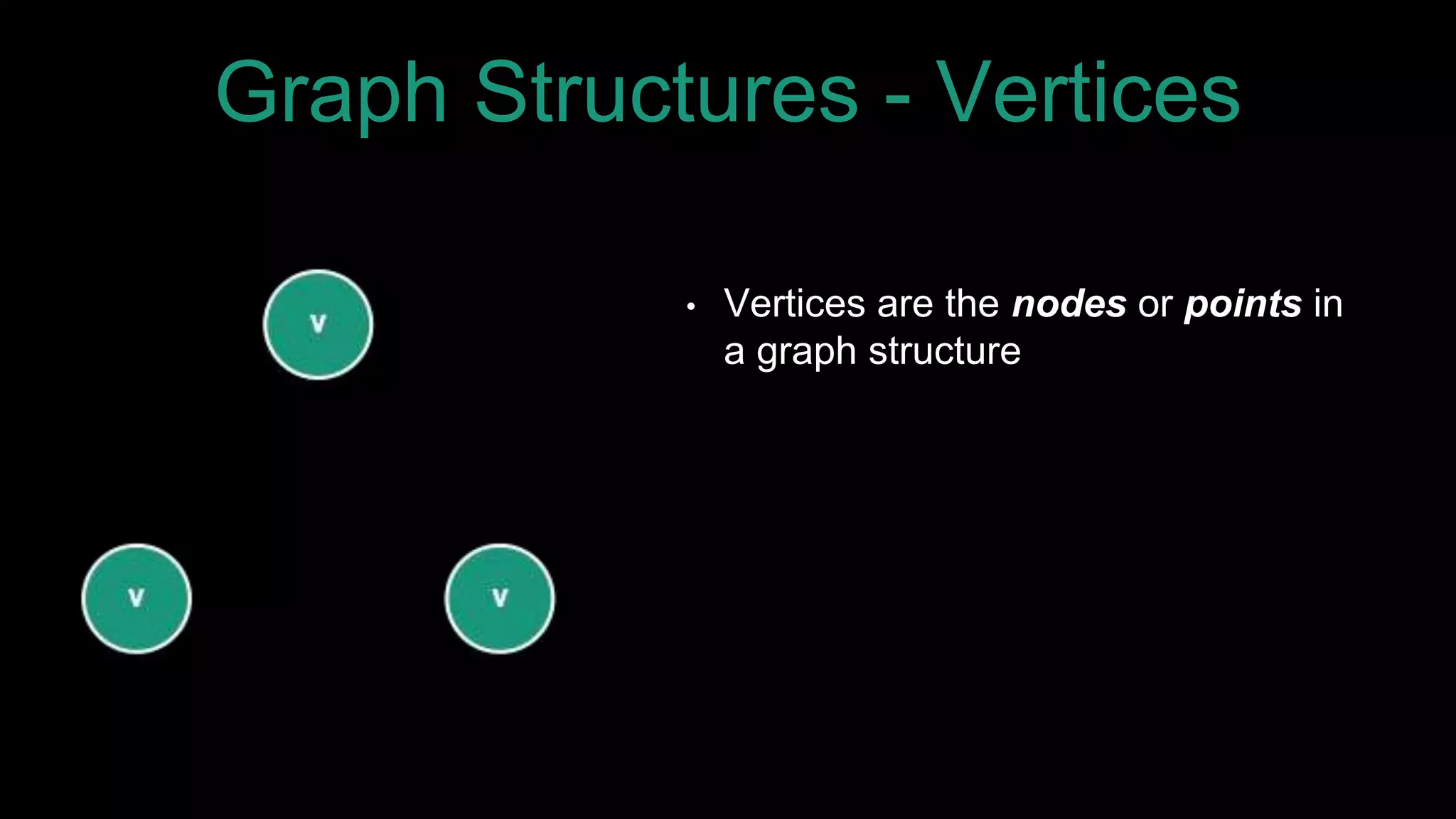
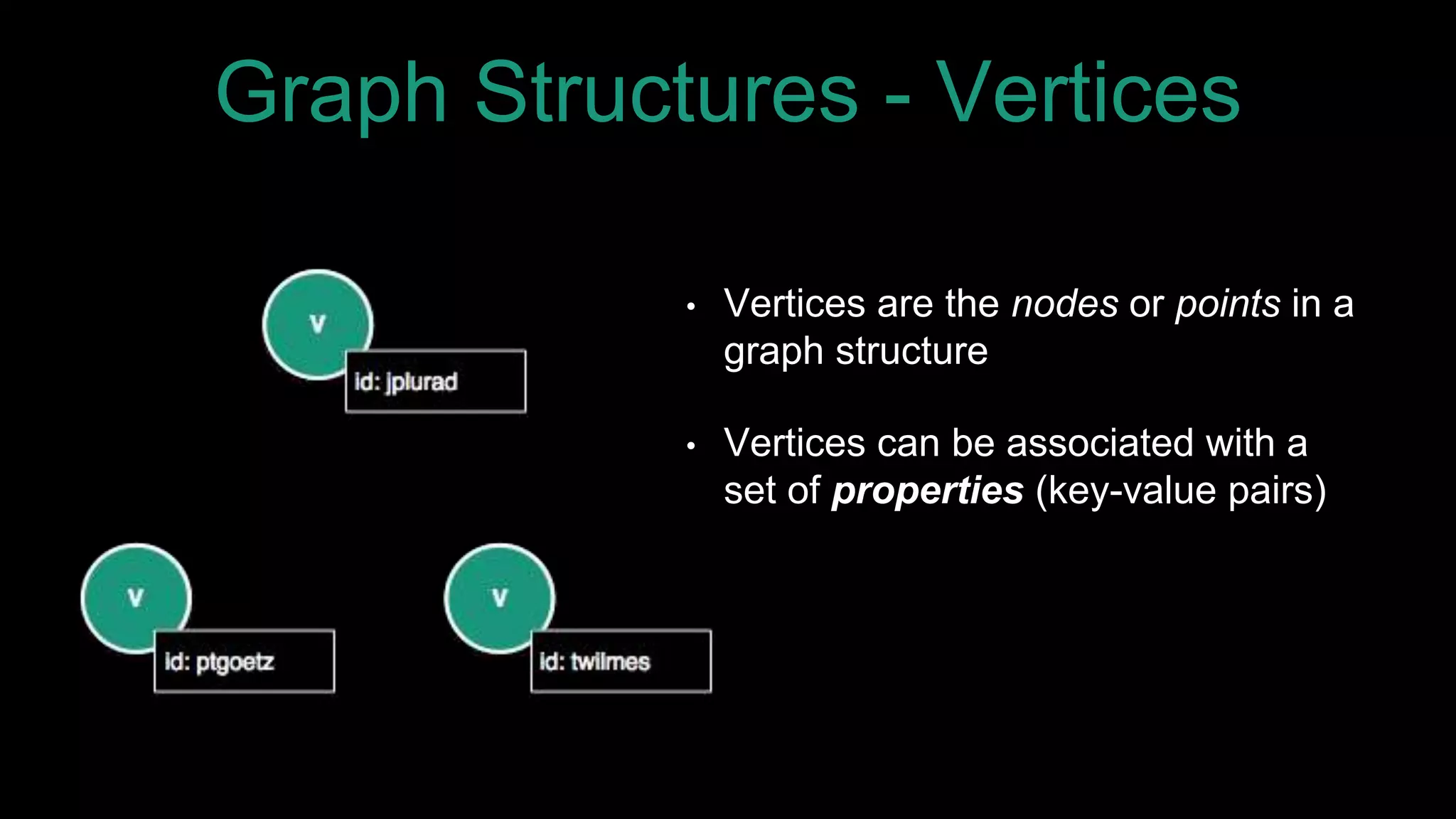
Graph Structures - Vertices
• Vertices are the nodes or points in
a graph structure
Graph Structures - Vertices
• Vertices are the nodes or points in a
graph structure
• Vertices can be associated with a
set of properties (key-value pairs)
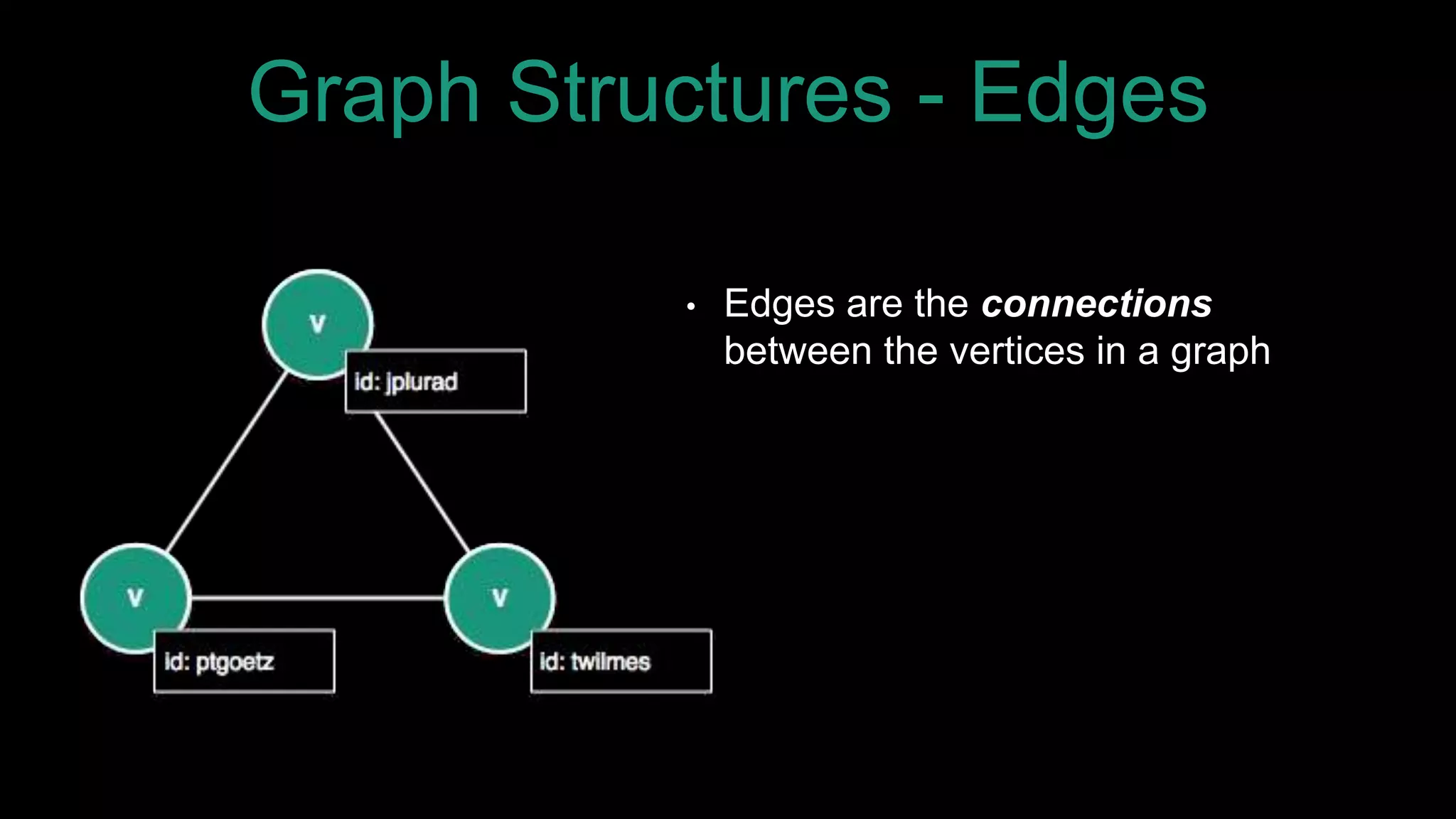
Graph Structures - Edges
• Edges are the connections
between the vertices in a graph
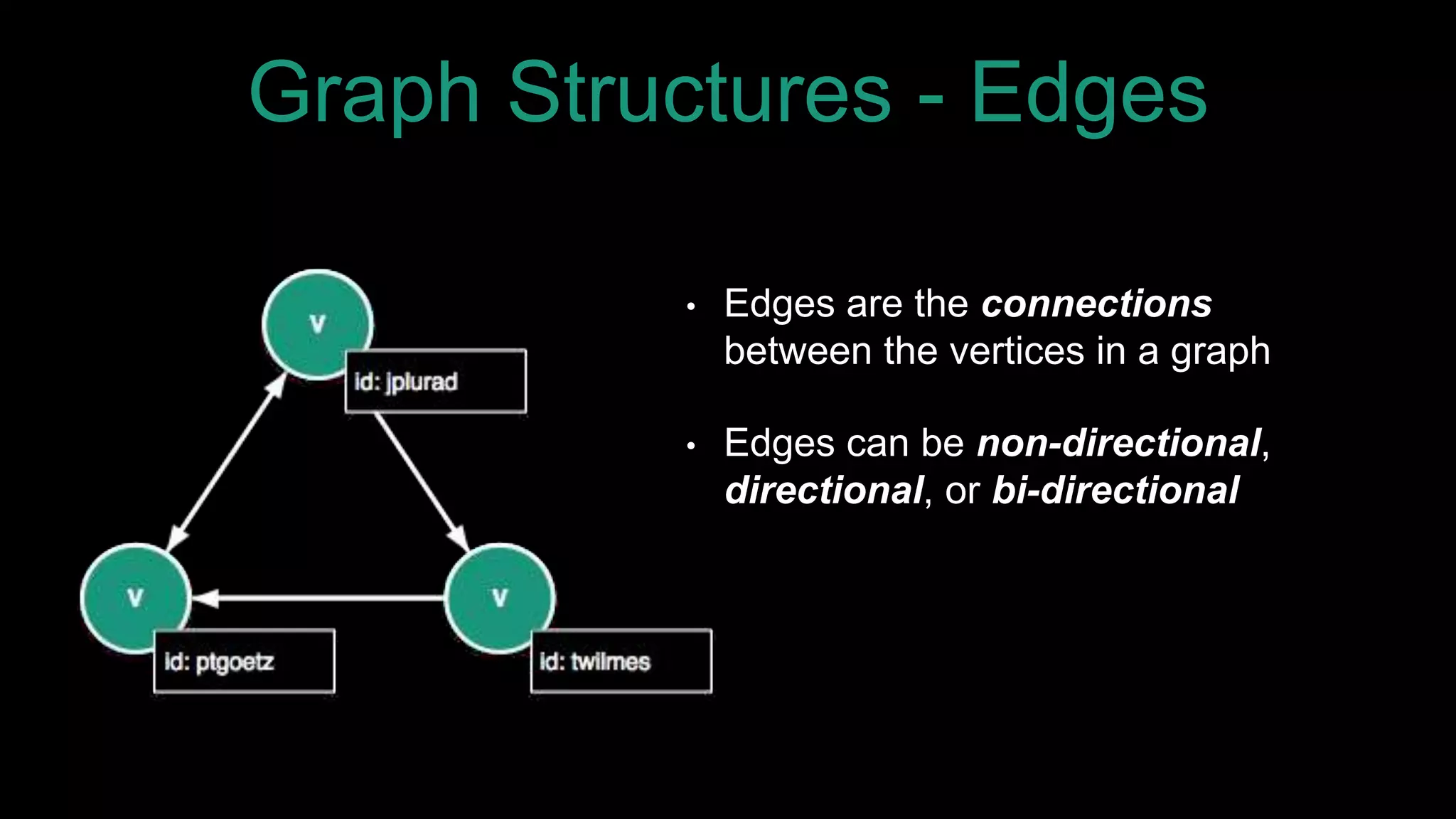
Graph Structures - Edges
• Edges are the connections
between the vertices in a graph
• Edges can be non-directional,
directional, or bi-directional
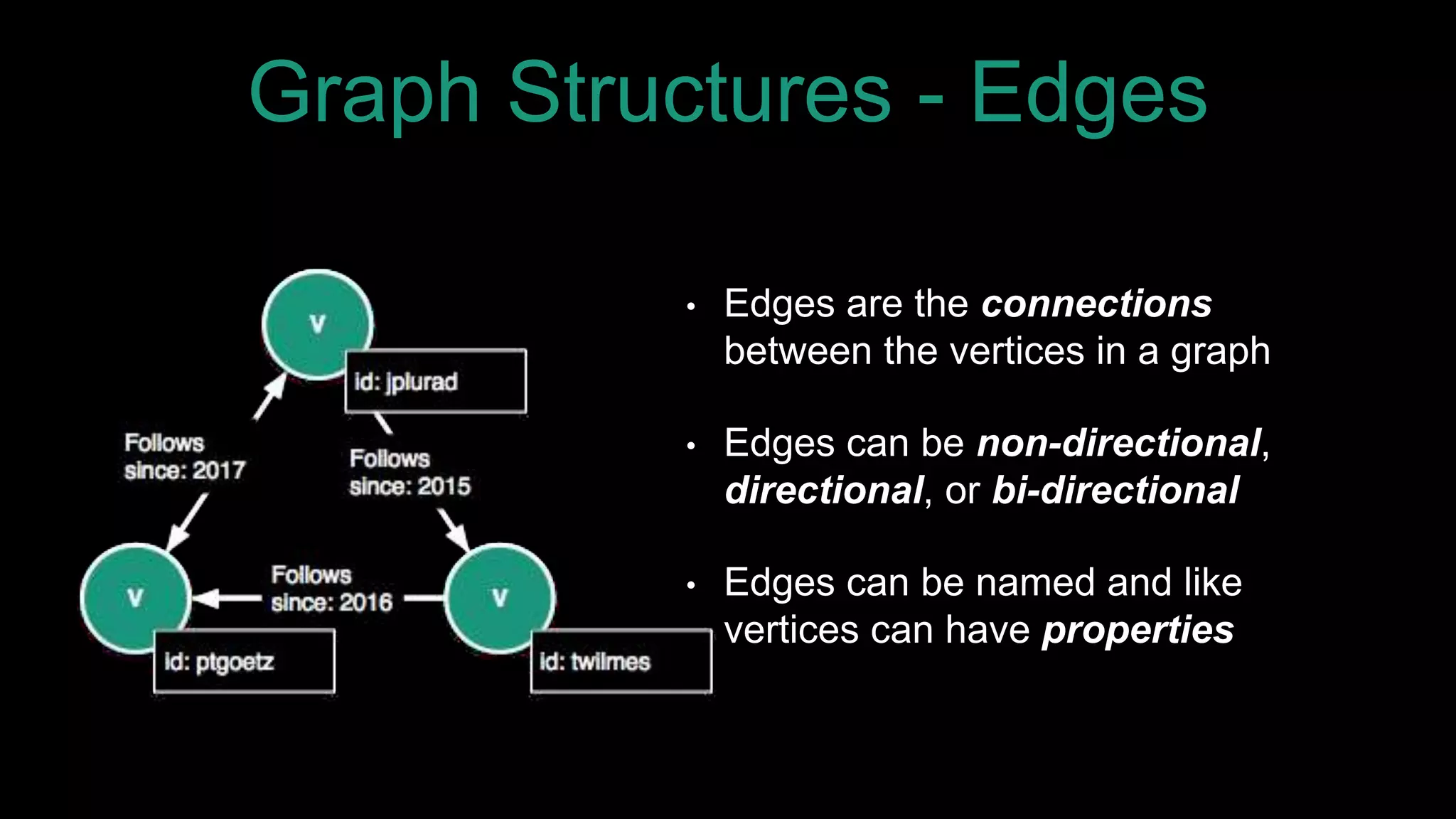
Graph Structures - Edges
• Edges are the connections
between the vertices in a graph
• Edges can be non-directional,
directional, or bi-directional
• Edges can be named and like
vertices can have properties
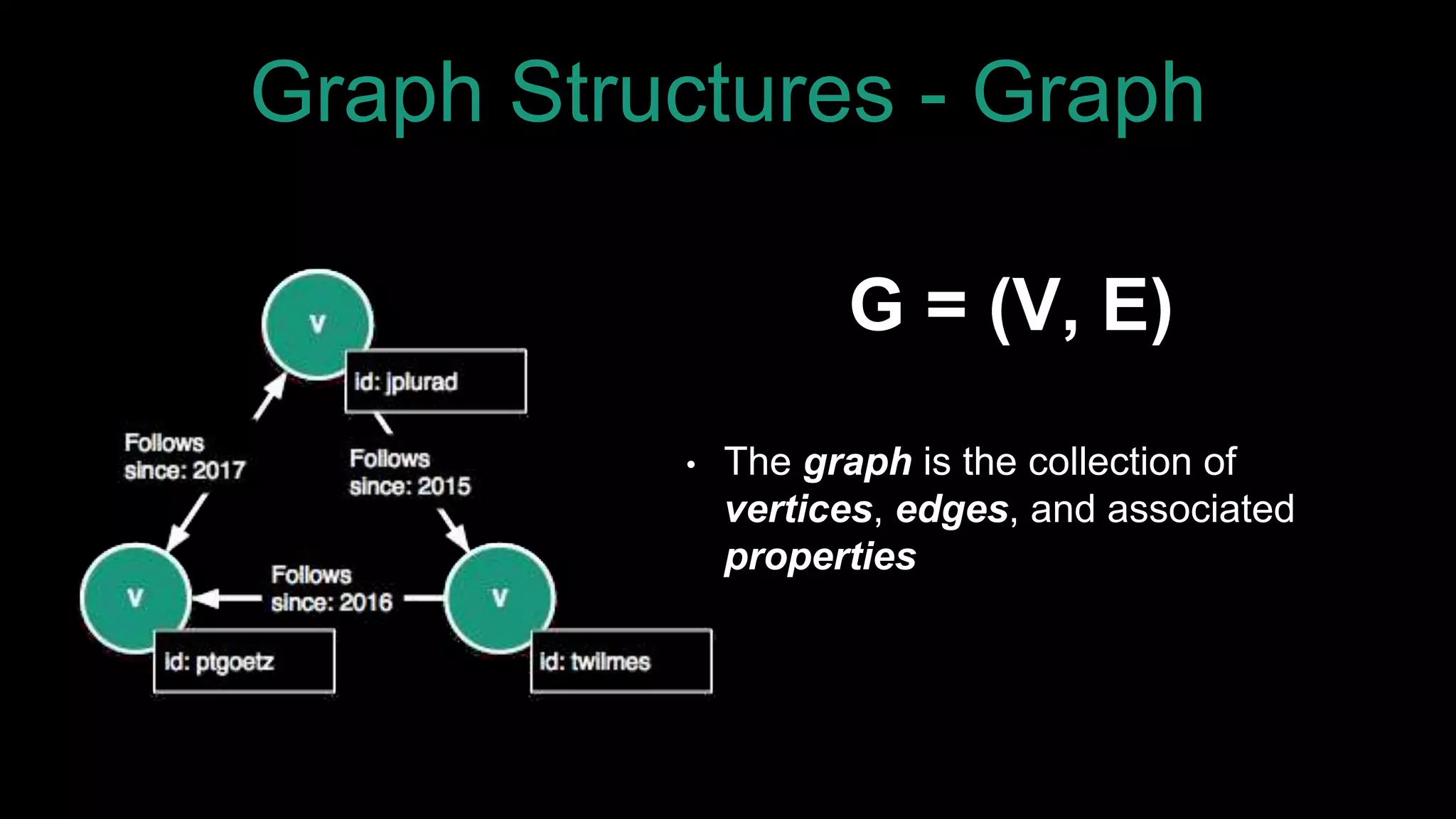
Graph Structures - Graph
• The graph is the collection of
vertices, edges, and associated
properties
G = (V, E)
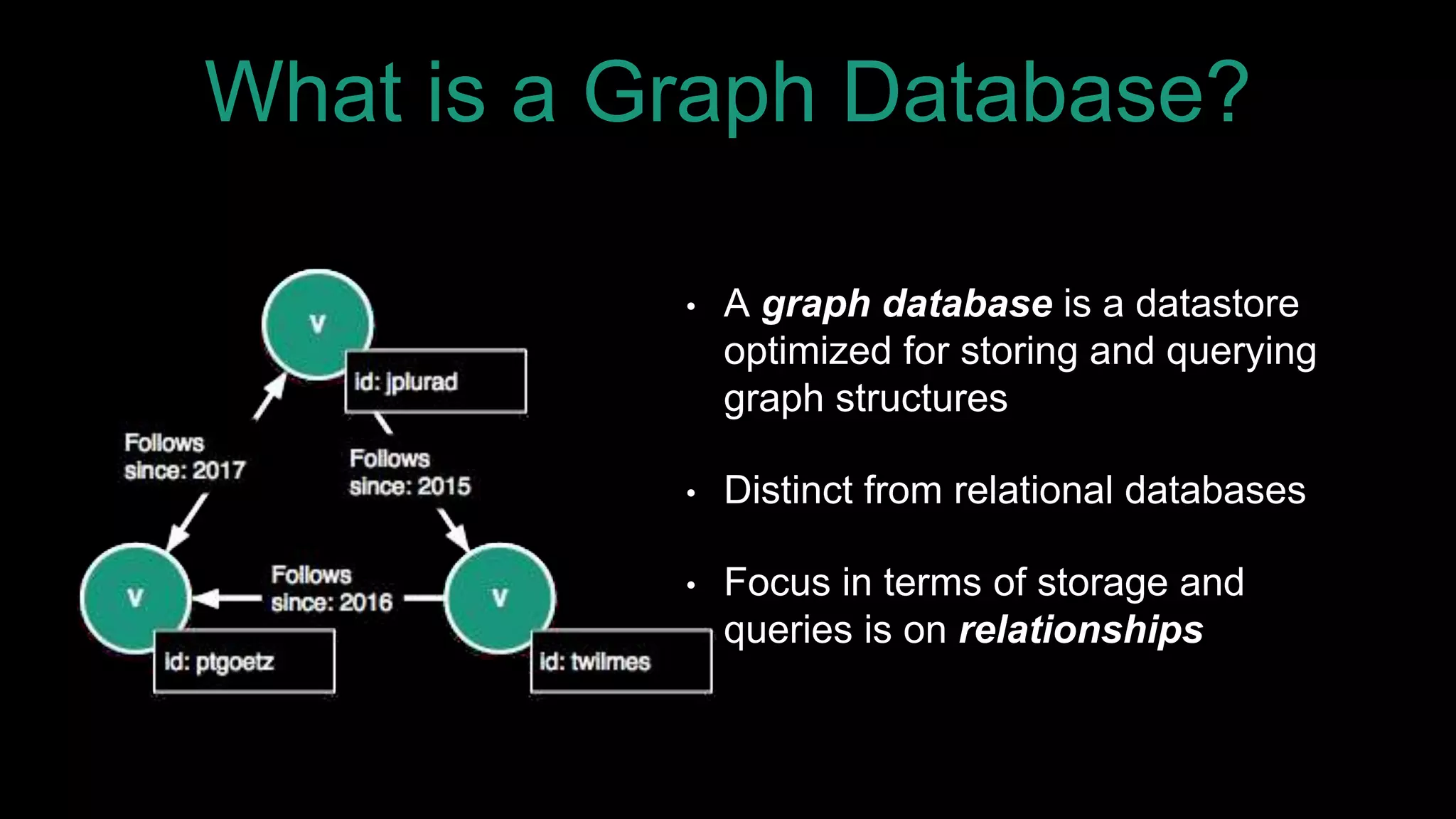
What is a Graph Database?
• A graph database is a datastore
optimized for storing and querying
graph structures
• Distinct from relational databases
• Focus in terms of storage and
queries is on relationships
Common Use Cases
Anywhere relationship modeling and analysis can provide insight or value.
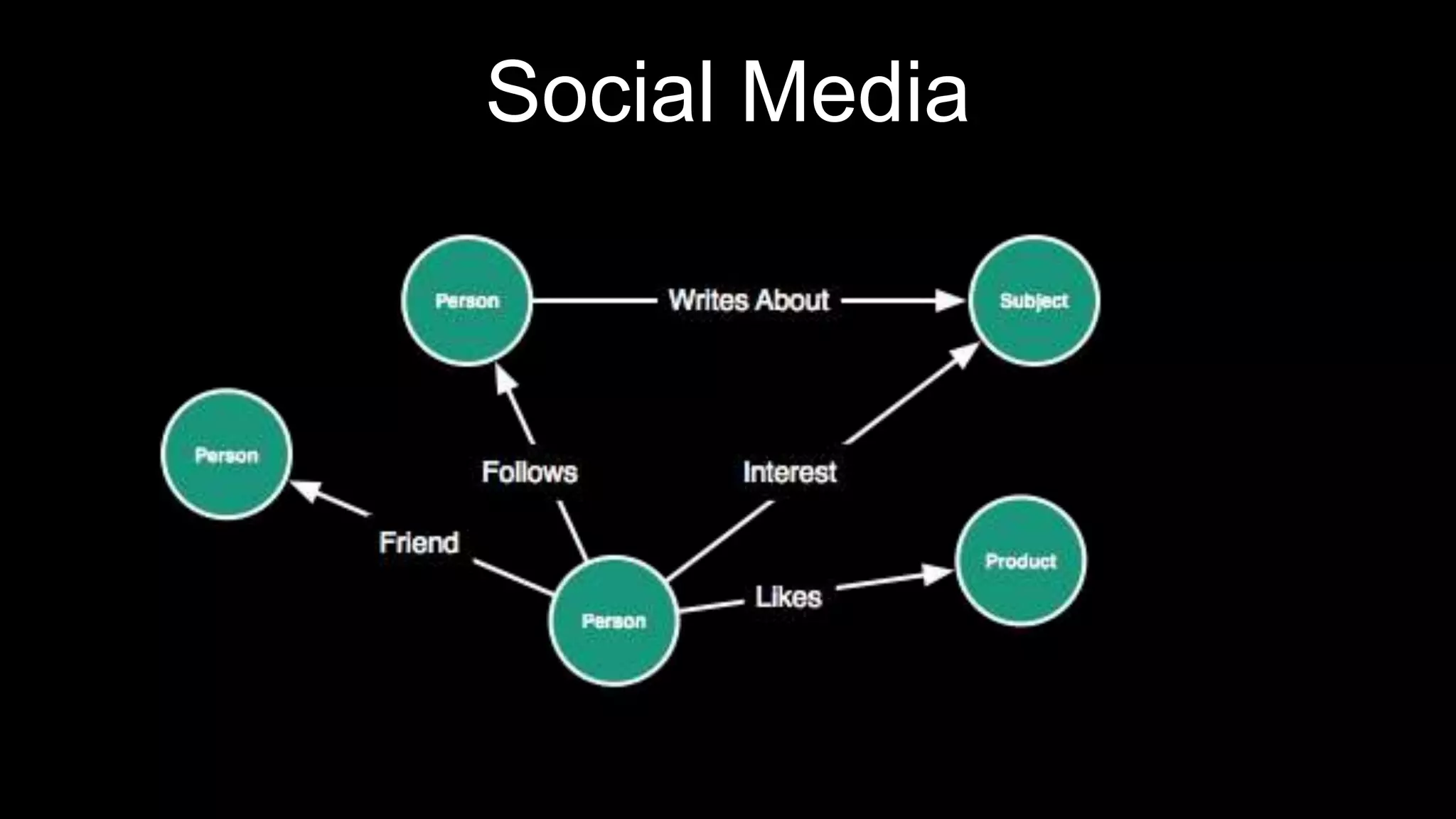
Social Media
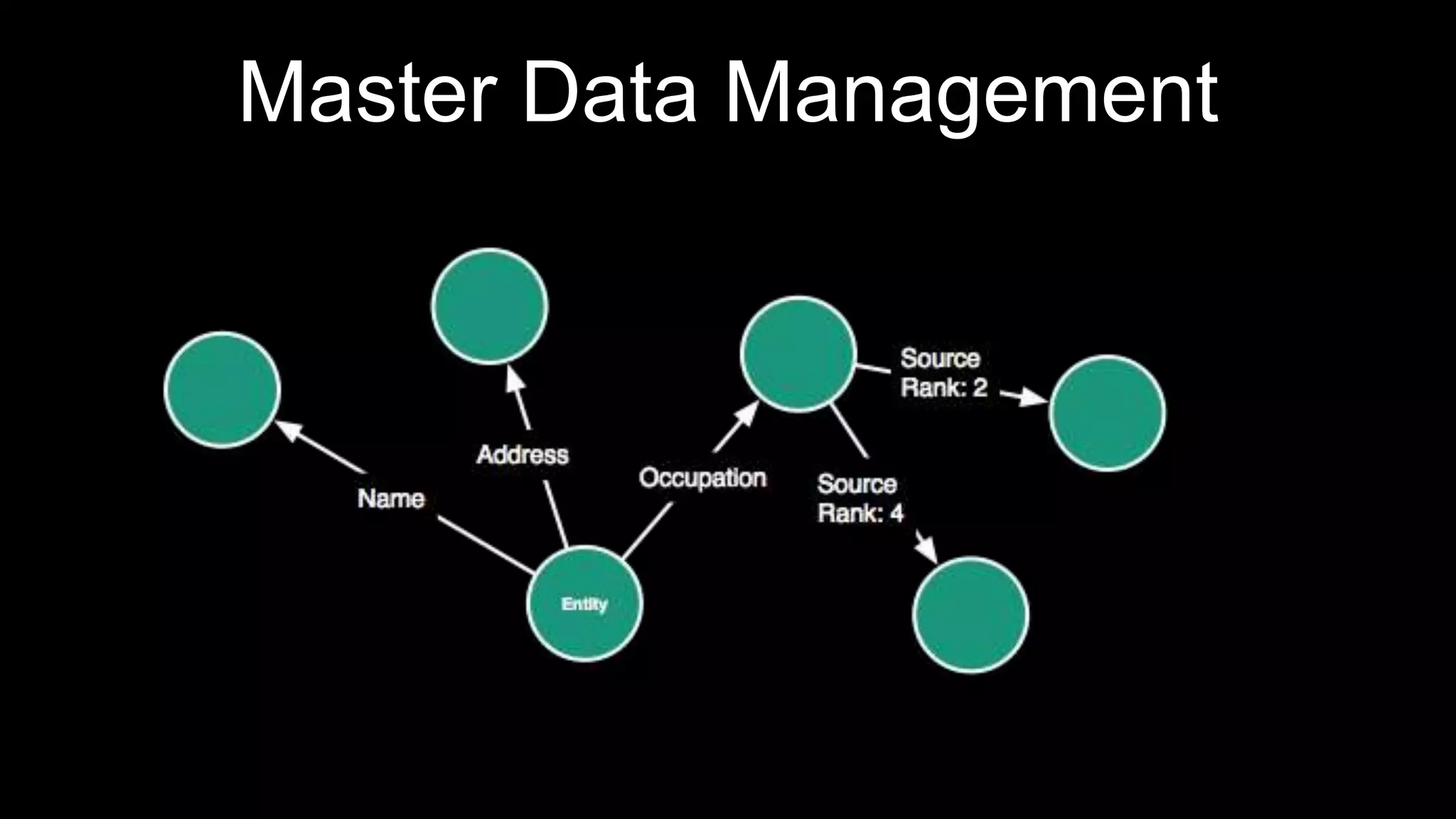
Master Data Management
Common Use Cases
• Social Networks
• Master Data Management
• Fraud Detection
• Cybersecurity
• Identity and Access Management
• Recommendation Engines
Common Use Cases
• Social Networks
• Master Data Management
• Fraud Detection
• Cybersecurity
• Identity and Access Management
• Recommendation Engines
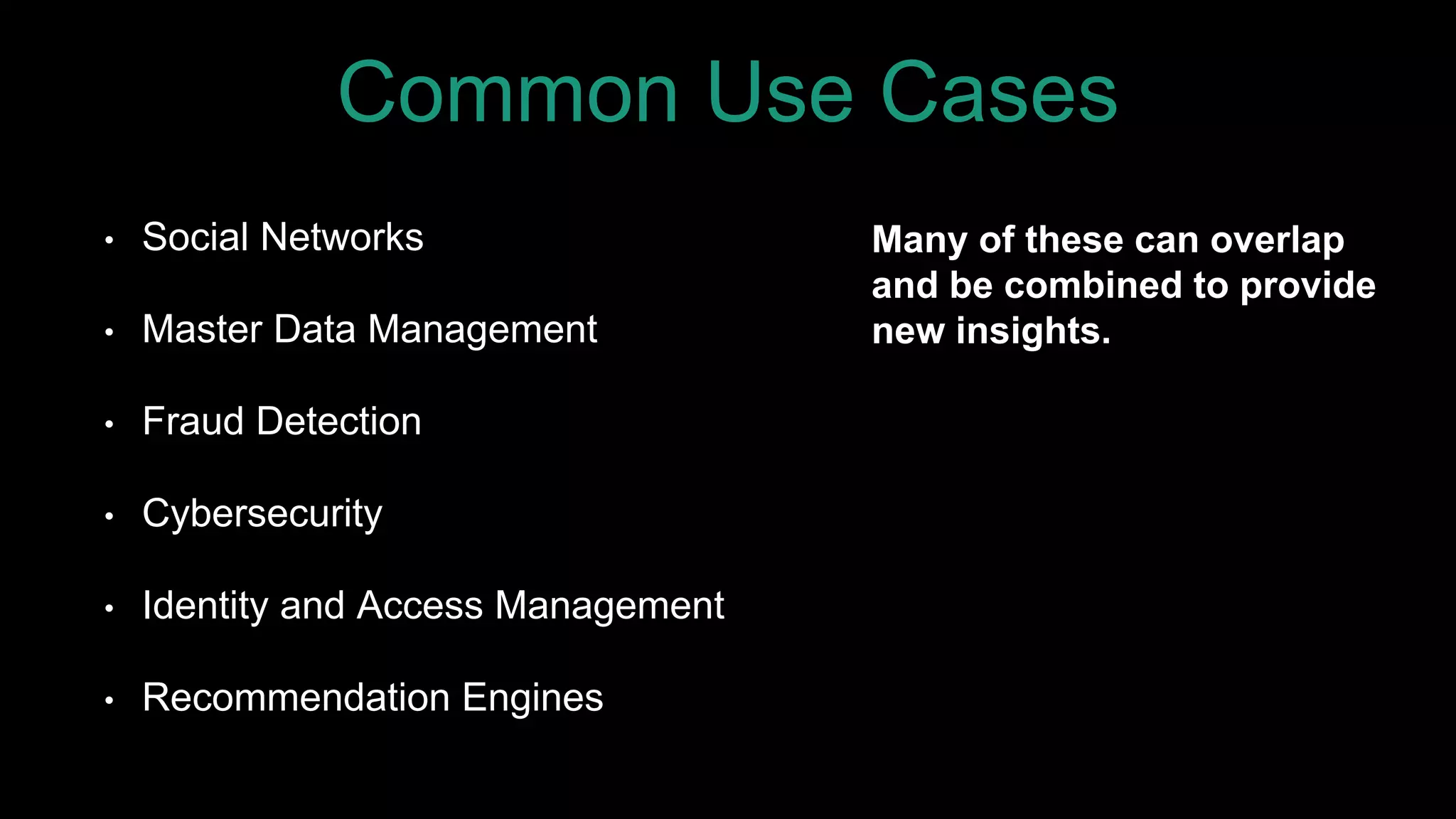
Many of these can overlap
and be combined to provide
new insights.
The Power of Relationships
• Harness the value of interconnectedness
• “Paths to Insight”
• Traversal vs. Traditional Query: Join Reduction
• “If you can whiteboard it, you can graph it.”
A little history and the
importance of OSS licensing.
Titan DB
• Large scale graph db developed by Aurelius
• Licensed under ALv2 (this is important)
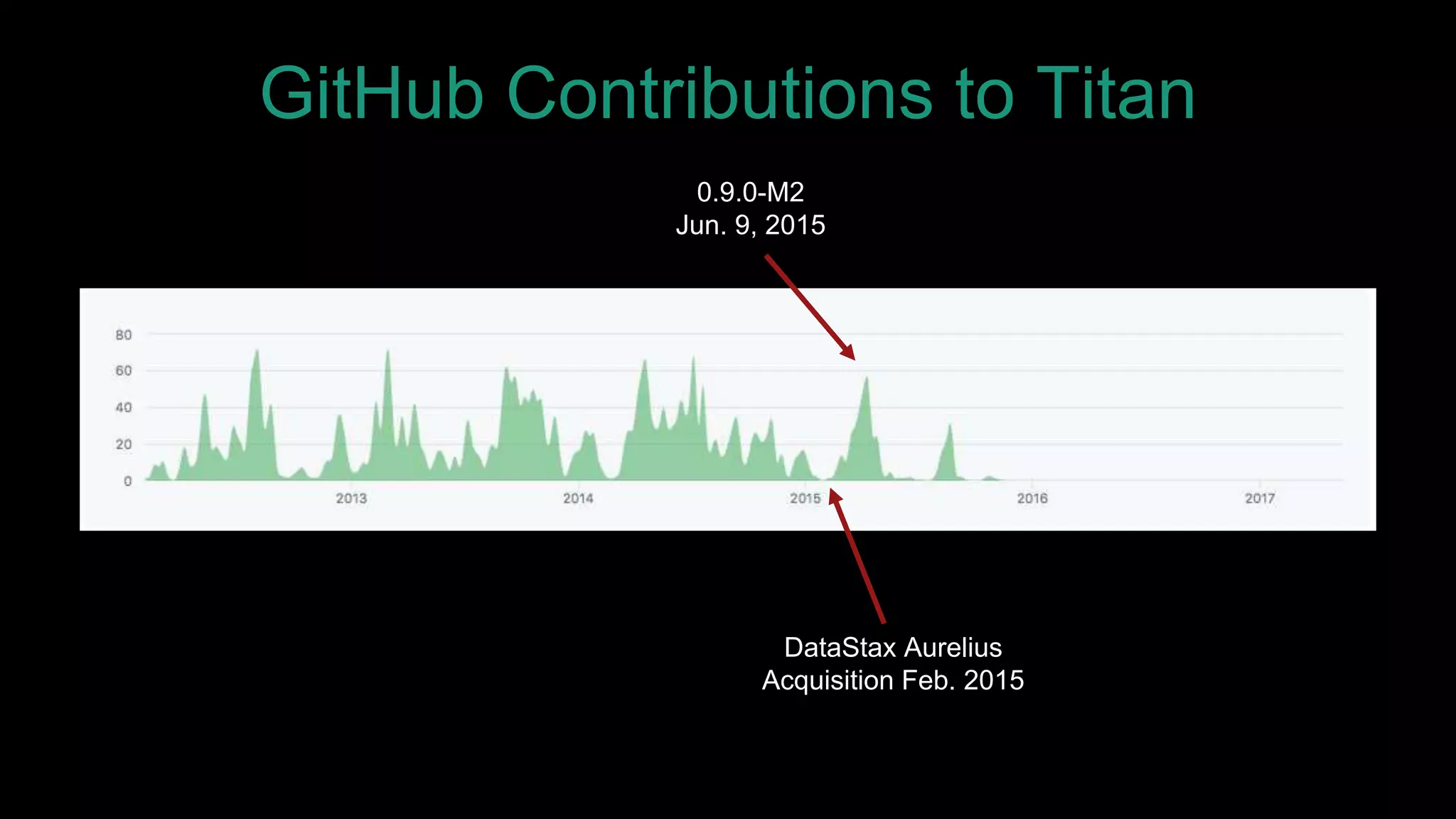
• Aurelius acquired by DataStax Feb. 2015
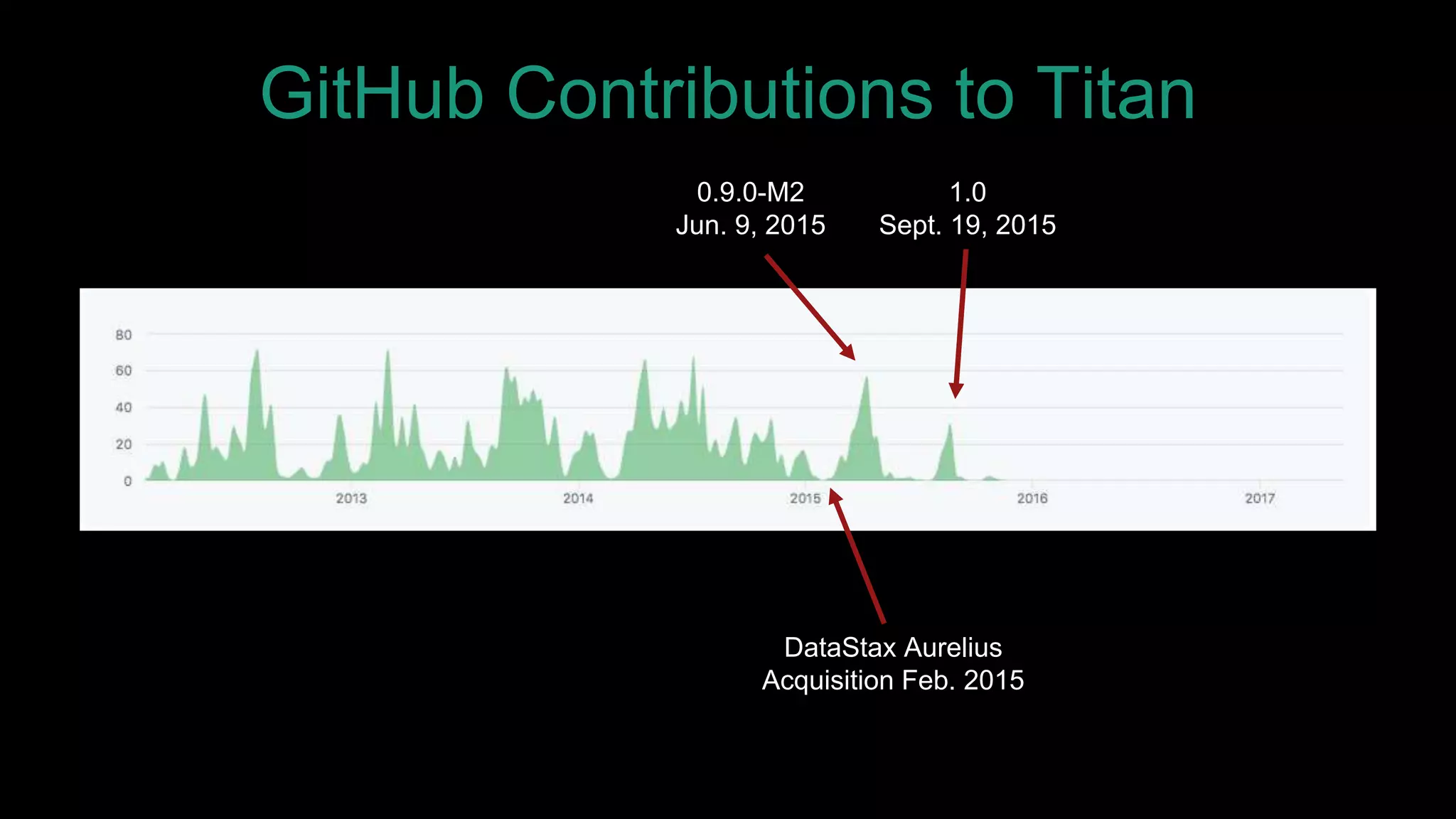
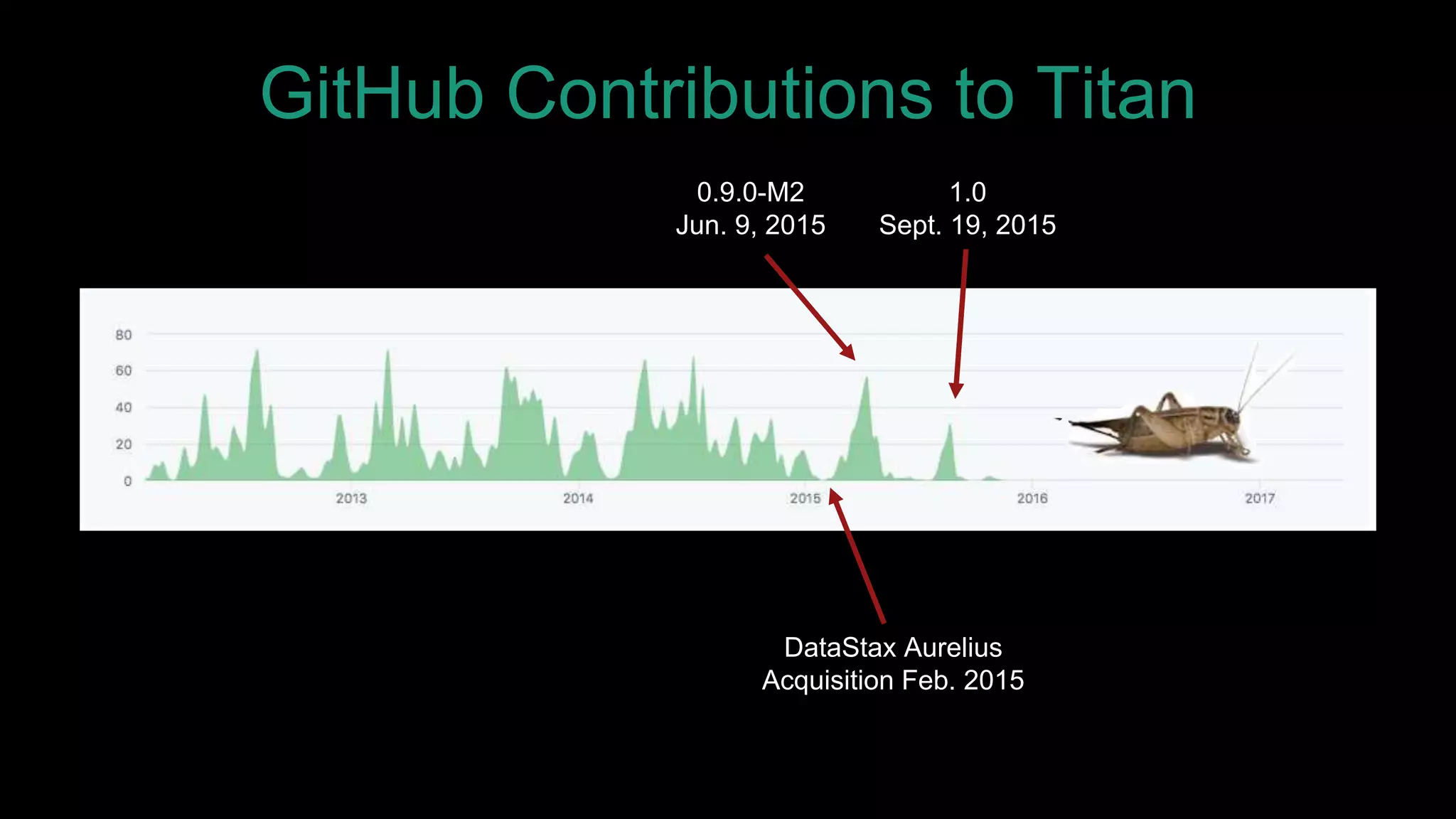
• 1.0 released Sept. 19, 2015
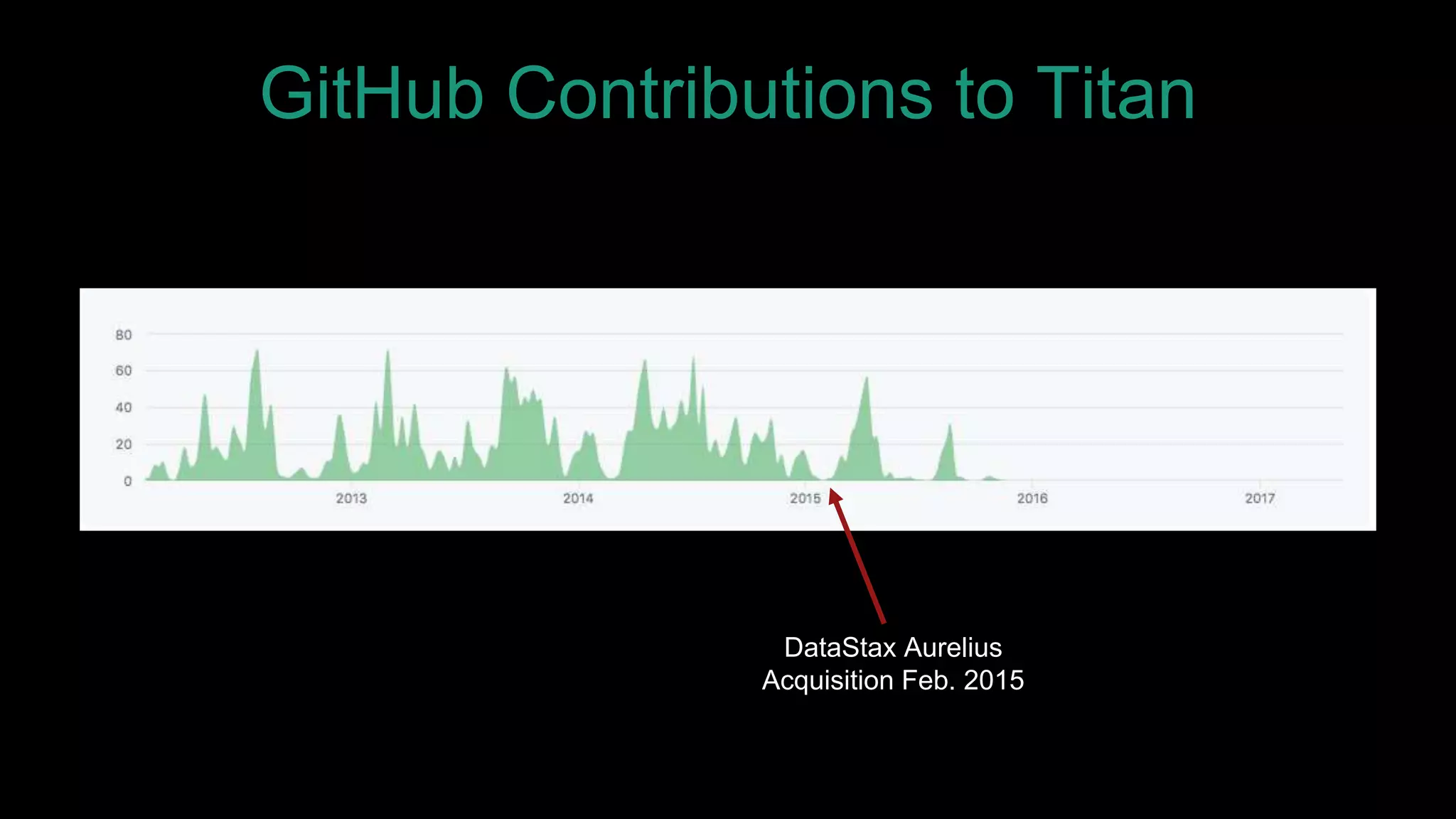
GitHub Contributions to Titan
DataStax Aurelius
Acquisition Feb. 2015
GitHub Contributions to Titan
DataStax Aurelius
Acquisition Feb. 2015
0.9.0-M2
Jun. 9, 2015
GitHub Contributions to Titan
DataStax Aurelius
Acquisition Feb. 2015
0.9.0-M2
Jun. 9, 2015
1.0
Sept. 19, 2015
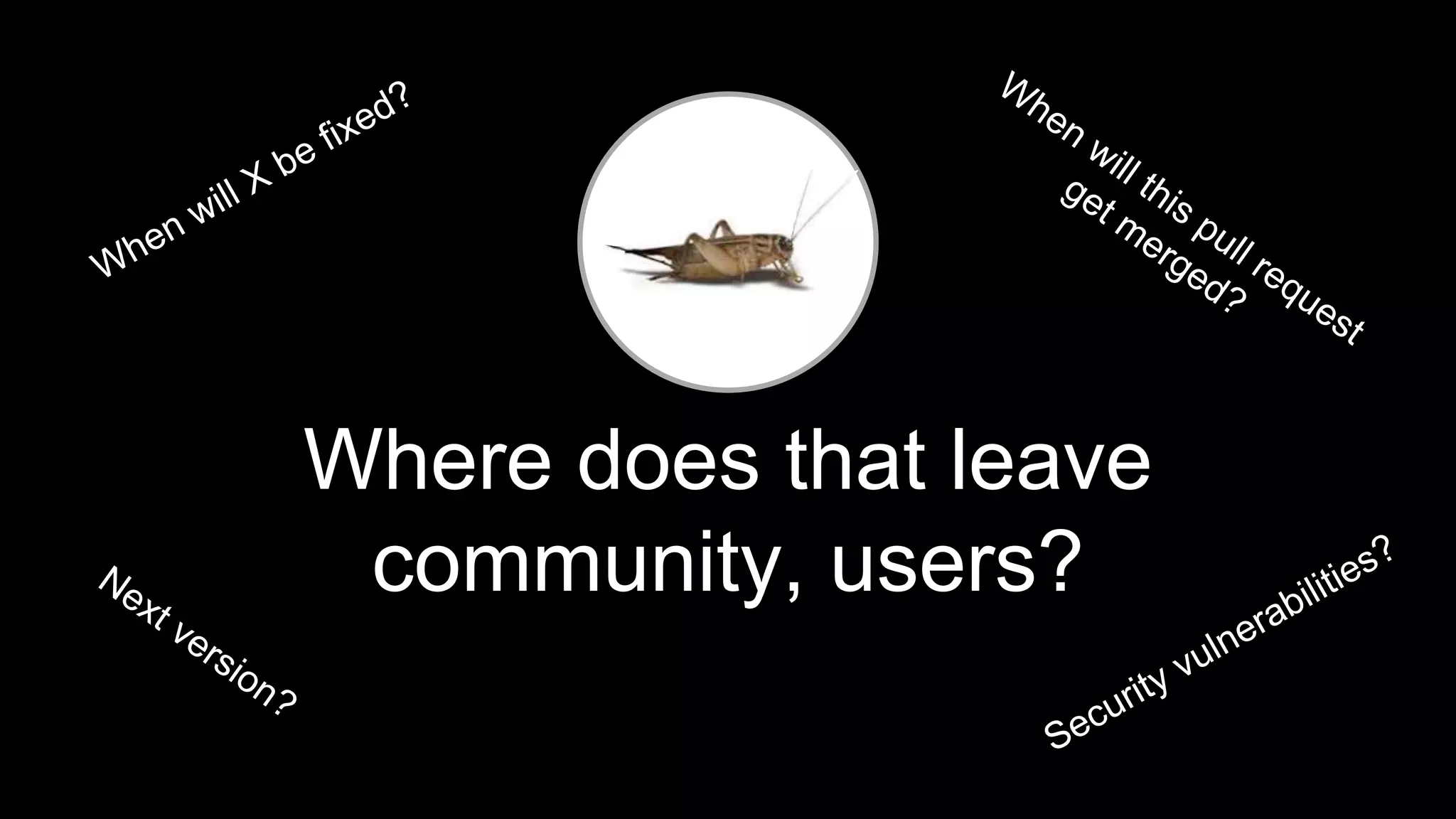
GitHub Contributions to Titan
DataStax Aurelius
Acquisition Feb. 2015
0.9.0-M2
Jun. 9, 2015
1.0
Sept. 19, 2015
Where does that leave
community, users?
ALv2 to the
Rescue!
Empowering Communities
ALv2 to the
Rescue!
Empowering Communities
“We can do this. What’s the next step?”
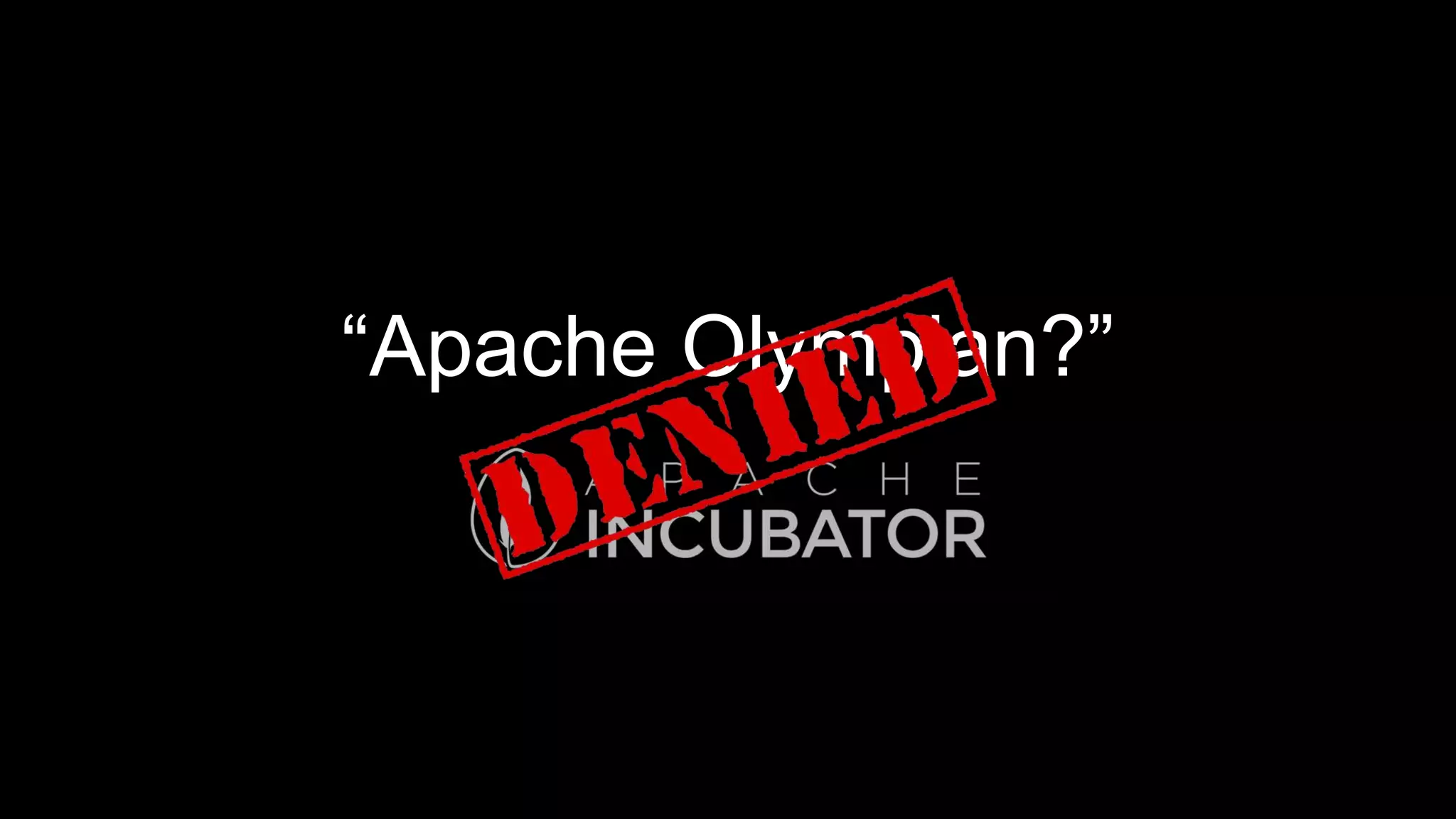
“Apache Olympian?”
What is a “hostile fork?”
A "hostile fork" is a fork of a project that goes against the wishes of the
copyright holders and/or community.
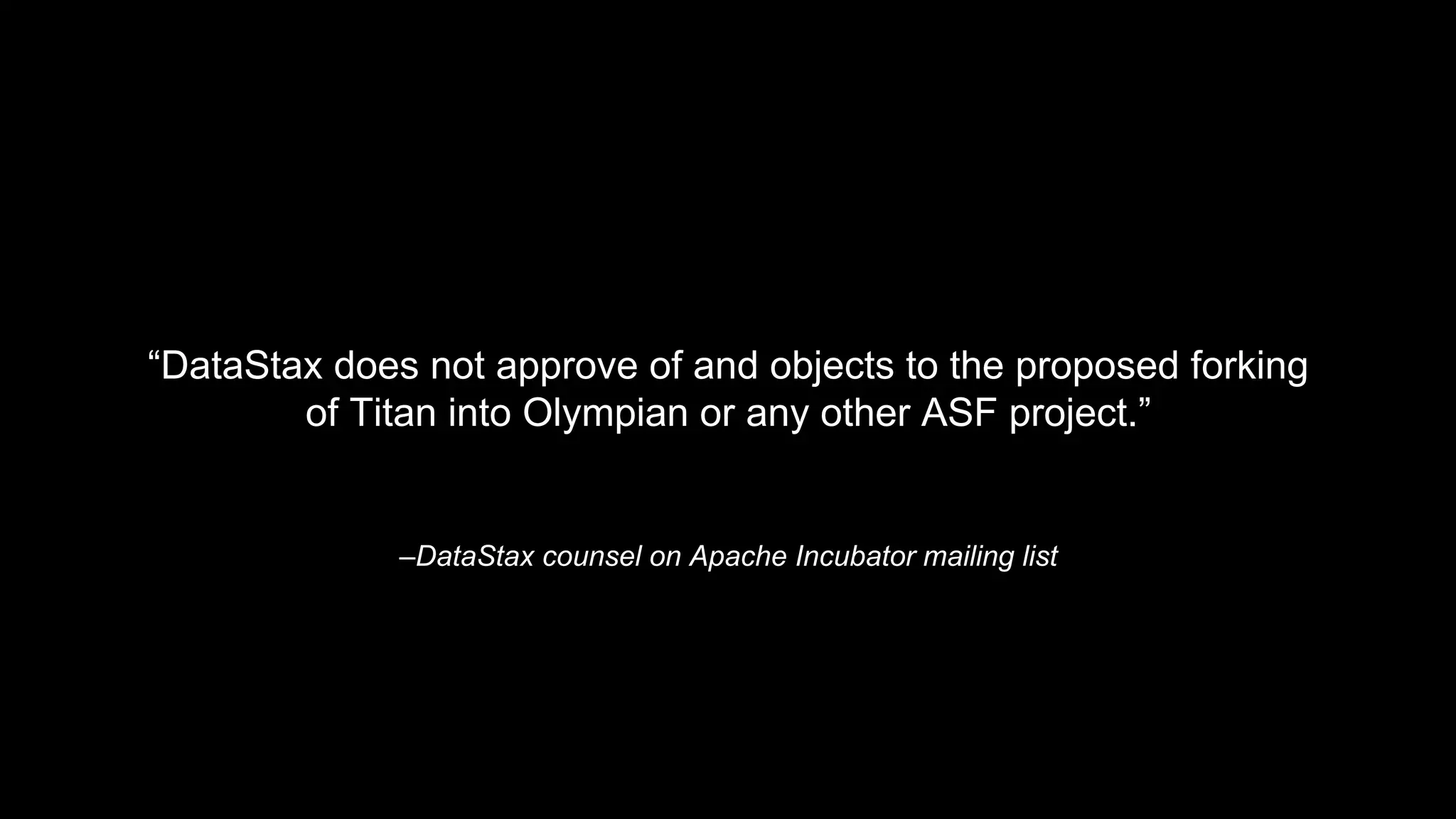
–DataStax counsel on Apache Incubator mailing list
“DataStax does not approve of and objects to the proposed forking
of Titan into Olympian or any other ASF project.”
“Apache Olympian?”
Next stop…
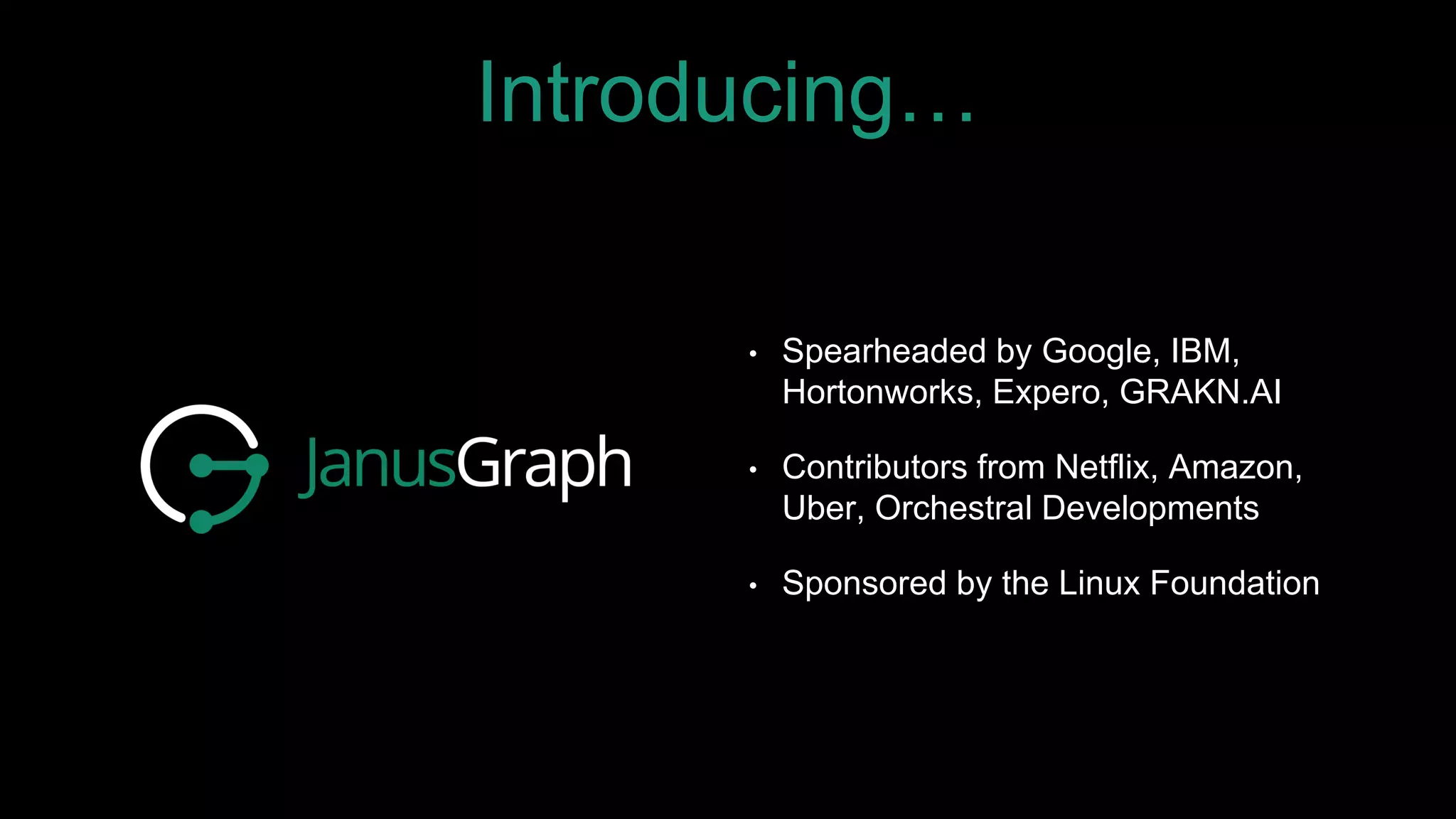
Introducing…
• Spearheaded by Google, IBM,
Hortonworks, Expero, GRAKN.AI
• Contributors from Netflix, Amazon,
Uber, Orchestral Developments
• Sponsored by the Linux Foundation
Introducing…
• ALv2 License
• Apache style governance model
• Source code, issues hosted on
GitHub
• Mailing lists on Google Groups
• Chat on Gitter
Technical Dive
• Optimized for storing/querying billions of vertices and edges
• Supports thousands of concurrent users
• Can execute local queries (OLTP) or cross-cluster distributed
queries (OLAP)
Apache Tinkerpop
• THE framework and API for graph manipulation and
traversal
• Open source, vendor agnostic
• Supported by a number of Graph DBs
• Promotes portability
Gremlin Query Language
• DSL for graph traversal and manipulation
• Fluent style API
• Multi-language support (Java, Scala,
Groovy, Python, Ruby, etc.)
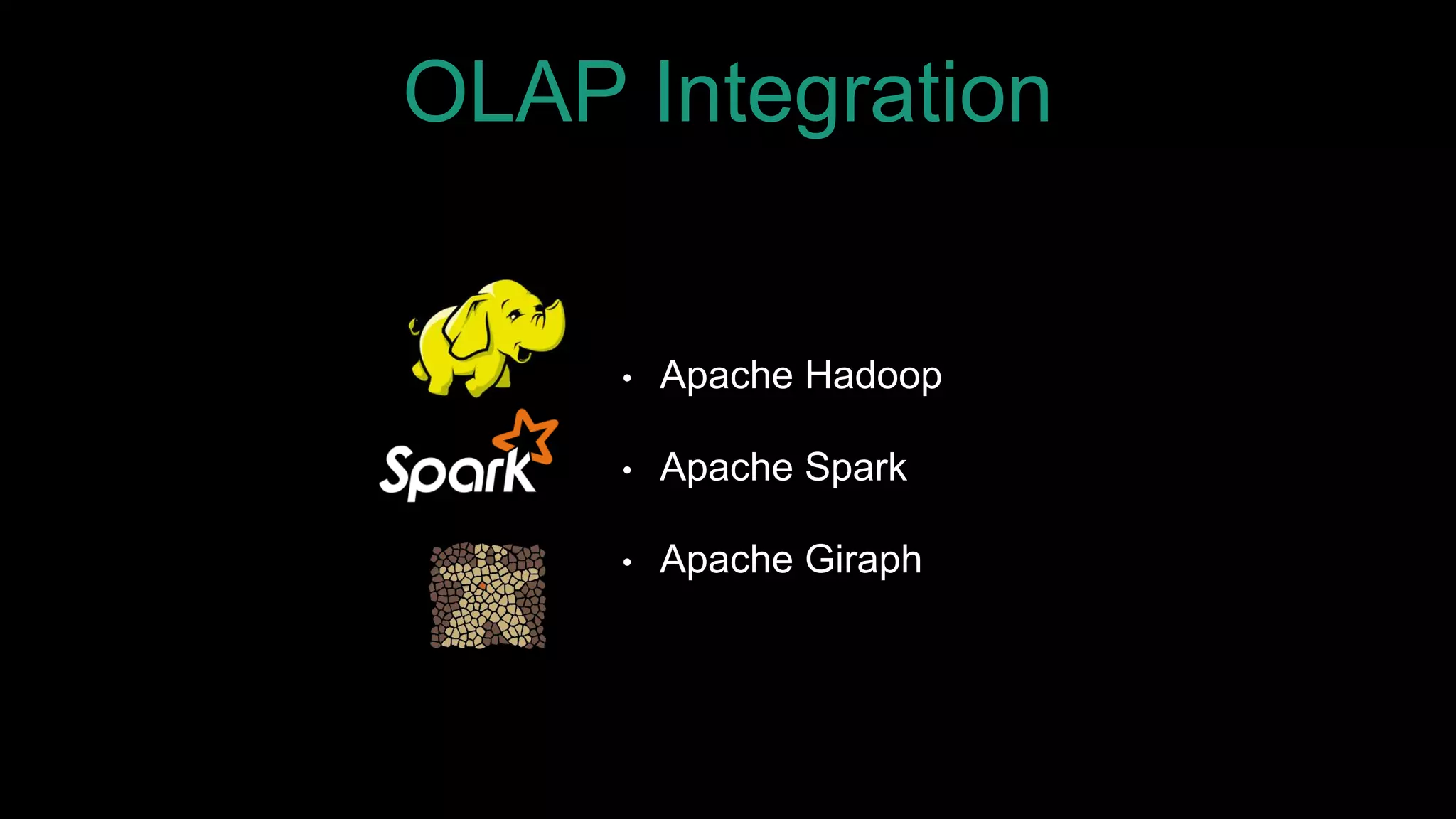
OLAP Integration
• Apache Hadoop
• Apache Spark
• Apache Giraph
• ACID compliant (depending on backend)
• Supports very many concurrent transactions
• Embedded, Single Node, or Scale out
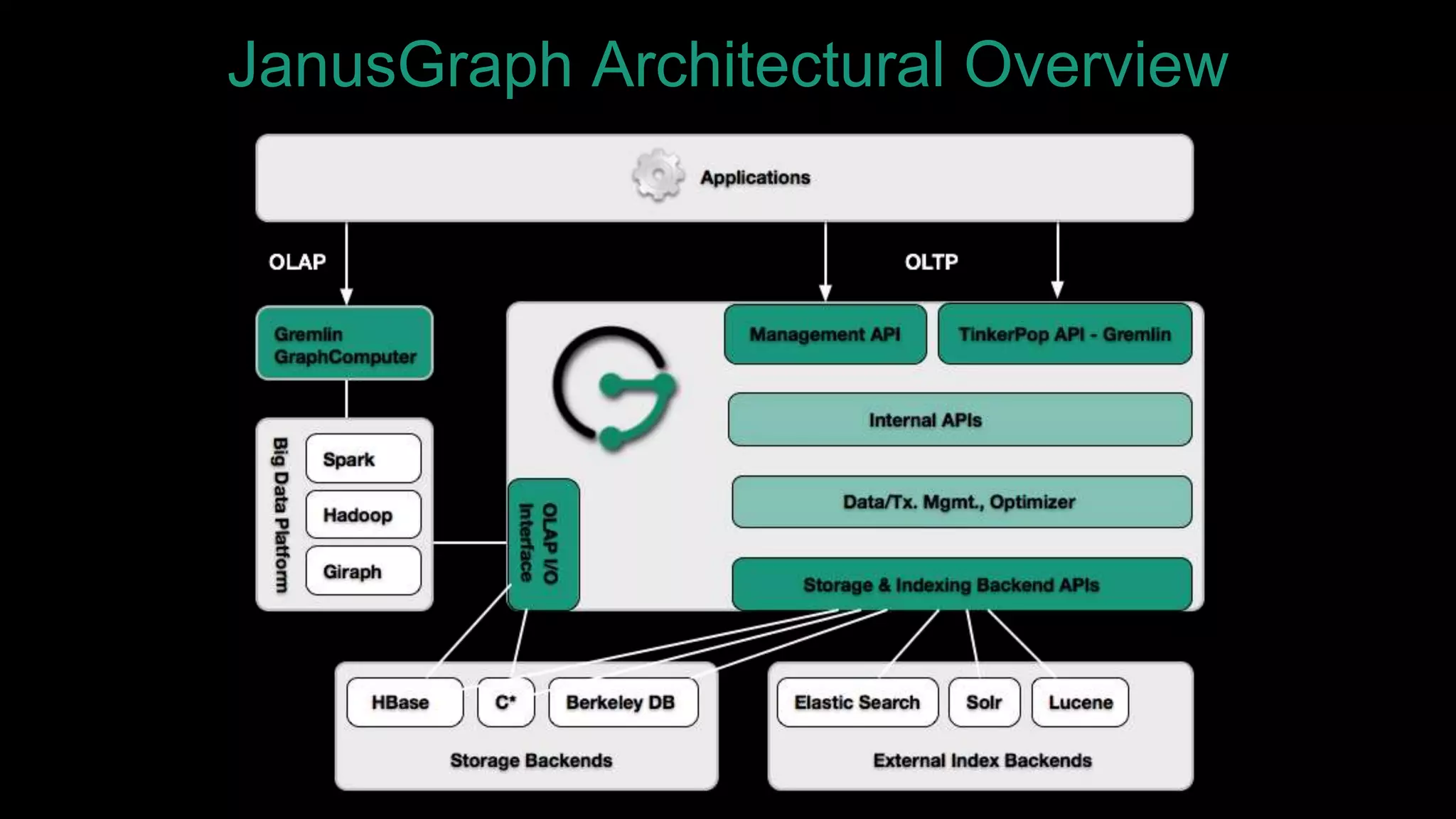
JanusGraph Architectural Overview
Storage Backends
• Well defined storage API allows for easily
pluggable implementations
• Choose the backend best for your use case and
architecture
• Options include: Apache HBase, Apache
Cassandra, Google Cloud Bigtable, Berkeley DB
• More on the way…
Choose Your Own [CAP] Adventure
Consistency
Availability
Partition
Tolerance
Apache
HBase
Berkeley DB
Apache
Cassandra
Scylla DB
Google Cloud
Bigtable
JanusGraph External Indices
• Secondary to primary graph storage
• Provide a means to speed up graph traversal
and information retrieval
• Two types:
• Graph Index
• Vertex-centric Index
Graph Indices
• Global index structures across entire graph
• Efficient retrieval of vertices and edges based on
associated properties
• Eliminates need to do a full graph scan
• When querying, JanusGraph will typically warn
when a full scan is necessary
• New indexes take effect immediately, but
reindexing may be required
Vertex-Centric Indexes
• Local index structures built per-vertex
• Eliminates the need to load all vertices from the
graph for filtering
Pluggable Index Backends
• Elastic Search
• Apache Solr
• Apache Lucene
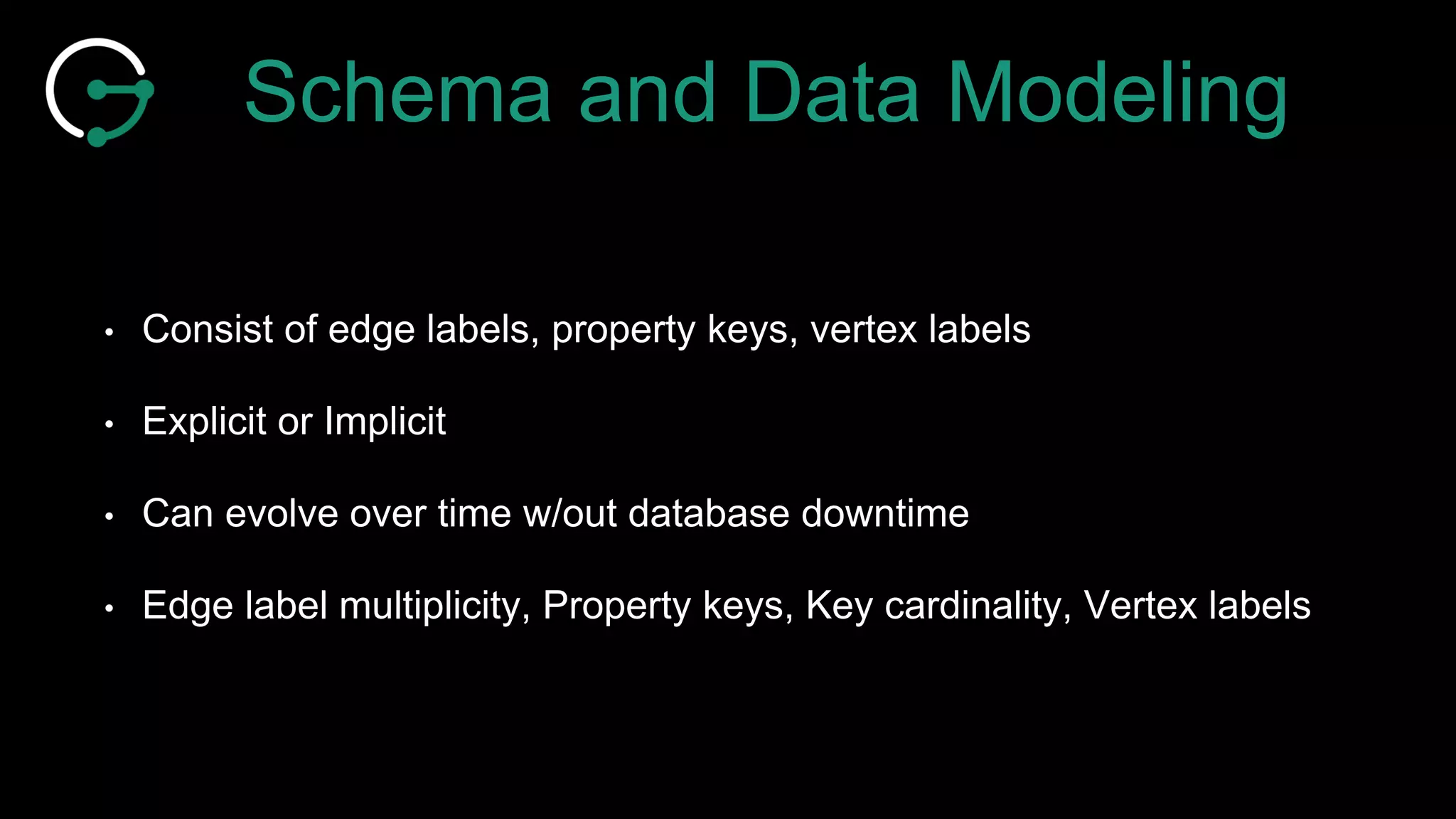
Schema and Data Modeling
• Consist of edge labels, property keys, vertex labels
• Explicit or Implicit
• Can evolve over time w/out database downtime
• Edge label multiplicity, Property keys, Key cardinality, Vertex labels
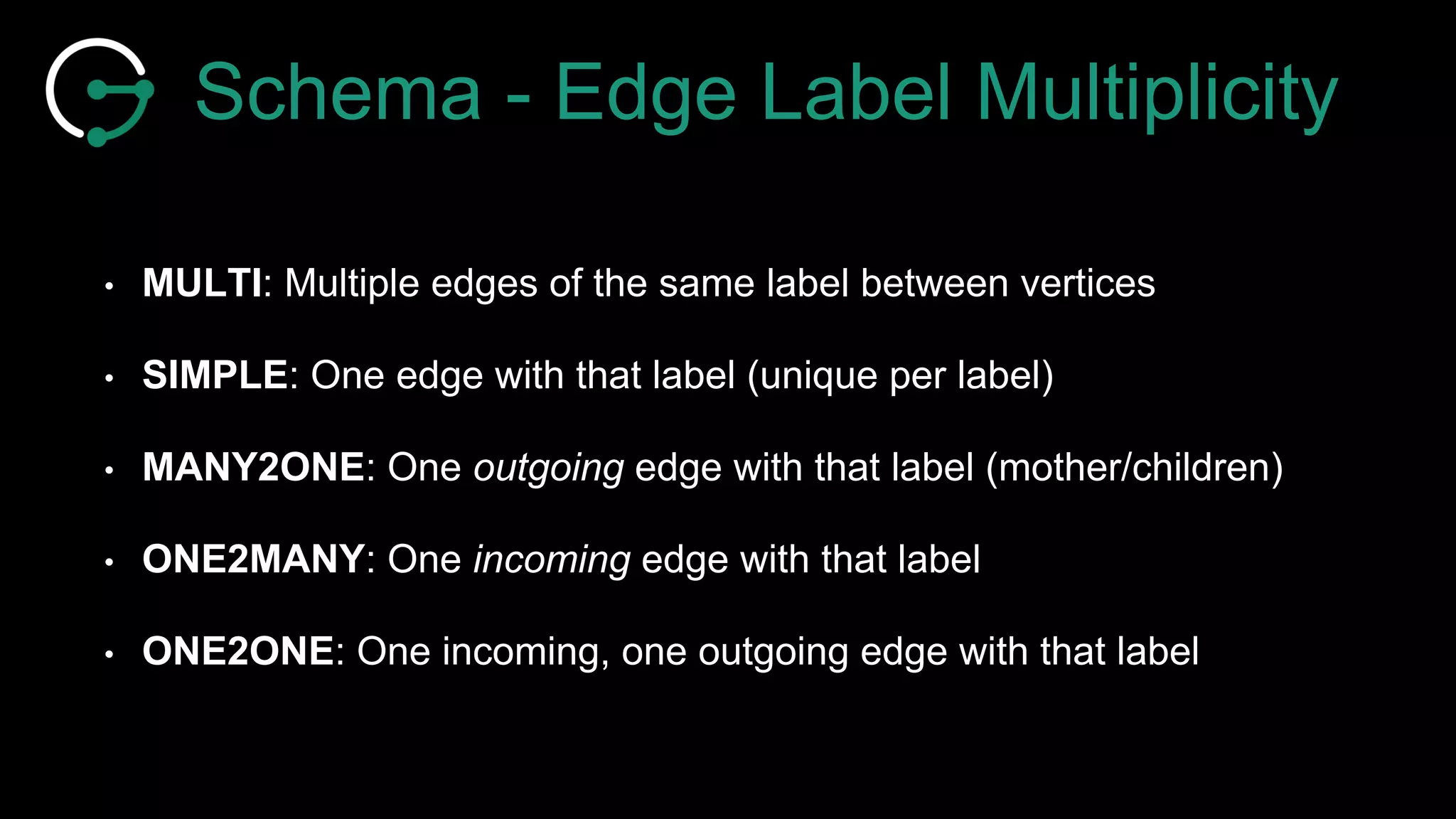
Schema - Edge Label Multiplicity
• MULTI: Multiple edges of the same label between vertices
• SIMPLE: One edge with that label (unique per label)
• MANY2ONE: One outgoing edge with that label (mother/children)
• ONE2MANY: One incoming edge with that label
• ONE2ONE: One incoming, one outgoing edge with that label
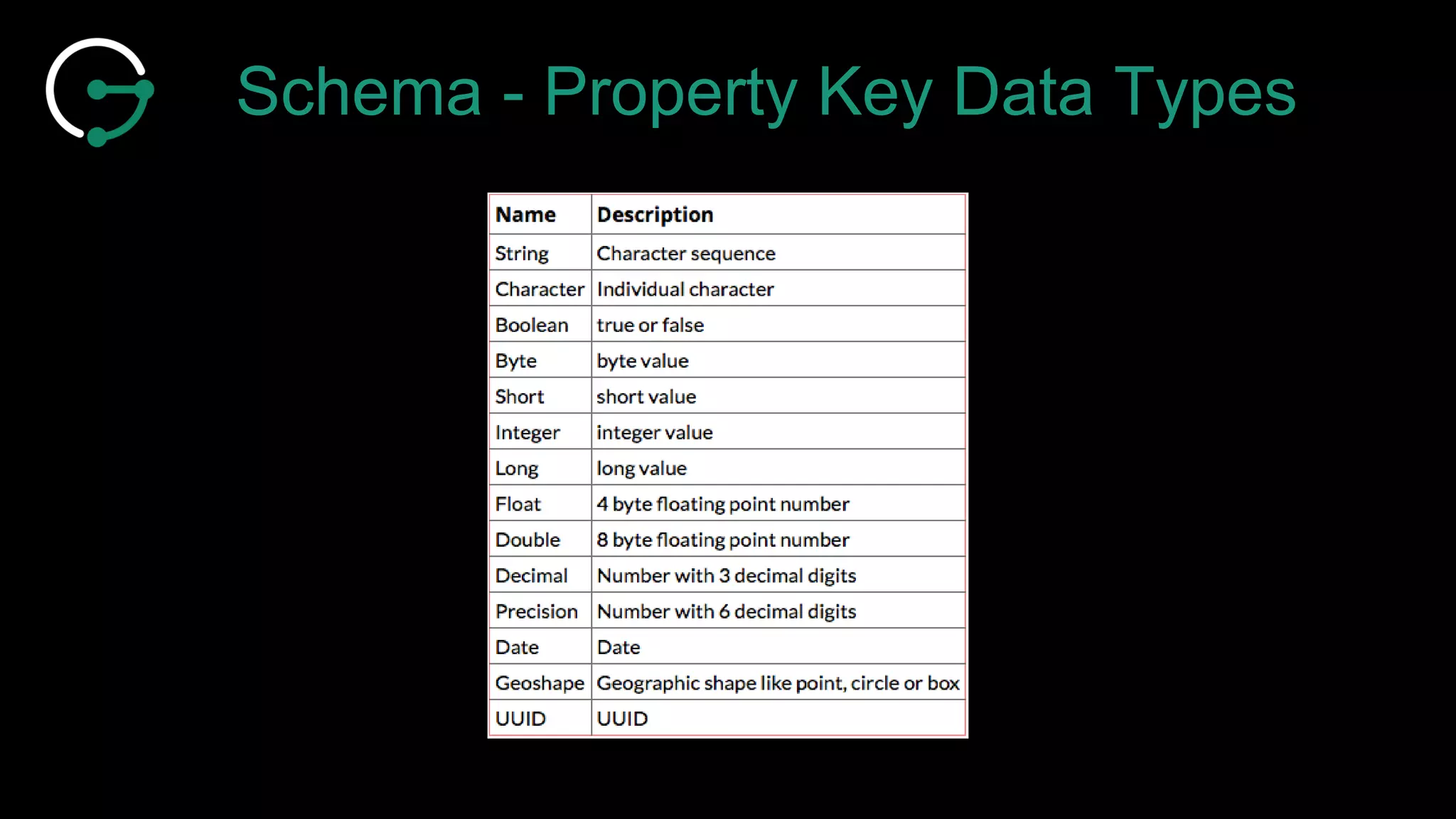
Schema - Property Key Data Types
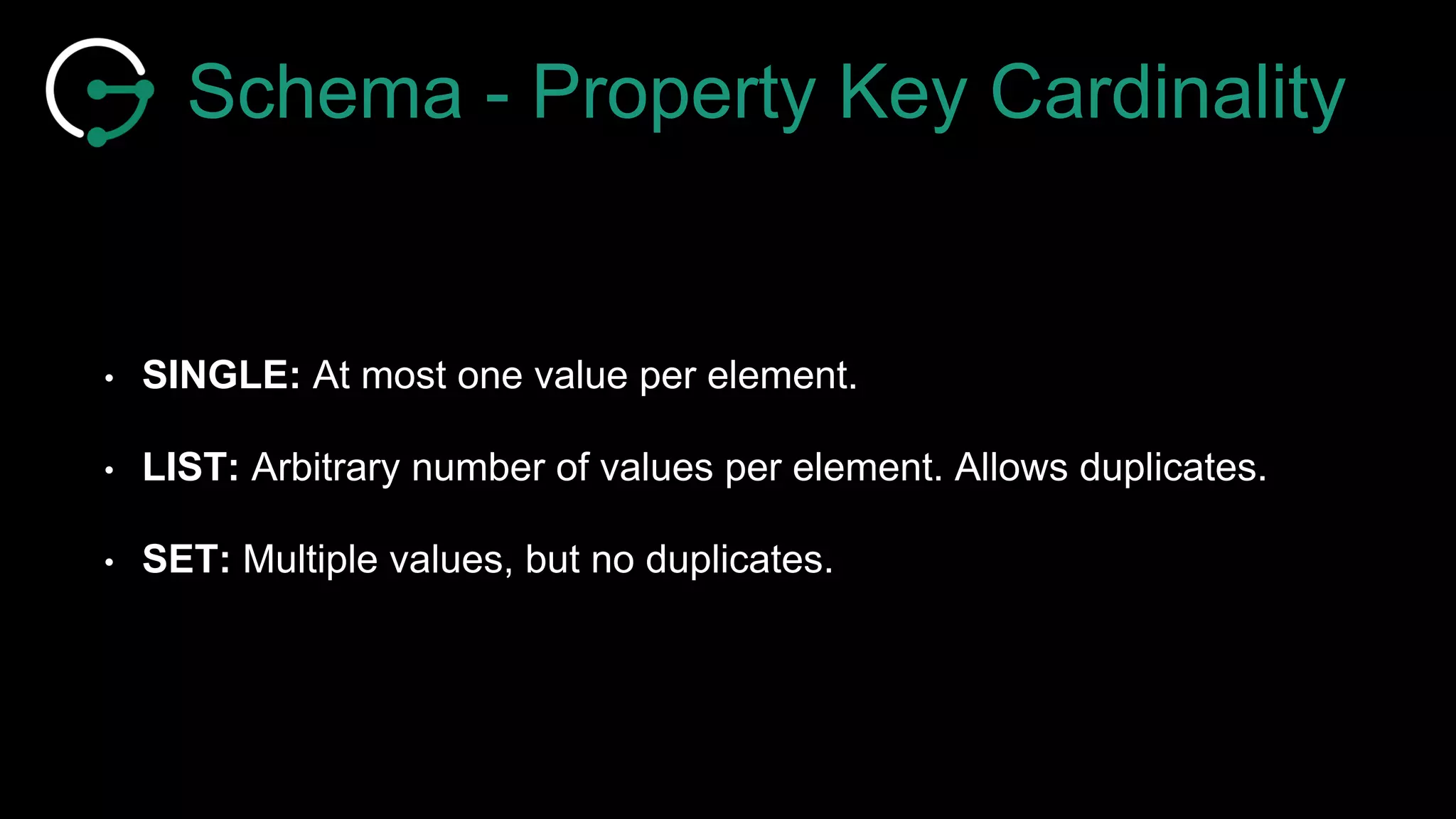
Schema - Property Key Cardinality
• SINGLE: At most one value per element.
• LIST: Arbitrary number of values per element. Allows duplicates.
• SET: Multiple values, but no duplicates.
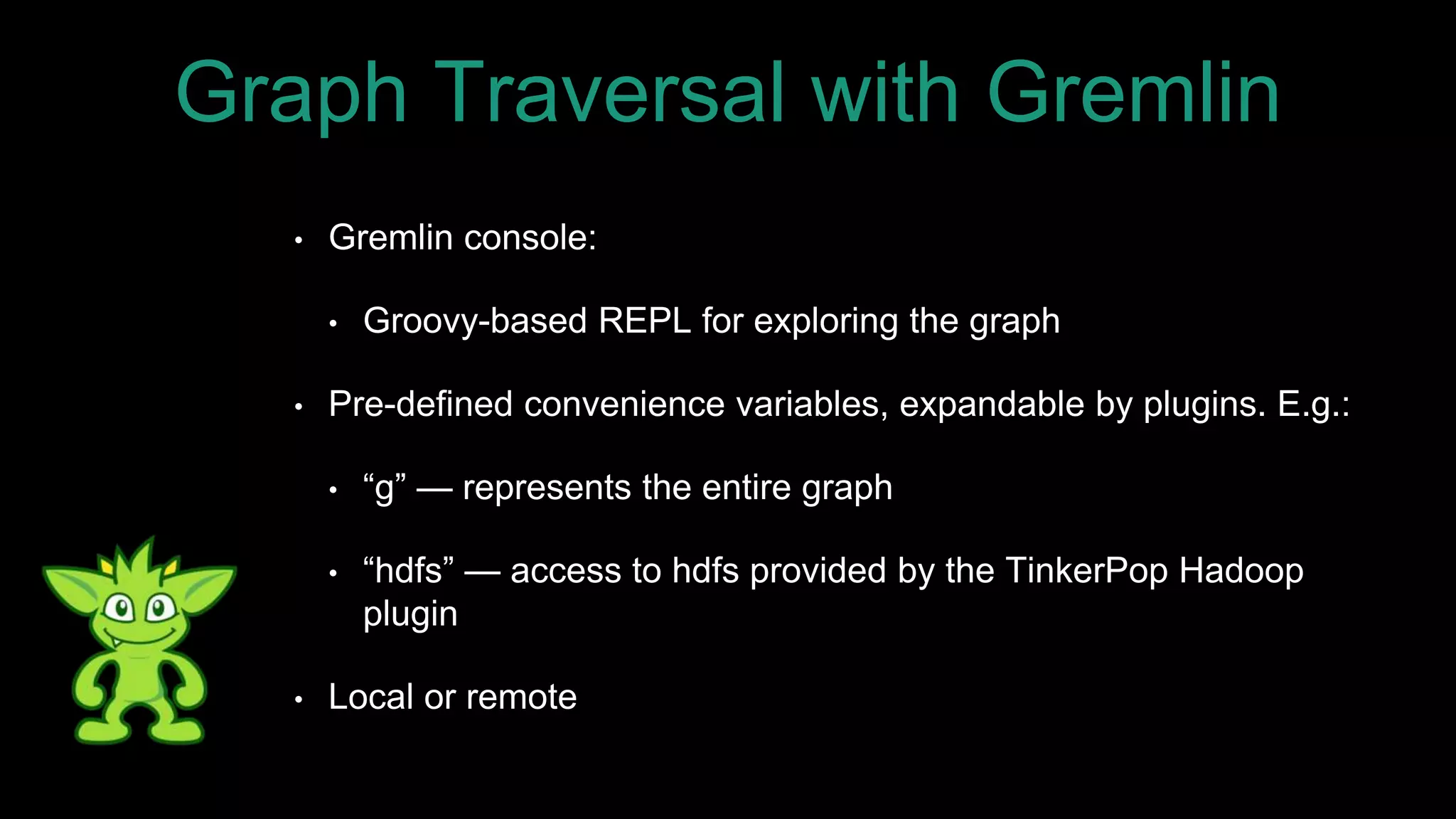
• Gremlin console:
• Groovy-based REPL for exploring the graph
• Pre-defined convenience variables, expandable by plugins. E.g.:
• “g” — represents the entire graph
• “hdfs” — access to hdfs provided by the TinkerPop Hadoop
plugin
• Local or remote
Graph Traversal with Gremlin
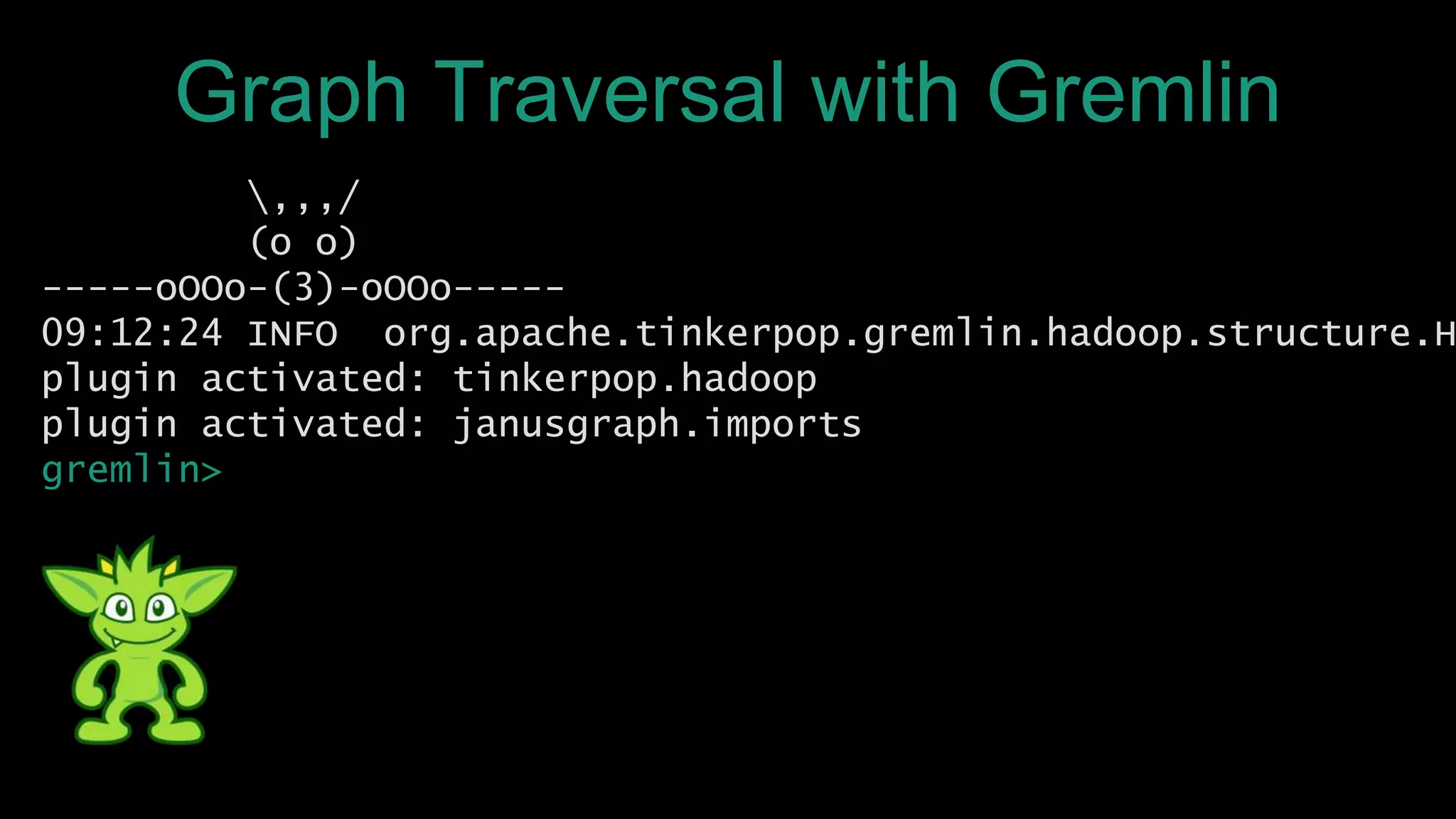
,,,/
(o o)
-----oOOo-(3)-oOOo-----
09:12:24 INFO org.apache.tinkerpop.gremlin.hadoop.structure.H
plugin activated: tinkerpop.hadoop
plugin activated: janusgraph.imports
gremlin>
Graph Traversal with Gremlin
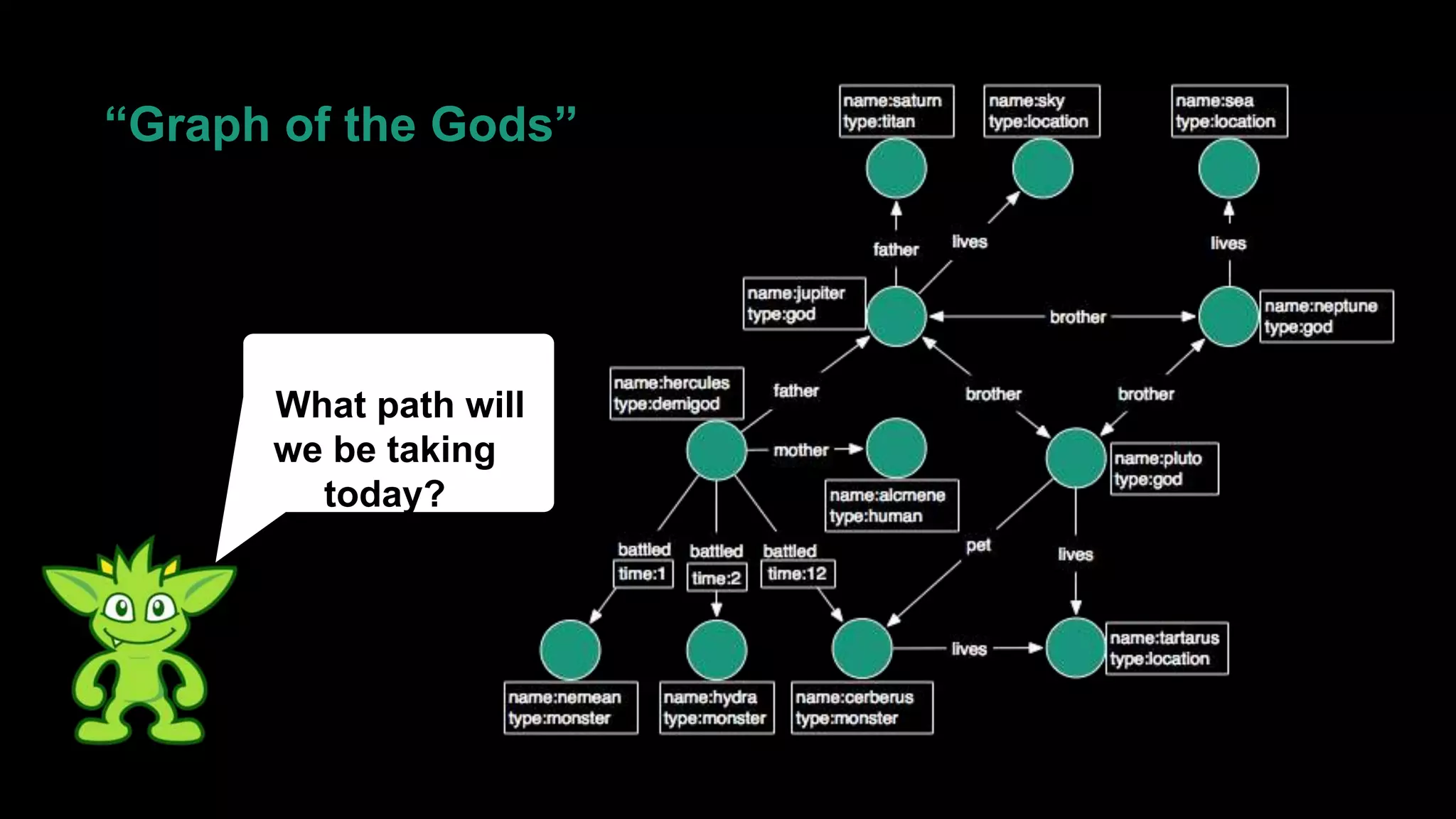
What path will
we be taking
today?
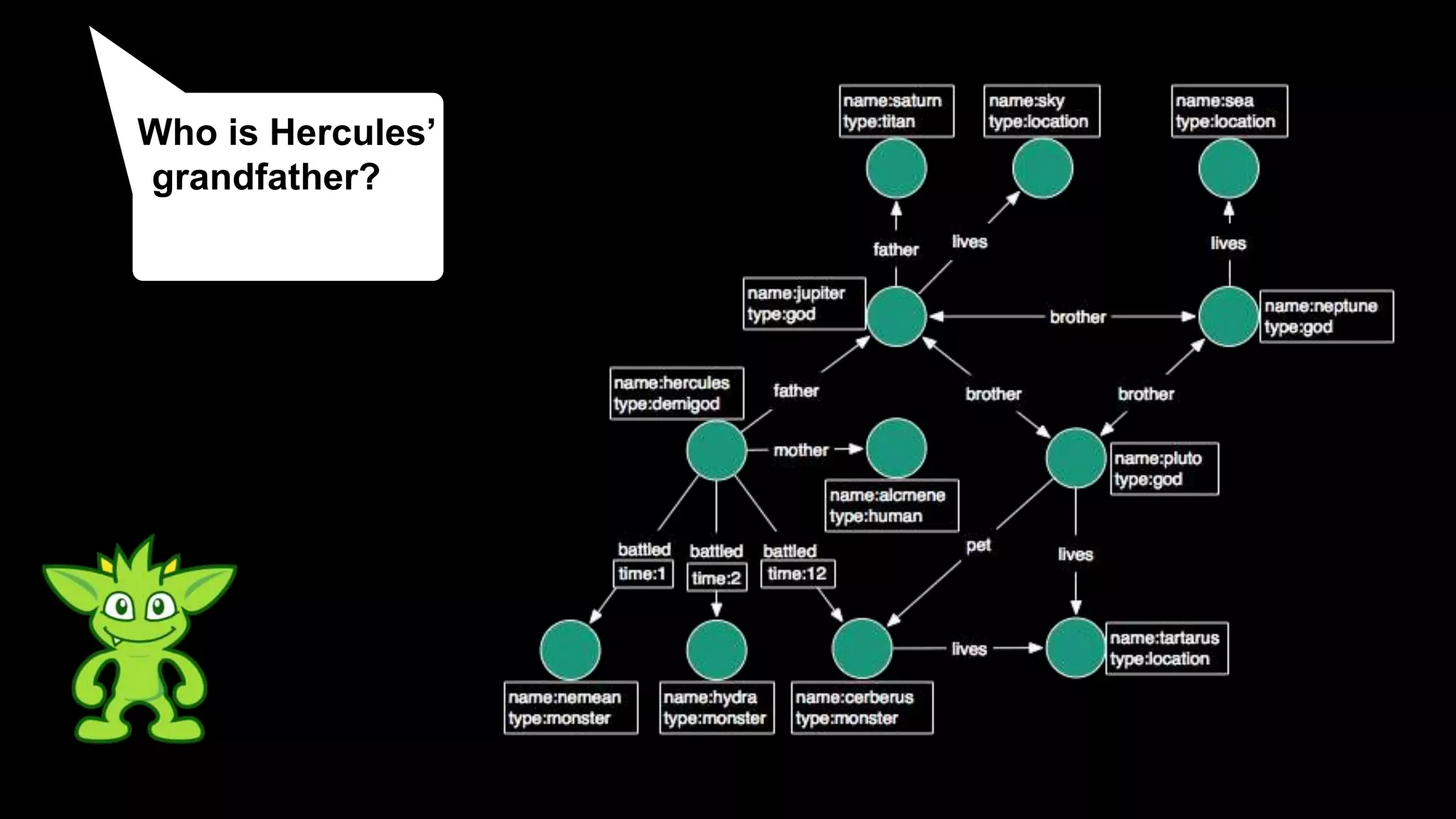
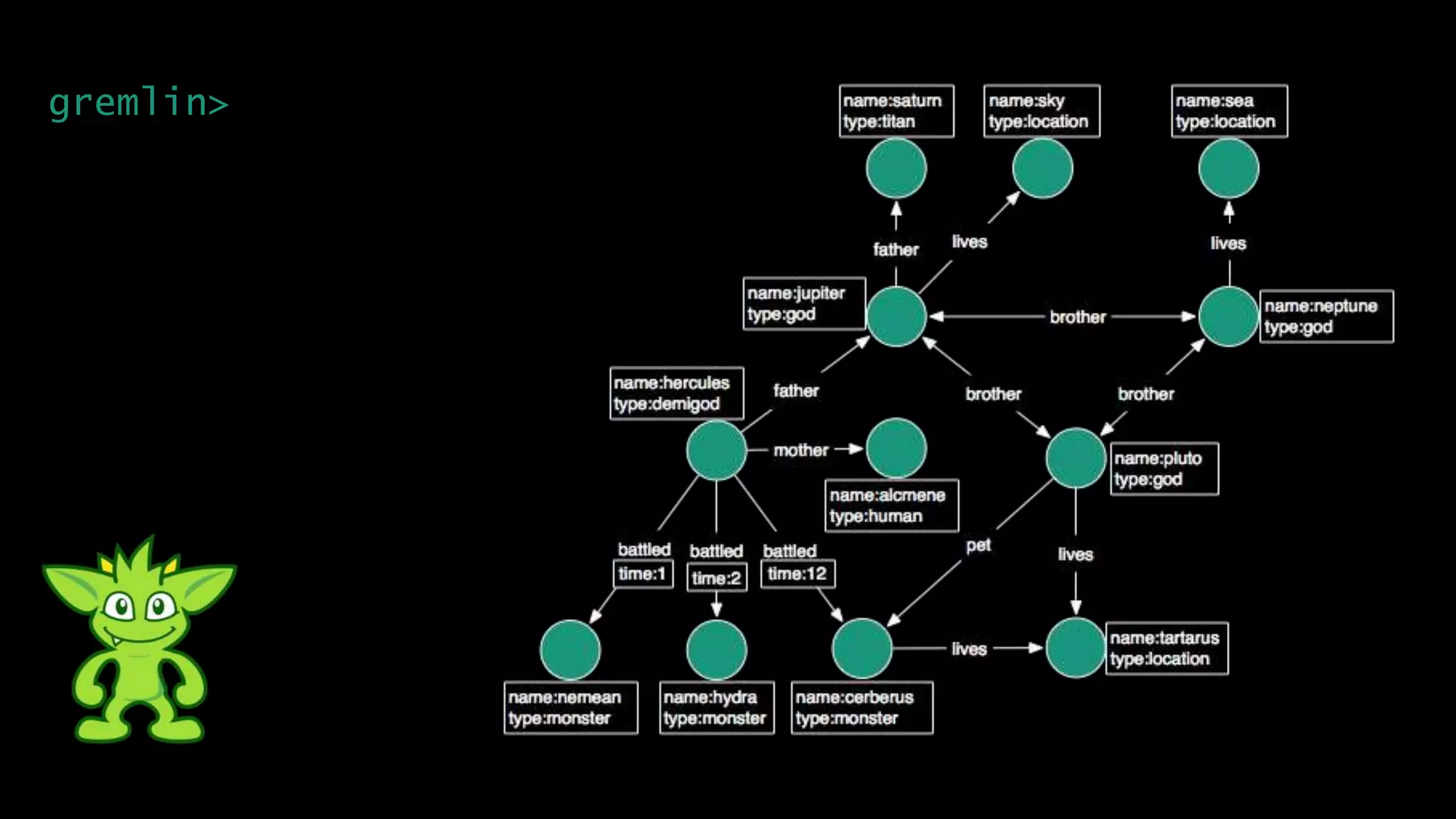
“Graph of the Gods”
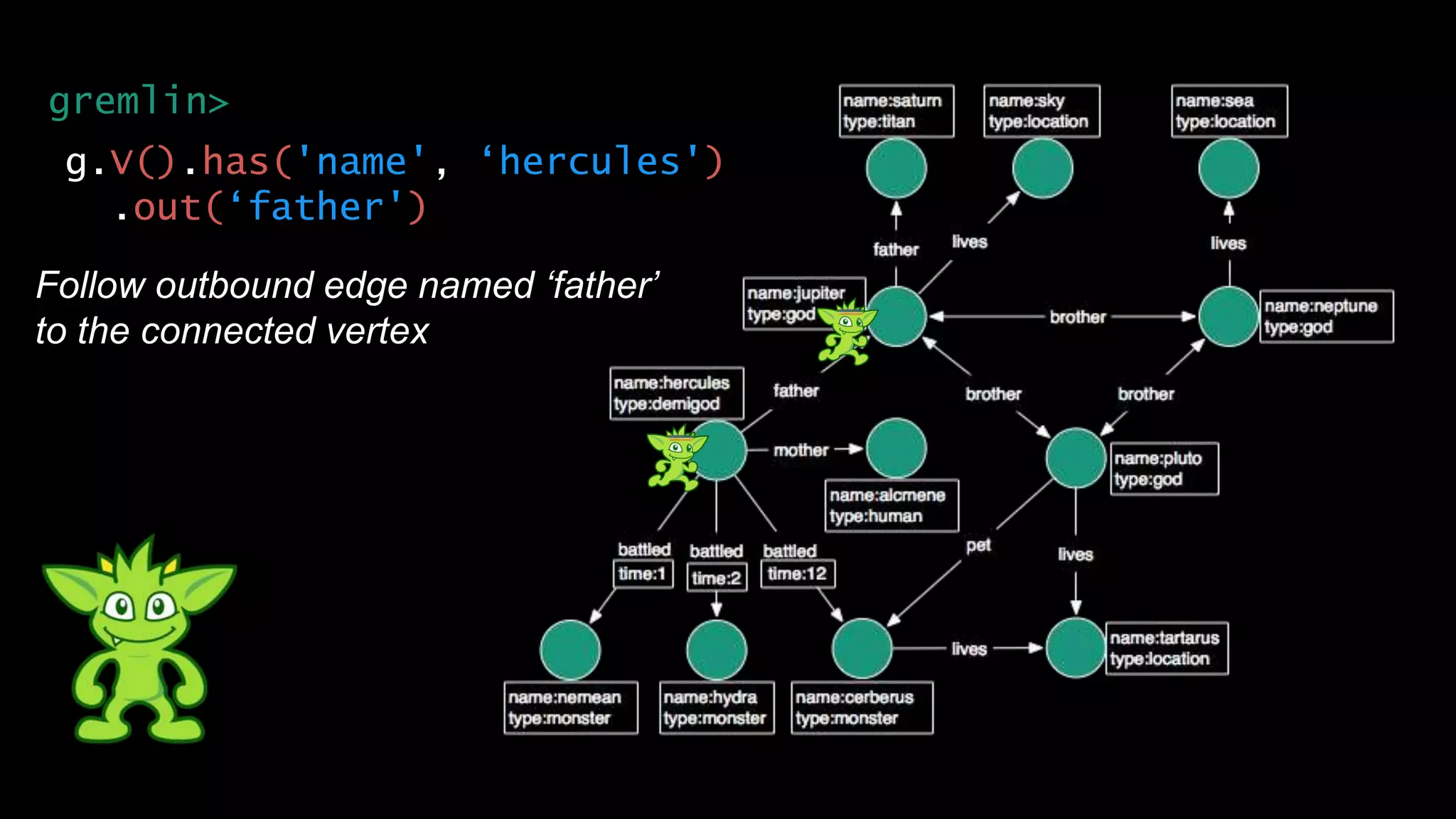
Who is Hercules’
grandfather?
gremlin>
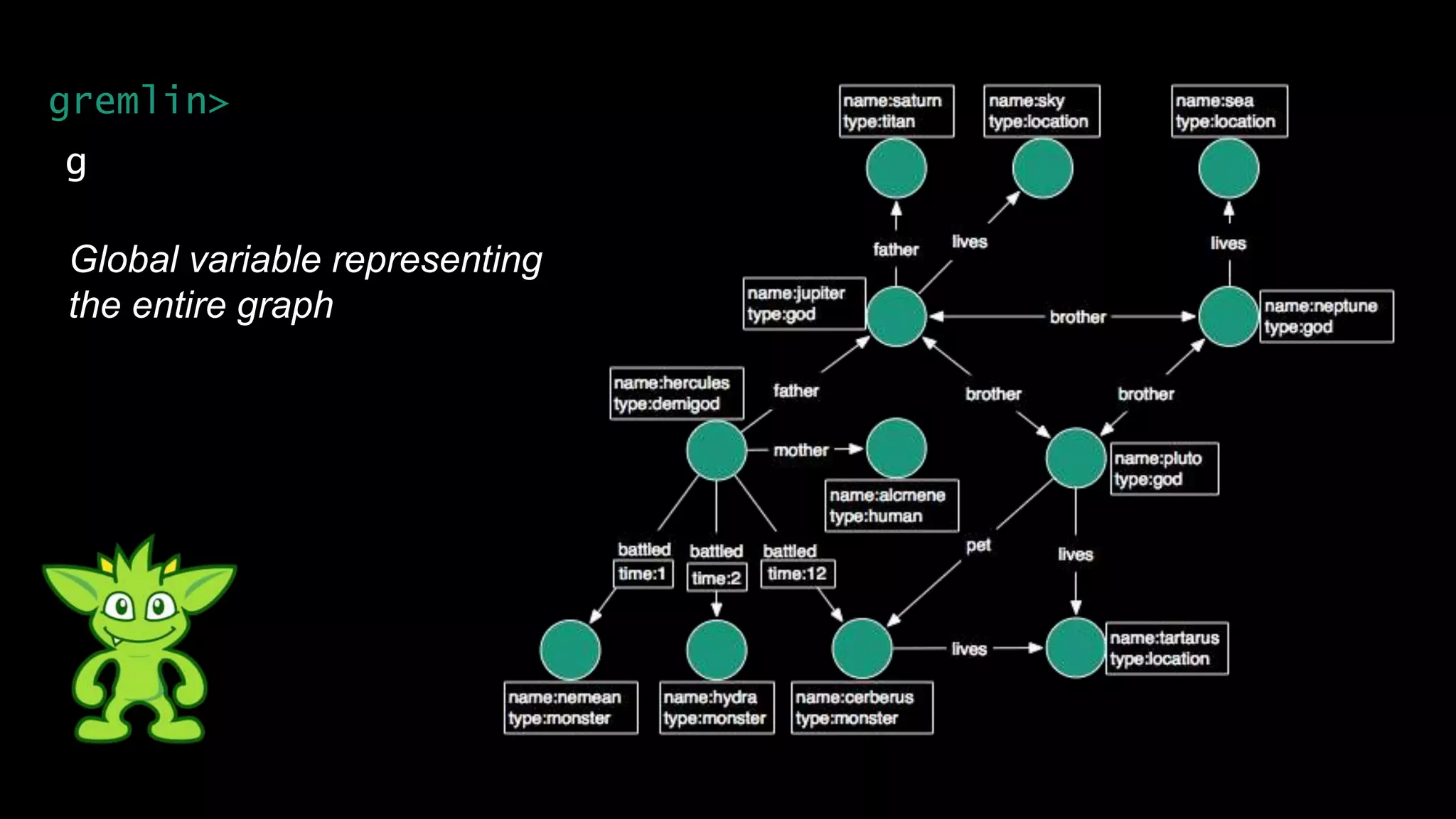
g
gremlin>
Global variable representing
the entire graph
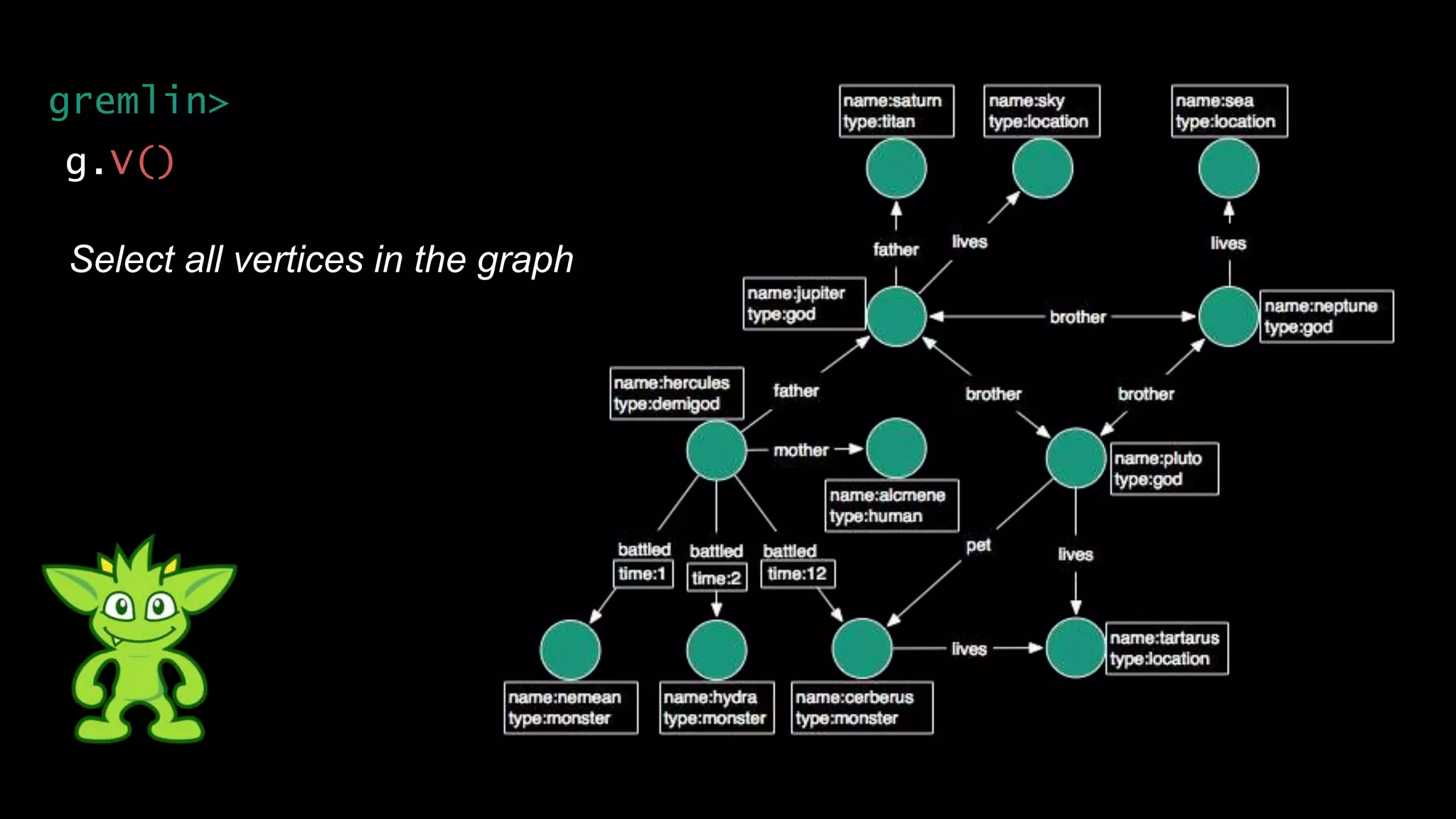
g.V()
Select all vertices in the graph
gremlin>
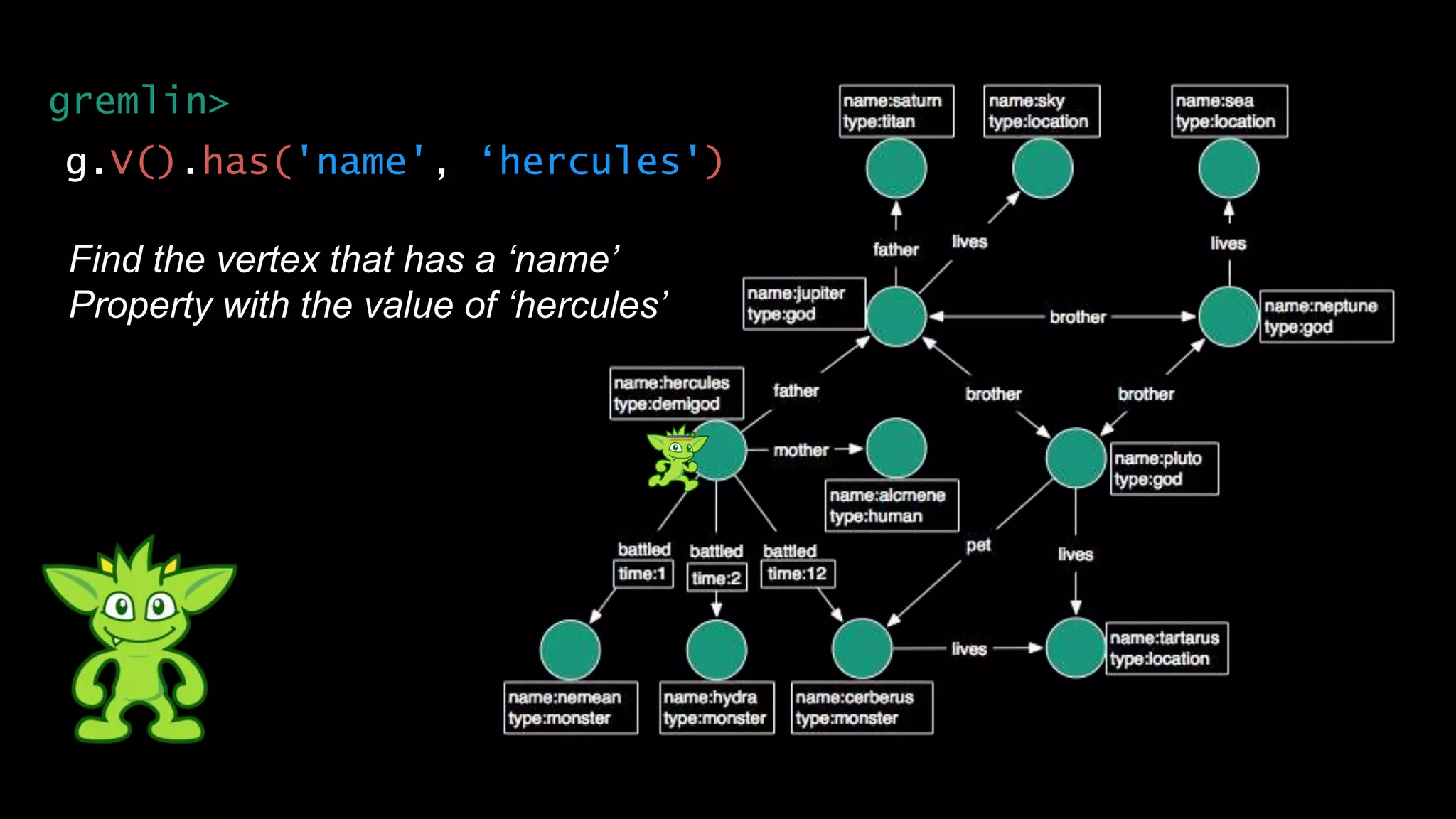
g.V().has('name', ‘hercules')
Find the vertex that has a ‘name’
Property with the value of ‘hercules’
gremlin>
g.V().has('name', ‘hercules')
.out(‘father')
Follow outbound edge named ‘father’
to the connected vertex
gremlin>
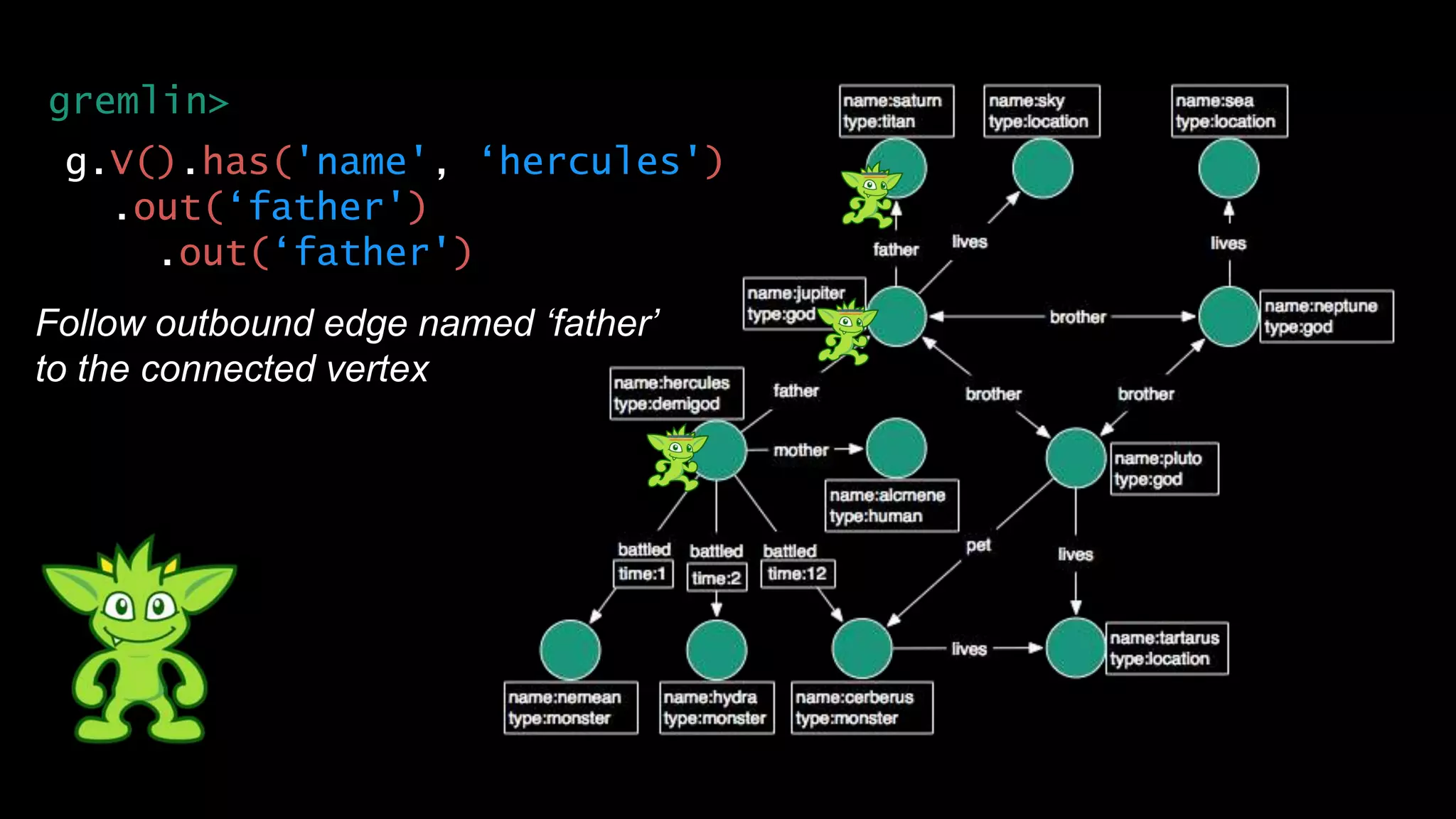
g.V().has('name', ‘hercules')
.out(‘father')
.out(‘father')
Follow outbound edge named ‘father’
to the connected vertex
gremlin>
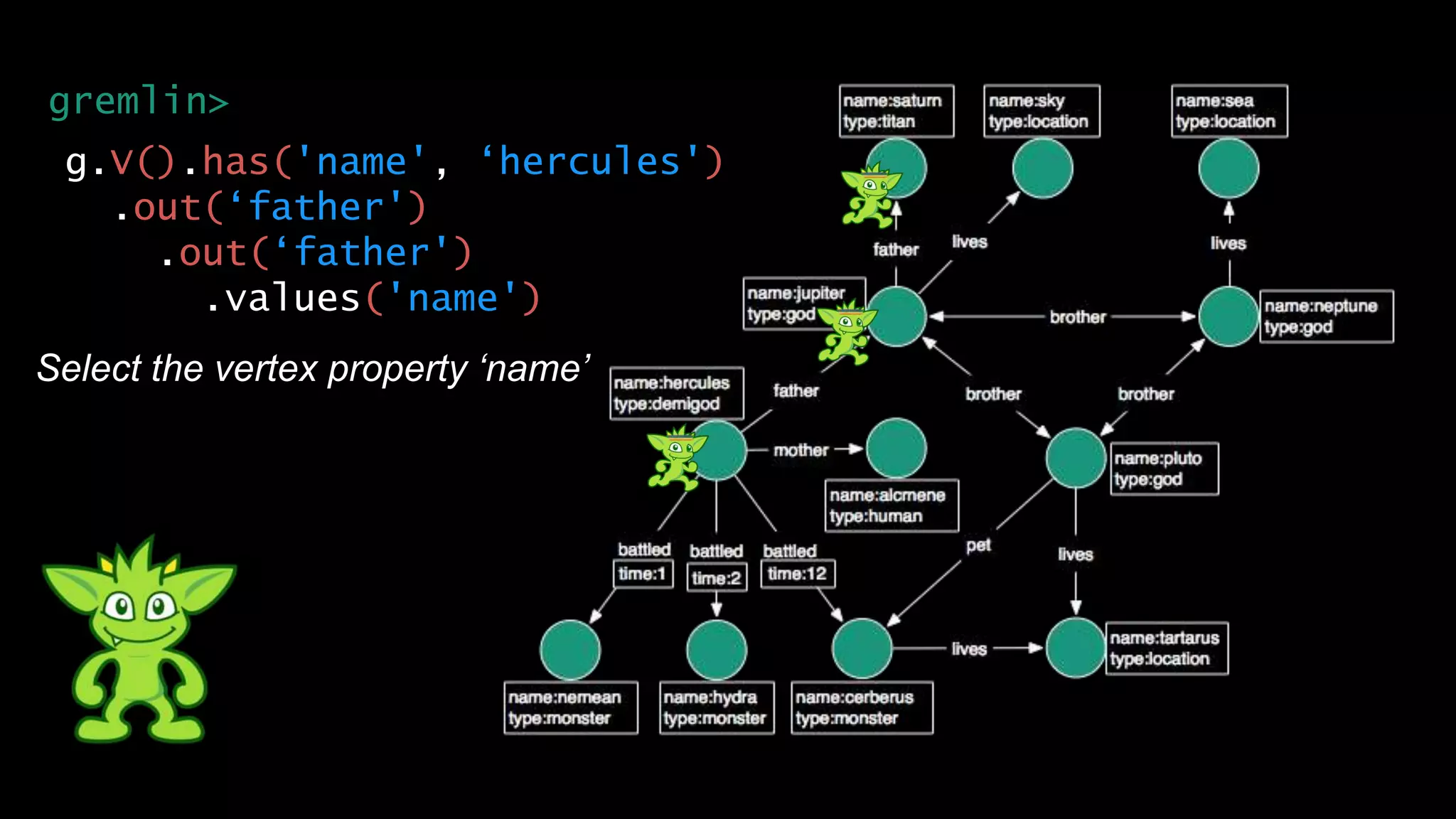
g.V().has('name', ‘hercules')
.out(‘father')
.out(‘father')
.values('name')
Select the vertex property ‘name’
gremlin>
g.V().has('name', ‘hercules')
.out(‘father')
.out(‘father')
.values('name')
Select the vertex property ‘name’
gremlin>
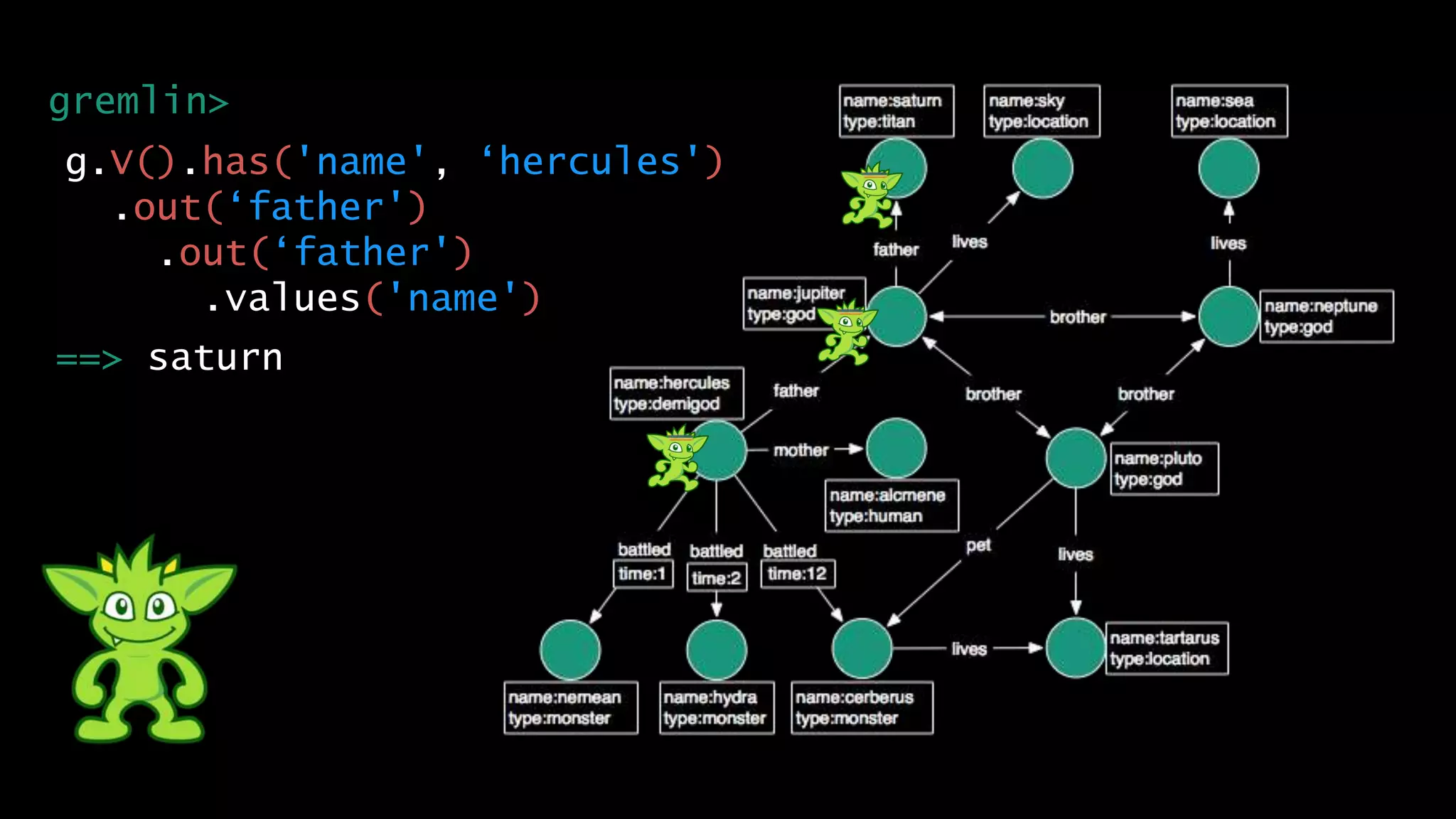
g.V().has('name', ‘hercules')
.out(‘father')
.out(‘father')
.values('name')
gremlin>
==> saturn
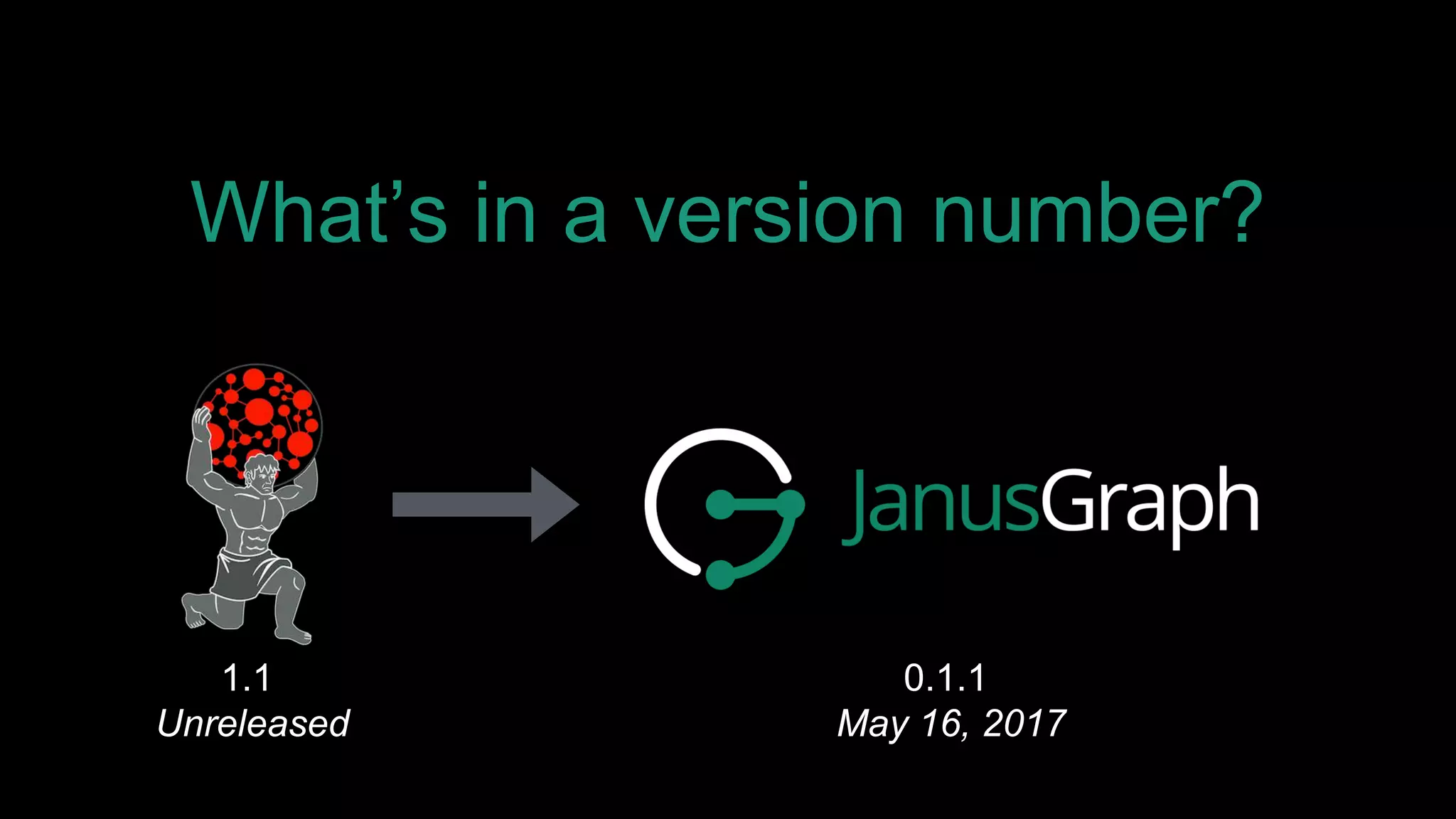
What’s in a version number?
1.1
Unreleased
0.1.1
May 16, 2017
Contributions Welcome!
• Website: http://janusgraph.org
• GitHub Organization: https://github.com/JanusGraph
• User Mailing List: janusgraph-user@googlegroups.com
• Developer Mailing List: janusgraph-dev@googlegroups.com
Thank you!
Questions?
P. Taylor Goetz, Hortonworks
@ptgoetz

Large Scale Graph Analytics with JanusGraph