VOMITING IN CHILDREN
Prof. Sushmita N. Bhatnagar
MBBS, M.S., M.Ch,M.PHIL(Hospital Management)
HEAD, PEDIATRIC SURGERY
B.J WADIA CHILDREN’S HOSPITAL, MUMBAI
CONSULTANT PEDIATRIC SURGEON
BOMBAY HOSPITAL
JOINT SECRETARY
ASSOCIATION OF MEDICAL CONSULTANTS
1
 What are the causes of vomiting
in children?
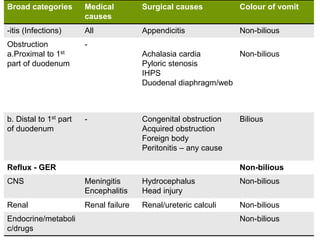
Broad categories Medical
causes
Surgical causes Colour of vomit
-itis (Infections) All Appendicitis Non-bilious
Obstruction
a.Proximal to 1st
part of duodenum
-
Achalasia cardia
Pyloric stenosis
IHPS
Duodenal diaphragm/web
Non-bilious
b. Distal to 1st part
of duodenum
- Congenital obstruction
Acquired obstruction
Foreign body
Peritonitis – any cause
Bilious
Reflux - GER Non-bilious
CNS Meningitis
Encephalitis
Hydrocephalus
Head injury
Non-bilious
Renal Renal failure Renal/ureteric calculi Non-bilious
Endocrine/metaboli
c/drugs
Non-bilious
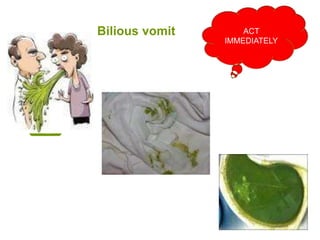
Bilious vomit ACT
IMMEDIATELY
2
 When would we call GER
pathologic?
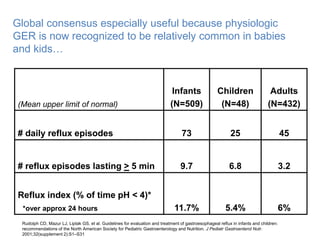
Global consensus especially useful because physiologic
GER is now recognized to be relatively common in babies
and kids…
(Mean upper limit of normal)
Infants
(N=509)
Children
(N=48)
Adults
(N=432)
# daily reflux episodes 73 25 45
# reflux episodes lasting > 5 min 9.7 6.8 3.2
Reflux index (% of time pH < 4)*
*over approx 24 hours 11.7% 5.4% 6%
Rudolph CD, Mazur LJ, Liptak GS, et al. Guidelines for evaluation and treatment of gastroesophageal reflux in infants and children:
recommendations of the North American Society for Pediatric Gastroenterology and Nutrition. J Pediatr Gastroenterol Nutr.
2001;32(supplement 2):S1–S31
Clarification via Global
Consensus
GERD is defined to be present when
reflux of gastric contents causes either
troublesome symptoms or complications
Troublesome symptoms/
complications
• Recurrent vomiting and
poor weight gain in infant
• Recurrent vomiting and
irritability in infant
• Recurrent vomiting in
older child
• Heartburn in
child/adolescent
• Esophagitis
• Dysphagia or feeding
refusal
• Apnea or ALTE
• Asthma
• Recurrent pneumonia
• Upper airway symptoms
• Unusual arching or seizure-
like movements (Sandifer
syndrome)
WHEN DOES GER “become” GERD
Aberrance in normal physiology
 Insufficient clearance and buffering of
refluxate
 Decreased rate of gastric emptying
 Abnormalities in efficacy of epithelial repair
 Decreased neural protective reflexes
Development of erosive esophagitis
causes esophageal shortening
 May result in hiatal herniation
3
Is pH monitoring a feasible and
reliable investigation for GER?
Testing for Reflux Disorders
No one test can be used to diagnose reflux,
and instead must be matched to a clinical
question
Reflux tests are useful
 To document the presence of GER(D)
 To detect complications
 To establish a causal relationship between
GER and symptoms
 To evaluate therapy
 To exclude other conditions
Diagnostic Approach
Depends on symptoms and signs
History and physical examination
Upper gastrointestinal (GI) series
Esophageal pH monitoring
Esophagogastroduodenoscopy and
biopsy
Empirical medical therapy
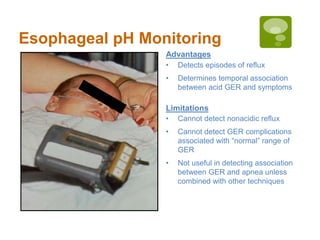
Esophageal pH Monitoring
• Cannot detect nonacidic reflux
• Cannot detect GER complications
associated with “normal” range of
GER
• Not useful in detecting association
between GER and apnea unless
combined with other techniques
Limitations
• Detects episodes of reflux
• Determines temporal association
between acid GER and symptoms
Advantages
4
What are the various methods to thicken the
feeds, especially in infants who are on
breast-feeds?
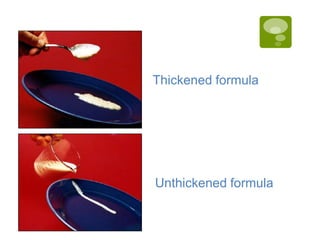
Thickened formula
Unthickened formula
5
What is conservative therapy for
GER?
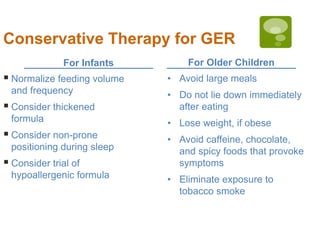
For Infants For Older Children
Conservative Therapy for GER
 Normalize feeding volume
and frequency
 Consider thickened
formula
 Consider non-prone
positioning during sleep
 Consider trial of
hypoallergenic formula
• Avoid large meals
• Do not lie down immediately
after eating
• Lose weight, if obese
• Avoid caffeine, chocolate,
and spicy foods that provoke
symptoms
• Eliminate exposure to
tobacco smoke
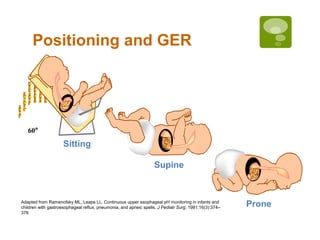
Positioning and GER
Sitting
Supine
Prone
60°
Adapted from Ramenofsky ML, Leape LL. Continuous upper esophageal pH monitoring in infants and
children with gastroesophageal reflux, pneumonia, and apneic spells. J Pediatr Surg. 1981;16(3):374–
378
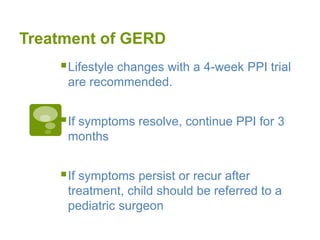
Treatment of GERD
Lifestyle changes with a 4-week PPI trial
are recommended.
If symptoms resolve, continue PPI for 3
months
If symptoms persist or recur after
treatment, child should be referred to a
pediatric surgeon
6
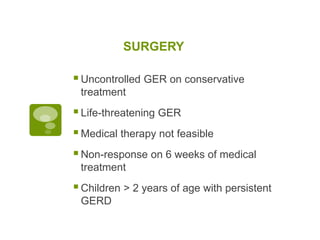
What are the indications for surgery
in GER?
SURGERY
Uncontrolled GER on conservative
treatment
Life-threatening GER
Medical therapy not feasible
Non-response on 6 weeks of medical
treatment
Children > 2 years of age with persistent
GERD
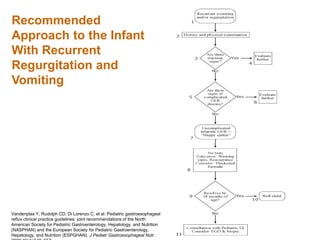
Recommended
Approach to the Infant
With Recurrent
Regurgitation and
Vomiting
Vandenplas Y, Rudolph CD, Di Lorenzo C, et al. Pediatric gastroesophageal
reflux clinical practice guidelines: joint recommendations of the North
American Society for Pediatric Gastroenterology, Hepatology, and Nutrition
(NASPHAN) and the European Society for Pediatric Gastroenterology,
Hepatology, and Nutrition (ESPGHAN). J Pediatr Gastroesophageal Nutr.
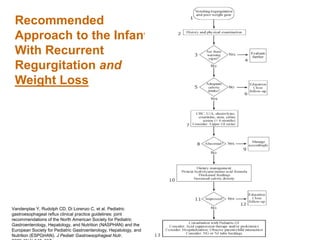
Recommended
Approach to the Infant
With Recurrent
Regurgitation and
Weight Loss
Vandenplas Y, Rudolph CD, Di Lorenzo C, et al. Pediatric
gastroesophageal reflux clinical practice guidelines: joint
recommendations of the North American Society for Pediatric
Gastroenterology, Hepatology, and Nutrition (NASPHAN) and the
European Society for Pediatric Gastroenterology, Hepatology, and
Nutrition (ESPGHAN). J Pediatr Gastroesophageal Nutr.
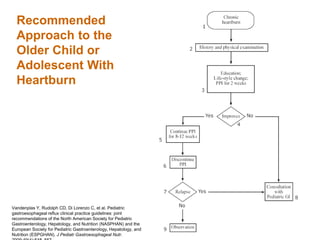
Recommended
Approach to the
Older Child or
Adolescent With
Heartburn
Vandenplas Y, Rudolph CD, Di Lorenzo C, et al. Pediatric
gastroesophageal reflux clinical practice guidelines: joint
recommendations of the North American Society for Pediatric
Gastroenterology, Hepatology, and Nutrition (NASPHAN) and the
European Society for Pediatric Gastroenterology, Hepatology, and
Nutrition (ESPGHAN). J Pediatr Gastroesophageal Nutr.
THANK-YOU
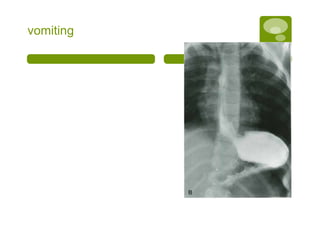
vomiting

Vomiting in children

  • 1.
    VOMITING IN CHILDREN Prof.Sushmita N. Bhatnagar MBBS, M.S., M.Ch,M.PHIL(Hospital Management) HEAD, PEDIATRIC SURGERY B.J WADIA CHILDREN’S HOSPITAL, MUMBAI CONSULTANT PEDIATRIC SURGEON BOMBAY HOSPITAL JOINT SECRETARY ASSOCIATION OF MEDICAL CONSULTANTS
  • 2.
    1  What arethe causes of vomiting in children?
  • 3.
    Broad categories Medical causes Surgicalcauses Colour of vomit -itis (Infections) All Appendicitis Non-bilious Obstruction a.Proximal to 1st part of duodenum - Achalasia cardia Pyloric stenosis IHPS Duodenal diaphragm/web Non-bilious b. Distal to 1st part of duodenum - Congenital obstruction Acquired obstruction Foreign body Peritonitis – any cause Bilious Reflux - GER Non-bilious CNS Meningitis Encephalitis Hydrocephalus Head injury Non-bilious Renal Renal failure Renal/ureteric calculi Non-bilious Endocrine/metaboli c/drugs Non-bilious
  • 4.
  • 5.
    2  When wouldwe call GER pathologic?
  • 6.
    Global consensus especiallyuseful because physiologic GER is now recognized to be relatively common in babies and kids… (Mean upper limit of normal) Infants (N=509) Children (N=48) Adults (N=432) # daily reflux episodes 73 25 45 # reflux episodes lasting > 5 min 9.7 6.8 3.2 Reflux index (% of time pH < 4)* *over approx 24 hours 11.7% 5.4% 6% Rudolph CD, Mazur LJ, Liptak GS, et al. Guidelines for evaluation and treatment of gastroesophageal reflux in infants and children: recommendations of the North American Society for Pediatric Gastroenterology and Nutrition. J Pediatr Gastroenterol Nutr. 2001;32(supplement 2):S1–S31
  • 7.
    Clarification via Global Consensus GERDis defined to be present when reflux of gastric contents causes either troublesome symptoms or complications
  • 8.
    Troublesome symptoms/ complications • Recurrentvomiting and poor weight gain in infant • Recurrent vomiting and irritability in infant • Recurrent vomiting in older child • Heartburn in child/adolescent • Esophagitis • Dysphagia or feeding refusal • Apnea or ALTE • Asthma • Recurrent pneumonia • Upper airway symptoms • Unusual arching or seizure- like movements (Sandifer syndrome)
  • 9.
    WHEN DOES GER“become” GERD Aberrance in normal physiology  Insufficient clearance and buffering of refluxate  Decreased rate of gastric emptying  Abnormalities in efficacy of epithelial repair  Decreased neural protective reflexes Development of erosive esophagitis causes esophageal shortening  May result in hiatal herniation
  • 10.
    3 Is pH monitoringa feasible and reliable investigation for GER?
  • 11.
    Testing for RefluxDisorders No one test can be used to diagnose reflux, and instead must be matched to a clinical question Reflux tests are useful  To document the presence of GER(D)  To detect complications  To establish a causal relationship between GER and symptoms  To evaluate therapy  To exclude other conditions
  • 12.
    Diagnostic Approach Depends onsymptoms and signs History and physical examination Upper gastrointestinal (GI) series Esophageal pH monitoring Esophagogastroduodenoscopy and biopsy Empirical medical therapy
  • 13.
    Esophageal pH Monitoring •Cannot detect nonacidic reflux • Cannot detect GER complications associated with “normal” range of GER • Not useful in detecting association between GER and apnea unless combined with other techniques Limitations • Detects episodes of reflux • Determines temporal association between acid GER and symptoms Advantages
  • 14.
    4 What are thevarious methods to thicken the feeds, especially in infants who are on breast-feeds?
  • 15.
  • 16.
    5 What is conservativetherapy for GER?
  • 17.
    For Infants ForOlder Children Conservative Therapy for GER  Normalize feeding volume and frequency  Consider thickened formula  Consider non-prone positioning during sleep  Consider trial of hypoallergenic formula • Avoid large meals • Do not lie down immediately after eating • Lose weight, if obese • Avoid caffeine, chocolate, and spicy foods that provoke symptoms • Eliminate exposure to tobacco smoke
  • 18.
    Positioning and GER Sitting Supine Prone 60° Adaptedfrom Ramenofsky ML, Leape LL. Continuous upper esophageal pH monitoring in infants and children with gastroesophageal reflux, pneumonia, and apneic spells. J Pediatr Surg. 1981;16(3):374– 378
  • 19.
    Treatment of GERD Lifestylechanges with a 4-week PPI trial are recommended. If symptoms resolve, continue PPI for 3 months If symptoms persist or recur after treatment, child should be referred to a pediatric surgeon
  • 20.
    6 What are theindications for surgery in GER?
  • 21.
    SURGERY Uncontrolled GER onconservative treatment Life-threatening GER Medical therapy not feasible Non-response on 6 weeks of medical treatment Children > 2 years of age with persistent GERD
  • 22.
    Recommended Approach to theInfant With Recurrent Regurgitation and Vomiting Vandenplas Y, Rudolph CD, Di Lorenzo C, et al. Pediatric gastroesophageal reflux clinical practice guidelines: joint recommendations of the North American Society for Pediatric Gastroenterology, Hepatology, and Nutrition (NASPHAN) and the European Society for Pediatric Gastroenterology, Hepatology, and Nutrition (ESPGHAN). J Pediatr Gastroesophageal Nutr.
  • 23.
    Recommended Approach to theInfant With Recurrent Regurgitation and Weight Loss Vandenplas Y, Rudolph CD, Di Lorenzo C, et al. Pediatric gastroesophageal reflux clinical practice guidelines: joint recommendations of the North American Society for Pediatric Gastroenterology, Hepatology, and Nutrition (NASPHAN) and the European Society for Pediatric Gastroenterology, Hepatology, and Nutrition (ESPGHAN). J Pediatr Gastroesophageal Nutr.
  • 24.
    Recommended Approach to the OlderChild or Adolescent With Heartburn Vandenplas Y, Rudolph CD, Di Lorenzo C, et al. Pediatric gastroesophageal reflux clinical practice guidelines: joint recommendations of the North American Society for Pediatric Gastroenterology, Hepatology, and Nutrition (NASPHAN) and the European Society for Pediatric Gastroenterology, Hepatology, and Nutrition (ESPGHAN). J Pediatr Gastroesophageal Nutr.
  • 25.
  • 26.