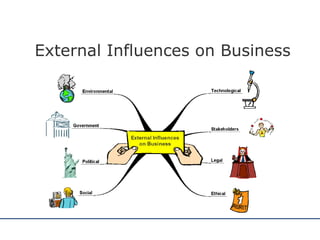
External Influences on Business
External Influences Technology and Changing Social Attitudes
External Influences New Technology: New business opportunities Creation of substitutes Opening up of new markets Technical progress in foreign countries Productivity Ways of working Communication Cost of investment versus return
External Influences New business opportunities: Within the same industry?  (Core business) Totally new markets/opportunities Amount of investment needed Market research – do consumers need the product?
External Influences e.g. Canon – core business, optical technologies:   cameras, photocopiers, scanners, projectors, calculators, binoculars, digital cameras, printers, projectors New markets  – Discmans? DVD players? Flat Screen TVs? Plasma TVs? Risk versus gain
External Influences Threats: Cheaper alternatives from abroad – CFC technology, bio-technology, computer and micro-processor technology (especially China?) Rivals producing substitutes – PS2, X-Box and Game Cube How to react?
External Influences Working practices: Technology and productivity –  impact on workers, morale, motivation? Implications for ‘old’ plants (e.g. Longbridge versus Sunderland? Flexible working – working from home,  hot desking, mobile computing  (wireless networks) video-conferencing
External Influences Communication: Faster? More efficient? – if so why have some firms banned the use of e-mail  at work for any purpose? Impact on motivation, morale  and worker attitudes To what extent does the message  get through?
External Influences Changing Social Attitudes: Social ‘class’ – changing socio–economic groupings Links with behaviour and demand (e.g. growing number of pensioners; those who smoke or drink certain types of alcohol) Changing tastes – concern for ‘green’ production, attitudes to fur, wine versus beer, vegetarians  (long term or short term?) Changing lifestyles – convenience and   fast foods, use of freezers, use of cars, amount of leisure time and how it is used, etc.
External Influences Changing income structures Distribution of income Regional distribution of income Impact of government taxation  on disposable incomes Relative income elasticity of demand for different goods and services
External Influences Business Ethics and Moral Behaviour
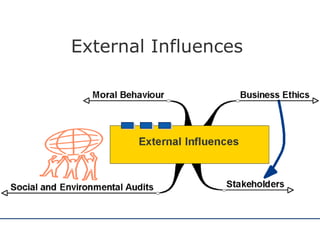
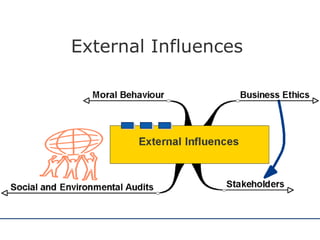
External Influences
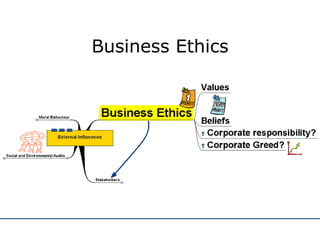
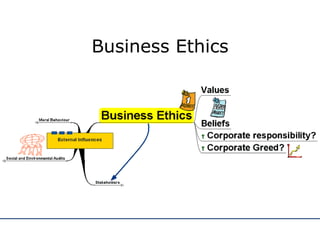
Business Ethics
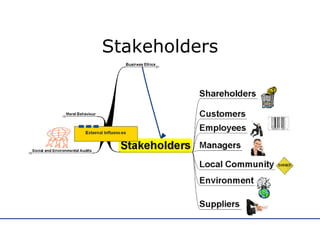
Stakeholders
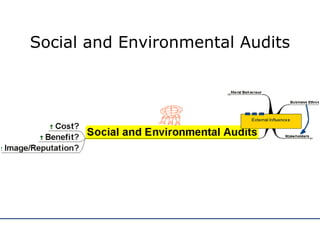
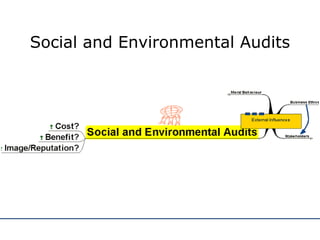
Social and Environmental Audits
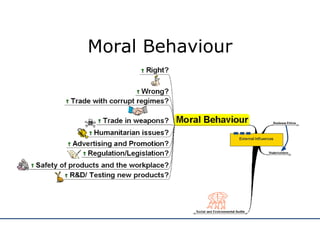
Moral Behaviour
External Influences 3: Legal and Political
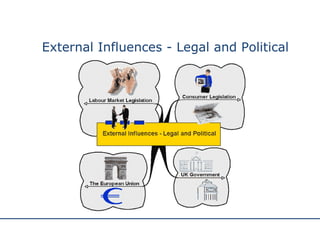
External Influences - Legal and Political
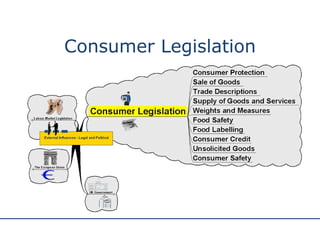
Consumer Legislation
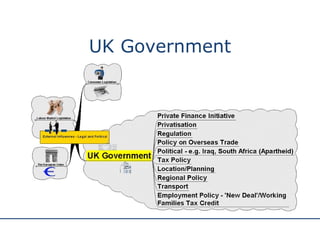
UK Government
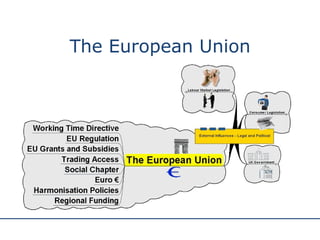
The European Union
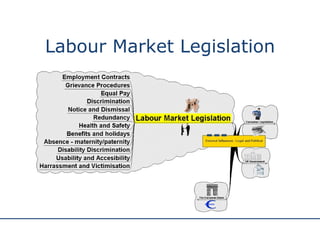
Labour Market Legislation
External Influences - Legal and Political Impact on Business: Impact on costs Impact on competitiveness Impact on profitability Impact on behaviour Impact on decision making Impact on innovation  and new product development
External Influences - Legal and Political Example 1 - Accessibility and usability   Increases need to provide  for those with different needs Installation of lifts, ramps, wheelchair access, widening doorways, etc., monitoring of Web site, use of colour, font in documents – all adds costs
External Influences - Legal and Political Example 2 - Government Policy: Government procurement policies Should government focus on securing most cost-effective solution or supporting of UK industry? Decisions to privatise – wide impact  on businesses in relevant sectors  Government planning law –  out-of-town shopping centres
External Influences - Legal and Political Example 3 - The EU Stilton Cheese, Cornish Pasties, Parma Ham, Parmesan Cheese – Who has the right to name their products in a certain way? Date marking and food labelling – stricter controls – how much meat is in sausages? Impact on costs to comply Who benefits – consumer?  But at what cost?
External Influences 4 Business Ethics, Moral  and Environmental Issues
External Influences
Business Ethics
Business Ethics Rules or standards governing  the conduct of a business Moral code – what is ‘right’  and what is ‘wrong’? Highly subjective nature Tension between different stakeholders
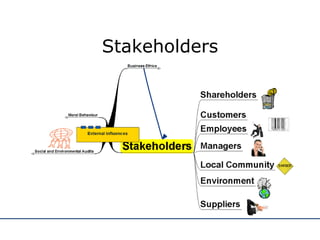
Stakeholders
Stakeholders Responsibilities to stakeholder groups: Shareholders  – Generate profits  and pay dividends Customers  – provide good quality products  at reasonable prices. Safety, honesty, decency and truthfulness Employees  – health and safety at work, security, fair pay Suppliers  – pay on time, pay fair rates  for the work done, provide element of security
Stakeholders Local Community  – provide employment, safe working environment, minimise pollution and negative externalities – provide external benefits? Government  – abide by the law, pay taxes, abide by regulations Management  – their aims versus those  of the organisation as a whole Environment  – limit pollution, congestion, environmental degradation, development, etc.
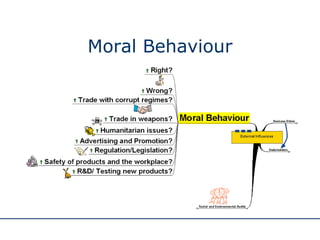
Moral Behaviour
Business Ethics Tensions: Profits versus higher wages Expansion versus development Production versus pollution Supplier benefits versus consumer prices/lower costs Survival of the business versus needs of stakeholders
Business Ethics Examples: Production of children's toys Coffee industry Baby milk  Music industry Multi-national operations McDonalds – food quality, litter Chocolate industry Jewellery – diamonds and gold Chemical industry
Business Ethics Solutions: Taxation Self Regulation Subsidies Government/EU regulation Legislation  Pressure Groups Improve competition and contestability  of markets Social and Environmental Audits
Social and Environmental Audits
Environment Urban blight  –  excessive development, inappropriate development,  use of greenbelt land Waste  – land-fill? re-cycling? burning? Energy use  – renewable energy,  non-renewable resources Global Warming  – fact or fiction? Pollution: Noise Air Land Sea Water
Externalities Impact on a third party  of a business decision Those affected not involved  in the decision Negative externalities  – negative effects of business activity – pollution, urban development, etc e.g. out of town shopping centres – impact on city centres
Externalities Positive Externalities: Benefits to third parties of business activity e.g. new infrastructure as a result of development, side effects of research and development, technology (the Internet?), convenience, improved standards of living Out of town shopping centres – greater ease of access, everything in one place, pleasant environment to shop in, etc.
Externalities Out of town shopping centres: Highlights complexity  of the interaction of positive  and negative externalities Government policies – encourage business activity that leads  to positive externalities  and discourage those that lead  to negative externalities
External Influences The Macro-Economy
External Influences – The Macro-Economy The Macro-economy: The production and exchange process of the whole economy as opposed  to individual markets within  the economy Businesses affected by changes  in the macro–economy and  by government policies
External Influences – The Macro-Economy Government Macro-economic objectives: Control of inflation – 2.0% Maintain full employment –  all who want a job can get one! Control of balance of payments Stability of exchange rate Maintain steady economic growth -> 2-2.5%?
External Influences – The Macro-Economy Inflation: a general rise in the price level over a period of time Measured by: RPI  – Retail Price Index RPIX  = RPI – mortgage interest payments RPIY  = RPIX – indirect taxes and local authority tax HICP  – Harmonised Index of Consumer Prices (From November 2003)
External Influences – The Macro-Economy HICP  – Internationally comparable measure of inflation adopted by all EU countries Geometric rather than arithmetic mean Does not include: housing costs,  buildings insurance, mortgage costs Does include: university accommodation fees, tuition fees, stock broker charges Weights determined by expenditure  by private households AND all private visitors to UK, and residents  of institutional households
External Influences – The Macro-Economy Full Employment: Policies designed to help those  who want to work get work: Strong economy National Minimum Wage and changes  to welfare benefits ‘ New Deal’ and ‘Employment Zones’ Investing in education and training Investing in diversity Source: Adapted from ‘Towards full employment in a modern society’, Department for Work and Pensions, 2001 (http://www.dwp.gov.uk/fullemployment/pdf/NewDealall.pdf)
External Influences – The Macro-Economy Balance of Payments: A record of the trade between the UK and other countries Imports  – visible and invisible – purchase  of goods and services from other countries which result in payments  being made abroad Exports  – visible and invisible – the sale  of goods and services to other countries  which results in payments being received from those countries
External Influences – The Macro-Economy Balance of Payments: Ease with which businesses  can sell products abroad Impact on business costs  from imports Impact on competition  from imports and exports
External Influences – The Macro-Economy Exchange Rates The rate at which one currency  can be exchanged for another e.g. £1 = €1.72, £1 = $1.68 Influences the perceived prices  of imports and exports and therefore costs and competitiveness
External Influences – The Macro-Economy Exchange Rates: Effects on Business: Appreciation  – value of  £ against other currencies rises, e.g. £1 = €1.72 to £1 = €1.75 Exports  harder to sell abroad - foreign traders have to give up more of their currency to get same amount of £ - export prices appear to rise Imports  appear to be cheaper – buyer in UK gets more foreign currency for every £
External Influences – The Macro-Economy Depreciation   – value of £ against other currencies falls, e.g. £1 = $1.68 to £1 = $1.60 Exporters  benefit – foreign traders  get more £ for their currency –  export prices appear to fall Importers   – have to give up more £  to get same amount of foreign currency – appears import prices have risen Precise effect of both depends on  Price Elasticity of demand for imports and exports
External Influences – The Macro-Economy Economic Growth: Measured by  Gross Domestic Product  (GDP) – the value of output of goods and services  in the economy over a period of a year Measured by adding up total incomes (Y)  or total expenditure (E) or total output of industry  In theory all should be the same! Appropriate growth levels in UK  too high - economy overheating,  too low - economy stagnating, resources unemployed Actual growth of 2–2.5% seen as being sustainable
External Influences – The Macro-Economy Economic Growth Effects on business: Low growth  –  business sales low,  profit margins tight, excess capacity, orders reduced,  excess stock, redundancies High growth  –  business sales rising quickly, profits rising, skill shortages, inflationary pressure on prices, capacity squeezed, stocks running down
 
External Influences – The Macro-Economy Government Policies: Fiscal Policy  – influencing economic and non-economic objectives through variations in public income and expenditure (tax revenue, borrowing and government spending) Affects all aspects of business activity  – regulations, infrastructure – roads, transport, etc, health and safety, support for industry, business taxation, employment laws and taxes – income tax and national insurance contributions, pension contributions, etc.
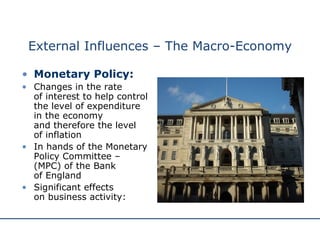
External Influences – The Macro-Economy Monetary Policy: Changes in the rate  of interest to help control the level of expenditure in the economy  and therefore the level  of inflation In hands of the Monetary Policy Committee – (MPC) of the Bank  of England Significant effects  on business activity:
External Influences – The Macro-Economy Rising Interest Rates: Likely to depress consumer spending Increases the cost of borrowing –  impacts on investment decisions Increases existing loan costs – the more highly geared the greater the impact Affects exchange rate – could impact  on sales abroad (exports)  or cost of imported resources Falling rates have the opposite effect

External Influences

  • 1.
  • 2.
  • 3.
    External Influences Technologyand Changing Social Attitudes
  • 4.
    External Influences NewTechnology: New business opportunities Creation of substitutes Opening up of new markets Technical progress in foreign countries Productivity Ways of working Communication Cost of investment versus return
  • 5.
    External Influences Newbusiness opportunities: Within the same industry? (Core business) Totally new markets/opportunities Amount of investment needed Market research – do consumers need the product?
  • 6.
    External Influences e.g.Canon – core business, optical technologies: cameras, photocopiers, scanners, projectors, calculators, binoculars, digital cameras, printers, projectors New markets – Discmans? DVD players? Flat Screen TVs? Plasma TVs? Risk versus gain
  • 7.
    External Influences Threats:Cheaper alternatives from abroad – CFC technology, bio-technology, computer and micro-processor technology (especially China?) Rivals producing substitutes – PS2, X-Box and Game Cube How to react?
  • 8.
    External Influences Workingpractices: Technology and productivity – impact on workers, morale, motivation? Implications for ‘old’ plants (e.g. Longbridge versus Sunderland? Flexible working – working from home, hot desking, mobile computing (wireless networks) video-conferencing
  • 9.
    External Influences Communication:Faster? More efficient? – if so why have some firms banned the use of e-mail at work for any purpose? Impact on motivation, morale and worker attitudes To what extent does the message get through?
  • 10.
    External Influences ChangingSocial Attitudes: Social ‘class’ – changing socio–economic groupings Links with behaviour and demand (e.g. growing number of pensioners; those who smoke or drink certain types of alcohol) Changing tastes – concern for ‘green’ production, attitudes to fur, wine versus beer, vegetarians (long term or short term?) Changing lifestyles – convenience and fast foods, use of freezers, use of cars, amount of leisure time and how it is used, etc.
  • 11.
    External Influences Changingincome structures Distribution of income Regional distribution of income Impact of government taxation on disposable incomes Relative income elasticity of demand for different goods and services
  • 12.
    External Influences BusinessEthics and Moral Behaviour
  • 13.
  • 14.
  • 15.
  • 16.
  • 17.
  • 18.
    External Influences 3:Legal and Political
  • 19.
    External Influences -Legal and Political
  • 20.
  • 21.
  • 22.
  • 23.
  • 24.
    External Influences -Legal and Political Impact on Business: Impact on costs Impact on competitiveness Impact on profitability Impact on behaviour Impact on decision making Impact on innovation and new product development
  • 25.
    External Influences -Legal and Political Example 1 - Accessibility and usability Increases need to provide for those with different needs Installation of lifts, ramps, wheelchair access, widening doorways, etc., monitoring of Web site, use of colour, font in documents – all adds costs
  • 26.
    External Influences -Legal and Political Example 2 - Government Policy: Government procurement policies Should government focus on securing most cost-effective solution or supporting of UK industry? Decisions to privatise – wide impact on businesses in relevant sectors Government planning law – out-of-town shopping centres
  • 27.
    External Influences -Legal and Political Example 3 - The EU Stilton Cheese, Cornish Pasties, Parma Ham, Parmesan Cheese – Who has the right to name their products in a certain way? Date marking and food labelling – stricter controls – how much meat is in sausages? Impact on costs to comply Who benefits – consumer? But at what cost?
  • 28.
    External Influences 4Business Ethics, Moral and Environmental Issues
  • 29.
  • 30.
  • 31.
    Business Ethics Rulesor standards governing the conduct of a business Moral code – what is ‘right’ and what is ‘wrong’? Highly subjective nature Tension between different stakeholders
  • 32.
  • 33.
    Stakeholders Responsibilities tostakeholder groups: Shareholders – Generate profits and pay dividends Customers – provide good quality products at reasonable prices. Safety, honesty, decency and truthfulness Employees – health and safety at work, security, fair pay Suppliers – pay on time, pay fair rates for the work done, provide element of security
  • 34.
    Stakeholders Local Community – provide employment, safe working environment, minimise pollution and negative externalities – provide external benefits? Government – abide by the law, pay taxes, abide by regulations Management – their aims versus those of the organisation as a whole Environment – limit pollution, congestion, environmental degradation, development, etc.
  • 35.
  • 36.
    Business Ethics Tensions:Profits versus higher wages Expansion versus development Production versus pollution Supplier benefits versus consumer prices/lower costs Survival of the business versus needs of stakeholders
  • 37.
    Business Ethics Examples:Production of children's toys Coffee industry Baby milk Music industry Multi-national operations McDonalds – food quality, litter Chocolate industry Jewellery – diamonds and gold Chemical industry
  • 38.
    Business Ethics Solutions:Taxation Self Regulation Subsidies Government/EU regulation Legislation Pressure Groups Improve competition and contestability of markets Social and Environmental Audits
  • 39.
  • 40.
    Environment Urban blight – excessive development, inappropriate development, use of greenbelt land Waste – land-fill? re-cycling? burning? Energy use – renewable energy, non-renewable resources Global Warming – fact or fiction? Pollution: Noise Air Land Sea Water
  • 41.
    Externalities Impact ona third party of a business decision Those affected not involved in the decision Negative externalities – negative effects of business activity – pollution, urban development, etc e.g. out of town shopping centres – impact on city centres
  • 42.
    Externalities Positive Externalities:Benefits to third parties of business activity e.g. new infrastructure as a result of development, side effects of research and development, technology (the Internet?), convenience, improved standards of living Out of town shopping centres – greater ease of access, everything in one place, pleasant environment to shop in, etc.
  • 43.
    Externalities Out oftown shopping centres: Highlights complexity of the interaction of positive and negative externalities Government policies – encourage business activity that leads to positive externalities and discourage those that lead to negative externalities
  • 44.
  • 45.
    External Influences –The Macro-Economy The Macro-economy: The production and exchange process of the whole economy as opposed to individual markets within the economy Businesses affected by changes in the macro–economy and by government policies
  • 46.
    External Influences –The Macro-Economy Government Macro-economic objectives: Control of inflation – 2.0% Maintain full employment – all who want a job can get one! Control of balance of payments Stability of exchange rate Maintain steady economic growth -> 2-2.5%?
  • 47.
    External Influences –The Macro-Economy Inflation: a general rise in the price level over a period of time Measured by: RPI – Retail Price Index RPIX = RPI – mortgage interest payments RPIY = RPIX – indirect taxes and local authority tax HICP – Harmonised Index of Consumer Prices (From November 2003)
  • 48.
    External Influences –The Macro-Economy HICP – Internationally comparable measure of inflation adopted by all EU countries Geometric rather than arithmetic mean Does not include: housing costs, buildings insurance, mortgage costs Does include: university accommodation fees, tuition fees, stock broker charges Weights determined by expenditure by private households AND all private visitors to UK, and residents of institutional households
  • 49.
    External Influences –The Macro-Economy Full Employment: Policies designed to help those who want to work get work: Strong economy National Minimum Wage and changes to welfare benefits ‘ New Deal’ and ‘Employment Zones’ Investing in education and training Investing in diversity Source: Adapted from ‘Towards full employment in a modern society’, Department for Work and Pensions, 2001 (http://www.dwp.gov.uk/fullemployment/pdf/NewDealall.pdf)
  • 50.
    External Influences –The Macro-Economy Balance of Payments: A record of the trade between the UK and other countries Imports – visible and invisible – purchase of goods and services from other countries which result in payments being made abroad Exports – visible and invisible – the sale of goods and services to other countries which results in payments being received from those countries
  • 51.
    External Influences –The Macro-Economy Balance of Payments: Ease with which businesses can sell products abroad Impact on business costs from imports Impact on competition from imports and exports
  • 52.
    External Influences –The Macro-Economy Exchange Rates The rate at which one currency can be exchanged for another e.g. £1 = €1.72, £1 = $1.68 Influences the perceived prices of imports and exports and therefore costs and competitiveness
  • 53.
    External Influences –The Macro-Economy Exchange Rates: Effects on Business: Appreciation – value of £ against other currencies rises, e.g. £1 = €1.72 to £1 = €1.75 Exports harder to sell abroad - foreign traders have to give up more of their currency to get same amount of £ - export prices appear to rise Imports appear to be cheaper – buyer in UK gets more foreign currency for every £
  • 54.
    External Influences –The Macro-Economy Depreciation – value of £ against other currencies falls, e.g. £1 = $1.68 to £1 = $1.60 Exporters benefit – foreign traders get more £ for their currency – export prices appear to fall Importers – have to give up more £ to get same amount of foreign currency – appears import prices have risen Precise effect of both depends on Price Elasticity of demand for imports and exports
  • 55.
    External Influences –The Macro-Economy Economic Growth: Measured by Gross Domestic Product (GDP) – the value of output of goods and services in the economy over a period of a year Measured by adding up total incomes (Y) or total expenditure (E) or total output of industry In theory all should be the same! Appropriate growth levels in UK too high - economy overheating, too low - economy stagnating, resources unemployed Actual growth of 2–2.5% seen as being sustainable
  • 56.
    External Influences –The Macro-Economy Economic Growth Effects on business: Low growth – business sales low, profit margins tight, excess capacity, orders reduced, excess stock, redundancies High growth – business sales rising quickly, profits rising, skill shortages, inflationary pressure on prices, capacity squeezed, stocks running down
  • 57.
  • 58.
    External Influences –The Macro-Economy Government Policies: Fiscal Policy – influencing economic and non-economic objectives through variations in public income and expenditure (tax revenue, borrowing and government spending) Affects all aspects of business activity – regulations, infrastructure – roads, transport, etc, health and safety, support for industry, business taxation, employment laws and taxes – income tax and national insurance contributions, pension contributions, etc.
  • 59.
    External Influences –The Macro-Economy Monetary Policy: Changes in the rate of interest to help control the level of expenditure in the economy and therefore the level of inflation In hands of the Monetary Policy Committee – (MPC) of the Bank of England Significant effects on business activity:
  • 60.
    External Influences –The Macro-Economy Rising Interest Rates: Likely to depress consumer spending Increases the cost of borrowing – impacts on investment decisions Increases existing loan costs – the more highly geared the greater the impact Affects exchange rate – could impact on sales abroad (exports) or cost of imported resources Falling rates have the opposite effect

Editor's Notes

  • #7 The aim of this slide is to demonstrate that companies with a core skill are able to use that knowledge to apply to a range of associated products. But, how far should a company extend itself into other products using similar but not exact technologies? DVD players, Discmans, etc. all utilise similar types of technology but a company like Canon may decide to steer clear of them because it is not their core skill – many businesses are re-focusing on what they are good at rather than trying to spread themselves too far. This is becoming even more relevant as the boundaries between technologies become ever more blurred and micro processors are used to control or execute so many products, e.g. the intelligent fridge! Many years ago cameras did not have micro-chips in them, Canon have had to acquire an understanding of that technology to keep ahead in the field of photographic equipment and now even more so with digital cameras.