

Global NCAP Annual Meeting 2015
Brasilia, Brazil
15th November 2015
NASVA
(National Agency for Automotive Safety and Victims’Aid)
JNCAP UPDATE
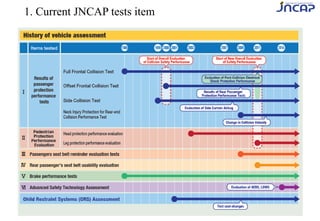
1. Current JNCAP tests item
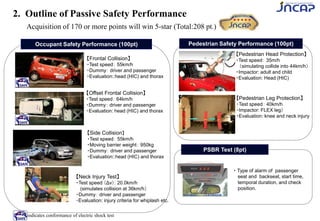
2. Outline of Passive Safety Performance
【Side Collision】
・Test speed: 55km/h
・Moving barrier weight: 950kg
・Dummy: driver and passenger
・Evaluation::head (HIC) and thorax
【Neck Injury Test】
・Test speed (Δv): 20.0km/h
(simulates collision at 36km/h)
・Dummy: driver and passenger
・Evaluation: injury criteria for whiplash etc.
【Pedestrian Head Protection】
・Test speed: 35m/h
(simulating collide into 44km/h)
・Impactor: adult and child
・Evaluation: Head (HIC)
【Pedestrian Leg Protection】
・Test speed: 40km/h
・Impactor: FLEX leg)
・Evaluation: knee and neck injury
【Offset Frontal Collision】
・Test speed: 64km/h
・Dummy: driver and passenger
・Evaluation: head (HIC) and thorax
【Frontal Collision】
・Test speed: 55km/h
・Dummy: driver and passenger
・Evaluation::head (HIC) and thorax
・Type of alarm of passenger
seat and backseat, start time,
temporal duration, and check
position.
Occupant Safety Performance (100pt)
indicates conformance of electric shock test
Pedestrian Safety Performance (100pt)
PSBR Test (8pt)
Acquisition of 170 or more points will win 5-star (Total:208 pt.)
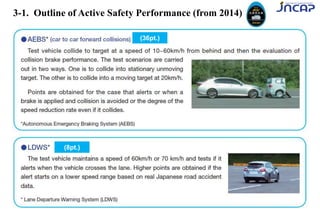
3-1. Outline of Active Safety Performance (from 2014)
(36pt.)
(8pt.)
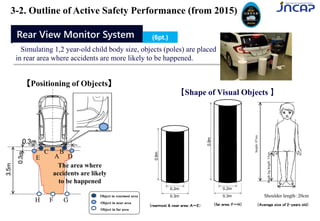
Rear View Monitor System
(rearmost & near area:A~E) (far area:F~H)
0.2m
0.3m
0.9m
0.2m
0.3m
0.6m
Shoulder length:20cm
height:87cm
Insideleglength:33cm
(Average size of 2-years old)
【Shape of Visual Objects 】
F GH
0.3m
The area where
accidents are likely
to be happened
3.5m
A DE
BC
0.3m
B
【Positioning of Objects】
Object in rearmost area
Object in near area
Object in far area
Simulating 1,2 year-old child body size, objects (poles) are placed
in rear area where accidents are more likely to be happened.
3-2. Outline of Active Safety Performance (from 2015)
(6pt.)
4. JNCAP Roadmap
Side
Neck injury protection
Prepares a test methods
Head protection
Leg protection
Usability evaluation
Overall evaluation
The vehicle type corresponding to i-SIZE
Implementation of
overall evaluation
Publication of a
correspondence vehicle type
CRSPerformance
Evaluation
Frontal collision Modifying test methods slightly
Research
Change of dummy
Side collision Implementation of test
Modifying test methods slightly Implementation of test
Implemention of possible
measures for pedestrian
accident at night time
Adaptive Front-lighting System
Night time pedestrian monitoring
system
Other advanced safety
technology system
Research of real road accident data
(Research for present technology)
Automatic Crash Notification Research Implementation of test※
Rear view monitor System Reseach Implementation of test
(AEBS[for pedestrian]) Fundamental research
Implementation of test
LDWS Implementation of test
LKAS [LDPS] Reseach Implementation of test ※
Implementation of the next-generation overall evaluation
unified with prevention assessment evaluation
Research of real road accident data
Others Research of real road accident data
AdvancedSafetyPerformanceEvaluation
AEBS[car to car] Implementation of test
AEBS[for pedestrian] Fundamental research Reseach
Overall evaluation
Reseach minor changes Reseach major renewal Research
Examining threshold value
Examining dummy,MDB,
threshold value
Fuel (Hydrogen) leakage Reseach
Pedestrian
protection
Starts test
Starts test
2021~
CollisionPerformanceEvaluation
Passengerprotection
Full-overlap
fronatal Reseach
Starts test based on thrax
flection and changes
threshold value
Examining dummy used
Offset
Research of real road accident data
Test/Evaluation 2014 2015 2016 2017 2018 2019 2020
research and
examination for
next generation
dummy
5. Roadmap of Active Safety Assessment (2016-2018)
AEBS
for pedestrian
[at daytime]
for pedestrian
[at night]
LKAS Lane Keep Assist
2016 2017 2018
Test starts
Test starts
Preparing of test
procedure Test starts
Preparing of test
procedure
We need to deploy advanced technology tests which has great
mitigation effect of traffic accidents in Japan
Consideration of test scenario and test procedure
 LKAS
 AEBS for pedestrian [at night]
 Brightness, contrast, colliding position, test facility, etc.
Others
 Work Efficiency
 Strengthen PR strategy
6. Our issues on JNCAP roadmap
8 8
Thank you
for your attention

NCAP Roundtable JNCAP

  • 1.
    Global NCAP AnnualMeeting 2015 Brasilia, Brazil 15th November 2015 NASVA (National Agency for Automotive Safety and Victims’Aid) JNCAP UPDATE
  • 2.
    1. Current JNCAPtests item
  • 3.
    2. Outline ofPassive Safety Performance 【Side Collision】 ・Test speed: 55km/h ・Moving barrier weight: 950kg ・Dummy: driver and passenger ・Evaluation::head (HIC) and thorax 【Neck Injury Test】 ・Test speed (Δv): 20.0km/h (simulates collision at 36km/h) ・Dummy: driver and passenger ・Evaluation: injury criteria for whiplash etc. 【Pedestrian Head Protection】 ・Test speed: 35m/h (simulating collide into 44km/h) ・Impactor: adult and child ・Evaluation: Head (HIC) 【Pedestrian Leg Protection】 ・Test speed: 40km/h ・Impactor: FLEX leg) ・Evaluation: knee and neck injury 【Offset Frontal Collision】 ・Test speed: 64km/h ・Dummy: driver and passenger ・Evaluation: head (HIC) and thorax 【Frontal Collision】 ・Test speed: 55km/h ・Dummy: driver and passenger ・Evaluation::head (HIC) and thorax ・Type of alarm of passenger seat and backseat, start time, temporal duration, and check position. Occupant Safety Performance (100pt) indicates conformance of electric shock test Pedestrian Safety Performance (100pt) PSBR Test (8pt) Acquisition of 170 or more points will win 5-star (Total:208 pt.)
  • 4.
    3-1. Outline ofActive Safety Performance (from 2014) (36pt.) (8pt.)
  • 5.
    Rear View MonitorSystem (rearmost & near area:A~E) (far area:F~H) 0.2m 0.3m 0.9m 0.2m 0.3m 0.6m Shoulder length:20cm height:87cm Insideleglength:33cm (Average size of 2-years old) 【Shape of Visual Objects 】 F GH 0.3m The area where accidents are likely to be happened 3.5m A DE BC 0.3m B 【Positioning of Objects】 Object in rearmost area Object in near area Object in far area Simulating 1,2 year-old child body size, objects (poles) are placed in rear area where accidents are more likely to be happened. 3-2. Outline of Active Safety Performance (from 2015) (6pt.)
  • 6.
    4. JNCAP Roadmap Side Neckinjury protection Prepares a test methods Head protection Leg protection Usability evaluation Overall evaluation The vehicle type corresponding to i-SIZE Implementation of overall evaluation Publication of a correspondence vehicle type CRSPerformance Evaluation Frontal collision Modifying test methods slightly Research Change of dummy Side collision Implementation of test Modifying test methods slightly Implementation of test Implemention of possible measures for pedestrian accident at night time Adaptive Front-lighting System Night time pedestrian monitoring system Other advanced safety technology system Research of real road accident data (Research for present technology) Automatic Crash Notification Research Implementation of test※ Rear view monitor System Reseach Implementation of test (AEBS[for pedestrian]) Fundamental research Implementation of test LDWS Implementation of test LKAS [LDPS] Reseach Implementation of test ※ Implementation of the next-generation overall evaluation unified with prevention assessment evaluation Research of real road accident data Others Research of real road accident data AdvancedSafetyPerformanceEvaluation AEBS[car to car] Implementation of test AEBS[for pedestrian] Fundamental research Reseach Overall evaluation Reseach minor changes Reseach major renewal Research Examining threshold value Examining dummy,MDB, threshold value Fuel (Hydrogen) leakage Reseach Pedestrian protection Starts test Starts test 2021~ CollisionPerformanceEvaluation Passengerprotection Full-overlap fronatal Reseach Starts test based on thrax flection and changes threshold value Examining dummy used Offset Research of real road accident data Test/Evaluation 2014 2015 2016 2017 2018 2019 2020 research and examination for next generation dummy
  • 7.
    5. Roadmap ofActive Safety Assessment (2016-2018) AEBS for pedestrian [at daytime] for pedestrian [at night] LKAS Lane Keep Assist 2016 2017 2018 Test starts Test starts Preparing of test procedure Test starts Preparing of test procedure
  • 8.
    We need todeploy advanced technology tests which has great mitigation effect of traffic accidents in Japan Consideration of test scenario and test procedure  LKAS  AEBS for pedestrian [at night]  Brightness, contrast, colliding position, test facility, etc. Others  Work Efficiency  Strengthen PR strategy 6. Our issues on JNCAP roadmap
  • 9.
    8 8 Thank you foryour attention