Interprocess
Communication
Mutual exclusion
And
synchronizations
Interprocess Communication
• Communication of processes running
concurrently on a computer system.
• Major issues
– Passing information to another process
– Not disturbing other processes when
doing critical activities.
– Process synchronization
Race conditions
• Occurs when multiple processes access
and manipulate the same shared data
concurrently and the outcome of the
execution depends on the particular order in
which the access takes place.
• Example
– Assume two processes incrementing the value
of the same shared variable.
– The value of the var will depend on the
sequence the processes access the var.
Critical Region/section
• A piece of code that access a shared
resource.
• A process is said to be in its critical
section when it is executing critical code.
Mutual exclusion
• When one process is executing in its critical
section, no other process can execute in its
critical section
• Each process takes the form
– Repeat
• Entry section
• Critical section
– Exit critical section
• Remainder section
– Forever
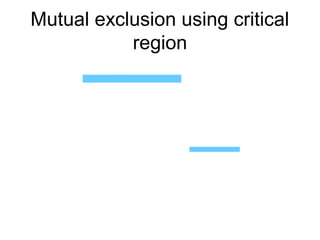
Mutual exclusion using critical
region
Process A
Process B
t1 t2 t3
t4
Time
Enter Critical section
A leaves critical section
B attempts to critical section and is blocked
B leaves critical section
Conditions for mutual exclusion
solution
• No two processes may be
simultaneously inside their critical
region
• No assumption may be made about
the speeds or the number of CPUs
• No process running outside its critical
section may block other processes
• No process should have to wait
forever to enter its critical region.
Solutions to Mutual exclusion
• Disabling interrupts
• Using lock variables
• Strict alternation
• Using TLS instruction
• Strict alternation
• Petersons solution
• Semaphores
• Monitors
Semaphores
• Suggested by E W Dijkstra(1965)
• Nonnegative integer variable(S) that can be
operated upon by wait(s) and Signal(s) and
the initialization operation.
• Used in mutual exclusion and process
synchronization
• Types
– Binary /mutex semaphore
– Counting semaphores
Semaphore operations
• Signal(S)
– Increases the value of S
– Atomic operation (cannot be interrupted)
• Signal()
– S++
• Wait(S)
– Decreases the value of S
– Atomic operation (cannot be interrupted)
• Signal()
– S--
Semaphore Types
• Types
– Binary /mutex semaphore
• Used for mutual exclusion
• S only takes on values 0,1
– Counting semaphores
• Used for process synchronization
• Represents the number of resources available
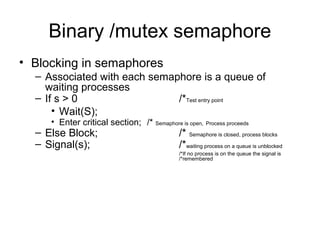
Binary /mutex semaphore
• Blocking in semaphores
– Associated with each semaphore is a queue of
waiting processes
– If s > 0 /*Test entry point
• Wait(S);
• Enter critical section; /* Semaphore is open, Process proceeds
– Else Block; /* Semaphore is closed, process blocks
– Signal(s); /*waiting process on a queue is unblocked
/*If no process is on the queue the signal is
/*remembered
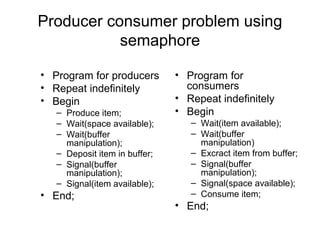
Producer consumer problem using
semaphore
• Program for producers
• Repeat indefinitely
• Begin
– Produce item;
– Wait(space available);
– Wait(buffer
manipulation);
– Deposit item in buffer;
– Signal(buffer
manipulation);
– Signal(item available);
• End;
• Program for
consumers
• Repeat indefinitely
• Begin
– Wait(item available);
– Wait(buffer
manipulation)
– Excract item from buffer;
– Signal(buffer
manipulation);
– Signal(space available);
– Consume item;
• End;
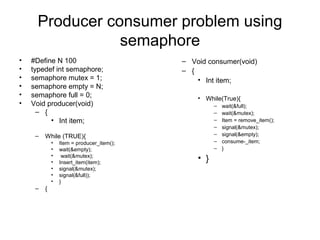
Producer consumer problem using
semaphore
• #Define N 100
• typedef int semaphore;
• semaphore mutex = 1;
• semaphore empty = N;
• semaphore full = 0;
• Void producer(void)
– {
• Int item;
– While (TRUE){
• Item = producer_item();
• wait(&empty);
• wait(&mutex);
• Insert_item(item);
• signal(&mutex);
• signal(&full));
• }
– {
– Void consumer(void)
– {
• Int item;
• While(True){
– wait(&full);
– wait(&mutex);
– Item = remove_item();
– signal(&mutex);
– signal(&empty);
– consume-_item;
– }
• }
Semaphore summary
• Semaphores can be used to solve any of the
synchronization problem
• However ,thy have some drawbacks
– They are shared variables.
– No connection between the semaphore and the data
being controlled
– No guarantee of proper usage
• Hard to use
– Use programming language support
Monitors
• Programming language construct that controls access to shared
data
• Mutual exclusion code added by the compiler, enforced at runtime
• Consists of
– Shared data structures and variables
– Procedures that operate on (1)
– Piece of program that initialize the variables
• Protects its data from unstructured access
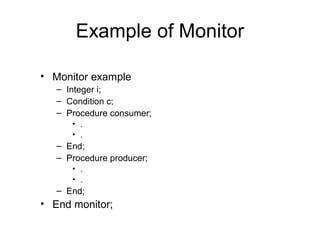
Example of Monitor
• Monitor example
– Integer i;
– Condition c;
– Procedure consumer;
• .
• .
– End;
– Procedure producer;
• .
• .
– End;
• End monitor;
Monitors and mutual exclusion
• Monitors guarantees mutual exclusion
• Only one process can be active in a monitor at any time
– Compiler must handle monitor procedures differently from other
procedures
– Compiler must implement mutual exclusion on monitor entries
• If a second process invokes a monitor procedure when
the first one is within the monitor, it blocks.
– Monitor has to have a wait queue
• If no process is using the monitor, the calling process
may enter.
Condition Variables
• Provides a mechanism to wait for
events
• Support two operations
• Wait
– Causes the calling process to block
• Signal
– Wake up sleeping process
Signal Semantics
• Hoare monitors
– Allow newly awakened process to run, suspending the
other
• Brinch Hansen proposal
– Process doing a signal must exit the monitor immediately
– Putting signal statement as the final statement in a monitor
procedure
• Mesa Monitor
– Signal() places a waiter on the ready queue,but signaler
continues inside the monitor
– Condition is not necessarily true when waiter runs again
Condition variables vs
semaphores
• Semaphores
– Can be used anywhere in a program, but should not be used in a monitor Wait()
– Wait() does not always block the caller (i.e., when the semaphore counter is greater than
zero).
– Signal() either releases a blocked thread, if there is one, or increases the semaphore
counter.
– If Signal() releases a blocked thread, the caller and the released thread both continue.
• Condition Variables
– Can only be used in monitors
– Wait always block the caller
– Signal() either releases a blocked thread, if there is one, or the signal is lost as if it never
happens.
– If Signal() releases a blocked thread, the caller yields the monitor (Hoare type) or continues
(Mesa Type). Only one of the caller or the released thread can continue, but not both.

Inter process communication

  • 1.
  • 2.
    Interprocess Communication • Communicationof processes running concurrently on a computer system. • Major issues – Passing information to another process – Not disturbing other processes when doing critical activities. – Process synchronization
  • 3.
    Race conditions • Occurswhen multiple processes access and manipulate the same shared data concurrently and the outcome of the execution depends on the particular order in which the access takes place. • Example – Assume two processes incrementing the value of the same shared variable. – The value of the var will depend on the sequence the processes access the var.
  • 4.
    Critical Region/section • Apiece of code that access a shared resource. • A process is said to be in its critical section when it is executing critical code.
  • 5.
    Mutual exclusion • Whenone process is executing in its critical section, no other process can execute in its critical section • Each process takes the form – Repeat • Entry section • Critical section – Exit critical section • Remainder section – Forever
  • 6.
    Mutual exclusion usingcritical region Process A Process B t1 t2 t3 t4 Time Enter Critical section A leaves critical section B attempts to critical section and is blocked B leaves critical section
  • 7.
    Conditions for mutualexclusion solution • No two processes may be simultaneously inside their critical region • No assumption may be made about the speeds or the number of CPUs • No process running outside its critical section may block other processes • No process should have to wait forever to enter its critical region.
  • 8.
    Solutions to Mutualexclusion • Disabling interrupts • Using lock variables • Strict alternation • Using TLS instruction • Strict alternation • Petersons solution • Semaphores • Monitors
  • 9.
    Semaphores • Suggested byE W Dijkstra(1965) • Nonnegative integer variable(S) that can be operated upon by wait(s) and Signal(s) and the initialization operation. • Used in mutual exclusion and process synchronization • Types – Binary /mutex semaphore – Counting semaphores
  • 10.
    Semaphore operations • Signal(S) –Increases the value of S – Atomic operation (cannot be interrupted) • Signal() – S++ • Wait(S) – Decreases the value of S – Atomic operation (cannot be interrupted) • Signal() – S--
  • 11.
    Semaphore Types • Types –Binary /mutex semaphore • Used for mutual exclusion • S only takes on values 0,1 – Counting semaphores • Used for process synchronization • Represents the number of resources available
  • 12.
    Binary /mutex semaphore •Blocking in semaphores – Associated with each semaphore is a queue of waiting processes – If s > 0 /*Test entry point • Wait(S); • Enter critical section; /* Semaphore is open, Process proceeds – Else Block; /* Semaphore is closed, process blocks – Signal(s); /*waiting process on a queue is unblocked /*If no process is on the queue the signal is /*remembered
  • 13.
    Producer consumer problemusing semaphore • Program for producers • Repeat indefinitely • Begin – Produce item; – Wait(space available); – Wait(buffer manipulation); – Deposit item in buffer; – Signal(buffer manipulation); – Signal(item available); • End; • Program for consumers • Repeat indefinitely • Begin – Wait(item available); – Wait(buffer manipulation) – Excract item from buffer; – Signal(buffer manipulation); – Signal(space available); – Consume item; • End;
  • 14.
    Producer consumer problemusing semaphore • #Define N 100 • typedef int semaphore; • semaphore mutex = 1; • semaphore empty = N; • semaphore full = 0; • Void producer(void) – { • Int item; – While (TRUE){ • Item = producer_item(); • wait(&empty); • wait(&mutex); • Insert_item(item); • signal(&mutex); • signal(&full)); • } – { – Void consumer(void) – { • Int item; • While(True){ – wait(&full); – wait(&mutex); – Item = remove_item(); – signal(&mutex); – signal(&empty); – consume-_item; – } • }
  • 15.
    Semaphore summary • Semaphorescan be used to solve any of the synchronization problem • However ,thy have some drawbacks – They are shared variables. – No connection between the semaphore and the data being controlled – No guarantee of proper usage • Hard to use – Use programming language support
  • 16.
    Monitors • Programming languageconstruct that controls access to shared data • Mutual exclusion code added by the compiler, enforced at runtime • Consists of – Shared data structures and variables – Procedures that operate on (1) – Piece of program that initialize the variables • Protects its data from unstructured access
  • 17.
    Example of Monitor •Monitor example – Integer i; – Condition c; – Procedure consumer; • . • . – End; – Procedure producer; • . • . – End; • End monitor;
  • 18.
    Monitors and mutualexclusion • Monitors guarantees mutual exclusion • Only one process can be active in a monitor at any time – Compiler must handle monitor procedures differently from other procedures – Compiler must implement mutual exclusion on monitor entries • If a second process invokes a monitor procedure when the first one is within the monitor, it blocks. – Monitor has to have a wait queue • If no process is using the monitor, the calling process may enter.
  • 19.
    Condition Variables • Providesa mechanism to wait for events • Support two operations • Wait – Causes the calling process to block • Signal – Wake up sleeping process
  • 20.
    Signal Semantics • Hoaremonitors – Allow newly awakened process to run, suspending the other • Brinch Hansen proposal – Process doing a signal must exit the monitor immediately – Putting signal statement as the final statement in a monitor procedure • Mesa Monitor – Signal() places a waiter on the ready queue,but signaler continues inside the monitor – Condition is not necessarily true when waiter runs again
  • 21.
    Condition variables vs semaphores •Semaphores – Can be used anywhere in a program, but should not be used in a monitor Wait() – Wait() does not always block the caller (i.e., when the semaphore counter is greater than zero). – Signal() either releases a blocked thread, if there is one, or increases the semaphore counter. – If Signal() releases a blocked thread, the caller and the released thread both continue. • Condition Variables – Can only be used in monitors – Wait always block the caller – Signal() either releases a blocked thread, if there is one, or the signal is lost as if it never happens. – If Signal() releases a blocked thread, the caller yields the monitor (Hoare type) or continues (Mesa Type). Only one of the caller or the released thread can continue, but not both.