What is Poetry?
2
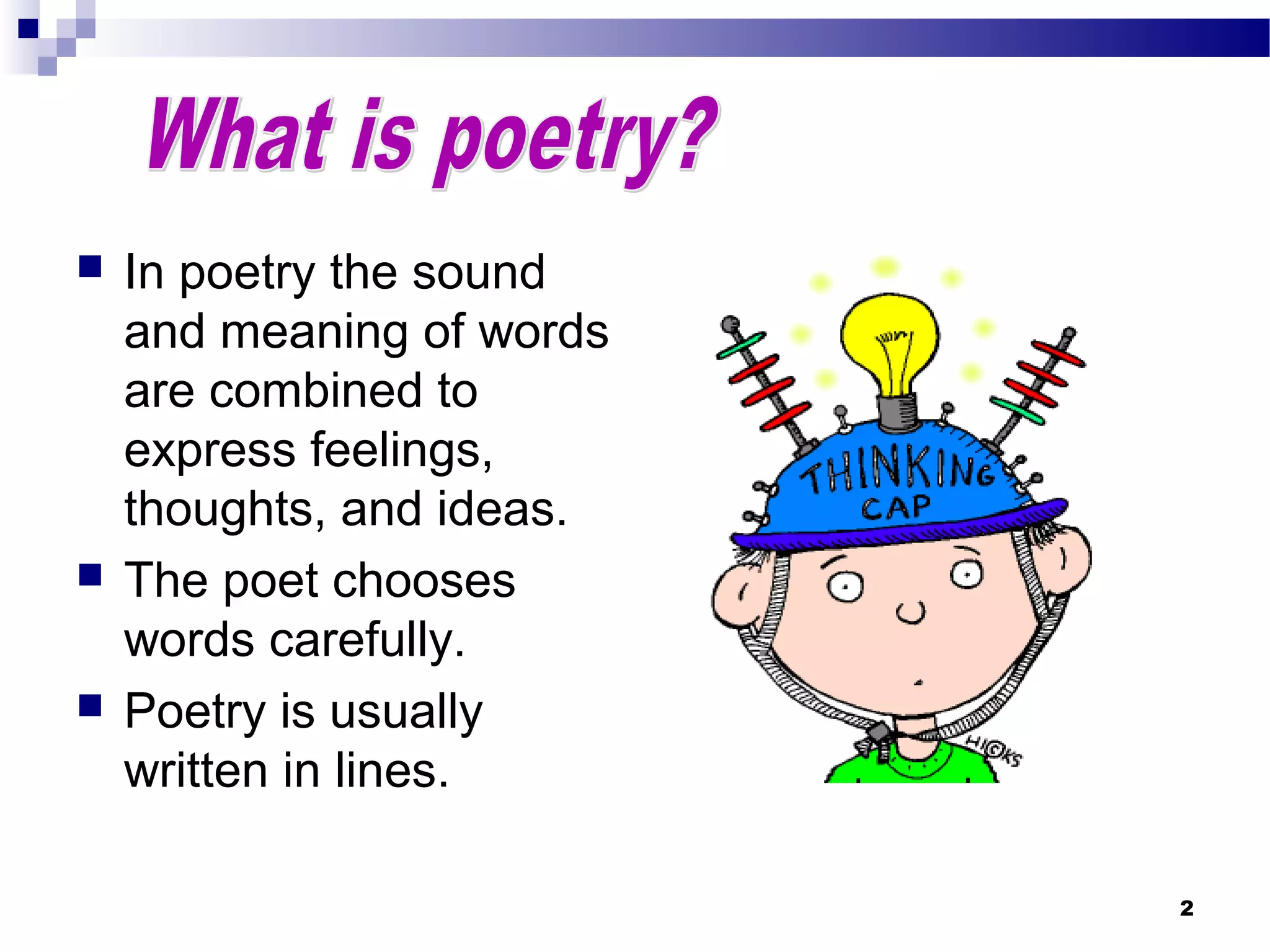
 In poetry the sound
and meaning of words
are combined to
express feelings,
thoughts, and ideas.
 The poet chooses
words carefully.
 Poetry is usually
written in lines.
3
Poetry Elements
 Rhythm
 Sound
 Imagery
 Form
Writers use many elements to create their
poems. These elements include:
4
Rhythm
 Rhythm is the flow of the
beat in a poem.
 Gives poetry a musical
feel.
 Can be fast or slow,
depending on mood and
subject of poem.
 You can measure rhythm
in meter, by counting the
beats in each line.
 (See next two slides for
examples.)
5
Rhythm Example
The pickety fence
The pickety fence
Give it a lick it's
The pickety fence
Give it a lick it's
A clickety fence
Give it a lick it's a lickety fence
Give it a lick
Give it a lick
Give it a lick
With a rickety stick
pickety
pickety
pickety
pick.
The Pickety Fence by David McCord
The rhythm in this poem is fast –
to match the speed of the stick
striking the fence.
6
Rhythm Example
When the night begins to fall
And the sky begins to glow
You look up and see the tall
City of lights begin to grow –
In rows and little golden squares
The lights come out. First here, then there
Behind the windowpanes as though
A million billion bees had built
Their golden hives and honeycombs
Above you in the air.
By Mary Britton Miller
Where Are You Now?
The rhythm in this poem is
slow – to match the night
gently falling and the
lights slowly coming on.
7
Sound
 Rhyme
 Repetition
 Alliteration
 Onomatopoeia
Writers love to use interesting sounds in
their poems. After all, poems are meant
to be heard. These sound devices include:
8
Rhyme
 Rhymes are words that
end with the same sound.
(Hat, cat and bat rhyme.)
 Rhyming sounds don’t
have to be spelled the
same way. (Cloud and
allowed rhyme.)
 Rhyme is the most
common sound device in
poetry.
9
Rhyming Patterns
 Poets can choose from
a variety of different
rhyming patterns.
 (See next four slides
for examples.)
 AABB – lines 1 & 2 rhyme
and lines 3 & 4 rhyme
 ABAB – lines 1 & 3 rhyme
and lines 2 & 4 rhyme
 ABBA – lines 1 & 4 rhyme
and lines 2 & 3 rhyme
 ABCB – lines 2 & 4 rhyme
and lines 1 & 3 do not
rhyme
10
AABB Rhyming Pattern
Snow makes whiteness where it falls.
The bushes look like popcorn balls.
And places where I always play,
Look like somewhere else today.
By Marie Louise Allen
First Snow
11
ABAB Rhyming Pattern
I love noodles. Give me oodles.
Make a mound up to the sun.
Noodles are my favorite foodles.
I eat noodles by the ton.
By Lucia and James L. Hymes, Jr.
Oodles of Noodles
12
ABBA Rhyming Pattern
Let me fetch sticks,
Let me fetch stones,
Throw me your bones,
Teach me your tricks.
By Eleanor Farjeon
From “Bliss”
13
ABCB Rhyming Pattern
The alligator chased his tail
Which hit him in the snout;
He nibbled, gobbled, swallowed it,
And turned right inside-out.
by Mary Macdonald
The Alligator
14
Repetition
 Repetition occurs when
poets repeat words, phrases,
or lines in a poem.
 Creates a pattern.
 Increases rhythm.
 Strengthens feelings, ideas
and mood in a poem.
 (See next slide for example.)
15
Repetition Example
Some one tossed a pancake,
A buttery, buttery, pancake.
Someone tossed a pancake
And flipped it up so high,
That now I see the pancake,
The buttery, buttery pancake,
Now I see that pancake
Stuck against the sky.
by Sandra Liatsos
The Sun
16
Alliteration
 Alliteration is the
repetition of the first
consonant sound in
words, as in the
nursery rhyme “Peter
Piper picked a peck
of pickled peppers.”
 (See next slide for
example.)
The snake slithered silently
along the sunny sidewalk.
17
Alliteration Example
I jiggled it
jaggled it
jerked it.
I pushed
and pulled
and poked it.
But –
As soon as I stopped,
And left it alone
This tooth came out
On its very own!
by Lee Bennett Hopkins
This Tooth
18
Onomatopoeia
 Words that represent the
actual sound of something
are words of onomatopoeia.
Dogs “bark,” cats “purr,”
thunder “booms,” rain
“drips,” and the clock “ticks.”
 Appeals to the sense of
sound.
 (See next slide for example.)
19
Onomatopoeia Example
Scrunch, scrunch, scrunch.
Crunch, crunch, crunch.
Frozen snow and brittle ice
Make a winter sound that’s nice
Underneath my stamping feet
And the cars along the street.
Scrunch, scrunch, scrunch.
Crunch, crunch, crunch.
by Margaret Hillert
Listen
20
Imagery
Five Senses
 Imagery is the use of words
to create pictures, or images,
in your mind.
 Appeals to the five senses:
smell, sight, hearing, taste
and touch.
 Details about smells, sounds,
colors, and taste create
strong images.
 To create vivid images
writers use figures of speech.
21
Figures of Speech
 Figures of speech are
tools that writers use to
create images, or “paint
pictures,” in your mind.
 Similes, metaphors, and
personification are three
figures of speech that
create imagery.
22
Simile
 A simile compares two
things using the words
“like” or “as.”
 Comparing one thing to
another creates a vivid
image.
 (See next slide for
example.) The runner streaked like a cheetah.
23
Simile Example
An emerald is as green as grass,
A ruby red as blood;
A sapphire shines as blue as heaven;
A flint lies in the mud.
A diamond is a brilliant stone,
To catch the world’s desire;
An opal holds a fiery spark;
But a flint holds fire.
By Christina Rosetti
Flint
24
Metaphor
 A metaphor compares
two things without using
the words “like” or “as.”
 Gives the qualities of one
thing to something that is
quite different.
 (See next slide for
example.)
The winter wind is a wolf
howling at the door.
25
Metaphor Example
The Night is a big black cat
The moon is her topaz eye,
The stars are the mice she hunts at night,
In the field of the sultry sky.
By G. Orr Clark
The Night is a Big Black Cat
26
Personification
 Personification gives
human traits and
feelings to things that
are not human – like
animals or objects.
 (See next slide for
example.)
The moon smiled down at
me.
27
Personification Example
Mister Sun
Wakes up at dawn,
Puts his golden
Slippers on,
Climbs the summer
Sky at noon,
Trading places
With the moon.
by J. Patrick Lewis
From “Mister Sun”
28
Forms of Poetry
 Couplet
 Tercet
 Acrostic
 Cinquain
 Haiku
 Senryu
 Concrete Poem
 Free Verse
 Limerick
There are many forms of poetry including the:

What is poetry?

  • 1.
  • 2.
    2  In poetrythe sound and meaning of words are combined to express feelings, thoughts, and ideas.  The poet chooses words carefully.  Poetry is usually written in lines.
  • 3.
    3 Poetry Elements  Rhythm Sound  Imagery  Form Writers use many elements to create their poems. These elements include:
  • 4.
    4 Rhythm  Rhythm isthe flow of the beat in a poem.  Gives poetry a musical feel.  Can be fast or slow, depending on mood and subject of poem.  You can measure rhythm in meter, by counting the beats in each line.  (See next two slides for examples.)
  • 5.
    5 Rhythm Example The picketyfence The pickety fence Give it a lick it's The pickety fence Give it a lick it's A clickety fence Give it a lick it's a lickety fence Give it a lick Give it a lick Give it a lick With a rickety stick pickety pickety pickety pick. The Pickety Fence by David McCord The rhythm in this poem is fast – to match the speed of the stick striking the fence.
  • 6.
    6 Rhythm Example When thenight begins to fall And the sky begins to glow You look up and see the tall City of lights begin to grow – In rows and little golden squares The lights come out. First here, then there Behind the windowpanes as though A million billion bees had built Their golden hives and honeycombs Above you in the air. By Mary Britton Miller Where Are You Now? The rhythm in this poem is slow – to match the night gently falling and the lights slowly coming on.
  • 7.
    7 Sound  Rhyme  Repetition Alliteration  Onomatopoeia Writers love to use interesting sounds in their poems. After all, poems are meant to be heard. These sound devices include:
  • 8.
    8 Rhyme  Rhymes arewords that end with the same sound. (Hat, cat and bat rhyme.)  Rhyming sounds don’t have to be spelled the same way. (Cloud and allowed rhyme.)  Rhyme is the most common sound device in poetry.
  • 9.
    9 Rhyming Patterns  Poetscan choose from a variety of different rhyming patterns.  (See next four slides for examples.)  AABB – lines 1 & 2 rhyme and lines 3 & 4 rhyme  ABAB – lines 1 & 3 rhyme and lines 2 & 4 rhyme  ABBA – lines 1 & 4 rhyme and lines 2 & 3 rhyme  ABCB – lines 2 & 4 rhyme and lines 1 & 3 do not rhyme
  • 10.
    10 AABB Rhyming Pattern Snowmakes whiteness where it falls. The bushes look like popcorn balls. And places where I always play, Look like somewhere else today. By Marie Louise Allen First Snow
  • 11.
    11 ABAB Rhyming Pattern Ilove noodles. Give me oodles. Make a mound up to the sun. Noodles are my favorite foodles. I eat noodles by the ton. By Lucia and James L. Hymes, Jr. Oodles of Noodles
  • 12.
    12 ABBA Rhyming Pattern Letme fetch sticks, Let me fetch stones, Throw me your bones, Teach me your tricks. By Eleanor Farjeon From “Bliss”
  • 13.
    13 ABCB Rhyming Pattern Thealligator chased his tail Which hit him in the snout; He nibbled, gobbled, swallowed it, And turned right inside-out. by Mary Macdonald The Alligator
  • 14.
    14 Repetition  Repetition occurswhen poets repeat words, phrases, or lines in a poem.  Creates a pattern.  Increases rhythm.  Strengthens feelings, ideas and mood in a poem.  (See next slide for example.)
  • 15.
    15 Repetition Example Some onetossed a pancake, A buttery, buttery, pancake. Someone tossed a pancake And flipped it up so high, That now I see the pancake, The buttery, buttery pancake, Now I see that pancake Stuck against the sky. by Sandra Liatsos The Sun
  • 16.
    16 Alliteration  Alliteration isthe repetition of the first consonant sound in words, as in the nursery rhyme “Peter Piper picked a peck of pickled peppers.”  (See next slide for example.) The snake slithered silently along the sunny sidewalk.
  • 17.
    17 Alliteration Example I jiggledit jaggled it jerked it. I pushed and pulled and poked it. But – As soon as I stopped, And left it alone This tooth came out On its very own! by Lee Bennett Hopkins This Tooth
  • 18.
    18 Onomatopoeia  Words thatrepresent the actual sound of something are words of onomatopoeia. Dogs “bark,” cats “purr,” thunder “booms,” rain “drips,” and the clock “ticks.”  Appeals to the sense of sound.  (See next slide for example.)
  • 19.
    19 Onomatopoeia Example Scrunch, scrunch,scrunch. Crunch, crunch, crunch. Frozen snow and brittle ice Make a winter sound that’s nice Underneath my stamping feet And the cars along the street. Scrunch, scrunch, scrunch. Crunch, crunch, crunch. by Margaret Hillert Listen
  • 20.
    20 Imagery Five Senses  Imageryis the use of words to create pictures, or images, in your mind.  Appeals to the five senses: smell, sight, hearing, taste and touch.  Details about smells, sounds, colors, and taste create strong images.  To create vivid images writers use figures of speech.
  • 21.
    21 Figures of Speech Figures of speech are tools that writers use to create images, or “paint pictures,” in your mind.  Similes, metaphors, and personification are three figures of speech that create imagery.
  • 22.
    22 Simile  A similecompares two things using the words “like” or “as.”  Comparing one thing to another creates a vivid image.  (See next slide for example.) The runner streaked like a cheetah.
  • 23.
    23 Simile Example An emeraldis as green as grass, A ruby red as blood; A sapphire shines as blue as heaven; A flint lies in the mud. A diamond is a brilliant stone, To catch the world’s desire; An opal holds a fiery spark; But a flint holds fire. By Christina Rosetti Flint
  • 24.
    24 Metaphor  A metaphorcompares two things without using the words “like” or “as.”  Gives the qualities of one thing to something that is quite different.  (See next slide for example.) The winter wind is a wolf howling at the door.
  • 25.
    25 Metaphor Example The Nightis a big black cat The moon is her topaz eye, The stars are the mice she hunts at night, In the field of the sultry sky. By G. Orr Clark The Night is a Big Black Cat
  • 26.
    26 Personification  Personification gives humantraits and feelings to things that are not human – like animals or objects.  (See next slide for example.) The moon smiled down at me.
  • 27.
    27 Personification Example Mister Sun Wakesup at dawn, Puts his golden Slippers on, Climbs the summer Sky at noon, Trading places With the moon. by J. Patrick Lewis From “Mister Sun”
  • 28.
    28 Forms of Poetry Couplet  Tercet  Acrostic  Cinquain  Haiku  Senryu  Concrete Poem  Free Verse  Limerick There are many forms of poetry including the: