Imagery
 Descriptive language that appeals to the five senses.
 There are five types of imagery you need to know…
Imagery (cont.)
 Visual Imagery-
 Imagery that deals with picturing something.
 Example: The dark, black cloud began to block the
azure, blue sky as we sat and watched on the beach.
 Auditory Imagery-
 Imagery that deals with sound and hearing.
 Example: The doorbell rang and Rayna screamed, “I’ll get it!”
Imagery (cont.)
 Olfactory Imagery-
 Imagery that represents a smell.
 Example: The garbage can released an odor of rancid,
three-week-old milk.
 Gustatory Imagery-
 Imagery that represents a taste.
 Example: Mark tasted the briny, bitter salt water for the
first time.
Imagery (cont.)
 Tactile Imagery-
 Imagery that represents touch.
 Example: She dug her toes in the wet sand, but she was
still sweating from the hot sun.
Tone
 An author’s attitude toward his or her subject matter.
 We can figure out tone by an author’s word choice,
punctuation, sentence structure, and figures of speech.
 SAMPLE TONE WORDS:
sympathetic, serious, ironic, sad, bitter, humorous,
angry, apologetic, critical, proud
Mood
 The emotional quality of a literary work.
 Mood is determined by setting, subject matter, and
tone.
 SAMPLE MOOD WORDS:
Cheerful, gloomy, bleak, eerie, tense, calm, ominous,
uncertain, miserable
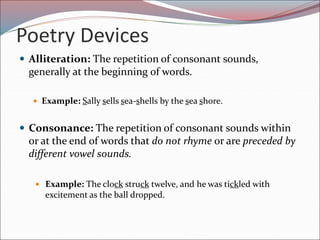
Poetry Devices
 Alliteration: The repetition of consonant sounds,
generally at the beginning of words.
 Example: Sally sells sea-shells by the sea shore.
 Consonance: The repetition of consonant sounds within
or at the end of words that do not rhyme or are preceded by
different vowel sounds.
 Example: The clock struck twelve, and he was tickled with
excitement as the ball dropped.
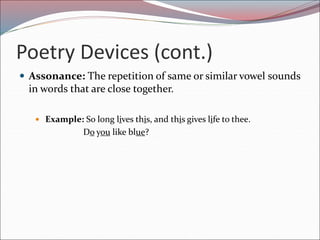
Poetry Devices (cont.)
 Assonance: The repetition of same or similar vowel sounds
in words that are close together.
 Example: So long lives this, and this gives life to thee.
Do you like blue?
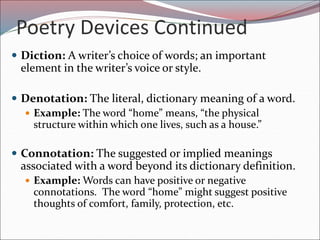
Poetry Devices Continued
 Diction: A writer’s choice of words; an important
element in the writer’s voice or style.
 Denotation: The literal, dictionary meaning of a word.
 Example: The word “home” means, “the physical
structure within which one lives, such as a house.”
 Connotation: The suggested or implied meanings
associated with a word beyond its dictionary definition.
 Example: Words can have positive or negative
connotations. The word “home” might suggest positive
thoughts of comfort, family, protection, etc.
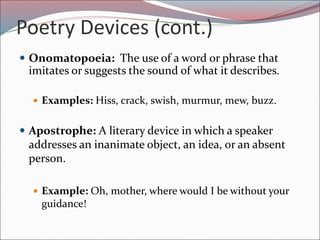
Poetry Devices (cont.)
 Onomatopoeia: The use of a word or phrase that
imitates or suggests the sound of what it describes.
 Examples: Hiss, crack, swish, murmur, mew, buzz.
 Apostrophe: A literary device in which a speaker
addresses an inanimate object, an idea, or an absent
person.
 Example: Oh, mother, where would I be without your
guidance!
Poetry Devices (cont.)
 Repetition: The recurrence of sounds, words, phrases,
lines or stanzas in a poem.
 Writers use repetition to emphasize an important
point, to expand on an idea, to create rhythm, and to
increase the unity of the work.
 Example: The repeated chorus of a song emphasizes the
message of that song.
Poetry Devices: 3 Types of Rhyme
 End Rhyme: The rhyming of words at the end of a line.
 Example: They could not excuse the sin.
That was committed by his kin.
 Internal Rhyme: Rhyme that occurs within a single line of
poetry.
 Example: No, baby, no, you may not go.”
 Slant Rhyme: Two words sound similar, but do not have a
perfect rhyme.
 Example: The words jackal and buckle.
Structure Items
 Speaker: The voice that communicates with the
reader of a poem (like a narrator).
 Stanza: A group of lines forming a unit in a poem
or a song.
 Line: The basic unit of poetry. The line is a word
or a row of words (not a sentence that extends over
to the next line, though).
 There are four structural poems you will need to know
based on the number of lines.
Structural Items (continued)
 Four types of poems based on line number:
 Couplet: Consists of two lines.
 Quatrain: Consists of four lines.
 Sestet: Consists of six lines.
 Octave: Consists of eight lines.
Structural Items (continued)
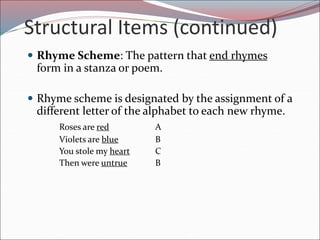
 Rhyme Scheme: The pattern that end rhymes
form in a stanza or poem.
 Rhyme scheme is designated by the assignment of a
different letter of the alphabet to each new rhyme.
Roses are red A
Violets are blue B
You stole my heart C
Then were untrue B
Poetry Types
 Narrative Poem: A poem that tells a story. Narrative
poems are usually contrasted with lyric poems.
 Lyric Poem: Poetry that expresses a speaker’s personal
thoughts or feelings.
 Free Verse: Poetry that has no fixed pattern of meter,
rhyme, line length, or stanza arrangement.
Poetry Types (cont.)
 Ode: A long, serious lyric poem that is elevated in
tone and style.
 Some odes celebrate a person, an event, or even a power
or object.
 Haiku: A traditional, nature-inspired Japanese form
of poetry that has 3 lines and 17 syllables.
 Lines one and three are five syllables each.
 Line two is seven syllables.
 Sonnet: A lyric poem of 14 lines, typically written in
iambic pentameter and following strict patterns of
stanza division and rhyme.
Haiku Poems
 One thing haiku poems try to do is present imagery
and details that try to convey a larger insight or
meaning.
 For example, a writer is not simply describing a setting,
but they are describing a setting to provide insight or a
larger meaning.
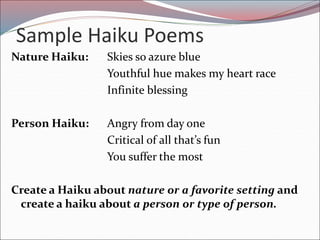
Sample Haiku Poems
Nature Haiku: Skies so azure blue
Youthful hue makes my heart race
Infinite blessing
Person Haiku: Angry from day one
Critical of all that’s fun
You suffer the most
Create a Haiku about nature or a favorite setting and
create a haiku about a person or type of person.

Poetry Devices Structure and Forms.ppt

  • 2.
    Imagery  Descriptive languagethat appeals to the five senses.  There are five types of imagery you need to know…
  • 3.
    Imagery (cont.)  VisualImagery-  Imagery that deals with picturing something.  Example: The dark, black cloud began to block the azure, blue sky as we sat and watched on the beach.  Auditory Imagery-  Imagery that deals with sound and hearing.  Example: The doorbell rang and Rayna screamed, “I’ll get it!”
  • 4.
    Imagery (cont.)  OlfactoryImagery-  Imagery that represents a smell.  Example: The garbage can released an odor of rancid, three-week-old milk.  Gustatory Imagery-  Imagery that represents a taste.  Example: Mark tasted the briny, bitter salt water for the first time.
  • 5.
    Imagery (cont.)  TactileImagery-  Imagery that represents touch.  Example: She dug her toes in the wet sand, but she was still sweating from the hot sun.
  • 6.
    Tone  An author’sattitude toward his or her subject matter.  We can figure out tone by an author’s word choice, punctuation, sentence structure, and figures of speech.  SAMPLE TONE WORDS: sympathetic, serious, ironic, sad, bitter, humorous, angry, apologetic, critical, proud
  • 7.
    Mood  The emotionalquality of a literary work.  Mood is determined by setting, subject matter, and tone.  SAMPLE MOOD WORDS: Cheerful, gloomy, bleak, eerie, tense, calm, ominous, uncertain, miserable
  • 8.
    Poetry Devices  Alliteration:The repetition of consonant sounds, generally at the beginning of words.  Example: Sally sells sea-shells by the sea shore.  Consonance: The repetition of consonant sounds within or at the end of words that do not rhyme or are preceded by different vowel sounds.  Example: The clock struck twelve, and he was tickled with excitement as the ball dropped.
  • 9.
    Poetry Devices (cont.) Assonance: The repetition of same or similar vowel sounds in words that are close together.  Example: So long lives this, and this gives life to thee. Do you like blue?
  • 10.
    Poetry Devices Continued Diction: A writer’s choice of words; an important element in the writer’s voice or style.  Denotation: The literal, dictionary meaning of a word.  Example: The word “home” means, “the physical structure within which one lives, such as a house.”  Connotation: The suggested or implied meanings associated with a word beyond its dictionary definition.  Example: Words can have positive or negative connotations. The word “home” might suggest positive thoughts of comfort, family, protection, etc.
  • 11.
    Poetry Devices (cont.) Onomatopoeia: The use of a word or phrase that imitates or suggests the sound of what it describes.  Examples: Hiss, crack, swish, murmur, mew, buzz.  Apostrophe: A literary device in which a speaker addresses an inanimate object, an idea, or an absent person.  Example: Oh, mother, where would I be without your guidance!
  • 12.
    Poetry Devices (cont.) Repetition: The recurrence of sounds, words, phrases, lines or stanzas in a poem.  Writers use repetition to emphasize an important point, to expand on an idea, to create rhythm, and to increase the unity of the work.  Example: The repeated chorus of a song emphasizes the message of that song.
  • 13.
    Poetry Devices: 3Types of Rhyme  End Rhyme: The rhyming of words at the end of a line.  Example: They could not excuse the sin. That was committed by his kin.  Internal Rhyme: Rhyme that occurs within a single line of poetry.  Example: No, baby, no, you may not go.”  Slant Rhyme: Two words sound similar, but do not have a perfect rhyme.  Example: The words jackal and buckle.
  • 14.
    Structure Items  Speaker:The voice that communicates with the reader of a poem (like a narrator).  Stanza: A group of lines forming a unit in a poem or a song.  Line: The basic unit of poetry. The line is a word or a row of words (not a sentence that extends over to the next line, though).  There are four structural poems you will need to know based on the number of lines.
  • 15.
    Structural Items (continued) Four types of poems based on line number:  Couplet: Consists of two lines.  Quatrain: Consists of four lines.  Sestet: Consists of six lines.  Octave: Consists of eight lines.
  • 16.
    Structural Items (continued) Rhyme Scheme: The pattern that end rhymes form in a stanza or poem.  Rhyme scheme is designated by the assignment of a different letter of the alphabet to each new rhyme. Roses are red A Violets are blue B You stole my heart C Then were untrue B
  • 17.
    Poetry Types  NarrativePoem: A poem that tells a story. Narrative poems are usually contrasted with lyric poems.  Lyric Poem: Poetry that expresses a speaker’s personal thoughts or feelings.  Free Verse: Poetry that has no fixed pattern of meter, rhyme, line length, or stanza arrangement.
  • 18.
    Poetry Types (cont.) Ode: A long, serious lyric poem that is elevated in tone and style.  Some odes celebrate a person, an event, or even a power or object.  Haiku: A traditional, nature-inspired Japanese form of poetry that has 3 lines and 17 syllables.  Lines one and three are five syllables each.  Line two is seven syllables.  Sonnet: A lyric poem of 14 lines, typically written in iambic pentameter and following strict patterns of stanza division and rhyme.
  • 19.
    Haiku Poems  Onething haiku poems try to do is present imagery and details that try to convey a larger insight or meaning.  For example, a writer is not simply describing a setting, but they are describing a setting to provide insight or a larger meaning.
  • 20.
    Sample Haiku Poems NatureHaiku: Skies so azure blue Youthful hue makes my heart race Infinite blessing Person Haiku: Angry from day one Critical of all that’s fun You suffer the most Create a Haiku about nature or a favorite setting and create a haiku about a person or type of person.