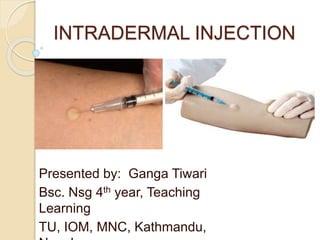
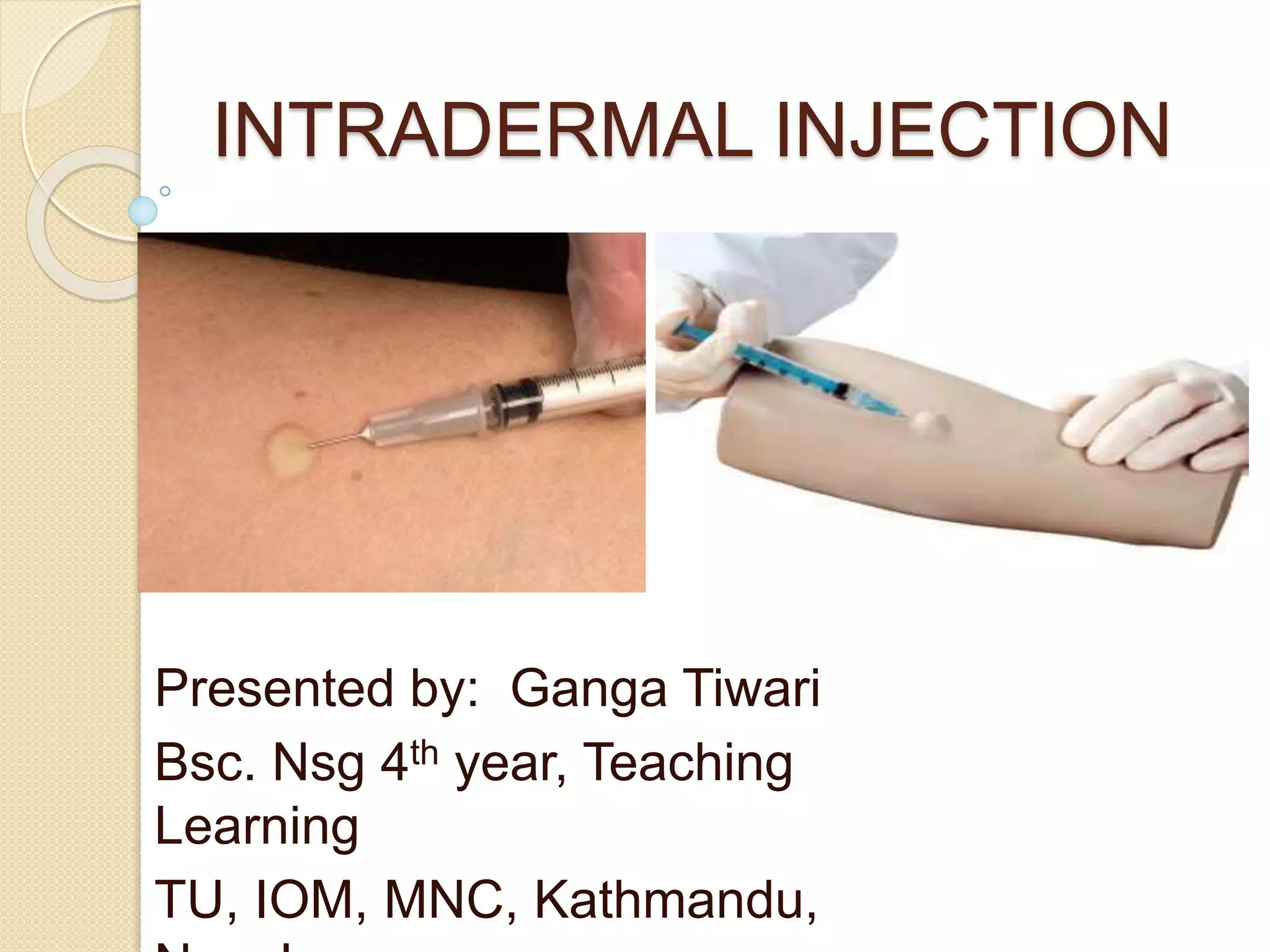
INTRADERMAL INJECTION
Presented by: Ganga Tiwari
Bsc. Nsg 4th year, Teaching
Learning
TU, IOM, MNC, Kathmandu,
Contents
 Introduction of intradermal injection
 Purposes
 Common sites
 Article required
 Procedure
 Complications
Contents..
 Introduction of intravenous injection
 Purposes
 Types of intravenous administration
 Articles required
 Procedure for intravenous bolus
administration.
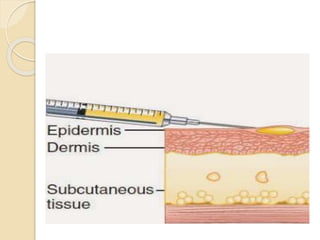
Intradermal injection
 The intradermal injections are
administered into the dermis, just
below epidermis.
 Intradermal routes has longest
absorption time of all parenteral route.
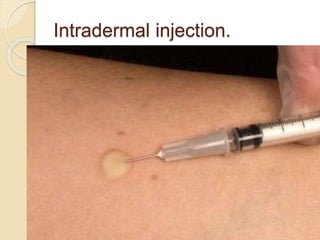
Intradermal injection.
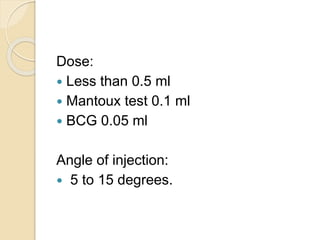
Dose:
 Less than 0.5 ml
 Mantoux test 0.1 ml
 BCG 0.05 ml
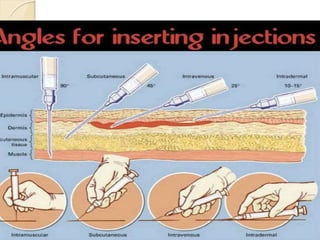
Angle of injection:
 5 to 15 degrees.
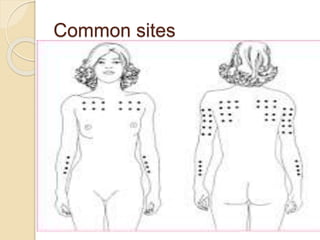
Common sites
 Inner surface of the fore arm.
 Upper arm
 Upper back under the scapula.
 Upper chest just below the clavicle.
Common sites
Articles required:
 Medication tray containing
 cardex
 Medicine (ampule or vial)
 syringe( tuberculin syringe/ BCG
syringe) and needle(26-27 gauge)
 sprit swab
 Disposable gloves
 Kidney tray
 Ampule cutter or opener
Procedure
 Check the physician’s instructions and
identify the patient.
 Explain the procedure to the patient.
 Wash hands
 Arrange necessary articles. Check
medication against the cardex before
preparing the medication.
 Prepare the medication from ampule
or vial.
Procedure..
 Maintain privacy
 Position the patient comfortably and
locate the sites for intradermal
injection.
 Asses the area for any scars,
tenderness, tattoo , lesions, abscess
etc.
 Assemble the necessary articles at
patient’s bed site.
 Wear disposable gloves.
Procedure..
 Clean the site with spirit swab in a firm
circular motion (about 5 cm) and
moving outward from the injection site
 Allow skin to dry.
 In case of live vaccine (BCG Vaccine)
do not clean the area with spirit swab,
it may interfere with the viability of the
vaccine. So clean the area with
sterile water swab.
Procedure..
 Remove the cap with non-dominant
hand to spread skin taut over injection
site.
 Grasp the syringe in dominant hand
holding in between thumb and fore
finger.
 Place the needle almost against the
patient skin at 5 -15 degree angles
and insert the needle into the skin with
the bevel site up so that needle can be
seen through the skin.
 Insert 1/8 inch of the needle.
Procedure..
 Slowly inject the drug, watching for a
bleb / wheal or blister to develop. If not
present withdraw the needle slightly
and inject the medication.
 Withdraw needle quickly in the same
angle as it was inserted.
 Don’t massage.
 Don’t recap the needle.
 Discard the needle and syringe in
puncture proof container.
Procedure..
 Assist patient in comfortable position.
 Draw a circle using blue or black pen
in injection area.
 Remove gloves and dispose them
properly.
 Wash hands.
 Record and report the medication
administration.
Health teaching
 Do not massage or scratch the
injection site.
 Do not put anything on injection site
oil, soap, powder etc.
 Keep the area clean and dry.
Health teaching..
 Avoid putting bandage, lotions and
cream to the injection site.
• If water spills in the injection site it is
not harmful but do not wipe or scrub
the area.
• Inform patient about the reading of
mantoux and sensitivity test.
Complications
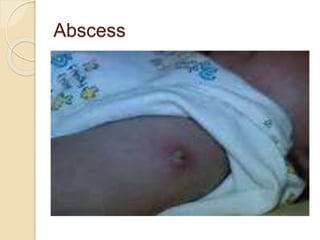
 Abscess
 Tenderness
 Itching
 Irritation
 Severe immediate allergic reactions.
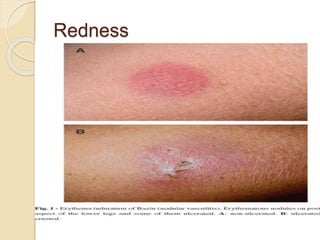
 Redness
 Keloid scar formation in case of BCG
vaccination
Redness
Abscess
Keloid Scar
References
 Health learning material center. Institute of
medicine of medicine ,Tribhuwan
University.Fundamentals of nursing (
second edition reprint ,2010).
Kathmandu:Heidal Press ,Dillibazar.
 Basvanthappa,B.T.(2004). Fundamentals of
Nursing. New Delhi :Jaypee Brothers.
 Perry, A.G. and Potter, P.A. (2007).Basic
Nursing Essentials For Practice .(sixth
edition): Mosby
 Giri, M. and Sharma,P. (2013). Essential
Fundamental Of Nursing.(first
edition).Kathmandu: Medhavi Publication.
References
 Pathak ,S.and Devkota ,R.(2011).A
Textbook of Fundamentals of
Nursing.(second
edition).Kathmandu:Vidyarthi Prakashan.
 Taylor,C.R. and Lillis,C.(2008).
Fundamental of
Nursing.(Volume1):Lippincott William and
Willikins
 Skidmere ,L . Nursing Drug
Reference(2009): Mosby
THANK YOU!!

Intradermal injection- Introduction, procedure,complications

  • 1.
    INTRADERMAL INJECTION Presented by:Ganga Tiwari Bsc. Nsg 4th year, Teaching Learning TU, IOM, MNC, Kathmandu,
  • 2.
    Contents  Introduction ofintradermal injection  Purposes  Common sites  Article required  Procedure  Complications
  • 3.
    Contents..  Introduction ofintravenous injection  Purposes  Types of intravenous administration  Articles required  Procedure for intravenous bolus administration.
  • 4.
    Intradermal injection  Theintradermal injections are administered into the dermis, just below epidermis.  Intradermal routes has longest absorption time of all parenteral route.
  • 6.
  • 7.
    Dose:  Less than0.5 ml  Mantoux test 0.1 ml  BCG 0.05 ml Angle of injection:  5 to 15 degrees.
  • 9.
    Common sites  Innersurface of the fore arm.  Upper arm  Upper back under the scapula.  Upper chest just below the clavicle.
  • 10.
  • 11.
    Articles required:  Medicationtray containing  cardex  Medicine (ampule or vial)  syringe( tuberculin syringe/ BCG syringe) and needle(26-27 gauge)  sprit swab  Disposable gloves  Kidney tray  Ampule cutter or opener
  • 12.
    Procedure  Check thephysician’s instructions and identify the patient.  Explain the procedure to the patient.  Wash hands  Arrange necessary articles. Check medication against the cardex before preparing the medication.  Prepare the medication from ampule or vial.
  • 13.
    Procedure..  Maintain privacy Position the patient comfortably and locate the sites for intradermal injection.  Asses the area for any scars, tenderness, tattoo , lesions, abscess etc.  Assemble the necessary articles at patient’s bed site.  Wear disposable gloves.
  • 14.
    Procedure..  Clean thesite with spirit swab in a firm circular motion (about 5 cm) and moving outward from the injection site  Allow skin to dry.  In case of live vaccine (BCG Vaccine) do not clean the area with spirit swab, it may interfere with the viability of the vaccine. So clean the area with sterile water swab.
  • 15.
    Procedure..  Remove thecap with non-dominant hand to spread skin taut over injection site.  Grasp the syringe in dominant hand holding in between thumb and fore finger.  Place the needle almost against the patient skin at 5 -15 degree angles and insert the needle into the skin with the bevel site up so that needle can be seen through the skin.  Insert 1/8 inch of the needle.
  • 16.
    Procedure..  Slowly injectthe drug, watching for a bleb / wheal or blister to develop. If not present withdraw the needle slightly and inject the medication.  Withdraw needle quickly in the same angle as it was inserted.  Don’t massage.  Don’t recap the needle.  Discard the needle and syringe in puncture proof container.
  • 17.
    Procedure..  Assist patientin comfortable position.  Draw a circle using blue or black pen in injection area.  Remove gloves and dispose them properly.  Wash hands.  Record and report the medication administration.
  • 18.
    Health teaching  Donot massage or scratch the injection site.  Do not put anything on injection site oil, soap, powder etc.  Keep the area clean and dry.
  • 19.
    Health teaching..  Avoidputting bandage, lotions and cream to the injection site. • If water spills in the injection site it is not harmful but do not wipe or scrub the area. • Inform patient about the reading of mantoux and sensitivity test.
  • 20.
    Complications  Abscess  Tenderness Itching  Irritation  Severe immediate allergic reactions.  Redness  Keloid scar formation in case of BCG vaccination
  • 21.
  • 22.
  • 23.
  • 24.
    References  Health learningmaterial center. Institute of medicine of medicine ,Tribhuwan University.Fundamentals of nursing ( second edition reprint ,2010). Kathmandu:Heidal Press ,Dillibazar.  Basvanthappa,B.T.(2004). Fundamentals of Nursing. New Delhi :Jaypee Brothers.  Perry, A.G. and Potter, P.A. (2007).Basic Nursing Essentials For Practice .(sixth edition): Mosby  Giri, M. and Sharma,P. (2013). Essential Fundamental Of Nursing.(first edition).Kathmandu: Medhavi Publication.
  • 25.
    References  Pathak ,S.andDevkota ,R.(2011).A Textbook of Fundamentals of Nursing.(second edition).Kathmandu:Vidyarthi Prakashan.  Taylor,C.R. and Lillis,C.(2008). Fundamental of Nursing.(Volume1):Lippincott William and Willikins  Skidmere ,L . Nursing Drug Reference(2009): Mosby
  • 26.