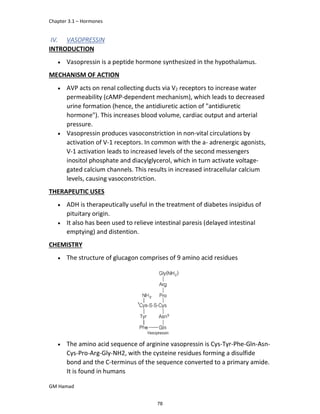
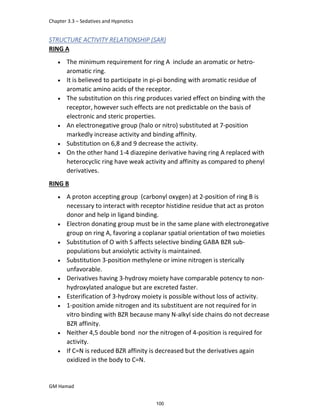
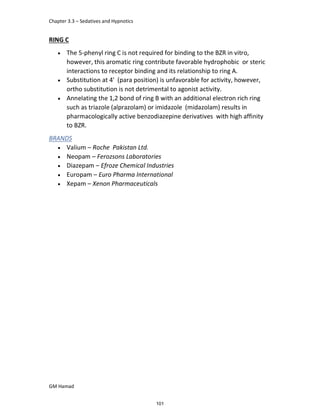
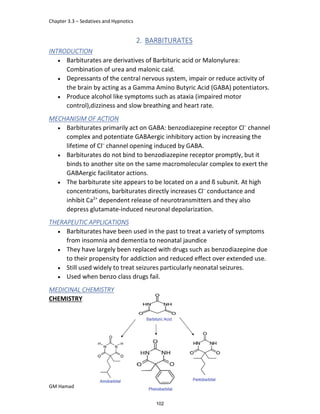
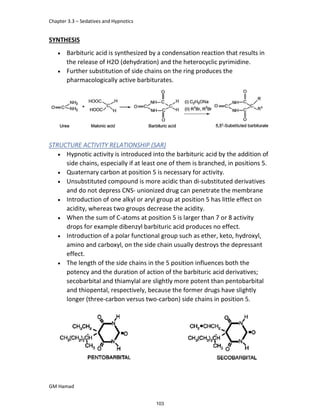
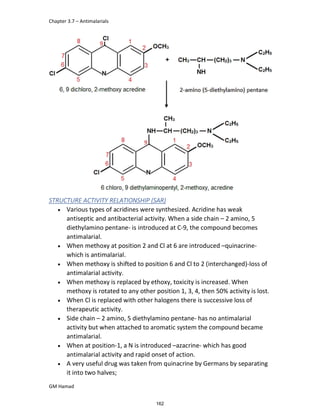
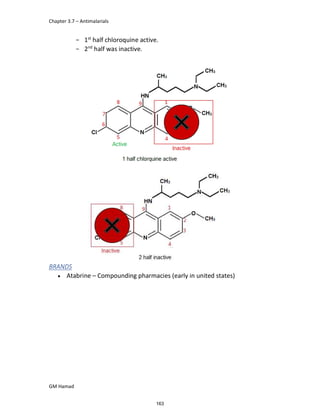
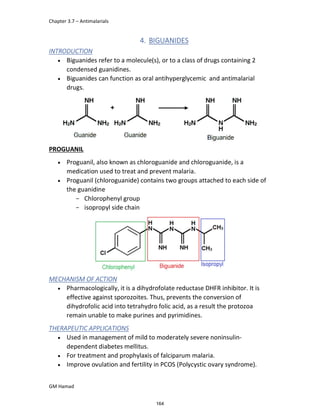
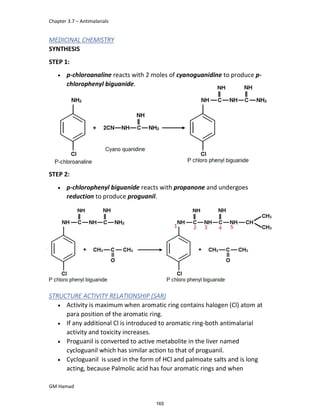
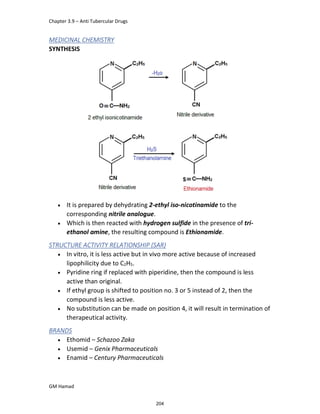
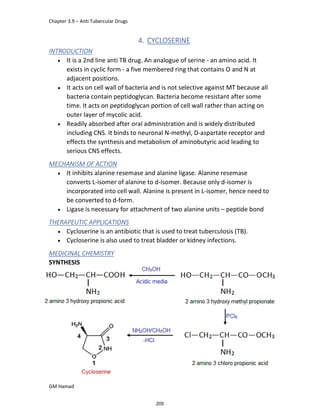
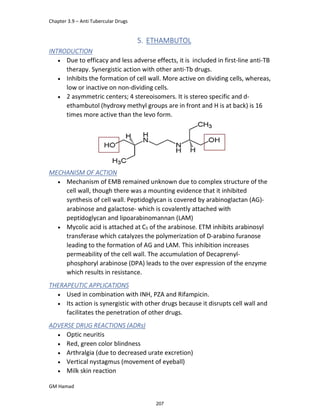
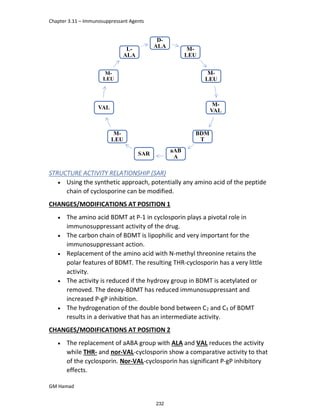
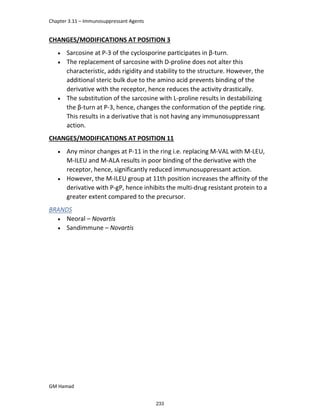
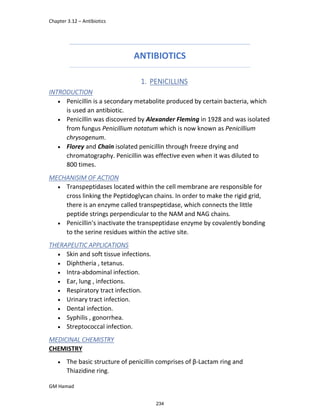
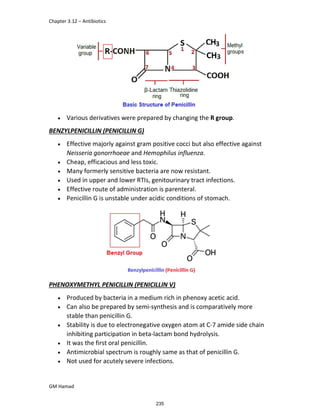
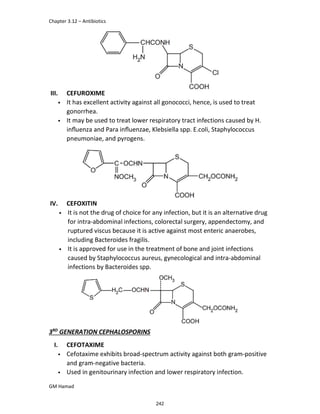
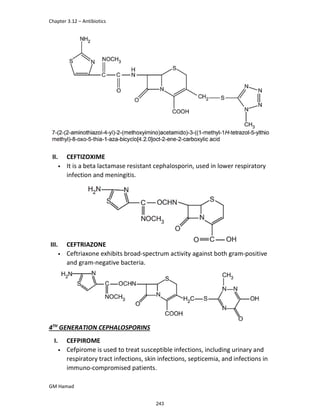
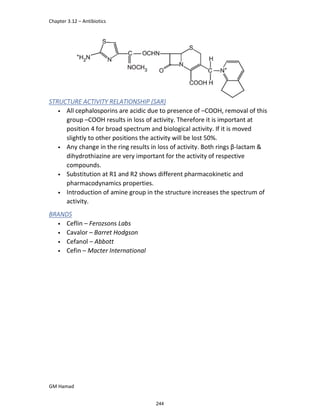
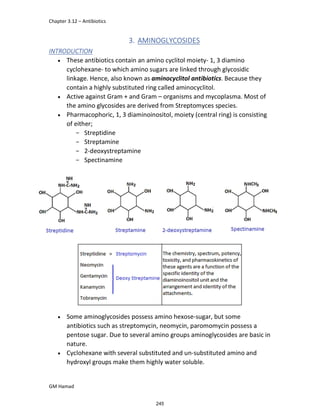
Doctor of Pharmacy, Final Professional
CHEMISTRY
Ghulam Murtaza Hamad
Punjab University College of Pharmacy, Lahore, Pakistan
Session 2016-2021
GM Hamad
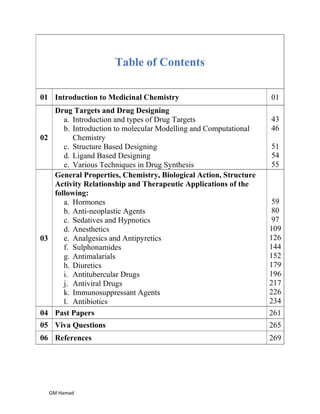
Table of Contents
01 Introduction to Medicinal Chemistry 01
02
Drug Targets and Drug Designing
a. Introduction and types of Drug Targets
b. Introduction to molecular Modelling and Computational
Chemistry
c. Structure Based Designing
d. Ligand Based Designing
e. Various Techniques in Drug Synthesis
43
46
51
54
55
03
General Properties, Chemistry, Biological Action, Structure
Activity Relationship and Therapeutic Applications of the
following:
a. Hormones
b. Anti-neoplastic Agents
c. Sedatives and Hypnotics
d. Anesthetics
e. Analgesics and Antipyretics
f. Sulphonamides
g. Antimalarials
h. Diuretics
i. Antitubercular Drugs
j. Antiviral Drugs
k. Immunosuppressant Agents
l. Antibiotics
59
80
97
109
126
144
152
179
196
217
226
234
04 Past Papers 261
05 Viva Questions 265
06 References 269
Chapter 1 – Introduction to Medicinal Chemistry
GM Hamad
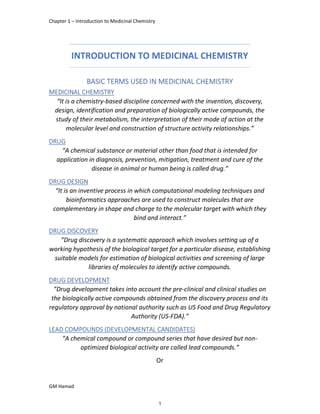
INTRODUCTION TO MEDICINAL CHEMISTRY
BASIC TERMS USED IN MEDICINAL CHEMISTRY
MEDICINAL CHEMISTRY
“It is a chemistry-based discipline concerned with the invention, discovery,
design, identification and preparation of biologically active compounds, the
study of their metabolism, the interpretation of their mode of action at the
molecular level and construction of structure activity relationships.”
DRUG
“A chemical substance or material other than food that is intended for
application in diagnosis, prevention, mitigation, treatment and cure of the
disease in animal or human being is called drug.”
DRUG DESIGN
“It is an inventive process in which computational modeling techniques and
bioinformatics approaches are used to construct molecules that are
complementary in shape and charge to the molecular target with which they
bind and interact.”
DRUG DISCOVERY
”Drug discovery is a systematic approach which involves setting up of a
working hypothesis of the biological target for a particular disease, establishing
suitable models for estimation of biological activities and screening of large
libraries of molecules to identify active compounds.
DRUG DEVELOPMENT
”Drug development takes into account the pre-clinical and clinical studies on
the biologically active compounds obtained from the discovery process and its
regulatory approval by national authority such as US Food and Drug Regulatory
Authority (US-FDA).”
LEAD COMPOUNDS (DEVELOPMENTAL CANDIDATES)
“A chemical compound or compound series that have desired but non-
optimized biological activity are called lead compounds.”
Or
1
Chapter 1 – Introduction to Medicinal Chemistry
GM Hamad
“A chemical compound or compound series that satisfy predefined minimum
criteria – appropriate stereo-electronic, physicochemical, pharmacokinetic and
toxicological properties for clinical usefulness, selectivity against chosen
molecular target and tractable structure activity relationship – but have
suboptimal structure that requires modifications to improve the selectivity,
potency, and/or pharmacokinetic and toxic properties are called lead
compounds.”
LEAD DISCOVERY
“Lead discovery refers to a process of identifying lead compounds.”
LEAD GENERATION
“Lead generation refers to the strategies developed to generate lead
compounds.”
LEAD OPTIMIZATION
“Lead optimization refers to the synthetic modification of lead compounds.”
LEAD VALIDATION
“Lead validation is a process of authenticating a lead compound i.e. confirming
the expected physicochemical, pharmacological, pharmacokinetic and toxic
properties through experiments.”
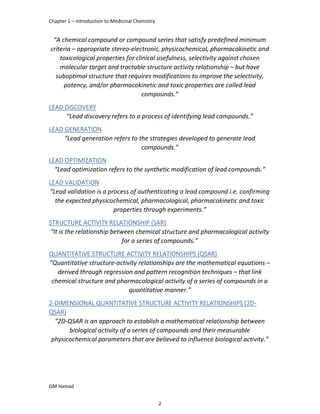
STRUCTURE ACTIVITY RELATIONSHIP (SAR)
“It is the relationship between chemical structure and pharmacological activity
for a series of compounds.”
QUANTITATIVE STRUCTURE ACTIVITY RELATIONSHIPS (QSAR)
“Quantitative structure-activity relationships are the mathematical equations –
derived through regression and pattern recognition techniques – that link
chemical structure and pharmacological activity of a series of compounds in a
quantitative manner.”
2-DIMENSIONAL QUANTITATIVE STRUCTURE ACTIVITY RELATIONSHIPS (2D-
QSAR)
“2D-QSAR is an approach to establish a mathematical relationship between
biological activity of a series of compounds and their measurable
physicochemical parameters that are believed to influence biological activity.”
2
Chapter 1 – Introduction to Medicinal Chemistry
GM Hamad
3-DIMENSIONAL QUANTITATIVE STRUCTURE ACTIVITY RELATIONSHIPS (3D-
QSAR)
“3D-QSAR is an approach to establish a mathematical relationship between
biological activity and 3-dimensional structure of a series of compounds that is
believed to influence biological activity.”
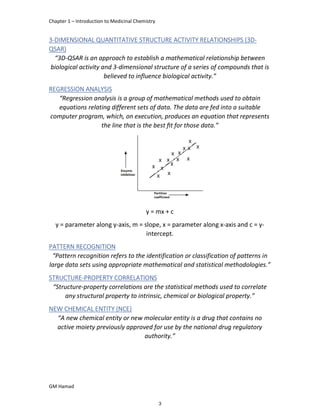
REGRESSION ANALYSIS
“Regression analysis is a group of mathematical methods used to obtain
equations relating different sets of data. The data are fed into a suitable
computer program, which, on execution, produces an equation that represents
the line that is the best fit for those data.”
y = mx + c
y = parameter along y-axis, m = slope, x = parameter along x-axis and c = y-
intercept.
PATTERN RECOGNITION
“Pattern recognition refers to the identification or classification of patterns in
large data sets using appropriate mathematical and statistical methodologies.”
STRUCTURE-PROPERTY CORRELATIONS
“Structure-property correlations are the statistical methods used to correlate
any structural property to intrinsic, chemical or biological property.”
NEW CHEMICAL ENTITY (NCE)
“A new chemical entity or new molecular entity is a drug that contains no
active moiety previously approved for use by the national drug regulatory
authority.”
3
Chapter 1 – Introduction to Medicinal Chemistry
GM Hamad
INVESTIGATIONAL NEW DRUG (IND)
“An investigational new drug is a compound that is not yet approved for
general use by the national authority but undergoing clinical investigations to
assess its safety and efficacy.”
MOLECULAR TARGET (BIOLOGICAL TARGET)
“A molecular target is a protein (receptor, enzyme or ion-channel) or nucleic
acid (RNA or DNA) that is involved in manifestation of a clinical disorder or
propagation of any untoward event. During drug discovery process, the first
step is to obtain the biochemical, physiological, pharmacological or genomic
information of the molecular target that supports its role in a disease.”
PRIVILEGED STRUCTURE
“It refers to the substructural features – semi-rigid scaffold presenting multiple
hydrophobic residues without undergoing hydrophobic collapse – that confer
desirable (drug-like) properties in compounds containing that feature.”
DRUG-LIKELINESS
“Drug likeliness is a complex balance of various molecular and structural
properties (molecular weight, shape, electronic distribution, polar surface area,
log P, reactivity, hydrogen bond donors/acceptors, dissociation constant and
pharmacophore) which determine, whether a particular compound is similar to
known drugs or not. These features are important predictors of its
physicochemical, biochemical, pharmacokinetic and toxic properties of a drug.”
DRUG-LIKE COMPOUND
“A compound is considered to be drug-like, if it possesses acceptable ADME and
toxicity properties to survive through the human Phase-I trials.”
PHARMACOPHORE
“A pharmacophore is the group of steric and electronic features that is
necessary to ensure the optimal supramolecular interactions with a specific
biological target structure and to trigger or block its biological response.”
A pharmacophore does not represent a real molecule or a real association of
functional groups, but a purely abstract concept that accounts for the common
molecular interaction capacities of a group of compounds toward their target
structure. The pharmacophore can be considered as the largest common
denominator shared by a set of active molecules.
4
Chapter 1 – Introduction to Medicinal Chemistry
GM Hamad
PHARMACOPHORIC DESCRIPTORS
“These are the descriptors that define a pharmacophore such as hydrogen
bonding, hydrophobic and electrostatic interaction sites due to the constituent
atoms, ring centers and virtual points.”
PATENTABILITY
“It refers to the set of criteria – suitability, novelty, inventiveness, utility and an
adequate description – that must be satisfied to achieve commercial exclusivity
for an invention.”
ANALOGUE
“Chemical compounds that have structural similarity to a reference compound
but display different chemical and/or biological properties. During drug
development, a number of analogues of lead compounds are synthesized for
SAR studies.”
ATTRITION RATE (HIGH FAILURE RATE)
”It refers to the rate of loss of candidates during progression through the drug
development and optimization phases.”
BACK-UP COMPOUND:
”It is a molecule – pharmacologically equivalent to lead but has significant
structural differences – selected as a replacement for lead drug candidate if it
fails during pre-clinical and clinical studies.”
BEST-IN-CLASS
“It is a drug that acts on a specific molecular target that provides the best
balance between efficacy and adverse effects.”
BIOASSAY
“It is procedure for determination of the concentration, purity, and/or
biological activity of a substance (vitamin, hormone, plant growth factor, drug,
enzymes) by measuring its effect on an organism, tissue, cell and enzyme or
receptor preparation and comparing them with a standard.”
BIOINFORMATICS
“It is a discipline that encompasses the development and utilization of
computational tools such as databases and data management tools to
integrate, presentation tools to comprehend, and algorithms to extract
meaning and useful information from large amounts of heterogeneous
biological data.”
5
Chapter 1 – Introduction to Medicinal Chemistry
GM Hamad
CHEMICAL DATABASE
“A chemical database is a specific electronic repository for storing and
retrieving chemical information.”
CHEMICAL LIBRARY
“A collection of compounds which represent expansion around a single core
structure or scaffold produced through combinatorial synthesis and is available
for biological screening.”
clogP
“It is the calculated value of octanol/water partition coefficient used for
structure-property correlation and QSAR studies.”
CLUSTER
“It is a group of compounds that are structurally, physicochemically or
biologically related. Organizing a set of compounds into clusters is often used
to assess diversity or develop SAR models.”
COMPARATIVE MOLECULAR FIELD ANALYSIS (COMFA)
“It is a 3D-QSAR method that uses statistical correlation techniques for the
analysis of the quantitative relationship between the biological activities of a
set of compounds with a specific alignments, and their three dimensional
electronic and steric properties. “
CONGENER
“Substances that are structurally related to each other and linked by origin or
function are called congeners.”
6
Chapter 1 – Introduction to Medicinal Chemistry
GM Hamad
RECEPTORS
DEFINITION
“A receptor is a macromolecule that specifically recognizes and binds a ligand
and, transduces and integrates the signal received from it into biological
systems.”
CHEMISTRY
The majority of receptors are;
 Proteins (amino acid polymers)
 Glycoproteins
STRUCTURE
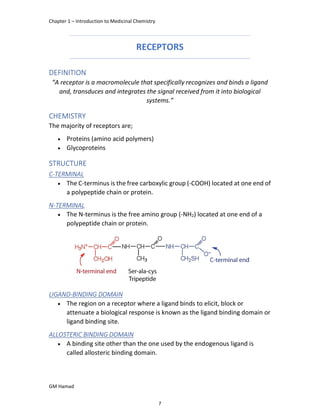
C-TERMINAL
 The C-terminus is the free carboxylic group (-COOH) located at one end of
a polypeptide chain or protein.
N-TERMINAL
 The N-terminus is the free amino group (-NH2) located at one end of a
polypeptide chain or protein.
LIGAND-BINDING DOMAIN
 The region on a receptor where a ligand binds to elicit, block or
attenuate a biological response is known as the ligand binding domain or
ligand binding site.
ALLOSTERIC BINDING DOMAIN
 A binding site other than the one used by the endogenous ligand is
called allosteric binding domain.
7
Chapter 1 – Introduction to Medicinal Chemistry
GM Hamad
DUAL BINDING DOMAIN
 It refers to the presence of two distinct ligand-binding domains on the
same receptor.
CLASSIFICATION
ON THE BASIS OF LOCATION
I. CELL SURFACE RECEPTORS
 These receptors are embedded in the lipid membrane of cells.
SYNONYMS
 Transmembrane receptors
COMPONENTS
 Each cell-surface receptor has three main components:
­ An external ligand-binding domain
­ A hydrophobic membrane-spanning region
­ An intracellular domain inside the cell
LIGANDS
 Large molecular weight substances (peptides)
 Highly polar substances or charged species (catecholamines)
FUNCTION
 Signal transduction (receive message from extracellular ligand and
convert it to intracellular signal).
EXAMPLES
 Ion channel-linked receptors (ionotropic receptors)
 G protein-linked receptors (metabotropic receptors)
 Enzyme-linked receptors
<
II. INTRACELLULAR RECEPTORS
 These receptors are found inside the cell.
SYNONYMS
 Internal receptors
LIGANDS
8
Chapter 1 – Introduction to Medicinal Chemistry
GM Hamad
 Small molecular weight substances
 Hydrophobic (lipid-soluble) compounds
EXAMPLES
 Cytoplasmic receptors
 Nuclear receptors
ON THE BASIS OF FUNCTION
 According to functions, receptors are divided into four superfamilies.
The members of each superfamily have same general structure and
mechanism of action but may vary in the sequence of amino acid residue
in certain regions and sizes of extracellular and intracellular domains.
I. SUPERFAMILY 1
TYPE
 Cell-surface receptors
SYNONYM
 Ion channel-linked receptors
STRUCTURE
 -C and -N terminus in the extracellular fluid
 Sugar is attached to extracellular –N terminal chain
 4-5 membrane-spanning subunits (2 α, 1 β, 1γ and 1 δ) surrounding a
central pore
 Each membrane-spanning subunit contains 20-25 amino acid residues
arranged in an α-helix
LIGANDS
 Fast neurotransmitters (nicotine, acetylcholine, gamma amino butyric
acid, glutamate)
EFFECTOR
 Ion channels
ACTIVATION
9
Chapter 1 – Introduction to Medicinal Chemistry
GM Hamad
 Two molecules of ligand upon binding to the α-subunits activate the
receptor that cause opening of the central pore and consequently
passage of ions in and out of a cell.
EXAMPLES
 Nicotine acetylcholine (nAChR) receptor
 Gamma amino butyric acid (GABAA) receptor
 Glutamate receptor
II. SUPERFAMILY 2
TYPE
 Cell-surface receptors
SYNONYM
 G-protein coupled receptors
STRUCTURE
 Single polypeptide chain containing 400-500 amino acid residues
 -N terminus lies in the extracellular fluid
 -C terminus lies in the intracellular fluid
 7 membrane-spanning subunits surrounding a central pocket containing
receptor site
 Each membrane-spanning subunit contains 20-25 amino acid residues
arranged in an α-helix
 Intracellular domain is attached with an effector protein called G-protein
LIGANDS
 Slow transmitters (epinephrine, dopamine and serotonin)
EFFECTOR
 Ion channel
 Enzymes
ACTIVATION AND SIGNAL TRANSDUCTION
 The binding of ligand to the receptor site causes conformational change
in the intracellular polypeptide loop and C-terminus chain. These
10
Chapter 1 – Introduction to Medicinal Chemistry
GM Hamad
changes attract G-protein associated with intracellular domain of the
receptor.
 G-Proteins are a family of unattached proteins that diffuse through the
cytoplasm. They consist of three polypeptide subunits (α, β and γ). In
resting state, guanosine diphosphate (GDP) is bound to α subunit of the
G-protein. Upon activation, GDP at α subunit of G-protein is exchanged
for GTP. The activated subunit detaches from the protein and migrates
to either the receptor of an ion channel or the active site of an enzyme.
The coupling of α -GTP subunit to the receptor of the ion channel opens
or closes the channel, and to the enzyme inhibits or activates it.
 The action of α -GTP subunit is terminated when the GTP is hydrolyzed
to GDP by the catalytic action of α subunit.
EXAMPLES
 Muscarinic acetylcholine (mAChR) receptor
 Noradrenergic receptor
III. SUPERFAMILY 3
TYPE
 Cell-surface receptors
SYNONYM
 Enzyme-linked receptors
STRUCTURE
 -N terminus in the extracellular fluid
 -C terminus in the intracellular fluid
 Single helical transmembrane subunit
 Intracellular domain contains tyrosine kinase residue, an ATP binding
site near the surface of membrane and substrate site near the end of
domain.
LIGANDS
 Insulin
 Growth factors
EFFECTOR
11
Chapter 1 – Introduction to Medicinal Chemistry
GM Hamad
 Intracellular proteins and enzymes
ACTIVATION
 Binding of ligand causes dimerization of receptor and subsequent
conformational changes which trigger the autophosphorylation of
tyrosine residues in the intracellular domain. The phosphorylated
residues attract and bind to intracellular proteins and lead to biological
responses.
EXAMPLES
 Insulin receptors
 Cytokine receptors
IV. SUPERFAMILY 4
TYPE
 Intracellular receptors
SYNONYM
 Nuclear receptors
STRUCTURE
 Large proteins with 400-1000 amino acid residues
 Central section of the protein contains two loops having 15 residues.
These loops are called zinc fingers since they originate from a group of 4
cysteine residues coordinated to a zinc atom.
 Hormone receptor lies on C-terminal side
 N-terminal controls the gene transcription
LIGANDS
 Steroidal hormones
 Thyroid hormones
 Retinoic acid
 Vitamin D
EFFECTOR
 Gene transcription
ACTIVATION
12
Chapter 1 – Introduction to Medicinal Chemistry
GM Hamad
 Conformational changes caused by the binding of the hormone to the
receptor expose the DNA binding domain, which is normally hidden
within the structure of the protein. This allows the DNA to bind to the
protein, an increase in RNA polymerase activity and production of a
specific mRNA. This mRNA controls the synthesis of a specific protein
that produces the cellular response.
EXAMPLES
 Glucocorticoid receptors
 Antidiuretic hormone receptors
 Vasopressin receptors
13
Chapter 1 – Introduction to Medicinal Chemistry
GM Hamad
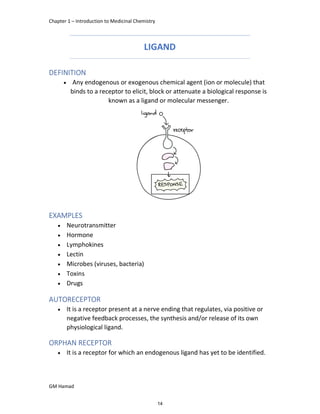
LIGAND
DEFINITION
 Any endogenous or exogenous chemical agent (ion or molecule) that
binds to a receptor to elicit, block or attenuate a biological response is
known as a ligand or molecular messenger.
EXAMPLES
 Neurotransmitter
 Hormone
 Lymphokines
 Lectin
 Microbes (viruses, bacteria)
 Toxins
 Drugs
AUTORECEPTOR
 It is a receptor present at a nerve ending that regulates, via positive or
negative feedback processes, the synthesis and/or release of its own
physiological ligand.
ORPHAN RECEPTOR
 It is a receptor for which an endogenous ligand has yet to be identified.
14
Chapter 1 – Introduction to Medicinal Chemistry
GM Hamad
SIGNAL TRANSDUCTION
DEFINITION
 Signal transduction refers to the series of molecular events that take
place when a ligand binds to cell-surface receptor and the message
carried by it is transmitted through the cell to evoke an appropriate
response.
SIGNALING MOLECULES
 These are the molecules that transmit the message produced by ligand-
receptor complex through the cell in order to evoke an appropriate
response.
1. PHOSPHORYLATED PROTEINS
 Proteins are important signaling molecules. Phosphorylation at one or
more sites in a protein can alter its activity by activation or deactivation.
Typically, addition of phosphate groups in a protein takes place at a
particular site i.e. hydroxyl (-OH) groups in the side chains one of the
three amino acids;
­ Tyrosine
­ Threonine
­ Serine
 The transfer of the phosphate group is a reversible process. The forward
reaction (phosphorylation) is catalyzed by kinases while the backward
reaction (dephosphorylation) is catalyzed by phosphatases.
EXAMPLE
 Growth factor signaling
2. SECOND MESSENGERS
Second messengers are small, non-protein molecules that pass along a signal
initiated by the binding of a ligand (the “first messenger”) to its receptor.
I. CALCIUM IONS
 Calcium ions are a widely used type of second messenger.
 In most cells, the concentration of calcium ions in the cytosol is very low.
It is due to the normal functioning of ion-channels in the plasma
membrane.
15
Chapter 1 – Introduction to Medicinal Chemistry
GM Hamad
 The binding of a ligand to cell-surface receptors attached to the ligand-
gated calcium ion channels causes them to open and promote influx of
calcium ion. This results in increasing the intracellular levels of calcium
ions which binds to the target proteins having ion-binding sites, brings
about some conformational changes and hence, alters their activity.
EXAMPLE
 The release of insulin from β-cells of the pancreas is mediated through
high levels of intracellular calcium.
II. CYCLIC ADENOSINE MONOPHOSPHATE (cAMP)
 Cyclic adenosine monophosphate (cAMP) is a small molecule produced
by the activity of an enzyme called adenylyl cyclase. The enzyme, upon
receiving the signals, is activated and converts ATP to cAMP by removing
two phosphates and linking the last one to the sugar in a ring shape.
 One generated, cAMP activates protein kinase A that phosphorylates its
targets and passes along the signal.
EXAMPLE
 Epinephrine signaling
III. PHOSPHATIDYLINOSITOLS
 Phosphatidylinositols are phospholipids which upon phosphorylation
cleave in half and produce two secondary messengers, diacylglycerol
(DAG) and inositol triphosphate (IP3). The cleavage of the phospholipid is
catalyzed by phospholipase C that is activated in response to a signal.
 DAG stays in the plasma membrane and activates protein kinase C that
phosphorylates its target while IP3 diffuses into the cytoplasm, binds to
ligand-gated calcium channels in the endoplasmic reticulum and
increases cytosolic calcium levels that continue the signal cascade.
16
Chapter 1 – Introduction to Medicinal Chemistry
GM Hamad
MOLECULAR RECOGNITION
BINDING FORCES BETWEEN LIGANDS AND RECEPTORS
 The formation of ligand-receptor complex is promoted by chemical
bonds between functional groups on the ligand and the receptor. The
bonds formation occurs spontaneously as the ligand reaches the
appropriate distance from its receptor. The forces that bind ligands to
receptors include:
­ Covalent bonding
­ Ionic bonding
­ Hydrogen bonding
­ Charge-transfer
interactions
­ Hydrophobic
interactions
­ Dipole-dipole and ion-
dipole interactions
­ Van der Waals’ forces
1. COVALENT BONDING
 Covalent bond between a ligand and a receptor is formed through
sharing of electron pairs between atoms.
FEATURES
 Strongest bond that cannot be broken under biologic conditions
 Irreversible interaction between ligand and receptor
 Not occurs commonly (seldom found in drug action)
 Not desirable
EXAMPLES
 Cancer therapy
­ Nitrogen mustards (mechlorethamine, ifosfamide,
cyclophosphamide, chlorambucil, mustine and bendamustine) and
carboplatin bind irreversibly to DNA and cause subsequent cell
death.
 Enzyme inhibition
­ 5-fluorouracil binds irreversibly with thymidylate synthase and
prevents generation of deoxythymidine monophosphate (dTMP)
from deoxyuridine monophosphate (dUMP).
17
Chapter 1 – Introduction to Medicinal Chemistry
GM Hamad
2. IONIC BONDING
 An ionic bond between a ligand and a receptor is formed due to
attraction oppositely charged atoms.
FEATURES
 It is most prevalent form of bonding since many of the functional groups
on the receptor and ligands are ionized at physiological pH.
 Ionic interactions are usually reversible.
 Ionic interactions are weaker than covalent.
 They are effective at distances that are considerably greater than those
required by other types of bonding.
 The strength of ionic bond decreases as the distance between the
charges increases.
EXAMPLES
 Pivagabine (anti-depressant and anxiolytic drug) binds to GABA receptor
through ionic bond formation between carboxylate residue of the drug
and amino group of the receptor.
 Acetylcholine, histamine, nicotine and adrenaline contain nitrogen atom
which are positively charged at biological pH, hence, the interaction of
these drugs with carboxylic ends of the amino acids in their receptors
(cholinergic, histamine, nicotinic and adrenergic, respectively) is through
formation of ionic bonds.
3. HYDROGEN BONDING
 It is an electrostatic interaction between the non-bonding electron pair
of a heteroatom (N, O, S) as a donor and electron deficient hydrogen
that is chemically bonded to a more electronegative atom (–SH, –NH and
–OH).
FEATURES
 Weak interaction
EXAMPLE
 Atorvastatin specifically binds to HMG-CoA reductase due to its
complementary shape and pattern of hydrogen bonding (9 specific
hydrogen bonds) and inhibits the ability of the enzyme to catalyze the
formation of mevalonate in cholesterol biosynthesis pathway.
18
Chapter 1 – Introduction to Medicinal Chemistry
GM Hamad
4. CHARGE TRANSFER INTERACTIONS
 Charge-transfer bonds are formed when an electron donor group – π-
electron rich species (alkene, alkyne, aromatic compounds) and chemical
moieties with lone pair of electrons (oxygen, nitrogen, sulfur) – transfers
a portion of its charge to the adjacent electron acceptor group.
FEATURES
 Weak interaction
EXAMPLE
 Chloroquine
5. HYDROPHOBIC INTERACTIONS
 Hydrophobic bonding occurs when non-polar sections of ligand are
closer to the non-polar sections (hydrophobic pocket) of a receptor.
FEATURES
 Very weak ligand-receptor interaction
EXAMPLE
 Lincosamides
6. ION-DIPOLE AND DIPOLE-DIPOLE INTERACTIONS
 Ion-dipole and dipole-dipole interactions take place when partial
positive or partial negative charges (due to electronegativity) form an
electrostatic bond with either partially charged atoms or ionized
elements.
FEATURES & EXAMPLE
 Weak interaction, Zaleplon
7. VAN DER WAAL’S FORCES
 A Van der Waal’s interaction between a ligand and receptor takes place
when an induced dipole in one of the participant induces dipole in the
atoms of the other participant.
FEATURES
 Very weak and temporary interaction.
19
Chapter 1 – Introduction to Medicinal Chemistry
GM Hamad
STRUCTURE ACTIVITY RELATIONSHIP (SAR)
STRUCTURE ACTIVITY RELATIONSHIP
 It is the relationship between the chemical or three dimensional (3D)
structure of a molecule and its biological activity.
REASON FOR SAR STUDIES
 Discovery of lead from a compound library under investigation is the
milestone in developing clinically useful agent. A lead compound has
appropriate stereoelectronic, physicochemical, pharmacokinetic and
toxicological properties for clinical usefulness and selectivity against
chosen molecular target but suboptimal structure that requires
modifications to improve the selectivity, potency, and/or
pharmacokinetic and toxic properties.
 Hence, structure-activity relationship studies are planned to modify the
structure of a lead to produce analogues and assess the effect of these
structural changes on biological activity. These studies are performed at
lead optimization stage and are critical for identifying pharmacophore
and producing an investigational new drug with desirable properties.
STRATEGIES IN SAR STUDIES
 Every change in the chemical structure of a lead modulates its 3D,
physicochemical and biological (spectrum and potency) properties.
However, important strategies in SAR studies include;
STRUCTURAL SIMPLIFICATION (REDUCING MOLECULAR OBESITY)
 During hit-to-lead optimization, medicinal chemists always attempt to
improve the target binding affinity and maximize the in vitro potency.
This usually leads to compounds with higher molecular weights and
lipophilicities, resulting in undesirable physicochemical properties and
pharmacokinetic properties.
 For large or complex lead compounds, structural simplification is helpful
to discover drug-like molecules with improved synthetic accessibility and
favorable pharmacodynamics and pharmacokinetic profiles.
PROCESS OF REDUCING MOLECULAR OBESITY
 The typical process for structural simplification includes:
20
Chapter 1 – Introduction to Medicinal Chemistry
GM Hamad
1. Step-by-step breaking of the complex structure to generate simplified
analogues and determination of the substructures (or groups) important
for the biological activity
2. Removal of unnecessary structural motifs
3. Elimination of redundant chiral centers and rings.
EXAMPLE
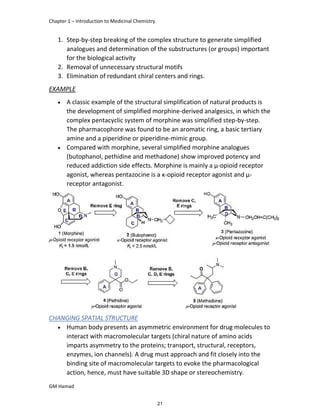
 A classic example of the structural simplification of natural products is
the development of simplified morphine-derived analgesics, in which the
complex pentacyclic system of morphine was simplified step-by-step.
The pharmacophore was found to be an aromatic ring, a basic tertiary
amine and a piperidine or piperidine-mimic group.
 Compared with morphine, several simplified morphine analogues
(butophanol, pethidine and methadone) show improved potency and
reduced addiction side effects. Morphine is mainly a μ-opioid receptor
agonist, whereas pentazocine is a κ-opioid receptor agonist and μ-
receptor antagonist.
CHANGING SPATIAL STRUCTURE
 Human body presents an asymmetric environment for drug molecules to
interact with macromolecular targets (chiral nature of amino acids
imparts asymmetry to the proteins; transport, structural, receptors,
enzymes, ion channels). A drug must approach and fit closely into the
binding site of macromolecular targets to evoke the pharmacological
action, hence, must have suitable 3D shape or stereochemistry.
21
Chapter 1 – Introduction to Medicinal Chemistry
GM Hamad
 It is also well established now that the shape of a molecule is one of the
most important factors affecting the activity. Stereoisomers exhibit
different potencies, type of activity and unwanted effects. Moreover,
some enantiomers racemize endogenously and produce different
effects.
 Thalidomide developed and marketed as a racemate in 1950s for
sedation was found to teratogenic. Later, it was found that S-enantiomer
of the drug was teratogenic while R-form was sedative with non-
teratogenic potential.
CONFIGURATIONAL ISOMERS
GEOMETRIC ISOMERS
 Cis- and trans- isomers of a drug differ in their physical and chemical
properties and hence, have variable biological properties.
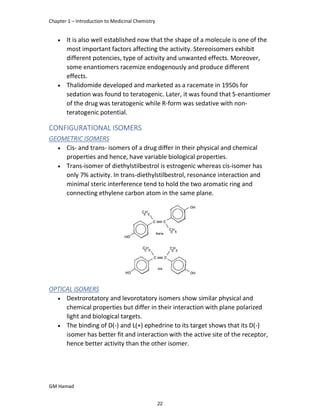
 Trans-isomer of diethylstilbestrol is estrogenic whereas cis-isomer has
only 7% activity. In trans-diethylstilbestrol, resonance interaction and
minimal steric interference tend to hold the two aromatic ring and
connecting ethylene carbon atom in the same plane.
OPTICAL ISOMERS
 Dextrorotatory and levorotatory isomers show similar physical and
chemical properties but differ in their interaction with plane polarized
light and biological targets.
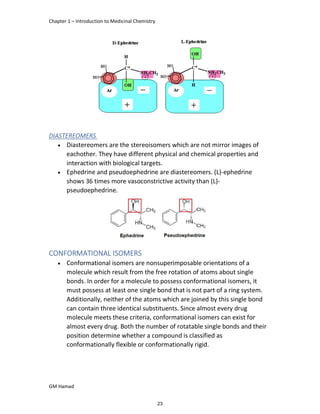
 The binding of D(-) and L(+) ephedrine to its target shows that its D(-)
isomer has better fit and interaction with the active site of the receptor,
hence better activity than the other isomer.
22
Chapter 1 – Introduction to Medicinal Chemistry
GM Hamad
DIASTEREOMERS
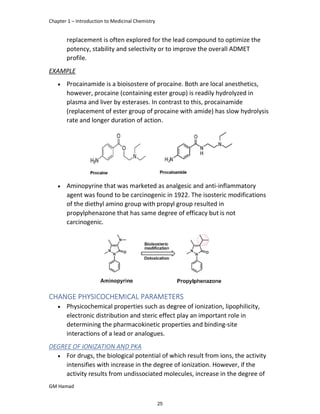
 Diastereomers are the stereoisomers which are not mirror images of
eachother. They have different physical and chemical properties and
interaction with biological targets.
 Ephedrine and pseudoephedrine are diastereomers. (L)-ephedrine
shows 36 times more vasoconstrictive activity than (L)-
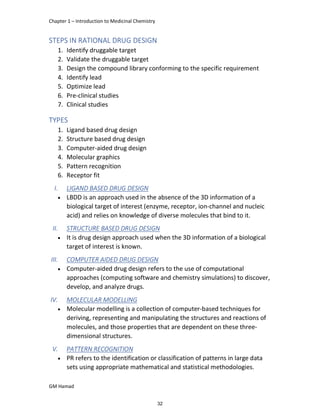
pseudoephedrine.
CONFORMATIONAL ISOMERS
 Conformational isomers are nonsuperimposable orientations of a
molecule which result from the free rotation of atoms about single
bonds. In order for a molecule to possess conformational isomers, it
must possess at least one single bond that is not part of a ring system.
Additionally, neither of the atoms which are joined by this single bond
can contain three identical substituents. Since almost every drug
molecule meets these criteria, conformational isomers can exist for
almost every drug. Both the number of rotatable single bonds and their
position determine whether a compound is classified as
conformationally flexible or conformationally rigid.
23
Chapter 1 – Introduction to Medicinal Chemistry
GM Hamad
ENERGETICALLY PREFERRED CONFORMER
 The conformations which minimize any repulsive interactions and
maximize all attractive interactions are more energetically favorable
than other conformations. Looking at the steric factors, the anti-
conformer of acetylcholine seems to be preferred. However, it is actually
the gauche-conformer which is preferred. The intramolecular attractive
force between the quaternary nitrogen and the ester carbonyl
overcomes steric barriers and stabilizes the gauche conformer.
ACTIVE CONFORMER
 The conformation of a drug molecule that binds to either a receptor or
an enzyme is known as its active conformation. This active conformation
contains the correct spatial arrangement of all essential binding groups
but is not necessarily the same as the most energetically preferred
conformation. While the gauche conformer of acetylcholine is
energetically preferred, the anti-conformer is required for binding to the
muscarinic receptor.
ISOSTERIC REPLACEMENTS
 Isosteres are the functional groups that have same number of atoms,
same number of total electrons and same number of valence electrons.
Groups No. of atoms No. of electrons (total) No. of valence electrons
CO2 3 6+(8*2)=22 4+(6*2)=16
N2O (nitrous oxide) 3 (7*2)+8=22 (5*2)+6=16
NO2
+
(nitrogen dioxide) 3 7+(8*2)-1=22 5+(6*2)-1=16
CNO-
(cyanate) 3 6+7+8+1=22 4+5+6+1=16
 The biological characteristics of isosteres appear to be similar; more
frequently than physical or chemical characteristics. Hence, isosteric
24
Chapter 1 – Introduction to Medicinal Chemistry
GM Hamad
replacement is often explored for the lead compound to optimize the
potency, stability and selectivity or to improve the overall ADMET
profile.
EXAMPLE
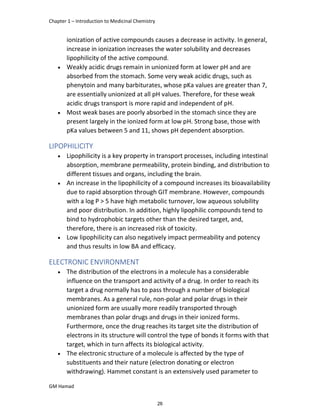
 Procainamide is a bioisostere of procaine. Both are local anesthetics,
however, procaine (containing ester group) is readily hydrolyzed in
plasma and liver by esterases. In contrast to this, procainamide
(replacement of ester group of procaine with amide) has slow hydrolysis
rate and longer duration of action.
 Aminopyrine that was marketed as analgesic and anti-inflammatory
agent was found to be carcinogenic in 1922. The isosteric modifications
of the diethyl amino group with propyl group resulted in
propylphenazone that has same degree of efficacy but is not
carcinogenic.
CHANGE PHYSICOCHEMICAL PARAMETERS
 Physicochemical properties such as degree of ionization, lipophilicity,
electronic distribution and steric effect play an important role in
determining the pharmacokinetic properties and binding-site
interactions of a lead or analogues.
DEGREE OF IONIZATION AND PKA
 For drugs, the biological potential of which result from ions, the activity
intensifies with increase in the degree of ionization. However, if the
activity results from undissociated molecules, increase in the degree of
25
Chapter 1 – Introduction to Medicinal Chemistry
GM Hamad
ionization of active compounds causes a decrease in activity. In general,
increase in ionization increases the water solubility and decreases
lipophilicity of the active compound.
 Weakly acidic drugs remain in unionized form at lower pH and are
absorbed from the stomach. Some very weak acidic drugs, such as
phenytoin and many barbiturates, whose pKa values are greater than 7,
are essentially unionized at all pH values. Therefore, for these weak
acidic drugs transport is more rapid and independent of pH.
 Most weak bases are poorly absorbed in the stomach since they are
present largely in the ionized form at low pH. Strong base, those with
pKa values between 5 and 11, shows pH dependent absorption.
LIPOPHILICITY
 Lipophilicity is a key property in transport processes, including intestinal
absorption, membrane permeability, protein binding, and distribution to
different tissues and organs, including the brain.
 An increase in the lipophilicity of a compound increases its bioavailability
due to rapid absorption through GIT membrane. However, compounds
with a log P > 5 have high metabolic turnover, low aqueous solubility
and poor distribution. In addition, highly lipophilic compounds tend to
bind to hydrophobic targets other than the desired target, and,
therefore, there is an increased risk of toxicity.
 Low lipophilicity can also negatively impact permeability and potency
and thus results in low BA and efficacy.
ELECTRONIC ENVIRONMENT
 The distribution of the electrons in a molecule has a considerable
influence on the transport and activity of a drug. In order to reach its
target a drug normally has to pass through a number of biological
membranes. As a general rule, non-polar and polar drugs in their
unionized form are usually more readily transported through
membranes than polar drugs and drugs in their ionized forms.
Furthermore, once the drug reaches its target site the distribution of
electrons in its structure will control the type of bonds it forms with that
target, which in turn affects its biological activity.
 The electronic structure of a molecule is affected by the type of
substituents and their nature (electron donating or electron
withdrawing). Hammet constant is an extensively used parameter to
26
Chapter 1 – Introduction to Medicinal Chemistry
GM Hamad
determine the effect of a particular substituent on the electronic
environment and activity of the resulting compound.
STERIC EFFECT
 For effective binding of a molecule to its target, the dimensions of the
pharmacophore must be complementary to the target site. Presence of
steric effect due to introduction of bulkier group can favor the direction
of reaction, prevent unwanted interactions and increase stability of the
resulting structure.
METHODS FOR SAR STUDIES
1. Computational methods
­ For predicting;
 Physicochemical properties
 Bioactivity
 Pharmacokinetics
 Pharmacodynamics (docking)
 Toxicity
 QSAR equation
2. In-vitro method
­ Confirming computational predictions of qualifying lead analogues
 Physicochemical properties
 Bioactivity
 Bioavailability and metabolism
 Toxicity (irritancy, embryotoxicity, cytotoxicity, hemolysis)
3. In-vivo method
­ Confirm the activity, pharmacokinetic changes and toxicity of
analogues in animals
APPROACHES TO SAR STUDIES
 Changing shape and size of carbon skeleton
 Changing the number of carbon in chains and rings
 Changing the degree of unsaturation
 Introducing or removing a ring system
 Changing the nature and degree of substitution
 Changing the stereochemistry
27
Chapter 1 – Introduction to Medicinal Chemistry
GM Hamad
DRUG METABOLISM
DEFINITION
“Drug metabolism or biotransformation refers to a set of chemical reactions
that are responsible for the conversion of drugs into other products
(metabolites) within the body before and after they have reached their sites of
action.”
CHARACTERISTICS
 The metabolism of a drug in the body usually occurs by more than one
route.
 The routes for metabolism of a drug normally consist of a series of
enzyme-controlled reactions. These enzymes may be specific or non-
specific. The former enzymes are stereospecific i.e. they usually catalyze
the metabolism of drugs that have structures related to those of the
normal substrates of the enzyme.
 The stereospecific nature of some enzymes means that enantiomers
may be metabolized by different routes and produce different
metabolites. Hence, racemic modifications must be treated as though
they contained two different drugs, each with its own pharmacokinetics
and pharmacodynamics.
 The ultimate end products of a drug’s metabolism are normally
pharmacologically inert compounds that are more easily excreted than
the original drug.
SIGNIFICANCE
INDICATOR OF DURATION OF ACTION OF A DRUG
 The rate of metabolism of a drug indicates the duration of action of a
drug. The drugs which are metabolized faster have short duration of
action than the one having slower metabolism.
INDICATOR OF INTENSITY OF ACTION OF A DRUG
 The rate of drug metabolism controls the intensity of the action of many
drugs by controlling the amount of the drug reaching its target site.
28
Chapter 1 – Introduction to Medicinal Chemistry
GM Hamad
DETOXIFICATION
 The metabolic routes that result in inactive metabolites are classified as
detoxification processes. For example, the detoxification of phenol
results in the formation of phenyl hydrogen sulphate, which is
pharmacologically inactive. This compound is very water soluble and so
is readily excreted through the kidney.
ACTIVATION OF A PRO-DRUG
 A prodrug – a drug delivery system containing non-toxic protective
groups used in a transient manner to alter or to eliminate undesirable
properties in the parent molecule – requires metabolism before
exhibiting its pharmacological effects.
GENERATION OF ACTIVE METABOLITES
ACTIVE METABOLITES WITH A SIMILAR ACTIVITY TO THE DRUG
 The consequence of some metabolic reactions is active metabolite/s
which can exhibit similar pharmacological effects but either a different
potency or duration of action or both with respect to the original drug.
 For example, diazepam – an anxiolytic with a sustained action – is
metabolized to the anxiolytic temazepam, which has a short duration of
action. The latter is metabolized by demethylation to the anxiolytic
oxazepam, which also has a short duration of action.
ACTIVE METABOLITES WITH A DISSIMILAR ACTIVITY TO THE DRUG
 The consequence of some metabolic reactions is active metabolite/s
which has no relationship to that of its parent drug i.e. a different
pharmacological effect.
 For example, the antidepressant iproniazid is metabolized by
dealkylation to the anti-tubercular drug isoniazid.
ACTIVE METABOLITES WITH TOXIC EFFECTS
 The consequence of some metabolic reactions is active metabolite/s
which either activate an alternative receptor or acts as a precursor for
other toxic compounds.
 For example, deacylation of the analgesic phenacetin yields p-
phenetidine, which is believed to act as the precursor of substances that
cause the condition methaemoglobinaemia. Phenacetin is also
29
Chapter 1 – Introduction to Medicinal Chemistry
GM Hamad
metabolized via its N-hydroxy derivative, which is believed to cause liver
damage.
CLASSIFICATION OF METABOLIC REACTIONS
PHASE I REACTIONS
 The Phase-I metabolic reactions either introduce or unmask functional
groups that act as a center for Phase II reactions.
TYPES
 The type of Phase-I reaction include
a. Oxidation
b. Reduction
c. Hydrolysis
PHASE II REACTIONS
 Phase-II reactions are conjugation reactions and involve the attachment
of a group or a molecule to the drug or metabolite.
 They may occur at any point in the metabolism of a drug or xenobiotic
but they are often the final step in the metabolic pathway before
excretion. The products formed by these reactions are known as
conjugates. They are normally water soluble and are usually excreted in
the urine and/or bile.
 The conjugates formed are usually pharmacologically inactive although
there are some notable exceptions. For example, hepatotoxicity and
nephrotoxicity of phenacetin is due to the formation of the O-sulphate
esters.
TYPES
 Acylation
 Sulphate formation
 Conjugation with
­ Amino acids
­ Glucuronic acid
­ Glutathione
­ Mercapturic acid
30
Chapter 1 – Introduction to Medicinal Chemistry
GM Hamad
RATIONAL DRUG DESIGN
DEFINITION
“Rational drug design is an inventive process of finding new drugs based on the
knowledge of a biological target.”
NEED OF RATIONAL DRUG DESIGN
 The traditional drug design process is a non-target-based process to find
new drugs by;
1. Random screening
2. Verifying ethnopharmacological claims
3. Serendipitous method
4. Classical pharmacology
I. RANDOM SCREENING
 Screening of natural, synthetic or semi-synthetic compounds against a
number of biological assays.
II. VERIFYING ETHNOPHARMACOLOGICAL CLAIMS
 Using different biological assays to verify the traditional claims
associated with herbal drugs and identifying the active constituents
responsible for the most promising activity.
III. SERENDIPITOUS METHOD
 Accidental discovery -Finding a new activity of the compound in a library
while screening for another
IV. CLASSICAL PHARMACOLOGY
 Using cell, tissue, organ or organism-based assays to determine
compound’s activity.
 The traditional method of drug design is based on hit and trial method
and does not focus on the target, the modulation of which can produce
desirable effects.
 Therefore, it is a lengthy, nonsystematic and error-prone approach.
Moreover, it does not provide any information on the mechanisms
involved in producing the desirable outcome. In contrast to this, RDD is a
systematic approach to identify and validate a druggable target which is
used to design new drugs.
31
Chapter 1 – Introduction to Medicinal Chemistry
GM Hamad
STEPS IN RATIONAL DRUG DESIGN
1. Identify druggable target
2. Validate the druggable target
3. Design the compound library conforming to the specific requirement
4. Identify lead
5. Optimize lead
6. Pre-clinical studies
7. Clinical studies
TYPES
1. Ligand based drug design
2. Structure based drug design
3. Computer-aided drug design
4. Molecular graphics
5. Pattern recognition
6. Receptor fit
I. LIGAND BASED DRUG DESIGN
 LBDD is an approach used in the absence of the 3D information of a
biological target of interest (enzyme, receptor, ion-channel and nucleic
acid) and relies on knowledge of diverse molecules that bind to it.
II. STRUCTURE BASED DRUG DESIGN
 It is drug design approach used when the 3D information of a biological
target of interest is known.
III. COMPUTER AIDED DRUG DESIGN
 Computer-aided drug design refers to the use of computational
approaches (computing software and chemistry simulations) to discover,
develop, and analyze drugs.
IV. MOLECULAR MODELLING
 Molecular modelling is a collection of computer-based techniques for
deriving, representing and manipulating the structures and reactions of
molecules, and those properties that are dependent on these three-
dimensional structures.
V. PATTERN RECOGNITION
 PR refers to the identification or classification of patterns in large data
sets using appropriate mathematical and statistical methodologies.
32
Chapter 1 – Introduction to Medicinal Chemistry
GM Hamad
VI. RECEPTOR FIT
 It refers to pharmacological receptor characterization which involves
determining type of drug receptor interactions using instrumental
techniques such as NMR spectroscopy.
 Using the information on the type of interactions, a template
(pharmacophore) can be designed which serves as a motif to produce
library of compounds.
33
Chapter 1 – Introduction to Medicinal Chemistry
GM Hamad
COMBINATORIAL CHEMISTRY
DEFINITION
“Combinatorial chemistry involves the generation of a large array of
structurally diverse compounds through systematic, repetitive and covalent
linkage of various “building blocks”.
SIGNIFICANCE
 The combinatorial synthesis of large chemical libraries followed by high-
throughput screening is helpful in;
­ Rational drug designing
­ Speeding-up the process of drug discovery and development
­ Efficient screening and testing of combinatorial library
­ Lowering the cost associated with the research and development
LINKING COMPUTATIONAL CHEMISTRY WITH COMBINATORIAL
CHEMISTRY
 With increase in understanding and maturation of fields of
combinatorial chemistry and computational chemistry, it is clear now
that combining the two can lead to higher hit and lower attrition rates.
 It is more cost-effective to design and screen virtual chemical libraries in
silico prior to the actual synthesis and screening of the libraries.
Computer-assisted drug design, such as generation of virtual libraries,
analogue docking and in silico screening are hence the standard
procedure in rational drug discovery programs.
GENERATING COMBINATORIAL LIBRARIES
Methods of generating
combiantorial libraries
Solid-phase synthesis
Solution-phase
synthesis
34
Chapter 1 – Introduction to Medicinal Chemistry
GM Hamad
1. SOLID-PHASE SYNTHESIS
 Solid phase synthesis is heterogeneous reaction in which target
molecules are synthesized in well-ordered sets (arrays) from a building
block attached to a solid support.
PRINCIPLE
 A building block containing reactive functional groups is coupled to a
solid support via chemical functionality. A multistep synthesis transforms
the bound building block into the target molecule which is eventually
cleaved from the support.
REQUIREMENTS FOR SOLID-PHASE SYNTHESIS
 Solid support
 Anchor (Linker and Spacer)
 Protection group
 Cleavage reagents
I. SOLID SUPPORT
 A solid support refers to cross-linked, insoluble and solvent swellable
polymeric molecules that are inert to the condition of synthesis.
PROPERTIES
 Solvent swellable
 Insoluble
 Stable to reaction conditions
EXAMPLES
 Polystyrene resin
 Polyamide resin
 Cellulose
 Coated glass and ceramic beads, pins and microchip
II. ANCHOR
 An anchor is a resin-immobilized functional group forming a cleavable
coupling site.
LINKER
 Linkers are bifunctional molecules that anchor building block to the solid
support.
 PROPERTIES
35
Chapter 1 – Introduction to Medicinal Chemistry
GM Hamad
­ Irreversibly attached to solid support
­ Easily cleavable using mild conditions without damaging final
product
­ Stable to reaction conditions
­ Regenerate the originally linked functionality
 EXAMPLES
­ Carboxylic acid linker
­ Carboxamide linker
­ Alcohol linker
SPACER
 It is a functional moiety between solid support and linker.
 PROPERTIES
­ Reduces steric hindrance
­ Remains with solid support after cleavage
III. PROTECTION GROUPS
 They are the functional groups that are used to protect at all reactive
sites in the building blocks.
 The order of deprotection ensures that the reaction proceed in a
desirable manner i.e. intended reactions take place at a particular
reactive site.
IV. CLEAVAGE REAGENTS
 Acids
 Bases
 Enzymes
 Electromagnetic radiation
 Oxidizing and reducing agents
 Palladium
METHODOLOGY
 Solid phase synthesis is heterogeneous reaction in which a building block
is coupled to a solid support via chemical functionality present on solid
support.
 A multistep synthesis transforms the bound building block into the
target molecule which is eventually cleaved from the support.
APPLICATIONS
36
Chapter 1 – Introduction to Medicinal Chemistry
GM Hamad
 Synthesis of peptides, deoxyribonucleic acid (DNA) and ribonucleic acid
(RNA)
 Synthesis of benzodiazepines
 Synthesis of benzopyran derivatives
 Synthesis of (±)-epibatidine
ADVANTAGES
 Ease of isolation (usually by filtration)
 Removal of unreacted reagents is possible so large excesses can be used
to drive the reaction to completion
2. SOLUTION-PHASE SYNTHESIS
 Solution-phase synthesis involves conducting chemical reaction
simultaneously in well-ordered sets (arrays) of reaction vessels in
solution.
PRINCIPLE
 Compound libraries are formed by reacting each of members of a one
set of similar compounds with the each of members of the second set of
compounds. The reaction vessel contains building blocks dissolved in a
solvent or attached to a soluble support.
TYPES
SOLUTION PHASE SYNTHESIS WITHOUT USING SUPPORTS
 Parallel synthesis of aminothiazoles (Single vessel single product)
 Synthesis of amides (Libraries of mixtures)
SOLUTION PHASE SYNTHESIS USING POLYETHYLENE GLYCOLS AS SOLUBLE
SUPPORTS
 PEG contains hydroxy groups at each end of the chain. Combinatorial
syntheses in solution can be carried out using monomethyl polyethylene
glycol which precipitates in diethyl ether.
ADVANTAGES
 Synthesis may be possible by linear and convergent approach.
 Unmodified traditional organic reactions may be used
 Does not require additional synthesis steps to attach the initial building
block to and remove the product from the support.
37
Chapter 1 – Introduction to Medicinal Chemistry
GM Hamad
 Final product is not likely to be contaminated with truncated
intermediates.
 Easy characterization
APPLICATIONS
 Synthesis of peptides
 Synthesis of substituted benzoxazinones
 Synthesis of thiohydantoine
PURIFICATION TECHNIQUES
 Liquid-liquid extraction (especially for solution-phase synthesis)
 Solid-phase extraction (filtration and adsorption to a suitable surface)
 Fluorous phase extraction (attachment of an insoluble perfluorinated
moiety with the compound and retain the molecule from fluorous
solvent)
LIBRARY FORMATS
 One bead one compound library
 Pre-encoded libraries
 Spatially-addressable libraries
38
Chapter 1 – Introduction to Medicinal Chemistry
GM Hamad
COMPUTER AIDED DRUG DESIGN
DEFINITION
“Computer-aided drug design refers to the use of computational approaches
(computing software and chemistry simulations) to discover, develop, and
analyze drugs and similar biologically active molecules.”
SIGNIFICANCE
 The drug discovery and development of novel bioactive compounds is a
complex and lengthy process. It is evident from the reports that in the
United States, a new chemical entity requires 10-15 years of research
and costs more than $300 million before entering in the market.
 Despite the technological advancements in target identification,
chemical synthesis and screening methods which have made the drug
development process relatively fast, it is a tragic truth that a vast
majority of compounds (99.99%) never become a drug. The contributing
factors to high attrition rate at different stages of drug discovery include;
­ Low bioavailability
­ Poor pharmacokinetics
­ High toxicity
­ Drug drug interactions
 However, computational prioritization before in-vitro and in-vivo
experimentation can ensure that only valuable resources are
apportioned to the most promising candidates.
 The computational tools are helpful in;
­ Rational drug designing
­ Speeding-up the process of drug discovery and development
­ Efficient screening and testing of compound library
­ Removing hopeless candidates in early stages and reducing high
attrition rates in later stages of drug development
­ Lowering the cost associated with the research and development
APPLICATIONS
 The computational programs may be used at any of the following stages
of drug discovery;
39
Chapter 1 – Introduction to Medicinal Chemistry
GM Hamad
TARGET IDENTIFICATION
 Bioinformatics
 Reverse docking
 Prediction of protein structure
 Predicting bioactivity of compound library
TARGET VALIDATION
 Prediction of druggability of the chosen target
 Designing of tool compounds
LEAD DISCOVERY
 De-novo drug design
 Designing compound library
 Determination of drug-likeliness parameters of compound library
 Identification of pharmacophore
 Determination of flexibility of target
 Molecular docking (scoring)
 Determination of ligand-binding site interactions
LEAD OPTIMIZATION
 Quantitative structure activity relationship
 3D- Quantitative structure activity relationship
 Structure-based optimization
PRE-CLINICAL STUDIES
 In-silico ADMET prediction
 Physiologically-based pharmacokinetic simulations
 In-vitro/in-vivo correlation studies
TYPES
 Ligand Based Design
 Structure Based Design
SUCCESS STORIES OF CADD
STRUCTURE-BASED DRUG DESIGN
 Potassium channel blocker (sotalol; anti-arrhythmic drug)
CHEMICAL DESCRIPTOR BASED DRUG DISCOVERY
 Calcium channel antagonist (amlodipine; anti-hypertensive)
DE-NOVO DESIGN + DOCKING
 Thrombin inhibitor (hirudin; anti-coagulant)
40
Chapter 1 – Introduction to Medicinal Chemistry
GM Hamad
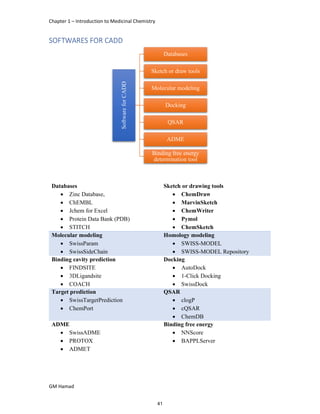
SOFTWARES FOR CADD
Databases
 Zinc Database,
 ChEMBL
 Jchem for Excel
 Protein Data Bank (PDB)
 STITCH
Sketch or drawing tools
 ChemDraw
 MarvinSketch
 ChemWriter
 Pymol
 ChemSketch
Molecular modeling
 SwissParam
 SwissSideChain
Homology modeling
 SWISS-MODEL
 SWISS-MODEL Repository
Binding cavity prediction
 FINDSITE
 3DLigandsite
 COACH
Docking
 AutoDock
 1-Click Docking
 SwissDock
Target prediction
 SwissTargetPrediction
 ChemPort
QSAR
 clogP
 cQSAR
 ChemDB
ADME
 SwissADME
 PROTOX
 ADMET
Binding free energy
 NNScore
 BAPPLServer
Software
for
CADD
Databases
Sketch or draw tools
Molecular modeling
Docking
QSAR
ADME
Binding free energy
determination tool
41
Chapter 1 – Introduction to Medicinal Chemistry
GM Hamad
ANTISENSE MOLECULES
INTRODUCTION
 Antisense therapy is a form of treatment for genetic disorders or
infections. When the genetic sequence of a particular gene is known to
be causative of a particular disease, it is possible to synthesize a strand
of nucleic acid (DNA, RNA or a chemical analogue) that will bind to the
messenger RNA (mRNA) produced by that gene and inactivate it,
effectively turning that gene "off". This is because mRNA has to be single
stranded for it to be translated.
PRINCIPLE OF THERAPY
 Most human diseases are caused by production of abnormal or
malfunctioning proteins. Antisense therapy involves inhibiting
production of these proteins. The antisense oligonucleotide binds to
mRNA and inhibits protein synthesis by two mechanisms;
­ Stopping the ribosome from reading the sequence
­ Destroying target mRNA by recruiting the enzyme “RNase”
ADVANTAGES
 Effects of antisense therapy are similar as of enzyme inhibitor and
receptor antagonist, however, smaller doses are needed that is why side
effects are also less. Antisense therapy also imparts specificity to the
treatment.
DISADVANTAGES
 Short lifetime
 Poor absorption
 Instability of oligonucleotides
 Difficulty in expressing RNA only in targeted tissue
EXAMPLE
 Mipomersen for homozygous familial hypercholesterolemia (mutations
in LDL-R gene that encodes LDL receptor protein)
 Formi virsen for cytomegalovirus retinitis (inflammation of retina caused
by CMV that leads to blindness) in AIDS patients.
42
Chapter 2 – Drug Target and Drug Designing
GM Hamad
DRUG TARGETS
DEFINITION
 A drug/druggable target is a naturally existing cellular/molecular
structure involved in pathogenesis, the direct or indirect inhibition or
activation of which will elicit a measurable biological response.
CLASSES OF DRUG TARGETS
 Following are the drug targets:
­ Enzymes
­ Receptors
­ Proteins
­ Membrane lipids
­ Carbohydrates
­ Nucleic acids
­ Ion channels
1. ENZYMES
 Enzymes are organic, thermolabile catalysts produced by the living
organisms. They increase the rate of a chemical reaction without any
permanent change in their structure or being consumed in
the process.
 Almost all chemical reactions in the body are catalyzed by enzymes.
During their catalytic activity, enzymes;
­ Hold substrate in the active site in such a position that it can easily
and effectively be attacked by the reagent
­ Provide functional groups that will attack the substrate and carry
out the biochemical reactions
 Enzymes generally make good drug targets because a specific reaction of
interest can be targeted with a high degree of selectivity.
 Drugs acting on enzymes can either increase or decrease the rate of
reactions mediated by them. Hence, are classified as;
­ Enzyme activators
­ Enzyme inhibitors
43
Chapter 2 – Drug Target and Drug Designing
GM Hamad
2. RECEPTORS
 Receptors are macromolecules that specifically recognize and bind a
ligand and, transduce and integrate the signal received from it into
biological systems.
CLASSES OF RECEPTORS
 Cell surface receptors
­ G protein coupled receptors
­ Ion channel linked receptors
­ Enzyme linked receptors
 Nuclear receptors
3. CELL MEMBRANE LIPIDS
 Drugs can interact with membrane lipids and disrupt the function of cell
membrane by interfering with its permeability.
EXAMPLE
 Anesthetics
 Anti-fungal agents (Amphotericin B)
 Gramicidin and Megainins (peptide antibiotic)
 Valinomycin
4. CARBOHYDRATES
 Carbohydrates play an important role in cell recognition, regulation and
growth. They are important targets for treatment of viral and bacterial
infections, cancer and auto-immune diseases. They also act as antigens.
EXAMPLE
 Antibodies recognize the antigen on the foreign cells and mark it for
destruction. Then, immune system destroys the cell. Hence, act as anti-
cancer agents.
5. NUCLEIC ACIDS
Nucleic acids are biopolymers composed of nucleotides i.e. monomers made of
three components: a 5-carbon sugar, a phosphate group and a nitrogenous
base.
DRUGS ACTING ON DNA
 Intercalating agents
 Alkylating agents
44
Chapter 2 – Drug Target and Drug Designing
GM Hamad
 Chain cutters
DRUGS ACTING ON RNA
 Antibiotics
 Antisense molecules
DRUGS ACTING ON NUCLEIC ACID BUILDING BLOCK
 Antiviral agents
6. ION CHANNELS
 Ion channels are pore-forming membrane proteins whose functions
include establishing a resting membrane potential, shaping action
potentials and other electrical signals by gating the flow of ions across
the cell membrane, controlling the flow of ions across secretory and
epithelial cells, and regulating cell volume
TYPES
 Voltage gated ion channels
 Ligand gated ion channels
45
Chapter 2 – Drug Target and Drug Designing
GM Hamad
DRUG DISCOVERY AND DEVELOPMENT
INTRODUCTION
 Discovery and development of new natural and synthetic compounds
comes under the umbrella of medicinal chemistry research.
 The discipline encompasses background knowledge and understanding
of physicochemical properties of compounds to produce novel agents,
elucidation of mechanisms of action and correlation of the structure
with biological activity, molecular docking, and pharmacokinetics,
metabolomics and toxicological profiling to select the most promising
candidates for treatment of a disease condition.
DRUG DISCOVERY
 Drug discovery is a systematic approach which involves setting up of a
working hypothesis of the target for a particular disease, establishing
suitable models for estimation of biological activities and screening of
large libraries of molecules to identify lead compounds.
DRUG DEVELOPMENT
 Drug development takes into account the pre-clinical and clinical studies
on the most promising candidate and its regulatory approval.
DRIVING FORCES FOR THE DRUG DISCOVERY AND DEVELOPMENT
PROGRAMS
 The novel comprehensions into a disease process or targeting
technologies and unsatisfied clinical needs are the driving forces for the
drug discovery programmes.
 The general steps towards discovery of innovative leads are as follows:
STEP 1: IDENTIFICATION AND SELECTION OF A “DRUGGABLE TARGET”
 A druggable target is a naturally existing cellular/molecular structure
involved in pathogenesis, the direct or indirect inhibition or activation of
which will elicit a measurable biological response.
 The major classes of the drug targets are enzymes (proteases, estrases,
phosphatases and protein kinases), proteins (structural or transport),
receptors (nuclear hormone and G-protein coupled), nucleic acids and
ion-channels (ligand-gated and voltage-gated).
46
Chapter 2 – Drug Target and Drug Designing
GM Hamad
 These targets may be a newly discovered or explored protein or the ones
with sound scientific understanding on their function in both
physiological and pathological conditions. The process of the selection
and prioritization of a diseased target can be made efficient through
mining of the data from gene expression, proteomics, transgenic
phenotype profile, patents and publications.
STEP 2: TARGET VALIDATION
 Target validation is an approach to verify that a molecular target is
directly involved in a disease process, and that modulation of the target
is likely to have a therapeutic effect.
 Most powerful target validation tools include monoclonal antibodies and
transgenic animals and chemical genomics.
STEP 3: LEAD DISCOVERY
 A “lead” refers to a compound having sufficient potency, efficacy and
selectivity for the chosen target, and favorable drug-like features but
suboptimal structure requiring modifications to enhance the ligand-
binding site interactions.
 The process of lead discovery consists of various steps that are
summarized as follows:
STEP 3.1. DEVELOPMENT OF SCREENING PROGRAMS
 The first step in lead discovery is the development of programs for
screening the compounds at the validated target. These programs may
include high-throughput screen (HTS), focused screen, fragment screen,
physiological screen and virtual screen (VS).
 Amongst all, HTS and VS (analysis of library compounds using in vitro
assays in microtiter plate and molecular docking, respectively) are the
most commonly used screening programs. However, high cost and low
hit rate associated with the former call for the use of later method to
filter large chemical libraries into manageable ones.
STEP 3.2. GENERATION OF “HIT” SERIES
 A “hit” series refers to the library of compounds showing sufficient
selectivity and potency against the chosen target during the screening
programs that can be confirmed upon retesting.
47
Chapter 2 – Drug Target and Drug Designing
GM Hamad
STEP 3.3. COMPUTATIONAL PRIORITIZATION OF THE DRUG-LIKE
COMPOUNDS FROM “HIT” SERIES
 In the initial stages of lead discovery, it is imperative to select the small
and simple molecules since in the optimization phase, structural
modifications to improve potency and selectivity result in increasing the
molecular weight which in turn creates safety and tolerability issues.
 The recent advances in the computational chemistry enable the
researchers to scrutinize the hits into leads based on several
physiochemical, pharmacokinetic and toxic properties. A compound is
deemed to be drug or lead like if it passes through filters such as Lipinski
Rule of Five, Rule of Three, Veber Rules, CMC-50 Like Rules, BBB Rules,
MDDR Rules and Ghose Filters.
 The most commonly observed parameters in such cases include
molecular weight, hydrogen bond donors and acceptors, rotatable
bonds, polar surface area, molar refractivity, number of atoms and rings,
and log P.
Step 3.4. Generation of dose-response curves of the successful lead
candidates through primary and secondary biological assays
 The dose-response curves generated through primary biological assays
on isolated or engineered protein provide information on competitive
behavior of hits for the target. Compounds showing an “all or none”
response at low concentrations are believed to have no binding to the
target while those having irreversible interactions are rejected also. The
compounds with reversible biding are considered since their effects can
be “washed-out” following the withdrawal.
 The secondary biological assays are carried out on cells, tissues or
whole-animals, predictive of a particular disease state, in order to
evaluate efficacy and safety. Furthermore, the data obtained reassure
that the successful compounds can modulate intact systems rather than
the isolated simple proteins.
 The net result of the dose-response curves is the data on “half maximal
inhibitory concentration” that can be used for comparison of the
potencies of the lead candidates with the standards.
STEP 3.5. PHARMACOKINETICS STUDIES
48
Chapter 2 – Drug Target and Drug Designing
GM Hamad
 This stage involves detailed in vitro validation of the computationally
determined physicochemical and pharmacokinetic properties including
lipophilicity, aqueous solubility, log S and log D (solubility and
permeability as a function of pH, respectively), Caco-2 and MDR1-MDCK
permeability, and microsomal stability.
 These parameters help in selection of the lead candidates having
optimal pharmacokinetics to be subjected to in vivo experimentation for
obtaining data on bioavailability, distribution, metabolism, half-life,
clearance and interactions with food or metabolic enzymes.
STEP 3.6. TOXICITY STUDIES
 In pre-clinical toxicity studies, the lead candidates are subjected to
various in vitro (cytotoxicity, genotoxicity, mutagenicity and lethality)
and in vivo (developmental toxicity, acute oral toxicity and repeated-
dose toxicity) assays.
 The doses are usually selected based on the data from the
pharmacological experimentation.
STEP 3.7. STRUCTURE-ACTIVITY RELATIONSHIP (SAR)
 The last step in lead discovery is an intensive and systematic SAR studies.
Each and every part of structure of the successful lead candidate is
considered and effect of removal or introduction of a particular group on
the magnitude of activity and selectivity are measured.
STEP 4: LEAD OPTIMIZATION
 Lead optimization, the final stage in drug discovery, aims to improve the
deficiencies and modify the properties of the lead compound by taking
into account the SAR and chemical stability data. The end result of the
process, the optimized lead (drug candidate) then makes its way to the
pre-clinical and clinical development.
 The pre-clinical development provides comprehensive information on
the dosing and safety of the drug candidate in animals. Most of the
organizations start the Investigational New Drug (IND) Process before
conducting the clinical trials and ask for the guidance and assistance
from Food and Drug Administration. The process of generating and
gathering data on humans continues until a marketing application is filed
and upon approval the “new drug” finds its place in market.
49
Chapter 2 – Drug Target and Drug Designing
GM Hamad
 Note: It is noteworthy that only 10% of the molecules under
consideration in drug discovery program pass to the pre-clinical and
clinical phase.
 The major attributable factors for such high attrition rate include;
­ Inability to develop reliable screening assays
­ No developable hits identified by screening
­ Variable behavior of the hits in biological assays
­ Poor pharmacokinetic or pharmacodynamics profile
­ Side effects that cannot be separated from the mechanism of
action of the target
­ In vitro and in vivo toxicity
 However, the process of drug discovery does not cease and the working
on the backup series is continued to prevent failure of the program.
50
Chapter 2 – Drug Target and Drug Designing
GM Hamad
STRUCTURE BASED DESIGNING
DEFINITION
 It is drug design approach used when the 3D information of a biological
target of interest is known.
INTRODUCTION
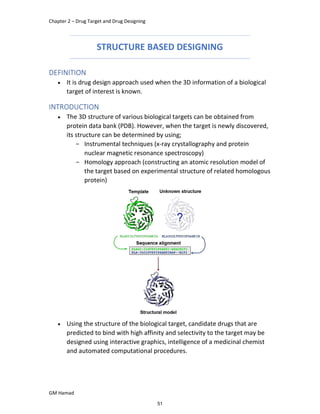
 The 3D structure of various biological targets can be obtained from
protein data bank (PDB). However, when the target is newly discovered,
its structure can be determined by using;
­ Instrumental techniques (x-ray crystallography and protein
nuclear magnetic resonance spectroscopy)
­ Homology approach (constructing an atomic resolution model of
the target based on experimental structure of related homologous
protein)
 Using the structure of the biological target, candidate drugs that are
predicted to bind with high affinity and selectivity to the target may be
designed using interactive graphics, intelligence of a medicinal chemist
and automated computational procedures.
51
Chapter 2 – Drug Target and Drug Designing
GM Hamad
APPLICATIONS
STRUCTURE-BASED VIRTUAL SCREENING
IDENTIFICATION OF BINDING SITE
 SBDD is used for identification of concave surfaces on the target that can
accommodate drug sized molecules that also possess appropriate "hot
spots" (hydrophobic surfaces, hydrogen bonding sites, etc.) that drive
ligand binding.
DETERMINATION OF BINDING AFFINITY
 SBDD is used for determination of the strength of binding of ligand at
the binding site of the target.
DETERMINATION OF BINDING CONFORMATION
 SBDD is used for determination of conformation (pose) of ligand relative
to the best binding affinity scores.
DETERMINATION OF LIGAND-BINDING SITE INTERACTIONS
 SBDD is used for determination of chemical bonds (type and strength)
formed between functional groups of ligand and amino acid residues of
the target for molecular recognition.
DE-NOVO DESIGN OF NOVEL LIGANDS
52
Chapter 2 – Drug Target and Drug Designing
GM Hamad
 Using the 3D information of the target’s structure, ligand molecules are
built up within the constraints of the binding pocket by assembling small
pieces in a stepwise manner. These pieces can be either individual atoms
or molecular fragments.
LEAD OPTIMIZATION
 SBDD is used for optimization of lead compounds by evaluating
proposed analogs within the binding cavity.
53
Chapter 2 – Drug Target and Drug Designing
GM Hamad
LIGAND BASED DESIGNING
 Indirect drug design
DEFINITION
 LBDD is an approach used in the absence of the 3D information of a
biological target of interest (enzyme, receptor, ion-channel and nucleic
acid) and relies on knowledge of diverse molecules that bind to it.
APPLICATIONS
DESIGNING PHARMACOPHORE MODEL
 The information obtained from binding of different molecules with the
biological target of interest can be used to obtain a pharmacophore
model that defines the minimum necessary structural characteristics a
molecule should have so as to bind to the target. Then, a series of novel
compounds sharing similar structural skeleton can be developed.
ENGINEERING BIOLOGICAL TARGET MODEL
 A model of the biological target can be engineered based on the
information of what binds thereto, and this model consecutively can be
accustomed to design new molecular entities that interact with the
target.
QSAR STUDIES
 In LBDD, a quantitative structure-activity relationship (QSAR) devised
already between calculated properties of a series of similar molecules
and their experimentally determined biological activity can be used to
predict the activity of latest analogs.
54
Chapter 2 – Drug Target and Drug Designing
GM Hamad
DRUG SYNTHESIS
INTRODUCTION
 The word synthesis refers to “man-made”. Chemical synthesis is a
process in which one or more reactants react to form one or more
products.
NEED OF CHEMICAL SYNTHESIS
 The process of chemical synthesis is aimed at the generating such
compounds that have therapeutic or commercial advantage over the
existing ones.
GENERAL CONSIDERATION BEFORE CHEMICAL SYNTHESIS
 The process of chemical synthesis is usually laborious and requires
comprehensive knowledge of basic principles of organic and inorganic
chemistry for the successful outcome. Therefore, before starting a
synthesis process, due consideration must be given to the following;
STARTING MATERIAL
 The choice of starting materials is important in any synthetic route.
Common sense dictates that they should be chosen on the basis of;
­ What will give the best chance of reaching the desired product
­ Cost
­ Availability
­ Reactant’s exposure-associated risks and hazards
CHEMICAL REACTION
 The chemical reactions selected for the proposed synthetic pathway will
obviously depend on the structure of the target compound. However, a
number of general considerations need to be borne in mind when
selecting these reactions includes:
­ The yields of reactions should be high, particularly when the
synthetic pathway involves a large number of steps.
­ The products should be relatively easy to isolate, purify and
identify.
­ Reactions should be stereospecific.
55
Chapter 2 – Drug Target and Drug Designing
GM Hamad
­ The reactions used should be adaptable to large-scale production
methods.
DESIGN OF PATHWAY/ROUTE OF SYNTHESIS
 The design of pathway for synthesis of target compounds depends on;
­ Chemistry of functional groups
­ Carbon skeletons associated to functional groups
 Ideally, the chosen route should be;
­ Easy to modify the structure of the lead compound either directly
or during the course of its synthesis.
­ Economic (less number of steps and reactants)
­ Diverse (produce a greater range of analogues)
­ Including stages where it is possible to introduce new side chains
and substituents
PROTECTION STRATEGY
 The design of synthetic pathways often requires a reaction to be carried
out at one center in a molecule, the primary process, whilst preventing a
second center from either interfering with the primary process or
undergoing a similar unwanted reaction. This objective may be achieved
by careful choice of reagents and reaction conditions or combining the
second center with a protecting group. Whenever, protection strategy is
used, following must be considered;
­ The protection group must be easy to attach to the relevant
functional group
­ The protected site should form a stable structure that is not
affected by the reaction conditions and reagents being used to
carry out the reaction
­ The protection group should be easily removed once it is no
longer required
­ In some circumstances, protecting groups may not be removed
but converted into another structure as part of the synthesis
CLASSIFICATION
BASED UPON THE NUMBER OF STEPS INVOLVED IN THE CHEMICAL REACTION
I. ELEMENTARY REACTIONS
 A chemical reaction that takes place in one step to produce target
molecule is called elementary reaction.
56
Chapter 2 – Drug Target and Drug Designing
GM Hamad
 Based upon the number of molecules taking part, elementary reactions
can be uni-molecular, bimolecular and ter-molecular reactions having
one, two, and three molecules as reactants, respectively.
II. COMPLEX REACTIONS
 A chemical reaction that takes place in multiple steps to produce target
molecule is called complex reaction. In such reactions, one product of a
reaction is treated with another reactant to form another product and
this is continuously done until target compound is reached.
BASED ON STRATEGY OF SYNTHESIS
I. GROUP ORIENTED SYNTHESIS
 It involves interconversion, addition, removal, masking or unmasking of
functional group/s.
II. BOND ORIENTED SYNTHESIS
 It involves formation or breaking of bonds or fusion of one ring with
another ring or a chemical moiety.
III. RETROSYNTHESIS
 It is the reverse of a synthetic reaction. This approach starts with the target structure
and then works backwards by artificially cutting the target into sections known as
synthons. Each of the possible synthons is converted on paper into a real compound
known as a reagent whose structure is similar to that of the synthon. The
disconnection selected for a step in the pathway is the one that gives rise to the best
reagents for a reconnection reaction.
IV. CONSTRUCTION MOTIFS
 It involves use of available natural or synthetic compounds containing
the main part of the target structure and modifying their structure to
produce the desired product.
BASED ON ROUTE OF SYNTHESIS
I. LINEAR
 In linear route of synthesis, one step in the pathway is immediately
followed by another until target compound is reached.
II. CONVERGENT
 In convergent route of synthesis, two or more sections of the molecule
are synthesized separately before being combined to form the target
structure.
III. DIVERGENT
 In a divergent synthesis, several compounds are prepared from a
common intermediate.
57
Chapter 2 – Drug Target and Drug Designing
GM Hamad
BASED ON SYNTHETIC PATHWAY
FULL SYNTHETIC PATHWAY
 Full synthetic pathway involves the use of traditional organic synthesis
to convert the reactant to the target structure.
PARTIAL SYNTHETIC PATHWAY
 Partial synthetic pathways use biochemical and other methods to
produce the initial starting materials and traditional organic synthesis to
convert these compounds to the target structure.
ASYMMETRY IN SYNTHESIS
 The presence of an asymmetric center or centers in a target structure
requires;
USE OF NON-STEREOSELECTIVE REACTIONS TO PRODUCE STEREOSPECIFIC
CENTRES
 Non-stereoselective reactions produce either a mixture of
diastereoisomers or a racemic modification. In such instances, isolation
and purification of desirable product is needed which can considerably
reduce the overall yield.
 Diastereoisomers exhibit different physical properties. Consequently,
techniques utilizing these differences may be used to separate the
isomers. The most common methods of separation are fractional
crystallization and appropriate forms of chromatography.
 The separation (resolution) of a racemic modification into its constituent
enantiomers is normally achieved by converting the enantiomers in the
racemate into a pair of diastereoisomers by reaction with a pure
enantiomer. Enantiomers of acids are used for racemates of bases whilst
enantiomers of bases are used for racemates of acids.
USE OF STEREOSELECTIVE REACTIONS TO PRODUCE STEREOSPECIFC CENTRES
 Stereoselective reactions result in the selective production of one of the
stereoisomers of the product.
 The stereoselectivity in synthesis can be achieved by using;
­ Catalyst (enzymatic or non-enzymatic)
­ Chiral agents (building blocks and auxiliary)
­ Achiral reactants and substrate
58
Chapter 3.1 – Hormones
GM Hamad
HORMONES
DEFINITTION
“Hormones are chemical messengers needed in small concentrations to
inhibit or accelerate the metabolic activity of the target organ.”
OR
“A hormone is a class of signaling molecules produced by glands in
multicellular organisms that are transported by the circulatory system to
target distant organs to regulate physiology and behavior.”
OR
“Hormones are substances produced by highly specialized tissues called the
"Endocrine" or "ductless glands", carried by the blood stream to target
organs for exerting characteristic physiological effects.”
CHEMICAL CLASSIFICATION OF HORMONES
1. PROTEIN / PROTEIN DERIVATIVES (POLYPEPTIDE)
 Protein derivatives contain hormone secreted by anterior and
posterior pituitary gland and pancreas. E.g, insulin, glucagon
2. STEROIDAL HORMONES
 Hormones secreted by ovaries, testes and adrenal cortex. E.g,
corticosteroids, estrogen, progesterone, testosterone.
3. AMINO ACIDS
 Hormones secreted by thyroid and adrenal medulla. E.g, thyroidal
hormones.
RELATED COMPOUNDS
 Following are the compounds related to hormones:
­ Vitamins
­ Enzymes
COMPARISON BETWEEN HORMONES, VITAMINS AND ENZYMES
59
Chapter 3.1 – Hormones
GM Hamad
CHARACTER HORMONE ENZYME VITAMINS
DEFINITION
Molecules (peptide /
steroid) that triggers
specific cellular
reaction in target
tissues and organs at
some distance away
Biological
macromolecules which
speed up the chemical
reactions without
undergoing any change
Essential micro-
nutrients needed for
proper functioning of
metabolism
CHEMICALLY
Glycoprotein, steroid
or polypeptide
Always proteinaceous
in nature
Organic acid / amide /
amine / ester / alcohol
or steroid
OCCURANCE
Internal supplies
secreted in our body
Internal supplies
present within our
body
External supplies
obtained from food
PRODUCED
BY
Endocrine gland Exocrine gland Taken by food
DEFICIENCY Hormonal disorder
Required in small
amount
Disease
EXAMPLE
Melatonin, insulin,
thyroid hormone
Protease, amylase,
lipase, transferase
Vitamin A, D, E, K, B, C
1. STEROIDAL HORMONES
DEFINITION
“Any compound containing steroidal ring is called steroid / steroidal
hormone.”
 Steroids forms a group of structurally related compounds, which are
widely distributed in animal and plant kingdom. The structure of steroids
are based on the 1,2 Cyclopentanophenanthrene skeleton.
THERAPEUTIC USES OF STEROIDAL HORMONES
 Steroids or steroid hormones are naturally occurring compounds which
are responsible for maintaining, development and regulation of
reproductive system.
 These drugs are used primarily in;
­ Birth control
­ Hormone-replacement therapy (HRT)
­ Inflammatory conditions
­ Cancer treatment
CHEMISTRY OF STEROIDAL HORMONES
 The steroidal hormones are chemically based on a common structural
backbone, the steroid backbone.
60
Chapter 3.1 – Hormones
GM Hamad
 Although, steroidal drugs share a common structural foundation, the
variations in the structures provide specificity for the unique molecular
targets.
BIOSYNTHESIS OF STEROIDAL HORMONES
 Steroid hormones in mammals are biosynthesized from cholesterol,
which in turn is made in vivo from acetyl-CoA via the mevalonate
pathway.
 The biosynthetic pathways for steroidal hormone (Testosterone,
Progesterone, Estrogen, Aldosterone, Cortisol) are as follows;
CONVERSION OF CHOLESTEROL TO PREGNENOLONE
 It is the rate-limiting step in steroid hormone biosynthesis due to the
dependency of cholesterol on Steroidogenic Acute Regulatory protein to
translocate it to the inner mitochondrial membrane of steroid-
synthesizing cells.
 P450scc mediates the cleavage of the C-17 side chain on the D ring of
the sterol to provide pregnenolone. Pregnenolone can be either directly
converted into progesterone or modified for synthesis of GCs, estrogens,
and androgens.
ROUTE 1: PROGESTERONE AND ALDOSTERONE PATHWAY
 Conversion of pregnenolone to progesterone.
­ This transformation is mediated by a bifunctional enzyme,
hydroxysteroid dehydrogenase (HSD) that causes oxidation of the
alcohol at C-3 to ketone and isomerization of double bond at 5-6C
to 4-5C to produce progesterone.
 Conversion of progesterone to aldosterone
­ Progesterone is directly acted on by 21-hydroxylase and
aldosterone synthase (a multifunctional enzyme, mediates the
hydroxylation at C11, as well as the two-step oxidation of C18 to
an aldehyde) providing aldosterone
61
Chapter 3.1 – Hormones
GM Hamad
ROUTE 2: SEX STEROID HORMONES AND GLUCOCORTICOIDS PATHWAY
 Conversion of pregnenolone to 17-hydroxy pregnenolone
­ Hydroxylation at C17 produces 17-hydroxy pregnenolone
 Conversion of 17-hydroxy pregnenolone to cortisol
­ Hydroxylation at C11 and HSD activity at 3C produces cortisol
 Conversion of 17-hydroxy pregnenolone to androgens and estrogens
­ The lyase oxidatively removes the two carbons at C17, providing
the C17 ketone which in the case of 17-hydroxypregnenolone is
dehydroepiandrosterone (DHEA). DHEA is converted to
androstenedione by the action 3-HSD. If 17-hydroxyprogesterone
is the substrate, androstenedione is resulted.
 Androstenedione can either be converted to;
­ Testosterone (due to 17-HSD) which in turn is aromatized to
estradiol by aromatase.
­ Estrone by aromatase.
NOTE
 Cholesterol is the precursor of all sex hormones.
 In direct route, only progesterone is formed directly from cholesterol
while estrogen and testosterone are formed indirectly from
progesterone.
 Testosterone is the precursor of estrogen hormone.
62
Chapter 3.1 – Hormones
GM Hamad
63
Chapter 3.1 – Hormones
GM Hamad
CLASSIFICATION OF STEROIDAL HORMONES
 Classes of steroidal hormones are;
­ Testosterone
­ Progesterone
­ Estrogen
­ Aldosterone
­ Cortisol
I. TESTOSTERONE
INTRODUCTION
 Testosterone is the male sex hormone which is responsible for the
development, maintenance, and regulation of the male reproductive
system and secondary sex characters of male.
 It belongs to the class of androgens. The androgens are a group of
steroids that have anabolic and/or masculinizing effects in both males
and females.
 The site of action of testosterone is androgen receptor.
MECHANISIM OF ACTION
 Testosterone antagonizes the androgen receptor to induce gene
expression that causes the growth and development of masculine sex
organs and secondary sexual characteristics.
THERAPEUTIC USES
 Testosterone controls the development as well as maintenance of male
sex organs and is solely responsible for the male secondary sex
characteristics.
 It also increases the size of scrotum, phallus, seminal vesicles, prostate
and enhance the sexual activity of adolescent males.
 Androgen replacement therapy in men having hypogonadism.
 Treatment of breast cancer in post-menopausal women.
BIOSYNTHESIS
 Biosynthesis is given earlier (Biosynthesis of Steroidal Hormone).
MEDICINAL CHEMISTRY
 It contains a steroidal ring. It consists of 4 fused rings A, B, C, D
­ A = cyclohexanone
64
Chapter 3.1 – Hormones
GM Hamad
­ B = Cyclohexane
­ C = Cyclohexane
­ D = Cyclopentane
STRUCTURE ACTIVITY RELATIONSHIP (SAR)
 They are important androgens. They possess androgenic and anabolic
activity (growth of new cells). Introduction of methyl group at carbon 17
along with hydroxyl, leads to formation of methyl testosterone. It can be
given orally. Methyl group is responsible for metabolic process. While
oxygen of hydroxyl group is responsible for receptor binding.
 Keto group at carbon 3 is responsible for androgenicity not for
anabolicity.
 Introduction of halogen at any position will lead to decrease of activity
except position no. 4 and 9 of steroidal nucleus. The activity is enhanced
when halogen is introduced at C-4 or 9. For e.g. floxymetreone is
obtained after the attachment of fluorine at C-9. It is 5 times more
potent than methyl testosterone.
 The androgenic and anabolic, both activities are decreased when
testosterone is reduced into dihydrotestosterone.
 First and second ring is in Trans-configuration form, if converted into Cis-
configuration the activity will be lost.
ASSAY
 Dilute the sample in alcohol to 50ml with ethyl alcohol. Measure the
absorption at 241nm.
BRANDS
 Sustanol – Pharmatec Pakistan
 Testoviran – Bayer Healthcare
 Syandrol – Pfizer
65
Chapter 3.1 – Hormones
GM Hamad
II. PROGESTERONE
INTRODUCTION
 Progesterone is a female sex hormone which is responsible for the
development, maintenance, and regulation of the female reproductive
system and secondary sex characters of female.
 Progesterone belongs to the class of Estrogens or Corpus Leuteum
Hormones.
 The site of action of progesterone is vaginal epithelium progesterone
receptor.
MECHANISIM OF ACTION
 Progesterone binds and activates its nuclear receptor, PR, which plays an
important part in the signaling of stimuli that maintain the endometrium
during its preparation for pregnancy.
 Progesterone receptor (PR) is a member of the nuclear/steroid hormone
receptor (SHR) family of ligand-dependent transcription factors that is
expressed primarily in female reproductive tissue as well as the central
nervous system. As a result of its binding its associated steroid hormone,
progesterone, the progesterone receptor (PR) modulates the expression
of genes that regulate the development, differentiation, and
proliferation of target tissues. In humans, PR is found to be highly
expressed in the stromal (connective tissue) cells during the secretory
phase and during pregnancy.
 Progesterone may prevent pregnancy by changing the consistency of
cervical mucus to be unfavorable for sperm penetration, and by
inhibiting follicle-stimulating hormone (FSH), which normally causes
ovulation.
THERAPEUTIC USES
 Treatment of functional uterine bleeding.
 Support pregnancy and fertility.
 Treatment of gynecological problems.
 Menstrual disorders.
 Treatment of habitual and threatened abortion.
BIOSYNTHESIS
 Biosynthesis is given earlier (Biosynthesis of Steroidal Hormone).
66
Chapter 3.1 – Hormones
GM Hamad
MEDICINAL CHEMISTRY
 It contains a steroidal ring. It consists of 4 fused rings A, B, C, D
­ A = cyclohexanone
­ B = Cyclohexane
­ C = Cyclohexane
­ D = Cyclopentane
STRUCTURE ACTIVITY RELATIONSHIP (SAR)
 The 4 rings in the structure of progesterone are essential and
unsubstituted, if we replace them or change their position the
therapeutic activity will be terminated.
 The 2 methyl groups present at positions 10 and 13 are essential and
unsubstituted, if we replace them with any other group or change their
position the therapeutic activity will be terminated.
 The acetyl group at position 17 is essential and unsubstituted, if we
replace this with any group or change its position the therapeutic
activity will be terminated.
 The ketonic group at position 3 is essential and unsubstituted, if we
replace this with any group or change its position the therapeutic
activity will be terminated.
ASSAY
 Rapid UV Spectrometry (UV) and Reversed phase high performance
liquid chromatography (HPLC) methods are developed for the
determination of estradiol in preparation.
BRANDS
 Prolutan – Bayer Healthcare
 Progesterone – Geofman Pharmaceuticals
67
Chapter 3.1 – Hormones
GM Hamad
 Gastron Depot – Global Pharmaceuticals
 Utrogestan – Galaxy Pharma
III. ESTEROGEN
INTRODUCTION
 Estrogen is a female sex hormone which is responsible for the
development maintenance and regulation of the reproductive system
and secondary sex characters in female
 It belongs to the class of estrogens.
 The site of action of estrogen is estrogen receptor (Erα, Erβ, mERs).
MECHANISIM OF ACTION
 Steroid hormones diffuse through the cell membrane and bind to
specific nuclear receptor. Two estrogen receptor sub types α and β,
mediates the effect of estrogen hormone.
 The transcriptional properties of α and β estrogen receptors are
different. Activated steroid receptor interacts with nuclear chromatin to
initiate RNA synthesis and specific proteins that mediate physiological
function.
THERAPEUTIC USES
 Hormonal contraception
 Hormone Replacement Therapy
 Treat gender dysphoria in transgender women
BIOSYNTHESIS
 Biosynthesis is given earlier (Biosynthesis of Steroidal Hormone).
MEDICINAL CHEMISTRY
 It contains a steroidal ring. It consists of 4 fused rings A, B, C, D
­ A = cyclohexanone
­ B = Cyclohexane
­ C = Cyclohexane
­ D = Cyclopentane
68
Chapter 3.1 – Hormones
GM Hamad
STRUCTURE ACTIVITY RELATIONSHIP (SAR)
 The most potent naturally occurring estrogens in humans are 17-β-
estradiol, oestrione and oestriol.
 Each of these molecule is an 18-C steroid containing a phenolic -A ring
(an aromatic ring with hydroxyl group at C-3), and a β-hydroxyl group or
ketone on position 17 of ring -D.
 The phenolic -A ring is the principle structure feature for selective, high
affinity binding to estrogen receptors.
 Most Alkyl substitutions on the phenolic -A ring impair such binding, but
substitution on ring C or D may be tolerated.
 Ethinyl substitution at C-17 position greatly increases oral potency by
inhibiting the first pass hepatic metabolism.
ASSAY
 Rapid UV Spectrometry (UV) and Reversed phase high performance
liquid chromatography (HPLC) methods are developed for the
determination of estradiol in preparation.
BRANDS
 DestroDose – Galaxy Pharma
 Progynon Depot – Bayer Healthcare
 Ovlogyn – Zafa Pharmaceuticals
 Femoston – Abbott Lab
 Globinan – Global Pharma
69
Chapter 3.1 – Hormones
GM Hamad
IV. ALDOSTERON
INTRODUCTION
 Aldosterone is the main mineralocorticoid steroid hormone produced by
the zona glomerulosa of the adrenal cortex in the adrenal gland.
 It is essential for sodium conservation in the kidney, salivary glands,
sweat glands, and colon.
 Aldosterone plays a central role in the homeostatic regulation of blood
pressure, plasma sodium (Na+), and potassium (K+) levels.
MECHANISIM OF ACTION
 Binding of aldosterone with the receptors initiates DNA transcription,
initiating transcription of specific proteins resulting an increase in the
number of sodium channels Na+-K+-ATPase molecules.
THERAPEUTIC USES
 Systemic Hypertension
 Hypertensive patients with post MI
 Hypertensive patients with Diabetes Mellitus
 Congestive Heart Failure
BIOSYNTHESIS
 Biosynthesis is given earlier (Biosynthesis of Steroidal Hormone).
MEDICINAL CHEMISTRY
 It contains a steroidal ring. It consists of 4 fused rings A, B, C, D
­ A = cyclohexanone
­ B = Cyclohexane
­ C = Cyclohexane
­ D = Cyclopentane
70
Chapter 3.1 – Hormones
GM Hamad
STRUCTURE ACTIVITY RELATIONSHIP (SAR)
 Steroidal nucleus is essential for steroidal activity.
 Keto group at C-3, carbonyl group at C-20 and double bond between C-4
and 5 is essential for glucocorticoid and mineralocorticoid activity.
 There is α-hydroxyl group is attached at C-17, essential for glucocorticoid
but not for mineralocorticoids. Mineralocorticoid require –OH at C-21.
while glucocorticoids require –OH group at C-11.
BRANDS
 Aldactone– Searle
 Diuton – Medera Pharmaceuticals
V. CORTISOL
INTRODUCTION
 Cortisol is a steroid hormone, in the glucocorticoid class of hormones.
Cortisol is a steroid hormone that regulates a wide range of processes
throughout the body, including metabolism and the immune response.
 It also has a very important role in helping the body respond to stress.
MECHANISIM OF ACTION
 Cortisol is the major glucocorticoid in humans. It has two primary
actions:
­ It stimulates gluconeogenesis – the breakdown of protein and fat
to provide metabolites that can be converted to glucose in the
liver
­ It activates antistress and anti-inflammatory pathways.
THERAPEUTIC USES
 Control blood sugar levels
 Control blood pressure
 Regulate metabolism
 Reduce inflammation
 Assist with memory formulation
BIOSYNTHESIS
 Biosynthesis is given earlier (Biosynthesis of Steroidal Hormone).
71
Chapter 3.1 – Hormones
GM Hamad
MEDICINAL CHEMISTRY
 It contains a steroidal ring. It consists of 4 fused rings A, B, C, D
­ A = cyclohexanone
­ B = Cyclohexane
­ C = Cyclohexane
­ D = Cyclopentane
<
STRUCTURE ACTIVITY RELATIONSHIP (SAR)
 Naturally occurring glucocorticoids are; cortisone and hydrocortisone.
Synthetics are; prednisolone, methylprednisolone, dexamethasone,
betamethasone etc.
 Conversion of single bond between carbon 1 and 2 to double bond,
increases the anti-inflammatory action and salt & water retention effect
weakens.
 Adding methyl group at C-6 of prednisolone the anti-inflammatory
action enhances and results into methylprednisolone. Thus increased
glucocorticoid activity.
 Adding halogen like F or Cl at C-9 and methyl group at C-16, results in
pronounced anti-inflammatory activity and the salt and water retention
effect also weakens.
 11-beta hydroxyl group is considered to be an important group for
receptor binding. The hydrophilicity and lipophilicity can be changed by
modifications into suitable esters.
BRANDS
 Solu Cortef – Pfizer Laboratories
 Hydrocort – Akhai Pharmaceuticals
 Cortisol – Bio Pharma
72
Chapter 3.1 – Hormones
GM Hamad
2. PROTEINOUS HORMONES
INTRODUCTION
 These hormones, like other proteins, are synthesized in cells from amino
acids according to mRNA transcripts.
 Several important peptide hormones are secreted from the pituitary
gland. The anterior pituitary secretes prolactin, adrenocorticotropic
hormone, and growth hormone while posterior pituitary gland secretes
anti-diuretic hormone (vasopressin), and oxytocin.
 Peptide hormones produced by pancreas include glucagon, insulin and
somatostatin, and the gastrointestinal tract are cholecystokinin, gastrin.
CLASSIFICATION OF PROTEINOUS HORMONES
 Classes of proteinous hormones are;
­ Insulin
­ Glucagon
­ Oxytocin
­ Vasopressin
I. INSULIN
INTRODUCTION
 Insulin is a peptide hormone produced by beta cells of the pancreatic
islets.
MECHANISM OF ACTION
 Insulin regulates both metabolic enzymes and gene expression. It does
not enter cells but initiates a signal that travels from the cell surface
receptor to cytosol and to the nucleus.
 The insulin receptor is a glycoprotein receptor with tyrosine-kinase
activity.
THERAPEUTIC USES
 Type 1 diabetes mellitus
 Post pancreatectomy diabetes
 Gestational diabetes
 Type 2 diabetes mellitus not controlled by diet and exercise
 Failure of oral hypoglycemic agents
CHEMISTRY
73
Chapter 3.1 – Hormones
GM Hamad
 Insulin structure consists of 51 amino acids arranged in two polypeptide
chains (A and B)
 Chain A contains 21 while chain B contains 30 amino acids.
 These chains have two interchain bridges, 1) A7-B7 and 2) A20-B19
 Interchain disulfide link is Chain A is present between amino acids 6 and
11.
SYNTHESIS
 Insulin is synthesized from 86-amino-acid polypeptide precursor
(proinsulin) which is synthesized in rough endoplasmic reticulum from
preproinsulin (B chain of preproinsulin is extended at the NH2-terminus
by at least 23 amino acids). Proinsulin traverses the Golgi apparatus and
enters the storage granules, where the conversion to insulin occurs.
 The proteolytic conversion of proinsulin to insulin is accomplished by the
removal of the Arg-Arg residue at positions 31 and 32 and the Arg-Lys
residue at positions 64 and 65 by an endopeptidase. The actions of these
proteolytic enzymes on proinsulin result in the formation of insulin
molecule having two chains A and B.
BRANDS
 Dongsulin70/30 – Highnoon Laboratories
 Dongsulin70/30 Penfill – Highnoon Laboratories
 Mixtard 30 Penfills – Novo Nordisk
 Mixtard Hm – Novo Nordisk
74
Chapter 3.1 – Hormones
GM Hamad
II. GLUCAGON
INTRODUCTION
 Glucagon is a peptide hormone, produced by alpha cells of the pancreas.
MECHANISM OF ACTION
 On target cells, glucagon combines with the receptor and activates
adenyl cyclase via G-protein. Adenyl cyclase causes the formation of
cyclic AMP. The increase in cAMP activates the protein kinase that
catalyzes phosphorylation of phosphorylase kinase to
phosphophosphorylase kinase.
 The latter is necessary for the activation of phosphorylase to form
phosphorylase P. Finally, phosphorylase P catalyzes glycogenolysis,
which is the basis for the hyperglycemic action of glucagon.
THERAPEUTIC USES
 It is used for treatment of severe hypoglycemic reactions caused by the
administration of insulin to diabetic or psychiatric patients.
 This treatment is effective only when hepatic glycogen is available.
CHEMISTRY
 The structure of glucagon comprises of 29 amino acid residues arranged
in a chain.
SYNTHESIS
 Glucagon is produced as a prohormone with 160 amino acids by alpha
islet cells. The cleavage of this amino acid chain produces four peptides
one of which is glucagon that is stored in secretory vesicles in cytoplasm
of alpha cells. In response to low blood sugar levels, the stimuli causes
release of glucagon.
Preproglucagon → Proglucagon → Glucagon
75
Chapter 3.1 – Hormones
GM Hamad
BRANDS
 Glucagon – Elly Lilly
 GlucaGen – Bedford Laboratories
 Glucagon – Fresenius Kabi
 Glugon – Avalon Pharma
III. OXYTOCIN
INTRODUCTION
 Oxytocin is a peptide hormone synthesized in the hypothalamus and
released by the posterior pituitary into the bloodstream.
MECHANISM OF ACTION
 Oxytocin acts via specific G protein-coupled receptors closely related to
the V1a and V2 vasopressin receptors. In the human myometrium, these
receptors couple to Gq and G11, activating the PLCb-IP3-Ca2+
pathway and
enhancing activation of voltage-sensitive Ca2+
channels.
 Oxytocin also increases local prostaglandin production, which further
stimulates uterine contractions.
THERAPEUTIC USES
 Induce labor, particularly in cases of intrapartum hypotonic inertia
 Inevitable or incomplete abortion after the 20th week of gestation
 Prevent or control hemorrhage
 Correct uterine hypotonicity
 Promote milk ejection
CHEMISTRY
 Polypeptide contains 9 amino acids in the sequence cysteine-tyrosine-
isoleucine-glutamine-asparagine-cysteine-proline-leucine-glycine-amide
(Cys – Tyr – Ile – Gln – Asn – Cys – Pro – Leu – Gly – NH2).
 The C-terminus is converted to a primary amide and a disulfide bridge
joins the cysteine moieties.
76
Chapter 3.1 – Hormones
GM Hamad
 The structure of oxytocin is very similar to that of vasopressin. Both have
a single disulfide bridge, differing only by two substitutions in the amino
acid sequence.
SYNTHESIS
 Oxytocin is synthesized as an inactive precursor protein from the OXT
gene.
 The inactive precursor protein is progressively hydrolyzed enzymatically
into smaller fragments including the oxytocin carrier protein
neurophysin I.
 The last hydrolysis that releases the active oxytocin nonapeptide is
catalyzed by peptidylglycine alpha-amidating monooxygenase.
 Outside the brain, oxytocin-containing cells have been identified in
several diverse tissues, including;
­ Corpus luteum and the placenta (females)
­ Testicles’ interstitial cells of Leydig
­ Retina, adrenal medulla, thymus and pancreas (male and female)
BRANDS
 Oxytocin – Shifa Laboratories.
 Oxytocin – Dosaco Laboratories
 Syntocinon – Novartis Pharma
 Tocinox – Geofman Pharmaceuticals
77
Chapter 3.1 – Hormones
GM Hamad
IV. VASOPRESSIN
INTRODUCTION
 Vasopressin is a peptide hormone synthesized in the hypothalamus.
MECHANISM OF ACTION
 AVP acts on renal collecting ducts via V2 receptors to increase water
permeability (cAMP-dependent mechanism), which leads to decreased
urine formation (hence, the antidiuretic action of "antidiuretic
hormone"). This increases blood volume, cardiac output and arterial
pressure.
 Vasopressin produces vasoconstriction in non-vital circulations by
activation of V-1 receptors. In common with the a- adrenergic agonists,
V-1 activation leads to increased levels of the second messengers
inositol phosphate and diacylglycerol, which in turn activate voltage-
gated calcium channels. This results in increased intracellular calcium
levels, causing vasoconstriction.
THERAPEUTIC USES
 ADH is therapeutically useful in the treatment of diabetes insipidus of
pituitary origin.
 It also has been used to relieve intestinal paresis (delayed intestinal
emptying) and distention.
CHEMISTRY
 The structure of glucagon comprises of 9 amino acid residues
 The amino acid sequence of arginine vasopressin is Cys-Tyr-Phe-Gln-Asn-
Cys-Pro-Arg-Gly-NH2, with the cysteine residues forming a disulfide
bond and the C-terminus of the sequence converted to a primary amide.
It is found in humans
78
Chapter 3.1 – Hormones
GM Hamad
 Lysine vasopressin has a lysine in place of the arginine as the eighth
amino acid and is found in pigs and some related animals.
SYNTHESIS
 This hormone is synthesized as a peptide prohormone in neurons in the
hypothalamus and is converted to arginine vasopressin.
 It then travels down the axon of that cell, which terminates in the
posterior pituitary, and is released from vesicles into the circulation in
response to extracellular fluid hypertonicity (hyperosmolality).
Hypothalamus → Provasopressin → Arginin vasopressin
BRANDS
 Minirin – Atco Labs.
 Octorin – Bosch Pharmaceuticals.
79
Chapter 3.2 – Anti-neoplastic agents
GM Hamad
ANTI NEOPLASTIC AGENTS
CANCER
 Cancer is a disease in which there is abnormal division of cells without
control and can invade nearby tissues.
TYPES OF CANCER
I. CARCINOMA
 Cancer of skin or tissue that lines or covers internal organs, epithelial
cells.
II. SARCOMA
 Cancer of bones, cartilage, fat, muscles, blood vessels and other
connective/ supportive tissues.
III. LEUKEMIA
 Cancer of WBC and their precursor cells such as bone marrow cells,
causes abnormal blood cells to be produced and enter into blood.
IV. LYMPHOMA
 Cancer of immune system cells that effects lymphatic system.
V. MYELOMA
 Cancer in which β cells produce anti bodies that spreads through
lymphatic system.
VI. CNS CANCER
 Cancer that begins in tissues of brain and spinal cord.
REASONS/ ETIOLOGY OF CANCER
 Cancer is caused by changes/ mutation to DNA within cells. As DNA
inside cell is packages into large individual genes, each of which contains
a set of instructions telling the cell what functions to perform, as well as
how to grow and divide.
OTHER CAUSES
 Smoking
 Heavy Alcohol consumption
 Age, Poor nutrition
 Genetic factor
80
Chapter 3.2 – Anti-neoplastic agents
GM Hamad
1. METHOTREXATE
INTRODUCTION
 Methotrexate is an anti-cancer drug that is used for treatment of:
­ Breast cancer
­ Lung cancer
­ Lymphoma
­ Sarcoma
 Methotrexate is the only drug that is used in multiple cancers. It is also
used as an anti-allergic e.g., in psoriasis (psoriasis is known as skin
allergy or skin cancer as in this condition, there is abnormal condition of
skin cells).
 Methotrexate is also used to treat Arthritis and Leukemia. Yet, this drug
also causes skin allergy.
BACKGROUND
 Methotrexate formerly known as Amethopterin, chemotherapy agent
and immune system suppressant.
 It was first discovered by team of researchers led by Sidney Forber in
1947, as analog of folic acid developed by yellapragada Subbarao.
 By 1950, MTX was used for treatment of leukemia. In 1951 Jane Wright
demonstrated the use of methotrexate in solid tumors.
 In 1960, Wright et al remission in mycosis fungoides.
MECHANISIM OF ACTION
 Methotrexate inhibits Dihydrofolate Reductase (DHFR), resulting in
inhibition of synthesis of thymidylate, purine nucleotides, serine and
methionine.
ANTIDOTE OF METHOTREXATE
 Leucovorin (folinic acid) is the primary antidote for a patient who
receives an overdose of methotrexate.
THERAPEUTIC APPLICATIONS
 Breast cancer
 Bladder cancer
 Choriocarcinoma
 CNS lymphoma
 Non-Hodgkin’s lymphoma
 Head and Neck cancer
MEDICINAL CHEMISTRY
 In 1st
step, there is reaction between open chain and close ring. There
are two reactants 2,3 dibromo propionic aldehyde and 2,4 tetra amino
pyrimidine react to form the product, 6 bromo methyl 2,4 diamino
pyrimidine by crystallization.
81
Chapter 3.2 – Anti-neoplastic agents
GM Hamad
 In 2nd
step, 6-bromo methyl 2,4-diamino pyridine will react with para-
amino benzyl glutamic acid to form 2,4 diamino pyridine 6 methyl N
methyl amino benzyl glutamic acid or Methotrexate.
­ By eliminating bromine, by eliminating H of amino methyl amino.
STRUCTURE ACTIVITY RELATIONSHIP (SAR)
 Amino group and pyridine group is unsubstituted and essential.
 Methyl, benzyl, and amino groups are also unsubstituted and essential.
 If glutaric acid is placed instead of glutamic acid by removing its amino
group, therapeutical activity will be terminated.
BRANDS
 Methotrexate Tablet – Highnoon Laboratories
 DMARD – Wilshire Labs
82
Chapter 3.2 – Anti-neoplastic agents
GM Hamad
2. TEMOXIFEN
INTRODUCTION
 Tamoxifen was discovered in 1966, by the company ICI (Imperial
Chemical Industry). The latest name of which is AstraZeneca (Astra =
Sweden company, Zeneca = Britain company).
 This drug is especially used in breast cancer. The drug targets estrogen
receptor on target tissue.
 It is SERM (Selective Estrogen Receptor Modulator).
SITE OF ACTION
 Hormone site  Transcription of genes
CLASS
 Antiestrogens
­ They block the estrogen activity, compounds belonging to this
category are essentially the structural analogues of the estrogen
triphenyl ethylene.
MECHANISIM OF ACTION
 Under normal physiological conditions, estrogen stimulation increases
tumor cell production of transforming growth factor β (TGF-β), an
autocrine inhibitor of tumor cell growth.
 Tamoxifen is a competitor inhibitor of estradiol binding to the estrogen
receptor. By blocking the TGF-β pathway, it is used to decrease the
autocrine stimulation of breast cancer growth.
THERAPEUTIC APPLICATIONS
 Tamoxifen is employed as an alternative to androgens and estrogens in
the management of breast cancer.
 Tamoxifen is also used to stimulate ovulation in infertility.
 Tamoxifen is a drug of choice for breast cancer used worldwide.
METABOLISIM
 Being estrogen antagonist, it blocks estrogen receptor in breast tissue
via its active metabolites.
­ 4-Hydrotamoxifen
­ N-Desmethyl-4-Hydroxy tamoxifen
 Both the metabolites have 30-100 times more affinity toward estrogen
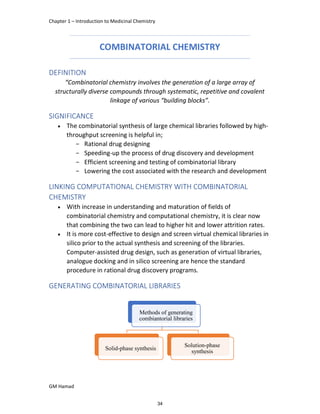
receptor than the tamoxifen itself.
83
Chapter 3.2 – Anti-neoplastic agents
GM Hamad
 In other tissues like endometrium, it behaves as an agonist, hence
tamoxifen may be characterized as a mixed agonist/antagonist.
 It is a standard endocrine (anti-estrogen) therapy for hormone-positive
early breast cancer in pre-menopausal women.
 Some breast cancer cells require estrogen to grow. Estrogen binds and
activates the estrogen receptors in these cells.
 Tamoxifen and its metabolites bind to the estrogen receptor but do not
activate it. Hence breast cancer cell growth is blocked.
 It is a non-steroidal agent with potent anti-estrogenic properties and
competes with estrogen for binding in breast and other tissues.
 Tamoxifen causes cells to remain in the G0 and G1 phase of the cell cycle,
hence prevents pre-cancerous cells from dividing without killing them.
 Therefore, tamoxifen is cytostatic rather than cytocidal.
84
Chapter 3.2 – Anti-neoplastic agents
GM Hamad
STRUCTURE
PROPERTIES
 Physical state – White crystalline powder
 Solubility (Slightly) – Water, Acetone
 Solubility (Freely) – Methanol
MEDICINAL CHEMISTRY
 In 1st
step, Phenyl allyl tetra methyl silane reacts with Benzaldehyde
resulting in formation of Biphenyl butenyl phenoxy methyl.
 In 2nd
and last step, Biphenyl butenyl phenoxy methyl shifts its butene
bonds and there is addition of ethyl dimethyl amine and the product
tamoxifen is formed.
85
Chapter 3.2 – Anti-neoplastic agents
GM Hamad
STRUCTURE ACTIVITY RELATIONSHIP (SAR)
 Tamoxifen derivated to Toremifene, which has similar pharmacological
profile to that of tamoxifen.
PHARMACOKINETICS
 Absorption
­ Oral
 Metabolism
­ Liver
 Excretion
­ Unchanged and metabolites are excreted pre-dominantly through
bile into feces.
86
Chapter 3.2 – Anti-neoplastic agents
GM Hamad
 Biotransformation
ASSAY
 Dissolve the sample in anhydrous acetic acid and titrate with 0.1M
perchloric acid using naphthol benzene as an indicator.
DOSE
 For breast cancer – 10mg to 20mg of tamoxifen oral twice daily or 20mg
to 40mg daily.
 For ovary stimulation – Usual 10mg of tamoxifen two times per day on
day 2,3,4 and 5 of menstrual cycle, alternatively daily doses of 20mg to
80mg per day may be employed on the same days.
SIDE EFFECTS
 Headache
 Skin rash
 Vaginal discharge
 Erectile dysfunction
 Fatigue
 Irregular or loss of menstrual
periods.
 Menopause – like symptoms
 Neuropathy
 Progression of cataracts
 Edema
 Nausea
 Retinopathy
 Maculopathy
CONTRAINDICATIONS
 High amount of calcium in blood
 Decreased blood platelets
 Lower level of WBCs
 Stroke
 Liver problems
 Pregnancy
 Lactation and breast feeding
BRANDS
 Tamoxifen – Delta Pharma
 Tamodex – Madinet Pharmaceuticals
 Tamox - Pharmedic
87
Chapter 3.2 – Anti-neoplastic agents
GM Hamad
3. VINCRISTINE
INTRODUCTION
 Vincristine was discovered in 1963 by the company Eli-Lilly. Eli-Lilly
marketed this drug under the trade name oncovin. The natural source of
this drug is vinca alkaloid. Catharanthus roseus, Vinca rosea are two
scientific names of this plant.
 This drug is used for the treatment of lungs cancer, leukemia,
neuroblastoma, and other different types of cancer.
 Definition of Alkaloid: Basic organic nitrogenous compounds containing
ring obtained from natural source having physiological action.
MECHANISIM OF ACTION
 Mechanism of action of vincristine involves inhibition of tubulin
polymerization, which disrupts assembly of microtubules, an important
part of the cytoskeleton and the mitotic spindle. This inhibitory effect
results in mitotic arrest in metaphase, bringing cell division to a halt,
which then leads to cell death.
THERAPEUTIC APPLICATIONS
VINCRISTINE
 All Hodgkin’s and non-Hodgkin’s lymphomas, rhabdomyosarcoma,
neuroblastoma and Wilms’ tumor.
VINBLASTINE
 Non-small cell lung cancer, breast cancer, ovarian cancer
MEDICINAL CHEMISTRY
 The structure of vincristine is divided into two portions, firstly an upper
portion and a lower portion.
 These two portions are connected by single covalent bond.
UPPER PORTION
 Upper portion starts with combination of two rings in fused form; one is
benzene (6 membered) and other is an azole or pyrrole (5 membered)
ring. Combinedly called indole (Benzapyrol/ benza-azole). Indole has two
double bonds. When we reduce azole, it will be converted into
tetrahydroazole. In this case the double bond on left side is written as it
is in this case but considered of benzene.
88
Chapter 3.2 – Anti-neoplastic agents
GM Hamad
 Azole of indole is connected with piperidine by ethyl groups on upper
side as well as from lower side.
 Piperidine contains two groups (OH and CH2CH3) as substitutions.
 The lower ethyl group has acetoxy group (acetyl contains extra oxygen)
also called methyl carbonyl or acetate.
 The lower side of ethyl group of upper portion of vincristine is connected
with the lower portion of vincristine at benzene ring. The bond is single
covalent bond.
LOWER PORTION
 Lower portion also starts with indole but here is a difference. The
benzene ring of this indole contains methoxide/methoxy group and the
azole is reduced. This is called as tetrahydroazole / tetrahydropyrrole /
azolidine / pyrrolidine / pyrolo / azolo.
 Ring number 3 is cyclohexane with its substitutions. The OH group, the 2
acetates, and an ethyl.
 Ring 4 and 5 are again indole derivative with some changes. Indole is in
reduced form and the other ring is derivative of pyridine/ piperidine, it is
neither completely piperidine not pyridine.
 Ring 3 and 5 are said to be naphthalene derivative or quinolone
derivative.
 If we substitute R with CHO (an aldehyde) it will be called vincristine and
if CH3 then it is called vinblastine. Vincristine is neurotoxic due to
aldehyde group.
89
Chapter 3.2 – Anti-neoplastic agents
GM Hamad
STRUCTURE ACTIVITY RELATIONSHIP (SAR)
 The structure of vincristine is divided into two portions; an upper and a
lower. These two portions are connected by single covalent bond. Both
are essential and unsubstituted.
 Upper portion starts with combination of two rings in fused form; one is
benzene (6 membered) and other is an azole or pyrrole (5 membered)
ring. Combinedly called indole (benzapyrole/ benza-azole). It is essential
and unsubstituted. Any changes in this group will terminate its activity.
 Azole of indole is connected with piperidine by ethyl groups on upper
side as well as from lower side. Both upper and lower ethyl groups are
essential and unsubstituted. Any changes in this group will terminate its
activity.
 Piperidine contains two groups (OH and CH2CH3) as substitutions. Both
are essential and unsubstituted. Any changes/substitution in these
groups will terminate its activity.
 The lower ethyl group has acetoxy group (acetyl contains extra oxygen)
also called methyl carbonyl or acetate. It is essential and unsubstituted.
Any changes in this group will terminate its activity.
 The lower side of ethyl group of upper portion of vincristine is connected
with the lower portion of vincristine at benzene ring. The bond is single
covalent bond. This bond is essential and unsubstituted. Removing this
bond will terminate its activity.
 Lower portion also starts with indole but here is a difference. The
benzene ring of this indole contains methoxide/methoxy group and the
azole is reduced. This is called as tetrahydroazole / tetrahydropyrrole /
azolidine / pyrrolidine / pyrolo / azolo. Both rings are essential and
unsubstituted. Any changes in these rings will terminate its activity.
 Ring number 3 is cyclohexane with its substitutions. The OH group, the 2
acetates, and an ethyl. This is essential and unsubstituted. Any changes
in this group will terminate its activity.
 Ring 4 and 5 are again indole derivative with some changes. Indole is in
reduced form and the other ring is derivative of pyridine/ piperidine, it is
neither completely piperidine not pyridine. Both are essential and
unsubstituted. Any changes in these rings will terminate its activity.
 Ring 3 and 5 are said to be naphthalene derivative or quinolone
derivative. Both are essential and unsubstituted. Any changes in these
rings will terminate its activity.
90
Chapter 3.2 – Anti-neoplastic agents
GM Hamad
 If we substitute R with CHO (an aldehyde) it will be called vincristine and
if CH3 then it is called vinblastine. These groups are essential and
unsubstituted. Any changes in these groups will terminate its activity.
COMPARISON BETWEEN VINCRISTINE AND VINBLASTINE
Vincristine Vinblastine
 Bone marrow sparing effect
 Alopecia is more common
 Peripheral and autonomic
neuropathy and muscle weakness
 Constipation
 Uses: All Hodgkin’s and non-
Hodgkin’s lymphomas,
rhabdomyosarcoma,
neuroblastoma, Wilms’ tumor
 Bone marrow suppression
 Less common alopecia
 Less common Peripheral and
autonomic neuropathy and muscle
weakness (CNS)
 Temperature, mental depression
 Nausea, vomiting, diarrhea
 Uses: Non-small cell lung cancer,
breast cancer, ovarian cancer
BRANDS
 Oncovin – Eli Lilly
 Pharmacristine – Pharmedic
 Vincristine – Atco labs
91
Chapter 3.2 – Anti-neoplastic agents
GM Hamad
4. MERCAPTOPURINE
INTRODUCTION
 Mercaptopurine is used for the treatment of leukemia and ulcerative
colitis. Mercaptopurine is the research product of Welcome Research
Laboratories. Welcome company marketed the drug under trade name
“Purinethol”.
 In 1950, two scientists Gertrude B. Elion and George H. Hitchings
discovered this drug, for which they won noble prize. She was also the
discoverer of Allopurinol for gout.
MECHANISIM OF ACTION
 6-mercaptupurine is converted to 6- mercaptopurine nucleotides leading
to an inhibition of de-novo purine nucleotide synthesis.6-
Mercaptopurine competes with hypoxanthine and guanine for the
enzyme hypoxanthine-guanine phosphoribosyl transferase and is
converted to thioinosinic acid. This intracellular nucleotide inhibits
several reactions involving inosinic mono phosphate (IMP) including the
conversion of IMP to xanthylic acid and adenylic acid.
 6-methylthioinosinate is formed by the methylation of thioinosinic
monophosphate (TIMP) Both TIMP and MTIMP have been reported to
inhibit glutamine-5-phosphoribosylpyrophosphate amidotransferase, an
enzyme required for purine ribonucleotide synthesis.
THERAPEUTIC APPLICATIONS
 Antineoplastic agent.
 Immunosuppressive agent in patients receiving solid-organ transplants,
and in rheumatology, dermatology, and gastroenterology.
 A corticosteroid-sparing agent.
MEDICINAL CHEMISTRY
SYNTHESIS
 In the 1st
step of synthesis of mercaptopurine, there is reaction of
Hypoxanthine / 6 hydroxy purine with Phosphoryl chloride (POCl3) or
Phosphorous oxychloride in the presence of pyridine (which acts as a
catalyst) the product formed is 6 Chloropurine. It is a nucleophilic
substitution reaction in which the OH group is substituted by Cl.
92
Chapter 3.2 – Anti-neoplastic agents
GM Hamad
 In the 2nd
step, there is reaction of water with 6 chloro purine with
sodium thiocyanide. The thiocyanide group will attach at position no. 6,
while the sodium will react with chloride displacing it from its position.
The product formed will be 6 thiocyanide purine.
 In the next step, there is reaction of water with 6 thiocyanide purine.
The process involved is hydrolysis. At position no. 6 thiocyanide will be
broken down. The cyanide will react with hydroxyl group and
cyanohydrin or cyanide hydroxyl will be formed. While the S will react
with hydrogen and Sulfhydryl / Mercaptopurine will be formed. The
product formed will be 6 Sulfhydryl / 6 Mercaptopurine.
93
Chapter 3.2 – Anti-neoplastic agents
GM Hamad
 In the next step, the hydrogen is eliminated from position no. 6 and only
sulphur is remaining behind. The ring, then undergoes rearrangement to
become stable. The product formed will be Mercaptopurine
CHEMISTRY OF STARTING MATERIALS
 Purine derivative: without OH group.
 Purine is combination of 2 heterocyclic rings fused together.
­ 1st
ring is Pyrimidine
­ 2nd
ring is imidazole
STRUCTURE ACTIVITY RELATIONSHIP (SAR)
 Both heterocyclic rings are essential for the therapeutic activity.
 With a little bit rearrangement, the thione group at position no. 6 is
essential and unsubstituted.
 The dihydroxyl group at position no. 3 and 7 are also essential and
unsubstituted.
 Without these groups, the therapeutic activity will be terminated.
BRANDS
 Mercoprine – Pharmedic
 Mercaptepurine – Lahore Chemical and Pharmaceutical Works
 Purinetone – Al Habib Pharmaceuticals.
94
Chapter 3.2 – Anti-neoplastic agents
GM Hamad
5. FLUROURACIL
INTRODUCTION
 Fluorouracil drug was discovered in 1958, but this drug was medicinally
used in 1962. This drug was marketed under the trade name Adrucil by
the company Teva pharmaceuticals.
 This drug is used for the treatment of colon cancer, cervical cancer,
stomach cancer, pancreatic cancer, esophageal cancer, and breast
cancer.
MECHANISIM OF ACTION
 After entering into the cell, Fluorouracil is converted into the active form
5-deoxy uridine monophosphate (5 – FdUMP).
 5 – FdUMP inhibits the enzyme thymidylate synthetase thus resulting in
the inhibition of DNA synthesis.
 Its metabolites also impairs the RNA synthesis.
THERAPEUTIC APPLICATIONS
 Colorectal cancer
 Breast carcinoma
 Pancreatic cancer
 Liver cell carcinoma
MEDICINAL CHEMISTRY
SYNTHESIS
STEP: 1 CONDENSATION
 In the 1st
step there are 2 reactants. The first is maleic acid and second is
urea. This is condensation process in which water and carbon dioxide
remove and the resulting product is Uracil. It is pyrimidine which is
pyrimidine dione. Scientific name of this compound is 2,4- diketo
pyrimidine or 2,4- dione pyrimidine.
95
Chapter 3.2 – Anti-neoplastic agents
GM Hamad
STEP 2: Fluorination
 In the next step fluorination of uracil takes place in the presence of
fluoroxy trifluoro methane. The resulting compound is 5-fluorouracil.
Chemical name of this compound is 5-fluoro-2,4-dione pyrimidine or 5-
fluoro-2,4-diketo pyrimidine.
STRUCTURE ACTIVITY RELATIONSHIP (SAR)
 Fluoride is essential and unsubstituted. If we substitute it with any other
halogen, therapeutic activity will be terminated.
 If we change Fluoride position to any other position like position 6,
therapeutic activity will be terminated with maximum toxicity.
 2 keto groups with their position are essential and unsubstituted. If we
change their position, therapeutic activity will be terminated.
BRANDS
 5-Fu – Highnoon
 Fluorouracil – Atco Labs
 Utoral – Al Habib pharmaceuticals
96
Chapter 3.3 – Sedatives and Hypnotics
GM Hamad
SEDATIVES AND HYPNOTICS
1. BENZODIAZEPINES
INTRODUCTION
 Benzodiazepines are a class of drugs primarily used for treating anxiety,
but they also are effective in treating several other conditions.
MECHANISIM OF ACTION
 Benzodiazepine receptors are present in the brain and they form a part
of GABAA receptor’s chloride ion channel macromolecular complex.
 Binding of benzodiazepines to these receptors produces activation of
GABAA receptor and increases chloride conductance by increasing the
frequency of opening chloride ion channel.
 These in turn inhibit neuronal activity by hyper-polarization and de-
polarization block.
THERAPEUTIC APPLICATIONS
 Benzodiazepines are used for treating:
­ Anxiety and panic
­ Seizures (convulsions)
­ Insomnia or trouble sleeping.
 They also are used for:
­ General anesthesia
­ Sedation prior to surgery or diagnostic procedures
­ Muscle relaxation
­ Depression, and panic attacks.
MEDICINAL CHEMISTRY
CHEMISTRY
 All benzodiazepines have a benzene ring attached to a
diazepine ring.
 In the green circles are benzene rings and in the red circle
is a diazepine ring, with the whole 1,4-benzodiazepine
system being in the blue ring (the 1 and 4 denote the
position of the nitrogen atoms in the ring).
97
Chapter 3.3 – Sedatives and Hypnotics
GM Hamad
 Different benzodiazepines have been developed through chemical
substitutions at two major positions on the benzodiazepine structure
 Therefore, all benzodiazepines are simply variations on the same core
chemical structure.
I. DIAZEPAM
II. NITRAZEPAM
III. OXAZEPAM
98
Chapter 3.3 – Sedatives and Hypnotics
GM Hamad
IV. LORAZEPAM
SYNTHESIS OF DIAZEPAM
 In the first step, 4-chloroanaline reacts with Benzoyl chloride in the
presence of Zinc Chloride to form 2-amino-5-chlorobenzophenone.
 In the next step, 2-amino-5-chlorobenzophenone reacts with
Chloroacetyl chloride and the resulting product undergoes cyclization in
the presence of ammonia and the resulting product is Nordiazepam.
 Nordiazepam reacts with dimethylformamide; iodomethane and the
resulting product is Diazepam.
99
Chapter 3.3 – Sedatives and Hypnotics
GM Hamad
STRUCTURE ACTIVITY RELATIONSHIP (SAR)
RING A
 The minimum requirement for ring A include an aromatic or hetro-
aromatic ring.
 It is believed to participate in pi-pi bonding with aromatic residue of
aromatic amino acids of the receptor.
 The substitution on this ring produces varied effect on binding with the
receptor, however such effects are not predictable on the basis of
electronic and steric properties.
 An electronegative group (halo or nitro) substituted at 7-position
markedly increase activity and binding affinity.
 Substitution on 6,8 and 9 decrease the activity.
 On the other hand 1-4 diazepine derivative having ring A replaced with
heterocyclic ring have weak activity and affinity as compared to phenyl
derivatives.
RING B
 A proton accepting group (carbonyl oxygen) at 2-position of ring B is
necessary to interact with receptor histidine residue that act as proton
donor and help in ligand binding.
 Electron donating group must be in the same plane with electronegative
group on ring A, favoring a coplanar spatial orientation of two moieties
 Substitution of O with S affects selective binding GABA BZR sub-
populations but anxiolytic activity is maintained.
 Substitution 3-position methylene or imine nitrogen is sterically
unfavorable.
 Derivatives having 3-hydroxy moiety have comparable potency to non-
hydroxylated analogue but are excreted faster.
 Esterification of 3-hydroxy moiety is possible without loss of activity.
 1-position amide nitrogen and its substituent are not required for in
vitro binding with BZR because many N-alkyl side chains do not decrease
BZR affinity.
 Neither 4,5 double bond nor the nitrogen of 4-position is required for
activity.
 If C=N is reduced BZR affinity is decreased but the derivatives again
oxidized in the body to C=N.
100
Chapter 3.3 – Sedatives and Hypnotics
GM Hamad
RING C
 The 5-phenyl ring C is not required for binding to the BZR in vitro,
however, this aromatic ring contribute favorable hydrophobic or steric
interactions to receptor binding and its relationship to ring A.
 Substitution at 4' (para position) is unfavorable for activity, however,
ortho substitution is not detrimental to agonist activity.
 Annelating the 1,2 bond of ring B with an additional electron rich ring
such as triazole (alprazolam) or imidazole (midazolam) results in
pharmacologically active benzodiazepine derivatives with high affinity
to BZR.
BRANDS
 Valium – Roche Pakistan Ltd.
 Neopam – Ferozsons Laboratories
 Diazepam – Efroze Chemical Industries
 Europam – Euro Pharma International
 Xepam – Xenon Pharmaceuticals
101
Chapter 3.3 – Sedatives and Hypnotics
GM Hamad
2. BARBITURATES
INTRODUCTION
 Barbiturates are derivatives of Barbituric acid or Malonylurea:
Combination of urea and malonic caid.
 Depressants of the central nervous system, impair or reduce activity of
the brain by acting as a Gamma Amino Butyric Acid (GABA) potentiators.
 Produce alcohol like symptoms such as ataxia (impaired motor
control),dizziness and slow breathing and heart rate.
MECHANISIM OF ACTION
 Barbiturates primarily act on GABA: benzodiazepine receptor Cl–
channel
complex and potentiate GABAergic inhibitory action by increasing the
lifetime of Cl–
channel opening induced by GABA.
 Barbiturates do not bind to benzodiazepine receptor promptly, but it
binds to another site on the same macromolecular complex to exert the
GABAergic facilitator actions.
 The barbiturate site appears to be located on a and ß subunit. At high
concentrations, barbiturates directly increases Cl–
conductance and
inhibit Ca2+
dependent release of neurotransmitters and they also
depress glutamate-induced neuronal depolarization.
THERAPEUTIC APPLICATIONS
 Barbiturates have been used in the past to treat a variety of symptoms
from insomnia and dementia to neonatal jaundice
 They have largely been replaced with drugs such as benzodiazepine due
to their propensity for addiction and reduced effect over extended use.
 Still used widely to treat seizures particularly neonatal seizures.
 Used when benzo class drugs fail.
MEDICINAL CHEMISTRY
CHEMISTRY
102
Chapter 3.3 – Sedatives and Hypnotics
GM Hamad
SYNTHESIS
 Barbituric acid is synthesized by a condensation reaction that results in
the release of H2O (dehydration) and the heterocyclic pyrimidine.
 Further substitution of side chains on the ring produces the
pharmacologically active barbiturates.
STRUCTURE ACTIVITY RELATIONSHIP (SAR)
 Hypnotic activity is introduced into the barbituric acid by the addition of
side chains, especially if at least one of them is branched, in positions 5.
 Quaternary carbon at position 5 is necessary for activity.
 Unsubstituted compound is more acidic than di-substituted derivatives
and do not depress CNS- unionized drug can penetrate the membrane
 Introduction of one alkyl or aryl group at position 5 has little effect on
acidity, whereas two groups decrease the acidity.
 When the sum of C-atoms at position 5 is larger than 7 or 8 activity
drops for example dibenzyl barbituric acid produces no effect.
 Introduction of a polar functional group such as ether, keto, hydroxyl,
amino and carboxyl, on the side chain usually destroys the depressant
effect.
 The length of the side chains in the 5 position influences both the
potency and the duration of action of the barbituric acid derivatives;
secobarbital and thiamylal are slightly more potent than pentobarbital
and thiopental, respectively, because the former drugs have slightly
longer (three-carbon versus two-carbon) side chains in position 5.
103
Chapter 3.3 – Sedatives and Hypnotics
GM Hamad
 Replacing the oxygen atom with a sulfur atom at position 2 of an active
barbiturate produces a barbiturate with a more rapid onset and a
shorter duration of action; the thiobarbiturates, thiopental and
thiamylal, have faster onsets and shorter durations of action than their
oxybarbiturate analogues, pentobarbital and secobarbital.
 Methylation of an active barbiturate in position 1 produces a drug such
as methohexital with not only a rapid onset and short duration of action
but also an increased incidence of excitatory side effects. Therefore, any
chemical modification that increases the lipophilicity of a hypnotic
barbiturate generally increases both its potency and its rate of onset
while shortening its duration of action.
 Many barbiturates have asymmetric carbon atoms in one of the side
chains attached to carbon 5 of the barbiturate ring.
 d-isomers are two times potent, despite their similar access to the
central nervous system.
 Differences in the potency of stereoisomers suggests interaction with
the chiral active center of a receptor rather than a nonspecific action.
BRANDS
 Phenobarbitone – Ferozsons Labs
 Phenobarb – Atco Labs
 Phenotab– Wilshire Labs
 Phenobarbitone – Jawa Pharmaceuticals
104
Chapter 3.3 – Sedatives and Hypnotics
GM Hamad
3. PARALDEHYDE
INTRODUCTION
 Aliphatic aldehydes are thought to exert their hypnotic effect by being
converted into corresponding alcohols.
 Paraldehyde is a trimer of acetaldehyde and is considered to be cyclic
acetal of the parent compound.
MECHANISIM OF ACTION
 Paraldehyde is believed to reduce the release of acetylcholine in
response to neuronal depolarization.
THERAPEUTIC APPLICATIONS
 Paraldehyde is used to treat certain convulsive disorders. It also has
been used in the treatment of alcoholism and in the treatment of
nervous and mental conditions to calm or relax patients who are
nervous or tense and to produce sleep.
MEDICINAL CHEMISTRY
CHEMISTRY
 Paraldehyde is the cyclic trimer of acetaldehyde molecules. Formally, it
is a derivative of 1,3,5-trioxane, with a methyl group substituted for a
hydrogen atom at each carbon.
SYNTHESIS
 Paraldehyde is synthesized by the reaction of Acetaldehyde with
Sulphuric acid at 25o
C and removal of water molecules.
105
Chapter 3.3 – Sedatives and Hypnotics
GM Hamad
4. GLUTETHIMIDE
INTRODUCTION
 Glutethimide is a hypnotic sedative that was introduced by Ciba in 1954
as a safe alternative to barbiturates to treat insomnia.
 Structurally similar to phenobarbital and produce hypnotic effect similar
to barbiturates.
MECHANISIM OF ACTION
 Glutethimide seems to be a GABA agonist which helps induce sedation.
It also induces CYP 2D6.
 When taken with codeine, it enables the body to convert higher
amounts of codeine to morphine. This combination of effects enhances
sedation.
THERAPEUTIC APPLICATIONS
 It is used as a hypnotic drug to induce sleep without depressing
respiration.
MEDICINAL CHEMISTRY
CHEMISTRY
SYNTHESIS
106
Chapter 3.3 – Sedatives and Hypnotics
GM Hamad
5. CHLORALHYDRATE
INTRODUCTION
 A hypnotic and sedative used in the treatment of insomnia. The safety
margin is too narrow for chloral hydrate to be used as a general
anesthetic in humans, but it is commonly used for that purpose in
animal experiments. It is no longer considered useful as an anti-anxiety
medication.
MECHANISIM OF ACTION
 it evidently acts analogous to ethanol on the CNS by increasing
membrane permeability, which leads to sedation or sleep.
THERAPEUTIC APPLICATIONS
 Mainly used as a hypnotic in the treatment of insomnia; however, it is
only effective as a hypnotic for short-term use.
 May be used as a routine sedative preoperatively to decrease anxiety
and cause sedation and/or sleep with respiration depression or cough
reflex.
MEDICINAL CHEMISTRY
CHEMISTRY
SYNTHESIS
BRANDS
 Chloral Hydrate – Merck
107
Chapter 3.3 – Sedatives and Hypnotics
GM Hamad
6. ALCOHOLS
ETHYL ALCOHOL
 Ethyl alcohol is narcotic and depresses, first the highest cerebral center
and then the lower ones, cerebellum and spinal cord.
 Hypnotic activity increases with the increase in molecular weight,
maximum with n-hexanol or n-octanol, afterwards activity declines.
 Branching in alkyl chain raises the activity, primary < secondary <
tertiary.
 Chlorination or bromination of simple and branched alcohol induces
favorable effect on distribution coefficient. For example trichloro- or
tribromoethanol has strong hypnotic activity
CHLOROBUTANOL
 2 hydroxy, 2 methyl, 1,1,1 trichloropropane (2-trichloromethyl, 2 methyl
propanol)
 It is a strong hypnotic agent and has been used as a preanesthetic
medication. It is as dangerous as chloral hydrate.
METHYL PARAFYNOL
 Has pronounced hypnotic effect with wide margin of safety.
 Active orally and parenterally.
 Short duration of action due to oxidation of triple bond.
108
Chapter 3.4 – Anesthetics
GM Hamad
ANESTHETICS
LOCAL ANESTHETICS
INTRODUCTION
 Loss of sensation in a circumscribed area without loss of consciousness
MECHANISIM OF ACTION
 Reversible binding of the drugs to the opened sodium channel results in
cessation of sodium influx which is necessary for the depolarization of
nerve cell membranes and subsequent propagation of impulses along
the course of the nerve.
 When a nerve loses depolarization and capacity to propagate an
impulse, the sensation in the area supplied by the nerve is lost.
STRUCTURE
 The structure a local anesthetic agent consists of three parts;
­ An aromatic ring
­ A linker with intermediate chain of various lengths
­ An amine group (usually a tertiary amine)
CLASSIFICATION
 On the basis of type of linker that connects an amine terminal to the
aromatic ring, local anesthetics are;
AMINO ESTERS
 Ester link between the intermediate chain and the aromatic end e.g. in
Cocaine, procaine, chloroprocaine, tetracaine and benzocaine.
109
Chapter 3.4 – Anesthetics
GM Hamad
AMINO AMIDES
 Amide link between the intermediate chain and the aromatic end e.g.
lidocaine, etidocaine, prilocaine, bupivacaine, levobupivacaine,
mepivacaine and ropivacaine.
STRUCTURE ACTIVITY RELATIONSHIP (SAR)
AROMATIC RING
 The aromatic ring adds lipophilicity and helps penetrate the molecule
across biological membranes.
 The aromatic ring interacts with the binding site (S6 domain) on the
sodium channel by;
­ π-π interaction
­ π-cation interaction
 Substitution on the aromatic ring may increase or decrease the activity.
 Substitution at the para position of the aromatic ring with lipophilic or
electron-donating groups increases the penetration and hence, affinity
at the receptor site by creating a resonance effect between the carbonyl
group and the ring (increased electronic cloud around the oxygen).
When the aromatic ring is substituted with an electron-withdrawing
group, the electron cloud around the carbonyl oxygen is decreased
resulting in decreased activity.
LINKERS
 Chemically, linker is an ester or an amide group along with a carbon
chain of various lengths.
 Upon increasing the number of carbon atoms in the linker, the lipid
solubility, protein binding, duration of action, and toxicity increases.
 Esters and amides are bioisosteres having similar sizes, shapes, and
electronic structures. So, esters and amides anesthetics have similar
binding properties but differ only in their stability in vivo and in vitro.
 For molecules that only differ at the linker functional groups, amides
are more stable than esters and thus have higher plasma protein binding
and longer half-lives.
110
Chapter 3.4 – Anesthetics
GM Hamad
AMINE GROUP
 In local anesthetics, the amine group contains tertiary nitrogen and has
pKa between 7.5 and 9.5. Hence, at physiological pH, both the cationic
and neutral form of the molecule exists. The molecule penetrates the
nerve membrane in its neutral form and re-equilibrates with its cationic
form on the internal side of the membrane that binds to the receptor.
1. PROCAINE
INTRODUCTION
 Produced to combat addictive and irritant properties of cocaine
 Low lipid solubility does not allow effective penetration across
membrane, hence, used as infiltration agent for cutaneous or mucous
membranes, peripheral nerve block and epidural agent.
 Procaine is also included in some formulations of penicillin G to decrease
the pain of intramuscular injection.
 Short half-life (60 sec)
 Hydrolysis produces PABA that can result in allergic reactions
CHEMISTRY
SYNTHESIS
2. LIGNOCAINE
INTRODUCTION
 Lidocaine (Xylocaine), an aminoethylamide, is the prototypical amide
local anesthetic. Lidocaine produces faster, more intense, longer-lasting,
and more extensive anesthesia.
 Lidocaine is an alternative choice for individuals sensitive to ester-type
local anesthetics.
111
Chapter 3.4 – Anesthetics
GM Hamad
THERAPEUTIC USES
 It has utility in almost any application where a local anesthetic of
intermediate duration is needed.
 Lidocaine also is used as an antiarrhythmic agent.
CHEMISTRY
SYNTHESIS
BRANDS
 Xylocaine – Barret Hodgson
 Somogel – Abbott Laboratories
3. EUCAINE
INTRODUCTION
 It was designed as an analog of cocaine and was one of the first
synthetic chemical compounds to find general use as an anesthetic.
 Non-addictive and has similar activity and half-life as for cocaine.
CHEMISTRY
SYNTHESIS
112
Chapter 3.4 – Anesthetics
GM Hamad
4. COCAINE
INTRODUCTION
 Topical anesthetic since it has high lipid solubility that allows penetration
across membranes.
 Addiction, irritation and vasoconstriction properties limits its use
medicinally.
CHEMISTRY
SYNTHESIS
113
Chapter 3.4 – Anesthetics
GM Hamad
5. BENZOCAINE
INTRODUCTION
 Benzocaine is an unusual local anesthetic of very low solubility. The drug
is slowly released and produces long-lasting surface anesthesia.
THERAPEUTIC USES
 It is used as a dry powder to dress painful skin ulcers, or as throat
lozenges.
CHEMISTRY
SYNTHESIS
114
Chapter 3.4 – Anesthetics
GM Hamad
General anesthetics
Inhalation
Gases
Volatile liquids
Injectable
Sedative and hypnotics
Neuromuscular blocking
agents
Inhibitors of ion channel
receptors
GENERAL ANESTHETICS
INTRODUCTION
 These drugs cause loss of sensation accompanied with unconsciousness.
CLASSIFICATION
1. INHALATION ANESTHETICS
I. ALKANES
 These are the saturated hydrocarbons and may be in the chain or cyclic
form.
SAR OF ALKANES
 Number of carbons
­ The potency of alkanes and cycloalkanes increases in direct
proportion to the number of carbon atoms in the structure up to a
cutoff point (n = 10 for n-alkanes, n = 8 for cycloalkanes). n-decane
shows minimal anesthetic potency while cyclooctane shows no
anesthetic activity in the rat.
­ The reduced activity of the compounds beyond their cutoff
number could be a result of problems getting to the site of action
(reduced vapor pressure or high blood solubility) or inability to
bind to the site of action and induce the conformational change
required for anesthetic action.
­ The cycloalkanes are more potent anesthetics than the straight
chain analog with the same number of carbons.
 Halogenation
­ Halogenating the alkanes decreases the flammability of the
compounds, enhances the stability and increases the potency.
115
Chapter 3.4 – Anesthetics
GM Hamad
­ Higher atomic mass halogens increase potency compared to lower
atomic mass halogens
­ For the n-alkane series, fully saturating the alkane with fluorine
abolishes activity except when n equaled one. When n was 2 to 4
carbons the highest potency is seen when the terminal carbon
contains one hydrogen (CHF2(CF2)nCHF2).
A. CHLOROFORM
INTRODUCTION
 Colorless, sweet-smelling, dense liquid.
THERAPEUTIC USES
 CHCl3 increases the movement of potassium ions through certain types
of potassium channels in nerve cells, hence, causes anesthesia.
 For anesthetic effects, chloroform can be mixed with other anesthetic
agents such as ether to make C.E. mixture, or ether and alcohol to make
A.C.E. mixture.
SYNTHESIS
 Chloroform may also be produced on a small scale via the haloform
reaction between acetone and sodium hypochlorite:
3 NaClO + (CH3)2CO → CHCl3 + 2 NaOH + CH3COONa
CHEMISTRY
SYNTHESIS
116
Chapter 3.4 – Anesthetics
GM Hamad
B. HALOTHANE
INTRODUCTION
 It is a clear, colorless, heavy, nonflammable liquid, slightly soluble in
water, miscible with ethanol, and with trichloroethylene.
 Halothane lacks flammability. It may produce any depth of anesthesia
without causing hypoxia.
THERAPEUTIC USES
 Being a nonirritant, its inherent hypotensive effect retards capillary
bleeding and renders a comparatively bloodless field. It is a potent,
relatively safe general inhalation anesthetic used in conjunction with
N2O.
 For skeletal muscle relaxation, it is used with succinyl choline or
tubocurarine.
CHEMISTRY
SYNTHESIS
117
Chapter 3.4 – Anesthetics
GM Hamad
C. CYCLOPROPANE
INTRODUCTION
 Cyclopropane is a cycloalkane composed of three carbon atoms to form
a ring. It is a cycloalkane and a member of cyclopropanes.
THERAPEUTIC USES
 It has a role as an inhalation anesthetic.
CHEMISTRY
SYNTHESIS
 It is prepared by reaction of 1,3 dichloro propane with zinc metal.
II. ALKANOLS / ALCOHOLS
 These are the anesthetics containing alkyl group attached to a hydroxyl
group.
SAR OF ALCOHOLS
 Number of carbons
­ The potency of ethers increases in direct proportion to the
number of carbon atoms.
 Halogenation
­ Halogenating the ethers decreases the flammability of the
compounds, enhances the stability and increases the potency.
­ Higher atomic mass halogens increase potency compared to lower
atomic mass halogens.
­ The n-alkanol with a given number of carbons is more potent than
the n-alkane with the same chain length.
A. TRIBROMO ETHANOL
INTRODUCTION
118
Chapter 3.4 – Anesthetics
GM Hamad
 It is used to anesthetize laboratory animals, particularly rodents, before
surgery.
THERAPEUTIC USES
 Administered intravenously, it causes rapid and deep anesthesia
followed by rapid and full postoperative recovery in small mammals.
CHEMISTRY
SYNTHESIS
B. NITROUS OXIDE
INTRODUCTION
 Nitrous oxide is a gas at room temperature, however, is supplied as a
liquid under pressure in metal cylinders.
THERAPEUTIC USES
 Nitrous oxide is a popular anesthetic in dentistry were it is commonly
referred to as “laughing gas.”
STRUCTURE
SYNTHESIS
119
Chapter 3.4 – Anesthetics
GM Hamad
2. INTRAVENOUS ANESTHETICS
I. THIOPENTAL SODIUM
INTRODUCTION
 Thiopental has very high lipid solubility, and this accounts for the speed
of onset and transience of its effect when it is injected intravenously.
The free acid is insoluble in water, so thiopental is given as the sodium
salt. On intravenous injection, thiopental causes unconsciousness within
about 20 sec. lasting for 5-10 min.
 Repeated intravenous doses cause progressively longer periods of
anesthesia because blood concentration becomes progressively more
elevated as more drugs accumulates in the body. For this reason,
thiopental is not used to maintain surgical anesthesia but only as an
induction agent.
MECHANISM OF ACTION
 Thiopental potentiates GABA induced chloride current by chloride
channels opening period. In this way they produce their action.
CHEMISTRY
SYNTHESIS
 In first step, there is preparation of diethyl ester of ethyl (1-methyl
butyl) Malonate.
120
Chapter 3.4 – Anesthetics
GM Hamad
 In the next step, condensation of diethyl ester of malonic acid with
thiourea results in the production of thiopental.
 In last step, Thiopental sodium is prepared by reaction of thiopental
with sodium hydroxide.
II. KETAMINE
INTRODUCTION
 Ketamine closely resembles, both chemically and pharmacologically,
phencyclidine. Given intravenously, ketamine effect more slowly than
thiopental, and produces 'dissociative anesthesia', in which there is a
marked sensory loss and analgesia, as well as amnesia, without
complete loss of consciousness.
MECHANISM OF ACTION
 Ketamine acts as a noncompetitive antagonist at NMDA (n-methyl, d-
aspartate) receptor that is located throughout the brain and contains
four binding sites a) primary binding site binds L-glutamate, NMDA, and
aspartate, b) allosteric site binds glycine, which facilitates primary ligand
binding, c) magnesium binding site that blocks ion flow through the
channel and d) phencyclidine binding site that blocks the ion channel
121
Chapter 3.4 – Anesthetics
GM Hamad
when occupied. Ketamine binds to the phencyclidine binding site and
block the flow of calcium ions into the cell thus prevents building and
triggering excitatory synaptic transmissions in the brain and spinal cord.
 Ketamine also binds to mu, delta, and kappa opioid receptors as well as
the sigma receptors. Hence, produces different degree of analgesia
CHEMISTRY
SYNTHESIS
STRUCTURE ACTIVITY RELATIONSHIP (SAR)
 Ketamine is a derivative of phencyclidine; a very potent hallucinogen
 Phencyclidine has addictive and abuse potential and due to un-
predictable oral absorption behavior and postoperative psychoses and
dysphoria was discontinued to be used medicinally for anesthesia.
 Presence of electron donating group on the aromatic ring increases
potency, hence –MeO derivatives are more active.
 Benzyl and cyclohexane ring are essential for the activity.
 Increasing the no. of carbon on amine increase potency and activity.
122
Chapter 3.4 – Anesthetics
GM Hamad
III. METHOHEXITAL SODIUM
INTRODUCTION
 Methohexital Sodium belongs to the group of Anesthetics particularly
General Anesthetics as intravenous anesthetics.
 An intravenous anesthetic with a short duration of action that may be
used for induction of anesthesia.
MECHANISIM OF ACTION
 Methohexital binds at a distinct binding site associated with a Cl-
ionopore at the GABAA receptor, increasing the duration of time for
which the Cl- ionopore is open. The post-synaptic inhibitory effect of
GABA in the thalamus is, therefore, prolonged.
THERAPEUTIC USES
 Methohexital is indicated for use as an intravenous anesthetic. It has
also been commonly used to induce deep sedation.
CHEMISTRY
SYNTHESIS
123
Chapter 3.4 – Anesthetics
GM Hamad
IV. THIOAMYLAL SODIUM
INTRODUCTION
 Thiamylal Sodium belongs to the group of Anesthetics particularly
General Anesthetics as intravenous anesthetics.
 It is an ultra-short acting barbiturate mainly used for intravenous
anesthesia in conditions of comparatively short-duration. It is also
effective for the termination of convulsions of unknown origin.
MECHANISIM OF ACTION
 Thiamylal binds at a distinct binding site associated with a Cl- ionopore
at the GABAA receptor, increasing the duration of time for which the Cl-
ionopore is open.
 The post-synaptic inhibitory effect of GABA in the thalamus is, therefore,
prolonged.
THERAPEUTIC USES
 Used for the production of complete anesthesia of short duration, for
the induction of general anesthesia, and for inducing a hypnotic state.
CHEMISTRY
SYNTHESIS
124
Chapter 3.4 – Anesthetics
GM Hamad
V. FENTANYL CITRATE
INTRODUCTION
 Fentanyl Citrate belongs to the group of Anesthetics particularly General
Anesthetics as Basal Anesthetics.
THERAPEUTIC USES
 It is employed basically as an analgesic for the control of pain associated
with all kinds of surgery.
 It may also be used an adjunct to all drugs commonly employed for
regional and general anesthesia.
 It is one of the components in ‘Fentanyl citrate and Droperidol Injection’
which is used as premedication for anesthesia and also as a supplement
for induction and maintenance of anesthesia.
CHEMISTRY
125
Chapter 3.5 – Analgesics and Antipyretics
GM Hamad
ANALGESICS AND ANTIPYRETICS
1. IBUPROFEN
INTRODUCTION
 It was discovered in 1964. This drug was marketed in UK in 1969 and in
USA in 1974.
 Ibuprofen is marketed as racemic form but its S+ isomer is more active.
Ibuprofen is synthesized from parent compound isobutyl phenyl.
MECHANISIM OF ACTION
 Ibuprofen is considered as NSAID and thus it is a non-selective inhibitor
of cox, which is an enzyme involved prostaglandin (pain mediators) and
thromboxane (blood clotting stimulator) synthesis via the arachidonic
acid pathway. Ibuprofen is a non-selective cox inhibitor and hence it
inhibits the activity of both cox 1 and cox 2.
 The inhibition of cox 2 activity decreases the synthesis of prostaglandin
involved in mediating inflammation, pain, fever and swelling while
inhibition of cox 1 is thought to cause some of side effects of ibuprofen.
THERAPEUTIC APPLICATIONS
 It is common OTC drug widely used as analgesic, anti-inflammatory and
antipyretic.
 The main therapeutic indications are:
­ Patent Ductus Arteriosus: This is a condition in neonatal where the
ductus arteriosus (blood vessel that connects the main pulmonary
artery to proximal descending aorta) fails to close after birth,
causing severe risk of heart failure. Prostaglandin E2 is responsible
for keeping ductus arteriosus open.
­ Rheumatoid arthritis and osteo arthritis.
­ Cystic fibrosis: Ibuprofen decreases inflammation.
­ Dental pain: Manage acute and chronic orofacial pain.
­ Minor pain.
MEDICINAL CHEMISTRY
STEP 1: ACETYLATION
 The parent compound in the synthesis of Ibuprofen is isobutyl phenyl. In
126
Chapter 3.5 – Analgesics and Antipyretics
GM Hamad
the 1st
step, there is acetylation at position no. 4 of isobutyl phenyl and
the product formed is para isobutyl phenyl acetyl / para isobutyl
acetophenone.
STEP 2: REDUCTION
 In the next step, there is reduction at position no. 4 of para isobutyl
phenyl acetyl and the product formed is para isobutyl phenyl ethanol
 Rearrangement of above product
STEP 3: CARBOXYLATION
 In the next step, there is carboxylation, a nucleophilic substitution
reaction occurs at position no. 4 of para isobutyl ethanol and the
127
Chapter 3.5 – Analgesics and Antipyretics
GM Hamad
product formed is para isobutyl phenyl propanoic acid / Ibuprofen.
STRUCTURE ACTIVITY RELATIONSHIP (SAR)
 In ibuprofen 2 groups are attached at position 1 and 4.
 At position 1, there is alkyl group with any other group, therapeutic
activity will be terminated.
 At position 4, there is carboxylic acid functional group which is propionic
acid, in combinational chemistry, propionic acid was substituted by
acetic acid which leads to the formation of Ibufenac which can be used
therapeutically but have increased therapeutic effects.
ISOMERS
 It is both isomers are therapeutically and optically active.
 But the racemic mixture is therapeutically active but optically inactive.
EUDISMIC RATIO
 It is defined as a comparison of 2 enantiomers of drugs in
pharmacological activity.
 Ibuprofen is usually marketed as a racemic mixture (50:50 mixture of
[S],[+] and [R],[-] enantiomers), although the [S],[+] enantiomer is more
active and hence has increased anti-inflammatory activity.
DERIVATIVE
IBUFENAC
 Ibufenac is mono carboxylic acid
that is acetic acid.
 It was effective in treatment of
Rheumatoid arthritis but was
discontinued due to hepatotoxic
effects.
128
Chapter 3.5 – Analgesics and Antipyretics
GM Hamad
BRANDS
 Bludol – Stand Pharm
 Brufen – Abbott
 Arinac – Abbott
 Arinac Forte – Abbott
2. DICLOFENAC / DICLOFENAC SODIUM
INTRODUCTION
 Diclofenac is the research product of Ciba-Geigy (latest name Novartis).
Ciba-Geigy introduced this drug in 1973.
 Diclofenac was introduced and marketed in japan in 1974 and
introduced in USA in 1989.
 This drug is available in 120 countries and most widely used NSAID or
analgesic and anti-pyretic. Diclofenac is 6 times more potent than
indomethacin and 40 times more potent than aspirin.
MECHANISIM OF ACTION
 Diclofenac is a non-selective NSAID. It inhibits both cyclooxygenase
isoforms (cox-1 and cox-2), and thereby decrease prostaglandin and
thromboxane synthesis throughout body.
THERAPEUTIC APPLICATIONS
 Pain and inflammation of Rheumatoid arthritis and osteo arthritis.
 Musculoskeletal disorders.
 Post-operative pains.
MEDICINAL CHEMISTRY
 Chemistry of this drug starts with synthesis.
STEP 1: FORMATION OF BENZOIC ACID
 In the first step there are two reactants. 2-Chloro benzoic acid reacts
with 2,6-dichloro aniline resulting in formation of 2(2,6-Dichloro anilino)
Benzoic acid.
129
Chapter 3.5 – Analgesics and Antipyretics
GM Hamad
STEP 2: REDUCTION
 In the next step 2(2,6-Dichloro anilino) Benzoic acid undergoes reduction
at position 1 by wolf kishner mechanism to form 2(2,6-Dichloro anilino)
benzyl alcohol.
 Reduction takes place at the carboxylic group (combination of carbonyl
and hydroxyl group) and as a result carbonyl group is converted to
methylene group.
STEP 3: NUCLEOPHILIC SUBSTITUTION
 In the next step there is a reaction of 2(2,6-Dichloro anilino) benzyl
alcohol at position 1 with thionyl chloride (SOCl2). This is nucleophilic
substitution reaction in which OH is replaced by Cl and 2(2,6-Dichloro
anilino) benzyl chloride is formed.
STEP 4: 2nd
NUCLEOPHILIC SUBSTITUTION
 In the next step, 2(2,6-dichloro anilino) benzoic chloride reacts with
sodium cyanide / sodium cyano / sodium nitrile and 2(2,6-Dichloro
anilino) benzyl cyanide is formed.
130
Chapter 3.5 – Analgesics and Antipyretics
GM Hamad
STEP 5: CARBOXYLATION
 In the next step, 2(2,6-Dichloro anilino) benzyl cyanide undergoes
carboxylation at cyano group to form 2(2,6-Dichloro anilino) phenyl
acetic acid or Diclofenac.
STEP 6: SALT FORMATION
 To improve its stability, sodium salt of diclofenac is formed by reacting it
with sodium hydroxide. The product is 2(2,6-dichloro anilino) phenyl
sodium acetic acid (Diclofenac sodium).
131
Chapter 3.5 – Analgesics and Antipyretics
GM Hamad
STRUCTURE ACTIVITY RELATIONSHIP (SAR)
 There are two benzene rings are present in diclofenac sodium. Both are
essential and unsubstituted. If we remove any one of the group, the
therapeutic activity will be terminated.
 There is an amino bridge present in between two rings in diclofenac
sodium. This bridge is essential and unsubstituted. If we change the
position or presence of this bridge, the therapeutic activity will be
terminated.
 There are two chlorides present in diclofenac sodium at position 2 and 6.
Both are essential and unsubstituted. If we remove any one with other
halogen or change the position, the therapeutic activity will be
terminated.
 There is acetic acid present at position 1 in diclofenac sodium. It is
essential and unsubstituted. If we change the position of this group or
replace it with any other carboxylic acid, the therapeutic activity will be
terminated.
BRANDS
 Dicloran – Sami pharmaceuticals
 Voltral – Novartis
 Artifen – Abbott
 Annuva – Novartis
132
Chapter 3.5 – Analgesics and Antipyretics
GM Hamad
3. MEFENAMIC ACID
INTRODUCTION
 This drug was introduced in 1967 and was marketed by Parke Davis
under the trade name Ponstan. Mefenamic acid is the only fenamic acid
derivative which produces central and peripheral analgesia.
MECHANISIM OF ACTION
 Mefenamic acid is a non-selective NSAID / inhibitor of both
cyclooxygenase isoforms (cox-1 and cox-2), potent inhibitor of
prostaglandin biosynthesis thus producing their anti-inflammatory
action.
THERAPEUTIC APPLICATIONS
 Pain and inflammation of Rheumatoid arthritis and osteo arthritis.
 Musculoskeletal disorders.
 Headache.
 Post-operative pains.
 Dysmenorrhea.
MEDICINAL CHEMISTRY
 The medicinal chemistry starts with the synthesis.
SYNTHESIS
 Synthesis of mefenamic acid is a single step process. There are two
reactants in the synthesis of mefenamic acid.
I. 2-chloro benzoic acid
II. 2,3-dimethyl aniline
 They react with each other and the resultant product is 2-(2, 3-dimethyl
phenyl) amino benzoic acid. This is the chemical name for mefenamic
acid.
133
Chapter 3.5 – Analgesics and Antipyretics
GM Hamad
 Amino group was a part of 2, 3-dimethyl aniline before reaction, but
after reaction became part of 2 chloro benzoic acid.
STRUCTURE ACTIVITY RELATIONSHIP (SAR)
 Benzene ring (with benzoic acid) is essential and unsubstituted while
the methyl groups are not.
 NH2 group is essential and unsubstituted.
DERIVATIVES
I. FLUFENAMIC ACID
 By removing the methyl group at position 2 and replace the three
hydrogens of methyl group on position 3 with three fluoride atoms, a
new compound is obtained named 2(3-trifloromethyl phenyl) amino
Benzoic acid or Flufenamic acid.
 This new drug has comparable therapeutics with mefenamic acid. It has
been used for many years but found out to be causing GI ulceration
and bleeding that is why it was discontinued.
134
Chapter 3.5 – Analgesics and Antipyretics
GM Hamad
II. MECLOFENAMIC ACID
 Keeping the methyl of position 3 intact and substituting the methyl
of position 2 with chloride and adding another chloride at position 6, a
new compound is obtained named 2(3-methyl,2,6-dichloro phenyl)
amino benzoic acid or meclofenamic acid.
III. FENAMIC ACID
 Mefenamic acid is a derivative of Fenamic acid. (Isostere – same space)
ISOSTERE
 Iso means same and stere means space. Isostere are the compounds
having same optical activity with same electrophilicity or nucleophilicity
/ same space.
 Example: All halogens are isosteres because same Nucleophilicity (-1).
BIOISOSTERES
 Compounds having same electrophilicity or nucleophilicity and having
same biological activity and therapeutics. They are also called as
derivatives in latest chemistry.
 Fenamic acid is a bio-isostere of Anthranilic acid.
 Salicylic acid is a bio-isostere of Salicylic acid.
135
Chapter 3.5 – Analgesics and Antipyretics
GM Hamad
 Salicylic acid is a bio-isostere of Benzoic acid.
 OH and NH2 are at the same position, so the two compounds, salicylic
acid and anthranilic acid are iso-steres.
 Flufenamic acid or Meclofenamic acid are the bio-isosteres of
Mefenamic acid.
ADVERSE DRUG REACTIONS (ADRs)
 Severe diarrhea, associated with inflammation of bowel.
 Hemolytic anemia.
BRANDS
 Ponstan – Pfizer
 Ponstan Forte – Pfizer
 Ponstan Flash – Pfizer
 Gardan – Sanofi Aventus
 Zegesic – Xenon Pharmaceuticals
136
Chapter 3.5 – Analgesics and Antipyretics
GM Hamad
4. ACETYL SALICYLIC ACID
INTRODUCTION
 This drug was discovered in 1853 but this drug was not used medicinally
till 1899. The name aspirin was given to acetyl salicylic acid by a scientist
Dreser who was professor of pharmacology at Bayer company in
Germany. As “A” of aspirin is from acetyl and “spirin” is from spiric acid.
Spiric acid is the old name of salicylic acid.
 Spiric acid was obtained from spirea plants. Spirea is the genus of family
rosease. Acetyl salicylic acid was obtained from salicylic acid and salicylic
acid is obtained from salicin. Salicin is a glycoside present in the bark of
large number of plants.
MECHANISM OF ACTION
 Aspirin irreversibly acetylates the cyclooxygenase (blockade of
prostaglandin synthesis at the thermoregulatory centers in the
hypothalamus and at peripheral tissue sites)
 Aspirin rapidly deacetylated by estrases in the body producing salicylate
which has anti-inflammatory, anti-pyretic and analgesic effect.
THERAPEUTIC APPLICATIONS
 Analgesic, antipyretic, anti-inflammatory.
 Aspirin is also used as blood thinner.
MEDICINAL CHEMISTRY
I. CHEMICAL EQUATION
II. SYNTHESIS
 Acetylating mixture was prepared by taking 10ml of acetyl chloride and
10ml of glacial acetic acid in round bottom flask. 10g of salicylic acid was
added with the addition of 3-4 drops of concentrated H2SO4
 Reflux condenser was fitted on the neck of round bottom flask. Mixture
was refluxed for 30 minutes at temperature of 70 – 80°C.
137
Chapter 3.5 – Analgesics and Antipyretics
GM Hamad
 After 30 minutes, mixture was transferred into a beaker containing ice
cold water / chilled water. Precipitates of acetyl salicylic acid were
formed.
 Precipitates were filtered, dried and weighed.
ROLE OF COMPONENTS
ACETYL SALICYLIC ACID
 To control or moderate the reaction.
CONCENTRATED H2SO4
 As a dehydrating agent.
STRUCTURE ACTIVITY RELATIONSHIP (SAR)
 In the structure of acetyl salicylic acid there are two groups. Acetate and
carboxylic at 1,2/ ortho position. If we change the position of these
groups to meta or para, the therapeutic activity will be terminated.
 There are 4 vacant positions in above structure, these positions should
be vacant. If we perform any process like hydrogenation, alkylation,
amination or electrophilic substitution, therapeutic activity will
be terminated.
DERIVATIVES
 Acetyl salicylic acid was reacted with amino group and the product was
acetyl salicylic amide.
 It is not used because it has greater toxicity and lower therapeutic effect
than original drug.
BRANDS
 Disprin Tablets – Reckitt benkeister
 Aspirin delayed release – Reckitt benkeister
 Loprin – Highnoon
 Ascard – Atco labs
138
Chapter 3.5 – Analgesics and Antipyretics
GM Hamad
5. PARACETAMOL
INTRODUCTION
 Acetanilide was introduced in 1886, but this drug was found to be
Hepatotoxic.
 Phenacetin was introduced in 1887, and remained in use until 1960,
because of reports of nephrotoxicity.
 Paracetamol was introduced in 1893 and this drug remained unpopular
for more than 50 years until it was observed that paracetamol was
derivative of acetanilide and phenacetin.
MECHANISM OF ACTION
 Paracetamol penetrates into blood brain barrier and blocks cox-3 in
brain. It inhibits formation and release of prostaglandins in CNS.
 It inhibits actions of endogenous pyrogens in heat regulating centers of
brain.
THERAPEUTIC APPLICATIONS
 Analgesic.
 Antipyretic.
MEDICINAL CHEMISTRY
SYNTHESIS
 Acetylating mixture was prepared by taking 10ml of acetyl chloride and
10ml of glacial acetic acid in round bottom flask. 10g of 4-aminophenol
was added with the addition of 3-4 drops of concentrated H2SO4
 Reflux condenser was fitted on the neck of round bottom flask. Mixture
was refluxed for 30 minutes at temperature of 70 – 80°C.
139
Chapter 3.5 – Analgesics and Antipyretics
GM Hamad
 After 30 minutes, mixture was transferred into a beaker containing ice
cold water / chilled water. Precipitates of paracetamol were formed.
 Precipitates were filtered, dried and weighed.
ROLE OF COMPONENTS
4-aminophenol
 Main/parent compound.
Acetylating mixture
 To moderate reaction.
CONCENTRATED H2SO4
 As a dehydrating agent.
STRUCTURE ACTIVITY RELATIONSHIP (SAR)
 There are 4 vacant positions on benzene ring in paracetamol structure,
these positions should be vacant. If we perform any process like
hydrogenation, alkylation, amination or electrophilic substitution,
therapeutic activity will be terminated.
 At position no. 1, functional group present is acetamide, if we substitute
this, therapeutic activity will be terminated.
 At position no. 4, functional group present is hydroxyl, if we substitute
this, therapeutic activity will be terminated.
DERIVATIVES
I. METACETAMOL
 Metacetamol will be formed if we:
­ Change OH from position 4 to position 3.
­ Change acetamide from position 1 to position 2.
 In above both conditions, 1,3 orientation will be formed with
formation of Metacetamol.
II. ORTHOCETAMOL
 Orthocetamol will be formed if we:
­ Change OH from position 4 to position 2.
­ Change acetamide from position 1 to position 3.
 In above both conditions, Orthocetamol will be formed.
But after clinical trials, safe data was found with
paracetamol.
140
Chapter 3.5 – Analgesics and Antipyretics
GM Hamad
BRANDS
 Panadol Tablets – GSK
 Calpol Tablet – GSK
 Provas Injection – Sami pharmaceuticals
6. NAPROXEN / NAPROXEN SODIUM
INTRODUCTION
 This drug was introduced in USA in 1976. This drug was marketed as
dextro-form but its levo isomer is also active therapeutically and
optically so both dextro and levo isomers are active therapeutically and
optically.
 Naproxen sodium is 12X more potent than aspirin and 3-4X more potent
than Ibuprofen.
MECHANISM OF ACTION
 Naproxen reversibly inhibits cox-1 and cox-2 non selectively that results
in decreased prostaglandin synthesis hence relieves pain.
THERAPEUTIC APPLICATIONS
 Analgesic
 Antipyretic
 Anti-inflammatory
MEDICINAL CHEMISTRY
 Starting material is β-naphthol/2 naphthol/ 2 hydroxy naphthalene. It
reacts with BR2 to form 1,6 dibromo 2 naphthol.
 In next step, there is elimination of bromine from above product at
position no. 1 with help of Sodium bisulfite (NaHSO3). Hence the
product formed after this reaction is 6 bromo 2 naphthol / 6 bromo 2
hydroxy naphthalene.
141
Chapter 3.5 – Analgesics and Antipyretics
GM Hamad
 In the next step, there is electrophilic substitution reaction at position
no. 2, the product formed is 2 methoxy 6 bromo naphthalene / 6 bromo
2 methoxy naphthalene.
 In the next step, there is substitution of bromine by propionic acid, the
product formed is 2 methoxy naphthalene 6 propionic acid / Naproxen
that is attached to carbon 2.
]
 In the last step, naproxen is reacted with NaOH to form atypical salt i.e.,
2 methoxy naphthalene 6 sodium propionate / Naproxen sodium.
 Salt is formed to increase bioavailability and solubility.
142
Chapter 3.5 – Analgesics and Antipyretics
GM Hamad
STRUCTURE ACTIVITY RELATIONSHIP (SAR)
 Main naphthalene ring is unsubstituted and essential.
 At position no. 2, there is methyl group with any other alkoxy / alkaloid
or if we change position no. 2 to any other position, therapeutic activity
will be hindered/ terminated.
BRANDS
 Synflex – ICI Pakistan
 Flexin – Abbott Pharma
 Neoprox – Merck Pharma
 Napoli – Wilshire labs
 Naprosyn – Roche Pakistan
143
Chapter 3.6 – Sulphonamides
GM Hamad
SULPHONAMIDES
INTRODUCTION
 The term sulphonamides are employed as a generic name for the
derivatives of para-amino benzene sulphonamides (sulphonamides).
 The sulphonamides drugs were the first effective chemotherapeutic
agents to be employed systemically for the prevention and treatment of
bacterial infections in humans.
 The sulphonamides are bacteriostatic antibiotics with a wide spectrum
action against most gram-positive bacteria and many gram-negative
organisms.
MECHANISIM OF ACTION
 Sulphonamides are structure analogues and competitive antagonists of
para-amino benzoic acid (PABA). They inhibit dihydropteroate
synthetase, the bacterial enzyme responsible for the incorporation of
PABA into dihydropteric acid, and it is the intermediate precursor of folic
acid.
 Synergistic effect is obtained by a combination of trimethoprim. The
compound trimethoprim is a potent and selective inhibitor of microbial
dihydrofolate reductase, the enzyme that reduces dihydrofolate to
tetrahydrofolate. The simultaneous administration of sulphonamides
and trimethoprim blocks the pathway of cell-wall synthesis sequentially.
THERAPEUTIC APPLICATIONS
 Sulfonamides are used to treat bacterial infections.
 They may be prescribed to treat urinary tract infections (UTIs),
bronchitis, eye infections, bacterial meningitis, pneumonia, ear
infections, severe burns, traveler's diarrhea, and other conditions.
MEDICINAL CHEMISTRY
SYNTHESIS
 Sulphonamides are synthesized by metabolic cleavage of Prontosil,
which is responsible for antibacterial activity, and this has given the
initiation to develop sulphonamides as antibacterial agents.
144
Chapter 3.6 – Sulphonamides
GM Hamad
I. PRONTOSIL
INTRODUCTION
 Prontosil is an antibacterial drug of the sulfonamide group. It has a
relatively broad effect against gram-positive cocci but not against
enterobacteria.
 One of the earliest antimicrobial drugs, it was widely used in the mid-
20th century but is little used today because better options now exist.
CHEMISTRY
II. SULFANILAMIDE
INTRODUCTION
 Sulfanilamide is a sulfonamide antibacterial drug. Chemically, it is an
organic compound consisting of an aniline derivatized with a
sulfonamide group.
 Its absorption from intestine is rapid. Concentration in blood is found in
1 – 2 hours. It is available in tablet. The dose is given depending upon
the severity of infection.
THERAPEUTIC USES
 It is the drug of choice in chancroid and actinomycosis.
 It is used in veterinary medicine as an antibacterial agent.
CHEMISTRY
145
Chapter 3.6 – Sulphonamides
GM Hamad
SYNTHESIS
III. SULFAPYRIDINE
INTRODUCTION
 Sulphapyridine is a sulfanilamide antibacterial medication.
Sulphapyridine is no longer prescribed for treatment of infections in
humans. However, it may be used to treat linear IgA disease and has use
in veterinary medicine.
THERAPEUTIC USES
 It is mainly used in the treatment of dermatitis, and herpetoformis. It is
more potent than sulfanilamide.
 On the other hand it is also more toxic cause crystal formation in kidney
and severe nausea. It is therefore replaced by sulfadiazine and
sulfamerazine.
CHEMISTRY
146
Chapter 3.6 – Sulphonamides
GM Hamad
SYNTHESIS
IV. SULFADIMIIDINE
INTRODUCTION
 It exists as white crystalline powder with a bitter taste, insoluble in
water, and sparingly soluble in alcohol.
THERAPEUTIC USES
 It is less effective in meningeal infection because of its poor penetration
into the cerebrospinal fluid.
CHEMISTRY
SYNTHESIS
147
Chapter 3.6 – Sulphonamides
GM Hamad
<<
V. SULFAMETHOXAZOLE
INTRODUCTION
 Sulfamethoxazole is a white or almost white crystalline powder,
practically insoluble in water, soluble in acetone, sparingly soluble in
ethanol, dissolves in dilute solutions of sodium hydroxide and in dilute
acids.
THERAPEUTIC USES
 It is used in the treatment of bacterial infections.
CHEMISTRY
SYNTHESIS
148
Chapter 3.6 – Sulphonamides
GM Hamad
VI. SULFADIAZINE
INTRODUCTION
 Sulphadiazine is a white or yellowish-white or pinkish-white crystalline
powder or crystals, insoluble in water, slightly soluble in acetone, very
slightly soluble in alcohol, and soluble in solutions of alkali hydroxides
and in dilute mineral acids.
THERAPEUTIC USES
 It is used in the treatment of cancroids and rheumatic fever.
CHEMISTRY
SYNTHESIS
149
Chapter 3.6 – Sulphonamides
GM Hamad
VII. SULFAFURAZOLE
INTRODUCTION
 Sulfisoxazole (Sulfafurazole) Sulfisoxazole is a sulfonamide antibiotic that
helps keep bacteria from growing in body.
 4-Amino-N-(3,4-dimethyl-5-isoxazolyl)benzenesulphonamide
150
Chapter 3.6 – Sulphonamides
GM Hamad
THERAPEUTIC USES
 Sulfisoxazole is used to treat or prevent many different types of
infections caused by bacteria, such as bladder infections, ear infections,
or meningitis.
CHEMISTRY
STRUCTURE ACTIVITY RELATIONSHIP (SAR)
 The amino and sulfonyl group on benzene ring are essential and should
be in 1,4-position.
 Replacement of aromatic ring by other ring systems or the introduction
of additional substituents on it decreases or abolishes activity.
 Exchange of the SO2NH group by –Co-NH reduces the activity.
 Substitution of the aromatic heterocyclic nuclei at N1
- yields high potent
compounds.
 N1
- Di substitution in general leads to inactivity.
BRANDS
 Septran – Glaxosmithkline
 Bactipront – Pfizer Laboratories
 Bactrim – Roche Pakistan
 Octil-S – Ferozsons Laboratoies
 Primox – Atco Laboratories
151
Chapter 3.7 – Antimalarials
GM Hamad
ANTI MALARIALS
1. 4-AMINO QUINOLONES
INTRODUCTION
 Contain quinoline ring which is a condensed form of a benzene ring and
a pyridine ring, Examples:
­ Chloroquine
­ Santoquine
­ Amodiaquine
CHLOROQUINE
 Chloroquine has:
­ Cl at position 7
­ 5-N, N diethyl isopentyl side chain at amino group of position 4 of
quinoline ring.
MECHANISIM OF ACTION
 It intercalates in strands of DNA of plasmodium and inhibits the
formation of vital proteins required for its survival.
 In erythrocytes, plasmodium grow and hemoglobin is broken down into
Hemozoin. Chloroquine blocks the formation of Hemozoin and resulting
excess of haem which is toxic to cell membrane.
 Chloroquine is basic in nature and due to this it is accumulated in
lysosomes, which have acidic pH and produce various enzymes for the
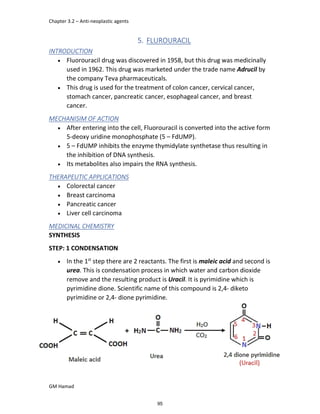
digestion of hemoglobin. When chloroquine is accumulated, pH is
increased, hence enzymes are broken down which are responsible for
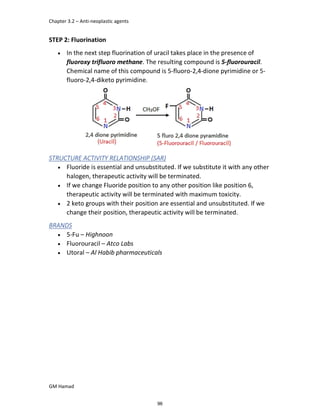
the breakdown of hemoglobin- resulting in cell death of plasmodium.
THERAPEUTIC APPLICATIONS
 Effective in erythrocytic stage of malaria
 Most effective against P. falciparum
 Provide radical cure (removal of clinical symptoms)
 Due to emergence of resistant strains it is used in combination with
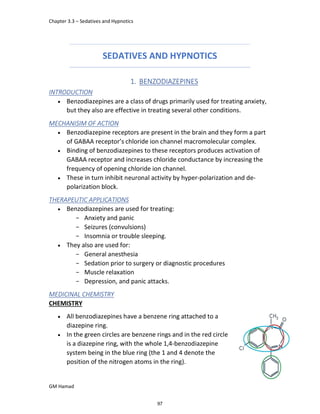
sulfonamides
 Used in Rheumatoid arthritis
152
Chapter 3.7 – Antimalarials
GM Hamad
 Used in Chronic discoid lupus erythematosus (an auto immune disease
effecting various organs such as skin, joints, heart etc.
 Chloroquine inhibits proliferation of lymphocytes.
MEDICINAL CHEMISTRY
SYNTHESIS
 In the first step, m-chloro aniline reacts with ethyloxale ethyl acetate
and the resulting product is m-chloroanaline propionate.
 In the next step, there is cyclization at 250o
C and the resulting product is
2-carboxy, 7-chloro, 4-hydroxy quinoline.
 In the next step, there is hydrolysis and decarboxylation, the product
formed is 7-chloro, 4-hydroxy quinoline.
 In the next step, 7-chloro, 4-hydroxy quinoline reacts with POCl3 and the
resulting product is 4,7 dichloro quinoline.
 4,7 dichloro quinoline reacts with 2-amino, 5 dimethylamine pentane
and forms the product Chloroquine.
153
Chapter 3.7 – Antimalarials
GM Hamad
STRUCTURE ACTIVITY RELATIONSHIP (SAR)
 Quinoline ring is necessary for antimalarial activity. When pyridine ring is
converted to piperidine (saturated) the compound becomes inactive
 If Cl is introduced at position no. 5, 6 or 8 the therapeutic activity is
reduced.
 When Cl is replaced by Br or I, there is a progressive loss of therapeutic
activity.
 When Cl is shifted to position no. 2 or 3, toxicity of the compound is
increased.
 Side chain has no activity by itself, but when it is attached to quinoline
ring, the compound becomes antimalarial. Isopentyl side chain gives
maximum activity, increase or decrease in chain length results in
reduction of activity.
 Chloroquine is unsubstituted at position no. 2 or 3 but when a CH3 group
is introduced at position no. 3 then it is called santoquine, which also has
antimalarial activity.
 When one H of the terminal C2H5 is replaced by OH, the resulting
compound (Hydroxy chloroquine), which is 20 times less active than
chloroquine; It is used for long-term treatment of rheumatoid arthritis.
 When an aromatic ring, benzene, is introduced at position no. 4 (at place
of hydrocarbon chain) e.g., amodiaquine. Which is antimalarial but in
long-term use causes hepatotoxicity and agranulocytosis.
BRANDS
 Klarquine – Genix Pharma
 Nivaquin-P – Sanofi Aventus
 Wilquine – Wilshire Labs
154
Chapter 3.7 – Antimalarials
GM Hamad
2. 8-AMINO QUINOLONES
INTRODUCTION
 Drugs in this group have amino group at position 8 of quinoline ring.
Important members of this family include:
­ Pamaquine
­ Primaquine, etc.
PAMAQUINE
 Such drugs have CH3O group at position 6. This molecule has
antimalarial activity but when side chain is introduced at amino group
antimalarial activity is intensified e.g. pamaquine. It causes hemolysis of
RBCs. It contains tertiary amino group.
PRIMAQUINE
 When the tertiary amino group is converted into primary amino group
the compound is called primaquine, which is less toxic, well tolerated. It
is the most commonly used agent in this group in the treatment of
malaria.
MECHANISIM OF ACTION
 Metabolites of primaquine are believed to act as oxidants that are
responsible for the schizonticidal action as well as for the hemolysis and
methemoglobinemia encountered as toxicities.
155
Chapter 3.7 – Antimalarials
GM Hamad
THERAPEUTIC APPLICATIONS
 Active against hepatic stage of plasmodium
 Provide radical cure to hepatic stage of P. vivax and P. ovale
 It also acts at gametocytes, hence used as prophylactic drugs
 Used in combination with chloroquine for complete eradication of
malaria.
MEDICINAL CHEMISTRY
SYNTHESIS
 Synthesis starts with Glycerol, it undergoes dehydration to produce
propene aldehyde.
 Dehydrating agent is sulphuric acid
• In the next step, there is addition reaction of propene aldehyde and 4
methoxy 2-nitro aniline to form the product, 4 methoxy 2-nitro aniline
propene aldehyde.
 In the next step, there is Tautomerization: 4 methoxy 2-nitro aniline
propene aldehyde (keto form) converted into enol form.
156
Chapter 3.7 – Antimalarials
GM Hamad
 In the next step, Enol form undergoes cyclization to form 6 methoxy 8
nitro dihydroquinoline.
 In next step, 6 methoxy 8 nitro dihydroquinoline is oxidized to form 6
methoxy 8 nitro quinoline.
 In next step, 6 methoxy 8 nitro quinoline undergoes reduction to form 8
amino 6 methoxy quinoline.
157
Chapter 3.7 – Antimalarials
GM Hamad
 In last step, 8 nitro 6 methoxy quinoline reacts with 2 chloro diethyl
amino pentane to form pamaquine.
STRUCTURE ACTIVITY RELATIONSHIP (SAR)
 The group, OCH3 when replaced by OC2H5, the compound becomes less
active and toxic in nature.
 When OCH3 group is replaced by CH3 group, the compound becomes
inactive.
 Introduction of halogens group increases toxicity of the compound.
 Presence of quinoline ring is necessary for antimalarial activity. When
pyridine ring is converted to piperidine (saturated) the compound
becomes inactive.
 Pentyl side chain gives maximum activity, increase or decrease of chain
results in reduction of activity.
 The branched side chain when converted into straight chain and an
isopropyl group is added at N, pentaquine is obtained, it has less
antimalarial activity as compared to both pamaquine and primaquine.
BRANDS
 Primaquine – Ethical Laboratories Pakistan
158
Chapter 3.7 – Antimalarials
GM Hamad
3. 9-AMINO ACRIDINES
INTRODUCTION
ARCIDINE
 Acridine is formed when an additional benzene ring is fused with
pyridine ring of quinoline nucleus. Acridine is overall aromatic, though
having nitrogen.
MECHANISIM OF ACTION
 These drugs appear to interfere with the parasite's metabolism. The
exact mechanism of antiparasitic action is unknown; however,
quinacrine binds to deoxyribonucleic acid (DNA) in vitro by intercalation
between adjacent base pairs, inhibiting transcription and translation to
ribonucleic acid (RNA)
THERAPEUTIC APPLICATIONS
 Treating erythrocytic stage of malaria
 Earlier, was used in treating black water fever
 Have anthelmintic activity against intestinal parasites
 It is eliminated slowly and have side effects.
NON-THERAPEUTICAK APPLICATION
 Being green-fluorescent dye, used to visualize blood cells, particularly
platelets.
 Platelets store the dye in dense granules.
MEDICINAL CHEMISTRY
CHEMISTRY
 Various types of acridines were synthesized. Acridine has weak
antiseptic and antibacterial activity. When a side chain 2 amino, 5
diethylamino pentane is introduced at C-9, the compound becomes
antimalarial.
159
Chapter 3.7 – Antimalarials
GM Hamad
9-AMINO ACRIDINE
 It has an amino group at C -9 and is a green, fluorescent dye.
 In the past, the compound was used as an antiseptic for treating wounds
infections.
QUINACRINE
 Quinacrine was the 1st synthetic agent that was used before quinolines.
 When methoxy at position 2 and Cl at 6 of acridine are introduced,
quinacrine- which is antimalarial is formed.
AZACRINE
 When at position-1 of acridine, a N is introduced azacrine is formed
which has good antimalarial activity and rapid onset of action.
160
Chapter 3.7 – Antimalarials
GM Hamad
SYNTHESIS
 In the first step, there is condensation reaction, 2, 4 dichloro benzoic
acid reacts with para methoxy aniline and the resulting product is 2-
para methoxy phenyl amino, 4 chloro benzoic acid.
 In the next step, 2-para methoxy phenyl amino, 4 chloro benzoic acid
reacts with phosphoryl chloride (POCl3), the product formed is 6-chloro,
2 methoxy acredinone.
 In the next step, 6-chloro, 2 methoxy acredinone reacts with phosphoryl
chloride (POCl3), the product formed is 6, 9 dichloro, 2 methoxy
acridine.
 In the next step, 6, 9 dichloro, 2 methoxy acridine reacts with 2-amino
(5-diethylamino) pentane and the compound formed is 6 chloro, 9
diethylamino pentyl, 2-methoxy, acridine
161
Chapter 3.7 – Antimalarials
GM Hamad
STRUCTURE ACTIVITY RELATIONSHIP (SAR)
 Various types of acridines were synthesized. Acridine has weak
antiseptic and antibacterial activity. When a side chain – 2 amino, 5
diethylamino pentane- is introduced at C-9, the compound becomes
antimalarial.
 When methoxy at position 2 and Cl at 6 are introduced –quinacrine-
which is antimalarial.
 When methoxy is shifted to position 6 and Cl to 2 (interchanged)-loss of
antimalarial activity.
 When methoxy is replaced by ethoxy, toxicity is increased. When
methoxy is rotated to any other position 1, 3, 4, then 50% activity is lost.
 When Cl is replaced with other halogens there is successive loss of
therapeutic activity.
 Side chain – 2 amino, 5 diethylamino pentane- has no antimalarial
activity but when attached to aromatic system the compound became
antimalarial.
 When at position-1, a N is introduced –azacrine- which has good
antimalarial activity and rapid onset of action.
 A very useful drug was taken from quinacrine by Germans by separating
it into two halves;
162
Chapter 3.7 – Antimalarials
GM Hamad
­ 1st
half chloroquine active.
­ 2nd
half was inactive.
BRANDS
 Atabrine – Compounding pharmacies (early in united states)
163
Chapter 3.7 – Antimalarials
GM Hamad
4. BIGUANIDES
INTRODUCTION
 Biguanides refer to a molecule(s), or to a class of drugs containing 2
condensed guanidines.
 Biguanides can function as oral antihyperglycemic and antimalarial
drugs.
PROGUANIL
 Proguanil, also known as chloroguanide and chloroguanide, is a
medication used to treat and prevent malaria.
 Proguanil (chloroguanide) contains two groups attached to each side of
the guanidine
­ Chlorophenyl group
­ isopropyl side chain
MECHANISM OF ACTION
 Pharmacologically, it is a dihydrofolate reductase DHFR inhibitor. It is
effective against sporozoites. Thus, prevents the conversion of
dihydrofolic acid into tetrahydro folic acid, as a result the protozoa
remain unable to make purines and pyrimidines.
THERAPEUTIC APPLICATIONS
 Used in management of mild to moderately severe noninsulin-
dependent diabetes mellitus.
 For treatment and prophylaxis of falciparum malaria.
 Improve ovulation and fertility in PCOS (Polycystic ovary syndrome).
164
Chapter 3.7 – Antimalarials
GM Hamad
MEDICINAL CHEMISTRY
SYNTHESIS
STEP 1:
 p-chloroanaline reacts with 2 moles of cyanoguanidine to produce p-
chlorophenyl biguanide.
STEP 2:
 p-chlorophenyl biguanide reacts with propanone and undergoes
reduction to produce proguanil.
STRUCTURE ACTIVITY RELATIONSHIP (SAR)
 Activity is maximum when aromatic ring contains halogen (Cl) atom at
para position of the aromatic ring.
 If any additional Cl is introduced to aromatic ring-both antimalarial
activity and toxicity increases.
 Proguanil is converted to active metabolite in the liver named
cycloguanil which has similar action to that of proguanil.
 Cycloguanil is used in the form of HCl and palmoate salts and is long
acting, because Palmolic acid has four aromatic rings and when
165
Chapter 3.7 – Antimalarials
GM Hamad
combined with cycloguanil, it becomes active for 6-9 months. HCl form is
rapidly acting while palmoate is sustained release; used for prophylaxis.
BRANDS
 Proqon – Hilton Pharma
166
Chapter 3.7 – Antimalarials
GM Hamad
5. PYRIMIDINE CLASS
INTRODUCTION
 It is a class of antimalarial drugs containing 6-membered heterocyclic
ring containing 2 nitrogen atoms at a distance of 1 carbon atom.
PYRIMETHAMINE
 Pyrimethamine belongs to the pyrimidine class of antimalarials. 2,4
diaminopyrimidine is an antifolate.
 This compound has been studied extensively and maximum activity was
noticed when a chlorophenyl group was attached at position 5 (Cl group
should be at para position) and an electron donating group (C2H5) at
position 6.
 By such modifications pyrimethamine was obtained. It has maximum
activity.
MECHANISM OF ACTION
 Pyrimethamine interferes with utilization of folic acid inside plasmodium
by inhibiting its dihydrofolate reductase
 Hence, there is no synthesis of folic acid, which in needed for the
synthesis of purine and pyrimidine that are required for nucleic acid. As
a result, replication of plasmodium is inhibited.
THERAPEUTIC APPLICATIONS
 Used in combination with other drugs to treat malaria.
 In combination with other medicines used against serious parasite
infection.
167
Chapter 3.7 – Antimalarials
GM Hamad
MEDICINAL CHEMISTRY
SYNTHESIS
 In the first step, Para chlorophenyl acetonitrile reacts with Ethyl
propionate and as a result the product Propionyl p-chlorophenyl
acetonitrile.
 In the next step, Propionyl p-chlorophenyl acetonitrile reacts with 3-
methyl butanol and the product formed is Hemiketal. A hemiacetal or a
hemiketal is a compound that results from the addition of an alcohol to
an aldehyde or a ketone, respectively.
 In the next step, Hemiketal undergoes dehydration and forms the
product, β-ethyl, β-isoamyl oxy, p-chlorophenyl acetonitrile.
168
Chapter 3.7 – Antimalarials
GM Hamad
 In the next step, β-ethyl, β-isoamyl oxy, p-chlorophenyl acetonitrile
reacts with Guanidine and isoamyl alcohol/isopentyl alcohol is replaced
with guanidine to form the product Pyrimethamine.
In the next step, there is rearrangement.
169
Chapter 3.7 – Antimalarials
GM Hamad
STRUCTURE ACTIVITY RELATIONSHIP (SAR)
 2 primary amino groups at position 2 and 4 when converted to 2o
or 3o
activity is reduced.
 An aromatic ring is directly attached with pyrimidine ring for maximum
activity, if carbon or N is inserted between them activity is decreased.
 If aromatic ring is replaced by heterocyclic compound activity is
decreased.
 Aromatic ring must contain an electron withdrawing group at p-position.
 Presence of electron donating group at position 6 is also necessary for
activity.
 When 2 rings are separated by a methylene, anti-plasmodial activity is
decreased but antibacterial activity is increased-trimethoprim.
BRANDS
 Fansidar – Roche Pakistan
 Fansiwil – Wilshire Labs
 Maladar – Efroze Chemical Industries
 Maladrin – Bosch Pharmaceuticals
 Melofin – Shaigan Pharmaceuticals
170
Chapter 3.7 – Antimalarials
GM Hamad
6. CINCHONA ALKALOIDS
INTRODUCTION
 Cinchona is a genus of flowering plants in the family
Rubiaceae containing at least 23 species of trees and shrubs.
 The artificial synthesis of quinine in 1944, an increase in resistant forms
of malaria, and the emergence of alternate therapies eventually ended
large-scale economic interest in cinchona cultivation.
 Cinchona alkaloids show promise in treating falciparum malaria, which
has evolved resistance to synthetic drugs.
QUININE
 Quinine is a natural compound and when administered, hydroxylation
takes place at position 2 and 8 of quinoline ring, thus these two positions
are blocked by hydrophilic groups.
 It has been synthesized in laboratory by a complex process but on large
scale it is extracted from plant source.
Extraction
 Powdered bark is mixed with alkali and extracted with petroleum ether.
Then H2SO4 is added and quinine is precipitated in the form of quinine
bisulphate because quinine contains two basic nitrogen groups.
 Quinine has 3 molecules of water as a water of crystallization.
MEFLOQUINE
 It is closely related to quinine, and Is a synthetic derivative of quinine, in
which position 2 and 8 have two lipophilic groups (CF3) that increase
half-life: 15-20 days. Bicyclic group has been replaced by piperidine ring
 It is effective as a single dose (750 mg). It is not used nowadays due to
cardiovascular and CNS side effects.
171
Chapter 3.7 – Antimalarials
GM Hamad
MECHANISM OF ACTION
 Quinine involves the inhibition of hemozoin biocrystallization, which
facilitates the aggregation of cytotoxic heme. Free cytotoxic heme
accumulates in the parasites, leading to their death. Hemozoin is a
disposal product formed from the digestion of blood by some blood-
feeding parasites, Plasmodium spp.
 The parasites digests hemoglobin and releases high quantities of free
heme, which is the non-protein component of hemoglobin. Free heme is
toxic to cells, so the parasites convert it into an insoluble crystalline form
called hemozoin. Since, the formation of hemozoin is essential to the
survival of these parasites, it is an attractive target for developing
antimalarial drugs
THERAPEUTIC APPLICATIONS
 Quinine is very effective antimalarial agent active at erythrocytic stage.
 Nowadays, quinine is not a drug of choice because of undesirable
effects-is only a lead compound.
 Quinine possesses antipyretic activity
 Flavoring agent in tonic water, and in some preparations used to
increases digestion.
MEDICINAL CHEMISTRY
 Cinchona alkaloids are derivatives of ruban, which is made up of
quinoline and quinuclidine rings linked through CH2. Ruban has little
antimalarial activity.
 When –OH is added on C-9 of ruban, the compound is called 9-Rubanol,
which has more anti-malarial activity than that of ruban.
172
Chapter 3.7 – Antimalarials
GM Hamad
 By adding two groups, methoxy and vinyl in rubanol, new compound
Quinine is formed having maximum activity.
 Quinidine is a stereoisomer of quinine.
 If methoxy group is removed from quinine, the compound formed is
called cinchonidine.
 Cinchonine is a stereoisomer of cinchonidine, (removal of methoxy from
quinidine)
173
Chapter 3.7 – Antimalarials
GM Hamad
STRUCTURE ACTIVITY RELATIONSHIP (SAR)
RELATED TO QUINOLINE NUCLEUS
 Any change at position 2, 3, 5, 7 and 8 of quinoline nucleus will not cause
complete loss of activity but there will be a drastic loss in therapeutic
activity.
 If position 8 is halogenated, there is no change in activity but increases
toxicity to brain and liver.
 Substitution at position 6 is very important. Quinine has methoxy group
at this position, which results in high therapeutic activity.
RELATED TO 6-METHOXY GROUP
 This group is not necessary for activity, hence may be removed. If
methoxy group is removed from quinine, 20% loss of activity occurs and
the resulting compound is cinchonidine.
 If methoxy group is removed from quinidine, the resulting compound is
cinchonine.
 If methoxy group is replaced by ethoxy group, there will be no difference
of activity, but the compound becomes more toxic to liver and optic
nerves.
RELATED TO 9-HYDROXYL GROUP
 OH group at position 9 is considered to be an important group for anti-
malarial activity, and if OH is replaced by H, 90% activity is lost.
 In quinine OH group is on front, whereas is on back in quinidine. Quinine
has the highest antimalarial activity whilst quinidine has anti-arrhythmic
activity.
 If OH group is replaced by CN, toxicity is increased.
RELATED TO QUINICLIDINE RING
174
Chapter 3.7 – Antimalarials
GM Hamad
 Bicyclic ring is not needed for activity, which is evident from chloroquine
and primaquine, whereby bicyclic ring has been replaced by side chain
containing tertiary nitrogen.
 Tertiary nitrogen is needed for activity.
RELATED TO VINYL GROUP
 Vinyl group present on bicyclic ring when reduced produces the
compound named dihydro-quinine, and this reduction has no effect on
antimalarial activity rather it is more active against P. gallinaceum and P.
reticulum.
 When vinyl group is oxidized the compound becomes inactive.
BRANDS
 Mediquin – Semos Pharmaceuticals
 Zafquin – Zafa Pharmaceuticals
 Hydroquine – Pharmedic
 Quinine – Lawrence Pharma
175
Chapter 3.7 – Antimalarials
GM Hamad
7. MISCELLANEOUS AGENTS
1. 9-PHENETHRENYL METHANOL CLASS
INTRODUCTION
 The evaluation of the antimalarial activity of the phenanthrene
methanol, halofantrine was reported in 1982 in the American Journal of
Tropical Medicine and Hygiene.
MECHANISM OF ACTION
 Halofantrine has also been shown to bind to plasmpesin, a hemoglobin
degrading enzyme
 In addition there is evidence to suggest that halofantrine may inhibit the
energy-dependent proton pump on the external surface of the
plasmodia in erythrocytes, thereby destroying the membrane integrity
of the parasite.
THERAPEUTIC APPLICATIONS
 Used in acute malaria.
 Used in chloroquine resistant malaria.
 Not to be used for chemoprophylaxis.
 Now a days used only when no alternative is available.
MEDICINAL CHEMISTRY
CHEMISTRY
PHENANTHRENE
 It is a polycyclic aromatic system comprising three fused benzene rings.
 The name phenanthrene is a composite of phenyl and anthracene.
 The methanol group is present at position no. 9
176
Chapter 3.7 – Antimalarials
GM Hamad
 Its derivatives are antimalarials. For example: halofantrine
 This compound was synthesized in World War-II. Developed into a drug
in 1960s. It contains one chiral center; Two enantiomers. Which are
active equally. Hence, the drug is a racemic mixture.
 It is an alternative drug for both chloroquine sensitive and chloroquine
resistant falciparum. The drug is metabolized via N-dealkylation by CYP
3A4 to desbutylhalofentrine; Which is many fold more sensitive than the
parent drug.
177
Chapter 3.7 – Antimalarials
GM Hamad
SYNTHESIS
STRUCTURE ACTIVITY RELATIONSHIP (SAR)
 Halofantrine's structure contains a substituted Phenanthrene ring,
 OH group, considered to be an important group for anti-malarial activity,
and if OH is replaced by H, 90% activity is lost.
 If OH group is replaced by CN, toxicity is increased.
BRANDS
 Halfan – GSK
 Halrin – Obsons Pharmaceuticals
 Halfamed – Mediate Pharmaceuticals
178
Chapter 3.7 – Antimalarials
GM Hamad
2. ARTEMISIN
INTRODUCTION
 Artemisinin a natural compound separated from an herb named
Artemisia annua, which has been used by Chinese for thousands years
for treating malaria. Nowadays, a derivative of artemisinin (artemether)
is being used for treating malaria.
MECHANISM OF ACTION
 Artemisinin Is active against erythrocytic stage. In body it is converted to
free radicals which cause oxidative decomposition of plasmodium cell
membrane.
THERAPEUTIC APPLICATIONS
 Used in combination with other drugs for the treatment of malaria.
MEDICINAL CHEMISTRY
 Chemically, is a sesquiterpene lactone containing an unusual peroxide
bridge. It is believed that this peroxide is responsible for the drug's
mechanism of action.
STRUCTURE ACTIVITY RELATIONSHIP (SAR)
 The structure contains peroxide which is essential, if we replace or
change, the therapeutic activity will be lost.
BRANDS
 Hitecxin – Highnoon Labs
 Cotecxin – Amsons Vaccines and Pharmaceuticals
179
Chapter 3.8 - Diuretics
GM Hamad
DIURETICS
INTRODUCTION
 Diuretics are chemicals that increase the rate of urine formation by
increasing the urine flow rate.
CLASSIFICATION OF DIURETICS
1. Loop diuretics: Furosemide
2. Carbonic anhydrase inhibitors: Acetazolamide, Methazolamide
3. Thiazides diuretics: Chlorthiazide
4. Potassium sparing diuretics: Spironolactone
MECHANISM OF ACTION
 The primary target organ for diuretics is the kidney, where these drugs
interfere with the reabsorption of sodium and other ions from the
lumina of the nephrons, which are the functional units of the kidney.
1. LOOP DIURETICS
 These are also called as high ceiling diuretics. These are highly
efficacious.
 High-ceiling diuretics are characterized by a quick onset and short
duration of activity.
FUROSEMIDE
DEFINITION
 Furosemide is a loop diuretic also called as (Heigh ceiling diuretic and
High efficacious diuretics) that prevents body from absorbing too much
salt, allowing the salt to instead be passed in urine.
INTRODUCTION
 Furosemide is the research product of Hoechst laboratories in Germany.
Latest name of this company is Sanofi-Aventis. (Originally, the company
was formed in 1973 and the current incarnation was formed as Sanofi-
Aventis in 2004, by the merger of Aventis and Sanofi Synthélabo, which
were each the product of several previous mergers. It changed its name
to Sanofi in May 2011).
180
Chapter 3.8 - Diuretics
GM Hamad
 Sanofi-Aventis marketed this drug under the trade name Lasix. This
word is derived from Last six. Because duration of action of this drug is 6
hours. Sometimes written as 6-8 hours.
 This drug is included in WHO list of essential medicine. This drug is also
included in World Anti-doping agency ban drug list because it can mask
the presence of other drugs such as opioids.
CHEMICAL NAME
 2-methylamine, 2-furan, 4-chloro, 5-sulfamoyl benzoic acid
MECHANISM OF ACTION
 Their main site of action is believed to be on the thick ascending limb of
the loop of Henle, where they inhibit the luminal Na+
/K+
/2Cl-
symporter.
These diuretics are commonly referred to as loop diuretics. (Foye’s
medicinal chemistry)
 Loop diuretics inhibit NKCC2, the luminal Na+
/K+
/2Cl−
transporter in the
thick ascending limb of Henle’s loop. By inhibiting this transporter, the
loop diuretics reduce the reabsorption of NaCl and also diminish the
lumen-positive potential that comes from K+
recycling. This positive
potential normally drives divalent cation reabsorption in the thick
ascending limb.
 Loop agents have direct effects on blood flow through several vascular
beds. Furosemide increases renal blood flow via prostaglandin actions
on kidney vasculature.
 Loop diuretics have also been shown to induce expression of the
cyclooxygenase COX-2, which participates in the synthesis of
prostaglandins from arachidonic acid. (Katzung)
THERAPEUTIC APPLICATIONS
 It is effective for the treatment of edemas connected with cardiac,
hepatic, and renal sites. Because it lowers the blood pressure similar to
the thiazide derivatives, one of its uses is in the treatment of
hypertension.
SITE OF ACTION
 Thick ascending limb of loop of henle.
181
Chapter 3.8 - Diuretics
GM Hamad
MEDICINAL CHEMISTRY
 Chemistry starts with synthesis
Furosemide is a benzoic acid derivative. The preferred group is carboxylic
group. That is why we start the numbering from carboxylic group. We cannot
substitute it.
 In the first step of synthesis of furosemide, the starting material is 2-
amino benzoic acid or Anthranilic acid which is the combination of
aniline and benzoic acid. There is a reaction between Chlorosulphonic
acid (ClSO3H) & ammonia (NH3) and as a result of this reaction the
product formed is Sulphamoyl (SO2NH2). Sulphamoyl group is
combination of Sulfonyl group (SO2) and Amino group (NH3). It
substituted the hydrogen atom at carbon 5 in anthranilic acid with the
formation of 5-sulphamoyl anthranilic acid or 2- amino-5-sulphamoyl
benzoic acid (Product I).
 In the second step there is methylation of Product I. the methylation
takes place at amino group at carbon 2 and the product form is 2-methyl
amino-5-sulphamoyl benzoic acid (Product II).
 In the third step chlorination of Product II takes place and the chlorine
substitute the Hydrogen at carbon 4 with the formation of 2-methyl
amino-4-chloro-5-sulphamoyl benzoic acid (Product III)
 In the next step, electrophilic substitution reaction between furan and
Product III takes place, the furan substitute the hydrogen atom of 2-
methyl amino group at carbon 2 and product formed is 2-methyl amino-
2-furan-4-chloro-5-sulphamoyl benzoic acid or furosemide.
182
Chapter 3.8 - Diuretics
GM Hamad
STRUCTURE ACTIVITY RELATIONSHIP (SAR)
 At position number 2 there are 2 groups attached. The methyl amine
and furan group. Both are essential and un-substituted. If we substitute
these 2 groups with any other groups or change the position of these 2
groups the activity of furosemide will be terminated.
 At position 4 there is a chloride group. It is also essential and un-
substituted. If we substitute this group with any other group or change
the position of this group the activity of furosemide will be terminated.
 Position 3 and 6 are vacant.
DERIVATIVE
 Some patients are sensitive to Sulphamoyl group of furosemide.
Ethacrynic acid is a derivative which can be given to these patients.
 Structure of Ethacrynic acid
ADDITIONAL THINGS
DOSE FOR EDEMA TREATMENT
ADULTS CHILDREN (>1month) NEONATES
ORALLY 20-80mg/day
(single dose initially)
repeat initially in 6-8hrs
2mg/kg (single
dose) increase 1-
2mg/kg q 6-8hrs
1-4mg/kg/dose
q -2 times
IV/IM 20-40mg q 1-2 hrs. and
increase by 20mg every
1-2hrs
1-2mg/kg dose q 6-
12hrs
1-2mg/kg q 12-
24hr
DOSAGE FORMS & STRENGTHS
Injectable solution
 10mg/mL
183
Chapter 3.8 - Diuretics
GM Hamad
Oral solution
 10mg/mL
 8mg/mL
Tablet
 20mg
 40mg
 80mg
COMPETITORS
 Sanofi's top competitors include AstraZeneca, Eli Lilly, AbbVie, Pfizer,
Novartis, Merck and Teva Pharmaceuticals.
BRANDS
 Lasix
 Salix - Merck
184
Chapter 3.8 - Diuretics
GM Hamad
2. CARBONIC ANHYDRASE INHIBITORS
ACETAZOLAMIDE
INTRODUCTION
 In 1937, it was proposed that acidification of the urine was caused by
the secretion of hydrogen ions by tubular cells of kidney. Hydrogen ions
were provided by the action of enzyme (carbonic anhydrase) which
catalyzes the reaction.
CO2 + H2O CA
→ H2CO3 → H+
+ HCO3
-
 So, inhibition of carbonic anhydrase resulted in lesser exchange or low
exchange of hydrogen ions with the sodium ions. So, Na+
ions were
excreted out with water and diuretic effect was noted.
 Acetazolamide was introduced in 1953, marketed under the trade name
DIAMOX by WYETH. It is manufacturer of Pfizer. Pfizer purchased WYETH
in 2009.
MECHANISM OF ACTION
 Acetazolamide is a reversible inhibitor of the carbonic anhydrase
enzyme that results in reduction of hydrogen ion secretion at the renal
tubule and an increased renal excretion of sodium, potassium,
bicarbonate and water.
 It can be used as a diuretic or to treat glaucoma as it prevents excessive
build-up of aqueous humor.
 It also inhibits carbonic anhydrase in the central nervous system to
minimize abnormal and excessive discharge from CNS neurons.
 Acetazolamide can be administered to patients with metabolic alkalosis
to promote secretion of hydrogen ions at the level of the renal tubule.
MECHANISM OF ACTION FOR THE REDUCTION OF INTRAOCULAR PRESSURE
 Acetazolamide inactivates carbonic anhydrase and interferes with the
sodium pump, which decreases aqueous humor formation and then
lowers intraocular pressure. Systemic effects, however, include
increased renal loss of Na+
and K+
and water secondary to the drugs
renal tubular effects. Arterial blood gases may show a mild
hyperchloremic metabolic acidosis.
MECHANISM OF ACTION (IN GLAUCOMA)
185
Chapter 3.8 - Diuretics
GM Hamad
 Acetazolamide inactivates carbonic anhydrase and interferes with the
sodium pump, which decreases aqueous humor formation and then
lowers intraocular pressure.
MECHANISM OF ACTION (IN SEIZURES)
 Mild acidosis in the brain may be the mechanism by which the drug
exerts its antiseizure activity.
 The depolarizing action of bicarbonate ions moving out of neurons via
GABA receptor ion channels may be diminished by carbonic anhydrase
inhibitor.
MECHANISM OF ACTION (IN ALTITUDE SICKNESS)
 Its mechanism is via inhibition of the carbonic anhydrase enzyme which
counteracts the respiratory alkalosis which occurs during moving up to
altitude. It facilitates the excretion of bicarbonate in the urine. As a
result, acetazolamide hastens acclimatization and helps to prevent
altitude disorder.
THERAPEUTIC USES
 Common uses are in edema and hypertension.
Note: This is the only diuretic that has other than diuretic uses i.e., Glaucoma,
seizures and mountain sickness.
MEDICINAL CHEMISTRY
 The starting compound is 1-thio-3,4-diazo-2-amino-5-sulph hydral or 1-
thio-3,4-diazole-2-amino-5-sulphhydral.
186
Chapter 3.8 - Diuretics
GM Hamad
 In the first step acetylation of amino group of 1-thio-3,4-diazo-2-amino-
5-sulph hydral takes place and the resulting structure is 1-thio-3,4-diazo-
2-acetamide-5-sulphhydral (product I).
 In the next step there is a reaction between Product I and hypochlorous
acid with the formation of 1-thio-3,4-diazo-2-acetamide-5-sulfural
chloride or 1-thio-3,4-diazo-2-acetamide-5-thionyl chloride (product II).
 In the third step amination of sulfural chloride of product II takes place
with the formation of 1-thio-3,4-diazo-2-acetamide-5-sulphamoyl
(Acetazolamide)
 All those drugs that contains sulfonyl group (SO2) are called as
‘Sulphones.’ Sulphamoyl (SO2NH2) group is called as sulphonamides.
METHAZOLAMIDE
 Another derivative Methazolamide is prepared.
It is same as acetazolamide but is not used due
to less activity then acetazolamide.
STRUCTURE ACTIVITY RELATIONSHIP (SAR)
 The structure of acetazolamide is a 5 membered ring (heterocyclic)
having 1 sulfur and 2 nitrogen. This heterocyclic ring with hetero
elements is essential and unsubstituted.
 At position no.2 if we substitute this acetamide with other amide ion,
any other group or if we change position 2 to any other position,
therapeutic activity will be terminated.
 If we substitute Sulphamoyl group at position no.5 with any other group
or change position to any other position, therapeutic activity will be
terminated with minimum toxicity.
IMPORTANT TERMS
 -OL comes in end as it is alcohol or phenol, except thiol it is (-SH)
sulfhydryl group bonded with carbon. S= Thio, N= Azo.
 Azoles: Class of five membered heterocyclic compounds containing
nitrogen atom and at least one other non-carbon atom (i.e., nitrogen,
sulfur or oxygen) as a part of ring.
 Azines: Heterocyclic compound containing a 6-membered aromatic ring.
 Diazole: 5 membered ring with 2 nitrogen.
 Diazines: They are six membered, aromatic heterocyclic compounds that
contain sp2
-hybridized nitrogen atoms in the ring. There are 3 isomers of
diazines: pyridiazine, pyridine and pyrazine.
187
Chapter 3.8 - Diuretics
GM Hamad
 Triazole: (2C, 3N): Heterocyclic compound with molecular formula
C2H3N3, having 5 membered ring of two carbon atoms and 3 nitrogen
atoms.
 Triazines: (3C,3N): They are nitrogen containing heterocycles. A triazine
is a heterocyclic structure that contains 3 nitrogen atoms and 3 carbon
atoms.
 Valencies: are called as bonds. O=2, C=4, N=3
 Sulfhydryl chloride = SO2Cl, Thionyl Chloride = SOCl2
COMPARISON BETWEEN ACETAZOLAMIDE AND METHAZOLAMIDE
Acetazolamide Methazolamide
 500mg/day in preventing
symptoms of acute mountain
sickness.
 Fall in CO2 partial pressure is
increased. Given 4 times/day.
 DIAMOX
­ Used parentally to treat
glaucoma.
­ Used for swelling,
glaucoma, acute
mountain sickness.
 150mg/day in preventing
symptoms of acute mountain
sickness.
 Fall in CO2 partial pressure is
decreased.
 NEPTOZENE
­ Used topically to treat
glaucoma.
­ Used in glaucoma.
Dosage forms
 Pills
 Extended-release pills
 Pills
Lowest price
 $15.97  $30.01
Side effects
 Dizziness
 Light headedness
 Decreased appetite
Stability
 More stable  Less stable
BRANDS
 International brands:
­ Acetamide Tablet
­ Acetavir Tablet
­ Diamox Tablet
­ Synomax Tablet
­ Zolamide Tablet.
188
Chapter 3.8 - Diuretics
GM Hamad
3. THIAZIDE DIURETICS
BENZOTHIADIAZIDE
 It is 3rd
group of diuretics called as thiazide diuretics. It is also called as
benzothiadiazide.
INTRODUCTION
 It is special class of diuretic which is used for treatment of hypertension
and edema. This class was developed by “Merck” in 1950.
 The first member/derivative of this class is chlorthiazide, was marketed
by “Merck” under trade name “Diuril”
 In 1958, another derivative of this class “hydrocholrthiazide” was
developed by “Ciba-Geigy”. Ciba-geigy is a swiss pharmaceutical
company, the latest name of this company is ‘Novartis”. Ciba-Geigy
marketed this drug under trade name “Esidrix”
THERAPEUTIC USES
 Hypertension
 Edema
SITE OF ACTION
 DCT (Distal convoluted tubule)
MECHANISM OF ACTION
 It inhibits active chloride reabsorption at early Distal convoluted tubule
via Na-Cl co-transporter, resulting in an increase excretion of sodium,
chloride and water. Thiazide like benzothiazide also inhibits sodium ion
transport across renal tubules through binding to the thiazide sensitive
sodium chloride co-transporter. It also increases calcium reabsorption at
DT, hence, decrease the excretion of calcium. As water excretion
increases, results in increased urination.
MEDICINAL CHEMISTRY
 The medicinal chemistry starts with synthesis;
 In the 1st
step there is substitution of Sulphamoyl group at position 7 of
benzothiadiazide resulting in 7-sulfamoyl benzothiadiazine.
189
Chapter 3.8 - Diuretics
GM Hamad
 In the next step 7-sulfamoyl benzothiadiazine reacts with NaOH and
forms Na-salt of 7-sulfamoyl benzothiadiazine. It occurs at position 2 of
7-sulfamoyl benzothiadiazine.
 The chemical nature of this class is Acidic (which can give hydrogen ion
to aqueous solution), but when we compare acidic character with
reference to left and right side, right side is more acidic. The left sided
hydrogen is bonded more tightly so right sided hydrogen is easy to
remove (so is acidic). So right side is more acidic and is strong acid (which
liberates hydrogen easily).
 That means hydrogen at N-2 is most acidic because of the electron
withdrawing effect of the neighboring sulfone group. The acidic protons
make possible the formation of water-soluble Na-salt for IV
administration. So, atypical salt is formed to have high polarity and
therapeutic activity.
 In the next step there is a halogenation and i.e., chlorination at position
6 so product formed is chlorthiazide.
190
Chapter 3.8 - Diuretics
GM Hamad
 In the next step, there is reduction at position 3 and 4 and the product
formed is hydrochlorthiazide.
STRUCTURE ACTIVITY RELATIONSHIP (SAR)
 The structure of cholrthiazide contains heterocyclic ring with hetro
elements which are essential and substituted.
 At position 6, there is halogen by halogenation which is chloride and it is
essential and unsubstituted. If we substitute it with any other group or
we change the position of this group, therapeutic activity will be
terminated.
 At position 7 Sulphamoyl group is essential and unsubstituted.
 Benzene ring (aromatic ring) is also essential and unsubstituted.
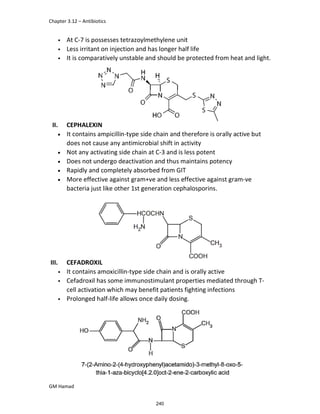
ADDITIONAL POINTS
 Why thiazide? Thia= sulphur, Azo (zide) = nitrogen
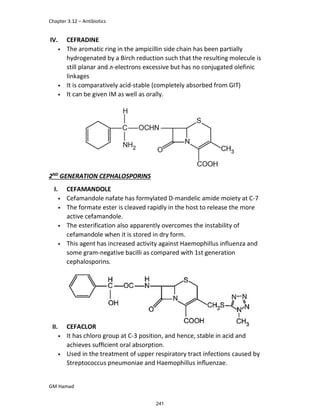
 Why 2 chemical names? Because acetazolamide also have same group as
this class.
BENZOTHIADIAZIDE
 Drugs with 2 rings
­ 1. Aromatic ring
191
Chapter 3.8 - Diuretics
GM Hamad
­ 2. 6 membered heterocyclic ring containing 1 sulfur and 2
nitrogen.
 Numbering of compound starts with most active or most inactive group.
Point of joining have no numbering because if group attach to joint, the
ring will break.
 Azo = Nitrogen
 Azole: 5 membered ring containing 1 nitrogen
 Diazole: 5 membered ring containing 2 nitrogen
 Triazole: 5 membered ring containing 3 nitrogen
 Azine: 6 membered ring containing 1 nitrogen
 Diazine: 6 membered ring containing 2 nitrogen
 Triazine: 6 membered ring containing 3 nitrogen
From 1958 to till now, hydrochlorothiazide is excellent drug. This comes in
combination with beta-blocker (atenolol). Combination is given for patient
compliance.
TYPICAL SALT
 When acid and base combines, salts are formed, having neutral pH,
formed ionic bond (ionic bond will form permanent bond and patient
death may occur.
ATYPICAL SALT
 Salt forming covalent bond, which is not permanent, sodium salt of
benzothiadiazine will form atypical salt that has increased polarity,
kinetics and therapeutic activity.
Hydrochlorothiazide is 10 times more potent than chlorthiazide with minimum
toxicity.
BRANDS
 Advantec – Getz Pharma
 Capozide – GSK
192
Chapter 3.8 - Diuretics
GM Hamad
4. POTASSIUM SPARING DIURETICS
SPIRONOLACTONE
INTRODUCTION
 Spironolactone is the combination of two words: Spirono and lactone.
The word spirono is from the word “spiro” which means respiration,
breathing, connector or bridge.
 They are called as connector or bridge because there is connection
between two rings, one is steroidal ring and other is lactone ring. They
are called for respiration and breathing because earlier (in past) this
class was used for breathing.
 Lactones are cyclic esters. Esters are formed when carboxylic acid reacts
with alcohol. Lactams are cyclic amides. Amides are carboxylic acid
derivatives.
 This drug was developed by Pfizer in 1959. Pfizer marketed this drug
under the trade name Aldactone. Spironolactone is also called as Anti-
androgen and mineralocorticoid antagonist.
SITE OF ACTION
 Late distal convoluted tubules or collecting ducts/collecting system.
MECHANISM OF ACTION
 Spironolactone is a specific pharmacological antagonist of aldosterone,
acting primarily through competitive binding of receptor at the
aldosterone dependent sodium-potassium exchange site in the distal
convoluted renal tubule.
USES
 Hyperaldosteronism
 Myocardial infarction
 Diabetic nephropathy
 Acne
 Alopecia
 Edema
 Gender Dysphoria
 Heart Failure
 High Blood Pressure
 Hirsutism
 Hypokalemia
193
Chapter 3.8 - Diuretics
GM Hamad
MEDICINAL CHEMISTRY
 It contains a steroidal ring. It consist of 4 fused rings A, B, C, D.
­ A = Cyclohexanone
­ B = Cyclohexane
­ C = Cyclohexane
­ D = Cyclopentane
 If we compare ring A with B or ring B with C it is naphthalene derivative.
If we compare ring C with D it is indole ring derivative of Benzapyrol. If
we compare ring A, B and C it is phenanthrene.
 At C-7 there is group called thioacetyl SCOCH3, while at C-17 there is
lactone ring (cyclic esters). When we compare ring A, B with ring C, D
they are of Cis configuration. When we compare B with C, they are in
trans configuration. So geometrical isomerism exists in spironolactone.
194
Chapter 3.8 - Diuretics
GM Hamad
STRUCTURE ACTIVITY RELATIONSHIP (SAR)
 As a whole steroidal ring contains 17 positions. At position number 3
there is a ketone group which is essential and unsubstituted. If we
substitute this group with any other group or if we change the position
of this group the therapeutic activity will be lost.
 At position number 10 and 13 there are methyl groups which are
essential and unsubstituted. If we substitute these groups with any
other groups or if we change the position of these groups
the therapeutic activity will be lost.
 At position number 7 there is a thioacetyl group which is essential and
unsubstituted. If we substitute this group with any other group or if we
change the position of this group the therapeutic activity will be lost.
 At position number 17 there is a lactone ring which is essential and
unsubstituted. If we substitute this ring with any other ring or group or
if we change the position of this ring the therapeutic activity will be lost.
BRANDS
 Aldactone - Pfizer
 Spiromide - Searle
195
Chapter 3.9 – Anti Tubercular Drugs
GM Hamad
ANTI TUBERCULAR DRUGS
TUBERCULOSIS (TB) AND MT
 Communicable disease.
 Etiological agent: Mycobacterium tuberculosis. which is a gram positive,
acid fast bacilli having characteristic cell wall and made up of
peptidoglycan (amino acids-sugars) layer, covered by lipopolysaccharide;
mainly made up of mycolic acid- Fatty acid.
 Most of the antibiotics are not effective against MT due to its
characteristic cell wall.
1. ISONIAZID
INTRODUCTION
 Synthetic anti-TB drug, introduced in 1950.
 Chemically, it is an iso-nicotinic acid derivative- combination of iso-
nicotinic acid and hydrazine: (Hydrazide)
 It is a prodrug- in MT it is converted into electrophilic species which
inhibit the synthesis of mycolic acid.
MECHANISIM OF ACTION
 INH undergoes oxidation by endogenous catalyzing enzymes, producing
reactive species, capable of acylating the enzyme (inhA)-found in MT
 Under the influence of (kat G) a gene also called (inhA), INH is converted
into:
­ Iso-nicotinic aldehyde
­ Iso-nicotinic acid
­ Iso-nicotinamide
 Then, such compounds produce highly reactive electrophilic species such
as:
196
Chapter 3.9 – Anti Tubercular Drugs
GM Hamad
­ Iso-nicotinyl radical
­ Iso-nicotinyl peroxy radical
 These radicals acylate NADPH dependent β-ketoacyl carrier protein
reductase, involved in elongation of mycolic acid. Hence, it results in the
inhibition of cell wall leading to cell death.
 This enzyme selectively acts on fatty acids (more than 26 carbon).
Mycolic acid is an α-branched fatty acids having a short arm of 20-24
carbon and a long arm of 26-50 carbon.
 Additionally, Free radicals combine with position 4 of the NADP and
make it inactive for reduction.
CLINICAL CONTEXT
 INH therapy causes peripheral neuritis or neuropathy, hence prescribed
with vitamin-B6.
 Pyridoxine (vitamin-B6) is the drug of choice for managing INH-induced
seizures, metabolic acidosis, and mental status changes.
 Pyridoxine is involved in synthesis of GABA within the CNS. INH depletes
pyridoxine, thus decreasing synthesis of GABA and increasing the
potential for seizures
THERAPEUTICAL APPLICATIONS
 It is effective against rapidly dividing MT but less effective against
dormant and semi-dormant MT.
 The drug is particularly effective against rapidly growing bacilli and is
also active against intracellular organisms.
MEDICINAL CHEMISTRY
SYNTHESIS
 Basic hydrolysis of 4-cyano pyridine converts cyano/nitrile group to an
amide-Iso-nicotinamide which then reacts with hydrazine to produce
isoniazid.
197
Chapter 3.9 – Anti Tubercular Drugs
GM Hamad
METABOLISM
STRUCTURE ACTIVITY RELATIONSHIP (SAR)
Pyridine ring, if replaced with piperidine then the compound is less active than
the original.
 Hydrazide linkage when converted into hydrazone, a series of active
compounds are produced. Later it was found that in the body
Hydrazones were converted again into isoniazid.
 If hydrazide is shifted to position no. 2 or 3 instead of 4, then the
compound is less active.
 If hydrazide group is replaced totally by alkyl or aryl, then the compound
remains active but less than isoniazid.
198
Chapter 3.9 – Anti Tubercular Drugs
GM Hamad
 Outside ring, INH contains two nitrogen atoms (hydrazine), when an
alkyl group is introduced at N1 then the compound becomes inactive.
When any alkyl group is introduced at N2 then a series of active
compounds are obtained but these are less active.
BRANDS
 Afracin – CCL Pharmaceuticals
 Cetazid – Wilshire Labs
 Myrin– Pfizer Laboratories
 Rin– Pfizer Laboratories
 Rimstar – Novartis
199
Chapter 3.9 – Anti Tubercular Drugs
GM Hamad
2. PYRAZINAMIDE
INTRODUCTION
 Pyrazinamide contains a pyrazine ring in its structure, which is a six
membered heterocyclic ring containing two nitrogen at a distance of 2
carbon atoms.
 It has an amide group at position 2. It is a prodrug; converted into
pyrazinoic acid in the body.
 Activity is pH dependent; maximum activity at pH 5.5. It can be
considered a derivative of iso-nicotinic acid, iso-nicotinic acid has 1 N
while pyrazinamide has 2. Both are called isosteres - those having same
biological and physicochemical properties.
 Nitrogen has atomic number 7 whereas CH also has 7, hence isosteres.
 OH group of iso-nicotinic acid is isostere of NH2 group of PZA because
both have atomic number 9.
 It is active against dormant MT.
MECHANISIM OF ACTION
 PZA is metabolized by pyrazinamidase to pyrazinoic acid. PZA and its
analog, 5-chloro-PZA, inhibit fatty acid synthetase-I. PZA is thought to
be more active at an acidic pH.
 In one study, pyrazinoic acid remained outside of M. tuberculosis cells at
a neutral or alkaline pH but accumulated within cells at an acidic pH
 Other mycobacterial strains appear to have natural resistance to PZA
due to lack of pyrazinamidase activity, or absence of transport
mechanisms to take up the drug.
 When used as part of combination therapy, PZA appears to accelerate
the effect of isoniazid and rifampin.
200
Chapter 3.9 – Anti Tubercular Drugs
GM Hamad
THERAPEUTIC APPLICATIONS
 It is effective against dormant MT.
 Activity is pH dependent, when administered pH is lowered to 5.5 which
is not suitable for the growth of MT-suitable is 7.2- hence, MT is
eradicated.
 It is given in combination with other anti-TB drugs; shortens TB
treatment duration.
MEDICINAL CHEMISTRY
 In 1st
step, Phenyl diamine reacts with Glyoxal and the resulting product
is Benzopyrazine.
 In next step, there is oxidation of Benzopyrazine and the compound
formed is pyrazine dicarboxylic acid.
 In next step, pyrazine dicarboxylic acid undergoes selective
decarboxylation and pyrazine carboxylic acid is formed.
 In next step, pyrazine carboxylic acid reacts with ethanol, and forms 2
carbo ethoxy pyrazine.
 In the last step 2 carbo ethoxy pyrazine reacts with ammonia and the
resulting compound is 2 carboxamide pyrazine (Pyrazinamide).
201
Chapter 3.9 – Anti Tubercular Drugs
GM Hamad
STRUCTURE ACTIVITY RELATIONSHIP (SAR)
 When pyrazine ring is replaced with alternate heterocyclic ring e.g.
pyridine or pyrimidine, the compound becomes less active.
 Pyrazine ring is mono-substituted while di-substituted derivatives are
less active.
 These were the initial findings because later on due to QSAR two di-
substituted derivatives were introduced – which were active.
­ 5-chloro, N-isobutyl pyrazinamide
­ 5 chloro, N- 2 methyl decyl pyrazinamide
BRANDS
 Afracin – CCL Pharmaceuticals
 Myrin–P – Pfizer Laboratories
 Pire – Genix Pharma
 Pyrazid – Schazoo Zaka
 Rifin – Pacific Pharmaceuticals
202
Chapter 3.9 – Anti Tubercular Drugs
GM Hamad
3. ETHIONAMIDE
INTRODUCTION
 2nd line anti-TB drug. Analogue of iso-nicotinamide. It is a pro-drug. Its
active metabolite is ethionamide sulfoxide.
 It is di-substituted:
­ Contains S in place of O, and
­ Ethyl group at position 2
 In vitro it is less active but in vivo more active because of increased
lipophilicity due to C2H5.
MECHANISM OF ACTION
 Mechanism of action is similar to INH. It is activated by the enzyme EthA,
a mono-oxygenase, in Mycobacterium tuberculosis, to form ethionamide
sulfoxide which binds with NAD+
to form an adduct which inhibits inhA
enoyal reductase.
THERAPEUTIC APPLICATIONS
 In combination with other drugs to treat active Tuberculosis.
 Ethionamide is an antibiotic and works by stopping the growth of
bacteria.
203
Chapter 3.9 – Anti Tubercular Drugs
GM Hamad
MEDICINAL CHEMISTRY
SYNTHESIS
 It is prepared by dehydrating 2-ethyl iso-nicotinamide to the
corresponding nitrile analogue.
 Which is then reacted with hydrogen sulfide in the presence of tri-
ethanol amine, the resulting compound is Ethionamide.
STRUCTURE ACTIVITY RELATIONSHIP (SAR)
 In vitro, it is less active but in vivo more active because of increased
lipophilicity due to C2H5.
 Pyridine ring if replaced with piperidine, then the compound is less
active than original.
 If ethyl group is shifted to position no. 3 or 5 instead of 2, then the
compound is less active.
 No substitution can be made on position 4, it will result in termination of
therapeutical activity.
BRANDS
 Ethomid – Schazoo Zaka
 Usemid – Genix Pharmaceuticals
 Enamid – Century Pharmaceuticals
204
Chapter 3.9 – Anti Tubercular Drugs
GM Hamad
4. CYCLOSERINE
INTRODUCTION
 It is a 2nd line anti TB drug. An analogue of serine - an amino acid. It
exists in cyclic form - a five membered ring that contains O and N at
adjacent positions.
 It acts on cell wall of bacteria and is not selective against MT because all
bacteria contain peptidoglycan. Bacteria become resistant after some
time. It acts on peptidoglycan portion of cell wall rather than acting on
outer layer of mycolic acid.
 Readily absorbed after oral administration and is widely distributed
including CNS. It binds to neuronal N-methyl, D-aspartate receptor and
effects the synthesis and metabolism of aminobutyric acid leading to
serious CNS effects.
MECHANISM OF ACTION
 It inhibits alanine resemase and alanine ligase. Alanine resemase
converts L-isomer of alanine to d-isomer. Because only d-isomer is
incorporated into cell wall. Alanine is present in L-isomer, hence need to
be converted to d-form.
 Ligase is necessary for attachment of two alanine units – peptide bond
THERAPEUTIC APPLICATIONS
 Cycloserine is an antibiotic that is used to treat tuberculosis (TB).
 Cycloserine is also used to treat bladder or kidney infections.
MEDICINAL CHEMISTRY
SYNTHESIS
205
Chapter 3.9 – Anti Tubercular Drugs
GM Hamad
STRUCTURE ACTIVITY RELATIONSHIP (SAR)
 This ring system is also called oxazolidine. It is obtained naturally as d-
isomer.
 It contains (Oxo) Keto group at position 3 and NH2 at position 4, which is
in front; 2 isomers. d-isomer is more active
BRANDS
 Closerin – Century Pharmaceuticals
 Closip – Shrooq Pharmaceuticals
 Tuberserine – Hoffman Health Pakistan
206
Chapter 3.9 – Anti Tubercular Drugs
GM Hamad
5. ETHAMBUTOL
INTRODUCTION
 Due to efficacy and less adverse effects, it is included in first-line anti-TB
therapy. Synergistic action with other anti-Tb drugs.
 Inhibits the formation of cell wall. More active on dividing cells, whereas,
low or inactive on non-dividing cells.
 2 asymmetric centers; 4 stereoisomers. It is stereo specific and d-
ethambutol (hydroxy methyl groups are in front and H is at back) is 16
times more active than the levo form.
MECHANISM OF ACTION
 Mechanism of EMB remained unknown due to complex structure of the
cell wall, though there was a mounting evidence that it inhibited
synthesis of cell wall. Peptidoglycan is covered by arabinoglactan (AG)-
arabinose and galactose- which is covalently attached with
peptidoglycan and lipoarabinomannan (LAM)
 Mycolic acid is attached at C5 of the arabinose. ETM inhibits arabinosyl
transferase which catalyzes the polymerization of D-arabino furanose
leading to the formation of AG and LAM. This inhibition increases
permeability of the cell wall. The accumulation of Decaprenyl-
phosphoryl arabinose (DPA) leads to the over expression of the enzyme
which results in resistance.
THERAPEUTIC APPLICATIONS
 Used in combination with INH, PZA and Rifampicin.
 Its action is synergistic with other drugs because it disrupts cell wall and
facilitates the penetration of other drugs.
ADVERSE DRUG REACTIONS (ADRs)
 Optic neuritis
 Red, green color blindness
 Arthralgia (due to decreased urate excretion)
 Vertical nystagmus (movement of eyeball)
 Milk skin reaction
207
Chapter 3.9 – Anti Tubercular Drugs
GM Hamad
MEDICINAL CHEMISTRY
CHEMISTRY
SYNTHESIS
 2-amino butanol reacts with 1,2 dichloro ethane to produce
ethambutol.
STRUCTURE ACTIVITY RELATIONSHIP (SAR)
 If OH groups are replaced by OCH3 or OC2H5, the compound remains
active, and if replaced by aromatic system (phenyl or pyridine) the
compound becomes inactive.
 Removing OH groups results in loss of activity.
 Extension of ethane diamine results in loss of activity.
 Removal of either of the amino groups results in loss of activity.
 Increase in size of N-substituent results in loss of activity.
ANTIBACTERIAL SPECTRUM
 Bacteriostatic
 Specific for most of the strains like MT and M. kansasii.
208
Chapter 3.9 – Anti Tubercular Drugs
GM Hamad
PHARMACOKINETICS
ABSORPTION
 Well absorbed after oral administration
DISTRIBUTION
 Well distributed in all body fluids and tissues including CNS
METABOLISM
 73% of the drug is excreted in urine as unchanged,15% is metabolized
into metabolite A and B, both of them are inactive.
BRANDS
 Afrazid – CCL Pharmaceuticals
 Myambutol-INH – Pfizer
 Myrin – Pfizer
 Pire 3 – Genix Pharmaceuticals
209
Chapter 3.9 – Anti Tubercular Drugs
GM Hamad
6. PARA AMINO SALICYLIC ACID
INTRODUCTION
 Synthetic 2nd line agent, used in case of resistance, re-treatment and
intolerance to the first-line therapy.
 Used in combination with streptomycin and INH. But its long-term use
(6-9 months) causes toxic effects on GIT and shows allergic reactions.
MECHANISM OF ACTION
 Acts as an anti-metabolite interfering to the incorporation of PABA into
folic acid. Being structural analogue of PABA, inhibits the synthesis of
folates in MT. MT can distinguish between PABA and sulfonamides but
not between PABA and PASA.
 When co-administered with INH, it prevents the acetylation of INH,
being a substrate, results in increase of INH concentration in plasma.
 There are two mechanisms responsible for bacteriostatic action against
Mycobacterium tuberculosis:
­ Firstly, p-amino-salicylic acid inhibits folic acid synthesis.
­ Secondly, p-amino-salicylic acid inhibits the synthesis of
mycobactin, thus reducing iron uptake by M. tuberculosis.
THERAPEUTIC APPLICATIONS
 This medication is used in combination with other drugs to treat
tuberculosis.
 This drug may also be used for ulcerative colitis or Crohn's Disease.
MEDICINAL CHEMISTRY
SYNTHESIS
STEP 1: NITRATION
 2-amino benzoic acid (anthranilic acid) undergoes nitration to produce
2-amino, 4-nitro benzoic acid.
210
Chapter 3.9 – Anti Tubercular Drugs
GM Hamad
STEP 2: DIAZOTIZATION
 The process of conversion of primary aromatic amines into its diazonium
salt is called diazotization.
STEP 3: DIAZONIUM SALT
 Diazonium salts are important synthetic intermediates that can undergo
coupling reactions to form azo dyes and electrophilic substitution
reactions to introduce functional groups.
STEP 4: HYDROLYSIS
 Diazonium salt undergoes hydrolysis to produce p-nitro salicylic acid.
211
Chapter 3.9 – Anti Tubercular Drugs
GM Hamad
STEP 5: REDUCTION
 Reduction of nitro group to amino group, the product formed is p-amino
salicylic acid.
STRUCTURE ACTIVITY RELATIONSHIP (SAR)
 For maximum activity COOH and NH2 groups should be at para-position
to each other.
 OH group may be at ortho or meta position, but activity is maximum, if it
is at ortho position.
 NH group if replaced with Cl or alkyl, activity is reduced.
 COOH if converted into amide or ester the compound becomes less
active.
METABOLISM
 It is extensively acetylated at amino group. It is conjugated with
glucuronic acid and glycine at the carboxylic group.
BRANDS
P.A.S – Star Laboratories
212
Chapter 3.9 – Anti Tubercular Drugs
GM Hamad
7. RIFAMPICIN
INTRODUCTION
 A semi-synthetic anti-TB agent derived from rifamycin B, which is
obtained from Streptomyces mediterranei.
 Streptomyces mediterranei produces 7 types of rifamycin, which are;
­ A, B, C, D, E, S and SV
­ These are active compounds active against Gram + bacteria and
MT, hence non-selective against MT.
 Among these only, rifamycin B is the most active.
MECHANISM OF ACTION
 Rifampicin is an inhibitor of DNA dependent RNA polymerase.
 Naphthalene ring has OH groups – behaving as phenols- which are acidic
and when H is removed, electron pair is delocalized on the aromatic
system (H)
 On the other hand piperazine part is basic in nature hence whole
molecule is amphoteric but rifamycin are not amphoteric (H)
 Heterocyclic ring at position 3 increases penetration of drug across the
cell wall and membrane of MT.
 Presence of naphthalene is necessary for antibacterial activity because
DDRP contains aromatic rings and drug is attached with these aromatic
systems through л- л bond formation between unsaturated groups.
 OH groups at 1, 8, 21 and 23 are necessary because these are also
involved in H-bonding with DDRP (H)
213
Chapter 3.9 – Anti Tubercular Drugs
GM Hamad
 OH groups of naphthalene produce phenoxide ions, hence form chelates
with Zn of the enzyme because DDRP is metalloenzyme containing Zn++
(H)
 In short drug forms a strong linkage with DDRP so, the synthesis of
mRNA is stopped resulting in inhibition of proteins that are vital for MT.
THERAPEUTIC APPLICATIONS
 Used in treatment of TB, and not used alone due to rapid emergence of
resistance, rather combined with INH
 By this combination, duration of therapy is reduced from 18 to 9 months
 It has more activity against gram+ bacteria hence can be used in
Staphylococcus septicemia especially when it is resistant to penicillin
 Also used as a prophylactic agent in meningitis
 Cause red coloration of urine.
MEDICINAL CHEMISTRY
CHEMISTRY
 Rifamycin contain a flat naphthalene ring which is fused with a 5-
member heterocyclic moiety called furan. Rifamycin-B is un-substituted
at position 3.
 Has a large aliphatic chain (15C) attached at two non-adjacent positions
of naphthalene-furan ring; forming a macrocyclic ring (5 CH3 (16,20, 22,
24, 26) 2 OH (21, 23), 1 OCH3 (27), 1 acetyl (25), 1 Keto group, 3
unsaturation)
214
Chapter 3.9 – Anti Tubercular Drugs
GM Hamad
­ If 1-iminomethyl, 4-methyl piperazinyl is attached at position 3:
rifampicin is formed.
SYNTHESIS
 Rifamycin-B is treated with formaldehyde and converted into formyl
rifamycin. This addition is at position no. 3 of naphthalene ring.
 Formyl rifamycin is treated with 1-amino, 4 methyl piperazine. Amino
group reacts with formyl group to produce rifampicin and water.
215
Chapter 3.9 – Anti Tubercular Drugs
GM Hamad
STRUCTURE ACTIVITY RELATIONSHIP (SAR)
 Many derivatives of rifamycin were prepared which indicated the
following;
­ Free OH groups (C-1, -8, -21 and -23) are required for activity (H)
­ Acetylation at C21 and C23 inactivates the compounds (H)
­ Reduction of double bonds in macrocyclic ring results in
progressive loss of activity (H)
­ The presence of macrocyclic ring is necessary and when cleaved
there is loss of activity (H)
­ Substitution at C3 or C4 produces compounds of varying activity.
 Acetyl group at position no. 25 can be removed with retention of
antibacterial activity-desacetyl rifampicin- a major metabolite.
 When methyl group in piperazine is replaced with cyclopentane -the
compound formed is rifapentine which has the same activity as that of
rifampicin. This drug is more lipophilic hence has long T50 prescribed
twice a week.
 When at position no. 3 and 4, an imidapiperidine ring is attached, the
compound is called rifabutane, which has activity against TB.
BRANDS
 Rifadin – Pacific Pharmaceuticals
 Rimactal – Novartis Pharma
 Remedil – Adamjee Pharmaceuticals
216
Chapter 3.10 – Antiviral Drugs
GM Hamad
ANTI VIRAL DRUGS
1. RIBAVIRIN
INTRODUCTION
 The 1st
anti-viral drug. It is an anti-viral drug used for the treatment of
hepatitis and other viral infections. Ribavirin comes in combination with
the interferon.
 Ribavirin was discovered and developed in 1970 by the researcher of
international chemical and nuclear corporation (ICN). This company is
now known as Valeant pharmaceutical (Canadian company).
MECHANISIM OF ACTION
 Ribavirin is a synthetic nucleotide, similar in structure to guanosine. It is
thought to act either by altering virus nucleotide parts or by interfering
with synthesis of viral mRNA and result in decreased ribonucleotide
protein synthesis. Ribavirin also has anti-metabolic activity.
THERAPEUTIC APPLICATIONS
 Drug of choice in hepatitis and viral infections.
MEDICINAL CHEMISTRY
STEP 1
 The medicinal chemistry starts with synthesis. The synthesis of ribavirin
starts with two compounds.
I. 2,3,4-triacetate, 5- methylene acetate, 1-oxolan
II. 1,2,4-triazole, 3-methyl carboxylate or triazole carboxylate
217
Chapter 3.10 – Antiviral Drugs
GM Hamad
 These two reacts with each other and the product formed is 3,4-
diacetate,5-methylene acetate, 1- oxolan, 2-(1,2,4-triazole,3-methyl
carboxylate)
STEP 2
 Reaction of above product with CH3–O–Na (sodium methoxide) and the
resulting compound is 3,4 hydroxy 5 methylene alcohol 1 oxolan –
2(1,2,4 triazole 3 methyl carboxylate)
 At position 5, acetyl group is substituted by hydrogen and acetate group
changes into hydroxy.
STEP 3: AMMINATION AT POSITION 3 OF TRIAZOLE RING
 In this step, there is amination at position 3 of ring, in which amino
group is given. Amino group substitute Methoxy group and the resulting
compound is 3,4 dihydroxy 5 methylene hydroxy, 1 oxolan – 2(1,2,4
triazole 3 carboxamide) Or Ribavirin.
 OCH3 (Methoxy) is a nucleophile with negative charge, when stronger
nucleophile came across, it will substitute and ester nature would
change into amide (carboxamide).
218
Chapter 3.10 – Antiviral Drugs
GM Hamad
SUMMARY
1. Reaction of 2,3,4-triacetate, 5- methylene acetate, 1-oxolan and 1,2,4-
triazole, 3-methyl carboxylate or triazole carboxylate compound results
in 3,4-diacetate,5-methylene acetate,1- oxolan, 2-(1,2,4-triazole,3-
methyl carboxylate).
2. Reaction of product with CH3 –O–Na i.e., substitution of acetyl group
with hydrogen at position 3,4,5 of oxolan ring.
3. At position 3 of triazole ring amide group is added.
STRUCTURE ACTIVITY RELATIONSHIP (SAR)
 The structure of ribavirin contains 2 rings, oxolan ring and triazole ring.
These are essential and unsubstituted. When we substitute these rings
with any other ring or change their position, their therapeutic activity
will be lost.
 At position 3 carboxamide is present. If we substitute this group with
any other group or change the position of this group to any other
position, the therapeutic activity of ribavirin will be terminated.
BRANDS
 Rebetol – Merck sharp and dome
 Virazole – Valeant Pharmaceuticals
 Ribazole – Getz Pharma
219
Chapter 3.10 – Antiviral Drugs
GM Hamad
2. ACYCLOVIR
INTRODUCTION
 Acyclovir is an antiviral drug which is used for the treatment of herpes
simplex virus and herpes zoster viral diseases.
 This drug was discovered and developed by Welcome research
laboratories in 1974.
 This drug is included in WHO list of essential medicines / essential drug
list (EDL).
MECHANISIM OF ACTION
 Acyclovir requires three phosphorylation steps for activation. It is
converted first to the monophosphate derivative by the virus specified
thymidine kinase and then to the di- and triphosphate compounds by
host cell enzymes. Because it requires the viral kinase for initial
phosphorylation, acyclovir is selectively activated—and the active
metabolite accumulates—only in infected cells.
 Acyclovir triphosphate inhibits viral DNA synthesis by two mechanisms:
1. Competition with deoxy GTP for the viral DNA polymerase,
resulting in binding to the DNA template as an irreversible
complex.
2. Chain termination following incorporation into the viral DNA.
THERAPEUTIC APPLICATIONS
 Acyclovir is used to treat infections caused by certain types of viruses:
1. It treats cold sores around the mouth caused by Herpes simplex.
2. Shingles caused by Herpes zoster.
3. Chicken pox.
4. Also used to treat outbreaks of Genital herpes.
5. Varicella zoster virus infection.
6. Neo-natal herpetic dissemination.
7. After heart transplant, to prevent dissemination of herpes from
existing lesions.
8. Prophylactically before bone marrow transplants to protect
against severe herpes lesions during post-transplant immune-
suppression.
MEDICINAL CHEMISTRY
 In the first step of synthesis of Acyclovir, there are two reactants.
­ Guanine and alkoxy alkane (ether).
220
Chapter 3.10 – Antiviral Drugs
GM Hamad
 There is a reaction of guanine and 2 acetate ethoxy methyl acetate or
acetate methyl ethoxy 2 acetate and the resulting compound is 1,9-
dihydro-2 amino-9(2-acetate ethoxy methyl) 6-purinone.
 In the next step, acetate is converted into hydroxyl group or in the
presence of NH3 / NaOH the above product is converted into Acyclovir.
STRUCTURE ACTIVITY RELATIONSHIP (SAR)
 At position number 2, amino group is essential and unsubstituted. If we
replace this with any other group or if we change the position with any
other position, the therapeutic activity will be terminated.
 At position 9, there is ethoxy methyl (Ether) is essential and
unsubstituted. If we change this with any other group the therapeutic
activity will be terminated.
 Imidazole ring, pyrimidine ring purinone and guanine are essential and
unsubstituted.
 At position number 2 of ethoxy methyl the hydroxyl can be substituted.
If we substitute this hydroxyl with valine it is converted into valacyclovir
which is a prodrug and converted to acyclovir in the body after
absorption.
BRANDS
 Zovirax – GSK
 Cycloz – Highnoon Laboratories
 Acylex – FerozSons Laboratories
221
Chapter 3.10 – Antiviral Drugs
GM Hamad
ACYCLOVIR VS VALACYCLOVIR
SIMILARITIES
 Both are prescribed for:
­ Herpes simplex
­ Genitals herpes
­ Herpes labialis (cold sores)
­ Herpes zoster (shingles)
­ Varicella zoster virus infections
 Both are pregnancy category B.
 Common side effects:
­ Headache
­ Nausea
­ Vomiting
­ Fatigue
­ Diarrhea
­ Abdominal pain
DIFFERENCES
 Dosage forms:
ACYCLOVIR VALCYCLOVIR
­ Injection, Infusion, Suspension,
Ointment, Cream, Capsule,
Tablet.
­ Acyclovir may need to be taken
up to 5 times daily depending
on infections.
­ Oral Tablet 500mg mostly
400mg and 800mg.
­ Valacyclovir can be taken up to
2 or 3 times daily depending
on infections.
 Structure of Valacyclovir:
222
Chapter 3.10 – Antiviral Drugs
GM Hamad
3. TROMANTADINE
INTRODUCTION
 Tromantadine is an anti-viral drug which is used for the treatment of
Herpes simplex viral diseases.
 It is marketed by Merz Pharma (German Company) under the trade
name Veru-merz.
 Tromantadine is the derivative of adamantane.
MECHANISM OF ACTION
 The primary antiviral mechanism of amantadine is to block the viral
membrane matrix protein (M2), which functions as a channel for
hydrogen ions. This channel is required for the fusion of viral
membrane with the cell membrane that ultimately forms the endosome
(created when the virus is internalized by endocytosis).
 Note: The acidic environment of the endosome is required for viral
uncoating this drug may also interfere with the release of new virus.
THERAPEUTIC APPLICATIONS
 Tromantadine is an antiviral drug used to treat Herpes Simplex virus.
 Its performance is similar to acyclovir.
 Applied topically in the treatment of herpes simplex infection of skin and
mucus membrane.
 Parkinson’s disease (because the drug potentiates the dopaminergic
function).
MEDICINAL CHEMISTRY
STEP 1
 In the 1st
step of synthesis of tromantadine, there’s amination at
position no. 1 of adamantane and forms 1 amino adamantane or
amantadine.
223
Chapter 3.10 – Antiviral Drugs
GM Hamad
STEP 2
 In the 2nd
step, there’s acetylation of amino group of amantadine (an
electrophilic substitution reaction) and forms 1 amino adamantine
acetamide or 1 amino admantyl acetamide or N-1 adamantane
/ admantyl acetamide.
STEP 3
 In the next step there’s Halogenation, which is chlorination at position
no. 2 of acetamide group.
STEP 4
 In the next or last step there is a reaction of 2-dimethyl amino lithium
ethoxide with above compound 1 amino adamantine 2 chloro
acetamide.
224
Chapter 3.10 – Antiviral Drugs
GM Hamad
 The product formed is 1-amino adamantine-2(2-dimethyl amino
ethoxide) acetamide.
STRUCTURE ACTIVITY RELATIONSHIP (SAR)
 In the structure of tromantadine, the main ring is amantadine which is
essential and unsubstituted then other functional group.
 Acetamide is essential and unsubstituted.
 NH2 group is essential and unsubstituted. If we substitute it with any
amine, therapeutic activity will be terminated.
ADVERSE DRUG REACTIONS (ADRs)
1. CNS: Restlessness, depression, irritability, insomnia, agitation,
excitement, hallucination, confusion. NOTE: these effects occur because
the drug causes release of stored catecholamines.
2. CVS: Congestive cardiac failure, postural hypotension, peripheral
edema.
3. GIT: Dry mouth, anorexia, nausea, constipation.
4. Renal: Urinary retention
5. Allergic skin reactions.
BRANDS
1. Hepa-Merz – Merz Pharma
 L-ornithine L-Aspartate, For chronic liver disease.
 Granules, infusion, injection (500mg/5ml) IV, Syrup (300mg/5ml)
2. Memantine – Merz Pharma
 Just active compound used worldwide for Alzheimer’s disease.
3. Pantogar – Merz Pharma
 Special treatment for hair and nails.
4. Contratubex (gel) – Merz Pharma
 For all scars also reduces redness, swelling and pain.
225
Chapter 3.11 – Immunosuppressant Agents
GM Hamad
IMMUNOSUPPRESSANT AGENTS
1. AZATHIOPRINE
INTRODUCTION
 AZT is a derivative of 6-marcaptopurine. It is an antimetabolite agent
and a prodrug.
 Azathioprine is an immunosuppressive drug used in organ
transplantation and autoimmune diseases and belongs to the chemical
class of purine analogues.
MECHANISIM OF ACTION
 AZT is a pro-drug that is bio-transformed in the intestinal wall, liver and
RBC’s to 6-MP. The biotransformation is non-enzymatic and takes place
due to the reductive cleavage of thioether with endogenous sulfhydryl
compounds such as cysteine and glutathione.
 6-MP, due to the action of hypoxanthine-guanine phosphoribosyl
transferases, forms 6-thioinosine monophosphate (6-TIMP) which inhibit
de-novo synthesis of purines
 6-thioguanine nucleotides (6-TGN; 6-TG monophosphate, 6-TG di-
phosphate and 6-TG tri-phosphate) resulting from 6-TIMP, through a
series of steps, causes activation of apoptosis genes in leucocytes and
result in cell-death.
 6-TGN are also incorporated in RNA, the deoxy derivatives are
incorporated into DNA and this results in non-functional RNA and DNA.
THERAPEUTIC APPLICATIONS
 Acute glomerulonephritis.
 Systemic lupus erythematosus.
 Rheumatoid arthritis.
 Crohn’ s disease.
 Immunosuppressant drug to avoid transplant rejection.
MEDICINAL CHEMISTRY
CHEMISTRY
 The backbone of the structure of AZT is the purine ring.
226
Chapter 3.11 – Immunosuppressant Agents
GM Hamad
 Purine ring consists of two heterocyclic rings; pyrimidine and imidazole,
fused together.
 Thiolation at P-6 in purine results in producing 6-mercaptopurine.
 Attachment of 1-methyl, 4-nitro imidazole ring at thiol group in
Mercaptopurine produces AZT.
SYNTHESIS
227
Chapter 3.11 – Immunosuppressant Agents
GM Hamad
STRUCTURE ACTIVITY RELATIONSHIP (SAR)
 The imidazole ring is essential for the activity. Any change on the ring
(e.g. reduction) leads to the termination of the activity.
 Presence of an electron withdrawing group at P-4 is necessary for bio-
transforming AZT to 6-MP.
 Removal of 1-methyl, 4-nitro imidazole ring from AZT, results in 6-MP
that has immunosuppressant effects, however, is metabolized faster
(rendered inactive)
 Addition of –NH2 at P-2 in AZT produces a prodrug that results in
producing an active metabolite, 6-thioguanine which pose similar effects
and experiences same metabolic route as 6-MP
BRANDS
 Imuran – GSk
 Azoprine – Global Pharmaceuticals
 Amorine – Mass Pharma
228
Chapter 3.11 – Immunosuppressant Agents
GM Hamad
2. CYCLOSPORIN
INTRODUCTION
 Cyclosporin was isolated from a soil fungus named “Tolypocladium
inflatum” in 1970 as an antifungal. Cyclosporin was established as an
immunosuppressant in 1976, approved by FDA in 1983 for treatment of
transplant rejection and 1997 for psoriasis and atopic dermatitis.
MECHANISIM OF ACTION
 Acts by blocking activation of T cells by inhibiting interleukin-2
production (IL-2). It decreases the proliferation and differentiation of T
cells. Cyclosporine binds to cyclophilin (immunophilin) intracellular
protein receptors.
 Cyclosporine – immunophilin complex inhibits calcineurin, a
phosphatase necessary for dephosphorylation of transcription factor
NFATc (Nuclear Factor of Activated T cells), required for interleukins
synthesis (IL-2). Thus, Suppresses cell-mediated immunity.
THERAPEUTIC APPLICATIONS
 Prevention and treatment of graft-versus-host disease in bone marrow
and organ transplantation.
 Treatment of autoimmune diseases such as rheumatoid arthritis,
psoriasis (raised, red, scaly patches on skin) and Sjogren’s syndrome
(dried mouth and eyes)
 Treatment of viral infections such as nummular keratitis (viral ulcer
causing tiny multiple granular deposits surrounded by a halo of stromal
haze)
 Management of inflammatory conditions such as atopic dermatitis,
Kimura’s disease (inflammation of cervical lymph nodes), Pyoderma
gangrenosum (pustules or nodules on the skin turned into ulcer), chronic
hives (urticaria), acute systemic mastocytosis (accumulation of
functionally defective mast cells) and severe ulcerative colitis.
MEDICINAL CHEMISTRY
CHEMISTRY
 Cyclosporin is a cyclic polypeptide composed of eleven amino acid
residues
1. D-alanine
2. L-alanine
3. N-Methyl Leucine
4. Valine
229
Chapter 3.11 – Immunosuppressant Agents
GM Hamad
5. N-Methyl Leucine
6. Sarcosine
7. Alpha amino butyric acid
8. Butenyl dimethyl
threonine
9. N-Methyl Leucine
10.N-Methyl Leucine
11.N-Methyl Valine
 Amongst the amino acid residues, three are non-proteogenic i.e.
­ D-alanine
­ Butenyl dimethyl threonine
­ Alpha-aminobutyric acid
 The seven amino groups at position 1, 3, 4, 6, 9, 10 and 11 are
methylated and thus restrict the number of possibilities for
intramolecular hydrogen bonds.
 The remaining amino groups at position 2, 5, 7 and 8 form
intramolecular hydrogen bonds with the carbonyl carbon’s oxygen,
hence, maintain the rigidity of the backbone structure.
POLYPEPTIDE STRUCTURE
 The backbone of the molecule between residues 11 and 7 forms a
fragment consisting of an antiparallel β-sheet.
 A type II β-turn is formed between residues 2 and 5.
 Residues 7–11 form an open loop structure with a cis-amide bond
between the N-methyl leucine residues at positions 9 and 10.
SYNTHESIS
230
Chapter 3.11 – Immunosuppressant Agents
GM Hamad
 The synthesis of cyclosporin is undertaken through Fragment-
condensation reaction. The amino and carboxyl protected amino acids
fragments are joined together through peptide linkages.
 BOC (butyloxy carbonyl) protects amino while benzyloxy group protects
carboxylic group.
 The cyclization (last step of the synthesis) takes place between D-ALA
and L-ALA.
STEPS FOR CONDENSATION OF THE AMINO ACID CHAINS
 STEP 1: CHAIN 1
BOC---D-ALA----M-LEU---M-LEU---M-VAL---BenzO
 STEP 2: CHAIN 2
BOC---aABA---Sar---BenzO
 STEP 3: CHAIN 3
BOC---M-LEU---VAL---M-LEU---L-ALA---BenzO
 STEP 4: CONDENSATION OF CHAIN 2 AND 3 (CHAIN 4)
BOC---aABA---SAR---M-LEU---VAL---M-LEU---L-ALA---BenzO
 STEP 5: CONDENSATION OF CHAIN 4 WITH BDMT (CHAIN 5)
BOC---BDMT---aABA---SAR---M-LEU---VAL---M-LEU---L-ALA---BenzO
 STEP 6: CONDENSATION OF CHAIN 5 AND 1
BOC---D-ALA----M-LEU---M-LEU---M-VAL---BDMT---aABA---SAR---M-LEU---VAL--
-M-LEU---L-ALA---BenzO
 STEP 7: CYCLIZATION
231
Chapter 3.11 – Immunosuppressant Agents
GM Hamad
D-
ALA M-
LEU
M-
LEU
M-
VAL
BDM
T
aAB
A
SAR
M-
LEU
VAL
M-
LEU
L-
ALA
STRUCTURE ACTIVITY RELATIONSHIP (SAR)
 Using the synthetic approach, potentially any amino acid of the peptide
chain of cyclosporine can be modified.
CHANGES/MODIFICATIONS AT POSITION 1
 The amino acid BDMT at P-1 in cyclosporin plays a pivotal role in
immunosuppressant activity of the drug.
 The carbon chain of BDMT is lipophilic and very important for the
immunosuppressant action.
 Replacement of the amino acid with N-methyl threonine retains the
polar features of BDMT. The resulting THR-cyclosporin has a very little
activity.
 The activity is reduced if the hydroxy group in BDMT is acetylated or
removed. The deoxy-BDMT has reduced immunosuppressant and
increased P-gP inhibition.
 The hydrogenation of the double bond between C2 and C3 of BDMT
results in a derivative that has an intermediate activity.
CHANGES/MODIFICATIONS AT POSITION 2
 The replacement of aABA group with ALA and VAL reduces the activity
while THR- and nor-VAL-cyclosporin show a comparative activity to that
of the cyclosporin. Nor-VAL-cyclosporin has significant P-gP inhibitory
effects.
232
Chapter 3.11 – Immunosuppressant Agents
GM Hamad
CHANGES/MODIFICATIONS AT POSITION 3
 Sarcosine at P-3 of the cyclosporine participates in β-turn.
 The replacement of sarcosine with D-proline does not alter this
characteristic, adds rigidity and stability to the structure. However, the
additional steric bulk due to the amino acid prevents binding of the
derivative with the receptor, hence reduces the activity drastically.
 The substitution of the sarcosine with L-proline results in destabilizing
the β-turn at P-3, hence, changes the conformation of the peptide ring.
This results in a derivative that is not having any immunosuppressant
action.
CHANGES/MODIFICATIONS AT POSITION 11
 Any minor changes at P-11 in the ring i.e. replacing M-VAL with M-LEU,
M-ILEU and M-ALA results in poor binding of the derivative with the
receptor, hence, significantly reduced immunosuppressant action.
 However, the M-ILEU group at 11th position increases the affinity of the
derivative with P-gP, hence inhibits the multi-drug resistant protein to a
greater extent compared to the precursor.
BRANDS
 Neoral – Novartis
 Sandimmune – Novartis
233
Chapter 3.12 – Antibiotics
GM Hamad
ANTIBIOTICS
1. PENICILLINS
INTRODUCTION
 Penicillin is a secondary metabolite produced by certain bacteria, which
is used an antibiotic.
 Penicillin was discovered by Alexander Fleming in 1928 and was isolated
from fungus Penicillium notatum which is now known as Penicillium
chrysogenum.
 Florey and Chain isolated penicillin through freeze drying and
chromatography. Penicillin was effective even when it was diluted to
800 times.
MECHANISIM OF ACTION
 Transpeptidases located within the cell membrane are responsible for
cross linking the Peptidoglycan chains. In order to make the rigid grid,
there is an enzyme called transpeptidase, which connects the little
peptide strings perpendicular to the NAM and NAG chains.
 Penicillin's inactivate the transpeptidase enzyme by covalently bonding
to the serine residues within the active site.
THERAPEUTIC APPLICATIONS
 Skin and soft tissue infections.
 Diphtheria , tetanus.
 Intra-abdominal infection.
 Ear, lung , infections.
 Respiratory tract infection.
 Urinary tract infection.
 Dental infection.
 Syphilis , gonorrhea.
 Streptococcal infection.
MEDICINAL CHEMISTRY
CHEMISTRY
 The basic structure of penicillin comprises of β-Lactam ring and
Thiazidine ring.
234
Chapter 3.12 – Antibiotics
GM Hamad
 Various derivatives were prepared by changing the R group.
BENZYLPENICILLIN (PENICILLIN G)
 Effective majorly against gram positive cocci but also effective against
Neisseria gonorrhoeae and Hemophilus influenza.
 Cheap, efficacious and less toxic.
 Many formerly sensitive bacteria are now resistant.
 Used in upper and lower RTIs, genitourinary tract infections.
 Effective route of administration is parenteral.
 Penicillin G is unstable under acidic conditions of stomach.
PHENOXYMETHYL PENICILLIN (PENICILLIN V)
 Produced by bacteria in a medium rich in phenoxy acetic acid.
 Can also be prepared by semi-synthesis and is comparatively more
stable than penicillin G.
 Stability is due to electronegative oxygen atom at C-7 amide side chain
inhibiting participation in beta-lactam bond hydrolysis.
 It was the first oral penicillin.
 Antimicrobial spectrum is roughly same as that of penicillin G.
 Not used for acutely severe infections.
235
Chapter 3.12 – Antibiotics
GM Hamad
METHICILLIN
 Although it is not used today but methicillin was first penicillinase
resistant penicillin used clinically.
 Unstable is gastric acid (half-life = 5 min at pH = 2)
 Increased bulk resulting from the addition of dimethoxybenzyl group to
6-APA leads to methicillin (beta-lactamase resistant).
 Methicillin has significantly narrower antimicrobial spectrum so it was
limited to use clinically only for infections caused by beta-lactamase
producing Staphylococcus aureus and few other infections.
 MRSA refers to methicillin resistant staphylococcus aureus.
 Resistance mechanism includes altered PBPs.
 Methicillin is also an effective inducer of penicillinases. Methicillin has
now been supplemented by a number of agents.
OXACILLIN, CLOXACILLIN AND DICLOXACILLIN
 They differ with reference to position of chlorine on benzene ring.
 They are somewhat more acid-stable with almost same antimicrobial
spectrum.
236
Chapter 3.12 – Antibiotics
GM Hamad
 They do not cause production of beta-lactamase but show activity
against those bacteria who do produce beta-lactamases.
 Can be taken orally and are more potent.
 Highly serum protein bound.
 Not good choice for treatment of septicemia.
 Microbes resistant to methicillin are also resistant to isoxazolyl group of
penicillins.
 Used against Staphylococcus aureus.
STRUCTURE ACTIVITY RELATIONSHIP (SAR)
 ACYLAMINO SIDE CHAIN
­ Electron withdrawing group render amide oxygen less
nucleophilic.
­ Bulky group provides steric hindrance to β-lactamase,
incorporation of polar group makes it more hydrophilic
 CARBONYL GROUP
237
Chapter 3.12 – Antibiotics
GM Hamad
­ Lone pair electron located on nitrogen atom not fed to carbonyl
group to form a stabilized resonance structure, thus more
electrophilic for nucleophilic attack.
 SULPHUR
­ Sulphur is usual but not essential.
 THIAZOLIDINE RING
­ 5 membered nitrogen saturated ring.
 CARBOXYLIC ACID
­ Usually ionized and administered as sodium/ potassium salt.
­ Carboxylate ions bind to charged nitrogen of a lysine residue in
the binding site.
­ Activity reduces when modified to alcohol/ ester.
 BICYCLIC SYSTEM
­ Confers further strain on β-lactam ring.
­ The greater the strain, the greater the activity, the greater the
instability of the molecule to other factors.
 β-LACTAM RING
­ β-lactam ring is strained.
BRANDS
 Benza-LA – Macter International
 Benzibiotic – Zafa Pharmaceuticals
238
Chapter 3.12 – Antibiotics
GM Hamad
2. CEPHALOSPORINS
INTRODUCTION
 These are beta lactam antibiotics isolated from cephalosporium sp.
and/or prepared synthetically.
 These are in fact 7-cephalosporanic acid (7-ACA) derivatives.
 More acid-labile than corresponding 6-APA derivatives.
MECHANISIM OF ACTION
 Mechanism of action is similar to penicillins i.e. they inhibit the cross-
linking of peptidoglycan by inhibiting the transpeptidase.
THERAPEUTIC APPLICATIONS
 Used to treat infections caused by bacteria
­ Respiratory infections
­ Ear infections
­ Bone/ joint infections
­ Genitourinary tract infections
MEDICINAL CHEMISTRY
CHEMISTRY
• The structure of cephalosporin comprises of Bicyclic system, called the
cepham nucleus. Four-members (3-lactam ring and six-member dihydro-
thiazine ring.
1ST
GENERATION CEPHALOSPORINS
I. CEFAZOLIN
• Natural acetyl side chain is replaced by thio-linked thiadiazole ring
• Although above group is good leaving group the drug is not subjected to
hydrolysis
239
Chapter 3.12 – Antibiotics
GM Hamad
• At C-7 is possesses tetrazoylmethylene unit
• Less irritant on injection and has longer half life
• It is comparatively unstable and should be protected from heat and light.
II. CEPHALEXIN
 It contains ampicillin-type side chain and therefore is orally active but
does not cause any antimicrobial shift in activity
 Not any activating side chain at C-3 and is less potent
 Does not undergo deactivation and thus maintains potency
 Rapidly and completely absorbed from GIT
 More effective against gram+ve and less effective against gram-ve
bacteria just like other 1st generation cephalosporins.
III. CEFADROXIL
• It contains amoxicillin-type side chain and is orally active
• Cefadroxil has some immunostimulant properties mediated through T-
cell activation which may benefit patients fighting infections
• Prolonged half-life allows once daily dosing.
240
Chapter 3.12 – Antibiotics
GM Hamad
IV. CEFRADINE
• The aromatic ring in the ampicillin side chain has been partially
hydrogenated by a Birch reduction such that the resulting molecule is
still planar and л-electrons excessive but has no conjugated olefinic
linkages
• It is comparatively acid-stable (completely absorbed from GIT)
• It can be given IM as well as orally.
2ND
GENERATION CEPHALOSPORINS
I. CEFAMANDOLE
• Cefamandole nafate has formylated D-mandelic amide moiety at C-7
• The formate ester is cleaved rapidly in the host to release the more
active cefamandole.
• The esterification also apparently overcomes the instability of
cefamandole when it is stored in dry form.
• This agent has increased activity against Haemophillus influenza and
some gram-negative bacilli as compared with 1st generation
cephalosporins.
II. CEFACLOR
• It has chloro group at C-3 position, and hence, stable in acid and
achieves sufficient oral absorption.
• Used in the treatment of upper respiratory tract infections caused by
Streptococcus pneumoniae and Haemophillus influenzae.
241
Chapter 3.12 – Antibiotics
GM Hamad
III. CEFUROXIME
• It has excellent activity against all gonococci, hence, is used to treat
gonorrhea.
• It may be used to treat lower respiratory tract infections caused by H.
influenza and Para influenzae, Klebsiella spp. E.coli, Staphylococcus
pneumoniae, and pyrogens.
IV. CEFOXITIN
• It is not the drug of choice for any infection, but it is an alternative drug
for intra-abdominal infections, colorectal surgery, appendectomy, and
ruptured viscus because it is active against most enteric anaerobes,
including Bacteroides fragilis.
• It is approved for use in the treatment of bone and joint infections
caused by Staphylococcus aureus, gynecological and intra-abdominal
infections by Bacteroides spp.
3RD
GENERATION CEPHALOSPORINS
I. CEFOTAXIME
• Cefotaxime exhibits broad-spectrum activity against both gram-positive
and gram-negative bacteria.
• Used in genitourinary infection and lower respiratory infection.
242
Chapter 3.12 – Antibiotics
GM Hamad
II. CEFTIZOXIME
• It is a beta lactamase resistant cephalosporin, used in lower respiratory
infection and meningitis.
III. CEFTRIAZONE
• Ceftriaxone exhibits broad-spectrum activity against both gram-positive
and gram-negative bacteria.
4TH
GENERATION CEPHALOSPORINS
I. CEFPIROME
• Cefpirome is used to treat susceptible infections, including urinary and
respiratory tract infections, skin infections, septicemia, and infections in
immuno-compromised patients.
243
Chapter 3.12 – Antibiotics
GM Hamad
STRUCTURE ACTIVITY RELATIONSHIP (SAR)
• All cephalosporins are acidic due to presence of –COOH, removal of this
group –COOH results in loss of activity. Therefore it is important at
position 4 for broad spectrum and biological activity. If it is moved
slightly to other positions the activity will be lost 50%.
• Any change in the ring results in loss of activity. Both rings β-lactam &
dihydrothiazine are very important for the activity of respective
compounds.
• Substitution at R1 and R2 shows different pharmacokinetic and
pharmacodynamics properties.
• Introduction of amine group in the structure increases the spectrum of
activity.
BRANDS
• Ceflin – Ferozsons Labs
• Cavalor – Barret Hodgson
• Cefanol – Abbott
• Cefin – Macter International
244
Chapter 3.12 – Antibiotics
GM Hamad
3. AMINOGLYCOSIDES
INTRODUCTION
 These antibiotics contain an amino cyclitol moiety- 1, 3 diamino
cyclohexane- to which amino sugars are linked through glycosidic
linkage. Hence, also known as aminocyclitol antibiotics. Because they
contain a highly substituted ring called aminocyclitol.
 Active against Gram + and Gram – organisms and mycoplasma. Most of
the amino glycosides are derived from Streptomyces species.
 Pharmacophoric, 1, 3 diaminoinositol, moiety (central ring) is consisting
of either;
­ Streptidine
­ Streptamine
­ 2-deoxystreptamine
­ Spectinamine
 Some aminoglycosides possess amino hexose-sugar, but some
antibiotics such as streptomycin, neomycin, paromomycin possess a
pentose sugar. Due to several amino groups aminoglycosides are basic in
nature.
 Cyclohexane with several substituted and un-substituted amino and
hydroxyl groups make them highly water soluble.
245
Chapter 3.12 – Antibiotics
GM Hamad
 Streptidine and Streptamine can be called 1, 3 diguanidino inositol and
1, 3 diamino inositol, respectively.
STREPTOMYCIN
INTRODUCTION
 Isolated in 1943 from Streptomyces griseus.
 6-membered ring with two sugar molecules.
 Large scale production started in 1950s.
 It was a major break-through in the treatment of TB.
MECHANISIM OF ACTION
 Initially they penetrate bacterial cell wall, to reach periplasmic space
through porin channels (passive diffusion). Further transport across
cytoplasmic membrane takes place by active transport by proton pump;
an oxygen-dependent process.
 They bind 30S ribosomal subunits and interfere the initiation complex
and induce misreading of genetic code on mRNA leading to breakup of
polysomes into monosomes causing non-functional ribosomes.
THERAPEUTIC APPLICATIONS
 Infective endocarditis caused by enterococcus when the organism is not
sensitive to gentamicin.
 Tuberculosis in combination with other antibiotics. For active
tuberculosis it is often given together with isoniazid, rifampicin, and
pyrazinamide.
 Plague (Yersinia pestis) has historically been treated with it as the first-
line treatment.
 In veterinary medicine, streptomycin is the first-line antibiotic for use
against gram negative bacteria in large animals (horses, cattle, sheep,
etc.).
 Tularemia infections have been treated mostly with streptomycin.
MEDICINAL CHEMISTRY
CHEMISTRY
 It is a triacidic base and has an aldo sugar. It consist of three parts;
­ Streptidine (1,3-diguano ring)
­ Streptose sugar (hexose)
­ Amino sugar (N-methyl L-glucosamine
246
Chapter 3.12 – Antibiotics
GM Hamad
STRUCTURE ACTIVITY RELATIONSHIP (SAR)
CYCLOHEXANE RING:
 Necessary for pharmacological activity, hence present in all
aminoglycoside antibiotics.
 Guanidine units are not present in other aminoglycosides.
 When guanidine groups are removed then activity is lost.
 Streptomycin is very hydrophilic as it contains several OH groups but for
activity these are not necessary. These can be removed from the central
ring with retention of pharmacological activity.
 Methylation of amino groups in the central ring does not alter the
activity.
STREPTOSE SUGAR
 Streptose sugar, which is necessary for activity, if replaced with mannose
activity is decreased.
 When OH group is introduced at CH3 of Streptose then the compound is
hydroxy streptomycin. It is less active than the parent compound
 When CHO group of streptose is reduced to CH2OH,
dihydrostreptomycin is obtained which has comparable activity but
causing severe deafness.
 Oxidation of CHO group to oxime, semicarbazone and phenylhydrazone
results in inactive compounds.
247
Chapter 3.12 – Antibiotics
GM Hamad
 Oxidation of CH3 of streptose to a hydroxymethyl produces active
analogue but no advantage over the parent compound.
N-METHYLGLUCOSAMINE
 The NHCH3 group of N-methyl glucosamine is necessary for activity, if
methyl group is replaced with higher alkyl groups the activity is reduced.
 N-methyl glucosamine contains secondary amino group and if changed
to tertiary there is no change of activity.
 The OH groups of glucosamine can be removed without loss of activity.
NEOMYCIN
 Isolated from cultures of Streptomyces fradia along with an anti-fungal
substance; Fradicin.
 Effective against GI and dermal infections.
GENTAMICIN
 Isolated from cultures of Micromonospora purpurea.
 The suffix “micin” denotes its origin.
 It is used against urinary infections caused by G (-) bacteria and
pseudomonas.
248
Chapter 3.12 – Antibiotics
GM Hamad
TOBRAMYCIN
 Isolated from cultures of Streptomyces tenebrarius.
 Antimicrobial activity against resistance P. aeruginosa.
KANAMYCIN
 Isolated from cultures of Streptomyces kanamyceticus.
 The least toxic member in the market is kanamycin A.
 It is used for the treatment of GI infections, such as dysentery and
systemic G (-) bacillus infections caused by klebsiella, proteus,
enterobacters.
 Also used for disinfection of GI before an operation.
AMIKACIN
 A semisynthetic derivative of kanamycin A.
 It is used in the treatment of infections caused by Mycobacterium
tuberculosis, Yersenia tularensis, Pseudomonas aeruginosa.
 The suffix "micin" denotes its origin.
249
Chapter 3.12 – Antibiotics
GM Hamad
PAROMOMYCIN
 Isolated from cultures of Streptomyces rimosus.
 Used in the treatment of GI infections caused by shigella, salmonella, E.
coli, amoebas.
SPECTINOMYCIN
 An unusual aminoglycoside isolated from cultures od Streptomyces
spectabilis.
 The sugar portion has a carbonyl group and is fused through glycosidic
bonds to the aminocyclitol portion, spectinamine.
 It is used in a single dose against Neisseria gonorrhea.
250
Chapter 3.12 – Antibiotics
GM Hamad
NETILMICIN
 A semisynthetic ethyl derivative of sisomicin isolated from
Micromonospora inyoensis.
 Ethylation causes spacial hinderance against APH and ATN enzymes.
 Against gentamicin resistant Pseudomonas and proteus.
BRANDS
 Streptomycin – PDH Pharmaceuticals
 Betnesol-N – GSK
 Biopred – Remington
 Bnarex – Bosch Pharma
251
Chapter 3.12 – Antibiotics
GM Hamad
4. CHLORAMPHENICOL
INTRODUCTION
 Chloramphenicol was originally produced by fermentation of
Streptomyces venezuelae, but its comparatively simple chemical
structure soon resulted in several efficient total chemical synthesis.
 With two asymmetric centers, it is one of four diastereomers, only one
of which is significantly active.
 Because total synthesis produces a mixture of all four , the unwanted
isomers must be removed before use.
 Chloramphenicol is a neutral substance that is only moderately soluble
in water because both nitrogen atoms are non-basic under physiologic
conditions (one is an amide and the other a nitro moiety)
 It was the first broad-spectrum oral antibiotic used in the United States
(1947) and was once very popular.
 Severe potential blood dyscrasia has greatly decreased its use in North
America.
 Although its cheapness and efficiency makes it still very popular in much
of the rest of the world where it can often be purchased over-the-
counter without a prescription.
MECHANISM OF ACTION
 Chloramphenicol is bacteriostatic by virtue of inhibition of protein
biosynthesis in both bacterial and to a lesser extent host ribosomes.
 Chloramphenicol binds to the 50s sub particle in a region near where the
macrolides and lincosamides bind.
THERAPEUTIC APPLICATIONS
 Despite, potential serious limitations, chloramphenicol is an excellent
drug when used carefully.
 It is of special value for treatment of typhoid and paratyphoid fevers,
hemophilus infections, pneumococcal and meningococcal meningitis in
beta lactam allergic patients.
 Safer antibiotics should be used whenever possible.
MEDICINAL CHEMISTRY
CHEMISTRY
 The basic structure of chloramphenicol comprises of 2,2-dichloro-N-
((1R,2R), 1,3-dihydroxy, and -1-(4-nitrophenyl)propan-2-yl) acetamide.
252
Chapter 3.12 – Antibiotics
GM Hamad
SYNTHESIS
 In the first step, there is acetylation, and 2 amino, p-nitroacetophenone
reacts with acetic anhydride and forms the product, 2 acetoamide, p-
nitroacetophenone.
 In the next step, there is addition of hydroxy methyl to 2 acetoamide, p-
nitroacetophenone followed by Reduction and Hydrolysis.
253
Chapter 3.12 – Antibiotics
GM Hamad
 In the last step, there is Acetylation of Amino group by Dichloromethyl
acetate to form the final product i.e., Chloramphenicol.
STRUCTURE ACTIVITY RELATIONSHIP (SAR)
 Replacement of phenyl group by other aromatic systems or cyclic
systems e.g. cyclohexyl, furyl, naphthyl, pyridyl or thienyl results in loss
of therapeutic activity.
 Replacement of NO2 by NH2, NHR, OH and CN results in loss of activity.
 Shifting of NO2 from para-position leads to loss of activity.
 The propanediol moiety should be in D threo-isomer. Other isomers are
inactive.
 Replacement of OH, and extension or suppression of terminal CH2OH
abolishes the activity.
 Replacement of nitro group by other electron withdrawing groups gives
active compounds as:
­ CH3SO2 (Thiamphenicol)
­ or CH3CO (Cetophenicol)
BRANDS
 Chlormax – Atco Labs
 Chloromycetin – Pfizer
 Chloroptic – Barret Hodgson
254
Chapter 3.12 – Antibiotics
GM Hamad
1. TETRACYCLINE
INTRODUCTION
 Tetracyclines are derivatives of naphthacene. They are broad spectrum
antibodies and effective against Gram positive and Gram negative,
aerobic and anaerobic bacteria. Especially important in sexually
transmitted, gonococcal, UTIs and upper RTIs. They are bacteriostatic in
their action.
 They were first discovered by a scientist name Benjamin Duggar in
Ledele Labs. He discovered it from soil bacterium “Streptomyces.” The
1st was Chlortetracycline was extracted from Streptomyces
aeureofiences.
 In 1950 oxytetracycline was discovered by Fidalay from species
Streptomyces rimosis. In 2005 tigecycline was produced.
They are amphoteric compounds (occurs as zwitterion). They show
epimerization (formation of optical isomers), epimers are inactive. They
make chelates with divalent ions.
MECHANISM OF ACTION
 Tetracyclines enter microorganism in part by passive diffusion and in
part by an energy dependent process by active transport. As a result,
susceptible cells concentrate the drug.
 Once inside the cell, tetracyclines bind reversibly to the 30S subunit of
the bacterial ribosome in a position that blocks the binding of the
aminoacyl- t RNA to the acceptor site on the mRNA – ribosome complex.
 This effectively prevents the addition of new amino acids to the growing
peptide chain inhibiting protein synthesis.
THERAPEUTIC APPLICATIONS
 Used orally.
 Used for community acquired UTIs usually due to e-coli.
 Brucellosis and rickettsia infection.
 Mycoplasma pneumonia.
 Prophylaxis of malaria
 Prevention of traveler's diarrhea
 Cholera treatment
 Enterobacter infection
 Lyme disease
 Rocky mountain spotted fever
255
Chapter 3.12 – Antibiotics
GM Hamad
 Anthrax
 Bronchitis and sinusitis
 Sexually transmitted Diseases
MEDICINAL CHEMISTRY
CHEMISTRY
 Structures of important tetracyclines
SYNTHESIS
 Chlortetracycline is obtained from Streptomyces aureofaciens.
 Chloride atom is removed from aromatic ring to produce tetracycline.
 Removal of chloride atom and induction of OH group at position no. 5,
oxytetracycline is produced.
256
Chapter 3.12 – Antibiotics
GM Hamad
SHORT ACTING TETRACYCLINES
OXYTETRACYCLINE
 One of the classic TCs, produced by the fermentation of Streptomyces
rimosis and other soil microorganisms.
 The most hydrophilic TC on the market. Largely been replaced by semi-
synthetic descendants. Primarily used as IM injection.
INTERMEDIATE ACTING TETRACYCLINES
DEMECLOCYCLINE
 Lacks the C-6 methyl of TC
 Produced by genetically altered strain of Streptomyces aureofaciens
 Being secondary alcohol, it is more stable to dehydration.
 Absorption in adults is 60% - 80% in fasting adults.
 Most highly associated with phototoxicity
 May produce dose-dependent and reversible diabetes insipidus with
extended use.
257
Chapter 3.12 – Antibiotics
GM Hamad
METHACYCLINE
 Methacycline is obtained by the chemical modification of
oxytetracycline.
 It has an antibiotic spectrum similar to tetracyclines, but greater
potency; about 600 mg of methacycline is equivalent to 1 g of
tetracycline.
LONG ACTING TETRACYCLINES
DOXYCYCLINE
 Most widely used among all TCs
 Produced by semi-synthesis from other TCs
 Well absorbed orally when fasting (90-100%)
 Once daily dosing for mild infections
 Excreted partly in feces and partly in urine.
258
Chapter 3.12 – Antibiotics
GM Hamad
TIGECYCLINE
 Increased resistance to TCs lead to discovery of new class of antibiotics
the glycylcyclines
 Characterized by having an additional glycylamido substituent at C-9
 Substitution at this site does not interfere with binding
 Limited indication such as complicated skin and abdominal infections.
 This agent is a broad-spectrum antibiotic based upon in-vitro data
 Tigecycline is first of these agents to be marketed.
 Administered IV and like TCs can cause pain on injection site
 Other adverse effects similar to TCs may also be observed.
MINOCYCLINE
 Minocycline is very active against gram-positive bacteria. It is especially
effective against Mycobacterium marinum.
 As a prophylactic against streptococcal infections, it is the drug of
choice. It lacks the 6-hydroxyl group, therefore, it is stable to acids and
does not dehydrate or rearrange to anhydro or lactone forms.
STRUCTURE ACTIVITY RELATIONSHIP (SAR)
 Herein the groups R1 - R4 are the only groups which may be varied
without effecting a substantial decrease in antimicrobial activity. The
259
Chapter 3.12 – Antibiotics
GM Hamad
simplest structure which has all of the elements necessary for activity is
6-demethyl-6-deoxytetracycline (sancycline)
 Functional groups at positions 5, 6, and 7 may be removed/varied
without drastically altering the antimicrobial properties
 The right configuration at C-5a and C-4 is essential for activity.
Equilibration involving C-4 leads to the relatively inactive 4-epi-
tetracyclines (quatrimycins).
 The principal active center is the C(11), C(12) diketone system of rings B
and C.
BRANDS
 Vagmycin – GSK
 Tetrawil – Wilshire Labs
 Rekomycin – Reko Pharma
260
Topic Viz Past Papers Medicinal Chemistry
GM Hamad
MEDICINAL CHEMISTRY PAST PAPERS
HORMONES
Q: Discuss the Medicinal chemistry of Testosterone with special reference to
structure activity relationship? (20) Annual 2015
ANTINEOPLASTIC AGENTS
Q: Describe the mechanism of action, SAR, synthesis and antidote of
Methotrexate? (10), (20) Annual 2017, Annual 2019
Q: Describe the medicinal chemistry of Tamoxifen? (10) Annual 2017
Q: Describe the medicinal chemistry of 6 Mercaptopurine? (10) 2nd
Annual 2017,
2nd
Annual 2018
Q: Describe the medicinal chemistry of 5 Fluorouracil? (10) 2nd
Annual 2017, 2nd
Annual 2018
SEDATIVES AND HYPNOTICS
Q: Describe the medicinal chemistry, synthesis, and SAR of Barbiturates? (20) 2nd
Annual 2016
ANESTHETICS
Q: Discuss in detail the medicinal chemistry of Local Anesthetics? (20) Annual
2015, 2nd
Annual 2018
Q: Discuss the medicinal chemistry of Inhalation Anesthetics? (20) Annual 2016
2nd
Annual 2017
ANALGESICS AND ANTIPYRETICS
Q: Discuss the medicinal chemistry, mechanism of action, and therapeutic
applications of Ibuprofen? (10) Annual 2019
Q: Write a note on Diclofenac sodium? (10) Annual 2016, Annual 2017
261
Topic Viz Past Papers Medicinal Chemistry
GM Hamad
Q: Describe medicinal chemistry, mechanism of action, and therapeutic
applications of Mefenamic acid? (10) 2nd
Annual 2018
Q: Write a note on Paracetamol? (10) Annual 2019 – Old course
SULPHONAMIDES
Q: Explain mechanism of action and structure activity relationship and medicinal
uses of sulphonamides drugs (20) Annual 2019
ANTI MALARIALS
Q: Discuss the chemistry, mechanism of action, Synthesis, SAR of 4-
aminoquinoline? (20) Annual 2015, 2nd
Annual 2016, Annual 2017, 2nd
Annual
2018, Annual 2019, Annual 2020
Q: Discuss the mechanism of action, Synthesis, SAR of 9-aminoacredines? (20)
Annual 2016
Q: Discuss the chemistry, mechanism of action, Synthesis, SAR of 8-
aminoquinoline? (20) 2nd
Annual 2017
Q: Discuss the chemistry, mechanism of action, Synthesis, SAR of Chloroquine?
(20) Annual 2020
DIURETICS
Q: Discuss the introduction, biological action, SAR and therapeutic applications of
Loop diuretics? (20) Annual 2015
Q: Write a note on Furosemide? (10), (20) Annual 2016, Annual 2017, Annual
2019, Annual 2020
Q: Describe the medicinal chemistry, including SAR and therapeutic uses of
Thiazide diuretics? (20) 2nd
Annual 2016
Q: Discuss chemistry, mechanism of action, synthesis, SAR of Acetazolamide? (10)
2nd
Annual 2017
Q: Discuss medicinal chemistry of Carbonic anhydrase inhibitors? (20) Annual
2019 – Old course
262
Topic Viz Past Papers Medicinal Chemistry
GM Hamad
ANTI TUBERCULAR DRUGS
Q: Describe the chemistry, mechanism of action, synthesis, SAR of Isoniazid? (10),
(20) Annual 2015, Annual 2017, Annual 2018, Annual 2019, Annual 2020
Q: Describe the chemistry, mechanism of action, synthesis, SAR of Ethambutol?
(10), (20) Annual 2015, 2nd
Annual 2017, Annual 2019 – Old course
Q: Describe the chemistry, mechanism of action, synthesis, SAR of Pyrazinamide?
(10) Annual 2016, 2nd
Annual 2017
Q: Describe the chemistry, mechanism of action, synthesis, SAR of Rifampicin?
(10) Annual 2017
Q: Write a note on Para amino salicylic acid? (10) Annual 2019 – Old course
Q: Describe the chemistry, mechanism of action, synthesis, SAR of Isoniazid? (10)
Annual 2017
ANTIVIRAL DRUGS
Q: Discuss the medicinal chemistry of Antiviral drugs? (20)2nd
Annual 2016
Q: Discuss the chemistry, mechanism of action, synthesis, SAR of Ribavirin? (10),
(20) 2nd
Annual 2017, Annual 2020
IMMUNOSUPPRESSANT AGENTS
Q: Discuss the chemistry, mechanism of action, Synthesis, SAR of Azathioprine?
(10) Annual 2017, Annual 2019, Annual 2020
Q: Discuss the chemistry, mechanism of action, Synthesis, SAR of Cyclosporine?
(10) Annual 2017, Annual 2020
ANTIBIOTICS
Q: Discuss the chemistry, mechanism of action, Synthesis, SAR of
Chloramphenicol? (20) Annual 2016, Annual 2017
Q: Discuss the chemistry, mechanism of action, Synthesis, SAR of Beta lactam
antibiotics? (20) 2nd
Annual 2016
Q: Discuss the chemistry, mechanism of action, Synthesis, SAR of
Aminoglycosides? (20) 2nd
Annual 2017
263
Topic Viz Past Papers Medicinal Chemistry
GM Hamad
Q: Discuss Aminoglycosides and describe SAR of Streptomycin? (20) 2nd
Annual
2018
Q: Compare medicinal chemistry of Penicillins with Cephalosporines? (10) Annual
2019
Q: Discuss the chemistry, mechanism of action, Synthesis, SAR of Penicillins? (20)
Annual 2020
264
Medicinal Viva Questions
GM Hamad Bisma Mushtaq
VIVA QUESTIONS
HYDROCHLORTHIAZIDE
1. Why is salt formed at position no. 2 but not at position no. 7?
2. What are sulfones, sulfonyl, Sulphamoyl, diazene?
3. What id atypical salts?
4. Mechanism of action, trade name, uses, dose, dosage form and strength of
hydrochlorthiazide.
RIBAVIRIN
1. Definition of virus.
2. Schedule of Hepatitis vaccine.
3. What is vaccine.
4. What is hepatitis, types, vaccines used for Hepatitis.
5. What is interferon. From where it is isolated?
6. What is oxole, and oxolan?
7. Why is interferon used along with hepatitis vaccine?
8. Therapeutic applications, dose, dosage form, trade name and strength.
9. Another name of Hepatitis A.
ACYCLOVIR
1. What is Herpes virus. Types?
2. Common name of chicken pox?
3. History of welcome laboratories?
4. What is alkoxy / alkoxide?
5. What is ether? General formula.
6. Comparison of acyclovir and valacyclovir
7. What is imidazole, pyrimidine, valine and pyridine?
8. Side effects, dose, dosage forms, trade name, and strength.
PARACETAMOL
1. Difference between phenyl and phenol?
2. Mechanism, uses of paracetamol, competitors, dosage forms.
265
Medicinal Viva Questions
GM Hamad Bisma Mushtaq
3. Isomeric forms of paracetamol, which one is more effective?
4. Different products of Panadol.
5. Ingredients / composition of Panadol, Panadol extra and Panadol CF.
6. Uses of caffeine, pseudoephedrine, and chlorpheniramine maleate in
Panadol.
SPIRONOLACTONE
1. Definition of lactose and lactam.
2. Mechanism of action, trade name of spironolactone.
3. Dose. dosage form and strength, brands.
4. What is naphthalene, anthracene, tetracycline, and phenanthrene?
5. What is steroid? (Definition)
6. Position of different groups on spironolactone.
7. What are stereoisomers? Types?
8. Example of steroidal drugs (Cardio glycosides)
ACETYL SALICYLIC ACID
1. Mechanism of action
2. Acetyl salicylamide
3. What is typical salt and atypical salt?
4. Solubility of acetyl salicylic acid
5. Enteric coating and its composition.
6. Side effect
7. Dose given to heart patients, Disprin CV and Disprin Max, Enteric coated
aspirin.
IBUPROFEN
1. Side effect.
2. Which isomer of ibuprofen is used?
3. Which drug racemic mixture is used?
4. Color of ibuprofen.
5. Ibufenac.
6. Eudysmic ratio.
7. Mechanism of action, uses.
8. Number of asymmetric carbons in ibuprofen?
266
Medicinal Viva Questions
GM Hamad Bisma Mushtaq
DICLOFENAC SODIUM
1. Benzyl, phenol, phenyl, toluene.
2. SO2Cl / SO2Cl → Sulphuryl chloride, SOCl2 → Thionyl chloride
3. Mechanism of action, synthesis, Dosage form and Strength.
MEFENAMIC ACID
1. Isostere and bioisosteres.
2. Structure of mefenamic acid, Flufenamic acid, meclofenamic acid, fenamic
acid, anthranilic acid, salicylic acid?
3. Synthesis of mefenamic acid.
4. Dosage form of mefenamic acid.
5. Trade name + Strength.
NAPROXEN
1. Similarity and Dissimilarity between atropine and ibuprofen + Ibuprofen
and naproxen.
2. Formation of atypical salt?
3. Atropine is used for treatment of which diseases?
4. Definition of alkaloid, RS system, S+?
5. Presence of z water molecules? (dihydrous)
6. Naproxen product of Synflex manufactured by ICI. Strength 550mg.
7. Structure of naphthalene, anthracene, phenanthrene.
METHOTREXATE
1. Difference between phenol / phenyl and benzoyl / benzyl.
2. Pyridozine? (1,2)
3. Reduced form of pyrimidine?
4. Reduced form of pyrazine?
5. Reduced form of pyridine?
6. What is pteridine?
7. Difference between glutaric acid and glutamic acid? Side effect – major
(skin reaction)
8. Why it is available in tablet form?
9. Definition of cancer. Types.
10.Difference between baldness and alopecia?
267
Medicinal Viva Questions
GM Hamad Bisma Mushtaq
11.Define Azine and Azole.
PRACTICALS
1. Definition of molarity, molality, normality, gram equivalent.
2. What is ester?
3. What is amine and amide?
4. What is standard solution?
5. What is thermolysis?
6. How to make 1N solution of Hcl and H2SO4?
7. What is hydrogenation, dehydration, oxidation, reduction?
8. What is valency of N, O, S?
9. What is meant by pseudo?
10.Where are mast cells present?
11.What is nascent hydrogen [H]?
12.Definition of titration, types, reason?
13.What is titer, analyte, titrates?
14.What are the derivatives of acetaminophen? Why only paracetamol is
used?
15.Give mechanism of disprin in blood thinning?
16.What is cyanide? Why is it toxic?
17.Give uses of paracetamol?
18.Structure of morphine, codeine, pholcodine, salol?
19.What are chemical names of ester and ether?
20.How is oil of winter green isolated from plants?
21.Physical state of methyl salicylate?
22.Brand names of different products containing methyl salicylate.
23.Function of H2SO4 in a chemical reaction?
24.Uses of 5-amino salicylic acid? (IBS)
25.Amine, amide, ester drugs?
268
References
GM Hamad
References for Medicinal Chemistry Notes
1. Dr Islam lectures
2. Dr Khalid lectures
3. Dr Naureen lectures
4. Foye’s Principles of Medicinal Chemistry
5. Medicinal chemistry - An Introduction - Gareth Thomas
6. Burger's Medicinal Chemistry & Drug Discovery Vol. 3
269

Medicinal Chemistry Complete Notes

  • 1.
    Doctor of Pharmacy,Final Professional CHEMISTRY Ghulam Murtaza Hamad Punjab University College of Pharmacy, Lahore, Pakistan Session 2016-2021
  • 2.
    GM Hamad Table ofContents 01 Introduction to Medicinal Chemistry 01 02 Drug Targets and Drug Designing a. Introduction and types of Drug Targets b. Introduction to molecular Modelling and Computational Chemistry c. Structure Based Designing d. Ligand Based Designing e. Various Techniques in Drug Synthesis 43 46 51 54 55 03 General Properties, Chemistry, Biological Action, Structure Activity Relationship and Therapeutic Applications of the following: a. Hormones b. Anti-neoplastic Agents c. Sedatives and Hypnotics d. Anesthetics e. Analgesics and Antipyretics f. Sulphonamides g. Antimalarials h. Diuretics i. Antitubercular Drugs j. Antiviral Drugs k. Immunosuppressant Agents l. Antibiotics 59 80 97 109 126 144 152 179 196 217 226 234 04 Past Papers 261 05 Viva Questions 265 06 References 269
  • 3.
    Chapter 1 –Introduction to Medicinal Chemistry GM Hamad INTRODUCTION TO MEDICINAL CHEMISTRY BASIC TERMS USED IN MEDICINAL CHEMISTRY MEDICINAL CHEMISTRY “It is a chemistry-based discipline concerned with the invention, discovery, design, identification and preparation of biologically active compounds, the study of their metabolism, the interpretation of their mode of action at the molecular level and construction of structure activity relationships.” DRUG “A chemical substance or material other than food that is intended for application in diagnosis, prevention, mitigation, treatment and cure of the disease in animal or human being is called drug.” DRUG DESIGN “It is an inventive process in which computational modeling techniques and bioinformatics approaches are used to construct molecules that are complementary in shape and charge to the molecular target with which they bind and interact.” DRUG DISCOVERY ”Drug discovery is a systematic approach which involves setting up of a working hypothesis of the biological target for a particular disease, establishing suitable models for estimation of biological activities and screening of large libraries of molecules to identify active compounds. DRUG DEVELOPMENT ”Drug development takes into account the pre-clinical and clinical studies on the biologically active compounds obtained from the discovery process and its regulatory approval by national authority such as US Food and Drug Regulatory Authority (US-FDA).” LEAD COMPOUNDS (DEVELOPMENTAL CANDIDATES) “A chemical compound or compound series that have desired but non- optimized biological activity are called lead compounds.” Or 1
  • 4.
    Chapter 1 –Introduction to Medicinal Chemistry GM Hamad “A chemical compound or compound series that satisfy predefined minimum criteria – appropriate stereo-electronic, physicochemical, pharmacokinetic and toxicological properties for clinical usefulness, selectivity against chosen molecular target and tractable structure activity relationship – but have suboptimal structure that requires modifications to improve the selectivity, potency, and/or pharmacokinetic and toxic properties are called lead compounds.” LEAD DISCOVERY “Lead discovery refers to a process of identifying lead compounds.” LEAD GENERATION “Lead generation refers to the strategies developed to generate lead compounds.” LEAD OPTIMIZATION “Lead optimization refers to the synthetic modification of lead compounds.” LEAD VALIDATION “Lead validation is a process of authenticating a lead compound i.e. confirming the expected physicochemical, pharmacological, pharmacokinetic and toxic properties through experiments.” STRUCTURE ACTIVITY RELATIONSHIP (SAR) “It is the relationship between chemical structure and pharmacological activity for a series of compounds.” QUANTITATIVE STRUCTURE ACTIVITY RELATIONSHIPS (QSAR) “Quantitative structure-activity relationships are the mathematical equations – derived through regression and pattern recognition techniques – that link chemical structure and pharmacological activity of a series of compounds in a quantitative manner.” 2-DIMENSIONAL QUANTITATIVE STRUCTURE ACTIVITY RELATIONSHIPS (2D- QSAR) “2D-QSAR is an approach to establish a mathematical relationship between biological activity of a series of compounds and their measurable physicochemical parameters that are believed to influence biological activity.” 2
  • 5.
    Chapter 1 –Introduction to Medicinal Chemistry GM Hamad 3-DIMENSIONAL QUANTITATIVE STRUCTURE ACTIVITY RELATIONSHIPS (3D- QSAR) “3D-QSAR is an approach to establish a mathematical relationship between biological activity and 3-dimensional structure of a series of compounds that is believed to influence biological activity.” REGRESSION ANALYSIS “Regression analysis is a group of mathematical methods used to obtain equations relating different sets of data. The data are fed into a suitable computer program, which, on execution, produces an equation that represents the line that is the best fit for those data.” y = mx + c y = parameter along y-axis, m = slope, x = parameter along x-axis and c = y- intercept. PATTERN RECOGNITION “Pattern recognition refers to the identification or classification of patterns in large data sets using appropriate mathematical and statistical methodologies.” STRUCTURE-PROPERTY CORRELATIONS “Structure-property correlations are the statistical methods used to correlate any structural property to intrinsic, chemical or biological property.” NEW CHEMICAL ENTITY (NCE) “A new chemical entity or new molecular entity is a drug that contains no active moiety previously approved for use by the national drug regulatory authority.” 3
  • 6.
    Chapter 1 –Introduction to Medicinal Chemistry GM Hamad INVESTIGATIONAL NEW DRUG (IND) “An investigational new drug is a compound that is not yet approved for general use by the national authority but undergoing clinical investigations to assess its safety and efficacy.” MOLECULAR TARGET (BIOLOGICAL TARGET) “A molecular target is a protein (receptor, enzyme or ion-channel) or nucleic acid (RNA or DNA) that is involved in manifestation of a clinical disorder or propagation of any untoward event. During drug discovery process, the first step is to obtain the biochemical, physiological, pharmacological or genomic information of the molecular target that supports its role in a disease.” PRIVILEGED STRUCTURE “It refers to the substructural features – semi-rigid scaffold presenting multiple hydrophobic residues without undergoing hydrophobic collapse – that confer desirable (drug-like) properties in compounds containing that feature.” DRUG-LIKELINESS “Drug likeliness is a complex balance of various molecular and structural properties (molecular weight, shape, electronic distribution, polar surface area, log P, reactivity, hydrogen bond donors/acceptors, dissociation constant and pharmacophore) which determine, whether a particular compound is similar to known drugs or not. These features are important predictors of its physicochemical, biochemical, pharmacokinetic and toxic properties of a drug.” DRUG-LIKE COMPOUND “A compound is considered to be drug-like, if it possesses acceptable ADME and toxicity properties to survive through the human Phase-I trials.” PHARMACOPHORE “A pharmacophore is the group of steric and electronic features that is necessary to ensure the optimal supramolecular interactions with a specific biological target structure and to trigger or block its biological response.” A pharmacophore does not represent a real molecule or a real association of functional groups, but a purely abstract concept that accounts for the common molecular interaction capacities of a group of compounds toward their target structure. The pharmacophore can be considered as the largest common denominator shared by a set of active molecules. 4
  • 7.
    Chapter 1 –Introduction to Medicinal Chemistry GM Hamad PHARMACOPHORIC DESCRIPTORS “These are the descriptors that define a pharmacophore such as hydrogen bonding, hydrophobic and electrostatic interaction sites due to the constituent atoms, ring centers and virtual points.” PATENTABILITY “It refers to the set of criteria – suitability, novelty, inventiveness, utility and an adequate description – that must be satisfied to achieve commercial exclusivity for an invention.” ANALOGUE “Chemical compounds that have structural similarity to a reference compound but display different chemical and/or biological properties. During drug development, a number of analogues of lead compounds are synthesized for SAR studies.” ATTRITION RATE (HIGH FAILURE RATE) ”It refers to the rate of loss of candidates during progression through the drug development and optimization phases.” BACK-UP COMPOUND: ”It is a molecule – pharmacologically equivalent to lead but has significant structural differences – selected as a replacement for lead drug candidate if it fails during pre-clinical and clinical studies.” BEST-IN-CLASS “It is a drug that acts on a specific molecular target that provides the best balance between efficacy and adverse effects.” BIOASSAY “It is procedure for determination of the concentration, purity, and/or biological activity of a substance (vitamin, hormone, plant growth factor, drug, enzymes) by measuring its effect on an organism, tissue, cell and enzyme or receptor preparation and comparing them with a standard.” BIOINFORMATICS “It is a discipline that encompasses the development and utilization of computational tools such as databases and data management tools to integrate, presentation tools to comprehend, and algorithms to extract meaning and useful information from large amounts of heterogeneous biological data.” 5
  • 8.
    Chapter 1 –Introduction to Medicinal Chemistry GM Hamad CHEMICAL DATABASE “A chemical database is a specific electronic repository for storing and retrieving chemical information.” CHEMICAL LIBRARY “A collection of compounds which represent expansion around a single core structure or scaffold produced through combinatorial synthesis and is available for biological screening.” clogP “It is the calculated value of octanol/water partition coefficient used for structure-property correlation and QSAR studies.” CLUSTER “It is a group of compounds that are structurally, physicochemically or biologically related. Organizing a set of compounds into clusters is often used to assess diversity or develop SAR models.” COMPARATIVE MOLECULAR FIELD ANALYSIS (COMFA) “It is a 3D-QSAR method that uses statistical correlation techniques for the analysis of the quantitative relationship between the biological activities of a set of compounds with a specific alignments, and their three dimensional electronic and steric properties. “ CONGENER “Substances that are structurally related to each other and linked by origin or function are called congeners.” 6
  • 9.
    Chapter 1 –Introduction to Medicinal Chemistry GM Hamad RECEPTORS DEFINITION “A receptor is a macromolecule that specifically recognizes and binds a ligand and, transduces and integrates the signal received from it into biological systems.” CHEMISTRY The majority of receptors are;  Proteins (amino acid polymers)  Glycoproteins STRUCTURE C-TERMINAL  The C-terminus is the free carboxylic group (-COOH) located at one end of a polypeptide chain or protein. N-TERMINAL  The N-terminus is the free amino group (-NH2) located at one end of a polypeptide chain or protein. LIGAND-BINDING DOMAIN  The region on a receptor where a ligand binds to elicit, block or attenuate a biological response is known as the ligand binding domain or ligand binding site. ALLOSTERIC BINDING DOMAIN  A binding site other than the one used by the endogenous ligand is called allosteric binding domain. 7
  • 10.
    Chapter 1 –Introduction to Medicinal Chemistry GM Hamad DUAL BINDING DOMAIN  It refers to the presence of two distinct ligand-binding domains on the same receptor. CLASSIFICATION ON THE BASIS OF LOCATION I. CELL SURFACE RECEPTORS  These receptors are embedded in the lipid membrane of cells. SYNONYMS  Transmembrane receptors COMPONENTS  Each cell-surface receptor has three main components: ­ An external ligand-binding domain ­ A hydrophobic membrane-spanning region ­ An intracellular domain inside the cell LIGANDS  Large molecular weight substances (peptides)  Highly polar substances or charged species (catecholamines) FUNCTION  Signal transduction (receive message from extracellular ligand and convert it to intracellular signal). EXAMPLES  Ion channel-linked receptors (ionotropic receptors)  G protein-linked receptors (metabotropic receptors)  Enzyme-linked receptors < II. INTRACELLULAR RECEPTORS  These receptors are found inside the cell. SYNONYMS  Internal receptors LIGANDS 8
  • 11.
    Chapter 1 –Introduction to Medicinal Chemistry GM Hamad  Small molecular weight substances  Hydrophobic (lipid-soluble) compounds EXAMPLES  Cytoplasmic receptors  Nuclear receptors ON THE BASIS OF FUNCTION  According to functions, receptors are divided into four superfamilies. The members of each superfamily have same general structure and mechanism of action but may vary in the sequence of amino acid residue in certain regions and sizes of extracellular and intracellular domains. I. SUPERFAMILY 1 TYPE  Cell-surface receptors SYNONYM  Ion channel-linked receptors STRUCTURE  -C and -N terminus in the extracellular fluid  Sugar is attached to extracellular –N terminal chain  4-5 membrane-spanning subunits (2 α, 1 β, 1γ and 1 δ) surrounding a central pore  Each membrane-spanning subunit contains 20-25 amino acid residues arranged in an α-helix LIGANDS  Fast neurotransmitters (nicotine, acetylcholine, gamma amino butyric acid, glutamate) EFFECTOR  Ion channels ACTIVATION 9
  • 12.
    Chapter 1 –Introduction to Medicinal Chemistry GM Hamad  Two molecules of ligand upon binding to the α-subunits activate the receptor that cause opening of the central pore and consequently passage of ions in and out of a cell. EXAMPLES  Nicotine acetylcholine (nAChR) receptor  Gamma amino butyric acid (GABAA) receptor  Glutamate receptor II. SUPERFAMILY 2 TYPE  Cell-surface receptors SYNONYM  G-protein coupled receptors STRUCTURE  Single polypeptide chain containing 400-500 amino acid residues  -N terminus lies in the extracellular fluid  -C terminus lies in the intracellular fluid  7 membrane-spanning subunits surrounding a central pocket containing receptor site  Each membrane-spanning subunit contains 20-25 amino acid residues arranged in an α-helix  Intracellular domain is attached with an effector protein called G-protein LIGANDS  Slow transmitters (epinephrine, dopamine and serotonin) EFFECTOR  Ion channel  Enzymes ACTIVATION AND SIGNAL TRANSDUCTION  The binding of ligand to the receptor site causes conformational change in the intracellular polypeptide loop and C-terminus chain. These 10
  • 13.
    Chapter 1 –Introduction to Medicinal Chemistry GM Hamad changes attract G-protein associated with intracellular domain of the receptor.  G-Proteins are a family of unattached proteins that diffuse through the cytoplasm. They consist of three polypeptide subunits (α, β and γ). In resting state, guanosine diphosphate (GDP) is bound to α subunit of the G-protein. Upon activation, GDP at α subunit of G-protein is exchanged for GTP. The activated subunit detaches from the protein and migrates to either the receptor of an ion channel or the active site of an enzyme. The coupling of α -GTP subunit to the receptor of the ion channel opens or closes the channel, and to the enzyme inhibits or activates it.  The action of α -GTP subunit is terminated when the GTP is hydrolyzed to GDP by the catalytic action of α subunit. EXAMPLES  Muscarinic acetylcholine (mAChR) receptor  Noradrenergic receptor III. SUPERFAMILY 3 TYPE  Cell-surface receptors SYNONYM  Enzyme-linked receptors STRUCTURE  -N terminus in the extracellular fluid  -C terminus in the intracellular fluid  Single helical transmembrane subunit  Intracellular domain contains tyrosine kinase residue, an ATP binding site near the surface of membrane and substrate site near the end of domain. LIGANDS  Insulin  Growth factors EFFECTOR 11
  • 14.
    Chapter 1 –Introduction to Medicinal Chemistry GM Hamad  Intracellular proteins and enzymes ACTIVATION  Binding of ligand causes dimerization of receptor and subsequent conformational changes which trigger the autophosphorylation of tyrosine residues in the intracellular domain. The phosphorylated residues attract and bind to intracellular proteins and lead to biological responses. EXAMPLES  Insulin receptors  Cytokine receptors IV. SUPERFAMILY 4 TYPE  Intracellular receptors SYNONYM  Nuclear receptors STRUCTURE  Large proteins with 400-1000 amino acid residues  Central section of the protein contains two loops having 15 residues. These loops are called zinc fingers since they originate from a group of 4 cysteine residues coordinated to a zinc atom.  Hormone receptor lies on C-terminal side  N-terminal controls the gene transcription LIGANDS  Steroidal hormones  Thyroid hormones  Retinoic acid  Vitamin D EFFECTOR  Gene transcription ACTIVATION 12
  • 15.
    Chapter 1 –Introduction to Medicinal Chemistry GM Hamad  Conformational changes caused by the binding of the hormone to the receptor expose the DNA binding domain, which is normally hidden within the structure of the protein. This allows the DNA to bind to the protein, an increase in RNA polymerase activity and production of a specific mRNA. This mRNA controls the synthesis of a specific protein that produces the cellular response. EXAMPLES  Glucocorticoid receptors  Antidiuretic hormone receptors  Vasopressin receptors 13
  • 16.
    Chapter 1 –Introduction to Medicinal Chemistry GM Hamad LIGAND DEFINITION  Any endogenous or exogenous chemical agent (ion or molecule) that binds to a receptor to elicit, block or attenuate a biological response is known as a ligand or molecular messenger. EXAMPLES  Neurotransmitter  Hormone  Lymphokines  Lectin  Microbes (viruses, bacteria)  Toxins  Drugs AUTORECEPTOR  It is a receptor present at a nerve ending that regulates, via positive or negative feedback processes, the synthesis and/or release of its own physiological ligand. ORPHAN RECEPTOR  It is a receptor for which an endogenous ligand has yet to be identified. 14
  • 17.
    Chapter 1 –Introduction to Medicinal Chemistry GM Hamad SIGNAL TRANSDUCTION DEFINITION  Signal transduction refers to the series of molecular events that take place when a ligand binds to cell-surface receptor and the message carried by it is transmitted through the cell to evoke an appropriate response. SIGNALING MOLECULES  These are the molecules that transmit the message produced by ligand- receptor complex through the cell in order to evoke an appropriate response. 1. PHOSPHORYLATED PROTEINS  Proteins are important signaling molecules. Phosphorylation at one or more sites in a protein can alter its activity by activation or deactivation. Typically, addition of phosphate groups in a protein takes place at a particular site i.e. hydroxyl (-OH) groups in the side chains one of the three amino acids; ­ Tyrosine ­ Threonine ­ Serine  The transfer of the phosphate group is a reversible process. The forward reaction (phosphorylation) is catalyzed by kinases while the backward reaction (dephosphorylation) is catalyzed by phosphatases. EXAMPLE  Growth factor signaling 2. SECOND MESSENGERS Second messengers are small, non-protein molecules that pass along a signal initiated by the binding of a ligand (the “first messenger”) to its receptor. I. CALCIUM IONS  Calcium ions are a widely used type of second messenger.  In most cells, the concentration of calcium ions in the cytosol is very low. It is due to the normal functioning of ion-channels in the plasma membrane. 15
  • 18.
    Chapter 1 –Introduction to Medicinal Chemistry GM Hamad  The binding of a ligand to cell-surface receptors attached to the ligand- gated calcium ion channels causes them to open and promote influx of calcium ion. This results in increasing the intracellular levels of calcium ions which binds to the target proteins having ion-binding sites, brings about some conformational changes and hence, alters their activity. EXAMPLE  The release of insulin from β-cells of the pancreas is mediated through high levels of intracellular calcium. II. CYCLIC ADENOSINE MONOPHOSPHATE (cAMP)  Cyclic adenosine monophosphate (cAMP) is a small molecule produced by the activity of an enzyme called adenylyl cyclase. The enzyme, upon receiving the signals, is activated and converts ATP to cAMP by removing two phosphates and linking the last one to the sugar in a ring shape.  One generated, cAMP activates protein kinase A that phosphorylates its targets and passes along the signal. EXAMPLE  Epinephrine signaling III. PHOSPHATIDYLINOSITOLS  Phosphatidylinositols are phospholipids which upon phosphorylation cleave in half and produce two secondary messengers, diacylglycerol (DAG) and inositol triphosphate (IP3). The cleavage of the phospholipid is catalyzed by phospholipase C that is activated in response to a signal.  DAG stays in the plasma membrane and activates protein kinase C that phosphorylates its target while IP3 diffuses into the cytoplasm, binds to ligand-gated calcium channels in the endoplasmic reticulum and increases cytosolic calcium levels that continue the signal cascade. 16
  • 19.
    Chapter 1 –Introduction to Medicinal Chemistry GM Hamad MOLECULAR RECOGNITION BINDING FORCES BETWEEN LIGANDS AND RECEPTORS  The formation of ligand-receptor complex is promoted by chemical bonds between functional groups on the ligand and the receptor. The bonds formation occurs spontaneously as the ligand reaches the appropriate distance from its receptor. The forces that bind ligands to receptors include: ­ Covalent bonding ­ Ionic bonding ­ Hydrogen bonding ­ Charge-transfer interactions ­ Hydrophobic interactions ­ Dipole-dipole and ion- dipole interactions ­ Van der Waals’ forces 1. COVALENT BONDING  Covalent bond between a ligand and a receptor is formed through sharing of electron pairs between atoms. FEATURES  Strongest bond that cannot be broken under biologic conditions  Irreversible interaction between ligand and receptor  Not occurs commonly (seldom found in drug action)  Not desirable EXAMPLES  Cancer therapy ­ Nitrogen mustards (mechlorethamine, ifosfamide, cyclophosphamide, chlorambucil, mustine and bendamustine) and carboplatin bind irreversibly to DNA and cause subsequent cell death.  Enzyme inhibition ­ 5-fluorouracil binds irreversibly with thymidylate synthase and prevents generation of deoxythymidine monophosphate (dTMP) from deoxyuridine monophosphate (dUMP). 17
  • 20.
    Chapter 1 –Introduction to Medicinal Chemistry GM Hamad 2. IONIC BONDING  An ionic bond between a ligand and a receptor is formed due to attraction oppositely charged atoms. FEATURES  It is most prevalent form of bonding since many of the functional groups on the receptor and ligands are ionized at physiological pH.  Ionic interactions are usually reversible.  Ionic interactions are weaker than covalent.  They are effective at distances that are considerably greater than those required by other types of bonding.  The strength of ionic bond decreases as the distance between the charges increases. EXAMPLES  Pivagabine (anti-depressant and anxiolytic drug) binds to GABA receptor through ionic bond formation between carboxylate residue of the drug and amino group of the receptor.  Acetylcholine, histamine, nicotine and adrenaline contain nitrogen atom which are positively charged at biological pH, hence, the interaction of these drugs with carboxylic ends of the amino acids in their receptors (cholinergic, histamine, nicotinic and adrenergic, respectively) is through formation of ionic bonds. 3. HYDROGEN BONDING  It is an electrostatic interaction between the non-bonding electron pair of a heteroatom (N, O, S) as a donor and electron deficient hydrogen that is chemically bonded to a more electronegative atom (–SH, –NH and –OH). FEATURES  Weak interaction EXAMPLE  Atorvastatin specifically binds to HMG-CoA reductase due to its complementary shape and pattern of hydrogen bonding (9 specific hydrogen bonds) and inhibits the ability of the enzyme to catalyze the formation of mevalonate in cholesterol biosynthesis pathway. 18
  • 21.
    Chapter 1 –Introduction to Medicinal Chemistry GM Hamad 4. CHARGE TRANSFER INTERACTIONS  Charge-transfer bonds are formed when an electron donor group – π- electron rich species (alkene, alkyne, aromatic compounds) and chemical moieties with lone pair of electrons (oxygen, nitrogen, sulfur) – transfers a portion of its charge to the adjacent electron acceptor group. FEATURES  Weak interaction EXAMPLE  Chloroquine 5. HYDROPHOBIC INTERACTIONS  Hydrophobic bonding occurs when non-polar sections of ligand are closer to the non-polar sections (hydrophobic pocket) of a receptor. FEATURES  Very weak ligand-receptor interaction EXAMPLE  Lincosamides 6. ION-DIPOLE AND DIPOLE-DIPOLE INTERACTIONS  Ion-dipole and dipole-dipole interactions take place when partial positive or partial negative charges (due to electronegativity) form an electrostatic bond with either partially charged atoms or ionized elements. FEATURES & EXAMPLE  Weak interaction, Zaleplon 7. VAN DER WAAL’S FORCES  A Van der Waal’s interaction between a ligand and receptor takes place when an induced dipole in one of the participant induces dipole in the atoms of the other participant. FEATURES  Very weak and temporary interaction. 19
  • 22.
    Chapter 1 –Introduction to Medicinal Chemistry GM Hamad STRUCTURE ACTIVITY RELATIONSHIP (SAR) STRUCTURE ACTIVITY RELATIONSHIP  It is the relationship between the chemical or three dimensional (3D) structure of a molecule and its biological activity. REASON FOR SAR STUDIES  Discovery of lead from a compound library under investigation is the milestone in developing clinically useful agent. A lead compound has appropriate stereoelectronic, physicochemical, pharmacokinetic and toxicological properties for clinical usefulness and selectivity against chosen molecular target but suboptimal structure that requires modifications to improve the selectivity, potency, and/or pharmacokinetic and toxic properties.  Hence, structure-activity relationship studies are planned to modify the structure of a lead to produce analogues and assess the effect of these structural changes on biological activity. These studies are performed at lead optimization stage and are critical for identifying pharmacophore and producing an investigational new drug with desirable properties. STRATEGIES IN SAR STUDIES  Every change in the chemical structure of a lead modulates its 3D, physicochemical and biological (spectrum and potency) properties. However, important strategies in SAR studies include; STRUCTURAL SIMPLIFICATION (REDUCING MOLECULAR OBESITY)  During hit-to-lead optimization, medicinal chemists always attempt to improve the target binding affinity and maximize the in vitro potency. This usually leads to compounds with higher molecular weights and lipophilicities, resulting in undesirable physicochemical properties and pharmacokinetic properties.  For large or complex lead compounds, structural simplification is helpful to discover drug-like molecules with improved synthetic accessibility and favorable pharmacodynamics and pharmacokinetic profiles. PROCESS OF REDUCING MOLECULAR OBESITY  The typical process for structural simplification includes: 20
  • 23.
    Chapter 1 –Introduction to Medicinal Chemistry GM Hamad 1. Step-by-step breaking of the complex structure to generate simplified analogues and determination of the substructures (or groups) important for the biological activity 2. Removal of unnecessary structural motifs 3. Elimination of redundant chiral centers and rings. EXAMPLE  A classic example of the structural simplification of natural products is the development of simplified morphine-derived analgesics, in which the complex pentacyclic system of morphine was simplified step-by-step. The pharmacophore was found to be an aromatic ring, a basic tertiary amine and a piperidine or piperidine-mimic group.  Compared with morphine, several simplified morphine analogues (butophanol, pethidine and methadone) show improved potency and reduced addiction side effects. Morphine is mainly a μ-opioid receptor agonist, whereas pentazocine is a κ-opioid receptor agonist and μ- receptor antagonist. CHANGING SPATIAL STRUCTURE  Human body presents an asymmetric environment for drug molecules to interact with macromolecular targets (chiral nature of amino acids imparts asymmetry to the proteins; transport, structural, receptors, enzymes, ion channels). A drug must approach and fit closely into the binding site of macromolecular targets to evoke the pharmacological action, hence, must have suitable 3D shape or stereochemistry. 21
  • 24.
    Chapter 1 –Introduction to Medicinal Chemistry GM Hamad  It is also well established now that the shape of a molecule is one of the most important factors affecting the activity. Stereoisomers exhibit different potencies, type of activity and unwanted effects. Moreover, some enantiomers racemize endogenously and produce different effects.  Thalidomide developed and marketed as a racemate in 1950s for sedation was found to teratogenic. Later, it was found that S-enantiomer of the drug was teratogenic while R-form was sedative with non- teratogenic potential. CONFIGURATIONAL ISOMERS GEOMETRIC ISOMERS  Cis- and trans- isomers of a drug differ in their physical and chemical properties and hence, have variable biological properties.  Trans-isomer of diethylstilbestrol is estrogenic whereas cis-isomer has only 7% activity. In trans-diethylstilbestrol, resonance interaction and minimal steric interference tend to hold the two aromatic ring and connecting ethylene carbon atom in the same plane. OPTICAL ISOMERS  Dextrorotatory and levorotatory isomers show similar physical and chemical properties but differ in their interaction with plane polarized light and biological targets.  The binding of D(-) and L(+) ephedrine to its target shows that its D(-) isomer has better fit and interaction with the active site of the receptor, hence better activity than the other isomer. 22
  • 25.
    Chapter 1 –Introduction to Medicinal Chemistry GM Hamad DIASTEREOMERS  Diastereomers are the stereoisomers which are not mirror images of eachother. They have different physical and chemical properties and interaction with biological targets.  Ephedrine and pseudoephedrine are diastereomers. (L)-ephedrine shows 36 times more vasoconstrictive activity than (L)- pseudoephedrine. CONFORMATIONAL ISOMERS  Conformational isomers are nonsuperimposable orientations of a molecule which result from the free rotation of atoms about single bonds. In order for a molecule to possess conformational isomers, it must possess at least one single bond that is not part of a ring system. Additionally, neither of the atoms which are joined by this single bond can contain three identical substituents. Since almost every drug molecule meets these criteria, conformational isomers can exist for almost every drug. Both the number of rotatable single bonds and their position determine whether a compound is classified as conformationally flexible or conformationally rigid. 23
  • 26.
    Chapter 1 –Introduction to Medicinal Chemistry GM Hamad ENERGETICALLY PREFERRED CONFORMER  The conformations which minimize any repulsive interactions and maximize all attractive interactions are more energetically favorable than other conformations. Looking at the steric factors, the anti- conformer of acetylcholine seems to be preferred. However, it is actually the gauche-conformer which is preferred. The intramolecular attractive force between the quaternary nitrogen and the ester carbonyl overcomes steric barriers and stabilizes the gauche conformer. ACTIVE CONFORMER  The conformation of a drug molecule that binds to either a receptor or an enzyme is known as its active conformation. This active conformation contains the correct spatial arrangement of all essential binding groups but is not necessarily the same as the most energetically preferred conformation. While the gauche conformer of acetylcholine is energetically preferred, the anti-conformer is required for binding to the muscarinic receptor. ISOSTERIC REPLACEMENTS  Isosteres are the functional groups that have same number of atoms, same number of total electrons and same number of valence electrons. Groups No. of atoms No. of electrons (total) No. of valence electrons CO2 3 6+(8*2)=22 4+(6*2)=16 N2O (nitrous oxide) 3 (7*2)+8=22 (5*2)+6=16 NO2 + (nitrogen dioxide) 3 7+(8*2)-1=22 5+(6*2)-1=16 CNO- (cyanate) 3 6+7+8+1=22 4+5+6+1=16  The biological characteristics of isosteres appear to be similar; more frequently than physical or chemical characteristics. Hence, isosteric 24
  • 27.
    Chapter 1 –Introduction to Medicinal Chemistry GM Hamad replacement is often explored for the lead compound to optimize the potency, stability and selectivity or to improve the overall ADMET profile. EXAMPLE  Procainamide is a bioisostere of procaine. Both are local anesthetics, however, procaine (containing ester group) is readily hydrolyzed in plasma and liver by esterases. In contrast to this, procainamide (replacement of ester group of procaine with amide) has slow hydrolysis rate and longer duration of action.  Aminopyrine that was marketed as analgesic and anti-inflammatory agent was found to be carcinogenic in 1922. The isosteric modifications of the diethyl amino group with propyl group resulted in propylphenazone that has same degree of efficacy but is not carcinogenic. CHANGE PHYSICOCHEMICAL PARAMETERS  Physicochemical properties such as degree of ionization, lipophilicity, electronic distribution and steric effect play an important role in determining the pharmacokinetic properties and binding-site interactions of a lead or analogues. DEGREE OF IONIZATION AND PKA  For drugs, the biological potential of which result from ions, the activity intensifies with increase in the degree of ionization. However, if the activity results from undissociated molecules, increase in the degree of 25
  • 28.
    Chapter 1 –Introduction to Medicinal Chemistry GM Hamad ionization of active compounds causes a decrease in activity. In general, increase in ionization increases the water solubility and decreases lipophilicity of the active compound.  Weakly acidic drugs remain in unionized form at lower pH and are absorbed from the stomach. Some very weak acidic drugs, such as phenytoin and many barbiturates, whose pKa values are greater than 7, are essentially unionized at all pH values. Therefore, for these weak acidic drugs transport is more rapid and independent of pH.  Most weak bases are poorly absorbed in the stomach since they are present largely in the ionized form at low pH. Strong base, those with pKa values between 5 and 11, shows pH dependent absorption. LIPOPHILICITY  Lipophilicity is a key property in transport processes, including intestinal absorption, membrane permeability, protein binding, and distribution to different tissues and organs, including the brain.  An increase in the lipophilicity of a compound increases its bioavailability due to rapid absorption through GIT membrane. However, compounds with a log P > 5 have high metabolic turnover, low aqueous solubility and poor distribution. In addition, highly lipophilic compounds tend to bind to hydrophobic targets other than the desired target, and, therefore, there is an increased risk of toxicity.  Low lipophilicity can also negatively impact permeability and potency and thus results in low BA and efficacy. ELECTRONIC ENVIRONMENT  The distribution of the electrons in a molecule has a considerable influence on the transport and activity of a drug. In order to reach its target a drug normally has to pass through a number of biological membranes. As a general rule, non-polar and polar drugs in their unionized form are usually more readily transported through membranes than polar drugs and drugs in their ionized forms. Furthermore, once the drug reaches its target site the distribution of electrons in its structure will control the type of bonds it forms with that target, which in turn affects its biological activity.  The electronic structure of a molecule is affected by the type of substituents and their nature (electron donating or electron withdrawing). Hammet constant is an extensively used parameter to 26
  • 29.
    Chapter 1 –Introduction to Medicinal Chemistry GM Hamad determine the effect of a particular substituent on the electronic environment and activity of the resulting compound. STERIC EFFECT  For effective binding of a molecule to its target, the dimensions of the pharmacophore must be complementary to the target site. Presence of steric effect due to introduction of bulkier group can favor the direction of reaction, prevent unwanted interactions and increase stability of the resulting structure. METHODS FOR SAR STUDIES 1. Computational methods ­ For predicting;  Physicochemical properties  Bioactivity  Pharmacokinetics  Pharmacodynamics (docking)  Toxicity  QSAR equation 2. In-vitro method ­ Confirming computational predictions of qualifying lead analogues  Physicochemical properties  Bioactivity  Bioavailability and metabolism  Toxicity (irritancy, embryotoxicity, cytotoxicity, hemolysis) 3. In-vivo method ­ Confirm the activity, pharmacokinetic changes and toxicity of analogues in animals APPROACHES TO SAR STUDIES  Changing shape and size of carbon skeleton  Changing the number of carbon in chains and rings  Changing the degree of unsaturation  Introducing or removing a ring system  Changing the nature and degree of substitution  Changing the stereochemistry 27
  • 30.
    Chapter 1 –Introduction to Medicinal Chemistry GM Hamad DRUG METABOLISM DEFINITION “Drug metabolism or biotransformation refers to a set of chemical reactions that are responsible for the conversion of drugs into other products (metabolites) within the body before and after they have reached their sites of action.” CHARACTERISTICS  The metabolism of a drug in the body usually occurs by more than one route.  The routes for metabolism of a drug normally consist of a series of enzyme-controlled reactions. These enzymes may be specific or non- specific. The former enzymes are stereospecific i.e. they usually catalyze the metabolism of drugs that have structures related to those of the normal substrates of the enzyme.  The stereospecific nature of some enzymes means that enantiomers may be metabolized by different routes and produce different metabolites. Hence, racemic modifications must be treated as though they contained two different drugs, each with its own pharmacokinetics and pharmacodynamics.  The ultimate end products of a drug’s metabolism are normally pharmacologically inert compounds that are more easily excreted than the original drug. SIGNIFICANCE INDICATOR OF DURATION OF ACTION OF A DRUG  The rate of metabolism of a drug indicates the duration of action of a drug. The drugs which are metabolized faster have short duration of action than the one having slower metabolism. INDICATOR OF INTENSITY OF ACTION OF A DRUG  The rate of drug metabolism controls the intensity of the action of many drugs by controlling the amount of the drug reaching its target site. 28
  • 31.
    Chapter 1 –Introduction to Medicinal Chemistry GM Hamad DETOXIFICATION  The metabolic routes that result in inactive metabolites are classified as detoxification processes. For example, the detoxification of phenol results in the formation of phenyl hydrogen sulphate, which is pharmacologically inactive. This compound is very water soluble and so is readily excreted through the kidney. ACTIVATION OF A PRO-DRUG  A prodrug – a drug delivery system containing non-toxic protective groups used in a transient manner to alter or to eliminate undesirable properties in the parent molecule – requires metabolism before exhibiting its pharmacological effects. GENERATION OF ACTIVE METABOLITES ACTIVE METABOLITES WITH A SIMILAR ACTIVITY TO THE DRUG  The consequence of some metabolic reactions is active metabolite/s which can exhibit similar pharmacological effects but either a different potency or duration of action or both with respect to the original drug.  For example, diazepam – an anxiolytic with a sustained action – is metabolized to the anxiolytic temazepam, which has a short duration of action. The latter is metabolized by demethylation to the anxiolytic oxazepam, which also has a short duration of action. ACTIVE METABOLITES WITH A DISSIMILAR ACTIVITY TO THE DRUG  The consequence of some metabolic reactions is active metabolite/s which has no relationship to that of its parent drug i.e. a different pharmacological effect.  For example, the antidepressant iproniazid is metabolized by dealkylation to the anti-tubercular drug isoniazid. ACTIVE METABOLITES WITH TOXIC EFFECTS  The consequence of some metabolic reactions is active metabolite/s which either activate an alternative receptor or acts as a precursor for other toxic compounds.  For example, deacylation of the analgesic phenacetin yields p- phenetidine, which is believed to act as the precursor of substances that cause the condition methaemoglobinaemia. Phenacetin is also 29
  • 32.
    Chapter 1 –Introduction to Medicinal Chemistry GM Hamad metabolized via its N-hydroxy derivative, which is believed to cause liver damage. CLASSIFICATION OF METABOLIC REACTIONS PHASE I REACTIONS  The Phase-I metabolic reactions either introduce or unmask functional groups that act as a center for Phase II reactions. TYPES  The type of Phase-I reaction include a. Oxidation b. Reduction c. Hydrolysis PHASE II REACTIONS  Phase-II reactions are conjugation reactions and involve the attachment of a group or a molecule to the drug or metabolite.  They may occur at any point in the metabolism of a drug or xenobiotic but they are often the final step in the metabolic pathway before excretion. The products formed by these reactions are known as conjugates. They are normally water soluble and are usually excreted in the urine and/or bile.  The conjugates formed are usually pharmacologically inactive although there are some notable exceptions. For example, hepatotoxicity and nephrotoxicity of phenacetin is due to the formation of the O-sulphate esters. TYPES  Acylation  Sulphate formation  Conjugation with ­ Amino acids ­ Glucuronic acid ­ Glutathione ­ Mercapturic acid 30
  • 33.
    Chapter 1 –Introduction to Medicinal Chemistry GM Hamad RATIONAL DRUG DESIGN DEFINITION “Rational drug design is an inventive process of finding new drugs based on the knowledge of a biological target.” NEED OF RATIONAL DRUG DESIGN  The traditional drug design process is a non-target-based process to find new drugs by; 1. Random screening 2. Verifying ethnopharmacological claims 3. Serendipitous method 4. Classical pharmacology I. RANDOM SCREENING  Screening of natural, synthetic or semi-synthetic compounds against a number of biological assays. II. VERIFYING ETHNOPHARMACOLOGICAL CLAIMS  Using different biological assays to verify the traditional claims associated with herbal drugs and identifying the active constituents responsible for the most promising activity. III. SERENDIPITOUS METHOD  Accidental discovery -Finding a new activity of the compound in a library while screening for another IV. CLASSICAL PHARMACOLOGY  Using cell, tissue, organ or organism-based assays to determine compound’s activity.  The traditional method of drug design is based on hit and trial method and does not focus on the target, the modulation of which can produce desirable effects.  Therefore, it is a lengthy, nonsystematic and error-prone approach. Moreover, it does not provide any information on the mechanisms involved in producing the desirable outcome. In contrast to this, RDD is a systematic approach to identify and validate a druggable target which is used to design new drugs. 31
  • 34.
    Chapter 1 –Introduction to Medicinal Chemistry GM Hamad STEPS IN RATIONAL DRUG DESIGN 1. Identify druggable target 2. Validate the druggable target 3. Design the compound library conforming to the specific requirement 4. Identify lead 5. Optimize lead 6. Pre-clinical studies 7. Clinical studies TYPES 1. Ligand based drug design 2. Structure based drug design 3. Computer-aided drug design 4. Molecular graphics 5. Pattern recognition 6. Receptor fit I. LIGAND BASED DRUG DESIGN  LBDD is an approach used in the absence of the 3D information of a biological target of interest (enzyme, receptor, ion-channel and nucleic acid) and relies on knowledge of diverse molecules that bind to it. II. STRUCTURE BASED DRUG DESIGN  It is drug design approach used when the 3D information of a biological target of interest is known. III. COMPUTER AIDED DRUG DESIGN  Computer-aided drug design refers to the use of computational approaches (computing software and chemistry simulations) to discover, develop, and analyze drugs. IV. MOLECULAR MODELLING  Molecular modelling is a collection of computer-based techniques for deriving, representing and manipulating the structures and reactions of molecules, and those properties that are dependent on these three- dimensional structures. V. PATTERN RECOGNITION  PR refers to the identification or classification of patterns in large data sets using appropriate mathematical and statistical methodologies. 32
  • 35.
    Chapter 1 –Introduction to Medicinal Chemistry GM Hamad VI. RECEPTOR FIT  It refers to pharmacological receptor characterization which involves determining type of drug receptor interactions using instrumental techniques such as NMR spectroscopy.  Using the information on the type of interactions, a template (pharmacophore) can be designed which serves as a motif to produce library of compounds. 33
  • 36.
    Chapter 1 –Introduction to Medicinal Chemistry GM Hamad COMBINATORIAL CHEMISTRY DEFINITION “Combinatorial chemistry involves the generation of a large array of structurally diverse compounds through systematic, repetitive and covalent linkage of various “building blocks”. SIGNIFICANCE  The combinatorial synthesis of large chemical libraries followed by high- throughput screening is helpful in; ­ Rational drug designing ­ Speeding-up the process of drug discovery and development ­ Efficient screening and testing of combinatorial library ­ Lowering the cost associated with the research and development LINKING COMPUTATIONAL CHEMISTRY WITH COMBINATORIAL CHEMISTRY  With increase in understanding and maturation of fields of combinatorial chemistry and computational chemistry, it is clear now that combining the two can lead to higher hit and lower attrition rates.  It is more cost-effective to design and screen virtual chemical libraries in silico prior to the actual synthesis and screening of the libraries. Computer-assisted drug design, such as generation of virtual libraries, analogue docking and in silico screening are hence the standard procedure in rational drug discovery programs. GENERATING COMBINATORIAL LIBRARIES Methods of generating combiantorial libraries Solid-phase synthesis Solution-phase synthesis 34
  • 37.
    Chapter 1 –Introduction to Medicinal Chemistry GM Hamad 1. SOLID-PHASE SYNTHESIS  Solid phase synthesis is heterogeneous reaction in which target molecules are synthesized in well-ordered sets (arrays) from a building block attached to a solid support. PRINCIPLE  A building block containing reactive functional groups is coupled to a solid support via chemical functionality. A multistep synthesis transforms the bound building block into the target molecule which is eventually cleaved from the support. REQUIREMENTS FOR SOLID-PHASE SYNTHESIS  Solid support  Anchor (Linker and Spacer)  Protection group  Cleavage reagents I. SOLID SUPPORT  A solid support refers to cross-linked, insoluble and solvent swellable polymeric molecules that are inert to the condition of synthesis. PROPERTIES  Solvent swellable  Insoluble  Stable to reaction conditions EXAMPLES  Polystyrene resin  Polyamide resin  Cellulose  Coated glass and ceramic beads, pins and microchip II. ANCHOR  An anchor is a resin-immobilized functional group forming a cleavable coupling site. LINKER  Linkers are bifunctional molecules that anchor building block to the solid support.  PROPERTIES 35
  • 38.
    Chapter 1 –Introduction to Medicinal Chemistry GM Hamad ­ Irreversibly attached to solid support ­ Easily cleavable using mild conditions without damaging final product ­ Stable to reaction conditions ­ Regenerate the originally linked functionality  EXAMPLES ­ Carboxylic acid linker ­ Carboxamide linker ­ Alcohol linker SPACER  It is a functional moiety between solid support and linker.  PROPERTIES ­ Reduces steric hindrance ­ Remains with solid support after cleavage III. PROTECTION GROUPS  They are the functional groups that are used to protect at all reactive sites in the building blocks.  The order of deprotection ensures that the reaction proceed in a desirable manner i.e. intended reactions take place at a particular reactive site. IV. CLEAVAGE REAGENTS  Acids  Bases  Enzymes  Electromagnetic radiation  Oxidizing and reducing agents  Palladium METHODOLOGY  Solid phase synthesis is heterogeneous reaction in which a building block is coupled to a solid support via chemical functionality present on solid support.  A multistep synthesis transforms the bound building block into the target molecule which is eventually cleaved from the support. APPLICATIONS 36
  • 39.
    Chapter 1 –Introduction to Medicinal Chemistry GM Hamad  Synthesis of peptides, deoxyribonucleic acid (DNA) and ribonucleic acid (RNA)  Synthesis of benzodiazepines  Synthesis of benzopyran derivatives  Synthesis of (±)-epibatidine ADVANTAGES  Ease of isolation (usually by filtration)  Removal of unreacted reagents is possible so large excesses can be used to drive the reaction to completion 2. SOLUTION-PHASE SYNTHESIS  Solution-phase synthesis involves conducting chemical reaction simultaneously in well-ordered sets (arrays) of reaction vessels in solution. PRINCIPLE  Compound libraries are formed by reacting each of members of a one set of similar compounds with the each of members of the second set of compounds. The reaction vessel contains building blocks dissolved in a solvent or attached to a soluble support. TYPES SOLUTION PHASE SYNTHESIS WITHOUT USING SUPPORTS  Parallel synthesis of aminothiazoles (Single vessel single product)  Synthesis of amides (Libraries of mixtures) SOLUTION PHASE SYNTHESIS USING POLYETHYLENE GLYCOLS AS SOLUBLE SUPPORTS  PEG contains hydroxy groups at each end of the chain. Combinatorial syntheses in solution can be carried out using monomethyl polyethylene glycol which precipitates in diethyl ether. ADVANTAGES  Synthesis may be possible by linear and convergent approach.  Unmodified traditional organic reactions may be used  Does not require additional synthesis steps to attach the initial building block to and remove the product from the support. 37
  • 40.
    Chapter 1 –Introduction to Medicinal Chemistry GM Hamad  Final product is not likely to be contaminated with truncated intermediates.  Easy characterization APPLICATIONS  Synthesis of peptides  Synthesis of substituted benzoxazinones  Synthesis of thiohydantoine PURIFICATION TECHNIQUES  Liquid-liquid extraction (especially for solution-phase synthesis)  Solid-phase extraction (filtration and adsorption to a suitable surface)  Fluorous phase extraction (attachment of an insoluble perfluorinated moiety with the compound and retain the molecule from fluorous solvent) LIBRARY FORMATS  One bead one compound library  Pre-encoded libraries  Spatially-addressable libraries 38
  • 41.
    Chapter 1 –Introduction to Medicinal Chemistry GM Hamad COMPUTER AIDED DRUG DESIGN DEFINITION “Computer-aided drug design refers to the use of computational approaches (computing software and chemistry simulations) to discover, develop, and analyze drugs and similar biologically active molecules.” SIGNIFICANCE  The drug discovery and development of novel bioactive compounds is a complex and lengthy process. It is evident from the reports that in the United States, a new chemical entity requires 10-15 years of research and costs more than $300 million before entering in the market.  Despite the technological advancements in target identification, chemical synthesis and screening methods which have made the drug development process relatively fast, it is a tragic truth that a vast majority of compounds (99.99%) never become a drug. The contributing factors to high attrition rate at different stages of drug discovery include; ­ Low bioavailability ­ Poor pharmacokinetics ­ High toxicity ­ Drug drug interactions  However, computational prioritization before in-vitro and in-vivo experimentation can ensure that only valuable resources are apportioned to the most promising candidates.  The computational tools are helpful in; ­ Rational drug designing ­ Speeding-up the process of drug discovery and development ­ Efficient screening and testing of compound library ­ Removing hopeless candidates in early stages and reducing high attrition rates in later stages of drug development ­ Lowering the cost associated with the research and development APPLICATIONS  The computational programs may be used at any of the following stages of drug discovery; 39
  • 42.
    Chapter 1 –Introduction to Medicinal Chemistry GM Hamad TARGET IDENTIFICATION  Bioinformatics  Reverse docking  Prediction of protein structure  Predicting bioactivity of compound library TARGET VALIDATION  Prediction of druggability of the chosen target  Designing of tool compounds LEAD DISCOVERY  De-novo drug design  Designing compound library  Determination of drug-likeliness parameters of compound library  Identification of pharmacophore  Determination of flexibility of target  Molecular docking (scoring)  Determination of ligand-binding site interactions LEAD OPTIMIZATION  Quantitative structure activity relationship  3D- Quantitative structure activity relationship  Structure-based optimization PRE-CLINICAL STUDIES  In-silico ADMET prediction  Physiologically-based pharmacokinetic simulations  In-vitro/in-vivo correlation studies TYPES  Ligand Based Design  Structure Based Design SUCCESS STORIES OF CADD STRUCTURE-BASED DRUG DESIGN  Potassium channel blocker (sotalol; anti-arrhythmic drug) CHEMICAL DESCRIPTOR BASED DRUG DISCOVERY  Calcium channel antagonist (amlodipine; anti-hypertensive) DE-NOVO DESIGN + DOCKING  Thrombin inhibitor (hirudin; anti-coagulant) 40
  • 43.
    Chapter 1 –Introduction to Medicinal Chemistry GM Hamad SOFTWARES FOR CADD Databases  Zinc Database,  ChEMBL  Jchem for Excel  Protein Data Bank (PDB)  STITCH Sketch or drawing tools  ChemDraw  MarvinSketch  ChemWriter  Pymol  ChemSketch Molecular modeling  SwissParam  SwissSideChain Homology modeling  SWISS-MODEL  SWISS-MODEL Repository Binding cavity prediction  FINDSITE  3DLigandsite  COACH Docking  AutoDock  1-Click Docking  SwissDock Target prediction  SwissTargetPrediction  ChemPort QSAR  clogP  cQSAR  ChemDB ADME  SwissADME  PROTOX  ADMET Binding free energy  NNScore  BAPPLServer Software for CADD Databases Sketch or draw tools Molecular modeling Docking QSAR ADME Binding free energy determination tool 41
  • 44.
    Chapter 1 –Introduction to Medicinal Chemistry GM Hamad ANTISENSE MOLECULES INTRODUCTION  Antisense therapy is a form of treatment for genetic disorders or infections. When the genetic sequence of a particular gene is known to be causative of a particular disease, it is possible to synthesize a strand of nucleic acid (DNA, RNA or a chemical analogue) that will bind to the messenger RNA (mRNA) produced by that gene and inactivate it, effectively turning that gene "off". This is because mRNA has to be single stranded for it to be translated. PRINCIPLE OF THERAPY  Most human diseases are caused by production of abnormal or malfunctioning proteins. Antisense therapy involves inhibiting production of these proteins. The antisense oligonucleotide binds to mRNA and inhibits protein synthesis by two mechanisms; ­ Stopping the ribosome from reading the sequence ­ Destroying target mRNA by recruiting the enzyme “RNase” ADVANTAGES  Effects of antisense therapy are similar as of enzyme inhibitor and receptor antagonist, however, smaller doses are needed that is why side effects are also less. Antisense therapy also imparts specificity to the treatment. DISADVANTAGES  Short lifetime  Poor absorption  Instability of oligonucleotides  Difficulty in expressing RNA only in targeted tissue EXAMPLE  Mipomersen for homozygous familial hypercholesterolemia (mutations in LDL-R gene that encodes LDL receptor protein)  Formi virsen for cytomegalovirus retinitis (inflammation of retina caused by CMV that leads to blindness) in AIDS patients. 42
  • 45.
    Chapter 2 –Drug Target and Drug Designing GM Hamad DRUG TARGETS DEFINITION  A drug/druggable target is a naturally existing cellular/molecular structure involved in pathogenesis, the direct or indirect inhibition or activation of which will elicit a measurable biological response. CLASSES OF DRUG TARGETS  Following are the drug targets: ­ Enzymes ­ Receptors ­ Proteins ­ Membrane lipids ­ Carbohydrates ­ Nucleic acids ­ Ion channels 1. ENZYMES  Enzymes are organic, thermolabile catalysts produced by the living organisms. They increase the rate of a chemical reaction without any permanent change in their structure or being consumed in the process.  Almost all chemical reactions in the body are catalyzed by enzymes. During their catalytic activity, enzymes; ­ Hold substrate in the active site in such a position that it can easily and effectively be attacked by the reagent ­ Provide functional groups that will attack the substrate and carry out the biochemical reactions  Enzymes generally make good drug targets because a specific reaction of interest can be targeted with a high degree of selectivity.  Drugs acting on enzymes can either increase or decrease the rate of reactions mediated by them. Hence, are classified as; ­ Enzyme activators ­ Enzyme inhibitors 43
  • 46.
    Chapter 2 –Drug Target and Drug Designing GM Hamad 2. RECEPTORS  Receptors are macromolecules that specifically recognize and bind a ligand and, transduce and integrate the signal received from it into biological systems. CLASSES OF RECEPTORS  Cell surface receptors ­ G protein coupled receptors ­ Ion channel linked receptors ­ Enzyme linked receptors  Nuclear receptors 3. CELL MEMBRANE LIPIDS  Drugs can interact with membrane lipids and disrupt the function of cell membrane by interfering with its permeability. EXAMPLE  Anesthetics  Anti-fungal agents (Amphotericin B)  Gramicidin and Megainins (peptide antibiotic)  Valinomycin 4. CARBOHYDRATES  Carbohydrates play an important role in cell recognition, regulation and growth. They are important targets for treatment of viral and bacterial infections, cancer and auto-immune diseases. They also act as antigens. EXAMPLE  Antibodies recognize the antigen on the foreign cells and mark it for destruction. Then, immune system destroys the cell. Hence, act as anti- cancer agents. 5. NUCLEIC ACIDS Nucleic acids are biopolymers composed of nucleotides i.e. monomers made of three components: a 5-carbon sugar, a phosphate group and a nitrogenous base. DRUGS ACTING ON DNA  Intercalating agents  Alkylating agents 44
  • 47.
    Chapter 2 –Drug Target and Drug Designing GM Hamad  Chain cutters DRUGS ACTING ON RNA  Antibiotics  Antisense molecules DRUGS ACTING ON NUCLEIC ACID BUILDING BLOCK  Antiviral agents 6. ION CHANNELS  Ion channels are pore-forming membrane proteins whose functions include establishing a resting membrane potential, shaping action potentials and other electrical signals by gating the flow of ions across the cell membrane, controlling the flow of ions across secretory and epithelial cells, and regulating cell volume TYPES  Voltage gated ion channels  Ligand gated ion channels 45
  • 48.
    Chapter 2 –Drug Target and Drug Designing GM Hamad DRUG DISCOVERY AND DEVELOPMENT INTRODUCTION  Discovery and development of new natural and synthetic compounds comes under the umbrella of medicinal chemistry research.  The discipline encompasses background knowledge and understanding of physicochemical properties of compounds to produce novel agents, elucidation of mechanisms of action and correlation of the structure with biological activity, molecular docking, and pharmacokinetics, metabolomics and toxicological profiling to select the most promising candidates for treatment of a disease condition. DRUG DISCOVERY  Drug discovery is a systematic approach which involves setting up of a working hypothesis of the target for a particular disease, establishing suitable models for estimation of biological activities and screening of large libraries of molecules to identify lead compounds. DRUG DEVELOPMENT  Drug development takes into account the pre-clinical and clinical studies on the most promising candidate and its regulatory approval. DRIVING FORCES FOR THE DRUG DISCOVERY AND DEVELOPMENT PROGRAMS  The novel comprehensions into a disease process or targeting technologies and unsatisfied clinical needs are the driving forces for the drug discovery programmes.  The general steps towards discovery of innovative leads are as follows: STEP 1: IDENTIFICATION AND SELECTION OF A “DRUGGABLE TARGET”  A druggable target is a naturally existing cellular/molecular structure involved in pathogenesis, the direct or indirect inhibition or activation of which will elicit a measurable biological response.  The major classes of the drug targets are enzymes (proteases, estrases, phosphatases and protein kinases), proteins (structural or transport), receptors (nuclear hormone and G-protein coupled), nucleic acids and ion-channels (ligand-gated and voltage-gated). 46
  • 49.
    Chapter 2 –Drug Target and Drug Designing GM Hamad  These targets may be a newly discovered or explored protein or the ones with sound scientific understanding on their function in both physiological and pathological conditions. The process of the selection and prioritization of a diseased target can be made efficient through mining of the data from gene expression, proteomics, transgenic phenotype profile, patents and publications. STEP 2: TARGET VALIDATION  Target validation is an approach to verify that a molecular target is directly involved in a disease process, and that modulation of the target is likely to have a therapeutic effect.  Most powerful target validation tools include monoclonal antibodies and transgenic animals and chemical genomics. STEP 3: LEAD DISCOVERY  A “lead” refers to a compound having sufficient potency, efficacy and selectivity for the chosen target, and favorable drug-like features but suboptimal structure requiring modifications to enhance the ligand- binding site interactions.  The process of lead discovery consists of various steps that are summarized as follows: STEP 3.1. DEVELOPMENT OF SCREENING PROGRAMS  The first step in lead discovery is the development of programs for screening the compounds at the validated target. These programs may include high-throughput screen (HTS), focused screen, fragment screen, physiological screen and virtual screen (VS).  Amongst all, HTS and VS (analysis of library compounds using in vitro assays in microtiter plate and molecular docking, respectively) are the most commonly used screening programs. However, high cost and low hit rate associated with the former call for the use of later method to filter large chemical libraries into manageable ones. STEP 3.2. GENERATION OF “HIT” SERIES  A “hit” series refers to the library of compounds showing sufficient selectivity and potency against the chosen target during the screening programs that can be confirmed upon retesting. 47
  • 50.
    Chapter 2 –Drug Target and Drug Designing GM Hamad STEP 3.3. COMPUTATIONAL PRIORITIZATION OF THE DRUG-LIKE COMPOUNDS FROM “HIT” SERIES  In the initial stages of lead discovery, it is imperative to select the small and simple molecules since in the optimization phase, structural modifications to improve potency and selectivity result in increasing the molecular weight which in turn creates safety and tolerability issues.  The recent advances in the computational chemistry enable the researchers to scrutinize the hits into leads based on several physiochemical, pharmacokinetic and toxic properties. A compound is deemed to be drug or lead like if it passes through filters such as Lipinski Rule of Five, Rule of Three, Veber Rules, CMC-50 Like Rules, BBB Rules, MDDR Rules and Ghose Filters.  The most commonly observed parameters in such cases include molecular weight, hydrogen bond donors and acceptors, rotatable bonds, polar surface area, molar refractivity, number of atoms and rings, and log P. Step 3.4. Generation of dose-response curves of the successful lead candidates through primary and secondary biological assays  The dose-response curves generated through primary biological assays on isolated or engineered protein provide information on competitive behavior of hits for the target. Compounds showing an “all or none” response at low concentrations are believed to have no binding to the target while those having irreversible interactions are rejected also. The compounds with reversible biding are considered since their effects can be “washed-out” following the withdrawal.  The secondary biological assays are carried out on cells, tissues or whole-animals, predictive of a particular disease state, in order to evaluate efficacy and safety. Furthermore, the data obtained reassure that the successful compounds can modulate intact systems rather than the isolated simple proteins.  The net result of the dose-response curves is the data on “half maximal inhibitory concentration” that can be used for comparison of the potencies of the lead candidates with the standards. STEP 3.5. PHARMACOKINETICS STUDIES 48
  • 51.
    Chapter 2 –Drug Target and Drug Designing GM Hamad  This stage involves detailed in vitro validation of the computationally determined physicochemical and pharmacokinetic properties including lipophilicity, aqueous solubility, log S and log D (solubility and permeability as a function of pH, respectively), Caco-2 and MDR1-MDCK permeability, and microsomal stability.  These parameters help in selection of the lead candidates having optimal pharmacokinetics to be subjected to in vivo experimentation for obtaining data on bioavailability, distribution, metabolism, half-life, clearance and interactions with food or metabolic enzymes. STEP 3.6. TOXICITY STUDIES  In pre-clinical toxicity studies, the lead candidates are subjected to various in vitro (cytotoxicity, genotoxicity, mutagenicity and lethality) and in vivo (developmental toxicity, acute oral toxicity and repeated- dose toxicity) assays.  The doses are usually selected based on the data from the pharmacological experimentation. STEP 3.7. STRUCTURE-ACTIVITY RELATIONSHIP (SAR)  The last step in lead discovery is an intensive and systematic SAR studies. Each and every part of structure of the successful lead candidate is considered and effect of removal or introduction of a particular group on the magnitude of activity and selectivity are measured. STEP 4: LEAD OPTIMIZATION  Lead optimization, the final stage in drug discovery, aims to improve the deficiencies and modify the properties of the lead compound by taking into account the SAR and chemical stability data. The end result of the process, the optimized lead (drug candidate) then makes its way to the pre-clinical and clinical development.  The pre-clinical development provides comprehensive information on the dosing and safety of the drug candidate in animals. Most of the organizations start the Investigational New Drug (IND) Process before conducting the clinical trials and ask for the guidance and assistance from Food and Drug Administration. The process of generating and gathering data on humans continues until a marketing application is filed and upon approval the “new drug” finds its place in market. 49
  • 52.
    Chapter 2 –Drug Target and Drug Designing GM Hamad  Note: It is noteworthy that only 10% of the molecules under consideration in drug discovery program pass to the pre-clinical and clinical phase.  The major attributable factors for such high attrition rate include; ­ Inability to develop reliable screening assays ­ No developable hits identified by screening ­ Variable behavior of the hits in biological assays ­ Poor pharmacokinetic or pharmacodynamics profile ­ Side effects that cannot be separated from the mechanism of action of the target ­ In vitro and in vivo toxicity  However, the process of drug discovery does not cease and the working on the backup series is continued to prevent failure of the program. 50
  • 53.
    Chapter 2 –Drug Target and Drug Designing GM Hamad STRUCTURE BASED DESIGNING DEFINITION  It is drug design approach used when the 3D information of a biological target of interest is known. INTRODUCTION  The 3D structure of various biological targets can be obtained from protein data bank (PDB). However, when the target is newly discovered, its structure can be determined by using; ­ Instrumental techniques (x-ray crystallography and protein nuclear magnetic resonance spectroscopy) ­ Homology approach (constructing an atomic resolution model of the target based on experimental structure of related homologous protein)  Using the structure of the biological target, candidate drugs that are predicted to bind with high affinity and selectivity to the target may be designed using interactive graphics, intelligence of a medicinal chemist and automated computational procedures. 51
  • 54.
    Chapter 2 –Drug Target and Drug Designing GM Hamad APPLICATIONS STRUCTURE-BASED VIRTUAL SCREENING IDENTIFICATION OF BINDING SITE  SBDD is used for identification of concave surfaces on the target that can accommodate drug sized molecules that also possess appropriate "hot spots" (hydrophobic surfaces, hydrogen bonding sites, etc.) that drive ligand binding. DETERMINATION OF BINDING AFFINITY  SBDD is used for determination of the strength of binding of ligand at the binding site of the target. DETERMINATION OF BINDING CONFORMATION  SBDD is used for determination of conformation (pose) of ligand relative to the best binding affinity scores. DETERMINATION OF LIGAND-BINDING SITE INTERACTIONS  SBDD is used for determination of chemical bonds (type and strength) formed between functional groups of ligand and amino acid residues of the target for molecular recognition. DE-NOVO DESIGN OF NOVEL LIGANDS 52
  • 55.
    Chapter 2 –Drug Target and Drug Designing GM Hamad  Using the 3D information of the target’s structure, ligand molecules are built up within the constraints of the binding pocket by assembling small pieces in a stepwise manner. These pieces can be either individual atoms or molecular fragments. LEAD OPTIMIZATION  SBDD is used for optimization of lead compounds by evaluating proposed analogs within the binding cavity. 53
  • 56.
    Chapter 2 –Drug Target and Drug Designing GM Hamad LIGAND BASED DESIGNING  Indirect drug design DEFINITION  LBDD is an approach used in the absence of the 3D information of a biological target of interest (enzyme, receptor, ion-channel and nucleic acid) and relies on knowledge of diverse molecules that bind to it. APPLICATIONS DESIGNING PHARMACOPHORE MODEL  The information obtained from binding of different molecules with the biological target of interest can be used to obtain a pharmacophore model that defines the minimum necessary structural characteristics a molecule should have so as to bind to the target. Then, a series of novel compounds sharing similar structural skeleton can be developed. ENGINEERING BIOLOGICAL TARGET MODEL  A model of the biological target can be engineered based on the information of what binds thereto, and this model consecutively can be accustomed to design new molecular entities that interact with the target. QSAR STUDIES  In LBDD, a quantitative structure-activity relationship (QSAR) devised already between calculated properties of a series of similar molecules and their experimentally determined biological activity can be used to predict the activity of latest analogs. 54
  • 57.
    Chapter 2 –Drug Target and Drug Designing GM Hamad DRUG SYNTHESIS INTRODUCTION  The word synthesis refers to “man-made”. Chemical synthesis is a process in which one or more reactants react to form one or more products. NEED OF CHEMICAL SYNTHESIS  The process of chemical synthesis is aimed at the generating such compounds that have therapeutic or commercial advantage over the existing ones. GENERAL CONSIDERATION BEFORE CHEMICAL SYNTHESIS  The process of chemical synthesis is usually laborious and requires comprehensive knowledge of basic principles of organic and inorganic chemistry for the successful outcome. Therefore, before starting a synthesis process, due consideration must be given to the following; STARTING MATERIAL  The choice of starting materials is important in any synthetic route. Common sense dictates that they should be chosen on the basis of; ­ What will give the best chance of reaching the desired product ­ Cost ­ Availability ­ Reactant’s exposure-associated risks and hazards CHEMICAL REACTION  The chemical reactions selected for the proposed synthetic pathway will obviously depend on the structure of the target compound. However, a number of general considerations need to be borne in mind when selecting these reactions includes: ­ The yields of reactions should be high, particularly when the synthetic pathway involves a large number of steps. ­ The products should be relatively easy to isolate, purify and identify. ­ Reactions should be stereospecific. 55
  • 58.
    Chapter 2 –Drug Target and Drug Designing GM Hamad ­ The reactions used should be adaptable to large-scale production methods. DESIGN OF PATHWAY/ROUTE OF SYNTHESIS  The design of pathway for synthesis of target compounds depends on; ­ Chemistry of functional groups ­ Carbon skeletons associated to functional groups  Ideally, the chosen route should be; ­ Easy to modify the structure of the lead compound either directly or during the course of its synthesis. ­ Economic (less number of steps and reactants) ­ Diverse (produce a greater range of analogues) ­ Including stages where it is possible to introduce new side chains and substituents PROTECTION STRATEGY  The design of synthetic pathways often requires a reaction to be carried out at one center in a molecule, the primary process, whilst preventing a second center from either interfering with the primary process or undergoing a similar unwanted reaction. This objective may be achieved by careful choice of reagents and reaction conditions or combining the second center with a protecting group. Whenever, protection strategy is used, following must be considered; ­ The protection group must be easy to attach to the relevant functional group ­ The protected site should form a stable structure that is not affected by the reaction conditions and reagents being used to carry out the reaction ­ The protection group should be easily removed once it is no longer required ­ In some circumstances, protecting groups may not be removed but converted into another structure as part of the synthesis CLASSIFICATION BASED UPON THE NUMBER OF STEPS INVOLVED IN THE CHEMICAL REACTION I. ELEMENTARY REACTIONS  A chemical reaction that takes place in one step to produce target molecule is called elementary reaction. 56
  • 59.
    Chapter 2 –Drug Target and Drug Designing GM Hamad  Based upon the number of molecules taking part, elementary reactions can be uni-molecular, bimolecular and ter-molecular reactions having one, two, and three molecules as reactants, respectively. II. COMPLEX REACTIONS  A chemical reaction that takes place in multiple steps to produce target molecule is called complex reaction. In such reactions, one product of a reaction is treated with another reactant to form another product and this is continuously done until target compound is reached. BASED ON STRATEGY OF SYNTHESIS I. GROUP ORIENTED SYNTHESIS  It involves interconversion, addition, removal, masking or unmasking of functional group/s. II. BOND ORIENTED SYNTHESIS  It involves formation or breaking of bonds or fusion of one ring with another ring or a chemical moiety. III. RETROSYNTHESIS  It is the reverse of a synthetic reaction. This approach starts with the target structure and then works backwards by artificially cutting the target into sections known as synthons. Each of the possible synthons is converted on paper into a real compound known as a reagent whose structure is similar to that of the synthon. The disconnection selected for a step in the pathway is the one that gives rise to the best reagents for a reconnection reaction. IV. CONSTRUCTION MOTIFS  It involves use of available natural or synthetic compounds containing the main part of the target structure and modifying their structure to produce the desired product. BASED ON ROUTE OF SYNTHESIS I. LINEAR  In linear route of synthesis, one step in the pathway is immediately followed by another until target compound is reached. II. CONVERGENT  In convergent route of synthesis, two or more sections of the molecule are synthesized separately before being combined to form the target structure. III. DIVERGENT  In a divergent synthesis, several compounds are prepared from a common intermediate. 57
  • 60.
    Chapter 2 –Drug Target and Drug Designing GM Hamad BASED ON SYNTHETIC PATHWAY FULL SYNTHETIC PATHWAY  Full synthetic pathway involves the use of traditional organic synthesis to convert the reactant to the target structure. PARTIAL SYNTHETIC PATHWAY  Partial synthetic pathways use biochemical and other methods to produce the initial starting materials and traditional organic synthesis to convert these compounds to the target structure. ASYMMETRY IN SYNTHESIS  The presence of an asymmetric center or centers in a target structure requires; USE OF NON-STEREOSELECTIVE REACTIONS TO PRODUCE STEREOSPECIFIC CENTRES  Non-stereoselective reactions produce either a mixture of diastereoisomers or a racemic modification. In such instances, isolation and purification of desirable product is needed which can considerably reduce the overall yield.  Diastereoisomers exhibit different physical properties. Consequently, techniques utilizing these differences may be used to separate the isomers. The most common methods of separation are fractional crystallization and appropriate forms of chromatography.  The separation (resolution) of a racemic modification into its constituent enantiomers is normally achieved by converting the enantiomers in the racemate into a pair of diastereoisomers by reaction with a pure enantiomer. Enantiomers of acids are used for racemates of bases whilst enantiomers of bases are used for racemates of acids. USE OF STEREOSELECTIVE REACTIONS TO PRODUCE STEREOSPECIFC CENTRES  Stereoselective reactions result in the selective production of one of the stereoisomers of the product.  The stereoselectivity in synthesis can be achieved by using; ­ Catalyst (enzymatic or non-enzymatic) ­ Chiral agents (building blocks and auxiliary) ­ Achiral reactants and substrate 58
  • 61.
    Chapter 3.1 –Hormones GM Hamad HORMONES DEFINITTION “Hormones are chemical messengers needed in small concentrations to inhibit or accelerate the metabolic activity of the target organ.” OR “A hormone is a class of signaling molecules produced by glands in multicellular organisms that are transported by the circulatory system to target distant organs to regulate physiology and behavior.” OR “Hormones are substances produced by highly specialized tissues called the "Endocrine" or "ductless glands", carried by the blood stream to target organs for exerting characteristic physiological effects.” CHEMICAL CLASSIFICATION OF HORMONES 1. PROTEIN / PROTEIN DERIVATIVES (POLYPEPTIDE)  Protein derivatives contain hormone secreted by anterior and posterior pituitary gland and pancreas. E.g, insulin, glucagon 2. STEROIDAL HORMONES  Hormones secreted by ovaries, testes and adrenal cortex. E.g, corticosteroids, estrogen, progesterone, testosterone. 3. AMINO ACIDS  Hormones secreted by thyroid and adrenal medulla. E.g, thyroidal hormones. RELATED COMPOUNDS  Following are the compounds related to hormones: ­ Vitamins ­ Enzymes COMPARISON BETWEEN HORMONES, VITAMINS AND ENZYMES 59
  • 62.
    Chapter 3.1 –Hormones GM Hamad CHARACTER HORMONE ENZYME VITAMINS DEFINITION Molecules (peptide / steroid) that triggers specific cellular reaction in target tissues and organs at some distance away Biological macromolecules which speed up the chemical reactions without undergoing any change Essential micro- nutrients needed for proper functioning of metabolism CHEMICALLY Glycoprotein, steroid or polypeptide Always proteinaceous in nature Organic acid / amide / amine / ester / alcohol or steroid OCCURANCE Internal supplies secreted in our body Internal supplies present within our body External supplies obtained from food PRODUCED BY Endocrine gland Exocrine gland Taken by food DEFICIENCY Hormonal disorder Required in small amount Disease EXAMPLE Melatonin, insulin, thyroid hormone Protease, amylase, lipase, transferase Vitamin A, D, E, K, B, C 1. STEROIDAL HORMONES DEFINITION “Any compound containing steroidal ring is called steroid / steroidal hormone.”  Steroids forms a group of structurally related compounds, which are widely distributed in animal and plant kingdom. The structure of steroids are based on the 1,2 Cyclopentanophenanthrene skeleton. THERAPEUTIC USES OF STEROIDAL HORMONES  Steroids or steroid hormones are naturally occurring compounds which are responsible for maintaining, development and regulation of reproductive system.  These drugs are used primarily in; ­ Birth control ­ Hormone-replacement therapy (HRT) ­ Inflammatory conditions ­ Cancer treatment CHEMISTRY OF STEROIDAL HORMONES  The steroidal hormones are chemically based on a common structural backbone, the steroid backbone. 60
  • 63.
    Chapter 3.1 –Hormones GM Hamad  Although, steroidal drugs share a common structural foundation, the variations in the structures provide specificity for the unique molecular targets. BIOSYNTHESIS OF STEROIDAL HORMONES  Steroid hormones in mammals are biosynthesized from cholesterol, which in turn is made in vivo from acetyl-CoA via the mevalonate pathway.  The biosynthetic pathways for steroidal hormone (Testosterone, Progesterone, Estrogen, Aldosterone, Cortisol) are as follows; CONVERSION OF CHOLESTEROL TO PREGNENOLONE  It is the rate-limiting step in steroid hormone biosynthesis due to the dependency of cholesterol on Steroidogenic Acute Regulatory protein to translocate it to the inner mitochondrial membrane of steroid- synthesizing cells.  P450scc mediates the cleavage of the C-17 side chain on the D ring of the sterol to provide pregnenolone. Pregnenolone can be either directly converted into progesterone or modified for synthesis of GCs, estrogens, and androgens. ROUTE 1: PROGESTERONE AND ALDOSTERONE PATHWAY  Conversion of pregnenolone to progesterone. ­ This transformation is mediated by a bifunctional enzyme, hydroxysteroid dehydrogenase (HSD) that causes oxidation of the alcohol at C-3 to ketone and isomerization of double bond at 5-6C to 4-5C to produce progesterone.  Conversion of progesterone to aldosterone ­ Progesterone is directly acted on by 21-hydroxylase and aldosterone synthase (a multifunctional enzyme, mediates the hydroxylation at C11, as well as the two-step oxidation of C18 to an aldehyde) providing aldosterone 61
  • 64.
    Chapter 3.1 –Hormones GM Hamad ROUTE 2: SEX STEROID HORMONES AND GLUCOCORTICOIDS PATHWAY  Conversion of pregnenolone to 17-hydroxy pregnenolone ­ Hydroxylation at C17 produces 17-hydroxy pregnenolone  Conversion of 17-hydroxy pregnenolone to cortisol ­ Hydroxylation at C11 and HSD activity at 3C produces cortisol  Conversion of 17-hydroxy pregnenolone to androgens and estrogens ­ The lyase oxidatively removes the two carbons at C17, providing the C17 ketone which in the case of 17-hydroxypregnenolone is dehydroepiandrosterone (DHEA). DHEA is converted to androstenedione by the action 3-HSD. If 17-hydroxyprogesterone is the substrate, androstenedione is resulted.  Androstenedione can either be converted to; ­ Testosterone (due to 17-HSD) which in turn is aromatized to estradiol by aromatase. ­ Estrone by aromatase. NOTE  Cholesterol is the precursor of all sex hormones.  In direct route, only progesterone is formed directly from cholesterol while estrogen and testosterone are formed indirectly from progesterone.  Testosterone is the precursor of estrogen hormone. 62
  • 65.
    Chapter 3.1 –Hormones GM Hamad 63
  • 66.
    Chapter 3.1 –Hormones GM Hamad CLASSIFICATION OF STEROIDAL HORMONES  Classes of steroidal hormones are; ­ Testosterone ­ Progesterone ­ Estrogen ­ Aldosterone ­ Cortisol I. TESTOSTERONE INTRODUCTION  Testosterone is the male sex hormone which is responsible for the development, maintenance, and regulation of the male reproductive system and secondary sex characters of male.  It belongs to the class of androgens. The androgens are a group of steroids that have anabolic and/or masculinizing effects in both males and females.  The site of action of testosterone is androgen receptor. MECHANISIM OF ACTION  Testosterone antagonizes the androgen receptor to induce gene expression that causes the growth and development of masculine sex organs and secondary sexual characteristics. THERAPEUTIC USES  Testosterone controls the development as well as maintenance of male sex organs and is solely responsible for the male secondary sex characteristics.  It also increases the size of scrotum, phallus, seminal vesicles, prostate and enhance the sexual activity of adolescent males.  Androgen replacement therapy in men having hypogonadism.  Treatment of breast cancer in post-menopausal women. BIOSYNTHESIS  Biosynthesis is given earlier (Biosynthesis of Steroidal Hormone). MEDICINAL CHEMISTRY  It contains a steroidal ring. It consists of 4 fused rings A, B, C, D ­ A = cyclohexanone 64
  • 67.
    Chapter 3.1 –Hormones GM Hamad ­ B = Cyclohexane ­ C = Cyclohexane ­ D = Cyclopentane STRUCTURE ACTIVITY RELATIONSHIP (SAR)  They are important androgens. They possess androgenic and anabolic activity (growth of new cells). Introduction of methyl group at carbon 17 along with hydroxyl, leads to formation of methyl testosterone. It can be given orally. Methyl group is responsible for metabolic process. While oxygen of hydroxyl group is responsible for receptor binding.  Keto group at carbon 3 is responsible for androgenicity not for anabolicity.  Introduction of halogen at any position will lead to decrease of activity except position no. 4 and 9 of steroidal nucleus. The activity is enhanced when halogen is introduced at C-4 or 9. For e.g. floxymetreone is obtained after the attachment of fluorine at C-9. It is 5 times more potent than methyl testosterone.  The androgenic and anabolic, both activities are decreased when testosterone is reduced into dihydrotestosterone.  First and second ring is in Trans-configuration form, if converted into Cis- configuration the activity will be lost. ASSAY  Dilute the sample in alcohol to 50ml with ethyl alcohol. Measure the absorption at 241nm. BRANDS  Sustanol – Pharmatec Pakistan  Testoviran – Bayer Healthcare  Syandrol – Pfizer 65
  • 68.
    Chapter 3.1 –Hormones GM Hamad II. PROGESTERONE INTRODUCTION  Progesterone is a female sex hormone which is responsible for the development, maintenance, and regulation of the female reproductive system and secondary sex characters of female.  Progesterone belongs to the class of Estrogens or Corpus Leuteum Hormones.  The site of action of progesterone is vaginal epithelium progesterone receptor. MECHANISIM OF ACTION  Progesterone binds and activates its nuclear receptor, PR, which plays an important part in the signaling of stimuli that maintain the endometrium during its preparation for pregnancy.  Progesterone receptor (PR) is a member of the nuclear/steroid hormone receptor (SHR) family of ligand-dependent transcription factors that is expressed primarily in female reproductive tissue as well as the central nervous system. As a result of its binding its associated steroid hormone, progesterone, the progesterone receptor (PR) modulates the expression of genes that regulate the development, differentiation, and proliferation of target tissues. In humans, PR is found to be highly expressed in the stromal (connective tissue) cells during the secretory phase and during pregnancy.  Progesterone may prevent pregnancy by changing the consistency of cervical mucus to be unfavorable for sperm penetration, and by inhibiting follicle-stimulating hormone (FSH), which normally causes ovulation. THERAPEUTIC USES  Treatment of functional uterine bleeding.  Support pregnancy and fertility.  Treatment of gynecological problems.  Menstrual disorders.  Treatment of habitual and threatened abortion. BIOSYNTHESIS  Biosynthesis is given earlier (Biosynthesis of Steroidal Hormone). 66
  • 69.
    Chapter 3.1 –Hormones GM Hamad MEDICINAL CHEMISTRY  It contains a steroidal ring. It consists of 4 fused rings A, B, C, D ­ A = cyclohexanone ­ B = Cyclohexane ­ C = Cyclohexane ­ D = Cyclopentane STRUCTURE ACTIVITY RELATIONSHIP (SAR)  The 4 rings in the structure of progesterone are essential and unsubstituted, if we replace them or change their position the therapeutic activity will be terminated.  The 2 methyl groups present at positions 10 and 13 are essential and unsubstituted, if we replace them with any other group or change their position the therapeutic activity will be terminated.  The acetyl group at position 17 is essential and unsubstituted, if we replace this with any group or change its position the therapeutic activity will be terminated.  The ketonic group at position 3 is essential and unsubstituted, if we replace this with any group or change its position the therapeutic activity will be terminated. ASSAY  Rapid UV Spectrometry (UV) and Reversed phase high performance liquid chromatography (HPLC) methods are developed for the determination of estradiol in preparation. BRANDS  Prolutan – Bayer Healthcare  Progesterone – Geofman Pharmaceuticals 67
  • 70.
    Chapter 3.1 –Hormones GM Hamad  Gastron Depot – Global Pharmaceuticals  Utrogestan – Galaxy Pharma III. ESTEROGEN INTRODUCTION  Estrogen is a female sex hormone which is responsible for the development maintenance and regulation of the reproductive system and secondary sex characters in female  It belongs to the class of estrogens.  The site of action of estrogen is estrogen receptor (Erα, Erβ, mERs). MECHANISIM OF ACTION  Steroid hormones diffuse through the cell membrane and bind to specific nuclear receptor. Two estrogen receptor sub types α and β, mediates the effect of estrogen hormone.  The transcriptional properties of α and β estrogen receptors are different. Activated steroid receptor interacts with nuclear chromatin to initiate RNA synthesis and specific proteins that mediate physiological function. THERAPEUTIC USES  Hormonal contraception  Hormone Replacement Therapy  Treat gender dysphoria in transgender women BIOSYNTHESIS  Biosynthesis is given earlier (Biosynthesis of Steroidal Hormone). MEDICINAL CHEMISTRY  It contains a steroidal ring. It consists of 4 fused rings A, B, C, D ­ A = cyclohexanone ­ B = Cyclohexane ­ C = Cyclohexane ­ D = Cyclopentane 68
  • 71.
    Chapter 3.1 –Hormones GM Hamad STRUCTURE ACTIVITY RELATIONSHIP (SAR)  The most potent naturally occurring estrogens in humans are 17-β- estradiol, oestrione and oestriol.  Each of these molecule is an 18-C steroid containing a phenolic -A ring (an aromatic ring with hydroxyl group at C-3), and a β-hydroxyl group or ketone on position 17 of ring -D.  The phenolic -A ring is the principle structure feature for selective, high affinity binding to estrogen receptors.  Most Alkyl substitutions on the phenolic -A ring impair such binding, but substitution on ring C or D may be tolerated.  Ethinyl substitution at C-17 position greatly increases oral potency by inhibiting the first pass hepatic metabolism. ASSAY  Rapid UV Spectrometry (UV) and Reversed phase high performance liquid chromatography (HPLC) methods are developed for the determination of estradiol in preparation. BRANDS  DestroDose – Galaxy Pharma  Progynon Depot – Bayer Healthcare  Ovlogyn – Zafa Pharmaceuticals  Femoston – Abbott Lab  Globinan – Global Pharma 69
  • 72.
    Chapter 3.1 –Hormones GM Hamad IV. ALDOSTERON INTRODUCTION  Aldosterone is the main mineralocorticoid steroid hormone produced by the zona glomerulosa of the adrenal cortex in the adrenal gland.  It is essential for sodium conservation in the kidney, salivary glands, sweat glands, and colon.  Aldosterone plays a central role in the homeostatic regulation of blood pressure, plasma sodium (Na+), and potassium (K+) levels. MECHANISIM OF ACTION  Binding of aldosterone with the receptors initiates DNA transcription, initiating transcription of specific proteins resulting an increase in the number of sodium channels Na+-K+-ATPase molecules. THERAPEUTIC USES  Systemic Hypertension  Hypertensive patients with post MI  Hypertensive patients with Diabetes Mellitus  Congestive Heart Failure BIOSYNTHESIS  Biosynthesis is given earlier (Biosynthesis of Steroidal Hormone). MEDICINAL CHEMISTRY  It contains a steroidal ring. It consists of 4 fused rings A, B, C, D ­ A = cyclohexanone ­ B = Cyclohexane ­ C = Cyclohexane ­ D = Cyclopentane 70
  • 73.
    Chapter 3.1 –Hormones GM Hamad STRUCTURE ACTIVITY RELATIONSHIP (SAR)  Steroidal nucleus is essential for steroidal activity.  Keto group at C-3, carbonyl group at C-20 and double bond between C-4 and 5 is essential for glucocorticoid and mineralocorticoid activity.  There is α-hydroxyl group is attached at C-17, essential for glucocorticoid but not for mineralocorticoids. Mineralocorticoid require –OH at C-21. while glucocorticoids require –OH group at C-11. BRANDS  Aldactone– Searle  Diuton – Medera Pharmaceuticals V. CORTISOL INTRODUCTION  Cortisol is a steroid hormone, in the glucocorticoid class of hormones. Cortisol is a steroid hormone that regulates a wide range of processes throughout the body, including metabolism and the immune response.  It also has a very important role in helping the body respond to stress. MECHANISIM OF ACTION  Cortisol is the major glucocorticoid in humans. It has two primary actions: ­ It stimulates gluconeogenesis – the breakdown of protein and fat to provide metabolites that can be converted to glucose in the liver ­ It activates antistress and anti-inflammatory pathways. THERAPEUTIC USES  Control blood sugar levels  Control blood pressure  Regulate metabolism  Reduce inflammation  Assist with memory formulation BIOSYNTHESIS  Biosynthesis is given earlier (Biosynthesis of Steroidal Hormone). 71
  • 74.
    Chapter 3.1 –Hormones GM Hamad MEDICINAL CHEMISTRY  It contains a steroidal ring. It consists of 4 fused rings A, B, C, D ­ A = cyclohexanone ­ B = Cyclohexane ­ C = Cyclohexane ­ D = Cyclopentane < STRUCTURE ACTIVITY RELATIONSHIP (SAR)  Naturally occurring glucocorticoids are; cortisone and hydrocortisone. Synthetics are; prednisolone, methylprednisolone, dexamethasone, betamethasone etc.  Conversion of single bond between carbon 1 and 2 to double bond, increases the anti-inflammatory action and salt & water retention effect weakens.  Adding methyl group at C-6 of prednisolone the anti-inflammatory action enhances and results into methylprednisolone. Thus increased glucocorticoid activity.  Adding halogen like F or Cl at C-9 and methyl group at C-16, results in pronounced anti-inflammatory activity and the salt and water retention effect also weakens.  11-beta hydroxyl group is considered to be an important group for receptor binding. The hydrophilicity and lipophilicity can be changed by modifications into suitable esters. BRANDS  Solu Cortef – Pfizer Laboratories  Hydrocort – Akhai Pharmaceuticals  Cortisol – Bio Pharma 72
  • 75.
    Chapter 3.1 –Hormones GM Hamad 2. PROTEINOUS HORMONES INTRODUCTION  These hormones, like other proteins, are synthesized in cells from amino acids according to mRNA transcripts.  Several important peptide hormones are secreted from the pituitary gland. The anterior pituitary secretes prolactin, adrenocorticotropic hormone, and growth hormone while posterior pituitary gland secretes anti-diuretic hormone (vasopressin), and oxytocin.  Peptide hormones produced by pancreas include glucagon, insulin and somatostatin, and the gastrointestinal tract are cholecystokinin, gastrin. CLASSIFICATION OF PROTEINOUS HORMONES  Classes of proteinous hormones are; ­ Insulin ­ Glucagon ­ Oxytocin ­ Vasopressin I. INSULIN INTRODUCTION  Insulin is a peptide hormone produced by beta cells of the pancreatic islets. MECHANISM OF ACTION  Insulin regulates both metabolic enzymes and gene expression. It does not enter cells but initiates a signal that travels from the cell surface receptor to cytosol and to the nucleus.  The insulin receptor is a glycoprotein receptor with tyrosine-kinase activity. THERAPEUTIC USES  Type 1 diabetes mellitus  Post pancreatectomy diabetes  Gestational diabetes  Type 2 diabetes mellitus not controlled by diet and exercise  Failure of oral hypoglycemic agents CHEMISTRY 73
  • 76.
    Chapter 3.1 –Hormones GM Hamad  Insulin structure consists of 51 amino acids arranged in two polypeptide chains (A and B)  Chain A contains 21 while chain B contains 30 amino acids.  These chains have two interchain bridges, 1) A7-B7 and 2) A20-B19  Interchain disulfide link is Chain A is present between amino acids 6 and 11. SYNTHESIS  Insulin is synthesized from 86-amino-acid polypeptide precursor (proinsulin) which is synthesized in rough endoplasmic reticulum from preproinsulin (B chain of preproinsulin is extended at the NH2-terminus by at least 23 amino acids). Proinsulin traverses the Golgi apparatus and enters the storage granules, where the conversion to insulin occurs.  The proteolytic conversion of proinsulin to insulin is accomplished by the removal of the Arg-Arg residue at positions 31 and 32 and the Arg-Lys residue at positions 64 and 65 by an endopeptidase. The actions of these proteolytic enzymes on proinsulin result in the formation of insulin molecule having two chains A and B. BRANDS  Dongsulin70/30 – Highnoon Laboratories  Dongsulin70/30 Penfill – Highnoon Laboratories  Mixtard 30 Penfills – Novo Nordisk  Mixtard Hm – Novo Nordisk 74
  • 77.
    Chapter 3.1 –Hormones GM Hamad II. GLUCAGON INTRODUCTION  Glucagon is a peptide hormone, produced by alpha cells of the pancreas. MECHANISM OF ACTION  On target cells, glucagon combines with the receptor and activates adenyl cyclase via G-protein. Adenyl cyclase causes the formation of cyclic AMP. The increase in cAMP activates the protein kinase that catalyzes phosphorylation of phosphorylase kinase to phosphophosphorylase kinase.  The latter is necessary for the activation of phosphorylase to form phosphorylase P. Finally, phosphorylase P catalyzes glycogenolysis, which is the basis for the hyperglycemic action of glucagon. THERAPEUTIC USES  It is used for treatment of severe hypoglycemic reactions caused by the administration of insulin to diabetic or psychiatric patients.  This treatment is effective only when hepatic glycogen is available. CHEMISTRY  The structure of glucagon comprises of 29 amino acid residues arranged in a chain. SYNTHESIS  Glucagon is produced as a prohormone with 160 amino acids by alpha islet cells. The cleavage of this amino acid chain produces four peptides one of which is glucagon that is stored in secretory vesicles in cytoplasm of alpha cells. In response to low blood sugar levels, the stimuli causes release of glucagon. Preproglucagon → Proglucagon → Glucagon 75
  • 78.
    Chapter 3.1 –Hormones GM Hamad BRANDS  Glucagon – Elly Lilly  GlucaGen – Bedford Laboratories  Glucagon – Fresenius Kabi  Glugon – Avalon Pharma III. OXYTOCIN INTRODUCTION  Oxytocin is a peptide hormone synthesized in the hypothalamus and released by the posterior pituitary into the bloodstream. MECHANISM OF ACTION  Oxytocin acts via specific G protein-coupled receptors closely related to the V1a and V2 vasopressin receptors. In the human myometrium, these receptors couple to Gq and G11, activating the PLCb-IP3-Ca2+ pathway and enhancing activation of voltage-sensitive Ca2+ channels.  Oxytocin also increases local prostaglandin production, which further stimulates uterine contractions. THERAPEUTIC USES  Induce labor, particularly in cases of intrapartum hypotonic inertia  Inevitable or incomplete abortion after the 20th week of gestation  Prevent or control hemorrhage  Correct uterine hypotonicity  Promote milk ejection CHEMISTRY  Polypeptide contains 9 amino acids in the sequence cysteine-tyrosine- isoleucine-glutamine-asparagine-cysteine-proline-leucine-glycine-amide (Cys – Tyr – Ile – Gln – Asn – Cys – Pro – Leu – Gly – NH2).  The C-terminus is converted to a primary amide and a disulfide bridge joins the cysteine moieties. 76
  • 79.
    Chapter 3.1 –Hormones GM Hamad  The structure of oxytocin is very similar to that of vasopressin. Both have a single disulfide bridge, differing only by two substitutions in the amino acid sequence. SYNTHESIS  Oxytocin is synthesized as an inactive precursor protein from the OXT gene.  The inactive precursor protein is progressively hydrolyzed enzymatically into smaller fragments including the oxytocin carrier protein neurophysin I.  The last hydrolysis that releases the active oxytocin nonapeptide is catalyzed by peptidylglycine alpha-amidating monooxygenase.  Outside the brain, oxytocin-containing cells have been identified in several diverse tissues, including; ­ Corpus luteum and the placenta (females) ­ Testicles’ interstitial cells of Leydig ­ Retina, adrenal medulla, thymus and pancreas (male and female) BRANDS  Oxytocin – Shifa Laboratories.  Oxytocin – Dosaco Laboratories  Syntocinon – Novartis Pharma  Tocinox – Geofman Pharmaceuticals 77
  • 80.
    Chapter 3.1 –Hormones GM Hamad IV. VASOPRESSIN INTRODUCTION  Vasopressin is a peptide hormone synthesized in the hypothalamus. MECHANISM OF ACTION  AVP acts on renal collecting ducts via V2 receptors to increase water permeability (cAMP-dependent mechanism), which leads to decreased urine formation (hence, the antidiuretic action of "antidiuretic hormone"). This increases blood volume, cardiac output and arterial pressure.  Vasopressin produces vasoconstriction in non-vital circulations by activation of V-1 receptors. In common with the a- adrenergic agonists, V-1 activation leads to increased levels of the second messengers inositol phosphate and diacylglycerol, which in turn activate voltage- gated calcium channels. This results in increased intracellular calcium levels, causing vasoconstriction. THERAPEUTIC USES  ADH is therapeutically useful in the treatment of diabetes insipidus of pituitary origin.  It also has been used to relieve intestinal paresis (delayed intestinal emptying) and distention. CHEMISTRY  The structure of glucagon comprises of 9 amino acid residues  The amino acid sequence of arginine vasopressin is Cys-Tyr-Phe-Gln-Asn- Cys-Pro-Arg-Gly-NH2, with the cysteine residues forming a disulfide bond and the C-terminus of the sequence converted to a primary amide. It is found in humans 78
  • 81.
    Chapter 3.1 –Hormones GM Hamad  Lysine vasopressin has a lysine in place of the arginine as the eighth amino acid and is found in pigs and some related animals. SYNTHESIS  This hormone is synthesized as a peptide prohormone in neurons in the hypothalamus and is converted to arginine vasopressin.  It then travels down the axon of that cell, which terminates in the posterior pituitary, and is released from vesicles into the circulation in response to extracellular fluid hypertonicity (hyperosmolality). Hypothalamus → Provasopressin → Arginin vasopressin BRANDS  Minirin – Atco Labs.  Octorin – Bosch Pharmaceuticals. 79
  • 82.
    Chapter 3.2 –Anti-neoplastic agents GM Hamad ANTI NEOPLASTIC AGENTS CANCER  Cancer is a disease in which there is abnormal division of cells without control and can invade nearby tissues. TYPES OF CANCER I. CARCINOMA  Cancer of skin or tissue that lines or covers internal organs, epithelial cells. II. SARCOMA  Cancer of bones, cartilage, fat, muscles, blood vessels and other connective/ supportive tissues. III. LEUKEMIA  Cancer of WBC and their precursor cells such as bone marrow cells, causes abnormal blood cells to be produced and enter into blood. IV. LYMPHOMA  Cancer of immune system cells that effects lymphatic system. V. MYELOMA  Cancer in which β cells produce anti bodies that spreads through lymphatic system. VI. CNS CANCER  Cancer that begins in tissues of brain and spinal cord. REASONS/ ETIOLOGY OF CANCER  Cancer is caused by changes/ mutation to DNA within cells. As DNA inside cell is packages into large individual genes, each of which contains a set of instructions telling the cell what functions to perform, as well as how to grow and divide. OTHER CAUSES  Smoking  Heavy Alcohol consumption  Age, Poor nutrition  Genetic factor 80
  • 83.
    Chapter 3.2 –Anti-neoplastic agents GM Hamad 1. METHOTREXATE INTRODUCTION  Methotrexate is an anti-cancer drug that is used for treatment of: ­ Breast cancer ­ Lung cancer ­ Lymphoma ­ Sarcoma  Methotrexate is the only drug that is used in multiple cancers. It is also used as an anti-allergic e.g., in psoriasis (psoriasis is known as skin allergy or skin cancer as in this condition, there is abnormal condition of skin cells).  Methotrexate is also used to treat Arthritis and Leukemia. Yet, this drug also causes skin allergy. BACKGROUND  Methotrexate formerly known as Amethopterin, chemotherapy agent and immune system suppressant.  It was first discovered by team of researchers led by Sidney Forber in 1947, as analog of folic acid developed by yellapragada Subbarao.  By 1950, MTX was used for treatment of leukemia. In 1951 Jane Wright demonstrated the use of methotrexate in solid tumors.  In 1960, Wright et al remission in mycosis fungoides. MECHANISIM OF ACTION  Methotrexate inhibits Dihydrofolate Reductase (DHFR), resulting in inhibition of synthesis of thymidylate, purine nucleotides, serine and methionine. ANTIDOTE OF METHOTREXATE  Leucovorin (folinic acid) is the primary antidote for a patient who receives an overdose of methotrexate. THERAPEUTIC APPLICATIONS  Breast cancer  Bladder cancer  Choriocarcinoma  CNS lymphoma  Non-Hodgkin’s lymphoma  Head and Neck cancer MEDICINAL CHEMISTRY  In 1st step, there is reaction between open chain and close ring. There are two reactants 2,3 dibromo propionic aldehyde and 2,4 tetra amino pyrimidine react to form the product, 6 bromo methyl 2,4 diamino pyrimidine by crystallization. 81
  • 84.
    Chapter 3.2 –Anti-neoplastic agents GM Hamad  In 2nd step, 6-bromo methyl 2,4-diamino pyridine will react with para- amino benzyl glutamic acid to form 2,4 diamino pyridine 6 methyl N methyl amino benzyl glutamic acid or Methotrexate. ­ By eliminating bromine, by eliminating H of amino methyl amino. STRUCTURE ACTIVITY RELATIONSHIP (SAR)  Amino group and pyridine group is unsubstituted and essential.  Methyl, benzyl, and amino groups are also unsubstituted and essential.  If glutaric acid is placed instead of glutamic acid by removing its amino group, therapeutical activity will be terminated. BRANDS  Methotrexate Tablet – Highnoon Laboratories  DMARD – Wilshire Labs 82
  • 85.
    Chapter 3.2 –Anti-neoplastic agents GM Hamad 2. TEMOXIFEN INTRODUCTION  Tamoxifen was discovered in 1966, by the company ICI (Imperial Chemical Industry). The latest name of which is AstraZeneca (Astra = Sweden company, Zeneca = Britain company).  This drug is especially used in breast cancer. The drug targets estrogen receptor on target tissue.  It is SERM (Selective Estrogen Receptor Modulator). SITE OF ACTION  Hormone site  Transcription of genes CLASS  Antiestrogens ­ They block the estrogen activity, compounds belonging to this category are essentially the structural analogues of the estrogen triphenyl ethylene. MECHANISIM OF ACTION  Under normal physiological conditions, estrogen stimulation increases tumor cell production of transforming growth factor β (TGF-β), an autocrine inhibitor of tumor cell growth.  Tamoxifen is a competitor inhibitor of estradiol binding to the estrogen receptor. By blocking the TGF-β pathway, it is used to decrease the autocrine stimulation of breast cancer growth. THERAPEUTIC APPLICATIONS  Tamoxifen is employed as an alternative to androgens and estrogens in the management of breast cancer.  Tamoxifen is also used to stimulate ovulation in infertility.  Tamoxifen is a drug of choice for breast cancer used worldwide. METABOLISIM  Being estrogen antagonist, it blocks estrogen receptor in breast tissue via its active metabolites. ­ 4-Hydrotamoxifen ­ N-Desmethyl-4-Hydroxy tamoxifen  Both the metabolites have 30-100 times more affinity toward estrogen receptor than the tamoxifen itself. 83
  • 86.
    Chapter 3.2 –Anti-neoplastic agents GM Hamad  In other tissues like endometrium, it behaves as an agonist, hence tamoxifen may be characterized as a mixed agonist/antagonist.  It is a standard endocrine (anti-estrogen) therapy for hormone-positive early breast cancer in pre-menopausal women.  Some breast cancer cells require estrogen to grow. Estrogen binds and activates the estrogen receptors in these cells.  Tamoxifen and its metabolites bind to the estrogen receptor but do not activate it. Hence breast cancer cell growth is blocked.  It is a non-steroidal agent with potent anti-estrogenic properties and competes with estrogen for binding in breast and other tissues.  Tamoxifen causes cells to remain in the G0 and G1 phase of the cell cycle, hence prevents pre-cancerous cells from dividing without killing them.  Therefore, tamoxifen is cytostatic rather than cytocidal. 84
  • 87.
    Chapter 3.2 –Anti-neoplastic agents GM Hamad STRUCTURE PROPERTIES  Physical state – White crystalline powder  Solubility (Slightly) – Water, Acetone  Solubility (Freely) – Methanol MEDICINAL CHEMISTRY  In 1st step, Phenyl allyl tetra methyl silane reacts with Benzaldehyde resulting in formation of Biphenyl butenyl phenoxy methyl.  In 2nd and last step, Biphenyl butenyl phenoxy methyl shifts its butene bonds and there is addition of ethyl dimethyl amine and the product tamoxifen is formed. 85
  • 88.
    Chapter 3.2 –Anti-neoplastic agents GM Hamad STRUCTURE ACTIVITY RELATIONSHIP (SAR)  Tamoxifen derivated to Toremifene, which has similar pharmacological profile to that of tamoxifen. PHARMACOKINETICS  Absorption ­ Oral  Metabolism ­ Liver  Excretion ­ Unchanged and metabolites are excreted pre-dominantly through bile into feces. 86
  • 89.
    Chapter 3.2 –Anti-neoplastic agents GM Hamad  Biotransformation ASSAY  Dissolve the sample in anhydrous acetic acid and titrate with 0.1M perchloric acid using naphthol benzene as an indicator. DOSE  For breast cancer – 10mg to 20mg of tamoxifen oral twice daily or 20mg to 40mg daily.  For ovary stimulation – Usual 10mg of tamoxifen two times per day on day 2,3,4 and 5 of menstrual cycle, alternatively daily doses of 20mg to 80mg per day may be employed on the same days. SIDE EFFECTS  Headache  Skin rash  Vaginal discharge  Erectile dysfunction  Fatigue  Irregular or loss of menstrual periods.  Menopause – like symptoms  Neuropathy  Progression of cataracts  Edema  Nausea  Retinopathy  Maculopathy CONTRAINDICATIONS  High amount of calcium in blood  Decreased blood platelets  Lower level of WBCs  Stroke  Liver problems  Pregnancy  Lactation and breast feeding BRANDS  Tamoxifen – Delta Pharma  Tamodex – Madinet Pharmaceuticals  Tamox - Pharmedic 87
  • 90.
    Chapter 3.2 –Anti-neoplastic agents GM Hamad 3. VINCRISTINE INTRODUCTION  Vincristine was discovered in 1963 by the company Eli-Lilly. Eli-Lilly marketed this drug under the trade name oncovin. The natural source of this drug is vinca alkaloid. Catharanthus roseus, Vinca rosea are two scientific names of this plant.  This drug is used for the treatment of lungs cancer, leukemia, neuroblastoma, and other different types of cancer.  Definition of Alkaloid: Basic organic nitrogenous compounds containing ring obtained from natural source having physiological action. MECHANISIM OF ACTION  Mechanism of action of vincristine involves inhibition of tubulin polymerization, which disrupts assembly of microtubules, an important part of the cytoskeleton and the mitotic spindle. This inhibitory effect results in mitotic arrest in metaphase, bringing cell division to a halt, which then leads to cell death. THERAPEUTIC APPLICATIONS VINCRISTINE  All Hodgkin’s and non-Hodgkin’s lymphomas, rhabdomyosarcoma, neuroblastoma and Wilms’ tumor. VINBLASTINE  Non-small cell lung cancer, breast cancer, ovarian cancer MEDICINAL CHEMISTRY  The structure of vincristine is divided into two portions, firstly an upper portion and a lower portion.  These two portions are connected by single covalent bond. UPPER PORTION  Upper portion starts with combination of two rings in fused form; one is benzene (6 membered) and other is an azole or pyrrole (5 membered) ring. Combinedly called indole (Benzapyrol/ benza-azole). Indole has two double bonds. When we reduce azole, it will be converted into tetrahydroazole. In this case the double bond on left side is written as it is in this case but considered of benzene. 88
  • 91.
    Chapter 3.2 –Anti-neoplastic agents GM Hamad  Azole of indole is connected with piperidine by ethyl groups on upper side as well as from lower side.  Piperidine contains two groups (OH and CH2CH3) as substitutions.  The lower ethyl group has acetoxy group (acetyl contains extra oxygen) also called methyl carbonyl or acetate.  The lower side of ethyl group of upper portion of vincristine is connected with the lower portion of vincristine at benzene ring. The bond is single covalent bond. LOWER PORTION  Lower portion also starts with indole but here is a difference. The benzene ring of this indole contains methoxide/methoxy group and the azole is reduced. This is called as tetrahydroazole / tetrahydropyrrole / azolidine / pyrrolidine / pyrolo / azolo.  Ring number 3 is cyclohexane with its substitutions. The OH group, the 2 acetates, and an ethyl.  Ring 4 and 5 are again indole derivative with some changes. Indole is in reduced form and the other ring is derivative of pyridine/ piperidine, it is neither completely piperidine not pyridine.  Ring 3 and 5 are said to be naphthalene derivative or quinolone derivative.  If we substitute R with CHO (an aldehyde) it will be called vincristine and if CH3 then it is called vinblastine. Vincristine is neurotoxic due to aldehyde group. 89
  • 92.
    Chapter 3.2 –Anti-neoplastic agents GM Hamad STRUCTURE ACTIVITY RELATIONSHIP (SAR)  The structure of vincristine is divided into two portions; an upper and a lower. These two portions are connected by single covalent bond. Both are essential and unsubstituted.  Upper portion starts with combination of two rings in fused form; one is benzene (6 membered) and other is an azole or pyrrole (5 membered) ring. Combinedly called indole (benzapyrole/ benza-azole). It is essential and unsubstituted. Any changes in this group will terminate its activity.  Azole of indole is connected with piperidine by ethyl groups on upper side as well as from lower side. Both upper and lower ethyl groups are essential and unsubstituted. Any changes in this group will terminate its activity.  Piperidine contains two groups (OH and CH2CH3) as substitutions. Both are essential and unsubstituted. Any changes/substitution in these groups will terminate its activity.  The lower ethyl group has acetoxy group (acetyl contains extra oxygen) also called methyl carbonyl or acetate. It is essential and unsubstituted. Any changes in this group will terminate its activity.  The lower side of ethyl group of upper portion of vincristine is connected with the lower portion of vincristine at benzene ring. The bond is single covalent bond. This bond is essential and unsubstituted. Removing this bond will terminate its activity.  Lower portion also starts with indole but here is a difference. The benzene ring of this indole contains methoxide/methoxy group and the azole is reduced. This is called as tetrahydroazole / tetrahydropyrrole / azolidine / pyrrolidine / pyrolo / azolo. Both rings are essential and unsubstituted. Any changes in these rings will terminate its activity.  Ring number 3 is cyclohexane with its substitutions. The OH group, the 2 acetates, and an ethyl. This is essential and unsubstituted. Any changes in this group will terminate its activity.  Ring 4 and 5 are again indole derivative with some changes. Indole is in reduced form and the other ring is derivative of pyridine/ piperidine, it is neither completely piperidine not pyridine. Both are essential and unsubstituted. Any changes in these rings will terminate its activity.  Ring 3 and 5 are said to be naphthalene derivative or quinolone derivative. Both are essential and unsubstituted. Any changes in these rings will terminate its activity. 90
  • 93.
    Chapter 3.2 –Anti-neoplastic agents GM Hamad  If we substitute R with CHO (an aldehyde) it will be called vincristine and if CH3 then it is called vinblastine. These groups are essential and unsubstituted. Any changes in these groups will terminate its activity. COMPARISON BETWEEN VINCRISTINE AND VINBLASTINE Vincristine Vinblastine  Bone marrow sparing effect  Alopecia is more common  Peripheral and autonomic neuropathy and muscle weakness  Constipation  Uses: All Hodgkin’s and non- Hodgkin’s lymphomas, rhabdomyosarcoma, neuroblastoma, Wilms’ tumor  Bone marrow suppression  Less common alopecia  Less common Peripheral and autonomic neuropathy and muscle weakness (CNS)  Temperature, mental depression  Nausea, vomiting, diarrhea  Uses: Non-small cell lung cancer, breast cancer, ovarian cancer BRANDS  Oncovin – Eli Lilly  Pharmacristine – Pharmedic  Vincristine – Atco labs 91
  • 94.
    Chapter 3.2 –Anti-neoplastic agents GM Hamad 4. MERCAPTOPURINE INTRODUCTION  Mercaptopurine is used for the treatment of leukemia and ulcerative colitis. Mercaptopurine is the research product of Welcome Research Laboratories. Welcome company marketed the drug under trade name “Purinethol”.  In 1950, two scientists Gertrude B. Elion and George H. Hitchings discovered this drug, for which they won noble prize. She was also the discoverer of Allopurinol for gout. MECHANISIM OF ACTION  6-mercaptupurine is converted to 6- mercaptopurine nucleotides leading to an inhibition of de-novo purine nucleotide synthesis.6- Mercaptopurine competes with hypoxanthine and guanine for the enzyme hypoxanthine-guanine phosphoribosyl transferase and is converted to thioinosinic acid. This intracellular nucleotide inhibits several reactions involving inosinic mono phosphate (IMP) including the conversion of IMP to xanthylic acid and adenylic acid.  6-methylthioinosinate is formed by the methylation of thioinosinic monophosphate (TIMP) Both TIMP and MTIMP have been reported to inhibit glutamine-5-phosphoribosylpyrophosphate amidotransferase, an enzyme required for purine ribonucleotide synthesis. THERAPEUTIC APPLICATIONS  Antineoplastic agent.  Immunosuppressive agent in patients receiving solid-organ transplants, and in rheumatology, dermatology, and gastroenterology.  A corticosteroid-sparing agent. MEDICINAL CHEMISTRY SYNTHESIS  In the 1st step of synthesis of mercaptopurine, there is reaction of Hypoxanthine / 6 hydroxy purine with Phosphoryl chloride (POCl3) or Phosphorous oxychloride in the presence of pyridine (which acts as a catalyst) the product formed is 6 Chloropurine. It is a nucleophilic substitution reaction in which the OH group is substituted by Cl. 92
  • 95.
    Chapter 3.2 –Anti-neoplastic agents GM Hamad  In the 2nd step, there is reaction of water with 6 chloro purine with sodium thiocyanide. The thiocyanide group will attach at position no. 6, while the sodium will react with chloride displacing it from its position. The product formed will be 6 thiocyanide purine.  In the next step, there is reaction of water with 6 thiocyanide purine. The process involved is hydrolysis. At position no. 6 thiocyanide will be broken down. The cyanide will react with hydroxyl group and cyanohydrin or cyanide hydroxyl will be formed. While the S will react with hydrogen and Sulfhydryl / Mercaptopurine will be formed. The product formed will be 6 Sulfhydryl / 6 Mercaptopurine. 93
  • 96.
    Chapter 3.2 –Anti-neoplastic agents GM Hamad  In the next step, the hydrogen is eliminated from position no. 6 and only sulphur is remaining behind. The ring, then undergoes rearrangement to become stable. The product formed will be Mercaptopurine CHEMISTRY OF STARTING MATERIALS  Purine derivative: without OH group.  Purine is combination of 2 heterocyclic rings fused together. ­ 1st ring is Pyrimidine ­ 2nd ring is imidazole STRUCTURE ACTIVITY RELATIONSHIP (SAR)  Both heterocyclic rings are essential for the therapeutic activity.  With a little bit rearrangement, the thione group at position no. 6 is essential and unsubstituted.  The dihydroxyl group at position no. 3 and 7 are also essential and unsubstituted.  Without these groups, the therapeutic activity will be terminated. BRANDS  Mercoprine – Pharmedic  Mercaptepurine – Lahore Chemical and Pharmaceutical Works  Purinetone – Al Habib Pharmaceuticals. 94
  • 97.
    Chapter 3.2 –Anti-neoplastic agents GM Hamad 5. FLUROURACIL INTRODUCTION  Fluorouracil drug was discovered in 1958, but this drug was medicinally used in 1962. This drug was marketed under the trade name Adrucil by the company Teva pharmaceuticals.  This drug is used for the treatment of colon cancer, cervical cancer, stomach cancer, pancreatic cancer, esophageal cancer, and breast cancer. MECHANISIM OF ACTION  After entering into the cell, Fluorouracil is converted into the active form 5-deoxy uridine monophosphate (5 – FdUMP).  5 – FdUMP inhibits the enzyme thymidylate synthetase thus resulting in the inhibition of DNA synthesis.  Its metabolites also impairs the RNA synthesis. THERAPEUTIC APPLICATIONS  Colorectal cancer  Breast carcinoma  Pancreatic cancer  Liver cell carcinoma MEDICINAL CHEMISTRY SYNTHESIS STEP: 1 CONDENSATION  In the 1st step there are 2 reactants. The first is maleic acid and second is urea. This is condensation process in which water and carbon dioxide remove and the resulting product is Uracil. It is pyrimidine which is pyrimidine dione. Scientific name of this compound is 2,4- diketo pyrimidine or 2,4- dione pyrimidine. 95
  • 98.
    Chapter 3.2 –Anti-neoplastic agents GM Hamad STEP 2: Fluorination  In the next step fluorination of uracil takes place in the presence of fluoroxy trifluoro methane. The resulting compound is 5-fluorouracil. Chemical name of this compound is 5-fluoro-2,4-dione pyrimidine or 5- fluoro-2,4-diketo pyrimidine. STRUCTURE ACTIVITY RELATIONSHIP (SAR)  Fluoride is essential and unsubstituted. If we substitute it with any other halogen, therapeutic activity will be terminated.  If we change Fluoride position to any other position like position 6, therapeutic activity will be terminated with maximum toxicity.  2 keto groups with their position are essential and unsubstituted. If we change their position, therapeutic activity will be terminated. BRANDS  5-Fu – Highnoon  Fluorouracil – Atco Labs  Utoral – Al Habib pharmaceuticals 96
  • 99.
    Chapter 3.3 –Sedatives and Hypnotics GM Hamad SEDATIVES AND HYPNOTICS 1. BENZODIAZEPINES INTRODUCTION  Benzodiazepines are a class of drugs primarily used for treating anxiety, but they also are effective in treating several other conditions. MECHANISIM OF ACTION  Benzodiazepine receptors are present in the brain and they form a part of GABAA receptor’s chloride ion channel macromolecular complex.  Binding of benzodiazepines to these receptors produces activation of GABAA receptor and increases chloride conductance by increasing the frequency of opening chloride ion channel.  These in turn inhibit neuronal activity by hyper-polarization and de- polarization block. THERAPEUTIC APPLICATIONS  Benzodiazepines are used for treating: ­ Anxiety and panic ­ Seizures (convulsions) ­ Insomnia or trouble sleeping.  They also are used for: ­ General anesthesia ­ Sedation prior to surgery or diagnostic procedures ­ Muscle relaxation ­ Depression, and panic attacks. MEDICINAL CHEMISTRY CHEMISTRY  All benzodiazepines have a benzene ring attached to a diazepine ring.  In the green circles are benzene rings and in the red circle is a diazepine ring, with the whole 1,4-benzodiazepine system being in the blue ring (the 1 and 4 denote the position of the nitrogen atoms in the ring). 97
  • 100.
    Chapter 3.3 –Sedatives and Hypnotics GM Hamad  Different benzodiazepines have been developed through chemical substitutions at two major positions on the benzodiazepine structure  Therefore, all benzodiazepines are simply variations on the same core chemical structure. I. DIAZEPAM II. NITRAZEPAM III. OXAZEPAM 98
  • 101.
    Chapter 3.3 –Sedatives and Hypnotics GM Hamad IV. LORAZEPAM SYNTHESIS OF DIAZEPAM  In the first step, 4-chloroanaline reacts with Benzoyl chloride in the presence of Zinc Chloride to form 2-amino-5-chlorobenzophenone.  In the next step, 2-amino-5-chlorobenzophenone reacts with Chloroacetyl chloride and the resulting product undergoes cyclization in the presence of ammonia and the resulting product is Nordiazepam.  Nordiazepam reacts with dimethylformamide; iodomethane and the resulting product is Diazepam. 99
  • 102.
    Chapter 3.3 –Sedatives and Hypnotics GM Hamad STRUCTURE ACTIVITY RELATIONSHIP (SAR) RING A  The minimum requirement for ring A include an aromatic or hetro- aromatic ring.  It is believed to participate in pi-pi bonding with aromatic residue of aromatic amino acids of the receptor.  The substitution on this ring produces varied effect on binding with the receptor, however such effects are not predictable on the basis of electronic and steric properties.  An electronegative group (halo or nitro) substituted at 7-position markedly increase activity and binding affinity.  Substitution on 6,8 and 9 decrease the activity.  On the other hand 1-4 diazepine derivative having ring A replaced with heterocyclic ring have weak activity and affinity as compared to phenyl derivatives. RING B  A proton accepting group (carbonyl oxygen) at 2-position of ring B is necessary to interact with receptor histidine residue that act as proton donor and help in ligand binding.  Electron donating group must be in the same plane with electronegative group on ring A, favoring a coplanar spatial orientation of two moieties  Substitution of O with S affects selective binding GABA BZR sub- populations but anxiolytic activity is maintained.  Substitution 3-position methylene or imine nitrogen is sterically unfavorable.  Derivatives having 3-hydroxy moiety have comparable potency to non- hydroxylated analogue but are excreted faster.  Esterification of 3-hydroxy moiety is possible without loss of activity.  1-position amide nitrogen and its substituent are not required for in vitro binding with BZR because many N-alkyl side chains do not decrease BZR affinity.  Neither 4,5 double bond nor the nitrogen of 4-position is required for activity.  If C=N is reduced BZR affinity is decreased but the derivatives again oxidized in the body to C=N. 100
  • 103.
    Chapter 3.3 –Sedatives and Hypnotics GM Hamad RING C  The 5-phenyl ring C is not required for binding to the BZR in vitro, however, this aromatic ring contribute favorable hydrophobic or steric interactions to receptor binding and its relationship to ring A.  Substitution at 4' (para position) is unfavorable for activity, however, ortho substitution is not detrimental to agonist activity.  Annelating the 1,2 bond of ring B with an additional electron rich ring such as triazole (alprazolam) or imidazole (midazolam) results in pharmacologically active benzodiazepine derivatives with high affinity to BZR. BRANDS  Valium – Roche Pakistan Ltd.  Neopam – Ferozsons Laboratories  Diazepam – Efroze Chemical Industries  Europam – Euro Pharma International  Xepam – Xenon Pharmaceuticals 101
  • 104.
    Chapter 3.3 –Sedatives and Hypnotics GM Hamad 2. BARBITURATES INTRODUCTION  Barbiturates are derivatives of Barbituric acid or Malonylurea: Combination of urea and malonic caid.  Depressants of the central nervous system, impair or reduce activity of the brain by acting as a Gamma Amino Butyric Acid (GABA) potentiators.  Produce alcohol like symptoms such as ataxia (impaired motor control),dizziness and slow breathing and heart rate. MECHANISIM OF ACTION  Barbiturates primarily act on GABA: benzodiazepine receptor Cl– channel complex and potentiate GABAergic inhibitory action by increasing the lifetime of Cl– channel opening induced by GABA.  Barbiturates do not bind to benzodiazepine receptor promptly, but it binds to another site on the same macromolecular complex to exert the GABAergic facilitator actions.  The barbiturate site appears to be located on a and ß subunit. At high concentrations, barbiturates directly increases Cl– conductance and inhibit Ca2+ dependent release of neurotransmitters and they also depress glutamate-induced neuronal depolarization. THERAPEUTIC APPLICATIONS  Barbiturates have been used in the past to treat a variety of symptoms from insomnia and dementia to neonatal jaundice  They have largely been replaced with drugs such as benzodiazepine due to their propensity for addiction and reduced effect over extended use.  Still used widely to treat seizures particularly neonatal seizures.  Used when benzo class drugs fail. MEDICINAL CHEMISTRY CHEMISTRY 102
  • 105.
    Chapter 3.3 –Sedatives and Hypnotics GM Hamad SYNTHESIS  Barbituric acid is synthesized by a condensation reaction that results in the release of H2O (dehydration) and the heterocyclic pyrimidine.  Further substitution of side chains on the ring produces the pharmacologically active barbiturates. STRUCTURE ACTIVITY RELATIONSHIP (SAR)  Hypnotic activity is introduced into the barbituric acid by the addition of side chains, especially if at least one of them is branched, in positions 5.  Quaternary carbon at position 5 is necessary for activity.  Unsubstituted compound is more acidic than di-substituted derivatives and do not depress CNS- unionized drug can penetrate the membrane  Introduction of one alkyl or aryl group at position 5 has little effect on acidity, whereas two groups decrease the acidity.  When the sum of C-atoms at position 5 is larger than 7 or 8 activity drops for example dibenzyl barbituric acid produces no effect.  Introduction of a polar functional group such as ether, keto, hydroxyl, amino and carboxyl, on the side chain usually destroys the depressant effect.  The length of the side chains in the 5 position influences both the potency and the duration of action of the barbituric acid derivatives; secobarbital and thiamylal are slightly more potent than pentobarbital and thiopental, respectively, because the former drugs have slightly longer (three-carbon versus two-carbon) side chains in position 5. 103
  • 106.
    Chapter 3.3 –Sedatives and Hypnotics GM Hamad  Replacing the oxygen atom with a sulfur atom at position 2 of an active barbiturate produces a barbiturate with a more rapid onset and a shorter duration of action; the thiobarbiturates, thiopental and thiamylal, have faster onsets and shorter durations of action than their oxybarbiturate analogues, pentobarbital and secobarbital.  Methylation of an active barbiturate in position 1 produces a drug such as methohexital with not only a rapid onset and short duration of action but also an increased incidence of excitatory side effects. Therefore, any chemical modification that increases the lipophilicity of a hypnotic barbiturate generally increases both its potency and its rate of onset while shortening its duration of action.  Many barbiturates have asymmetric carbon atoms in one of the side chains attached to carbon 5 of the barbiturate ring.  d-isomers are two times potent, despite their similar access to the central nervous system.  Differences in the potency of stereoisomers suggests interaction with the chiral active center of a receptor rather than a nonspecific action. BRANDS  Phenobarbitone – Ferozsons Labs  Phenobarb – Atco Labs  Phenotab– Wilshire Labs  Phenobarbitone – Jawa Pharmaceuticals 104
  • 107.
    Chapter 3.3 –Sedatives and Hypnotics GM Hamad 3. PARALDEHYDE INTRODUCTION  Aliphatic aldehydes are thought to exert their hypnotic effect by being converted into corresponding alcohols.  Paraldehyde is a trimer of acetaldehyde and is considered to be cyclic acetal of the parent compound. MECHANISIM OF ACTION  Paraldehyde is believed to reduce the release of acetylcholine in response to neuronal depolarization. THERAPEUTIC APPLICATIONS  Paraldehyde is used to treat certain convulsive disorders. It also has been used in the treatment of alcoholism and in the treatment of nervous and mental conditions to calm or relax patients who are nervous or tense and to produce sleep. MEDICINAL CHEMISTRY CHEMISTRY  Paraldehyde is the cyclic trimer of acetaldehyde molecules. Formally, it is a derivative of 1,3,5-trioxane, with a methyl group substituted for a hydrogen atom at each carbon. SYNTHESIS  Paraldehyde is synthesized by the reaction of Acetaldehyde with Sulphuric acid at 25o C and removal of water molecules. 105
  • 108.
    Chapter 3.3 –Sedatives and Hypnotics GM Hamad 4. GLUTETHIMIDE INTRODUCTION  Glutethimide is a hypnotic sedative that was introduced by Ciba in 1954 as a safe alternative to barbiturates to treat insomnia.  Structurally similar to phenobarbital and produce hypnotic effect similar to barbiturates. MECHANISIM OF ACTION  Glutethimide seems to be a GABA agonist which helps induce sedation. It also induces CYP 2D6.  When taken with codeine, it enables the body to convert higher amounts of codeine to morphine. This combination of effects enhances sedation. THERAPEUTIC APPLICATIONS  It is used as a hypnotic drug to induce sleep without depressing respiration. MEDICINAL CHEMISTRY CHEMISTRY SYNTHESIS 106
  • 109.
    Chapter 3.3 –Sedatives and Hypnotics GM Hamad 5. CHLORALHYDRATE INTRODUCTION  A hypnotic and sedative used in the treatment of insomnia. The safety margin is too narrow for chloral hydrate to be used as a general anesthetic in humans, but it is commonly used for that purpose in animal experiments. It is no longer considered useful as an anti-anxiety medication. MECHANISIM OF ACTION  it evidently acts analogous to ethanol on the CNS by increasing membrane permeability, which leads to sedation or sleep. THERAPEUTIC APPLICATIONS  Mainly used as a hypnotic in the treatment of insomnia; however, it is only effective as a hypnotic for short-term use.  May be used as a routine sedative preoperatively to decrease anxiety and cause sedation and/or sleep with respiration depression or cough reflex. MEDICINAL CHEMISTRY CHEMISTRY SYNTHESIS BRANDS  Chloral Hydrate – Merck 107
  • 110.
    Chapter 3.3 –Sedatives and Hypnotics GM Hamad 6. ALCOHOLS ETHYL ALCOHOL  Ethyl alcohol is narcotic and depresses, first the highest cerebral center and then the lower ones, cerebellum and spinal cord.  Hypnotic activity increases with the increase in molecular weight, maximum with n-hexanol or n-octanol, afterwards activity declines.  Branching in alkyl chain raises the activity, primary < secondary < tertiary.  Chlorination or bromination of simple and branched alcohol induces favorable effect on distribution coefficient. For example trichloro- or tribromoethanol has strong hypnotic activity CHLOROBUTANOL  2 hydroxy, 2 methyl, 1,1,1 trichloropropane (2-trichloromethyl, 2 methyl propanol)  It is a strong hypnotic agent and has been used as a preanesthetic medication. It is as dangerous as chloral hydrate. METHYL PARAFYNOL  Has pronounced hypnotic effect with wide margin of safety.  Active orally and parenterally.  Short duration of action due to oxidation of triple bond. 108
  • 111.
    Chapter 3.4 –Anesthetics GM Hamad ANESTHETICS LOCAL ANESTHETICS INTRODUCTION  Loss of sensation in a circumscribed area without loss of consciousness MECHANISIM OF ACTION  Reversible binding of the drugs to the opened sodium channel results in cessation of sodium influx which is necessary for the depolarization of nerve cell membranes and subsequent propagation of impulses along the course of the nerve.  When a nerve loses depolarization and capacity to propagate an impulse, the sensation in the area supplied by the nerve is lost. STRUCTURE  The structure a local anesthetic agent consists of three parts; ­ An aromatic ring ­ A linker with intermediate chain of various lengths ­ An amine group (usually a tertiary amine) CLASSIFICATION  On the basis of type of linker that connects an amine terminal to the aromatic ring, local anesthetics are; AMINO ESTERS  Ester link between the intermediate chain and the aromatic end e.g. in Cocaine, procaine, chloroprocaine, tetracaine and benzocaine. 109
  • 112.
    Chapter 3.4 –Anesthetics GM Hamad AMINO AMIDES  Amide link between the intermediate chain and the aromatic end e.g. lidocaine, etidocaine, prilocaine, bupivacaine, levobupivacaine, mepivacaine and ropivacaine. STRUCTURE ACTIVITY RELATIONSHIP (SAR) AROMATIC RING  The aromatic ring adds lipophilicity and helps penetrate the molecule across biological membranes.  The aromatic ring interacts with the binding site (S6 domain) on the sodium channel by; ­ π-π interaction ­ π-cation interaction  Substitution on the aromatic ring may increase or decrease the activity.  Substitution at the para position of the aromatic ring with lipophilic or electron-donating groups increases the penetration and hence, affinity at the receptor site by creating a resonance effect between the carbonyl group and the ring (increased electronic cloud around the oxygen). When the aromatic ring is substituted with an electron-withdrawing group, the electron cloud around the carbonyl oxygen is decreased resulting in decreased activity. LINKERS  Chemically, linker is an ester or an amide group along with a carbon chain of various lengths.  Upon increasing the number of carbon atoms in the linker, the lipid solubility, protein binding, duration of action, and toxicity increases.  Esters and amides are bioisosteres having similar sizes, shapes, and electronic structures. So, esters and amides anesthetics have similar binding properties but differ only in their stability in vivo and in vitro.  For molecules that only differ at the linker functional groups, amides are more stable than esters and thus have higher plasma protein binding and longer half-lives. 110
  • 113.
    Chapter 3.4 –Anesthetics GM Hamad AMINE GROUP  In local anesthetics, the amine group contains tertiary nitrogen and has pKa between 7.5 and 9.5. Hence, at physiological pH, both the cationic and neutral form of the molecule exists. The molecule penetrates the nerve membrane in its neutral form and re-equilibrates with its cationic form on the internal side of the membrane that binds to the receptor. 1. PROCAINE INTRODUCTION  Produced to combat addictive and irritant properties of cocaine  Low lipid solubility does not allow effective penetration across membrane, hence, used as infiltration agent for cutaneous or mucous membranes, peripheral nerve block and epidural agent.  Procaine is also included in some formulations of penicillin G to decrease the pain of intramuscular injection.  Short half-life (60 sec)  Hydrolysis produces PABA that can result in allergic reactions CHEMISTRY SYNTHESIS 2. LIGNOCAINE INTRODUCTION  Lidocaine (Xylocaine), an aminoethylamide, is the prototypical amide local anesthetic. Lidocaine produces faster, more intense, longer-lasting, and more extensive anesthesia.  Lidocaine is an alternative choice for individuals sensitive to ester-type local anesthetics. 111
  • 114.
    Chapter 3.4 –Anesthetics GM Hamad THERAPEUTIC USES  It has utility in almost any application where a local anesthetic of intermediate duration is needed.  Lidocaine also is used as an antiarrhythmic agent. CHEMISTRY SYNTHESIS BRANDS  Xylocaine – Barret Hodgson  Somogel – Abbott Laboratories 3. EUCAINE INTRODUCTION  It was designed as an analog of cocaine and was one of the first synthetic chemical compounds to find general use as an anesthetic.  Non-addictive and has similar activity and half-life as for cocaine. CHEMISTRY SYNTHESIS 112
  • 115.
    Chapter 3.4 –Anesthetics GM Hamad 4. COCAINE INTRODUCTION  Topical anesthetic since it has high lipid solubility that allows penetration across membranes.  Addiction, irritation and vasoconstriction properties limits its use medicinally. CHEMISTRY SYNTHESIS 113
  • 116.
    Chapter 3.4 –Anesthetics GM Hamad 5. BENZOCAINE INTRODUCTION  Benzocaine is an unusual local anesthetic of very low solubility. The drug is slowly released and produces long-lasting surface anesthesia. THERAPEUTIC USES  It is used as a dry powder to dress painful skin ulcers, or as throat lozenges. CHEMISTRY SYNTHESIS 114
  • 117.
    Chapter 3.4 –Anesthetics GM Hamad General anesthetics Inhalation Gases Volatile liquids Injectable Sedative and hypnotics Neuromuscular blocking agents Inhibitors of ion channel receptors GENERAL ANESTHETICS INTRODUCTION  These drugs cause loss of sensation accompanied with unconsciousness. CLASSIFICATION 1. INHALATION ANESTHETICS I. ALKANES  These are the saturated hydrocarbons and may be in the chain or cyclic form. SAR OF ALKANES  Number of carbons ­ The potency of alkanes and cycloalkanes increases in direct proportion to the number of carbon atoms in the structure up to a cutoff point (n = 10 for n-alkanes, n = 8 for cycloalkanes). n-decane shows minimal anesthetic potency while cyclooctane shows no anesthetic activity in the rat. ­ The reduced activity of the compounds beyond their cutoff number could be a result of problems getting to the site of action (reduced vapor pressure or high blood solubility) or inability to bind to the site of action and induce the conformational change required for anesthetic action. ­ The cycloalkanes are more potent anesthetics than the straight chain analog with the same number of carbons.  Halogenation ­ Halogenating the alkanes decreases the flammability of the compounds, enhances the stability and increases the potency. 115
  • 118.
    Chapter 3.4 –Anesthetics GM Hamad ­ Higher atomic mass halogens increase potency compared to lower atomic mass halogens ­ For the n-alkane series, fully saturating the alkane with fluorine abolishes activity except when n equaled one. When n was 2 to 4 carbons the highest potency is seen when the terminal carbon contains one hydrogen (CHF2(CF2)nCHF2). A. CHLOROFORM INTRODUCTION  Colorless, sweet-smelling, dense liquid. THERAPEUTIC USES  CHCl3 increases the movement of potassium ions through certain types of potassium channels in nerve cells, hence, causes anesthesia.  For anesthetic effects, chloroform can be mixed with other anesthetic agents such as ether to make C.E. mixture, or ether and alcohol to make A.C.E. mixture. SYNTHESIS  Chloroform may also be produced on a small scale via the haloform reaction between acetone and sodium hypochlorite: 3 NaClO + (CH3)2CO → CHCl3 + 2 NaOH + CH3COONa CHEMISTRY SYNTHESIS 116
  • 119.
    Chapter 3.4 –Anesthetics GM Hamad B. HALOTHANE INTRODUCTION  It is a clear, colorless, heavy, nonflammable liquid, slightly soluble in water, miscible with ethanol, and with trichloroethylene.  Halothane lacks flammability. It may produce any depth of anesthesia without causing hypoxia. THERAPEUTIC USES  Being a nonirritant, its inherent hypotensive effect retards capillary bleeding and renders a comparatively bloodless field. It is a potent, relatively safe general inhalation anesthetic used in conjunction with N2O.  For skeletal muscle relaxation, it is used with succinyl choline or tubocurarine. CHEMISTRY SYNTHESIS 117
  • 120.
    Chapter 3.4 –Anesthetics GM Hamad C. CYCLOPROPANE INTRODUCTION  Cyclopropane is a cycloalkane composed of three carbon atoms to form a ring. It is a cycloalkane and a member of cyclopropanes. THERAPEUTIC USES  It has a role as an inhalation anesthetic. CHEMISTRY SYNTHESIS  It is prepared by reaction of 1,3 dichloro propane with zinc metal. II. ALKANOLS / ALCOHOLS  These are the anesthetics containing alkyl group attached to a hydroxyl group. SAR OF ALCOHOLS  Number of carbons ­ The potency of ethers increases in direct proportion to the number of carbon atoms.  Halogenation ­ Halogenating the ethers decreases the flammability of the compounds, enhances the stability and increases the potency. ­ Higher atomic mass halogens increase potency compared to lower atomic mass halogens. ­ The n-alkanol with a given number of carbons is more potent than the n-alkane with the same chain length. A. TRIBROMO ETHANOL INTRODUCTION 118
  • 121.
    Chapter 3.4 –Anesthetics GM Hamad  It is used to anesthetize laboratory animals, particularly rodents, before surgery. THERAPEUTIC USES  Administered intravenously, it causes rapid and deep anesthesia followed by rapid and full postoperative recovery in small mammals. CHEMISTRY SYNTHESIS B. NITROUS OXIDE INTRODUCTION  Nitrous oxide is a gas at room temperature, however, is supplied as a liquid under pressure in metal cylinders. THERAPEUTIC USES  Nitrous oxide is a popular anesthetic in dentistry were it is commonly referred to as “laughing gas.” STRUCTURE SYNTHESIS 119
  • 122.
    Chapter 3.4 –Anesthetics GM Hamad 2. INTRAVENOUS ANESTHETICS I. THIOPENTAL SODIUM INTRODUCTION  Thiopental has very high lipid solubility, and this accounts for the speed of onset and transience of its effect when it is injected intravenously. The free acid is insoluble in water, so thiopental is given as the sodium salt. On intravenous injection, thiopental causes unconsciousness within about 20 sec. lasting for 5-10 min.  Repeated intravenous doses cause progressively longer periods of anesthesia because blood concentration becomes progressively more elevated as more drugs accumulates in the body. For this reason, thiopental is not used to maintain surgical anesthesia but only as an induction agent. MECHANISM OF ACTION  Thiopental potentiates GABA induced chloride current by chloride channels opening period. In this way they produce their action. CHEMISTRY SYNTHESIS  In first step, there is preparation of diethyl ester of ethyl (1-methyl butyl) Malonate. 120
  • 123.
    Chapter 3.4 –Anesthetics GM Hamad  In the next step, condensation of diethyl ester of malonic acid with thiourea results in the production of thiopental.  In last step, Thiopental sodium is prepared by reaction of thiopental with sodium hydroxide. II. KETAMINE INTRODUCTION  Ketamine closely resembles, both chemically and pharmacologically, phencyclidine. Given intravenously, ketamine effect more slowly than thiopental, and produces 'dissociative anesthesia', in which there is a marked sensory loss and analgesia, as well as amnesia, without complete loss of consciousness. MECHANISM OF ACTION  Ketamine acts as a noncompetitive antagonist at NMDA (n-methyl, d- aspartate) receptor that is located throughout the brain and contains four binding sites a) primary binding site binds L-glutamate, NMDA, and aspartate, b) allosteric site binds glycine, which facilitates primary ligand binding, c) magnesium binding site that blocks ion flow through the channel and d) phencyclidine binding site that blocks the ion channel 121
  • 124.
    Chapter 3.4 –Anesthetics GM Hamad when occupied. Ketamine binds to the phencyclidine binding site and block the flow of calcium ions into the cell thus prevents building and triggering excitatory synaptic transmissions in the brain and spinal cord.  Ketamine also binds to mu, delta, and kappa opioid receptors as well as the sigma receptors. Hence, produces different degree of analgesia CHEMISTRY SYNTHESIS STRUCTURE ACTIVITY RELATIONSHIP (SAR)  Ketamine is a derivative of phencyclidine; a very potent hallucinogen  Phencyclidine has addictive and abuse potential and due to un- predictable oral absorption behavior and postoperative psychoses and dysphoria was discontinued to be used medicinally for anesthesia.  Presence of electron donating group on the aromatic ring increases potency, hence –MeO derivatives are more active.  Benzyl and cyclohexane ring are essential for the activity.  Increasing the no. of carbon on amine increase potency and activity. 122
  • 125.
    Chapter 3.4 –Anesthetics GM Hamad III. METHOHEXITAL SODIUM INTRODUCTION  Methohexital Sodium belongs to the group of Anesthetics particularly General Anesthetics as intravenous anesthetics.  An intravenous anesthetic with a short duration of action that may be used for induction of anesthesia. MECHANISIM OF ACTION  Methohexital binds at a distinct binding site associated with a Cl- ionopore at the GABAA receptor, increasing the duration of time for which the Cl- ionopore is open. The post-synaptic inhibitory effect of GABA in the thalamus is, therefore, prolonged. THERAPEUTIC USES  Methohexital is indicated for use as an intravenous anesthetic. It has also been commonly used to induce deep sedation. CHEMISTRY SYNTHESIS 123
  • 126.
    Chapter 3.4 –Anesthetics GM Hamad IV. THIOAMYLAL SODIUM INTRODUCTION  Thiamylal Sodium belongs to the group of Anesthetics particularly General Anesthetics as intravenous anesthetics.  It is an ultra-short acting barbiturate mainly used for intravenous anesthesia in conditions of comparatively short-duration. It is also effective for the termination of convulsions of unknown origin. MECHANISIM OF ACTION  Thiamylal binds at a distinct binding site associated with a Cl- ionopore at the GABAA receptor, increasing the duration of time for which the Cl- ionopore is open.  The post-synaptic inhibitory effect of GABA in the thalamus is, therefore, prolonged. THERAPEUTIC USES  Used for the production of complete anesthesia of short duration, for the induction of general anesthesia, and for inducing a hypnotic state. CHEMISTRY SYNTHESIS 124
  • 127.
    Chapter 3.4 –Anesthetics GM Hamad V. FENTANYL CITRATE INTRODUCTION  Fentanyl Citrate belongs to the group of Anesthetics particularly General Anesthetics as Basal Anesthetics. THERAPEUTIC USES  It is employed basically as an analgesic for the control of pain associated with all kinds of surgery.  It may also be used an adjunct to all drugs commonly employed for regional and general anesthesia.  It is one of the components in ‘Fentanyl citrate and Droperidol Injection’ which is used as premedication for anesthesia and also as a supplement for induction and maintenance of anesthesia. CHEMISTRY 125
  • 128.
    Chapter 3.5 –Analgesics and Antipyretics GM Hamad ANALGESICS AND ANTIPYRETICS 1. IBUPROFEN INTRODUCTION  It was discovered in 1964. This drug was marketed in UK in 1969 and in USA in 1974.  Ibuprofen is marketed as racemic form but its S+ isomer is more active. Ibuprofen is synthesized from parent compound isobutyl phenyl. MECHANISIM OF ACTION  Ibuprofen is considered as NSAID and thus it is a non-selective inhibitor of cox, which is an enzyme involved prostaglandin (pain mediators) and thromboxane (blood clotting stimulator) synthesis via the arachidonic acid pathway. Ibuprofen is a non-selective cox inhibitor and hence it inhibits the activity of both cox 1 and cox 2.  The inhibition of cox 2 activity decreases the synthesis of prostaglandin involved in mediating inflammation, pain, fever and swelling while inhibition of cox 1 is thought to cause some of side effects of ibuprofen. THERAPEUTIC APPLICATIONS  It is common OTC drug widely used as analgesic, anti-inflammatory and antipyretic.  The main therapeutic indications are: ­ Patent Ductus Arteriosus: This is a condition in neonatal where the ductus arteriosus (blood vessel that connects the main pulmonary artery to proximal descending aorta) fails to close after birth, causing severe risk of heart failure. Prostaglandin E2 is responsible for keeping ductus arteriosus open. ­ Rheumatoid arthritis and osteo arthritis. ­ Cystic fibrosis: Ibuprofen decreases inflammation. ­ Dental pain: Manage acute and chronic orofacial pain. ­ Minor pain. MEDICINAL CHEMISTRY STEP 1: ACETYLATION  The parent compound in the synthesis of Ibuprofen is isobutyl phenyl. In 126
  • 129.
    Chapter 3.5 –Analgesics and Antipyretics GM Hamad the 1st step, there is acetylation at position no. 4 of isobutyl phenyl and the product formed is para isobutyl phenyl acetyl / para isobutyl acetophenone. STEP 2: REDUCTION  In the next step, there is reduction at position no. 4 of para isobutyl phenyl acetyl and the product formed is para isobutyl phenyl ethanol  Rearrangement of above product STEP 3: CARBOXYLATION  In the next step, there is carboxylation, a nucleophilic substitution reaction occurs at position no. 4 of para isobutyl ethanol and the 127
  • 130.
    Chapter 3.5 –Analgesics and Antipyretics GM Hamad product formed is para isobutyl phenyl propanoic acid / Ibuprofen. STRUCTURE ACTIVITY RELATIONSHIP (SAR)  In ibuprofen 2 groups are attached at position 1 and 4.  At position 1, there is alkyl group with any other group, therapeutic activity will be terminated.  At position 4, there is carboxylic acid functional group which is propionic acid, in combinational chemistry, propionic acid was substituted by acetic acid which leads to the formation of Ibufenac which can be used therapeutically but have increased therapeutic effects. ISOMERS  It is both isomers are therapeutically and optically active.  But the racemic mixture is therapeutically active but optically inactive. EUDISMIC RATIO  It is defined as a comparison of 2 enantiomers of drugs in pharmacological activity.  Ibuprofen is usually marketed as a racemic mixture (50:50 mixture of [S],[+] and [R],[-] enantiomers), although the [S],[+] enantiomer is more active and hence has increased anti-inflammatory activity. DERIVATIVE IBUFENAC  Ibufenac is mono carboxylic acid that is acetic acid.  It was effective in treatment of Rheumatoid arthritis but was discontinued due to hepatotoxic effects. 128
  • 131.
    Chapter 3.5 –Analgesics and Antipyretics GM Hamad BRANDS  Bludol – Stand Pharm  Brufen – Abbott  Arinac – Abbott  Arinac Forte – Abbott 2. DICLOFENAC / DICLOFENAC SODIUM INTRODUCTION  Diclofenac is the research product of Ciba-Geigy (latest name Novartis). Ciba-Geigy introduced this drug in 1973.  Diclofenac was introduced and marketed in japan in 1974 and introduced in USA in 1989.  This drug is available in 120 countries and most widely used NSAID or analgesic and anti-pyretic. Diclofenac is 6 times more potent than indomethacin and 40 times more potent than aspirin. MECHANISIM OF ACTION  Diclofenac is a non-selective NSAID. It inhibits both cyclooxygenase isoforms (cox-1 and cox-2), and thereby decrease prostaglandin and thromboxane synthesis throughout body. THERAPEUTIC APPLICATIONS  Pain and inflammation of Rheumatoid arthritis and osteo arthritis.  Musculoskeletal disorders.  Post-operative pains. MEDICINAL CHEMISTRY  Chemistry of this drug starts with synthesis. STEP 1: FORMATION OF BENZOIC ACID  In the first step there are two reactants. 2-Chloro benzoic acid reacts with 2,6-dichloro aniline resulting in formation of 2(2,6-Dichloro anilino) Benzoic acid. 129
  • 132.
    Chapter 3.5 –Analgesics and Antipyretics GM Hamad STEP 2: REDUCTION  In the next step 2(2,6-Dichloro anilino) Benzoic acid undergoes reduction at position 1 by wolf kishner mechanism to form 2(2,6-Dichloro anilino) benzyl alcohol.  Reduction takes place at the carboxylic group (combination of carbonyl and hydroxyl group) and as a result carbonyl group is converted to methylene group. STEP 3: NUCLEOPHILIC SUBSTITUTION  In the next step there is a reaction of 2(2,6-Dichloro anilino) benzyl alcohol at position 1 with thionyl chloride (SOCl2). This is nucleophilic substitution reaction in which OH is replaced by Cl and 2(2,6-Dichloro anilino) benzyl chloride is formed. STEP 4: 2nd NUCLEOPHILIC SUBSTITUTION  In the next step, 2(2,6-dichloro anilino) benzoic chloride reacts with sodium cyanide / sodium cyano / sodium nitrile and 2(2,6-Dichloro anilino) benzyl cyanide is formed. 130
  • 133.
    Chapter 3.5 –Analgesics and Antipyretics GM Hamad STEP 5: CARBOXYLATION  In the next step, 2(2,6-Dichloro anilino) benzyl cyanide undergoes carboxylation at cyano group to form 2(2,6-Dichloro anilino) phenyl acetic acid or Diclofenac. STEP 6: SALT FORMATION  To improve its stability, sodium salt of diclofenac is formed by reacting it with sodium hydroxide. The product is 2(2,6-dichloro anilino) phenyl sodium acetic acid (Diclofenac sodium). 131
  • 134.
    Chapter 3.5 –Analgesics and Antipyretics GM Hamad STRUCTURE ACTIVITY RELATIONSHIP (SAR)  There are two benzene rings are present in diclofenac sodium. Both are essential and unsubstituted. If we remove any one of the group, the therapeutic activity will be terminated.  There is an amino bridge present in between two rings in diclofenac sodium. This bridge is essential and unsubstituted. If we change the position or presence of this bridge, the therapeutic activity will be terminated.  There are two chlorides present in diclofenac sodium at position 2 and 6. Both are essential and unsubstituted. If we remove any one with other halogen or change the position, the therapeutic activity will be terminated.  There is acetic acid present at position 1 in diclofenac sodium. It is essential and unsubstituted. If we change the position of this group or replace it with any other carboxylic acid, the therapeutic activity will be terminated. BRANDS  Dicloran – Sami pharmaceuticals  Voltral – Novartis  Artifen – Abbott  Annuva – Novartis 132
  • 135.
    Chapter 3.5 –Analgesics and Antipyretics GM Hamad 3. MEFENAMIC ACID INTRODUCTION  This drug was introduced in 1967 and was marketed by Parke Davis under the trade name Ponstan. Mefenamic acid is the only fenamic acid derivative which produces central and peripheral analgesia. MECHANISIM OF ACTION  Mefenamic acid is a non-selective NSAID / inhibitor of both cyclooxygenase isoforms (cox-1 and cox-2), potent inhibitor of prostaglandin biosynthesis thus producing their anti-inflammatory action. THERAPEUTIC APPLICATIONS  Pain and inflammation of Rheumatoid arthritis and osteo arthritis.  Musculoskeletal disorders.  Headache.  Post-operative pains.  Dysmenorrhea. MEDICINAL CHEMISTRY  The medicinal chemistry starts with the synthesis. SYNTHESIS  Synthesis of mefenamic acid is a single step process. There are two reactants in the synthesis of mefenamic acid. I. 2-chloro benzoic acid II. 2,3-dimethyl aniline  They react with each other and the resultant product is 2-(2, 3-dimethyl phenyl) amino benzoic acid. This is the chemical name for mefenamic acid. 133
  • 136.
    Chapter 3.5 –Analgesics and Antipyretics GM Hamad  Amino group was a part of 2, 3-dimethyl aniline before reaction, but after reaction became part of 2 chloro benzoic acid. STRUCTURE ACTIVITY RELATIONSHIP (SAR)  Benzene ring (with benzoic acid) is essential and unsubstituted while the methyl groups are not.  NH2 group is essential and unsubstituted. DERIVATIVES I. FLUFENAMIC ACID  By removing the methyl group at position 2 and replace the three hydrogens of methyl group on position 3 with three fluoride atoms, a new compound is obtained named 2(3-trifloromethyl phenyl) amino Benzoic acid or Flufenamic acid.  This new drug has comparable therapeutics with mefenamic acid. It has been used for many years but found out to be causing GI ulceration and bleeding that is why it was discontinued. 134
  • 137.
    Chapter 3.5 –Analgesics and Antipyretics GM Hamad II. MECLOFENAMIC ACID  Keeping the methyl of position 3 intact and substituting the methyl of position 2 with chloride and adding another chloride at position 6, a new compound is obtained named 2(3-methyl,2,6-dichloro phenyl) amino benzoic acid or meclofenamic acid. III. FENAMIC ACID  Mefenamic acid is a derivative of Fenamic acid. (Isostere – same space) ISOSTERE  Iso means same and stere means space. Isostere are the compounds having same optical activity with same electrophilicity or nucleophilicity / same space.  Example: All halogens are isosteres because same Nucleophilicity (-1). BIOISOSTERES  Compounds having same electrophilicity or nucleophilicity and having same biological activity and therapeutics. They are also called as derivatives in latest chemistry.  Fenamic acid is a bio-isostere of Anthranilic acid.  Salicylic acid is a bio-isostere of Salicylic acid. 135
  • 138.
    Chapter 3.5 –Analgesics and Antipyretics GM Hamad  Salicylic acid is a bio-isostere of Benzoic acid.  OH and NH2 are at the same position, so the two compounds, salicylic acid and anthranilic acid are iso-steres.  Flufenamic acid or Meclofenamic acid are the bio-isosteres of Mefenamic acid. ADVERSE DRUG REACTIONS (ADRs)  Severe diarrhea, associated with inflammation of bowel.  Hemolytic anemia. BRANDS  Ponstan – Pfizer  Ponstan Forte – Pfizer  Ponstan Flash – Pfizer  Gardan – Sanofi Aventus  Zegesic – Xenon Pharmaceuticals 136
  • 139.
    Chapter 3.5 –Analgesics and Antipyretics GM Hamad 4. ACETYL SALICYLIC ACID INTRODUCTION  This drug was discovered in 1853 but this drug was not used medicinally till 1899. The name aspirin was given to acetyl salicylic acid by a scientist Dreser who was professor of pharmacology at Bayer company in Germany. As “A” of aspirin is from acetyl and “spirin” is from spiric acid. Spiric acid is the old name of salicylic acid.  Spiric acid was obtained from spirea plants. Spirea is the genus of family rosease. Acetyl salicylic acid was obtained from salicylic acid and salicylic acid is obtained from salicin. Salicin is a glycoside present in the bark of large number of plants. MECHANISM OF ACTION  Aspirin irreversibly acetylates the cyclooxygenase (blockade of prostaglandin synthesis at the thermoregulatory centers in the hypothalamus and at peripheral tissue sites)  Aspirin rapidly deacetylated by estrases in the body producing salicylate which has anti-inflammatory, anti-pyretic and analgesic effect. THERAPEUTIC APPLICATIONS  Analgesic, antipyretic, anti-inflammatory.  Aspirin is also used as blood thinner. MEDICINAL CHEMISTRY I. CHEMICAL EQUATION II. SYNTHESIS  Acetylating mixture was prepared by taking 10ml of acetyl chloride and 10ml of glacial acetic acid in round bottom flask. 10g of salicylic acid was added with the addition of 3-4 drops of concentrated H2SO4  Reflux condenser was fitted on the neck of round bottom flask. Mixture was refluxed for 30 minutes at temperature of 70 – 80°C. 137
  • 140.
    Chapter 3.5 –Analgesics and Antipyretics GM Hamad  After 30 minutes, mixture was transferred into a beaker containing ice cold water / chilled water. Precipitates of acetyl salicylic acid were formed.  Precipitates were filtered, dried and weighed. ROLE OF COMPONENTS ACETYL SALICYLIC ACID  To control or moderate the reaction. CONCENTRATED H2SO4  As a dehydrating agent. STRUCTURE ACTIVITY RELATIONSHIP (SAR)  In the structure of acetyl salicylic acid there are two groups. Acetate and carboxylic at 1,2/ ortho position. If we change the position of these groups to meta or para, the therapeutic activity will be terminated.  There are 4 vacant positions in above structure, these positions should be vacant. If we perform any process like hydrogenation, alkylation, amination or electrophilic substitution, therapeutic activity will be terminated. DERIVATIVES  Acetyl salicylic acid was reacted with amino group and the product was acetyl salicylic amide.  It is not used because it has greater toxicity and lower therapeutic effect than original drug. BRANDS  Disprin Tablets – Reckitt benkeister  Aspirin delayed release – Reckitt benkeister  Loprin – Highnoon  Ascard – Atco labs 138
  • 141.
    Chapter 3.5 –Analgesics and Antipyretics GM Hamad 5. PARACETAMOL INTRODUCTION  Acetanilide was introduced in 1886, but this drug was found to be Hepatotoxic.  Phenacetin was introduced in 1887, and remained in use until 1960, because of reports of nephrotoxicity.  Paracetamol was introduced in 1893 and this drug remained unpopular for more than 50 years until it was observed that paracetamol was derivative of acetanilide and phenacetin. MECHANISM OF ACTION  Paracetamol penetrates into blood brain barrier and blocks cox-3 in brain. It inhibits formation and release of prostaglandins in CNS.  It inhibits actions of endogenous pyrogens in heat regulating centers of brain. THERAPEUTIC APPLICATIONS  Analgesic.  Antipyretic. MEDICINAL CHEMISTRY SYNTHESIS  Acetylating mixture was prepared by taking 10ml of acetyl chloride and 10ml of glacial acetic acid in round bottom flask. 10g of 4-aminophenol was added with the addition of 3-4 drops of concentrated H2SO4  Reflux condenser was fitted on the neck of round bottom flask. Mixture was refluxed for 30 minutes at temperature of 70 – 80°C. 139
  • 142.
    Chapter 3.5 –Analgesics and Antipyretics GM Hamad  After 30 minutes, mixture was transferred into a beaker containing ice cold water / chilled water. Precipitates of paracetamol were formed.  Precipitates were filtered, dried and weighed. ROLE OF COMPONENTS 4-aminophenol  Main/parent compound. Acetylating mixture  To moderate reaction. CONCENTRATED H2SO4  As a dehydrating agent. STRUCTURE ACTIVITY RELATIONSHIP (SAR)  There are 4 vacant positions on benzene ring in paracetamol structure, these positions should be vacant. If we perform any process like hydrogenation, alkylation, amination or electrophilic substitution, therapeutic activity will be terminated.  At position no. 1, functional group present is acetamide, if we substitute this, therapeutic activity will be terminated.  At position no. 4, functional group present is hydroxyl, if we substitute this, therapeutic activity will be terminated. DERIVATIVES I. METACETAMOL  Metacetamol will be formed if we: ­ Change OH from position 4 to position 3. ­ Change acetamide from position 1 to position 2.  In above both conditions, 1,3 orientation will be formed with formation of Metacetamol. II. ORTHOCETAMOL  Orthocetamol will be formed if we: ­ Change OH from position 4 to position 2. ­ Change acetamide from position 1 to position 3.  In above both conditions, Orthocetamol will be formed. But after clinical trials, safe data was found with paracetamol. 140
  • 143.
    Chapter 3.5 –Analgesics and Antipyretics GM Hamad BRANDS  Panadol Tablets – GSK  Calpol Tablet – GSK  Provas Injection – Sami pharmaceuticals 6. NAPROXEN / NAPROXEN SODIUM INTRODUCTION  This drug was introduced in USA in 1976. This drug was marketed as dextro-form but its levo isomer is also active therapeutically and optically so both dextro and levo isomers are active therapeutically and optically.  Naproxen sodium is 12X more potent than aspirin and 3-4X more potent than Ibuprofen. MECHANISM OF ACTION  Naproxen reversibly inhibits cox-1 and cox-2 non selectively that results in decreased prostaglandin synthesis hence relieves pain. THERAPEUTIC APPLICATIONS  Analgesic  Antipyretic  Anti-inflammatory MEDICINAL CHEMISTRY  Starting material is β-naphthol/2 naphthol/ 2 hydroxy naphthalene. It reacts with BR2 to form 1,6 dibromo 2 naphthol.  In next step, there is elimination of bromine from above product at position no. 1 with help of Sodium bisulfite (NaHSO3). Hence the product formed after this reaction is 6 bromo 2 naphthol / 6 bromo 2 hydroxy naphthalene. 141
  • 144.
    Chapter 3.5 –Analgesics and Antipyretics GM Hamad  In the next step, there is electrophilic substitution reaction at position no. 2, the product formed is 2 methoxy 6 bromo naphthalene / 6 bromo 2 methoxy naphthalene.  In the next step, there is substitution of bromine by propionic acid, the product formed is 2 methoxy naphthalene 6 propionic acid / Naproxen that is attached to carbon 2. ]  In the last step, naproxen is reacted with NaOH to form atypical salt i.e., 2 methoxy naphthalene 6 sodium propionate / Naproxen sodium.  Salt is formed to increase bioavailability and solubility. 142
  • 145.
    Chapter 3.5 –Analgesics and Antipyretics GM Hamad STRUCTURE ACTIVITY RELATIONSHIP (SAR)  Main naphthalene ring is unsubstituted and essential.  At position no. 2, there is methyl group with any other alkoxy / alkaloid or if we change position no. 2 to any other position, therapeutic activity will be hindered/ terminated. BRANDS  Synflex – ICI Pakistan  Flexin – Abbott Pharma  Neoprox – Merck Pharma  Napoli – Wilshire labs  Naprosyn – Roche Pakistan 143
  • 146.
    Chapter 3.6 –Sulphonamides GM Hamad SULPHONAMIDES INTRODUCTION  The term sulphonamides are employed as a generic name for the derivatives of para-amino benzene sulphonamides (sulphonamides).  The sulphonamides drugs were the first effective chemotherapeutic agents to be employed systemically for the prevention and treatment of bacterial infections in humans.  The sulphonamides are bacteriostatic antibiotics with a wide spectrum action against most gram-positive bacteria and many gram-negative organisms. MECHANISIM OF ACTION  Sulphonamides are structure analogues and competitive antagonists of para-amino benzoic acid (PABA). They inhibit dihydropteroate synthetase, the bacterial enzyme responsible for the incorporation of PABA into dihydropteric acid, and it is the intermediate precursor of folic acid.  Synergistic effect is obtained by a combination of trimethoprim. The compound trimethoprim is a potent and selective inhibitor of microbial dihydrofolate reductase, the enzyme that reduces dihydrofolate to tetrahydrofolate. The simultaneous administration of sulphonamides and trimethoprim blocks the pathway of cell-wall synthesis sequentially. THERAPEUTIC APPLICATIONS  Sulfonamides are used to treat bacterial infections.  They may be prescribed to treat urinary tract infections (UTIs), bronchitis, eye infections, bacterial meningitis, pneumonia, ear infections, severe burns, traveler's diarrhea, and other conditions. MEDICINAL CHEMISTRY SYNTHESIS  Sulphonamides are synthesized by metabolic cleavage of Prontosil, which is responsible for antibacterial activity, and this has given the initiation to develop sulphonamides as antibacterial agents. 144
  • 147.
    Chapter 3.6 –Sulphonamides GM Hamad I. PRONTOSIL INTRODUCTION  Prontosil is an antibacterial drug of the sulfonamide group. It has a relatively broad effect against gram-positive cocci but not against enterobacteria.  One of the earliest antimicrobial drugs, it was widely used in the mid- 20th century but is little used today because better options now exist. CHEMISTRY II. SULFANILAMIDE INTRODUCTION  Sulfanilamide is a sulfonamide antibacterial drug. Chemically, it is an organic compound consisting of an aniline derivatized with a sulfonamide group.  Its absorption from intestine is rapid. Concentration in blood is found in 1 – 2 hours. It is available in tablet. The dose is given depending upon the severity of infection. THERAPEUTIC USES  It is the drug of choice in chancroid and actinomycosis.  It is used in veterinary medicine as an antibacterial agent. CHEMISTRY 145
  • 148.
    Chapter 3.6 –Sulphonamides GM Hamad SYNTHESIS III. SULFAPYRIDINE INTRODUCTION  Sulphapyridine is a sulfanilamide antibacterial medication. Sulphapyridine is no longer prescribed for treatment of infections in humans. However, it may be used to treat linear IgA disease and has use in veterinary medicine. THERAPEUTIC USES  It is mainly used in the treatment of dermatitis, and herpetoformis. It is more potent than sulfanilamide.  On the other hand it is also more toxic cause crystal formation in kidney and severe nausea. It is therefore replaced by sulfadiazine and sulfamerazine. CHEMISTRY 146
  • 149.
    Chapter 3.6 –Sulphonamides GM Hamad SYNTHESIS IV. SULFADIMIIDINE INTRODUCTION  It exists as white crystalline powder with a bitter taste, insoluble in water, and sparingly soluble in alcohol. THERAPEUTIC USES  It is less effective in meningeal infection because of its poor penetration into the cerebrospinal fluid. CHEMISTRY SYNTHESIS 147
  • 150.
    Chapter 3.6 –Sulphonamides GM Hamad << V. SULFAMETHOXAZOLE INTRODUCTION  Sulfamethoxazole is a white or almost white crystalline powder, practically insoluble in water, soluble in acetone, sparingly soluble in ethanol, dissolves in dilute solutions of sodium hydroxide and in dilute acids. THERAPEUTIC USES  It is used in the treatment of bacterial infections. CHEMISTRY SYNTHESIS 148
  • 151.
    Chapter 3.6 –Sulphonamides GM Hamad VI. SULFADIAZINE INTRODUCTION  Sulphadiazine is a white or yellowish-white or pinkish-white crystalline powder or crystals, insoluble in water, slightly soluble in acetone, very slightly soluble in alcohol, and soluble in solutions of alkali hydroxides and in dilute mineral acids. THERAPEUTIC USES  It is used in the treatment of cancroids and rheumatic fever. CHEMISTRY SYNTHESIS 149
  • 152.
    Chapter 3.6 –Sulphonamides GM Hamad VII. SULFAFURAZOLE INTRODUCTION  Sulfisoxazole (Sulfafurazole) Sulfisoxazole is a sulfonamide antibiotic that helps keep bacteria from growing in body.  4-Amino-N-(3,4-dimethyl-5-isoxazolyl)benzenesulphonamide 150
  • 153.
    Chapter 3.6 –Sulphonamides GM Hamad THERAPEUTIC USES  Sulfisoxazole is used to treat or prevent many different types of infections caused by bacteria, such as bladder infections, ear infections, or meningitis. CHEMISTRY STRUCTURE ACTIVITY RELATIONSHIP (SAR)  The amino and sulfonyl group on benzene ring are essential and should be in 1,4-position.  Replacement of aromatic ring by other ring systems or the introduction of additional substituents on it decreases or abolishes activity.  Exchange of the SO2NH group by –Co-NH reduces the activity.  Substitution of the aromatic heterocyclic nuclei at N1 - yields high potent compounds.  N1 - Di substitution in general leads to inactivity. BRANDS  Septran – Glaxosmithkline  Bactipront – Pfizer Laboratories  Bactrim – Roche Pakistan  Octil-S – Ferozsons Laboratoies  Primox – Atco Laboratories 151
  • 154.
    Chapter 3.7 –Antimalarials GM Hamad ANTI MALARIALS 1. 4-AMINO QUINOLONES INTRODUCTION  Contain quinoline ring which is a condensed form of a benzene ring and a pyridine ring, Examples: ­ Chloroquine ­ Santoquine ­ Amodiaquine CHLOROQUINE  Chloroquine has: ­ Cl at position 7 ­ 5-N, N diethyl isopentyl side chain at amino group of position 4 of quinoline ring. MECHANISIM OF ACTION  It intercalates in strands of DNA of plasmodium and inhibits the formation of vital proteins required for its survival.  In erythrocytes, plasmodium grow and hemoglobin is broken down into Hemozoin. Chloroquine blocks the formation of Hemozoin and resulting excess of haem which is toxic to cell membrane.  Chloroquine is basic in nature and due to this it is accumulated in lysosomes, which have acidic pH and produce various enzymes for the digestion of hemoglobin. When chloroquine is accumulated, pH is increased, hence enzymes are broken down which are responsible for the breakdown of hemoglobin- resulting in cell death of plasmodium. THERAPEUTIC APPLICATIONS  Effective in erythrocytic stage of malaria  Most effective against P. falciparum  Provide radical cure (removal of clinical symptoms)  Due to emergence of resistant strains it is used in combination with sulfonamides  Used in Rheumatoid arthritis 152
  • 155.
    Chapter 3.7 –Antimalarials GM Hamad  Used in Chronic discoid lupus erythematosus (an auto immune disease effecting various organs such as skin, joints, heart etc.  Chloroquine inhibits proliferation of lymphocytes. MEDICINAL CHEMISTRY SYNTHESIS  In the first step, m-chloro aniline reacts with ethyloxale ethyl acetate and the resulting product is m-chloroanaline propionate.  In the next step, there is cyclization at 250o C and the resulting product is 2-carboxy, 7-chloro, 4-hydroxy quinoline.  In the next step, there is hydrolysis and decarboxylation, the product formed is 7-chloro, 4-hydroxy quinoline.  In the next step, 7-chloro, 4-hydroxy quinoline reacts with POCl3 and the resulting product is 4,7 dichloro quinoline.  4,7 dichloro quinoline reacts with 2-amino, 5 dimethylamine pentane and forms the product Chloroquine. 153
  • 156.
    Chapter 3.7 –Antimalarials GM Hamad STRUCTURE ACTIVITY RELATIONSHIP (SAR)  Quinoline ring is necessary for antimalarial activity. When pyridine ring is converted to piperidine (saturated) the compound becomes inactive  If Cl is introduced at position no. 5, 6 or 8 the therapeutic activity is reduced.  When Cl is replaced by Br or I, there is a progressive loss of therapeutic activity.  When Cl is shifted to position no. 2 or 3, toxicity of the compound is increased.  Side chain has no activity by itself, but when it is attached to quinoline ring, the compound becomes antimalarial. Isopentyl side chain gives maximum activity, increase or decrease in chain length results in reduction of activity.  Chloroquine is unsubstituted at position no. 2 or 3 but when a CH3 group is introduced at position no. 3 then it is called santoquine, which also has antimalarial activity.  When one H of the terminal C2H5 is replaced by OH, the resulting compound (Hydroxy chloroquine), which is 20 times less active than chloroquine; It is used for long-term treatment of rheumatoid arthritis.  When an aromatic ring, benzene, is introduced at position no. 4 (at place of hydrocarbon chain) e.g., amodiaquine. Which is antimalarial but in long-term use causes hepatotoxicity and agranulocytosis. BRANDS  Klarquine – Genix Pharma  Nivaquin-P – Sanofi Aventus  Wilquine – Wilshire Labs 154
  • 157.
    Chapter 3.7 –Antimalarials GM Hamad 2. 8-AMINO QUINOLONES INTRODUCTION  Drugs in this group have amino group at position 8 of quinoline ring. Important members of this family include: ­ Pamaquine ­ Primaquine, etc. PAMAQUINE  Such drugs have CH3O group at position 6. This molecule has antimalarial activity but when side chain is introduced at amino group antimalarial activity is intensified e.g. pamaquine. It causes hemolysis of RBCs. It contains tertiary amino group. PRIMAQUINE  When the tertiary amino group is converted into primary amino group the compound is called primaquine, which is less toxic, well tolerated. It is the most commonly used agent in this group in the treatment of malaria. MECHANISIM OF ACTION  Metabolites of primaquine are believed to act as oxidants that are responsible for the schizonticidal action as well as for the hemolysis and methemoglobinemia encountered as toxicities. 155
  • 158.
    Chapter 3.7 –Antimalarials GM Hamad THERAPEUTIC APPLICATIONS  Active against hepatic stage of plasmodium  Provide radical cure to hepatic stage of P. vivax and P. ovale  It also acts at gametocytes, hence used as prophylactic drugs  Used in combination with chloroquine for complete eradication of malaria. MEDICINAL CHEMISTRY SYNTHESIS  Synthesis starts with Glycerol, it undergoes dehydration to produce propene aldehyde.  Dehydrating agent is sulphuric acid • In the next step, there is addition reaction of propene aldehyde and 4 methoxy 2-nitro aniline to form the product, 4 methoxy 2-nitro aniline propene aldehyde.  In the next step, there is Tautomerization: 4 methoxy 2-nitro aniline propene aldehyde (keto form) converted into enol form. 156
  • 159.
    Chapter 3.7 –Antimalarials GM Hamad  In the next step, Enol form undergoes cyclization to form 6 methoxy 8 nitro dihydroquinoline.  In next step, 6 methoxy 8 nitro dihydroquinoline is oxidized to form 6 methoxy 8 nitro quinoline.  In next step, 6 methoxy 8 nitro quinoline undergoes reduction to form 8 amino 6 methoxy quinoline. 157
  • 160.
    Chapter 3.7 –Antimalarials GM Hamad  In last step, 8 nitro 6 methoxy quinoline reacts with 2 chloro diethyl amino pentane to form pamaquine. STRUCTURE ACTIVITY RELATIONSHIP (SAR)  The group, OCH3 when replaced by OC2H5, the compound becomes less active and toxic in nature.  When OCH3 group is replaced by CH3 group, the compound becomes inactive.  Introduction of halogens group increases toxicity of the compound.  Presence of quinoline ring is necessary for antimalarial activity. When pyridine ring is converted to piperidine (saturated) the compound becomes inactive.  Pentyl side chain gives maximum activity, increase or decrease of chain results in reduction of activity.  The branched side chain when converted into straight chain and an isopropyl group is added at N, pentaquine is obtained, it has less antimalarial activity as compared to both pamaquine and primaquine. BRANDS  Primaquine – Ethical Laboratories Pakistan 158
  • 161.
    Chapter 3.7 –Antimalarials GM Hamad 3. 9-AMINO ACRIDINES INTRODUCTION ARCIDINE  Acridine is formed when an additional benzene ring is fused with pyridine ring of quinoline nucleus. Acridine is overall aromatic, though having nitrogen. MECHANISIM OF ACTION  These drugs appear to interfere with the parasite's metabolism. The exact mechanism of antiparasitic action is unknown; however, quinacrine binds to deoxyribonucleic acid (DNA) in vitro by intercalation between adjacent base pairs, inhibiting transcription and translation to ribonucleic acid (RNA) THERAPEUTIC APPLICATIONS  Treating erythrocytic stage of malaria  Earlier, was used in treating black water fever  Have anthelmintic activity against intestinal parasites  It is eliminated slowly and have side effects. NON-THERAPEUTICAK APPLICATION  Being green-fluorescent dye, used to visualize blood cells, particularly platelets.  Platelets store the dye in dense granules. MEDICINAL CHEMISTRY CHEMISTRY  Various types of acridines were synthesized. Acridine has weak antiseptic and antibacterial activity. When a side chain 2 amino, 5 diethylamino pentane is introduced at C-9, the compound becomes antimalarial. 159
  • 162.
    Chapter 3.7 –Antimalarials GM Hamad 9-AMINO ACRIDINE  It has an amino group at C -9 and is a green, fluorescent dye.  In the past, the compound was used as an antiseptic for treating wounds infections. QUINACRINE  Quinacrine was the 1st synthetic agent that was used before quinolines.  When methoxy at position 2 and Cl at 6 of acridine are introduced, quinacrine- which is antimalarial is formed. AZACRINE  When at position-1 of acridine, a N is introduced azacrine is formed which has good antimalarial activity and rapid onset of action. 160
  • 163.
    Chapter 3.7 –Antimalarials GM Hamad SYNTHESIS  In the first step, there is condensation reaction, 2, 4 dichloro benzoic acid reacts with para methoxy aniline and the resulting product is 2- para methoxy phenyl amino, 4 chloro benzoic acid.  In the next step, 2-para methoxy phenyl amino, 4 chloro benzoic acid reacts with phosphoryl chloride (POCl3), the product formed is 6-chloro, 2 methoxy acredinone.  In the next step, 6-chloro, 2 methoxy acredinone reacts with phosphoryl chloride (POCl3), the product formed is 6, 9 dichloro, 2 methoxy acridine.  In the next step, 6, 9 dichloro, 2 methoxy acridine reacts with 2-amino (5-diethylamino) pentane and the compound formed is 6 chloro, 9 diethylamino pentyl, 2-methoxy, acridine 161
  • 164.
    Chapter 3.7 –Antimalarials GM Hamad STRUCTURE ACTIVITY RELATIONSHIP (SAR)  Various types of acridines were synthesized. Acridine has weak antiseptic and antibacterial activity. When a side chain – 2 amino, 5 diethylamino pentane- is introduced at C-9, the compound becomes antimalarial.  When methoxy at position 2 and Cl at 6 are introduced –quinacrine- which is antimalarial.  When methoxy is shifted to position 6 and Cl to 2 (interchanged)-loss of antimalarial activity.  When methoxy is replaced by ethoxy, toxicity is increased. When methoxy is rotated to any other position 1, 3, 4, then 50% activity is lost.  When Cl is replaced with other halogens there is successive loss of therapeutic activity.  Side chain – 2 amino, 5 diethylamino pentane- has no antimalarial activity but when attached to aromatic system the compound became antimalarial.  When at position-1, a N is introduced –azacrine- which has good antimalarial activity and rapid onset of action.  A very useful drug was taken from quinacrine by Germans by separating it into two halves; 162
  • 165.
    Chapter 3.7 –Antimalarials GM Hamad ­ 1st half chloroquine active. ­ 2nd half was inactive. BRANDS  Atabrine – Compounding pharmacies (early in united states) 163
  • 166.
    Chapter 3.7 –Antimalarials GM Hamad 4. BIGUANIDES INTRODUCTION  Biguanides refer to a molecule(s), or to a class of drugs containing 2 condensed guanidines.  Biguanides can function as oral antihyperglycemic and antimalarial drugs. PROGUANIL  Proguanil, also known as chloroguanide and chloroguanide, is a medication used to treat and prevent malaria.  Proguanil (chloroguanide) contains two groups attached to each side of the guanidine ­ Chlorophenyl group ­ isopropyl side chain MECHANISM OF ACTION  Pharmacologically, it is a dihydrofolate reductase DHFR inhibitor. It is effective against sporozoites. Thus, prevents the conversion of dihydrofolic acid into tetrahydro folic acid, as a result the protozoa remain unable to make purines and pyrimidines. THERAPEUTIC APPLICATIONS  Used in management of mild to moderately severe noninsulin- dependent diabetes mellitus.  For treatment and prophylaxis of falciparum malaria.  Improve ovulation and fertility in PCOS (Polycystic ovary syndrome). 164
  • 167.
    Chapter 3.7 –Antimalarials GM Hamad MEDICINAL CHEMISTRY SYNTHESIS STEP 1:  p-chloroanaline reacts with 2 moles of cyanoguanidine to produce p- chlorophenyl biguanide. STEP 2:  p-chlorophenyl biguanide reacts with propanone and undergoes reduction to produce proguanil. STRUCTURE ACTIVITY RELATIONSHIP (SAR)  Activity is maximum when aromatic ring contains halogen (Cl) atom at para position of the aromatic ring.  If any additional Cl is introduced to aromatic ring-both antimalarial activity and toxicity increases.  Proguanil is converted to active metabolite in the liver named cycloguanil which has similar action to that of proguanil.  Cycloguanil is used in the form of HCl and palmoate salts and is long acting, because Palmolic acid has four aromatic rings and when 165
  • 168.
    Chapter 3.7 –Antimalarials GM Hamad combined with cycloguanil, it becomes active for 6-9 months. HCl form is rapidly acting while palmoate is sustained release; used for prophylaxis. BRANDS  Proqon – Hilton Pharma 166
  • 169.
    Chapter 3.7 –Antimalarials GM Hamad 5. PYRIMIDINE CLASS INTRODUCTION  It is a class of antimalarial drugs containing 6-membered heterocyclic ring containing 2 nitrogen atoms at a distance of 1 carbon atom. PYRIMETHAMINE  Pyrimethamine belongs to the pyrimidine class of antimalarials. 2,4 diaminopyrimidine is an antifolate.  This compound has been studied extensively and maximum activity was noticed when a chlorophenyl group was attached at position 5 (Cl group should be at para position) and an electron donating group (C2H5) at position 6.  By such modifications pyrimethamine was obtained. It has maximum activity. MECHANISM OF ACTION  Pyrimethamine interferes with utilization of folic acid inside plasmodium by inhibiting its dihydrofolate reductase  Hence, there is no synthesis of folic acid, which in needed for the synthesis of purine and pyrimidine that are required for nucleic acid. As a result, replication of plasmodium is inhibited. THERAPEUTIC APPLICATIONS  Used in combination with other drugs to treat malaria.  In combination with other medicines used against serious parasite infection. 167
  • 170.
    Chapter 3.7 –Antimalarials GM Hamad MEDICINAL CHEMISTRY SYNTHESIS  In the first step, Para chlorophenyl acetonitrile reacts with Ethyl propionate and as a result the product Propionyl p-chlorophenyl acetonitrile.  In the next step, Propionyl p-chlorophenyl acetonitrile reacts with 3- methyl butanol and the product formed is Hemiketal. A hemiacetal or a hemiketal is a compound that results from the addition of an alcohol to an aldehyde or a ketone, respectively.  In the next step, Hemiketal undergoes dehydration and forms the product, β-ethyl, β-isoamyl oxy, p-chlorophenyl acetonitrile. 168
  • 171.
    Chapter 3.7 –Antimalarials GM Hamad  In the next step, β-ethyl, β-isoamyl oxy, p-chlorophenyl acetonitrile reacts with Guanidine and isoamyl alcohol/isopentyl alcohol is replaced with guanidine to form the product Pyrimethamine. In the next step, there is rearrangement. 169
  • 172.
    Chapter 3.7 –Antimalarials GM Hamad STRUCTURE ACTIVITY RELATIONSHIP (SAR)  2 primary amino groups at position 2 and 4 when converted to 2o or 3o activity is reduced.  An aromatic ring is directly attached with pyrimidine ring for maximum activity, if carbon or N is inserted between them activity is decreased.  If aromatic ring is replaced by heterocyclic compound activity is decreased.  Aromatic ring must contain an electron withdrawing group at p-position.  Presence of electron donating group at position 6 is also necessary for activity.  When 2 rings are separated by a methylene, anti-plasmodial activity is decreased but antibacterial activity is increased-trimethoprim. BRANDS  Fansidar – Roche Pakistan  Fansiwil – Wilshire Labs  Maladar – Efroze Chemical Industries  Maladrin – Bosch Pharmaceuticals  Melofin – Shaigan Pharmaceuticals 170
  • 173.
    Chapter 3.7 –Antimalarials GM Hamad 6. CINCHONA ALKALOIDS INTRODUCTION  Cinchona is a genus of flowering plants in the family Rubiaceae containing at least 23 species of trees and shrubs.  The artificial synthesis of quinine in 1944, an increase in resistant forms of malaria, and the emergence of alternate therapies eventually ended large-scale economic interest in cinchona cultivation.  Cinchona alkaloids show promise in treating falciparum malaria, which has evolved resistance to synthetic drugs. QUININE  Quinine is a natural compound and when administered, hydroxylation takes place at position 2 and 8 of quinoline ring, thus these two positions are blocked by hydrophilic groups.  It has been synthesized in laboratory by a complex process but on large scale it is extracted from plant source. Extraction  Powdered bark is mixed with alkali and extracted with petroleum ether. Then H2SO4 is added and quinine is precipitated in the form of quinine bisulphate because quinine contains two basic nitrogen groups.  Quinine has 3 molecules of water as a water of crystallization. MEFLOQUINE  It is closely related to quinine, and Is a synthetic derivative of quinine, in which position 2 and 8 have two lipophilic groups (CF3) that increase half-life: 15-20 days. Bicyclic group has been replaced by piperidine ring  It is effective as a single dose (750 mg). It is not used nowadays due to cardiovascular and CNS side effects. 171
  • 174.
    Chapter 3.7 –Antimalarials GM Hamad MECHANISM OF ACTION  Quinine involves the inhibition of hemozoin biocrystallization, which facilitates the aggregation of cytotoxic heme. Free cytotoxic heme accumulates in the parasites, leading to their death. Hemozoin is a disposal product formed from the digestion of blood by some blood- feeding parasites, Plasmodium spp.  The parasites digests hemoglobin and releases high quantities of free heme, which is the non-protein component of hemoglobin. Free heme is toxic to cells, so the parasites convert it into an insoluble crystalline form called hemozoin. Since, the formation of hemozoin is essential to the survival of these parasites, it is an attractive target for developing antimalarial drugs THERAPEUTIC APPLICATIONS  Quinine is very effective antimalarial agent active at erythrocytic stage.  Nowadays, quinine is not a drug of choice because of undesirable effects-is only a lead compound.  Quinine possesses antipyretic activity  Flavoring agent in tonic water, and in some preparations used to increases digestion. MEDICINAL CHEMISTRY  Cinchona alkaloids are derivatives of ruban, which is made up of quinoline and quinuclidine rings linked through CH2. Ruban has little antimalarial activity.  When –OH is added on C-9 of ruban, the compound is called 9-Rubanol, which has more anti-malarial activity than that of ruban. 172
  • 175.
    Chapter 3.7 –Antimalarials GM Hamad  By adding two groups, methoxy and vinyl in rubanol, new compound Quinine is formed having maximum activity.  Quinidine is a stereoisomer of quinine.  If methoxy group is removed from quinine, the compound formed is called cinchonidine.  Cinchonine is a stereoisomer of cinchonidine, (removal of methoxy from quinidine) 173
  • 176.
    Chapter 3.7 –Antimalarials GM Hamad STRUCTURE ACTIVITY RELATIONSHIP (SAR) RELATED TO QUINOLINE NUCLEUS  Any change at position 2, 3, 5, 7 and 8 of quinoline nucleus will not cause complete loss of activity but there will be a drastic loss in therapeutic activity.  If position 8 is halogenated, there is no change in activity but increases toxicity to brain and liver.  Substitution at position 6 is very important. Quinine has methoxy group at this position, which results in high therapeutic activity. RELATED TO 6-METHOXY GROUP  This group is not necessary for activity, hence may be removed. If methoxy group is removed from quinine, 20% loss of activity occurs and the resulting compound is cinchonidine.  If methoxy group is removed from quinidine, the resulting compound is cinchonine.  If methoxy group is replaced by ethoxy group, there will be no difference of activity, but the compound becomes more toxic to liver and optic nerves. RELATED TO 9-HYDROXYL GROUP  OH group at position 9 is considered to be an important group for anti- malarial activity, and if OH is replaced by H, 90% activity is lost.  In quinine OH group is on front, whereas is on back in quinidine. Quinine has the highest antimalarial activity whilst quinidine has anti-arrhythmic activity.  If OH group is replaced by CN, toxicity is increased. RELATED TO QUINICLIDINE RING 174
  • 177.
    Chapter 3.7 –Antimalarials GM Hamad  Bicyclic ring is not needed for activity, which is evident from chloroquine and primaquine, whereby bicyclic ring has been replaced by side chain containing tertiary nitrogen.  Tertiary nitrogen is needed for activity. RELATED TO VINYL GROUP  Vinyl group present on bicyclic ring when reduced produces the compound named dihydro-quinine, and this reduction has no effect on antimalarial activity rather it is more active against P. gallinaceum and P. reticulum.  When vinyl group is oxidized the compound becomes inactive. BRANDS  Mediquin – Semos Pharmaceuticals  Zafquin – Zafa Pharmaceuticals  Hydroquine – Pharmedic  Quinine – Lawrence Pharma 175
  • 178.
    Chapter 3.7 –Antimalarials GM Hamad 7. MISCELLANEOUS AGENTS 1. 9-PHENETHRENYL METHANOL CLASS INTRODUCTION  The evaluation of the antimalarial activity of the phenanthrene methanol, halofantrine was reported in 1982 in the American Journal of Tropical Medicine and Hygiene. MECHANISM OF ACTION  Halofantrine has also been shown to bind to plasmpesin, a hemoglobin degrading enzyme  In addition there is evidence to suggest that halofantrine may inhibit the energy-dependent proton pump on the external surface of the plasmodia in erythrocytes, thereby destroying the membrane integrity of the parasite. THERAPEUTIC APPLICATIONS  Used in acute malaria.  Used in chloroquine resistant malaria.  Not to be used for chemoprophylaxis.  Now a days used only when no alternative is available. MEDICINAL CHEMISTRY CHEMISTRY PHENANTHRENE  It is a polycyclic aromatic system comprising three fused benzene rings.  The name phenanthrene is a composite of phenyl and anthracene.  The methanol group is present at position no. 9 176
  • 179.
    Chapter 3.7 –Antimalarials GM Hamad  Its derivatives are antimalarials. For example: halofantrine  This compound was synthesized in World War-II. Developed into a drug in 1960s. It contains one chiral center; Two enantiomers. Which are active equally. Hence, the drug is a racemic mixture.  It is an alternative drug for both chloroquine sensitive and chloroquine resistant falciparum. The drug is metabolized via N-dealkylation by CYP 3A4 to desbutylhalofentrine; Which is many fold more sensitive than the parent drug. 177
  • 180.
    Chapter 3.7 –Antimalarials GM Hamad SYNTHESIS STRUCTURE ACTIVITY RELATIONSHIP (SAR)  Halofantrine's structure contains a substituted Phenanthrene ring,  OH group, considered to be an important group for anti-malarial activity, and if OH is replaced by H, 90% activity is lost.  If OH group is replaced by CN, toxicity is increased. BRANDS  Halfan – GSK  Halrin – Obsons Pharmaceuticals  Halfamed – Mediate Pharmaceuticals 178
  • 181.
    Chapter 3.7 –Antimalarials GM Hamad 2. ARTEMISIN INTRODUCTION  Artemisinin a natural compound separated from an herb named Artemisia annua, which has been used by Chinese for thousands years for treating malaria. Nowadays, a derivative of artemisinin (artemether) is being used for treating malaria. MECHANISM OF ACTION  Artemisinin Is active against erythrocytic stage. In body it is converted to free radicals which cause oxidative decomposition of plasmodium cell membrane. THERAPEUTIC APPLICATIONS  Used in combination with other drugs for the treatment of malaria. MEDICINAL CHEMISTRY  Chemically, is a sesquiterpene lactone containing an unusual peroxide bridge. It is believed that this peroxide is responsible for the drug's mechanism of action. STRUCTURE ACTIVITY RELATIONSHIP (SAR)  The structure contains peroxide which is essential, if we replace or change, the therapeutic activity will be lost. BRANDS  Hitecxin – Highnoon Labs  Cotecxin – Amsons Vaccines and Pharmaceuticals 179
  • 182.
    Chapter 3.8 -Diuretics GM Hamad DIURETICS INTRODUCTION  Diuretics are chemicals that increase the rate of urine formation by increasing the urine flow rate. CLASSIFICATION OF DIURETICS 1. Loop diuretics: Furosemide 2. Carbonic anhydrase inhibitors: Acetazolamide, Methazolamide 3. Thiazides diuretics: Chlorthiazide 4. Potassium sparing diuretics: Spironolactone MECHANISM OF ACTION  The primary target organ for diuretics is the kidney, where these drugs interfere with the reabsorption of sodium and other ions from the lumina of the nephrons, which are the functional units of the kidney. 1. LOOP DIURETICS  These are also called as high ceiling diuretics. These are highly efficacious.  High-ceiling diuretics are characterized by a quick onset and short duration of activity. FUROSEMIDE DEFINITION  Furosemide is a loop diuretic also called as (Heigh ceiling diuretic and High efficacious diuretics) that prevents body from absorbing too much salt, allowing the salt to instead be passed in urine. INTRODUCTION  Furosemide is the research product of Hoechst laboratories in Germany. Latest name of this company is Sanofi-Aventis. (Originally, the company was formed in 1973 and the current incarnation was formed as Sanofi- Aventis in 2004, by the merger of Aventis and Sanofi Synthélabo, which were each the product of several previous mergers. It changed its name to Sanofi in May 2011). 180
  • 183.
    Chapter 3.8 -Diuretics GM Hamad  Sanofi-Aventis marketed this drug under the trade name Lasix. This word is derived from Last six. Because duration of action of this drug is 6 hours. Sometimes written as 6-8 hours.  This drug is included in WHO list of essential medicine. This drug is also included in World Anti-doping agency ban drug list because it can mask the presence of other drugs such as opioids. CHEMICAL NAME  2-methylamine, 2-furan, 4-chloro, 5-sulfamoyl benzoic acid MECHANISM OF ACTION  Their main site of action is believed to be on the thick ascending limb of the loop of Henle, where they inhibit the luminal Na+ /K+ /2Cl- symporter. These diuretics are commonly referred to as loop diuretics. (Foye’s medicinal chemistry)  Loop diuretics inhibit NKCC2, the luminal Na+ /K+ /2Cl− transporter in the thick ascending limb of Henle’s loop. By inhibiting this transporter, the loop diuretics reduce the reabsorption of NaCl and also diminish the lumen-positive potential that comes from K+ recycling. This positive potential normally drives divalent cation reabsorption in the thick ascending limb.  Loop agents have direct effects on blood flow through several vascular beds. Furosemide increases renal blood flow via prostaglandin actions on kidney vasculature.  Loop diuretics have also been shown to induce expression of the cyclooxygenase COX-2, which participates in the synthesis of prostaglandins from arachidonic acid. (Katzung) THERAPEUTIC APPLICATIONS  It is effective for the treatment of edemas connected with cardiac, hepatic, and renal sites. Because it lowers the blood pressure similar to the thiazide derivatives, one of its uses is in the treatment of hypertension. SITE OF ACTION  Thick ascending limb of loop of henle. 181
  • 184.
    Chapter 3.8 -Diuretics GM Hamad MEDICINAL CHEMISTRY  Chemistry starts with synthesis Furosemide is a benzoic acid derivative. The preferred group is carboxylic group. That is why we start the numbering from carboxylic group. We cannot substitute it.  In the first step of synthesis of furosemide, the starting material is 2- amino benzoic acid or Anthranilic acid which is the combination of aniline and benzoic acid. There is a reaction between Chlorosulphonic acid (ClSO3H) & ammonia (NH3) and as a result of this reaction the product formed is Sulphamoyl (SO2NH2). Sulphamoyl group is combination of Sulfonyl group (SO2) and Amino group (NH3). It substituted the hydrogen atom at carbon 5 in anthranilic acid with the formation of 5-sulphamoyl anthranilic acid or 2- amino-5-sulphamoyl benzoic acid (Product I).  In the second step there is methylation of Product I. the methylation takes place at amino group at carbon 2 and the product form is 2-methyl amino-5-sulphamoyl benzoic acid (Product II).  In the third step chlorination of Product II takes place and the chlorine substitute the Hydrogen at carbon 4 with the formation of 2-methyl amino-4-chloro-5-sulphamoyl benzoic acid (Product III)  In the next step, electrophilic substitution reaction between furan and Product III takes place, the furan substitute the hydrogen atom of 2- methyl amino group at carbon 2 and product formed is 2-methyl amino- 2-furan-4-chloro-5-sulphamoyl benzoic acid or furosemide. 182
  • 185.
    Chapter 3.8 -Diuretics GM Hamad STRUCTURE ACTIVITY RELATIONSHIP (SAR)  At position number 2 there are 2 groups attached. The methyl amine and furan group. Both are essential and un-substituted. If we substitute these 2 groups with any other groups or change the position of these 2 groups the activity of furosemide will be terminated.  At position 4 there is a chloride group. It is also essential and un- substituted. If we substitute this group with any other group or change the position of this group the activity of furosemide will be terminated.  Position 3 and 6 are vacant. DERIVATIVE  Some patients are sensitive to Sulphamoyl group of furosemide. Ethacrynic acid is a derivative which can be given to these patients.  Structure of Ethacrynic acid ADDITIONAL THINGS DOSE FOR EDEMA TREATMENT ADULTS CHILDREN (>1month) NEONATES ORALLY 20-80mg/day (single dose initially) repeat initially in 6-8hrs 2mg/kg (single dose) increase 1- 2mg/kg q 6-8hrs 1-4mg/kg/dose q -2 times IV/IM 20-40mg q 1-2 hrs. and increase by 20mg every 1-2hrs 1-2mg/kg dose q 6- 12hrs 1-2mg/kg q 12- 24hr DOSAGE FORMS & STRENGTHS Injectable solution  10mg/mL 183
  • 186.
    Chapter 3.8 -Diuretics GM Hamad Oral solution  10mg/mL  8mg/mL Tablet  20mg  40mg  80mg COMPETITORS  Sanofi's top competitors include AstraZeneca, Eli Lilly, AbbVie, Pfizer, Novartis, Merck and Teva Pharmaceuticals. BRANDS  Lasix  Salix - Merck 184
  • 187.
    Chapter 3.8 -Diuretics GM Hamad 2. CARBONIC ANHYDRASE INHIBITORS ACETAZOLAMIDE INTRODUCTION  In 1937, it was proposed that acidification of the urine was caused by the secretion of hydrogen ions by tubular cells of kidney. Hydrogen ions were provided by the action of enzyme (carbonic anhydrase) which catalyzes the reaction. CO2 + H2O CA → H2CO3 → H+ + HCO3 -  So, inhibition of carbonic anhydrase resulted in lesser exchange or low exchange of hydrogen ions with the sodium ions. So, Na+ ions were excreted out with water and diuretic effect was noted.  Acetazolamide was introduced in 1953, marketed under the trade name DIAMOX by WYETH. It is manufacturer of Pfizer. Pfizer purchased WYETH in 2009. MECHANISM OF ACTION  Acetazolamide is a reversible inhibitor of the carbonic anhydrase enzyme that results in reduction of hydrogen ion secretion at the renal tubule and an increased renal excretion of sodium, potassium, bicarbonate and water.  It can be used as a diuretic or to treat glaucoma as it prevents excessive build-up of aqueous humor.  It also inhibits carbonic anhydrase in the central nervous system to minimize abnormal and excessive discharge from CNS neurons.  Acetazolamide can be administered to patients with metabolic alkalosis to promote secretion of hydrogen ions at the level of the renal tubule. MECHANISM OF ACTION FOR THE REDUCTION OF INTRAOCULAR PRESSURE  Acetazolamide inactivates carbonic anhydrase and interferes with the sodium pump, which decreases aqueous humor formation and then lowers intraocular pressure. Systemic effects, however, include increased renal loss of Na+ and K+ and water secondary to the drugs renal tubular effects. Arterial blood gases may show a mild hyperchloremic metabolic acidosis. MECHANISM OF ACTION (IN GLAUCOMA) 185
  • 188.
    Chapter 3.8 -Diuretics GM Hamad  Acetazolamide inactivates carbonic anhydrase and interferes with the sodium pump, which decreases aqueous humor formation and then lowers intraocular pressure. MECHANISM OF ACTION (IN SEIZURES)  Mild acidosis in the brain may be the mechanism by which the drug exerts its antiseizure activity.  The depolarizing action of bicarbonate ions moving out of neurons via GABA receptor ion channels may be diminished by carbonic anhydrase inhibitor. MECHANISM OF ACTION (IN ALTITUDE SICKNESS)  Its mechanism is via inhibition of the carbonic anhydrase enzyme which counteracts the respiratory alkalosis which occurs during moving up to altitude. It facilitates the excretion of bicarbonate in the urine. As a result, acetazolamide hastens acclimatization and helps to prevent altitude disorder. THERAPEUTIC USES  Common uses are in edema and hypertension. Note: This is the only diuretic that has other than diuretic uses i.e., Glaucoma, seizures and mountain sickness. MEDICINAL CHEMISTRY  The starting compound is 1-thio-3,4-diazo-2-amino-5-sulph hydral or 1- thio-3,4-diazole-2-amino-5-sulphhydral. 186
  • 189.
    Chapter 3.8 -Diuretics GM Hamad  In the first step acetylation of amino group of 1-thio-3,4-diazo-2-amino- 5-sulph hydral takes place and the resulting structure is 1-thio-3,4-diazo- 2-acetamide-5-sulphhydral (product I).  In the next step there is a reaction between Product I and hypochlorous acid with the formation of 1-thio-3,4-diazo-2-acetamide-5-sulfural chloride or 1-thio-3,4-diazo-2-acetamide-5-thionyl chloride (product II).  In the third step amination of sulfural chloride of product II takes place with the formation of 1-thio-3,4-diazo-2-acetamide-5-sulphamoyl (Acetazolamide)  All those drugs that contains sulfonyl group (SO2) are called as ‘Sulphones.’ Sulphamoyl (SO2NH2) group is called as sulphonamides. METHAZOLAMIDE  Another derivative Methazolamide is prepared. It is same as acetazolamide but is not used due to less activity then acetazolamide. STRUCTURE ACTIVITY RELATIONSHIP (SAR)  The structure of acetazolamide is a 5 membered ring (heterocyclic) having 1 sulfur and 2 nitrogen. This heterocyclic ring with hetero elements is essential and unsubstituted.  At position no.2 if we substitute this acetamide with other amide ion, any other group or if we change position 2 to any other position, therapeutic activity will be terminated.  If we substitute Sulphamoyl group at position no.5 with any other group or change position to any other position, therapeutic activity will be terminated with minimum toxicity. IMPORTANT TERMS  -OL comes in end as it is alcohol or phenol, except thiol it is (-SH) sulfhydryl group bonded with carbon. S= Thio, N= Azo.  Azoles: Class of five membered heterocyclic compounds containing nitrogen atom and at least one other non-carbon atom (i.e., nitrogen, sulfur or oxygen) as a part of ring.  Azines: Heterocyclic compound containing a 6-membered aromatic ring.  Diazole: 5 membered ring with 2 nitrogen.  Diazines: They are six membered, aromatic heterocyclic compounds that contain sp2 -hybridized nitrogen atoms in the ring. There are 3 isomers of diazines: pyridiazine, pyridine and pyrazine. 187
  • 190.
    Chapter 3.8 -Diuretics GM Hamad  Triazole: (2C, 3N): Heterocyclic compound with molecular formula C2H3N3, having 5 membered ring of two carbon atoms and 3 nitrogen atoms.  Triazines: (3C,3N): They are nitrogen containing heterocycles. A triazine is a heterocyclic structure that contains 3 nitrogen atoms and 3 carbon atoms.  Valencies: are called as bonds. O=2, C=4, N=3  Sulfhydryl chloride = SO2Cl, Thionyl Chloride = SOCl2 COMPARISON BETWEEN ACETAZOLAMIDE AND METHAZOLAMIDE Acetazolamide Methazolamide  500mg/day in preventing symptoms of acute mountain sickness.  Fall in CO2 partial pressure is increased. Given 4 times/day.  DIAMOX ­ Used parentally to treat glaucoma. ­ Used for swelling, glaucoma, acute mountain sickness.  150mg/day in preventing symptoms of acute mountain sickness.  Fall in CO2 partial pressure is decreased.  NEPTOZENE ­ Used topically to treat glaucoma. ­ Used in glaucoma. Dosage forms  Pills  Extended-release pills  Pills Lowest price  $15.97  $30.01 Side effects  Dizziness  Light headedness  Decreased appetite Stability  More stable  Less stable BRANDS  International brands: ­ Acetamide Tablet ­ Acetavir Tablet ­ Diamox Tablet ­ Synomax Tablet ­ Zolamide Tablet. 188
  • 191.
    Chapter 3.8 -Diuretics GM Hamad 3. THIAZIDE DIURETICS BENZOTHIADIAZIDE  It is 3rd group of diuretics called as thiazide diuretics. It is also called as benzothiadiazide. INTRODUCTION  It is special class of diuretic which is used for treatment of hypertension and edema. This class was developed by “Merck” in 1950.  The first member/derivative of this class is chlorthiazide, was marketed by “Merck” under trade name “Diuril”  In 1958, another derivative of this class “hydrocholrthiazide” was developed by “Ciba-Geigy”. Ciba-geigy is a swiss pharmaceutical company, the latest name of this company is ‘Novartis”. Ciba-Geigy marketed this drug under trade name “Esidrix” THERAPEUTIC USES  Hypertension  Edema SITE OF ACTION  DCT (Distal convoluted tubule) MECHANISM OF ACTION  It inhibits active chloride reabsorption at early Distal convoluted tubule via Na-Cl co-transporter, resulting in an increase excretion of sodium, chloride and water. Thiazide like benzothiazide also inhibits sodium ion transport across renal tubules through binding to the thiazide sensitive sodium chloride co-transporter. It also increases calcium reabsorption at DT, hence, decrease the excretion of calcium. As water excretion increases, results in increased urination. MEDICINAL CHEMISTRY  The medicinal chemistry starts with synthesis;  In the 1st step there is substitution of Sulphamoyl group at position 7 of benzothiadiazide resulting in 7-sulfamoyl benzothiadiazine. 189
  • 192.
    Chapter 3.8 -Diuretics GM Hamad  In the next step 7-sulfamoyl benzothiadiazine reacts with NaOH and forms Na-salt of 7-sulfamoyl benzothiadiazine. It occurs at position 2 of 7-sulfamoyl benzothiadiazine.  The chemical nature of this class is Acidic (which can give hydrogen ion to aqueous solution), but when we compare acidic character with reference to left and right side, right side is more acidic. The left sided hydrogen is bonded more tightly so right sided hydrogen is easy to remove (so is acidic). So right side is more acidic and is strong acid (which liberates hydrogen easily).  That means hydrogen at N-2 is most acidic because of the electron withdrawing effect of the neighboring sulfone group. The acidic protons make possible the formation of water-soluble Na-salt for IV administration. So, atypical salt is formed to have high polarity and therapeutic activity.  In the next step there is a halogenation and i.e., chlorination at position 6 so product formed is chlorthiazide. 190
  • 193.
    Chapter 3.8 -Diuretics GM Hamad  In the next step, there is reduction at position 3 and 4 and the product formed is hydrochlorthiazide. STRUCTURE ACTIVITY RELATIONSHIP (SAR)  The structure of cholrthiazide contains heterocyclic ring with hetro elements which are essential and substituted.  At position 6, there is halogen by halogenation which is chloride and it is essential and unsubstituted. If we substitute it with any other group or we change the position of this group, therapeutic activity will be terminated.  At position 7 Sulphamoyl group is essential and unsubstituted.  Benzene ring (aromatic ring) is also essential and unsubstituted. ADDITIONAL POINTS  Why thiazide? Thia= sulphur, Azo (zide) = nitrogen  Why 2 chemical names? Because acetazolamide also have same group as this class. BENZOTHIADIAZIDE  Drugs with 2 rings ­ 1. Aromatic ring 191
  • 194.
    Chapter 3.8 -Diuretics GM Hamad ­ 2. 6 membered heterocyclic ring containing 1 sulfur and 2 nitrogen.  Numbering of compound starts with most active or most inactive group. Point of joining have no numbering because if group attach to joint, the ring will break.  Azo = Nitrogen  Azole: 5 membered ring containing 1 nitrogen  Diazole: 5 membered ring containing 2 nitrogen  Triazole: 5 membered ring containing 3 nitrogen  Azine: 6 membered ring containing 1 nitrogen  Diazine: 6 membered ring containing 2 nitrogen  Triazine: 6 membered ring containing 3 nitrogen From 1958 to till now, hydrochlorothiazide is excellent drug. This comes in combination with beta-blocker (atenolol). Combination is given for patient compliance. TYPICAL SALT  When acid and base combines, salts are formed, having neutral pH, formed ionic bond (ionic bond will form permanent bond and patient death may occur. ATYPICAL SALT  Salt forming covalent bond, which is not permanent, sodium salt of benzothiadiazine will form atypical salt that has increased polarity, kinetics and therapeutic activity. Hydrochlorothiazide is 10 times more potent than chlorthiazide with minimum toxicity. BRANDS  Advantec – Getz Pharma  Capozide – GSK 192
  • 195.
    Chapter 3.8 -Diuretics GM Hamad 4. POTASSIUM SPARING DIURETICS SPIRONOLACTONE INTRODUCTION  Spironolactone is the combination of two words: Spirono and lactone. The word spirono is from the word “spiro” which means respiration, breathing, connector or bridge.  They are called as connector or bridge because there is connection between two rings, one is steroidal ring and other is lactone ring. They are called for respiration and breathing because earlier (in past) this class was used for breathing.  Lactones are cyclic esters. Esters are formed when carboxylic acid reacts with alcohol. Lactams are cyclic amides. Amides are carboxylic acid derivatives.  This drug was developed by Pfizer in 1959. Pfizer marketed this drug under the trade name Aldactone. Spironolactone is also called as Anti- androgen and mineralocorticoid antagonist. SITE OF ACTION  Late distal convoluted tubules or collecting ducts/collecting system. MECHANISM OF ACTION  Spironolactone is a specific pharmacological antagonist of aldosterone, acting primarily through competitive binding of receptor at the aldosterone dependent sodium-potassium exchange site in the distal convoluted renal tubule. USES  Hyperaldosteronism  Myocardial infarction  Diabetic nephropathy  Acne  Alopecia  Edema  Gender Dysphoria  Heart Failure  High Blood Pressure  Hirsutism  Hypokalemia 193
  • 196.
    Chapter 3.8 -Diuretics GM Hamad MEDICINAL CHEMISTRY  It contains a steroidal ring. It consist of 4 fused rings A, B, C, D. ­ A = Cyclohexanone ­ B = Cyclohexane ­ C = Cyclohexane ­ D = Cyclopentane  If we compare ring A with B or ring B with C it is naphthalene derivative. If we compare ring C with D it is indole ring derivative of Benzapyrol. If we compare ring A, B and C it is phenanthrene.  At C-7 there is group called thioacetyl SCOCH3, while at C-17 there is lactone ring (cyclic esters). When we compare ring A, B with ring C, D they are of Cis configuration. When we compare B with C, they are in trans configuration. So geometrical isomerism exists in spironolactone. 194
  • 197.
    Chapter 3.8 -Diuretics GM Hamad STRUCTURE ACTIVITY RELATIONSHIP (SAR)  As a whole steroidal ring contains 17 positions. At position number 3 there is a ketone group which is essential and unsubstituted. If we substitute this group with any other group or if we change the position of this group the therapeutic activity will be lost.  At position number 10 and 13 there are methyl groups which are essential and unsubstituted. If we substitute these groups with any other groups or if we change the position of these groups the therapeutic activity will be lost.  At position number 7 there is a thioacetyl group which is essential and unsubstituted. If we substitute this group with any other group or if we change the position of this group the therapeutic activity will be lost.  At position number 17 there is a lactone ring which is essential and unsubstituted. If we substitute this ring with any other ring or group or if we change the position of this ring the therapeutic activity will be lost. BRANDS  Aldactone - Pfizer  Spiromide - Searle 195
  • 198.
    Chapter 3.9 –Anti Tubercular Drugs GM Hamad ANTI TUBERCULAR DRUGS TUBERCULOSIS (TB) AND MT  Communicable disease.  Etiological agent: Mycobacterium tuberculosis. which is a gram positive, acid fast bacilli having characteristic cell wall and made up of peptidoglycan (amino acids-sugars) layer, covered by lipopolysaccharide; mainly made up of mycolic acid- Fatty acid.  Most of the antibiotics are not effective against MT due to its characteristic cell wall. 1. ISONIAZID INTRODUCTION  Synthetic anti-TB drug, introduced in 1950.  Chemically, it is an iso-nicotinic acid derivative- combination of iso- nicotinic acid and hydrazine: (Hydrazide)  It is a prodrug- in MT it is converted into electrophilic species which inhibit the synthesis of mycolic acid. MECHANISIM OF ACTION  INH undergoes oxidation by endogenous catalyzing enzymes, producing reactive species, capable of acylating the enzyme (inhA)-found in MT  Under the influence of (kat G) a gene also called (inhA), INH is converted into: ­ Iso-nicotinic aldehyde ­ Iso-nicotinic acid ­ Iso-nicotinamide  Then, such compounds produce highly reactive electrophilic species such as: 196
  • 199.
    Chapter 3.9 –Anti Tubercular Drugs GM Hamad ­ Iso-nicotinyl radical ­ Iso-nicotinyl peroxy radical  These radicals acylate NADPH dependent β-ketoacyl carrier protein reductase, involved in elongation of mycolic acid. Hence, it results in the inhibition of cell wall leading to cell death.  This enzyme selectively acts on fatty acids (more than 26 carbon). Mycolic acid is an α-branched fatty acids having a short arm of 20-24 carbon and a long arm of 26-50 carbon.  Additionally, Free radicals combine with position 4 of the NADP and make it inactive for reduction. CLINICAL CONTEXT  INH therapy causes peripheral neuritis or neuropathy, hence prescribed with vitamin-B6.  Pyridoxine (vitamin-B6) is the drug of choice for managing INH-induced seizures, metabolic acidosis, and mental status changes.  Pyridoxine is involved in synthesis of GABA within the CNS. INH depletes pyridoxine, thus decreasing synthesis of GABA and increasing the potential for seizures THERAPEUTICAL APPLICATIONS  It is effective against rapidly dividing MT but less effective against dormant and semi-dormant MT.  The drug is particularly effective against rapidly growing bacilli and is also active against intracellular organisms. MEDICINAL CHEMISTRY SYNTHESIS  Basic hydrolysis of 4-cyano pyridine converts cyano/nitrile group to an amide-Iso-nicotinamide which then reacts with hydrazine to produce isoniazid. 197
  • 200.
    Chapter 3.9 –Anti Tubercular Drugs GM Hamad METABOLISM STRUCTURE ACTIVITY RELATIONSHIP (SAR) Pyridine ring, if replaced with piperidine then the compound is less active than the original.  Hydrazide linkage when converted into hydrazone, a series of active compounds are produced. Later it was found that in the body Hydrazones were converted again into isoniazid.  If hydrazide is shifted to position no. 2 or 3 instead of 4, then the compound is less active.  If hydrazide group is replaced totally by alkyl or aryl, then the compound remains active but less than isoniazid. 198
  • 201.
    Chapter 3.9 –Anti Tubercular Drugs GM Hamad  Outside ring, INH contains two nitrogen atoms (hydrazine), when an alkyl group is introduced at N1 then the compound becomes inactive. When any alkyl group is introduced at N2 then a series of active compounds are obtained but these are less active. BRANDS  Afracin – CCL Pharmaceuticals  Cetazid – Wilshire Labs  Myrin– Pfizer Laboratories  Rin– Pfizer Laboratories  Rimstar – Novartis 199
  • 202.
    Chapter 3.9 –Anti Tubercular Drugs GM Hamad 2. PYRAZINAMIDE INTRODUCTION  Pyrazinamide contains a pyrazine ring in its structure, which is a six membered heterocyclic ring containing two nitrogen at a distance of 2 carbon atoms.  It has an amide group at position 2. It is a prodrug; converted into pyrazinoic acid in the body.  Activity is pH dependent; maximum activity at pH 5.5. It can be considered a derivative of iso-nicotinic acid, iso-nicotinic acid has 1 N while pyrazinamide has 2. Both are called isosteres - those having same biological and physicochemical properties.  Nitrogen has atomic number 7 whereas CH also has 7, hence isosteres.  OH group of iso-nicotinic acid is isostere of NH2 group of PZA because both have atomic number 9.  It is active against dormant MT. MECHANISIM OF ACTION  PZA is metabolized by pyrazinamidase to pyrazinoic acid. PZA and its analog, 5-chloro-PZA, inhibit fatty acid synthetase-I. PZA is thought to be more active at an acidic pH.  In one study, pyrazinoic acid remained outside of M. tuberculosis cells at a neutral or alkaline pH but accumulated within cells at an acidic pH  Other mycobacterial strains appear to have natural resistance to PZA due to lack of pyrazinamidase activity, or absence of transport mechanisms to take up the drug.  When used as part of combination therapy, PZA appears to accelerate the effect of isoniazid and rifampin. 200
  • 203.
    Chapter 3.9 –Anti Tubercular Drugs GM Hamad THERAPEUTIC APPLICATIONS  It is effective against dormant MT.  Activity is pH dependent, when administered pH is lowered to 5.5 which is not suitable for the growth of MT-suitable is 7.2- hence, MT is eradicated.  It is given in combination with other anti-TB drugs; shortens TB treatment duration. MEDICINAL CHEMISTRY  In 1st step, Phenyl diamine reacts with Glyoxal and the resulting product is Benzopyrazine.  In next step, there is oxidation of Benzopyrazine and the compound formed is pyrazine dicarboxylic acid.  In next step, pyrazine dicarboxylic acid undergoes selective decarboxylation and pyrazine carboxylic acid is formed.  In next step, pyrazine carboxylic acid reacts with ethanol, and forms 2 carbo ethoxy pyrazine.  In the last step 2 carbo ethoxy pyrazine reacts with ammonia and the resulting compound is 2 carboxamide pyrazine (Pyrazinamide). 201
  • 204.
    Chapter 3.9 –Anti Tubercular Drugs GM Hamad STRUCTURE ACTIVITY RELATIONSHIP (SAR)  When pyrazine ring is replaced with alternate heterocyclic ring e.g. pyridine or pyrimidine, the compound becomes less active.  Pyrazine ring is mono-substituted while di-substituted derivatives are less active.  These were the initial findings because later on due to QSAR two di- substituted derivatives were introduced – which were active. ­ 5-chloro, N-isobutyl pyrazinamide ­ 5 chloro, N- 2 methyl decyl pyrazinamide BRANDS  Afracin – CCL Pharmaceuticals  Myrin–P – Pfizer Laboratories  Pire – Genix Pharma  Pyrazid – Schazoo Zaka  Rifin – Pacific Pharmaceuticals 202
  • 205.
    Chapter 3.9 –Anti Tubercular Drugs GM Hamad 3. ETHIONAMIDE INTRODUCTION  2nd line anti-TB drug. Analogue of iso-nicotinamide. It is a pro-drug. Its active metabolite is ethionamide sulfoxide.  It is di-substituted: ­ Contains S in place of O, and ­ Ethyl group at position 2  In vitro it is less active but in vivo more active because of increased lipophilicity due to C2H5. MECHANISM OF ACTION  Mechanism of action is similar to INH. It is activated by the enzyme EthA, a mono-oxygenase, in Mycobacterium tuberculosis, to form ethionamide sulfoxide which binds with NAD+ to form an adduct which inhibits inhA enoyal reductase. THERAPEUTIC APPLICATIONS  In combination with other drugs to treat active Tuberculosis.  Ethionamide is an antibiotic and works by stopping the growth of bacteria. 203
  • 206.
    Chapter 3.9 –Anti Tubercular Drugs GM Hamad MEDICINAL CHEMISTRY SYNTHESIS  It is prepared by dehydrating 2-ethyl iso-nicotinamide to the corresponding nitrile analogue.  Which is then reacted with hydrogen sulfide in the presence of tri- ethanol amine, the resulting compound is Ethionamide. STRUCTURE ACTIVITY RELATIONSHIP (SAR)  In vitro, it is less active but in vivo more active because of increased lipophilicity due to C2H5.  Pyridine ring if replaced with piperidine, then the compound is less active than original.  If ethyl group is shifted to position no. 3 or 5 instead of 2, then the compound is less active.  No substitution can be made on position 4, it will result in termination of therapeutical activity. BRANDS  Ethomid – Schazoo Zaka  Usemid – Genix Pharmaceuticals  Enamid – Century Pharmaceuticals 204
  • 207.
    Chapter 3.9 –Anti Tubercular Drugs GM Hamad 4. CYCLOSERINE INTRODUCTION  It is a 2nd line anti TB drug. An analogue of serine - an amino acid. It exists in cyclic form - a five membered ring that contains O and N at adjacent positions.  It acts on cell wall of bacteria and is not selective against MT because all bacteria contain peptidoglycan. Bacteria become resistant after some time. It acts on peptidoglycan portion of cell wall rather than acting on outer layer of mycolic acid.  Readily absorbed after oral administration and is widely distributed including CNS. It binds to neuronal N-methyl, D-aspartate receptor and effects the synthesis and metabolism of aminobutyric acid leading to serious CNS effects. MECHANISM OF ACTION  It inhibits alanine resemase and alanine ligase. Alanine resemase converts L-isomer of alanine to d-isomer. Because only d-isomer is incorporated into cell wall. Alanine is present in L-isomer, hence need to be converted to d-form.  Ligase is necessary for attachment of two alanine units – peptide bond THERAPEUTIC APPLICATIONS  Cycloserine is an antibiotic that is used to treat tuberculosis (TB).  Cycloserine is also used to treat bladder or kidney infections. MEDICINAL CHEMISTRY SYNTHESIS 205
  • 208.
    Chapter 3.9 –Anti Tubercular Drugs GM Hamad STRUCTURE ACTIVITY RELATIONSHIP (SAR)  This ring system is also called oxazolidine. It is obtained naturally as d- isomer.  It contains (Oxo) Keto group at position 3 and NH2 at position 4, which is in front; 2 isomers. d-isomer is more active BRANDS  Closerin – Century Pharmaceuticals  Closip – Shrooq Pharmaceuticals  Tuberserine – Hoffman Health Pakistan 206
  • 209.
    Chapter 3.9 –Anti Tubercular Drugs GM Hamad 5. ETHAMBUTOL INTRODUCTION  Due to efficacy and less adverse effects, it is included in first-line anti-TB therapy. Synergistic action with other anti-Tb drugs.  Inhibits the formation of cell wall. More active on dividing cells, whereas, low or inactive on non-dividing cells.  2 asymmetric centers; 4 stereoisomers. It is stereo specific and d- ethambutol (hydroxy methyl groups are in front and H is at back) is 16 times more active than the levo form. MECHANISM OF ACTION  Mechanism of EMB remained unknown due to complex structure of the cell wall, though there was a mounting evidence that it inhibited synthesis of cell wall. Peptidoglycan is covered by arabinoglactan (AG)- arabinose and galactose- which is covalently attached with peptidoglycan and lipoarabinomannan (LAM)  Mycolic acid is attached at C5 of the arabinose. ETM inhibits arabinosyl transferase which catalyzes the polymerization of D-arabino furanose leading to the formation of AG and LAM. This inhibition increases permeability of the cell wall. The accumulation of Decaprenyl- phosphoryl arabinose (DPA) leads to the over expression of the enzyme which results in resistance. THERAPEUTIC APPLICATIONS  Used in combination with INH, PZA and Rifampicin.  Its action is synergistic with other drugs because it disrupts cell wall and facilitates the penetration of other drugs. ADVERSE DRUG REACTIONS (ADRs)  Optic neuritis  Red, green color blindness  Arthralgia (due to decreased urate excretion)  Vertical nystagmus (movement of eyeball)  Milk skin reaction 207
  • 210.
    Chapter 3.9 –Anti Tubercular Drugs GM Hamad MEDICINAL CHEMISTRY CHEMISTRY SYNTHESIS  2-amino butanol reacts with 1,2 dichloro ethane to produce ethambutol. STRUCTURE ACTIVITY RELATIONSHIP (SAR)  If OH groups are replaced by OCH3 or OC2H5, the compound remains active, and if replaced by aromatic system (phenyl or pyridine) the compound becomes inactive.  Removing OH groups results in loss of activity.  Extension of ethane diamine results in loss of activity.  Removal of either of the amino groups results in loss of activity.  Increase in size of N-substituent results in loss of activity. ANTIBACTERIAL SPECTRUM  Bacteriostatic  Specific for most of the strains like MT and M. kansasii. 208
  • 211.
    Chapter 3.9 –Anti Tubercular Drugs GM Hamad PHARMACOKINETICS ABSORPTION  Well absorbed after oral administration DISTRIBUTION  Well distributed in all body fluids and tissues including CNS METABOLISM  73% of the drug is excreted in urine as unchanged,15% is metabolized into metabolite A and B, both of them are inactive. BRANDS  Afrazid – CCL Pharmaceuticals  Myambutol-INH – Pfizer  Myrin – Pfizer  Pire 3 – Genix Pharmaceuticals 209
  • 212.
    Chapter 3.9 –Anti Tubercular Drugs GM Hamad 6. PARA AMINO SALICYLIC ACID INTRODUCTION  Synthetic 2nd line agent, used in case of resistance, re-treatment and intolerance to the first-line therapy.  Used in combination with streptomycin and INH. But its long-term use (6-9 months) causes toxic effects on GIT and shows allergic reactions. MECHANISM OF ACTION  Acts as an anti-metabolite interfering to the incorporation of PABA into folic acid. Being structural analogue of PABA, inhibits the synthesis of folates in MT. MT can distinguish between PABA and sulfonamides but not between PABA and PASA.  When co-administered with INH, it prevents the acetylation of INH, being a substrate, results in increase of INH concentration in plasma.  There are two mechanisms responsible for bacteriostatic action against Mycobacterium tuberculosis: ­ Firstly, p-amino-salicylic acid inhibits folic acid synthesis. ­ Secondly, p-amino-salicylic acid inhibits the synthesis of mycobactin, thus reducing iron uptake by M. tuberculosis. THERAPEUTIC APPLICATIONS  This medication is used in combination with other drugs to treat tuberculosis.  This drug may also be used for ulcerative colitis or Crohn's Disease. MEDICINAL CHEMISTRY SYNTHESIS STEP 1: NITRATION  2-amino benzoic acid (anthranilic acid) undergoes nitration to produce 2-amino, 4-nitro benzoic acid. 210
  • 213.
    Chapter 3.9 –Anti Tubercular Drugs GM Hamad STEP 2: DIAZOTIZATION  The process of conversion of primary aromatic amines into its diazonium salt is called diazotization. STEP 3: DIAZONIUM SALT  Diazonium salts are important synthetic intermediates that can undergo coupling reactions to form azo dyes and electrophilic substitution reactions to introduce functional groups. STEP 4: HYDROLYSIS  Diazonium salt undergoes hydrolysis to produce p-nitro salicylic acid. 211
  • 214.
    Chapter 3.9 –Anti Tubercular Drugs GM Hamad STEP 5: REDUCTION  Reduction of nitro group to amino group, the product formed is p-amino salicylic acid. STRUCTURE ACTIVITY RELATIONSHIP (SAR)  For maximum activity COOH and NH2 groups should be at para-position to each other.  OH group may be at ortho or meta position, but activity is maximum, if it is at ortho position.  NH group if replaced with Cl or alkyl, activity is reduced.  COOH if converted into amide or ester the compound becomes less active. METABOLISM  It is extensively acetylated at amino group. It is conjugated with glucuronic acid and glycine at the carboxylic group. BRANDS P.A.S – Star Laboratories 212
  • 215.
    Chapter 3.9 –Anti Tubercular Drugs GM Hamad 7. RIFAMPICIN INTRODUCTION  A semi-synthetic anti-TB agent derived from rifamycin B, which is obtained from Streptomyces mediterranei.  Streptomyces mediterranei produces 7 types of rifamycin, which are; ­ A, B, C, D, E, S and SV ­ These are active compounds active against Gram + bacteria and MT, hence non-selective against MT.  Among these only, rifamycin B is the most active. MECHANISM OF ACTION  Rifampicin is an inhibitor of DNA dependent RNA polymerase.  Naphthalene ring has OH groups – behaving as phenols- which are acidic and when H is removed, electron pair is delocalized on the aromatic system (H)  On the other hand piperazine part is basic in nature hence whole molecule is amphoteric but rifamycin are not amphoteric (H)  Heterocyclic ring at position 3 increases penetration of drug across the cell wall and membrane of MT.  Presence of naphthalene is necessary for antibacterial activity because DDRP contains aromatic rings and drug is attached with these aromatic systems through л- л bond formation between unsaturated groups.  OH groups at 1, 8, 21 and 23 are necessary because these are also involved in H-bonding with DDRP (H) 213
  • 216.
    Chapter 3.9 –Anti Tubercular Drugs GM Hamad  OH groups of naphthalene produce phenoxide ions, hence form chelates with Zn of the enzyme because DDRP is metalloenzyme containing Zn++ (H)  In short drug forms a strong linkage with DDRP so, the synthesis of mRNA is stopped resulting in inhibition of proteins that are vital for MT. THERAPEUTIC APPLICATIONS  Used in treatment of TB, and not used alone due to rapid emergence of resistance, rather combined with INH  By this combination, duration of therapy is reduced from 18 to 9 months  It has more activity against gram+ bacteria hence can be used in Staphylococcus septicemia especially when it is resistant to penicillin  Also used as a prophylactic agent in meningitis  Cause red coloration of urine. MEDICINAL CHEMISTRY CHEMISTRY  Rifamycin contain a flat naphthalene ring which is fused with a 5- member heterocyclic moiety called furan. Rifamycin-B is un-substituted at position 3.  Has a large aliphatic chain (15C) attached at two non-adjacent positions of naphthalene-furan ring; forming a macrocyclic ring (5 CH3 (16,20, 22, 24, 26) 2 OH (21, 23), 1 OCH3 (27), 1 acetyl (25), 1 Keto group, 3 unsaturation) 214
  • 217.
    Chapter 3.9 –Anti Tubercular Drugs GM Hamad ­ If 1-iminomethyl, 4-methyl piperazinyl is attached at position 3: rifampicin is formed. SYNTHESIS  Rifamycin-B is treated with formaldehyde and converted into formyl rifamycin. This addition is at position no. 3 of naphthalene ring.  Formyl rifamycin is treated with 1-amino, 4 methyl piperazine. Amino group reacts with formyl group to produce rifampicin and water. 215
  • 218.
    Chapter 3.9 –Anti Tubercular Drugs GM Hamad STRUCTURE ACTIVITY RELATIONSHIP (SAR)  Many derivatives of rifamycin were prepared which indicated the following; ­ Free OH groups (C-1, -8, -21 and -23) are required for activity (H) ­ Acetylation at C21 and C23 inactivates the compounds (H) ­ Reduction of double bonds in macrocyclic ring results in progressive loss of activity (H) ­ The presence of macrocyclic ring is necessary and when cleaved there is loss of activity (H) ­ Substitution at C3 or C4 produces compounds of varying activity.  Acetyl group at position no. 25 can be removed with retention of antibacterial activity-desacetyl rifampicin- a major metabolite.  When methyl group in piperazine is replaced with cyclopentane -the compound formed is rifapentine which has the same activity as that of rifampicin. This drug is more lipophilic hence has long T50 prescribed twice a week.  When at position no. 3 and 4, an imidapiperidine ring is attached, the compound is called rifabutane, which has activity against TB. BRANDS  Rifadin – Pacific Pharmaceuticals  Rimactal – Novartis Pharma  Remedil – Adamjee Pharmaceuticals 216
  • 219.
    Chapter 3.10 –Antiviral Drugs GM Hamad ANTI VIRAL DRUGS 1. RIBAVIRIN INTRODUCTION  The 1st anti-viral drug. It is an anti-viral drug used for the treatment of hepatitis and other viral infections. Ribavirin comes in combination with the interferon.  Ribavirin was discovered and developed in 1970 by the researcher of international chemical and nuclear corporation (ICN). This company is now known as Valeant pharmaceutical (Canadian company). MECHANISIM OF ACTION  Ribavirin is a synthetic nucleotide, similar in structure to guanosine. It is thought to act either by altering virus nucleotide parts or by interfering with synthesis of viral mRNA and result in decreased ribonucleotide protein synthesis. Ribavirin also has anti-metabolic activity. THERAPEUTIC APPLICATIONS  Drug of choice in hepatitis and viral infections. MEDICINAL CHEMISTRY STEP 1  The medicinal chemistry starts with synthesis. The synthesis of ribavirin starts with two compounds. I. 2,3,4-triacetate, 5- methylene acetate, 1-oxolan II. 1,2,4-triazole, 3-methyl carboxylate or triazole carboxylate 217
  • 220.
    Chapter 3.10 –Antiviral Drugs GM Hamad  These two reacts with each other and the product formed is 3,4- diacetate,5-methylene acetate, 1- oxolan, 2-(1,2,4-triazole,3-methyl carboxylate) STEP 2  Reaction of above product with CH3–O–Na (sodium methoxide) and the resulting compound is 3,4 hydroxy 5 methylene alcohol 1 oxolan – 2(1,2,4 triazole 3 methyl carboxylate)  At position 5, acetyl group is substituted by hydrogen and acetate group changes into hydroxy. STEP 3: AMMINATION AT POSITION 3 OF TRIAZOLE RING  In this step, there is amination at position 3 of ring, in which amino group is given. Amino group substitute Methoxy group and the resulting compound is 3,4 dihydroxy 5 methylene hydroxy, 1 oxolan – 2(1,2,4 triazole 3 carboxamide) Or Ribavirin.  OCH3 (Methoxy) is a nucleophile with negative charge, when stronger nucleophile came across, it will substitute and ester nature would change into amide (carboxamide). 218
  • 221.
    Chapter 3.10 –Antiviral Drugs GM Hamad SUMMARY 1. Reaction of 2,3,4-triacetate, 5- methylene acetate, 1-oxolan and 1,2,4- triazole, 3-methyl carboxylate or triazole carboxylate compound results in 3,4-diacetate,5-methylene acetate,1- oxolan, 2-(1,2,4-triazole,3- methyl carboxylate). 2. Reaction of product with CH3 –O–Na i.e., substitution of acetyl group with hydrogen at position 3,4,5 of oxolan ring. 3. At position 3 of triazole ring amide group is added. STRUCTURE ACTIVITY RELATIONSHIP (SAR)  The structure of ribavirin contains 2 rings, oxolan ring and triazole ring. These are essential and unsubstituted. When we substitute these rings with any other ring or change their position, their therapeutic activity will be lost.  At position 3 carboxamide is present. If we substitute this group with any other group or change the position of this group to any other position, the therapeutic activity of ribavirin will be terminated. BRANDS  Rebetol – Merck sharp and dome  Virazole – Valeant Pharmaceuticals  Ribazole – Getz Pharma 219
  • 222.
    Chapter 3.10 –Antiviral Drugs GM Hamad 2. ACYCLOVIR INTRODUCTION  Acyclovir is an antiviral drug which is used for the treatment of herpes simplex virus and herpes zoster viral diseases.  This drug was discovered and developed by Welcome research laboratories in 1974.  This drug is included in WHO list of essential medicines / essential drug list (EDL). MECHANISIM OF ACTION  Acyclovir requires three phosphorylation steps for activation. It is converted first to the monophosphate derivative by the virus specified thymidine kinase and then to the di- and triphosphate compounds by host cell enzymes. Because it requires the viral kinase for initial phosphorylation, acyclovir is selectively activated—and the active metabolite accumulates—only in infected cells.  Acyclovir triphosphate inhibits viral DNA synthesis by two mechanisms: 1. Competition with deoxy GTP for the viral DNA polymerase, resulting in binding to the DNA template as an irreversible complex. 2. Chain termination following incorporation into the viral DNA. THERAPEUTIC APPLICATIONS  Acyclovir is used to treat infections caused by certain types of viruses: 1. It treats cold sores around the mouth caused by Herpes simplex. 2. Shingles caused by Herpes zoster. 3. Chicken pox. 4. Also used to treat outbreaks of Genital herpes. 5. Varicella zoster virus infection. 6. Neo-natal herpetic dissemination. 7. After heart transplant, to prevent dissemination of herpes from existing lesions. 8. Prophylactically before bone marrow transplants to protect against severe herpes lesions during post-transplant immune- suppression. MEDICINAL CHEMISTRY  In the first step of synthesis of Acyclovir, there are two reactants. ­ Guanine and alkoxy alkane (ether). 220
  • 223.
    Chapter 3.10 –Antiviral Drugs GM Hamad  There is a reaction of guanine and 2 acetate ethoxy methyl acetate or acetate methyl ethoxy 2 acetate and the resulting compound is 1,9- dihydro-2 amino-9(2-acetate ethoxy methyl) 6-purinone.  In the next step, acetate is converted into hydroxyl group or in the presence of NH3 / NaOH the above product is converted into Acyclovir. STRUCTURE ACTIVITY RELATIONSHIP (SAR)  At position number 2, amino group is essential and unsubstituted. If we replace this with any other group or if we change the position with any other position, the therapeutic activity will be terminated.  At position 9, there is ethoxy methyl (Ether) is essential and unsubstituted. If we change this with any other group the therapeutic activity will be terminated.  Imidazole ring, pyrimidine ring purinone and guanine are essential and unsubstituted.  At position number 2 of ethoxy methyl the hydroxyl can be substituted. If we substitute this hydroxyl with valine it is converted into valacyclovir which is a prodrug and converted to acyclovir in the body after absorption. BRANDS  Zovirax – GSK  Cycloz – Highnoon Laboratories  Acylex – FerozSons Laboratories 221
  • 224.
    Chapter 3.10 –Antiviral Drugs GM Hamad ACYCLOVIR VS VALACYCLOVIR SIMILARITIES  Both are prescribed for: ­ Herpes simplex ­ Genitals herpes ­ Herpes labialis (cold sores) ­ Herpes zoster (shingles) ­ Varicella zoster virus infections  Both are pregnancy category B.  Common side effects: ­ Headache ­ Nausea ­ Vomiting ­ Fatigue ­ Diarrhea ­ Abdominal pain DIFFERENCES  Dosage forms: ACYCLOVIR VALCYCLOVIR ­ Injection, Infusion, Suspension, Ointment, Cream, Capsule, Tablet. ­ Acyclovir may need to be taken up to 5 times daily depending on infections. ­ Oral Tablet 500mg mostly 400mg and 800mg. ­ Valacyclovir can be taken up to 2 or 3 times daily depending on infections.  Structure of Valacyclovir: 222
  • 225.
    Chapter 3.10 –Antiviral Drugs GM Hamad 3. TROMANTADINE INTRODUCTION  Tromantadine is an anti-viral drug which is used for the treatment of Herpes simplex viral diseases.  It is marketed by Merz Pharma (German Company) under the trade name Veru-merz.  Tromantadine is the derivative of adamantane. MECHANISM OF ACTION  The primary antiviral mechanism of amantadine is to block the viral membrane matrix protein (M2), which functions as a channel for hydrogen ions. This channel is required for the fusion of viral membrane with the cell membrane that ultimately forms the endosome (created when the virus is internalized by endocytosis).  Note: The acidic environment of the endosome is required for viral uncoating this drug may also interfere with the release of new virus. THERAPEUTIC APPLICATIONS  Tromantadine is an antiviral drug used to treat Herpes Simplex virus.  Its performance is similar to acyclovir.  Applied topically in the treatment of herpes simplex infection of skin and mucus membrane.  Parkinson’s disease (because the drug potentiates the dopaminergic function). MEDICINAL CHEMISTRY STEP 1  In the 1st step of synthesis of tromantadine, there’s amination at position no. 1 of adamantane and forms 1 amino adamantane or amantadine. 223
  • 226.
    Chapter 3.10 –Antiviral Drugs GM Hamad STEP 2  In the 2nd step, there’s acetylation of amino group of amantadine (an electrophilic substitution reaction) and forms 1 amino adamantine acetamide or 1 amino admantyl acetamide or N-1 adamantane / admantyl acetamide. STEP 3  In the next step there’s Halogenation, which is chlorination at position no. 2 of acetamide group. STEP 4  In the next or last step there is a reaction of 2-dimethyl amino lithium ethoxide with above compound 1 amino adamantine 2 chloro acetamide. 224
  • 227.
    Chapter 3.10 –Antiviral Drugs GM Hamad  The product formed is 1-amino adamantine-2(2-dimethyl amino ethoxide) acetamide. STRUCTURE ACTIVITY RELATIONSHIP (SAR)  In the structure of tromantadine, the main ring is amantadine which is essential and unsubstituted then other functional group.  Acetamide is essential and unsubstituted.  NH2 group is essential and unsubstituted. If we substitute it with any amine, therapeutic activity will be terminated. ADVERSE DRUG REACTIONS (ADRs) 1. CNS: Restlessness, depression, irritability, insomnia, agitation, excitement, hallucination, confusion. NOTE: these effects occur because the drug causes release of stored catecholamines. 2. CVS: Congestive cardiac failure, postural hypotension, peripheral edema. 3. GIT: Dry mouth, anorexia, nausea, constipation. 4. Renal: Urinary retention 5. Allergic skin reactions. BRANDS 1. Hepa-Merz – Merz Pharma  L-ornithine L-Aspartate, For chronic liver disease.  Granules, infusion, injection (500mg/5ml) IV, Syrup (300mg/5ml) 2. Memantine – Merz Pharma  Just active compound used worldwide for Alzheimer’s disease. 3. Pantogar – Merz Pharma  Special treatment for hair and nails. 4. Contratubex (gel) – Merz Pharma  For all scars also reduces redness, swelling and pain. 225
  • 228.
    Chapter 3.11 –Immunosuppressant Agents GM Hamad IMMUNOSUPPRESSANT AGENTS 1. AZATHIOPRINE INTRODUCTION  AZT is a derivative of 6-marcaptopurine. It is an antimetabolite agent and a prodrug.  Azathioprine is an immunosuppressive drug used in organ transplantation and autoimmune diseases and belongs to the chemical class of purine analogues. MECHANISIM OF ACTION  AZT is a pro-drug that is bio-transformed in the intestinal wall, liver and RBC’s to 6-MP. The biotransformation is non-enzymatic and takes place due to the reductive cleavage of thioether with endogenous sulfhydryl compounds such as cysteine and glutathione.  6-MP, due to the action of hypoxanthine-guanine phosphoribosyl transferases, forms 6-thioinosine monophosphate (6-TIMP) which inhibit de-novo synthesis of purines  6-thioguanine nucleotides (6-TGN; 6-TG monophosphate, 6-TG di- phosphate and 6-TG tri-phosphate) resulting from 6-TIMP, through a series of steps, causes activation of apoptosis genes in leucocytes and result in cell-death.  6-TGN are also incorporated in RNA, the deoxy derivatives are incorporated into DNA and this results in non-functional RNA and DNA. THERAPEUTIC APPLICATIONS  Acute glomerulonephritis.  Systemic lupus erythematosus.  Rheumatoid arthritis.  Crohn’ s disease.  Immunosuppressant drug to avoid transplant rejection. MEDICINAL CHEMISTRY CHEMISTRY  The backbone of the structure of AZT is the purine ring. 226
  • 229.
    Chapter 3.11 –Immunosuppressant Agents GM Hamad  Purine ring consists of two heterocyclic rings; pyrimidine and imidazole, fused together.  Thiolation at P-6 in purine results in producing 6-mercaptopurine.  Attachment of 1-methyl, 4-nitro imidazole ring at thiol group in Mercaptopurine produces AZT. SYNTHESIS 227
  • 230.
    Chapter 3.11 –Immunosuppressant Agents GM Hamad STRUCTURE ACTIVITY RELATIONSHIP (SAR)  The imidazole ring is essential for the activity. Any change on the ring (e.g. reduction) leads to the termination of the activity.  Presence of an electron withdrawing group at P-4 is necessary for bio- transforming AZT to 6-MP.  Removal of 1-methyl, 4-nitro imidazole ring from AZT, results in 6-MP that has immunosuppressant effects, however, is metabolized faster (rendered inactive)  Addition of –NH2 at P-2 in AZT produces a prodrug that results in producing an active metabolite, 6-thioguanine which pose similar effects and experiences same metabolic route as 6-MP BRANDS  Imuran – GSk  Azoprine – Global Pharmaceuticals  Amorine – Mass Pharma 228
  • 231.
    Chapter 3.11 –Immunosuppressant Agents GM Hamad 2. CYCLOSPORIN INTRODUCTION  Cyclosporin was isolated from a soil fungus named “Tolypocladium inflatum” in 1970 as an antifungal. Cyclosporin was established as an immunosuppressant in 1976, approved by FDA in 1983 for treatment of transplant rejection and 1997 for psoriasis and atopic dermatitis. MECHANISIM OF ACTION  Acts by blocking activation of T cells by inhibiting interleukin-2 production (IL-2). It decreases the proliferation and differentiation of T cells. Cyclosporine binds to cyclophilin (immunophilin) intracellular protein receptors.  Cyclosporine – immunophilin complex inhibits calcineurin, a phosphatase necessary for dephosphorylation of transcription factor NFATc (Nuclear Factor of Activated T cells), required for interleukins synthesis (IL-2). Thus, Suppresses cell-mediated immunity. THERAPEUTIC APPLICATIONS  Prevention and treatment of graft-versus-host disease in bone marrow and organ transplantation.  Treatment of autoimmune diseases such as rheumatoid arthritis, psoriasis (raised, red, scaly patches on skin) and Sjogren’s syndrome (dried mouth and eyes)  Treatment of viral infections such as nummular keratitis (viral ulcer causing tiny multiple granular deposits surrounded by a halo of stromal haze)  Management of inflammatory conditions such as atopic dermatitis, Kimura’s disease (inflammation of cervical lymph nodes), Pyoderma gangrenosum (pustules or nodules on the skin turned into ulcer), chronic hives (urticaria), acute systemic mastocytosis (accumulation of functionally defective mast cells) and severe ulcerative colitis. MEDICINAL CHEMISTRY CHEMISTRY  Cyclosporin is a cyclic polypeptide composed of eleven amino acid residues 1. D-alanine 2. L-alanine 3. N-Methyl Leucine 4. Valine 229
  • 232.
    Chapter 3.11 –Immunosuppressant Agents GM Hamad 5. N-Methyl Leucine 6. Sarcosine 7. Alpha amino butyric acid 8. Butenyl dimethyl threonine 9. N-Methyl Leucine 10.N-Methyl Leucine 11.N-Methyl Valine  Amongst the amino acid residues, three are non-proteogenic i.e. ­ D-alanine ­ Butenyl dimethyl threonine ­ Alpha-aminobutyric acid  The seven amino groups at position 1, 3, 4, 6, 9, 10 and 11 are methylated and thus restrict the number of possibilities for intramolecular hydrogen bonds.  The remaining amino groups at position 2, 5, 7 and 8 form intramolecular hydrogen bonds with the carbonyl carbon’s oxygen, hence, maintain the rigidity of the backbone structure. POLYPEPTIDE STRUCTURE  The backbone of the molecule between residues 11 and 7 forms a fragment consisting of an antiparallel β-sheet.  A type II β-turn is formed between residues 2 and 5.  Residues 7–11 form an open loop structure with a cis-amide bond between the N-methyl leucine residues at positions 9 and 10. SYNTHESIS 230
  • 233.
    Chapter 3.11 –Immunosuppressant Agents GM Hamad  The synthesis of cyclosporin is undertaken through Fragment- condensation reaction. The amino and carboxyl protected amino acids fragments are joined together through peptide linkages.  BOC (butyloxy carbonyl) protects amino while benzyloxy group protects carboxylic group.  The cyclization (last step of the synthesis) takes place between D-ALA and L-ALA. STEPS FOR CONDENSATION OF THE AMINO ACID CHAINS  STEP 1: CHAIN 1 BOC---D-ALA----M-LEU---M-LEU---M-VAL---BenzO  STEP 2: CHAIN 2 BOC---aABA---Sar---BenzO  STEP 3: CHAIN 3 BOC---M-LEU---VAL---M-LEU---L-ALA---BenzO  STEP 4: CONDENSATION OF CHAIN 2 AND 3 (CHAIN 4) BOC---aABA---SAR---M-LEU---VAL---M-LEU---L-ALA---BenzO  STEP 5: CONDENSATION OF CHAIN 4 WITH BDMT (CHAIN 5) BOC---BDMT---aABA---SAR---M-LEU---VAL---M-LEU---L-ALA---BenzO  STEP 6: CONDENSATION OF CHAIN 5 AND 1 BOC---D-ALA----M-LEU---M-LEU---M-VAL---BDMT---aABA---SAR---M-LEU---VAL-- -M-LEU---L-ALA---BenzO  STEP 7: CYCLIZATION 231
  • 234.
    Chapter 3.11 –Immunosuppressant Agents GM Hamad D- ALA M- LEU M- LEU M- VAL BDM T aAB A SAR M- LEU VAL M- LEU L- ALA STRUCTURE ACTIVITY RELATIONSHIP (SAR)  Using the synthetic approach, potentially any amino acid of the peptide chain of cyclosporine can be modified. CHANGES/MODIFICATIONS AT POSITION 1  The amino acid BDMT at P-1 in cyclosporin plays a pivotal role in immunosuppressant activity of the drug.  The carbon chain of BDMT is lipophilic and very important for the immunosuppressant action.  Replacement of the amino acid with N-methyl threonine retains the polar features of BDMT. The resulting THR-cyclosporin has a very little activity.  The activity is reduced if the hydroxy group in BDMT is acetylated or removed. The deoxy-BDMT has reduced immunosuppressant and increased P-gP inhibition.  The hydrogenation of the double bond between C2 and C3 of BDMT results in a derivative that has an intermediate activity. CHANGES/MODIFICATIONS AT POSITION 2  The replacement of aABA group with ALA and VAL reduces the activity while THR- and nor-VAL-cyclosporin show a comparative activity to that of the cyclosporin. Nor-VAL-cyclosporin has significant P-gP inhibitory effects. 232
  • 235.
    Chapter 3.11 –Immunosuppressant Agents GM Hamad CHANGES/MODIFICATIONS AT POSITION 3  Sarcosine at P-3 of the cyclosporine participates in β-turn.  The replacement of sarcosine with D-proline does not alter this characteristic, adds rigidity and stability to the structure. However, the additional steric bulk due to the amino acid prevents binding of the derivative with the receptor, hence reduces the activity drastically.  The substitution of the sarcosine with L-proline results in destabilizing the β-turn at P-3, hence, changes the conformation of the peptide ring. This results in a derivative that is not having any immunosuppressant action. CHANGES/MODIFICATIONS AT POSITION 11  Any minor changes at P-11 in the ring i.e. replacing M-VAL with M-LEU, M-ILEU and M-ALA results in poor binding of the derivative with the receptor, hence, significantly reduced immunosuppressant action.  However, the M-ILEU group at 11th position increases the affinity of the derivative with P-gP, hence inhibits the multi-drug resistant protein to a greater extent compared to the precursor. BRANDS  Neoral – Novartis  Sandimmune – Novartis 233
  • 236.
    Chapter 3.12 –Antibiotics GM Hamad ANTIBIOTICS 1. PENICILLINS INTRODUCTION  Penicillin is a secondary metabolite produced by certain bacteria, which is used an antibiotic.  Penicillin was discovered by Alexander Fleming in 1928 and was isolated from fungus Penicillium notatum which is now known as Penicillium chrysogenum.  Florey and Chain isolated penicillin through freeze drying and chromatography. Penicillin was effective even when it was diluted to 800 times. MECHANISIM OF ACTION  Transpeptidases located within the cell membrane are responsible for cross linking the Peptidoglycan chains. In order to make the rigid grid, there is an enzyme called transpeptidase, which connects the little peptide strings perpendicular to the NAM and NAG chains.  Penicillin's inactivate the transpeptidase enzyme by covalently bonding to the serine residues within the active site. THERAPEUTIC APPLICATIONS  Skin and soft tissue infections.  Diphtheria , tetanus.  Intra-abdominal infection.  Ear, lung , infections.  Respiratory tract infection.  Urinary tract infection.  Dental infection.  Syphilis , gonorrhea.  Streptococcal infection. MEDICINAL CHEMISTRY CHEMISTRY  The basic structure of penicillin comprises of β-Lactam ring and Thiazidine ring. 234
  • 237.
    Chapter 3.12 –Antibiotics GM Hamad  Various derivatives were prepared by changing the R group. BENZYLPENICILLIN (PENICILLIN G)  Effective majorly against gram positive cocci but also effective against Neisseria gonorrhoeae and Hemophilus influenza.  Cheap, efficacious and less toxic.  Many formerly sensitive bacteria are now resistant.  Used in upper and lower RTIs, genitourinary tract infections.  Effective route of administration is parenteral.  Penicillin G is unstable under acidic conditions of stomach. PHENOXYMETHYL PENICILLIN (PENICILLIN V)  Produced by bacteria in a medium rich in phenoxy acetic acid.  Can also be prepared by semi-synthesis and is comparatively more stable than penicillin G.  Stability is due to electronegative oxygen atom at C-7 amide side chain inhibiting participation in beta-lactam bond hydrolysis.  It was the first oral penicillin.  Antimicrobial spectrum is roughly same as that of penicillin G.  Not used for acutely severe infections. 235
  • 238.
    Chapter 3.12 –Antibiotics GM Hamad METHICILLIN  Although it is not used today but methicillin was first penicillinase resistant penicillin used clinically.  Unstable is gastric acid (half-life = 5 min at pH = 2)  Increased bulk resulting from the addition of dimethoxybenzyl group to 6-APA leads to methicillin (beta-lactamase resistant).  Methicillin has significantly narrower antimicrobial spectrum so it was limited to use clinically only for infections caused by beta-lactamase producing Staphylococcus aureus and few other infections.  MRSA refers to methicillin resistant staphylococcus aureus.  Resistance mechanism includes altered PBPs.  Methicillin is also an effective inducer of penicillinases. Methicillin has now been supplemented by a number of agents. OXACILLIN, CLOXACILLIN AND DICLOXACILLIN  They differ with reference to position of chlorine on benzene ring.  They are somewhat more acid-stable with almost same antimicrobial spectrum. 236
  • 239.
    Chapter 3.12 –Antibiotics GM Hamad  They do not cause production of beta-lactamase but show activity against those bacteria who do produce beta-lactamases.  Can be taken orally and are more potent.  Highly serum protein bound.  Not good choice for treatment of septicemia.  Microbes resistant to methicillin are also resistant to isoxazolyl group of penicillins.  Used against Staphylococcus aureus. STRUCTURE ACTIVITY RELATIONSHIP (SAR)  ACYLAMINO SIDE CHAIN ­ Electron withdrawing group render amide oxygen less nucleophilic. ­ Bulky group provides steric hindrance to β-lactamase, incorporation of polar group makes it more hydrophilic  CARBONYL GROUP 237
  • 240.
    Chapter 3.12 –Antibiotics GM Hamad ­ Lone pair electron located on nitrogen atom not fed to carbonyl group to form a stabilized resonance structure, thus more electrophilic for nucleophilic attack.  SULPHUR ­ Sulphur is usual but not essential.  THIAZOLIDINE RING ­ 5 membered nitrogen saturated ring.  CARBOXYLIC ACID ­ Usually ionized and administered as sodium/ potassium salt. ­ Carboxylate ions bind to charged nitrogen of a lysine residue in the binding site. ­ Activity reduces when modified to alcohol/ ester.  BICYCLIC SYSTEM ­ Confers further strain on β-lactam ring. ­ The greater the strain, the greater the activity, the greater the instability of the molecule to other factors.  β-LACTAM RING ­ β-lactam ring is strained. BRANDS  Benza-LA – Macter International  Benzibiotic – Zafa Pharmaceuticals 238
  • 241.
    Chapter 3.12 –Antibiotics GM Hamad 2. CEPHALOSPORINS INTRODUCTION  These are beta lactam antibiotics isolated from cephalosporium sp. and/or prepared synthetically.  These are in fact 7-cephalosporanic acid (7-ACA) derivatives.  More acid-labile than corresponding 6-APA derivatives. MECHANISIM OF ACTION  Mechanism of action is similar to penicillins i.e. they inhibit the cross- linking of peptidoglycan by inhibiting the transpeptidase. THERAPEUTIC APPLICATIONS  Used to treat infections caused by bacteria ­ Respiratory infections ­ Ear infections ­ Bone/ joint infections ­ Genitourinary tract infections MEDICINAL CHEMISTRY CHEMISTRY • The structure of cephalosporin comprises of Bicyclic system, called the cepham nucleus. Four-members (3-lactam ring and six-member dihydro- thiazine ring. 1ST GENERATION CEPHALOSPORINS I. CEFAZOLIN • Natural acetyl side chain is replaced by thio-linked thiadiazole ring • Although above group is good leaving group the drug is not subjected to hydrolysis 239
  • 242.
    Chapter 3.12 –Antibiotics GM Hamad • At C-7 is possesses tetrazoylmethylene unit • Less irritant on injection and has longer half life • It is comparatively unstable and should be protected from heat and light. II. CEPHALEXIN  It contains ampicillin-type side chain and therefore is orally active but does not cause any antimicrobial shift in activity  Not any activating side chain at C-3 and is less potent  Does not undergo deactivation and thus maintains potency  Rapidly and completely absorbed from GIT  More effective against gram+ve and less effective against gram-ve bacteria just like other 1st generation cephalosporins. III. CEFADROXIL • It contains amoxicillin-type side chain and is orally active • Cefadroxil has some immunostimulant properties mediated through T- cell activation which may benefit patients fighting infections • Prolonged half-life allows once daily dosing. 240
  • 243.
    Chapter 3.12 –Antibiotics GM Hamad IV. CEFRADINE • The aromatic ring in the ampicillin side chain has been partially hydrogenated by a Birch reduction such that the resulting molecule is still planar and л-electrons excessive but has no conjugated olefinic linkages • It is comparatively acid-stable (completely absorbed from GIT) • It can be given IM as well as orally. 2ND GENERATION CEPHALOSPORINS I. CEFAMANDOLE • Cefamandole nafate has formylated D-mandelic amide moiety at C-7 • The formate ester is cleaved rapidly in the host to release the more active cefamandole. • The esterification also apparently overcomes the instability of cefamandole when it is stored in dry form. • This agent has increased activity against Haemophillus influenza and some gram-negative bacilli as compared with 1st generation cephalosporins. II. CEFACLOR • It has chloro group at C-3 position, and hence, stable in acid and achieves sufficient oral absorption. • Used in the treatment of upper respiratory tract infections caused by Streptococcus pneumoniae and Haemophillus influenzae. 241
  • 244.
    Chapter 3.12 –Antibiotics GM Hamad III. CEFUROXIME • It has excellent activity against all gonococci, hence, is used to treat gonorrhea. • It may be used to treat lower respiratory tract infections caused by H. influenza and Para influenzae, Klebsiella spp. E.coli, Staphylococcus pneumoniae, and pyrogens. IV. CEFOXITIN • It is not the drug of choice for any infection, but it is an alternative drug for intra-abdominal infections, colorectal surgery, appendectomy, and ruptured viscus because it is active against most enteric anaerobes, including Bacteroides fragilis. • It is approved for use in the treatment of bone and joint infections caused by Staphylococcus aureus, gynecological and intra-abdominal infections by Bacteroides spp. 3RD GENERATION CEPHALOSPORINS I. CEFOTAXIME • Cefotaxime exhibits broad-spectrum activity against both gram-positive and gram-negative bacteria. • Used in genitourinary infection and lower respiratory infection. 242
  • 245.
    Chapter 3.12 –Antibiotics GM Hamad II. CEFTIZOXIME • It is a beta lactamase resistant cephalosporin, used in lower respiratory infection and meningitis. III. CEFTRIAZONE • Ceftriaxone exhibits broad-spectrum activity against both gram-positive and gram-negative bacteria. 4TH GENERATION CEPHALOSPORINS I. CEFPIROME • Cefpirome is used to treat susceptible infections, including urinary and respiratory tract infections, skin infections, septicemia, and infections in immuno-compromised patients. 243
  • 246.
    Chapter 3.12 –Antibiotics GM Hamad STRUCTURE ACTIVITY RELATIONSHIP (SAR) • All cephalosporins are acidic due to presence of –COOH, removal of this group –COOH results in loss of activity. Therefore it is important at position 4 for broad spectrum and biological activity. If it is moved slightly to other positions the activity will be lost 50%. • Any change in the ring results in loss of activity. Both rings β-lactam & dihydrothiazine are very important for the activity of respective compounds. • Substitution at R1 and R2 shows different pharmacokinetic and pharmacodynamics properties. • Introduction of amine group in the structure increases the spectrum of activity. BRANDS • Ceflin – Ferozsons Labs • Cavalor – Barret Hodgson • Cefanol – Abbott • Cefin – Macter International 244
  • 247.
    Chapter 3.12 –Antibiotics GM Hamad 3. AMINOGLYCOSIDES INTRODUCTION  These antibiotics contain an amino cyclitol moiety- 1, 3 diamino cyclohexane- to which amino sugars are linked through glycosidic linkage. Hence, also known as aminocyclitol antibiotics. Because they contain a highly substituted ring called aminocyclitol.  Active against Gram + and Gram – organisms and mycoplasma. Most of the amino glycosides are derived from Streptomyces species.  Pharmacophoric, 1, 3 diaminoinositol, moiety (central ring) is consisting of either; ­ Streptidine ­ Streptamine ­ 2-deoxystreptamine ­ Spectinamine  Some aminoglycosides possess amino hexose-sugar, but some antibiotics such as streptomycin, neomycin, paromomycin possess a pentose sugar. Due to several amino groups aminoglycosides are basic in nature.  Cyclohexane with several substituted and un-substituted amino and hydroxyl groups make them highly water soluble. 245
  • 248.
    Chapter 3.12 –Antibiotics GM Hamad  Streptidine and Streptamine can be called 1, 3 diguanidino inositol and 1, 3 diamino inositol, respectively. STREPTOMYCIN INTRODUCTION  Isolated in 1943 from Streptomyces griseus.  6-membered ring with two sugar molecules.  Large scale production started in 1950s.  It was a major break-through in the treatment of TB. MECHANISIM OF ACTION  Initially they penetrate bacterial cell wall, to reach periplasmic space through porin channels (passive diffusion). Further transport across cytoplasmic membrane takes place by active transport by proton pump; an oxygen-dependent process.  They bind 30S ribosomal subunits and interfere the initiation complex and induce misreading of genetic code on mRNA leading to breakup of polysomes into monosomes causing non-functional ribosomes. THERAPEUTIC APPLICATIONS  Infective endocarditis caused by enterococcus when the organism is not sensitive to gentamicin.  Tuberculosis in combination with other antibiotics. For active tuberculosis it is often given together with isoniazid, rifampicin, and pyrazinamide.  Plague (Yersinia pestis) has historically been treated with it as the first- line treatment.  In veterinary medicine, streptomycin is the first-line antibiotic for use against gram negative bacteria in large animals (horses, cattle, sheep, etc.).  Tularemia infections have been treated mostly with streptomycin. MEDICINAL CHEMISTRY CHEMISTRY  It is a triacidic base and has an aldo sugar. It consist of three parts; ­ Streptidine (1,3-diguano ring) ­ Streptose sugar (hexose) ­ Amino sugar (N-methyl L-glucosamine 246
  • 249.
    Chapter 3.12 –Antibiotics GM Hamad STRUCTURE ACTIVITY RELATIONSHIP (SAR) CYCLOHEXANE RING:  Necessary for pharmacological activity, hence present in all aminoglycoside antibiotics.  Guanidine units are not present in other aminoglycosides.  When guanidine groups are removed then activity is lost.  Streptomycin is very hydrophilic as it contains several OH groups but for activity these are not necessary. These can be removed from the central ring with retention of pharmacological activity.  Methylation of amino groups in the central ring does not alter the activity. STREPTOSE SUGAR  Streptose sugar, which is necessary for activity, if replaced with mannose activity is decreased.  When OH group is introduced at CH3 of Streptose then the compound is hydroxy streptomycin. It is less active than the parent compound  When CHO group of streptose is reduced to CH2OH, dihydrostreptomycin is obtained which has comparable activity but causing severe deafness.  Oxidation of CHO group to oxime, semicarbazone and phenylhydrazone results in inactive compounds. 247
  • 250.
    Chapter 3.12 –Antibiotics GM Hamad  Oxidation of CH3 of streptose to a hydroxymethyl produces active analogue but no advantage over the parent compound. N-METHYLGLUCOSAMINE  The NHCH3 group of N-methyl glucosamine is necessary for activity, if methyl group is replaced with higher alkyl groups the activity is reduced.  N-methyl glucosamine contains secondary amino group and if changed to tertiary there is no change of activity.  The OH groups of glucosamine can be removed without loss of activity. NEOMYCIN  Isolated from cultures of Streptomyces fradia along with an anti-fungal substance; Fradicin.  Effective against GI and dermal infections. GENTAMICIN  Isolated from cultures of Micromonospora purpurea.  The suffix “micin” denotes its origin.  It is used against urinary infections caused by G (-) bacteria and pseudomonas. 248
  • 251.
    Chapter 3.12 –Antibiotics GM Hamad TOBRAMYCIN  Isolated from cultures of Streptomyces tenebrarius.  Antimicrobial activity against resistance P. aeruginosa. KANAMYCIN  Isolated from cultures of Streptomyces kanamyceticus.  The least toxic member in the market is kanamycin A.  It is used for the treatment of GI infections, such as dysentery and systemic G (-) bacillus infections caused by klebsiella, proteus, enterobacters.  Also used for disinfection of GI before an operation. AMIKACIN  A semisynthetic derivative of kanamycin A.  It is used in the treatment of infections caused by Mycobacterium tuberculosis, Yersenia tularensis, Pseudomonas aeruginosa.  The suffix "micin" denotes its origin. 249
  • 252.
    Chapter 3.12 –Antibiotics GM Hamad PAROMOMYCIN  Isolated from cultures of Streptomyces rimosus.  Used in the treatment of GI infections caused by shigella, salmonella, E. coli, amoebas. SPECTINOMYCIN  An unusual aminoglycoside isolated from cultures od Streptomyces spectabilis.  The sugar portion has a carbonyl group and is fused through glycosidic bonds to the aminocyclitol portion, spectinamine.  It is used in a single dose against Neisseria gonorrhea. 250
  • 253.
    Chapter 3.12 –Antibiotics GM Hamad NETILMICIN  A semisynthetic ethyl derivative of sisomicin isolated from Micromonospora inyoensis.  Ethylation causes spacial hinderance against APH and ATN enzymes.  Against gentamicin resistant Pseudomonas and proteus. BRANDS  Streptomycin – PDH Pharmaceuticals  Betnesol-N – GSK  Biopred – Remington  Bnarex – Bosch Pharma 251
  • 254.
    Chapter 3.12 –Antibiotics GM Hamad 4. CHLORAMPHENICOL INTRODUCTION  Chloramphenicol was originally produced by fermentation of Streptomyces venezuelae, but its comparatively simple chemical structure soon resulted in several efficient total chemical synthesis.  With two asymmetric centers, it is one of four diastereomers, only one of which is significantly active.  Because total synthesis produces a mixture of all four , the unwanted isomers must be removed before use.  Chloramphenicol is a neutral substance that is only moderately soluble in water because both nitrogen atoms are non-basic under physiologic conditions (one is an amide and the other a nitro moiety)  It was the first broad-spectrum oral antibiotic used in the United States (1947) and was once very popular.  Severe potential blood dyscrasia has greatly decreased its use in North America.  Although its cheapness and efficiency makes it still very popular in much of the rest of the world where it can often be purchased over-the- counter without a prescription. MECHANISM OF ACTION  Chloramphenicol is bacteriostatic by virtue of inhibition of protein biosynthesis in both bacterial and to a lesser extent host ribosomes.  Chloramphenicol binds to the 50s sub particle in a region near where the macrolides and lincosamides bind. THERAPEUTIC APPLICATIONS  Despite, potential serious limitations, chloramphenicol is an excellent drug when used carefully.  It is of special value for treatment of typhoid and paratyphoid fevers, hemophilus infections, pneumococcal and meningococcal meningitis in beta lactam allergic patients.  Safer antibiotics should be used whenever possible. MEDICINAL CHEMISTRY CHEMISTRY  The basic structure of chloramphenicol comprises of 2,2-dichloro-N- ((1R,2R), 1,3-dihydroxy, and -1-(4-nitrophenyl)propan-2-yl) acetamide. 252
  • 255.
    Chapter 3.12 –Antibiotics GM Hamad SYNTHESIS  In the first step, there is acetylation, and 2 amino, p-nitroacetophenone reacts with acetic anhydride and forms the product, 2 acetoamide, p- nitroacetophenone.  In the next step, there is addition of hydroxy methyl to 2 acetoamide, p- nitroacetophenone followed by Reduction and Hydrolysis. 253
  • 256.
    Chapter 3.12 –Antibiotics GM Hamad  In the last step, there is Acetylation of Amino group by Dichloromethyl acetate to form the final product i.e., Chloramphenicol. STRUCTURE ACTIVITY RELATIONSHIP (SAR)  Replacement of phenyl group by other aromatic systems or cyclic systems e.g. cyclohexyl, furyl, naphthyl, pyridyl or thienyl results in loss of therapeutic activity.  Replacement of NO2 by NH2, NHR, OH and CN results in loss of activity.  Shifting of NO2 from para-position leads to loss of activity.  The propanediol moiety should be in D threo-isomer. Other isomers are inactive.  Replacement of OH, and extension or suppression of terminal CH2OH abolishes the activity.  Replacement of nitro group by other electron withdrawing groups gives active compounds as: ­ CH3SO2 (Thiamphenicol) ­ or CH3CO (Cetophenicol) BRANDS  Chlormax – Atco Labs  Chloromycetin – Pfizer  Chloroptic – Barret Hodgson 254
  • 257.
    Chapter 3.12 –Antibiotics GM Hamad 1. TETRACYCLINE INTRODUCTION  Tetracyclines are derivatives of naphthacene. They are broad spectrum antibodies and effective against Gram positive and Gram negative, aerobic and anaerobic bacteria. Especially important in sexually transmitted, gonococcal, UTIs and upper RTIs. They are bacteriostatic in their action.  They were first discovered by a scientist name Benjamin Duggar in Ledele Labs. He discovered it from soil bacterium “Streptomyces.” The 1st was Chlortetracycline was extracted from Streptomyces aeureofiences.  In 1950 oxytetracycline was discovered by Fidalay from species Streptomyces rimosis. In 2005 tigecycline was produced. They are amphoteric compounds (occurs as zwitterion). They show epimerization (formation of optical isomers), epimers are inactive. They make chelates with divalent ions. MECHANISM OF ACTION  Tetracyclines enter microorganism in part by passive diffusion and in part by an energy dependent process by active transport. As a result, susceptible cells concentrate the drug.  Once inside the cell, tetracyclines bind reversibly to the 30S subunit of the bacterial ribosome in a position that blocks the binding of the aminoacyl- t RNA to the acceptor site on the mRNA – ribosome complex.  This effectively prevents the addition of new amino acids to the growing peptide chain inhibiting protein synthesis. THERAPEUTIC APPLICATIONS  Used orally.  Used for community acquired UTIs usually due to e-coli.  Brucellosis and rickettsia infection.  Mycoplasma pneumonia.  Prophylaxis of malaria  Prevention of traveler's diarrhea  Cholera treatment  Enterobacter infection  Lyme disease  Rocky mountain spotted fever 255
  • 258.
    Chapter 3.12 –Antibiotics GM Hamad  Anthrax  Bronchitis and sinusitis  Sexually transmitted Diseases MEDICINAL CHEMISTRY CHEMISTRY  Structures of important tetracyclines SYNTHESIS  Chlortetracycline is obtained from Streptomyces aureofaciens.  Chloride atom is removed from aromatic ring to produce tetracycline.  Removal of chloride atom and induction of OH group at position no. 5, oxytetracycline is produced. 256
  • 259.
    Chapter 3.12 –Antibiotics GM Hamad SHORT ACTING TETRACYCLINES OXYTETRACYCLINE  One of the classic TCs, produced by the fermentation of Streptomyces rimosis and other soil microorganisms.  The most hydrophilic TC on the market. Largely been replaced by semi- synthetic descendants. Primarily used as IM injection. INTERMEDIATE ACTING TETRACYCLINES DEMECLOCYCLINE  Lacks the C-6 methyl of TC  Produced by genetically altered strain of Streptomyces aureofaciens  Being secondary alcohol, it is more stable to dehydration.  Absorption in adults is 60% - 80% in fasting adults.  Most highly associated with phototoxicity  May produce dose-dependent and reversible diabetes insipidus with extended use. 257
  • 260.
    Chapter 3.12 –Antibiotics GM Hamad METHACYCLINE  Methacycline is obtained by the chemical modification of oxytetracycline.  It has an antibiotic spectrum similar to tetracyclines, but greater potency; about 600 mg of methacycline is equivalent to 1 g of tetracycline. LONG ACTING TETRACYCLINES DOXYCYCLINE  Most widely used among all TCs  Produced by semi-synthesis from other TCs  Well absorbed orally when fasting (90-100%)  Once daily dosing for mild infections  Excreted partly in feces and partly in urine. 258
  • 261.
    Chapter 3.12 –Antibiotics GM Hamad TIGECYCLINE  Increased resistance to TCs lead to discovery of new class of antibiotics the glycylcyclines  Characterized by having an additional glycylamido substituent at C-9  Substitution at this site does not interfere with binding  Limited indication such as complicated skin and abdominal infections.  This agent is a broad-spectrum antibiotic based upon in-vitro data  Tigecycline is first of these agents to be marketed.  Administered IV and like TCs can cause pain on injection site  Other adverse effects similar to TCs may also be observed. MINOCYCLINE  Minocycline is very active against gram-positive bacteria. It is especially effective against Mycobacterium marinum.  As a prophylactic against streptococcal infections, it is the drug of choice. It lacks the 6-hydroxyl group, therefore, it is stable to acids and does not dehydrate or rearrange to anhydro or lactone forms. STRUCTURE ACTIVITY RELATIONSHIP (SAR)  Herein the groups R1 - R4 are the only groups which may be varied without effecting a substantial decrease in antimicrobial activity. The 259
  • 262.
    Chapter 3.12 –Antibiotics GM Hamad simplest structure which has all of the elements necessary for activity is 6-demethyl-6-deoxytetracycline (sancycline)  Functional groups at positions 5, 6, and 7 may be removed/varied without drastically altering the antimicrobial properties  The right configuration at C-5a and C-4 is essential for activity. Equilibration involving C-4 leads to the relatively inactive 4-epi- tetracyclines (quatrimycins).  The principal active center is the C(11), C(12) diketone system of rings B and C. BRANDS  Vagmycin – GSK  Tetrawil – Wilshire Labs  Rekomycin – Reko Pharma 260
  • 263.
    Topic Viz PastPapers Medicinal Chemistry GM Hamad MEDICINAL CHEMISTRY PAST PAPERS HORMONES Q: Discuss the Medicinal chemistry of Testosterone with special reference to structure activity relationship? (20) Annual 2015 ANTINEOPLASTIC AGENTS Q: Describe the mechanism of action, SAR, synthesis and antidote of Methotrexate? (10), (20) Annual 2017, Annual 2019 Q: Describe the medicinal chemistry of Tamoxifen? (10) Annual 2017 Q: Describe the medicinal chemistry of 6 Mercaptopurine? (10) 2nd Annual 2017, 2nd Annual 2018 Q: Describe the medicinal chemistry of 5 Fluorouracil? (10) 2nd Annual 2017, 2nd Annual 2018 SEDATIVES AND HYPNOTICS Q: Describe the medicinal chemistry, synthesis, and SAR of Barbiturates? (20) 2nd Annual 2016 ANESTHETICS Q: Discuss in detail the medicinal chemistry of Local Anesthetics? (20) Annual 2015, 2nd Annual 2018 Q: Discuss the medicinal chemistry of Inhalation Anesthetics? (20) Annual 2016 2nd Annual 2017 ANALGESICS AND ANTIPYRETICS Q: Discuss the medicinal chemistry, mechanism of action, and therapeutic applications of Ibuprofen? (10) Annual 2019 Q: Write a note on Diclofenac sodium? (10) Annual 2016, Annual 2017 261
  • 264.
    Topic Viz PastPapers Medicinal Chemistry GM Hamad Q: Describe medicinal chemistry, mechanism of action, and therapeutic applications of Mefenamic acid? (10) 2nd Annual 2018 Q: Write a note on Paracetamol? (10) Annual 2019 – Old course SULPHONAMIDES Q: Explain mechanism of action and structure activity relationship and medicinal uses of sulphonamides drugs (20) Annual 2019 ANTI MALARIALS Q: Discuss the chemistry, mechanism of action, Synthesis, SAR of 4- aminoquinoline? (20) Annual 2015, 2nd Annual 2016, Annual 2017, 2nd Annual 2018, Annual 2019, Annual 2020 Q: Discuss the mechanism of action, Synthesis, SAR of 9-aminoacredines? (20) Annual 2016 Q: Discuss the chemistry, mechanism of action, Synthesis, SAR of 8- aminoquinoline? (20) 2nd Annual 2017 Q: Discuss the chemistry, mechanism of action, Synthesis, SAR of Chloroquine? (20) Annual 2020 DIURETICS Q: Discuss the introduction, biological action, SAR and therapeutic applications of Loop diuretics? (20) Annual 2015 Q: Write a note on Furosemide? (10), (20) Annual 2016, Annual 2017, Annual 2019, Annual 2020 Q: Describe the medicinal chemistry, including SAR and therapeutic uses of Thiazide diuretics? (20) 2nd Annual 2016 Q: Discuss chemistry, mechanism of action, synthesis, SAR of Acetazolamide? (10) 2nd Annual 2017 Q: Discuss medicinal chemistry of Carbonic anhydrase inhibitors? (20) Annual 2019 – Old course 262
  • 265.
    Topic Viz PastPapers Medicinal Chemistry GM Hamad ANTI TUBERCULAR DRUGS Q: Describe the chemistry, mechanism of action, synthesis, SAR of Isoniazid? (10), (20) Annual 2015, Annual 2017, Annual 2018, Annual 2019, Annual 2020 Q: Describe the chemistry, mechanism of action, synthesis, SAR of Ethambutol? (10), (20) Annual 2015, 2nd Annual 2017, Annual 2019 – Old course Q: Describe the chemistry, mechanism of action, synthesis, SAR of Pyrazinamide? (10) Annual 2016, 2nd Annual 2017 Q: Describe the chemistry, mechanism of action, synthesis, SAR of Rifampicin? (10) Annual 2017 Q: Write a note on Para amino salicylic acid? (10) Annual 2019 – Old course Q: Describe the chemistry, mechanism of action, synthesis, SAR of Isoniazid? (10) Annual 2017 ANTIVIRAL DRUGS Q: Discuss the medicinal chemistry of Antiviral drugs? (20)2nd Annual 2016 Q: Discuss the chemistry, mechanism of action, synthesis, SAR of Ribavirin? (10), (20) 2nd Annual 2017, Annual 2020 IMMUNOSUPPRESSANT AGENTS Q: Discuss the chemistry, mechanism of action, Synthesis, SAR of Azathioprine? (10) Annual 2017, Annual 2019, Annual 2020 Q: Discuss the chemistry, mechanism of action, Synthesis, SAR of Cyclosporine? (10) Annual 2017, Annual 2020 ANTIBIOTICS Q: Discuss the chemistry, mechanism of action, Synthesis, SAR of Chloramphenicol? (20) Annual 2016, Annual 2017 Q: Discuss the chemistry, mechanism of action, Synthesis, SAR of Beta lactam antibiotics? (20) 2nd Annual 2016 Q: Discuss the chemistry, mechanism of action, Synthesis, SAR of Aminoglycosides? (20) 2nd Annual 2017 263
  • 266.
    Topic Viz PastPapers Medicinal Chemistry GM Hamad Q: Discuss Aminoglycosides and describe SAR of Streptomycin? (20) 2nd Annual 2018 Q: Compare medicinal chemistry of Penicillins with Cephalosporines? (10) Annual 2019 Q: Discuss the chemistry, mechanism of action, Synthesis, SAR of Penicillins? (20) Annual 2020 264
  • 267.
    Medicinal Viva Questions GMHamad Bisma Mushtaq VIVA QUESTIONS HYDROCHLORTHIAZIDE 1. Why is salt formed at position no. 2 but not at position no. 7? 2. What are sulfones, sulfonyl, Sulphamoyl, diazene? 3. What id atypical salts? 4. Mechanism of action, trade name, uses, dose, dosage form and strength of hydrochlorthiazide. RIBAVIRIN 1. Definition of virus. 2. Schedule of Hepatitis vaccine. 3. What is vaccine. 4. What is hepatitis, types, vaccines used for Hepatitis. 5. What is interferon. From where it is isolated? 6. What is oxole, and oxolan? 7. Why is interferon used along with hepatitis vaccine? 8. Therapeutic applications, dose, dosage form, trade name and strength. 9. Another name of Hepatitis A. ACYCLOVIR 1. What is Herpes virus. Types? 2. Common name of chicken pox? 3. History of welcome laboratories? 4. What is alkoxy / alkoxide? 5. What is ether? General formula. 6. Comparison of acyclovir and valacyclovir 7. What is imidazole, pyrimidine, valine and pyridine? 8. Side effects, dose, dosage forms, trade name, and strength. PARACETAMOL 1. Difference between phenyl and phenol? 2. Mechanism, uses of paracetamol, competitors, dosage forms. 265
  • 268.
    Medicinal Viva Questions GMHamad Bisma Mushtaq 3. Isomeric forms of paracetamol, which one is more effective? 4. Different products of Panadol. 5. Ingredients / composition of Panadol, Panadol extra and Panadol CF. 6. Uses of caffeine, pseudoephedrine, and chlorpheniramine maleate in Panadol. SPIRONOLACTONE 1. Definition of lactose and lactam. 2. Mechanism of action, trade name of spironolactone. 3. Dose. dosage form and strength, brands. 4. What is naphthalene, anthracene, tetracycline, and phenanthrene? 5. What is steroid? (Definition) 6. Position of different groups on spironolactone. 7. What are stereoisomers? Types? 8. Example of steroidal drugs (Cardio glycosides) ACETYL SALICYLIC ACID 1. Mechanism of action 2. Acetyl salicylamide 3. What is typical salt and atypical salt? 4. Solubility of acetyl salicylic acid 5. Enteric coating and its composition. 6. Side effect 7. Dose given to heart patients, Disprin CV and Disprin Max, Enteric coated aspirin. IBUPROFEN 1. Side effect. 2. Which isomer of ibuprofen is used? 3. Which drug racemic mixture is used? 4. Color of ibuprofen. 5. Ibufenac. 6. Eudysmic ratio. 7. Mechanism of action, uses. 8. Number of asymmetric carbons in ibuprofen? 266
  • 269.
    Medicinal Viva Questions GMHamad Bisma Mushtaq DICLOFENAC SODIUM 1. Benzyl, phenol, phenyl, toluene. 2. SO2Cl / SO2Cl → Sulphuryl chloride, SOCl2 → Thionyl chloride 3. Mechanism of action, synthesis, Dosage form and Strength. MEFENAMIC ACID 1. Isostere and bioisosteres. 2. Structure of mefenamic acid, Flufenamic acid, meclofenamic acid, fenamic acid, anthranilic acid, salicylic acid? 3. Synthesis of mefenamic acid. 4. Dosage form of mefenamic acid. 5. Trade name + Strength. NAPROXEN 1. Similarity and Dissimilarity between atropine and ibuprofen + Ibuprofen and naproxen. 2. Formation of atypical salt? 3. Atropine is used for treatment of which diseases? 4. Definition of alkaloid, RS system, S+? 5. Presence of z water molecules? (dihydrous) 6. Naproxen product of Synflex manufactured by ICI. Strength 550mg. 7. Structure of naphthalene, anthracene, phenanthrene. METHOTREXATE 1. Difference between phenol / phenyl and benzoyl / benzyl. 2. Pyridozine? (1,2) 3. Reduced form of pyrimidine? 4. Reduced form of pyrazine? 5. Reduced form of pyridine? 6. What is pteridine? 7. Difference between glutaric acid and glutamic acid? Side effect – major (skin reaction) 8. Why it is available in tablet form? 9. Definition of cancer. Types. 10.Difference between baldness and alopecia? 267
  • 270.
    Medicinal Viva Questions GMHamad Bisma Mushtaq 11.Define Azine and Azole. PRACTICALS 1. Definition of molarity, molality, normality, gram equivalent. 2. What is ester? 3. What is amine and amide? 4. What is standard solution? 5. What is thermolysis? 6. How to make 1N solution of Hcl and H2SO4? 7. What is hydrogenation, dehydration, oxidation, reduction? 8. What is valency of N, O, S? 9. What is meant by pseudo? 10.Where are mast cells present? 11.What is nascent hydrogen [H]? 12.Definition of titration, types, reason? 13.What is titer, analyte, titrates? 14.What are the derivatives of acetaminophen? Why only paracetamol is used? 15.Give mechanism of disprin in blood thinning? 16.What is cyanide? Why is it toxic? 17.Give uses of paracetamol? 18.Structure of morphine, codeine, pholcodine, salol? 19.What are chemical names of ester and ether? 20.How is oil of winter green isolated from plants? 21.Physical state of methyl salicylate? 22.Brand names of different products containing methyl salicylate. 23.Function of H2SO4 in a chemical reaction? 24.Uses of 5-amino salicylic acid? (IBS) 25.Amine, amide, ester drugs? 268
  • 271.
    References GM Hamad References forMedicinal Chemistry Notes 1. Dr Islam lectures 2. Dr Khalid lectures 3. Dr Naureen lectures 4. Foye’s Principles of Medicinal Chemistry 5. Medicinal chemistry - An Introduction - Gareth Thomas 6. Burger's Medicinal Chemistry & Drug Discovery Vol. 3 269