1La Trobe University
Evaluating Sources
Image by Rochester Institute of Technology http://library.rit.edu/liv/6-1 CC BY 3.0 AU
http://creativecommons.org/licenses/by/3.0/au/
Use these slides to learn how to:
 Identify what to look for when
selecting resources
 Judge if information will be
relevant for your assignments
 Recognise if a source is
credible
 Find more information
2La Trobe University
What to look for
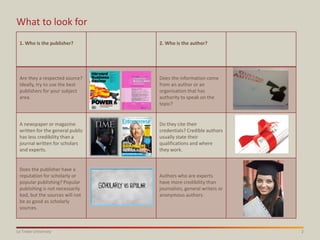
1. Who is the publisher? 2. Who is the author?
Are they a respected source?
Ideally, try to use the best
publishers for your subject
area.
Does the information come
from an author or an
organisation that has
authority to speak on the
topic?
A newspaper or magazine
written for the general public
has less credibility than a
journal written for scholars
and experts.
Do they cite their
credentials? Credible authors
usually state their
qualifications and where
they work.
Does the publisher have a
reputation for scholarly or
popular publishing? Popular
publishing is not necessarily
bad, but the sources will not
be as good as scholarly
sources.
Authors who are experts
have more credibility than
journalists, general writers or
anonymous authors.
3La Trobe University
What to look for
3. What evidence does the
author use to back up their
arguments?
4. Is the information
objective?
What type of research have
they performed or cited?
Is the information presented
with a bias?
/
Has the information been
peer-reviewed? This is when
other experts in the same
field have said this research
is good and worth
publishing.
You can still use sources that
have a specific perspective,
but be aware of both sides of
the argument.
Be sure there is enough
documentation to help you
decide whether the source is
reliable. Look for footnotes,
a bibliography, credits or
quotations.
How valid are the author’s
conclusions? Are they based
on personal opinion,
interviews, research or
experience?
4La Trobe University
What to look for
5. Timeliness 6. Point of view
When was the information
created or published? There
should always be a date.
What is the purpose of the
information? Is it informative
or trying to persuade people?
Are all of the facts being
presented?
Is timeliness important for
your topic? Does the research
need to have been published
recently?
Has information been
deliberately left out? Authors
may do this to suit their
argument, in which case they
are not a reliable source.
Some information will be
valid over time, while other
information may become
obsolete or discredited by
new research.
What kind of language is
being used? The writing
should be objective, not
emotionally charged or
generalised. There shouldn’t
be mistakes with grammar
and spelling.
5La Trobe University
What to look for – Websites
Use the same principles for evaluating websites as you would books and articles.
Additional things to consider:
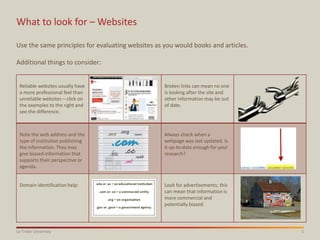
Reliable websites usually have
a more professional feel than
unreliable websites – click on
the examples to the right and
see the difference.
Broken links can mean no one
is looking after the site and
other information may be out
of date.
Note the web address and the
type of institution publishing
the information. They may
give biased information that
supports their perspective or
agenda.
Always check when a
webpage was last updated. Is
it up-to-date enough for your
research?
Domain identification help: Look for advertisements; this
can mean that information is
more commercial and
potentially biased.
6La Trobe University
Need more information?
 See the online tutorial on Evaluating Information Sources
http://latrobe.libguides.com/evaluatingsources
 See the online video What is a scholarly journal?
 https://www.youtube.com/watch?v=R6WVJEXJj_o
 See the online video Evaluating Sources
http://www.youtube.com/watch?v=i-y9VzE2YTs
 See the online video Why Can’t I Just Google?
http://www.youtube.com/watch?v=N39mnu1Pkgw
7La Trobe University

Evaluating Sources

  • 1.
    1La Trobe University EvaluatingSources Image by Rochester Institute of Technology http://library.rit.edu/liv/6-1 CC BY 3.0 AU http://creativecommons.org/licenses/by/3.0/au/ Use these slides to learn how to:  Identify what to look for when selecting resources  Judge if information will be relevant for your assignments  Recognise if a source is credible  Find more information
  • 2.
    2La Trobe University Whatto look for 1. Who is the publisher? 2. Who is the author? Are they a respected source? Ideally, try to use the best publishers for your subject area. Does the information come from an author or an organisation that has authority to speak on the topic? A newspaper or magazine written for the general public has less credibility than a journal written for scholars and experts. Do they cite their credentials? Credible authors usually state their qualifications and where they work. Does the publisher have a reputation for scholarly or popular publishing? Popular publishing is not necessarily bad, but the sources will not be as good as scholarly sources. Authors who are experts have more credibility than journalists, general writers or anonymous authors.
  • 3.
    3La Trobe University Whatto look for 3. What evidence does the author use to back up their arguments? 4. Is the information objective? What type of research have they performed or cited? Is the information presented with a bias? / Has the information been peer-reviewed? This is when other experts in the same field have said this research is good and worth publishing. You can still use sources that have a specific perspective, but be aware of both sides of the argument. Be sure there is enough documentation to help you decide whether the source is reliable. Look for footnotes, a bibliography, credits or quotations. How valid are the author’s conclusions? Are they based on personal opinion, interviews, research or experience?
  • 4.
    4La Trobe University Whatto look for 5. Timeliness 6. Point of view When was the information created or published? There should always be a date. What is the purpose of the information? Is it informative or trying to persuade people? Are all of the facts being presented? Is timeliness important for your topic? Does the research need to have been published recently? Has information been deliberately left out? Authors may do this to suit their argument, in which case they are not a reliable source. Some information will be valid over time, while other information may become obsolete or discredited by new research. What kind of language is being used? The writing should be objective, not emotionally charged or generalised. There shouldn’t be mistakes with grammar and spelling.
  • 5.
    5La Trobe University Whatto look for – Websites Use the same principles for evaluating websites as you would books and articles. Additional things to consider: Reliable websites usually have a more professional feel than unreliable websites – click on the examples to the right and see the difference. Broken links can mean no one is looking after the site and other information may be out of date. Note the web address and the type of institution publishing the information. They may give biased information that supports their perspective or agenda. Always check when a webpage was last updated. Is it up-to-date enough for your research? Domain identification help: Look for advertisements; this can mean that information is more commercial and potentially biased.
  • 6.
    6La Trobe University Needmore information?  See the online tutorial on Evaluating Information Sources http://latrobe.libguides.com/evaluatingsources  See the online video What is a scholarly journal?  https://www.youtube.com/watch?v=R6WVJEXJj_o  See the online video Evaluating Sources http://www.youtube.com/watch?v=i-y9VzE2YTs  See the online video Why Can’t I Just Google? http://www.youtube.com/watch?v=N39mnu1Pkgw
  • 7.