
Mobility Trends Impacting Healthcare
Mike Leibovitz
Director, Office of the CTO
Extreme Networks
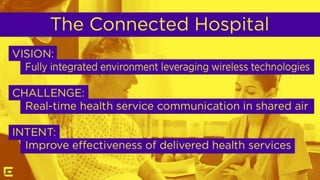
The Connected Hospital
Vision:
Fully integrated environment leveraging wireless technologies
Challenge:
Real-time health service communication in shared air
Intent:
Improve effectiveness of delivered health services
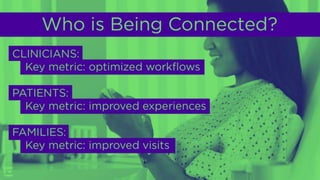
Who Is Being Connected?
Clinicians
Key metric: optimized workflows
Patients:
Key metric: improved experiences
Families:
Key metric: improved visits
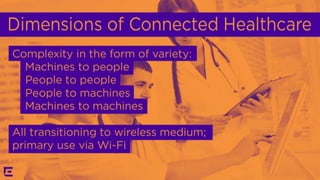
Dimensions of Connected Healthcare
Complexity in the form of variety:
Machines to people
People to people
People to machines
Machines to machines
All transitioning to wireless medium; primary use via Wi-Fi
5 Mobility Trends In 2016
1. The rise of 5GHz
2. Wide adoption of 802.11ac Wi-Fi
3. Wi-Fi calling
4. Engagement and analytics
5. Emergence of IoT
The Rise of 5GHz
5GHz is the preferred Wi-Fi frequency for indoor use
 5GHz should become dominant for your client devices
 2.4GHz should be left for Bluetooth, ZigBee and RTLS (M2M)
Unlicensed 5GHz spectrum is attracting service providers
Wide Adoption of 802.11ac Wi-Fi
The ”all wireless” connected hospital is approaching reality
Shared airspace needs to move traffic faster to offset load
 Life critical (medical devices)
 Mission critical (voice devices)
 Patient critical (Netflix and FaceTime)
802.11ac Wi-Fi, aka “Gigabit Wi-Fi” is shipping now
Wi-Fi Calling Is Here
Traditional DAS solutions no longer ”best” for indoor cellular
Wi-Fi Calling, offered by most carriers, is ramping very quickly
 It doesn’t require anything on-prem; connects automatically
Voice-quality Wi-Fi is mandatory for Healthcare Wi-Fi design
Engagement and analytics
Profound shift in IT; network is more than digitized plumbing
New forms of patient and visitor personalized mobile services
 New conveniences, improved amenities = increase HCAHP
scores
Evidence based approach to IT service delivery
 Biorhythm of hospital seen through analytics and insights
Emergence of IoT
Sensor-based networks spiraling outward from the bedside
Sensor types: wireless>wireless or wireless>wired
Alternate frequencies and protocols add to complexities
Failure To Plan Is Planning To Fail
Great networks are not delivered by luck
Start with correct assumptions when gathering requirements
Make budgets that are realistic to deliver robust wireless
Key Takeaways
1. Plan for explosive wireless growth (don’t overlook wired)
2. Educate and train your IT staff to manage high-density Wi-Fi
3. Leverage data for better decisions and improved outcomes
Mobility Trends Impacting Healthcare

Mobility Trends Impacting Healthcare

  • 1.
    Mobility Trends ImpactingHealthcare Mike Leibovitz Director, Office of the CTO Extreme Networks
  • 2.
    The Connected Hospital Vision: Fullyintegrated environment leveraging wireless technologies Challenge: Real-time health service communication in shared air Intent: Improve effectiveness of delivered health services
  • 3.
    Who Is BeingConnected? Clinicians Key metric: optimized workflows Patients: Key metric: improved experiences Families: Key metric: improved visits
  • 4.
    Dimensions of ConnectedHealthcare Complexity in the form of variety: Machines to people People to people People to machines Machines to machines All transitioning to wireless medium; primary use via Wi-Fi
  • 5.
    5 Mobility TrendsIn 2016 1. The rise of 5GHz 2. Wide adoption of 802.11ac Wi-Fi 3. Wi-Fi calling 4. Engagement and analytics 5. Emergence of IoT
  • 6.
    The Rise of5GHz 5GHz is the preferred Wi-Fi frequency for indoor use  5GHz should become dominant for your client devices  2.4GHz should be left for Bluetooth, ZigBee and RTLS (M2M) Unlicensed 5GHz spectrum is attracting service providers
  • 7.
    Wide Adoption of802.11ac Wi-Fi The ”all wireless” connected hospital is approaching reality Shared airspace needs to move traffic faster to offset load  Life critical (medical devices)  Mission critical (voice devices)  Patient critical (Netflix and FaceTime) 802.11ac Wi-Fi, aka “Gigabit Wi-Fi” is shipping now
  • 8.
    Wi-Fi Calling IsHere Traditional DAS solutions no longer ”best” for indoor cellular Wi-Fi Calling, offered by most carriers, is ramping very quickly  It doesn’t require anything on-prem; connects automatically Voice-quality Wi-Fi is mandatory for Healthcare Wi-Fi design
  • 9.
    Engagement and analytics Profoundshift in IT; network is more than digitized plumbing New forms of patient and visitor personalized mobile services  New conveniences, improved amenities = increase HCAHP scores Evidence based approach to IT service delivery  Biorhythm of hospital seen through analytics and insights
  • 10.
    Emergence of IoT Sensor-basednetworks spiraling outward from the bedside Sensor types: wireless>wireless or wireless>wired Alternate frequencies and protocols add to complexities
  • 11.
    Failure To PlanIs Planning To Fail Great networks are not delivered by luck Start with correct assumptions when gathering requirements Make budgets that are realistic to deliver robust wireless
  • 12.
    Key Takeaways 1. Planfor explosive wireless growth (don’t overlook wired) 2. Educate and train your IT staff to manage high-density Wi-Fi 3. Leverage data for better decisions and improved outcomes

Editor's Notes

  • #4 Clinicians: Optimized Workflows Vitals, Medications, EHR Patients: Improved Experiences Accuracy, Response, Entertainment Families: Improved Visits Guidance, Support, Services
  • #7 5GHz is the preferred Wi-Fi frequency for indoor use More capacity, less interference compared to 2.4GHz 5GHz should become dominant for your client devices 2.4GHz should be left for Bluetooth, ZigBee and RTLS (M2M) Unlicensed 5GHz spectrum is attractive for service providers New LTE-U/LAA services are coming; impact currently unknown
  • #8 The ”all wireless” connected hospital is approaching reality Most environments have more wireless than wired devices today 802.11ac Wi-Fi, aka “Gigabit Wi-Fi” is shipping now Leverages 5GHz exclusively to increase overall performance
  • #9 Traditional DAS solutions no longer ”the best solution” for indoor cellular Service providers aren’t sure just yet: LTE-U? Small Cell? DAS?