Health Care Industry- 
Emerging technologies 
 Prudhvi raju yellala-30116278 
 Siddarth gaddam-30115365 
 Akhil Gopalam-30124593
Introduction 
 Health care industry 
• Cloud computing 
• 4G technology 
• Sensors
Cloud Computing, 4G, And Sensors In 
Healthcare 
In this presentation, I would be highlighting the usefulness of cloud 
computing, tablets, and 4G, in the healthcare industry, and the way 
they have transformed the industry in recent times.
What is Cloud Computing? 
 Cloud computing is now among the most trending technologies. It is the 
form of computing that relies greatly on sharing computing resources, 
without the need for local servers or devices for handling applications.
Cloud Computing's Benefiting 
Healthcare 
 Though several industries have benefited greatly by incorporating cloud-based 
technologies, the one that has been experiencing the most 
benefits, recently, is the healthcare industry
Healthcare Before Cloud Computing 
 Healthcare has been lagging behind in adopting technology, right till 
recently. Healthcare organizations have been dependent on workflows 
that comprise paper medical records, film-based radiological images, 
fragmented IT systems, and handwritten notes
What Cloud Computing Can Do 
 To combat these inefficiencies in workflow, cloud computing 
technologies may be utilized for healthcare applications such as HIS, 
EMRs, and PACS, to make them more affordable and accessible.
Choice Of Organization 
 I have chosen Canberra Hospital, as the organization in which I would 
implement cloud-based technologies.
Judging The Effectiveness Of Cloud 
Computing 
 When it comes to judging the effectiveness of a technology, the return 
on investment plays a vital role i.e. it is important for an organization to 
experience monetary returns, when they invest in a new technology
Cloud Computing For Customer 
Satisfaction In Healthcare 
 Cloud computing technologies are geared towards providing business 
agility. Cloud computing would also offer tremendous benefits for the 
customers, which in this case, are patients, and one of these benefits 
include security.
Overall Benefit For Canberra Hospital 
 The cloud would provide Canberra hospital with fast access to any 
patient’s medical history, which would accelerate the treatment plan, 
prevent complications, and save lives (Osterhaus 2010)
Cloud Computing Might Be Expensive 
For Canberra Hospital 
 While cloud computing does have the ability to reduce the costs borne 
by Canberra Hospital, it is important to note that in certain cases, this 
may not be applicable. Implementation of the cloud might result in a 
greater expenditure, for Canberra hospital (Gray Kubie Garzone and 
Rhoads 2013).
Factors That Determine Canberra 
Hospital's Expenditure 
 The amount of money saved by Canberra hospital would be 
dependent on several factors. The first factor that would affect 
the hospital’s budget, is the current level of virtualization of their 
environment. It would also be determined by the resources being 
utilized by current applications. A common scenario would be 
that of some applications running at 30 percent of their capacity, 
while others are at 50 percent. Therefore, with the deployment of 
a cloud-based architecture, these applications would distribute 
the resources among themselves, resulting in extensive utilization 
of resources.(Gray Kubie Garzone and Rhoads 2013).
Future Of Cloud Computing In 
Healthcare 
 Looking at the present adoption rate of cloud computing technologies, 
it is very likely that cloud computing would continue to be used by the 
healthcare industry in the future. Research firm Markets and Markets 
reveal that the cloud computing market in the healthcare industry 
would grow to a staggering $5.4 million by the year 2017, with the major 
reasons being improved storage and computing power offered by the 
cloud (InfoWorld 2013).
Impact of 4G technology on 
health care. 
• There is great impact of 4G on health care 
• In the consumer world, this significant upgrade in wireless broadband 
means faster wireless web surfing/downloads and high-quality wireless 
videoconferencing. 
• 4G has a potential to exchange health care experience for patients, 
care givers etc. 
• With 4G these data intensive communications can be conducted 
wirelessly making the equipment easy to install and convenient for 
patient for use
Next generation tele health 
• 4G tele health solutions also help remove location barriers from the 
healthcare equation. With videoconferencing, a patient in a rural area 
with 4G coverage can receive a consultation from a world-renowned 
specialist in an urban location without ever leaving their neighbourhood 
or home.
• Once the mobile records are digital they become more 
mobile and can be shared easily with more physicians 
and hospitals. 
 Tele health solutions have a great impact on patient 
care and can reduce costs out of health care system.
• 4G helps in reducing the number of hospital admissions 
and office visits which are riddle with expense. 
• Customer convenience: The customer convenience is to 
greater extent. The customer can share his medical 
records to doctors from home.
Sharing medical information 
with help of 4G 
Video:- 
Healthcare Technology Outlook 2020 - Technology uptake
Sensors:-Technology 
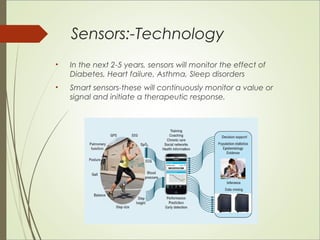
• In the next 2-5 years, sensors will monitor the effect of 
Diabetes, Heart failure, Asthma, Sleep disorders 
• Smart sensors-these will continuously monitor a value or 
signal and initiate a therapeutic response.
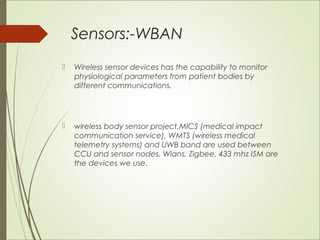
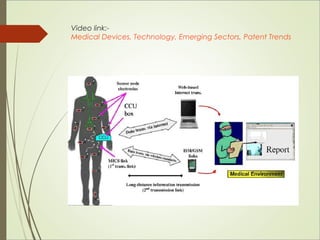
Sensors:-WBAN 
 Wireless sensor devices has the capability to monitor 
physiological parameters from patient bodies by 
different communications. 
 wireless body sensor project,MICS (medical impact 
communication service), WMTS (wireless medical 
telemetry systems) and UWB band are used between 
CCU and sensor nodes. Wlans, Zigbee, 433 mhz ISM are 
the devices we use.
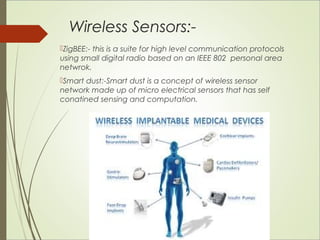
Wireless Sensors:- 
ZigBEE:- this is a suite for high level communication protocols 
using small digital radio based on an IEEE 802 personal area 
netwrok. 
Smart dust:-Smart dust is a concept of wireless sensor 
network made up of micro electrical sensors that has self 
conatined sensing and computation.
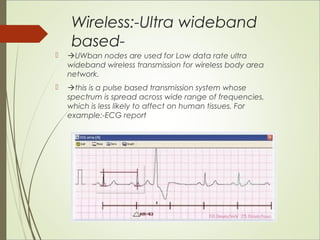
Wireless:-Ultra wideband 
based- 
 UWban nodes are used for Low data rate ultra 
wideband wireless transmission for wireless body area 
network. 
 this is a pulse based transmission system whose 
spectrum is spread across wide range of frequencies, 
which is less likely to affect on human tissues. For 
example:-ECG report
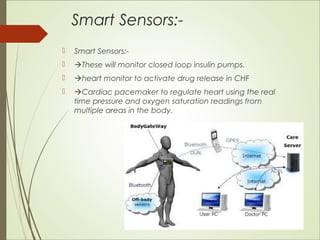
Smart Sensors:- 
 Smart Sensors:- 
 These will monitor closed loop insulin pumps. 
 heart monitor to activate drug release in CHF 
 Cardiac pacemaker to regulate heart using the real 
time pressure and oxygen saturation readings from 
multiple areas in the body.
Smart Sensors:- 
 Biometric monitoring:- 
 Continous measurement of biometric indicators with 
implanatable devices. 
 Portable bed unit integrated sensors capable of ICU 
monitoring functions. 
 point of care testing-analytical testing 
 environmental monitoring for screening, biosensors will 
identify pathogens
Hospitals can Determine their 
Return on investment:- 
 Determining priorities:-before knowing certain 
technology yielding a good result,executives must drill 
down about its contribution towards the success. 
 Benchmark:-most effective and frequently used way to 
look at the ROI. It compares the current performance to 
the historical metrics. 
 Work flow improvement:-A new technology had a great 
influence on ROI if it its able to eliminate some steps and 
save time. 
 Business growth:- this depends upon the costs of a 
technology and if the employees observe the benefits of 
a technology,then that has to be considered as a 
positive ROI
Advantages and customer 
convenience:- 
 Continous monitoring will be achieved and right treatment at the 
required time which was the crucial thing for any customer. 
 Easy to use and reduce the work load,which will adversly 
increase the competetive advantage. 
 It is a very fast process and meet the needs of the industry 
Disadvantages:- 
 Initial cost is high 
 Periodic maintainence is required.
Video link:- 
Medical Devices, Technology, Emerging Sectors, Patent Trends
References 
 Cloudtweaks 2012, Top 5 Cloud Computing Trends Of The Future, Viewed on 30/9/2014, 
http://cloudtweaks.com/2012/09/top-5-cloud-computing-trends-of-the-future/ 
 Cio 2013, Healthcare Finally Warming To Cloud Technology, Viewed on 30/9/2014, 
http://www.cio.com/article/2380823/healthcare/healthcare-finally-warming-to-cloud-technology. 
html 
 InfoWorld 2013, Health care and the cloud are finally coming together, Viewed on 29/9/2014, 
http://www.infoworld.com/article/2613547/cloud-computing/health-care-and-the-cloud-are-finally- 
coming-together.html 
 Gray Kubie Garzone and Rhoads 2013, Cloud Computing In The Healthcare Environment: 
Whether The Cloud is Right For You And What You Should Be Doing Now, Accessed on 29/9/2014, 
http://assets1.csc.com/health_services/downloads/CSC_Cloud_Computing_in_the_Healthcare_E 
nvironment.pdf 
 Reddy G. and Reddy U., Study of Cloud Computing In Healthcare Industry, Accessed on 
29/09/2014, http://arxiv.org/ftp/arxiv/papers/1402/1402.1841.pdf 
 Cloudstandardscustomercouncil 2012, Impact of Cloud Computing on Healthcare, Accessed on 
29/9/2014, http://www.cloudstandardscustomercouncil.org/cscchealthcare110512.pdf 
 Poweryourpractice, Should Healthcare Move To The Cloud?, Viewed on 29/9/2014, 
http://www.poweryourpractice.com/medical-technology-trends/should-health-care-move-to-the- 
cloud/ 
 Webopedia, Cloud Computing (The Cloud), Viewed on 29/9/2014, 
http://www.webopedia.com/TERM/C/cloud_computing.html
THANK 
YOU..

topic-emerging technologies

  • 1.
    Health Care Industry- Emerging technologies  Prudhvi raju yellala-30116278  Siddarth gaddam-30115365  Akhil Gopalam-30124593
  • 2.
    Introduction  Healthcare industry • Cloud computing • 4G technology • Sensors
  • 3.
    Cloud Computing, 4G,And Sensors In Healthcare In this presentation, I would be highlighting the usefulness of cloud computing, tablets, and 4G, in the healthcare industry, and the way they have transformed the industry in recent times.
  • 4.
    What is CloudComputing?  Cloud computing is now among the most trending technologies. It is the form of computing that relies greatly on sharing computing resources, without the need for local servers or devices for handling applications.
  • 5.
    Cloud Computing's Benefiting Healthcare  Though several industries have benefited greatly by incorporating cloud-based technologies, the one that has been experiencing the most benefits, recently, is the healthcare industry
  • 6.
    Healthcare Before CloudComputing  Healthcare has been lagging behind in adopting technology, right till recently. Healthcare organizations have been dependent on workflows that comprise paper medical records, film-based radiological images, fragmented IT systems, and handwritten notes
  • 7.
    What Cloud ComputingCan Do  To combat these inefficiencies in workflow, cloud computing technologies may be utilized for healthcare applications such as HIS, EMRs, and PACS, to make them more affordable and accessible.
  • 8.
    Choice Of Organization  I have chosen Canberra Hospital, as the organization in which I would implement cloud-based technologies.
  • 9.
    Judging The EffectivenessOf Cloud Computing  When it comes to judging the effectiveness of a technology, the return on investment plays a vital role i.e. it is important for an organization to experience monetary returns, when they invest in a new technology
  • 10.
    Cloud Computing ForCustomer Satisfaction In Healthcare  Cloud computing technologies are geared towards providing business agility. Cloud computing would also offer tremendous benefits for the customers, which in this case, are patients, and one of these benefits include security.
  • 11.
    Overall Benefit ForCanberra Hospital  The cloud would provide Canberra hospital with fast access to any patient’s medical history, which would accelerate the treatment plan, prevent complications, and save lives (Osterhaus 2010)
  • 12.
    Cloud Computing MightBe Expensive For Canberra Hospital  While cloud computing does have the ability to reduce the costs borne by Canberra Hospital, it is important to note that in certain cases, this may not be applicable. Implementation of the cloud might result in a greater expenditure, for Canberra hospital (Gray Kubie Garzone and Rhoads 2013).
  • 13.
    Factors That DetermineCanberra Hospital's Expenditure  The amount of money saved by Canberra hospital would be dependent on several factors. The first factor that would affect the hospital’s budget, is the current level of virtualization of their environment. It would also be determined by the resources being utilized by current applications. A common scenario would be that of some applications running at 30 percent of their capacity, while others are at 50 percent. Therefore, with the deployment of a cloud-based architecture, these applications would distribute the resources among themselves, resulting in extensive utilization of resources.(Gray Kubie Garzone and Rhoads 2013).
  • 14.
    Future Of CloudComputing In Healthcare  Looking at the present adoption rate of cloud computing technologies, it is very likely that cloud computing would continue to be used by the healthcare industry in the future. Research firm Markets and Markets reveal that the cloud computing market in the healthcare industry would grow to a staggering $5.4 million by the year 2017, with the major reasons being improved storage and computing power offered by the cloud (InfoWorld 2013).
  • 15.
    Impact of 4Gtechnology on health care. • There is great impact of 4G on health care • In the consumer world, this significant upgrade in wireless broadband means faster wireless web surfing/downloads and high-quality wireless videoconferencing. • 4G has a potential to exchange health care experience for patients, care givers etc. • With 4G these data intensive communications can be conducted wirelessly making the equipment easy to install and convenient for patient for use
  • 16.
    Next generation telehealth • 4G tele health solutions also help remove location barriers from the healthcare equation. With videoconferencing, a patient in a rural area with 4G coverage can receive a consultation from a world-renowned specialist in an urban location without ever leaving their neighbourhood or home.
  • 17.
    • Once themobile records are digital they become more mobile and can be shared easily with more physicians and hospitals.  Tele health solutions have a great impact on patient care and can reduce costs out of health care system.
  • 18.
    • 4G helpsin reducing the number of hospital admissions and office visits which are riddle with expense. • Customer convenience: The customer convenience is to greater extent. The customer can share his medical records to doctors from home.
  • 19.
    Sharing medical information with help of 4G Video:- Healthcare Technology Outlook 2020 - Technology uptake
  • 20.
    Sensors:-Technology • Inthe next 2-5 years, sensors will monitor the effect of Diabetes, Heart failure, Asthma, Sleep disorders • Smart sensors-these will continuously monitor a value or signal and initiate a therapeutic response.
  • 21.
    Sensors:-WBAN  Wirelesssensor devices has the capability to monitor physiological parameters from patient bodies by different communications.  wireless body sensor project,MICS (medical impact communication service), WMTS (wireless medical telemetry systems) and UWB band are used between CCU and sensor nodes. Wlans, Zigbee, 433 mhz ISM are the devices we use.
  • 22.
    Wireless Sensors:- ZigBEE:-this is a suite for high level communication protocols using small digital radio based on an IEEE 802 personal area netwrok. Smart dust:-Smart dust is a concept of wireless sensor network made up of micro electrical sensors that has self conatined sensing and computation.
  • 23.
    Wireless:-Ultra wideband based-  UWban nodes are used for Low data rate ultra wideband wireless transmission for wireless body area network.  this is a pulse based transmission system whose spectrum is spread across wide range of frequencies, which is less likely to affect on human tissues. For example:-ECG report
  • 24.
    Smart Sensors:- Smart Sensors:-  These will monitor closed loop insulin pumps.  heart monitor to activate drug release in CHF  Cardiac pacemaker to regulate heart using the real time pressure and oxygen saturation readings from multiple areas in the body.
  • 25.
    Smart Sensors:- Biometric monitoring:-  Continous measurement of biometric indicators with implanatable devices.  Portable bed unit integrated sensors capable of ICU monitoring functions.  point of care testing-analytical testing  environmental monitoring for screening, biosensors will identify pathogens
  • 26.
    Hospitals can Determinetheir Return on investment:-  Determining priorities:-before knowing certain technology yielding a good result,executives must drill down about its contribution towards the success.  Benchmark:-most effective and frequently used way to look at the ROI. It compares the current performance to the historical metrics.  Work flow improvement:-A new technology had a great influence on ROI if it its able to eliminate some steps and save time.  Business growth:- this depends upon the costs of a technology and if the employees observe the benefits of a technology,then that has to be considered as a positive ROI
  • 27.
    Advantages and customer convenience:-  Continous monitoring will be achieved and right treatment at the required time which was the crucial thing for any customer.  Easy to use and reduce the work load,which will adversly increase the competetive advantage.  It is a very fast process and meet the needs of the industry Disadvantages:-  Initial cost is high  Periodic maintainence is required.
  • 28.
    Video link:- MedicalDevices, Technology, Emerging Sectors, Patent Trends
  • 29.
    References  Cloudtweaks2012, Top 5 Cloud Computing Trends Of The Future, Viewed on 30/9/2014, http://cloudtweaks.com/2012/09/top-5-cloud-computing-trends-of-the-future/  Cio 2013, Healthcare Finally Warming To Cloud Technology, Viewed on 30/9/2014, http://www.cio.com/article/2380823/healthcare/healthcare-finally-warming-to-cloud-technology. html  InfoWorld 2013, Health care and the cloud are finally coming together, Viewed on 29/9/2014, http://www.infoworld.com/article/2613547/cloud-computing/health-care-and-the-cloud-are-finally- coming-together.html  Gray Kubie Garzone and Rhoads 2013, Cloud Computing In The Healthcare Environment: Whether The Cloud is Right For You And What You Should Be Doing Now, Accessed on 29/9/2014, http://assets1.csc.com/health_services/downloads/CSC_Cloud_Computing_in_the_Healthcare_E nvironment.pdf  Reddy G. and Reddy U., Study of Cloud Computing In Healthcare Industry, Accessed on 29/09/2014, http://arxiv.org/ftp/arxiv/papers/1402/1402.1841.pdf  Cloudstandardscustomercouncil 2012, Impact of Cloud Computing on Healthcare, Accessed on 29/9/2014, http://www.cloudstandardscustomercouncil.org/cscchealthcare110512.pdf  Poweryourpractice, Should Healthcare Move To The Cloud?, Viewed on 29/9/2014, http://www.poweryourpractice.com/medical-technology-trends/should-health-care-move-to-the- cloud/  Webopedia, Cloud Computing (The Cloud), Viewed on 29/9/2014, http://www.webopedia.com/TERM/C/cloud_computing.html
  • 30.