Development and Implementation of
Health Risk-Based Soil Quality Guidelines
in Turkey
H. Meltem İpek and Kahraman Ünlü
Middle East Technical University, Dept. of Environmental
Engineering, Ankara, Turkey
Risk Based Decision Making
• Management of contaminated land is a critical
environmental issue around the world due to the
human health risk involved for many sites and scarcity
of funding.
• Moreover, cleaning up all previously contaminated sites
to background levels is technically and economically
infeasible.
• For optimal utilization of available funds and
prioritization of contaminated sites, health-risk-based
soil quality standards should be preferred over the
traditional soil quality standards.
Risk Based Decision Making
• Most EU Member States and the North American
Countries regard risk based approaches as the cost
effective and best available strategy for dealing
with the problems posed by soil contamination.
• For these reasons, risk based contaminated land
management approaches have been included in
the environmental policy of Turkey.
Risk Based Decision Making
• The need for health-risk-based SQSs is clear, but developing
these standards and implementation of them in contaminated
land management is not a straightforward process;
• The goal of this paper is
 to present a conceptual framework that identifies the
essential steps for the derivation of human health risk-
based SQSs for Turkey, and
 to share Turkey’s experience to shed some light on various
problems that might be common for other countries
planning to develop their own health-risk-based SSQs.
Risk Based Approach
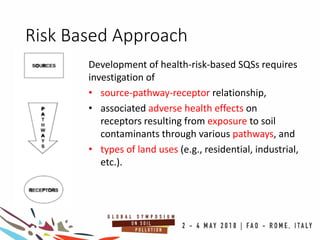
Development of health-risk-based SQSs requires
investigation of
• source-pathway-receptor relationship,
• associated adverse health effects on
receptors resulting from exposure to soil
contaminants through various pathways, and
• types of land uses (e.g., residential, industrial,
etc.).
Risk Based Approach
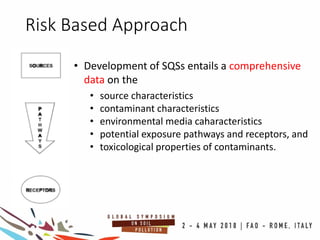
• Development of SQSs entails a comprehensive
data on the
• source characteristics
• contaminant characteristics
• environmental media caharacteristics
• potential exposure pathways and receptors, and
• toxicological properties of contaminants.
Challenges in setting SQSs
Developing health risk-based SQSs is a challenging work.
• Comprehensive assessment of nationwide
environmental media characteristics (e.g. soil,
(hydro)geological, climatic properties) and human
exposure characteristics (e.g. exposure scenarios and
parameters) are required.
• Political decisions need to be made regarding
acceptable risk level and associated economical
concerns.
Challenges in setting SQSs
• A procedure that is conservative, but at the same
time practically, technically and financially feasible;
and tailored according to the capabilities of the
country is needed.
• Extensive amount of time is required to conduct a
complete literature search, and to comprehend all
the available information.
Conceptual Framework
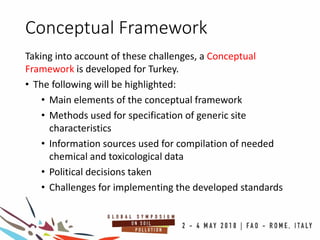
Taking into account of these challenges, a Conceptual
Framework is developed for Turkey.
• The following will be highlighted:
• Main elements of the conceptual framework
• Methods used for specification of generic site
characteristics
• Information sources used for compilation of needed
chemical and toxicological data
• Political decisions taken
• Challenges for implementing the developed standards
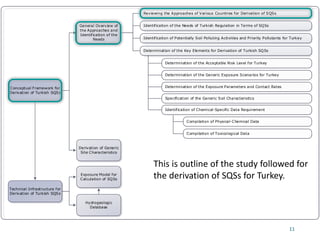
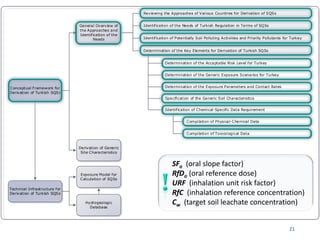
Conceptual Framework for
Derivation of Turkish SQSs
Reviewing the Approaches of Various Countries for Derivation of SQSs
Identification of Potentially Soil Polluting Activities and Priority Pollutants for Turkey
Determination of the Key Elements for Derivation of Turkish SQSs
Technical Infrastructure for
Derivation of Turkish SQSs
Exposure Model for
Calculation of SQSs
General Overview of
the Approaches and
Identification of the
Needs
Derivation of Generic
Site Characteristics
Hydrogeologic
Database
Determination of the Acceptable Risk Level for Turkey
Determination of the Exposure Parameters and Contact Rates
Identification of Chemical-Specific Data Requirement
Compilation of Physical-Chemical Data
Compilation of Toxicological Data
Determination of the Generic Exposure Scenarios for Turkey
Identification of the Needs of Turkish Regulation in Terms of SQSs
Specification of the Generic Soil Characteristics
11
This is outline of the study followed for
the derivation of SQSs for Turkey.
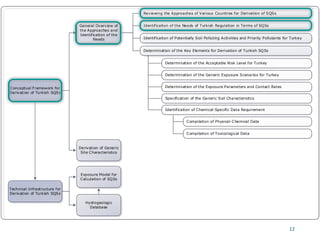
Conceptual Framework for
Derivation of Turkish SQSs
Reviewing the Approaches of Various Countries for Derivation of SQSs
Identification of Potentially Soil Polluting Activities and Priority Pollutants for Turkey
Determination of the Key Elements for Derivation of Turkish SQSs
Technical Infrastructure for
Derivation of Turkish SQSs
Exposure Model for
Calculation of SQSs
General Overview of
the Approaches and
Identification of the
Needs
Derivation of Generic
Site Characteristics
Hydrogeologic
Database
Determination of the Acceptable Risk Level for Turkey
Determination of the Exposure Parameters and Contact Rates
Identification of Chemical-Specific Data Requirement
Compilation of Physical-Chemical Data
Compilation of Toxicological Data
Determination of the Generic Exposure Scenarios for Turkey
Identification of the Needs of Turkish Regulation in Terms of SQSs
Specification of the Generic Soil Characteristics
12
Conceptual Framework for
Derivation of Turkish SQSs
Reviewing the Approaches of Various Countries for Derivation of SQSs
Identification of Potentially Soil Polluting Activities and Priority Pollutants for Turkey
Determination of the Key Elements for Derivation of Turkish SQSs
Technical Infrastructure for
Derivation of Turkish SQSs
Exposure Model for
Calculation of SQSs
General Overview of
the Approaches and
Identification of the
Needs
Derivation of Generic
Site Characteristics
Hydrogeologic
Database
Determination of the Acceptable Risk Level for Turkey
Determination of the Exposure Parameters and Contact Rates
Identification of Chemical-Specific Data Requirement
Compilation of Physical-Chemical Data
Compilation of Toxicological Data
Determination of the Generic Exposure Scenarios for Turkey
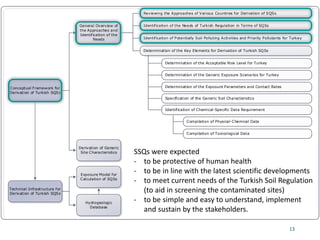
Identification of the Needs of Turkish Regulation in Terms of SQSs
Specification of the Generic Soil Characteristics
13
SSQs were expected
- to be protective of human health
- to be in line with the latest scientific developments
- to meet current needs of the Turkish Soil Regulation
(to aid in screening the contaminated sites)
- to be simple and easy to understand, implement
and sustain by the stakeholders.
Conceptual Framework for
Derivation of Turkish SQSs
Reviewing the Approaches of Various Countries for Derivation of SQSs
Identification of Potentially Soil Polluting Activities and Priority Pollutants for Turkey
Determination of the Key Elements for Derivation of Turkish SQSs
Technical Infrastructure for
Derivation of Turkish SQSs
Exposure Model for
Calculation of SQSs
General Overview of
the Approaches and
Identification of the
Needs
Derivation of Generic
Site Characteristics
Hydrogeologic
Database
Determination of the Acceptable Risk Level for Turkey
Determination of the Exposure Parameters and Contact Rates
Identification of Chemical-Specific Data Requirement
Compilation of Physical-Chemical Data
Compilation of Toxicological Data
Determination of the Generic Exposure Scenarios for Turkey
Identification of the Needs of Turkish Regulation in Terms of SQSs
Specification of the Generic Soil Characteristics
14
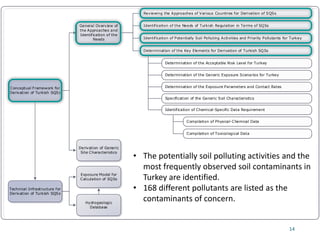
• The potentially soil polluting activities and the
most frequently observed soil contaminants in
Turkey are identified.
• 168 different pollutants are listed as the
contaminants of concern.
Determination of the Approach
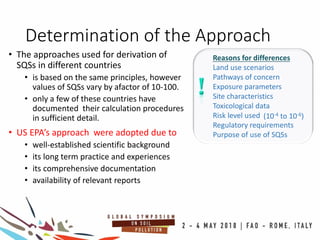
• The approaches used for derivation of
SQSs in different countries
• is based on the same principles, however
values of SQSs vary by afactor of 10-100.
• only a few of these countries have
documented their calculation procedures
in sufficient detail.
• US EPA’s approach were adopted due to
• well-established scientific background
• its long term practice and experiences
• its comprehensive documentation
• availability of relevant reports
Reasons for differences
Land use scenarios
Pathways of concern
Exposure parameters
Site characteristics
Toxicological data
Risk level used
Regulatory requirements
Purpose of use of SQSs
(10-4 to 10-6)
Conceptual Framework for
Derivation of Turkish SQSs
Reviewing the Approaches of Various Countries for Derivation of SQSs
Identification of Potentially Soil Polluting Activities and Priority Pollutants for Turkey
Determination of the Key Elements for Derivation of Turkish SQSs
Technical Infrastructure for
Derivation of Turkish SQSs
Exposure Model for
Calculation of SQSs
General Overview of
the Approaches and
Identification of the
Needs
Derivation of Generic
Site Characteristics
Hydrogeologic
Database
Determination of the Acceptable Risk Level for Turkey
Determination of the Exposure Parameters and Contact Rates
Identification of Chemical-Specific Data Requirement
Compilation of Physical-Chemical Data
Compilation of Toxicological Data
Determination of the Generic Exposure Scenarios for Turkey
Identification of the Needs of Turkish Regulation in Terms of SQSs
Specification of the Generic Soil Characteristics
16
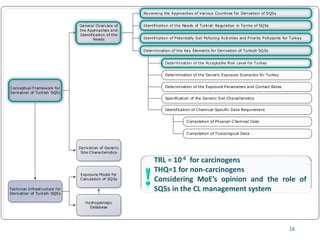
TRL = 10-6 for carcinogens
THQ=1 for non-carcinogens
Considering MoE’s opinion and the role of
SQSs in the CL management system
Conceptual Framework for
Derivation of Turkish SQSs
Reviewing the Approaches of Various Countries for Derivation of SQSs
Identification of Potentially Soil Polluting Activities and Priority Pollutants for Turkey
Determination of the Key Elements for Derivation of Turkish SQSs
Technical Infrastructure for
Derivation of Turkish SQSs
Exposure Model for
Calculation of SQSs
General Overview of
the Approaches and
Identification of the
Needs
Derivation of Generic
Site Characteristics
Hydrogeologic
Database
Determination of the Acceptable Risk Level for Turkey
Determination of the Exposure Parameters and Contact Rates
Identification of Chemical-Specific Data Requirement
Compilation of Physical-Chemical Data
Compilation of Toxicological Data
Determination of the Generic Exposure Scenarios for Turkey
Identification of the Needs of Turkish Regulation in Terms of SQSs
Specification of the Generic Soil Characteristics
17
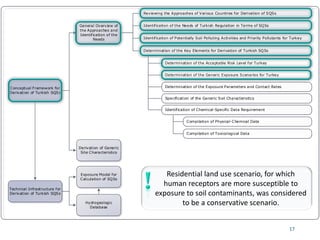
Residential land use scenario, for which
human receptors are more susceptible to
exposure to soil contaminants, was considered
to be a conservative scenario.
Conceptual Framework for
Derivation of Turkish SQSs
Reviewing the Approaches of Various Countries for Derivation of SQSs
Identification of Potentially Soil Polluting Activities and Priority Pollutants for Turkey
Determination of the Key Elements for Derivation of Turkish SQSs
Technical Infrastructure for
Derivation of Turkish SQSs
Exposure Model for
Calculation of SQSs
General Overview of
the Approaches and
Identification of the
Needs
Derivation of Generic
Site Characteristics
Hydrogeologic
Database
Determination of the Acceptable Risk Level for Turkey
Determination of the Exposure Parameters and Contact Rates
Identification of Chemical-Specific Data Requirement
Compilation of Physical-Chemical Data
Compilation of Toxicological Data
Determination of the Generic Exposure Scenarios for Turkey
Identification of the Needs of Turkish Regulation in Terms of SQSs
Specification of the Generic Soil Characteristics
18
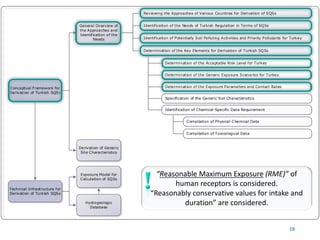
“Reasonable Maximum Exposure (RME)” of
human receptors is considered.
“Reasonably conservative values for intake and
duration” are considered.
19
Conceptual Framework for
Derivation of Turkish SQSs
Reviewing the Approaches of Various Countries for Derivation of SQSs
Identification of Potentially Soil Polluting Activities and Priority Pollutants for Turkey
Determination of the Key Elements for Derivation of Turkish SQSs
Technical Infrastructure for
Derivation of Turkish SQSs
Exposure Model for
Calculation of SQSs
General Overview of
the Approaches and
Identification of the
Needs
Derivation of Generic
Site Characteristics
Hydrogeologic
Database
Determination of the Acceptable Risk Level for Turkey
Determination of the Exposure Parameters and Contact Rates
Identification of Chemical-Specific Data Requirement
Compilation of Physical-Chemical Data
Compilation of Toxicological Data
Determination of the Generic Exposure Scenarios for Turkey
Identification of the Needs of Turkish Regulation in Terms of SQSs
Specification of the Generic Soil Characteristics
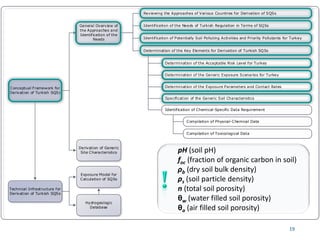
pH (soil pH)
foc (fraction of organic carbon in soil)
ρb (dry soil bulk density)
ρs (soil particle density)
n (total soil porosity)
θw (water filled soil porosity)
θa (air filled soil porosity)
Conceptual Framework for
Derivation of Turkish SQSs
Reviewing the Approaches of Various Countries for Derivation of SQSs
Identification of Potentially Soil Polluting Activities and Priority Pollutants for Turkey
Determination of the Key Elements for Derivation of Turkish SQSs
Technical Infrastructure for
Derivation of Turkish SQSs
Exposure Model for
Calculation of SQSs
General Overview of
the Approaches and
Identification of the
Needs
Derivation of Generic
Site Characteristics
Hydrogeologic
Database
Determination of the Acceptable Risk Level for Turkey
Determination of the Exposure Parameters and Contact Rates
Identification of Chemical-Specific Data Requirement
Compilation of Physical-Chemical Data
Compilation of Toxicological Data
Determination of the Generic Exposure Scenarios for Turkey
Identification of the Needs of Turkish Regulation in Terms of SQSs
Specification of the Generic Soil Characteristics
20
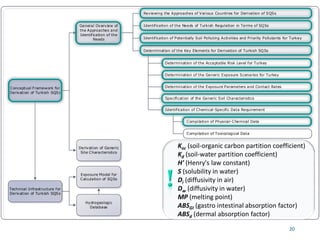
Koc (soil-organic carbon partition coefficient)
Kd (soil-water partition coefficient)
H' (Henry's law constant)
S (solubility in water)
Di (diffusivity in air)
Dw (diffusivity in water)
MP (melting point)
ABSGI (gastro intestinal absorption factor)
ABSd (dermal absorption factor)
Conceptual Framework for
Derivation of Turkish SQSs
Reviewing the Approaches of Various Countries for Derivation of SQSs
Identification of Potentially Soil Polluting Activities and Priority Pollutants for Turkey
Determination of the Key Elements for Derivation of Turkish SQSs
Technical Infrastructure for
Derivation of Turkish SQSs
Exposure Model for
Calculation of SQSs
General Overview of
the Approaches and
Identification of the
Needs
Derivation of Generic
Site Characteristics
Hydrogeologic
Database
Determination of the Acceptable Risk Level for Turkey
Determination of the Exposure Parameters and Contact Rates
Identification of Chemical-Specific Data Requirement
Compilation of Physical-Chemical Data
Compilation of Toxicological Data
Determination of the Generic Exposure Scenarios for Turkey
Identification of the Needs of Turkish Regulation in Terms of SQSs
Specification of the Generic Soil Characteristics
21
SFo (oral slope factor)
RfDo (oral reference dose)
URF (inhalation unit risk factor)
RfC (inhalation reference concentration)
Cw (target soil leachate concentration)
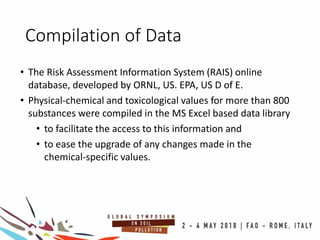
Compilation of Data
• The Risk Assessment Information System (RAIS) online
database, developed by ORNL, US. EPA, US D of E.
• Physical-chemical and toxicological values for more than 800
substances were compiled in the MS Excel based data library
• to facilitate the access to this information and
• to ease the upgrade of any changes made in the
chemical-specific values.
23
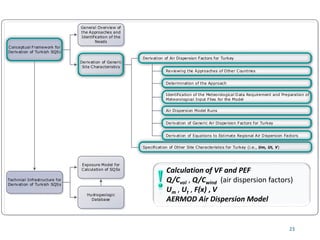
Conceptual Framework for
Derivation of Turkish SQSs
Technical Infrastructure for
Derivation of Turkish SQSs
Exposure Model for
Calculation of SQSs
General Overview of
the Approaches and
Identification of the
Needs
Derivation of Generic
Site Characteristics
Specification of Other Site Characteristics for Turkey (i.e., Um, Ut, V)
Hydrogeologic
Database
Reviewing the Approaches of Other Countries
Determination of the Approach
Derivation of Generic Air Dispersion Factors for Turkey
Identification of the Meteorological Data Requirement and Preparation of
Meteorological Input Files for the Model
Derivation of Air Dispersion Factors for Turkey
Air Dispersion Model Runs
Derivation of Equations to Estimate Regional Air Dispersion Factors
Calculation of VF and PEF
Q/Cvol , Q/Cwind (air dispersion factors)
Um , Ut , F(x) , V
AERMOD Air Dispersion Model
24
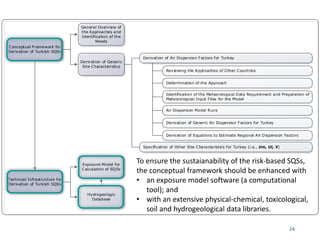
Conceptual Framework for
Derivation of Turkish SQSs
Technical Infrastructure for
Derivation of Turkish SQSs
Exposure Model for
Calculation of SQSs
General Overview of
the Approaches and
Identification of the
Needs
Derivation of Generic
Site Characteristics
Specification of Other Site Characteristics for Turkey (i.e., Um, Ut, V)
Hydrogeologic
Database
Reviewing the Approaches of Other Countries
Determination of the Approach
Derivation of Generic Air Dispersion Factors for Turkey
Identification of the Meteorological Data Requirement and Preparation of
Meteorological Input Files for the Model
Derivation of Air Dispersion Factors for Turkey
Air Dispersion Model Runs
Derivation of Equations to Estimate Regional Air Dispersion Factors
To ensure the sustaianability of the risk-based SQSs,
the conceptual framework should be enhanced with
• an exposure model software (a computational
tool); and
• with an extensive physical-chemical, toxicological,
soil and hydrogeological data libraries.
Recommendations
The following recommendations are made for researchers who are
working on developing risk-based SQSs for their own countries:
• Be ready to spend a lot of time continuously for literature review
and examining the existing procedures, approaches, and risk
assessment tools used by different countries.
• Learn and evaluate the special conditions and needs of your
country so that the procedure you develop for your country is
practically feasible to implement.
• Work with a multidisciplinary team of national and international
experts.
• Understand that risk assessment is still a developing process and
updates and modifications will continuously become necessary.
Recommendations
• Be aware of the possible inconsistencies of different risk
assessment tools developed by various countries and evaluate
different approaches and risk assessment tools accordingly.
• Get ready to deal with technical and financial difficulties regarding
sampling and analysis of contaminants in various environmental
media; therefore, while designing sampling strategies the cost and
time required for the analyses should be considered.
• Be aware of the need for substantial capacity building to educate
both engineers who will be conducting health risk assessment
studies for the polluters and government officers who will be
evaluating these studies and enforcing the guidelines.
Development and implementationof health risk-based soil Guidelines in Turkey

Development and implementationof health risk-based soil Guidelines in Turkey

  • 2.
    Development and Implementationof Health Risk-Based Soil Quality Guidelines in Turkey H. Meltem İpek and Kahraman Ünlü Middle East Technical University, Dept. of Environmental Engineering, Ankara, Turkey
  • 3.
    Risk Based DecisionMaking • Management of contaminated land is a critical environmental issue around the world due to the human health risk involved for many sites and scarcity of funding. • Moreover, cleaning up all previously contaminated sites to background levels is technically and economically infeasible. • For optimal utilization of available funds and prioritization of contaminated sites, health-risk-based soil quality standards should be preferred over the traditional soil quality standards.
  • 4.
    Risk Based DecisionMaking • Most EU Member States and the North American Countries regard risk based approaches as the cost effective and best available strategy for dealing with the problems posed by soil contamination. • For these reasons, risk based contaminated land management approaches have been included in the environmental policy of Turkey.
  • 5.
    Risk Based DecisionMaking • The need for health-risk-based SQSs is clear, but developing these standards and implementation of them in contaminated land management is not a straightforward process; • The goal of this paper is  to present a conceptual framework that identifies the essential steps for the derivation of human health risk- based SQSs for Turkey, and  to share Turkey’s experience to shed some light on various problems that might be common for other countries planning to develop their own health-risk-based SSQs.
  • 6.
    Risk Based Approach Developmentof health-risk-based SQSs requires investigation of • source-pathway-receptor relationship, • associated adverse health effects on receptors resulting from exposure to soil contaminants through various pathways, and • types of land uses (e.g., residential, industrial, etc.).
  • 7.
    Risk Based Approach •Development of SQSs entails a comprehensive data on the • source characteristics • contaminant characteristics • environmental media caharacteristics • potential exposure pathways and receptors, and • toxicological properties of contaminants.
  • 8.
    Challenges in settingSQSs Developing health risk-based SQSs is a challenging work. • Comprehensive assessment of nationwide environmental media characteristics (e.g. soil, (hydro)geological, climatic properties) and human exposure characteristics (e.g. exposure scenarios and parameters) are required. • Political decisions need to be made regarding acceptable risk level and associated economical concerns.
  • 9.
    Challenges in settingSQSs • A procedure that is conservative, but at the same time practically, technically and financially feasible; and tailored according to the capabilities of the country is needed. • Extensive amount of time is required to conduct a complete literature search, and to comprehend all the available information.
  • 10.
    Conceptual Framework Taking intoaccount of these challenges, a Conceptual Framework is developed for Turkey. • The following will be highlighted: • Main elements of the conceptual framework • Methods used for specification of generic site characteristics • Information sources used for compilation of needed chemical and toxicological data • Political decisions taken • Challenges for implementing the developed standards
  • 11.
    Conceptual Framework for Derivationof Turkish SQSs Reviewing the Approaches of Various Countries for Derivation of SQSs Identification of Potentially Soil Polluting Activities and Priority Pollutants for Turkey Determination of the Key Elements for Derivation of Turkish SQSs Technical Infrastructure for Derivation of Turkish SQSs Exposure Model for Calculation of SQSs General Overview of the Approaches and Identification of the Needs Derivation of Generic Site Characteristics Hydrogeologic Database Determination of the Acceptable Risk Level for Turkey Determination of the Exposure Parameters and Contact Rates Identification of Chemical-Specific Data Requirement Compilation of Physical-Chemical Data Compilation of Toxicological Data Determination of the Generic Exposure Scenarios for Turkey Identification of the Needs of Turkish Regulation in Terms of SQSs Specification of the Generic Soil Characteristics 11 This is outline of the study followed for the derivation of SQSs for Turkey.
  • 12.
    Conceptual Framework for Derivationof Turkish SQSs Reviewing the Approaches of Various Countries for Derivation of SQSs Identification of Potentially Soil Polluting Activities and Priority Pollutants for Turkey Determination of the Key Elements for Derivation of Turkish SQSs Technical Infrastructure for Derivation of Turkish SQSs Exposure Model for Calculation of SQSs General Overview of the Approaches and Identification of the Needs Derivation of Generic Site Characteristics Hydrogeologic Database Determination of the Acceptable Risk Level for Turkey Determination of the Exposure Parameters and Contact Rates Identification of Chemical-Specific Data Requirement Compilation of Physical-Chemical Data Compilation of Toxicological Data Determination of the Generic Exposure Scenarios for Turkey Identification of the Needs of Turkish Regulation in Terms of SQSs Specification of the Generic Soil Characteristics 12
  • 13.
    Conceptual Framework for Derivationof Turkish SQSs Reviewing the Approaches of Various Countries for Derivation of SQSs Identification of Potentially Soil Polluting Activities and Priority Pollutants for Turkey Determination of the Key Elements for Derivation of Turkish SQSs Technical Infrastructure for Derivation of Turkish SQSs Exposure Model for Calculation of SQSs General Overview of the Approaches and Identification of the Needs Derivation of Generic Site Characteristics Hydrogeologic Database Determination of the Acceptable Risk Level for Turkey Determination of the Exposure Parameters and Contact Rates Identification of Chemical-Specific Data Requirement Compilation of Physical-Chemical Data Compilation of Toxicological Data Determination of the Generic Exposure Scenarios for Turkey Identification of the Needs of Turkish Regulation in Terms of SQSs Specification of the Generic Soil Characteristics 13 SSQs were expected - to be protective of human health - to be in line with the latest scientific developments - to meet current needs of the Turkish Soil Regulation (to aid in screening the contaminated sites) - to be simple and easy to understand, implement and sustain by the stakeholders.
  • 14.
    Conceptual Framework for Derivationof Turkish SQSs Reviewing the Approaches of Various Countries for Derivation of SQSs Identification of Potentially Soil Polluting Activities and Priority Pollutants for Turkey Determination of the Key Elements for Derivation of Turkish SQSs Technical Infrastructure for Derivation of Turkish SQSs Exposure Model for Calculation of SQSs General Overview of the Approaches and Identification of the Needs Derivation of Generic Site Characteristics Hydrogeologic Database Determination of the Acceptable Risk Level for Turkey Determination of the Exposure Parameters and Contact Rates Identification of Chemical-Specific Data Requirement Compilation of Physical-Chemical Data Compilation of Toxicological Data Determination of the Generic Exposure Scenarios for Turkey Identification of the Needs of Turkish Regulation in Terms of SQSs Specification of the Generic Soil Characteristics 14 • The potentially soil polluting activities and the most frequently observed soil contaminants in Turkey are identified. • 168 different pollutants are listed as the contaminants of concern.
  • 15.
    Determination of theApproach • The approaches used for derivation of SQSs in different countries • is based on the same principles, however values of SQSs vary by afactor of 10-100. • only a few of these countries have documented their calculation procedures in sufficient detail. • US EPA’s approach were adopted due to • well-established scientific background • its long term practice and experiences • its comprehensive documentation • availability of relevant reports Reasons for differences Land use scenarios Pathways of concern Exposure parameters Site characteristics Toxicological data Risk level used Regulatory requirements Purpose of use of SQSs (10-4 to 10-6)
  • 16.
    Conceptual Framework for Derivationof Turkish SQSs Reviewing the Approaches of Various Countries for Derivation of SQSs Identification of Potentially Soil Polluting Activities and Priority Pollutants for Turkey Determination of the Key Elements for Derivation of Turkish SQSs Technical Infrastructure for Derivation of Turkish SQSs Exposure Model for Calculation of SQSs General Overview of the Approaches and Identification of the Needs Derivation of Generic Site Characteristics Hydrogeologic Database Determination of the Acceptable Risk Level for Turkey Determination of the Exposure Parameters and Contact Rates Identification of Chemical-Specific Data Requirement Compilation of Physical-Chemical Data Compilation of Toxicological Data Determination of the Generic Exposure Scenarios for Turkey Identification of the Needs of Turkish Regulation in Terms of SQSs Specification of the Generic Soil Characteristics 16 TRL = 10-6 for carcinogens THQ=1 for non-carcinogens Considering MoE’s opinion and the role of SQSs in the CL management system
  • 17.
    Conceptual Framework for Derivationof Turkish SQSs Reviewing the Approaches of Various Countries for Derivation of SQSs Identification of Potentially Soil Polluting Activities and Priority Pollutants for Turkey Determination of the Key Elements for Derivation of Turkish SQSs Technical Infrastructure for Derivation of Turkish SQSs Exposure Model for Calculation of SQSs General Overview of the Approaches and Identification of the Needs Derivation of Generic Site Characteristics Hydrogeologic Database Determination of the Acceptable Risk Level for Turkey Determination of the Exposure Parameters and Contact Rates Identification of Chemical-Specific Data Requirement Compilation of Physical-Chemical Data Compilation of Toxicological Data Determination of the Generic Exposure Scenarios for Turkey Identification of the Needs of Turkish Regulation in Terms of SQSs Specification of the Generic Soil Characteristics 17 Residential land use scenario, for which human receptors are more susceptible to exposure to soil contaminants, was considered to be a conservative scenario.
  • 18.
    Conceptual Framework for Derivationof Turkish SQSs Reviewing the Approaches of Various Countries for Derivation of SQSs Identification of Potentially Soil Polluting Activities and Priority Pollutants for Turkey Determination of the Key Elements for Derivation of Turkish SQSs Technical Infrastructure for Derivation of Turkish SQSs Exposure Model for Calculation of SQSs General Overview of the Approaches and Identification of the Needs Derivation of Generic Site Characteristics Hydrogeologic Database Determination of the Acceptable Risk Level for Turkey Determination of the Exposure Parameters and Contact Rates Identification of Chemical-Specific Data Requirement Compilation of Physical-Chemical Data Compilation of Toxicological Data Determination of the Generic Exposure Scenarios for Turkey Identification of the Needs of Turkish Regulation in Terms of SQSs Specification of the Generic Soil Characteristics 18 “Reasonable Maximum Exposure (RME)” of human receptors is considered. “Reasonably conservative values for intake and duration” are considered.
  • 19.
    19 Conceptual Framework for Derivationof Turkish SQSs Reviewing the Approaches of Various Countries for Derivation of SQSs Identification of Potentially Soil Polluting Activities and Priority Pollutants for Turkey Determination of the Key Elements for Derivation of Turkish SQSs Technical Infrastructure for Derivation of Turkish SQSs Exposure Model for Calculation of SQSs General Overview of the Approaches and Identification of the Needs Derivation of Generic Site Characteristics Hydrogeologic Database Determination of the Acceptable Risk Level for Turkey Determination of the Exposure Parameters and Contact Rates Identification of Chemical-Specific Data Requirement Compilation of Physical-Chemical Data Compilation of Toxicological Data Determination of the Generic Exposure Scenarios for Turkey Identification of the Needs of Turkish Regulation in Terms of SQSs Specification of the Generic Soil Characteristics pH (soil pH) foc (fraction of organic carbon in soil) ρb (dry soil bulk density) ρs (soil particle density) n (total soil porosity) θw (water filled soil porosity) θa (air filled soil porosity)
  • 20.
    Conceptual Framework for Derivationof Turkish SQSs Reviewing the Approaches of Various Countries for Derivation of SQSs Identification of Potentially Soil Polluting Activities and Priority Pollutants for Turkey Determination of the Key Elements for Derivation of Turkish SQSs Technical Infrastructure for Derivation of Turkish SQSs Exposure Model for Calculation of SQSs General Overview of the Approaches and Identification of the Needs Derivation of Generic Site Characteristics Hydrogeologic Database Determination of the Acceptable Risk Level for Turkey Determination of the Exposure Parameters and Contact Rates Identification of Chemical-Specific Data Requirement Compilation of Physical-Chemical Data Compilation of Toxicological Data Determination of the Generic Exposure Scenarios for Turkey Identification of the Needs of Turkish Regulation in Terms of SQSs Specification of the Generic Soil Characteristics 20 Koc (soil-organic carbon partition coefficient) Kd (soil-water partition coefficient) H' (Henry's law constant) S (solubility in water) Di (diffusivity in air) Dw (diffusivity in water) MP (melting point) ABSGI (gastro intestinal absorption factor) ABSd (dermal absorption factor)
  • 21.
    Conceptual Framework for Derivationof Turkish SQSs Reviewing the Approaches of Various Countries for Derivation of SQSs Identification of Potentially Soil Polluting Activities and Priority Pollutants for Turkey Determination of the Key Elements for Derivation of Turkish SQSs Technical Infrastructure for Derivation of Turkish SQSs Exposure Model for Calculation of SQSs General Overview of the Approaches and Identification of the Needs Derivation of Generic Site Characteristics Hydrogeologic Database Determination of the Acceptable Risk Level for Turkey Determination of the Exposure Parameters and Contact Rates Identification of Chemical-Specific Data Requirement Compilation of Physical-Chemical Data Compilation of Toxicological Data Determination of the Generic Exposure Scenarios for Turkey Identification of the Needs of Turkish Regulation in Terms of SQSs Specification of the Generic Soil Characteristics 21 SFo (oral slope factor) RfDo (oral reference dose) URF (inhalation unit risk factor) RfC (inhalation reference concentration) Cw (target soil leachate concentration)
  • 22.
    Compilation of Data •The Risk Assessment Information System (RAIS) online database, developed by ORNL, US. EPA, US D of E. • Physical-chemical and toxicological values for more than 800 substances were compiled in the MS Excel based data library • to facilitate the access to this information and • to ease the upgrade of any changes made in the chemical-specific values.
  • 23.
    23 Conceptual Framework for Derivationof Turkish SQSs Technical Infrastructure for Derivation of Turkish SQSs Exposure Model for Calculation of SQSs General Overview of the Approaches and Identification of the Needs Derivation of Generic Site Characteristics Specification of Other Site Characteristics for Turkey (i.e., Um, Ut, V) Hydrogeologic Database Reviewing the Approaches of Other Countries Determination of the Approach Derivation of Generic Air Dispersion Factors for Turkey Identification of the Meteorological Data Requirement and Preparation of Meteorological Input Files for the Model Derivation of Air Dispersion Factors for Turkey Air Dispersion Model Runs Derivation of Equations to Estimate Regional Air Dispersion Factors Calculation of VF and PEF Q/Cvol , Q/Cwind (air dispersion factors) Um , Ut , F(x) , V AERMOD Air Dispersion Model
  • 24.
    24 Conceptual Framework for Derivationof Turkish SQSs Technical Infrastructure for Derivation of Turkish SQSs Exposure Model for Calculation of SQSs General Overview of the Approaches and Identification of the Needs Derivation of Generic Site Characteristics Specification of Other Site Characteristics for Turkey (i.e., Um, Ut, V) Hydrogeologic Database Reviewing the Approaches of Other Countries Determination of the Approach Derivation of Generic Air Dispersion Factors for Turkey Identification of the Meteorological Data Requirement and Preparation of Meteorological Input Files for the Model Derivation of Air Dispersion Factors for Turkey Air Dispersion Model Runs Derivation of Equations to Estimate Regional Air Dispersion Factors To ensure the sustaianability of the risk-based SQSs, the conceptual framework should be enhanced with • an exposure model software (a computational tool); and • with an extensive physical-chemical, toxicological, soil and hydrogeological data libraries.
  • 25.
    Recommendations The following recommendationsare made for researchers who are working on developing risk-based SQSs for their own countries: • Be ready to spend a lot of time continuously for literature review and examining the existing procedures, approaches, and risk assessment tools used by different countries. • Learn and evaluate the special conditions and needs of your country so that the procedure you develop for your country is practically feasible to implement. • Work with a multidisciplinary team of national and international experts. • Understand that risk assessment is still a developing process and updates and modifications will continuously become necessary.
  • 26.
    Recommendations • Be awareof the possible inconsistencies of different risk assessment tools developed by various countries and evaluate different approaches and risk assessment tools accordingly. • Get ready to deal with technical and financial difficulties regarding sampling and analysis of contaminants in various environmental media; therefore, while designing sampling strategies the cost and time required for the analyses should be considered. • Be aware of the need for substantial capacity building to educate both engineers who will be conducting health risk assessment studies for the polluters and government officers who will be evaluating these studies and enforcing the guidelines.