Speaking presentation
by Rocio Soto Valic, Erica Ledesma, Claudia Sabor, Daiana
de los Santos & Evelyn Blasón
Teacher: Stella Saubidet
Subject: Language and Written Expression IV
ISFD 18 -2017-
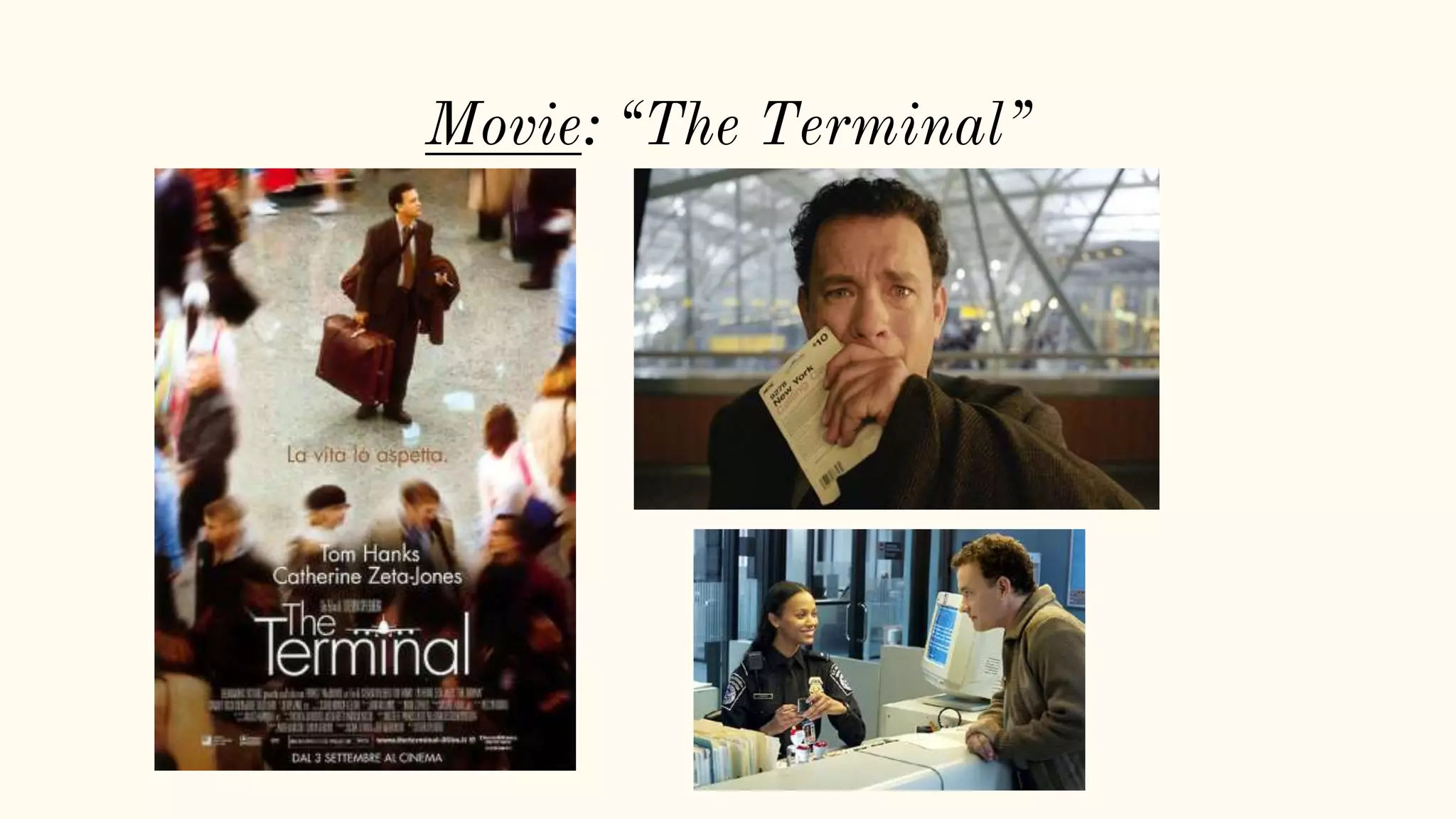
Movie: “The Terminal”
So...
Is speaking the
most difficult skill
or the easiest?
Message and medium in oral communication
“I AM HUNGRY”
LOCUTIONARY ILLOCUTIONARY
MEANING FORCES
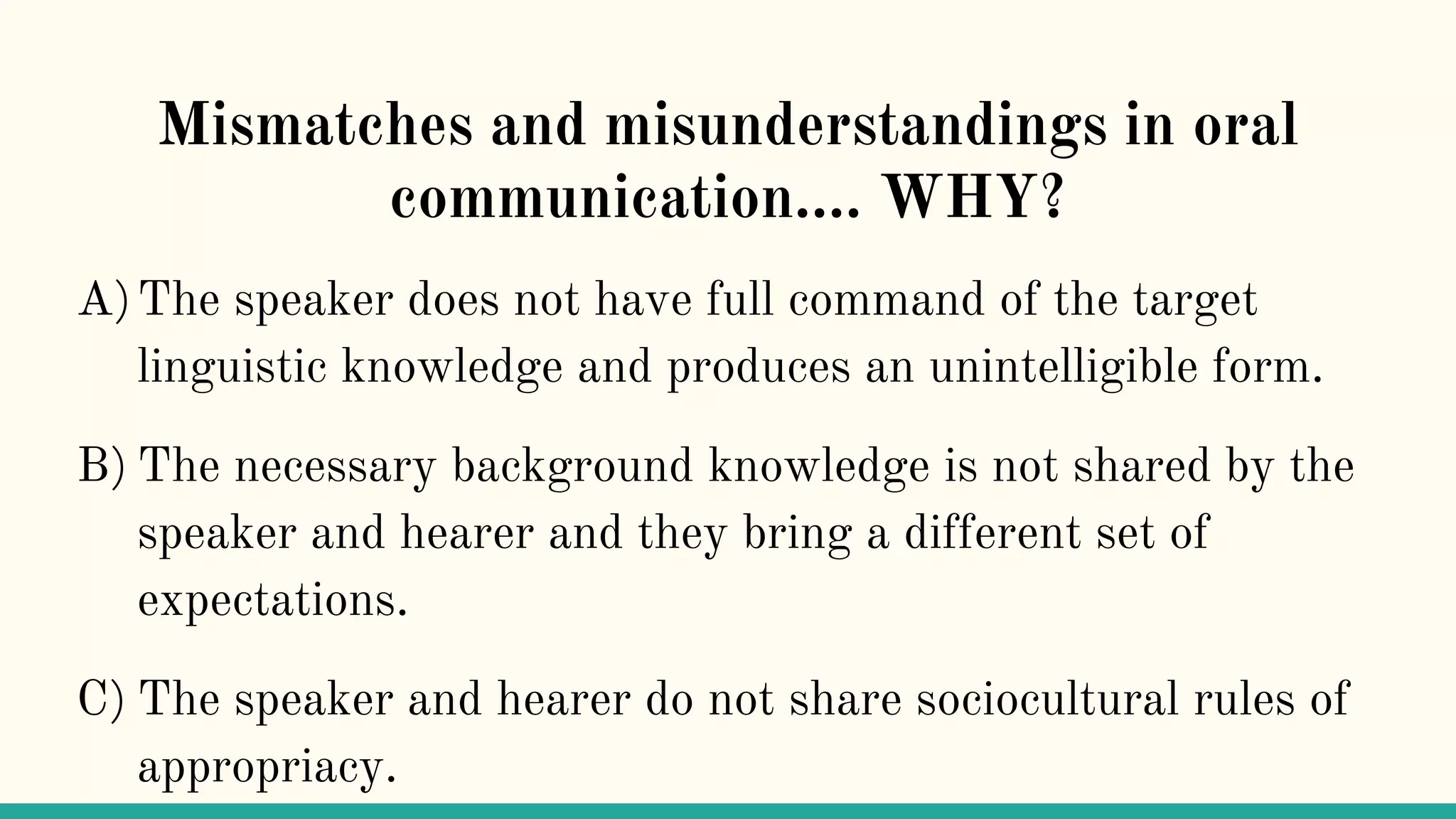
Mismatches and misunderstandings in oral
communication…. WHY?
A)The speaker does not have full command of the target
linguistic knowledge and produces an unintelligible form.
B) The necessary background knowledge is not shared by the
speaker and hearer and they bring a different set of
expectations.
C) The speaker and hearer do not share sociocultural rules of
appropriacy.
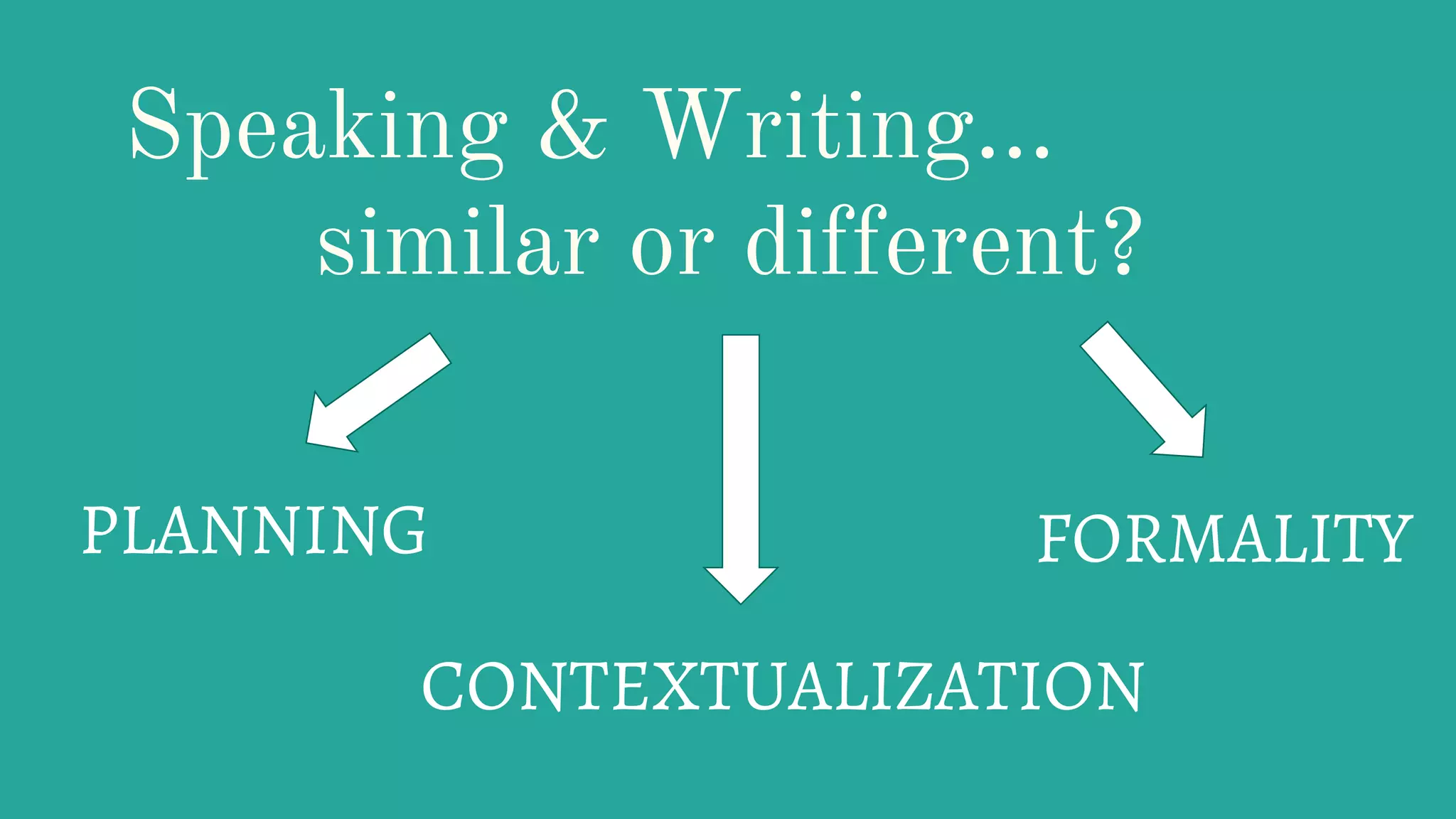
Speaking & Writing…
similar or different?
PLANNING
CONTEXTUALIZATION
FORMALITY
★ How does a speaker produce a meaningful utterance?
By the use of his grammatical competence and the relation of the utterance to the
context in which the interaction is carried out.
❖According to Levelt (1978), here are three important contextual factors in speech
production Demand
Aerousal
Feedback
Bear in mind that:
Linguistic features have an impact on successful production of spoken discourse
➔ Mastering question formation
➔ Using appropriate word order
Contextual factors and Sociocultural norms play an even more significant role in
successful interaction
➔ Using indirect representations of disagreement
Language ability needs to be combined with sociocultural considerations
Maxims of oral interaction
➔Speech act: a verbal utterance functions as a social act
“Please close the window!”
“Your work is not good enough” Illocutionary force
➔Spoken communication: the cooperative principle Speaker and
hearer construct meaning cooperatively
➔Grice(1975) suggests 4 Maxims: they apply when natural conversation
functions efficiently
Quantity - Relevance
Quality - Manner
★ The social and contextual factors play a significant role in
spoken interaction. Speakers need to be aware of sociocultural norms
such as the linguistic features from the target language.
★ Decisions and choices need to be made when a speaker intends to
communicate something in real life situations without prepared speeches.
This is one of the reasons why speaking is often seen as one of the
hardest macro skills to master in another language.
Some Prerequisites for Speaking on Another
Language.
Knowing the vocabulary relevant to the situation
Ability to use discourse connectors (well; oh; I see; okay)
Ability to use suitable “opening and closing phrases”
Ability to comprehend and use reduces forms (vowels sounds)
Knowing the syntax for producing basic clauses
Ability to use the basic intonation and tone patterns
Ability to use proper rhythm, stress and to make proper pauses
Compensatory Strategies
How learners or nonnative speakers can overcome their limitations in speaking by
adjusting or approximating the message, paraphrasing, getting help from the
native speaker.
These strategies can be developed by exposure to authentic speech and by
participating in a larger variety of oral practice activities such as spontaneous
conversations.
Common Activities for Speaking
Story-telling
Descriptions
Self-reports
Re-telling
Discussions
Participating in Oral
Interaction
Maintaining the flow of speech
· In a conversation, the roles of the speaker and the hearer switch between them
in the way that ideas are transferred.
· Turn-taking rules make possible for the speaker and hearer to change the
roles constantly and construct shared meaning.
· Members of community speech deal with exchanges by allowing overlap (if
acceptable) and pauses lengths.
· Conversation analysis attempts to describe developed sequences and the
sequential constraints, typical of the natural flow of conversation.
· Learners of a new language has to recognize and develop new rules of
behavior.
Accommodating the hearer
· The speaker needs to accommodate the hearer and facilitate the interpretation
of the spoken message. (Cooperative principle)
· The speaker needs to pay attention to body language and overall reaction.
· The speaker should attend to unexpected mishaps in exchanges, especially if
it is the initiator of a conversation.
Native and nonnative speakers
· Nonnative speakers need to expend much greater effort and exert more
attention to keep the flow of interaction.
· The learner L2 should develop strategies that will help him/her to convey
meaning in a conversation.
· Native speaker can control the conversation or he/she may use inappropriate
words which make the nonnative feel insulted.
· Speakers of L2 requires self-awareness and self-evaluation, tolerance and
accommodation.
Exchanges between native and nonnative speaker
Interaction using L1 and L2
· L1 and L2 are similar in the use of communication strategies. (Conceptual
strategies)
· The difference between native speaker and nonnative speakers is the
frequency and formulation types.
· Experiments dealing with spoken discourse.
Speaking in the Language
Classroom
- Provide students helpful and constructive FEEDBACK.
- Provide them with a specific spoken GENRE and context.
- Provide EXAMPLES of useful expressions, connectors, etc. You should use
written transcripts.
- Emphasize a succesful transmission of the MESSAGE.
- Create opportunities to integrate different SKILLS.
Conclusion:
The teaching of SPOKEN LANGUAGE un the
LANGUAGE CLASSROOM is perceived as a
very difficult task forma both the TEACHER and
the STUDENTS.
Take into consideration that:
- The teaching materials are not based on descriptions of WRITTEN ENGLISH.
- The teaching of speaking be focused on a PRAGMATIC perspective.
- Contextual and situational features of spoken interaction must become and
INTEGRAL part of classroom activities.

Choosing the linguistic features

  • 1.
    Speaking presentation by RocioSoto Valic, Erica Ledesma, Claudia Sabor, Daiana de los Santos & Evelyn Blasón Teacher: Stella Saubidet Subject: Language and Written Expression IV ISFD 18 -2017-
  • 2.
  • 3.
    So... Is speaking the mostdifficult skill or the easiest?
  • 4.
    Message and mediumin oral communication “I AM HUNGRY” LOCUTIONARY ILLOCUTIONARY MEANING FORCES
  • 5.
    Mismatches and misunderstandingsin oral communication…. WHY? A)The speaker does not have full command of the target linguistic knowledge and produces an unintelligible form. B) The necessary background knowledge is not shared by the speaker and hearer and they bring a different set of expectations. C) The speaker and hearer do not share sociocultural rules of appropriacy.
  • 6.
    Speaking & Writing… similaror different? PLANNING CONTEXTUALIZATION FORMALITY
  • 7.
    ★ How doesa speaker produce a meaningful utterance? By the use of his grammatical competence and the relation of the utterance to the context in which the interaction is carried out. ❖According to Levelt (1978), here are three important contextual factors in speech production Demand Aerousal Feedback
  • 8.
    Bear in mindthat: Linguistic features have an impact on successful production of spoken discourse ➔ Mastering question formation ➔ Using appropriate word order Contextual factors and Sociocultural norms play an even more significant role in successful interaction ➔ Using indirect representations of disagreement Language ability needs to be combined with sociocultural considerations
  • 9.
    Maxims of oralinteraction ➔Speech act: a verbal utterance functions as a social act “Please close the window!” “Your work is not good enough” Illocutionary force ➔Spoken communication: the cooperative principle Speaker and hearer construct meaning cooperatively ➔Grice(1975) suggests 4 Maxims: they apply when natural conversation functions efficiently Quantity - Relevance Quality - Manner
  • 10.
    ★ The socialand contextual factors play a significant role in spoken interaction. Speakers need to be aware of sociocultural norms such as the linguistic features from the target language. ★ Decisions and choices need to be made when a speaker intends to communicate something in real life situations without prepared speeches. This is one of the reasons why speaking is often seen as one of the hardest macro skills to master in another language.
  • 11.
    Some Prerequisites forSpeaking on Another Language. Knowing the vocabulary relevant to the situation Ability to use discourse connectors (well; oh; I see; okay) Ability to use suitable “opening and closing phrases” Ability to comprehend and use reduces forms (vowels sounds) Knowing the syntax for producing basic clauses Ability to use the basic intonation and tone patterns Ability to use proper rhythm, stress and to make proper pauses
  • 12.
    Compensatory Strategies How learnersor nonnative speakers can overcome their limitations in speaking by adjusting or approximating the message, paraphrasing, getting help from the native speaker. These strategies can be developed by exposure to authentic speech and by participating in a larger variety of oral practice activities such as spontaneous conversations.
  • 13.
    Common Activities forSpeaking Story-telling Descriptions Self-reports Re-telling Discussions
  • 14.
  • 15.
    Maintaining the flowof speech · In a conversation, the roles of the speaker and the hearer switch between them in the way that ideas are transferred. · Turn-taking rules make possible for the speaker and hearer to change the roles constantly and construct shared meaning. · Members of community speech deal with exchanges by allowing overlap (if acceptable) and pauses lengths. · Conversation analysis attempts to describe developed sequences and the sequential constraints, typical of the natural flow of conversation. · Learners of a new language has to recognize and develop new rules of behavior.
  • 16.
    Accommodating the hearer ·The speaker needs to accommodate the hearer and facilitate the interpretation of the spoken message. (Cooperative principle) · The speaker needs to pay attention to body language and overall reaction. · The speaker should attend to unexpected mishaps in exchanges, especially if it is the initiator of a conversation.
  • 17.
    Native and nonnativespeakers · Nonnative speakers need to expend much greater effort and exert more attention to keep the flow of interaction. · The learner L2 should develop strategies that will help him/her to convey meaning in a conversation. · Native speaker can control the conversation or he/she may use inappropriate words which make the nonnative feel insulted. · Speakers of L2 requires self-awareness and self-evaluation, tolerance and accommodation.
  • 18.
    Exchanges between nativeand nonnative speaker
  • 19.
    Interaction using L1and L2 · L1 and L2 are similar in the use of communication strategies. (Conceptual strategies) · The difference between native speaker and nonnative speakers is the frequency and formulation types. · Experiments dealing with spoken discourse.
  • 20.
    Speaking in theLanguage Classroom
  • 24.
    - Provide studentshelpful and constructive FEEDBACK. - Provide them with a specific spoken GENRE and context. - Provide EXAMPLES of useful expressions, connectors, etc. You should use written transcripts. - Emphasize a succesful transmission of the MESSAGE. - Create opportunities to integrate different SKILLS.
  • 25.
  • 26.
    The teaching ofSPOKEN LANGUAGE un the LANGUAGE CLASSROOM is perceived as a very difficult task forma both the TEACHER and the STUDENTS. Take into consideration that: - The teaching materials are not based on descriptions of WRITTEN ENGLISH. - The teaching of speaking be focused on a PRAGMATIC perspective. - Contextual and situational features of spoken interaction must become and INTEGRAL part of classroom activities.