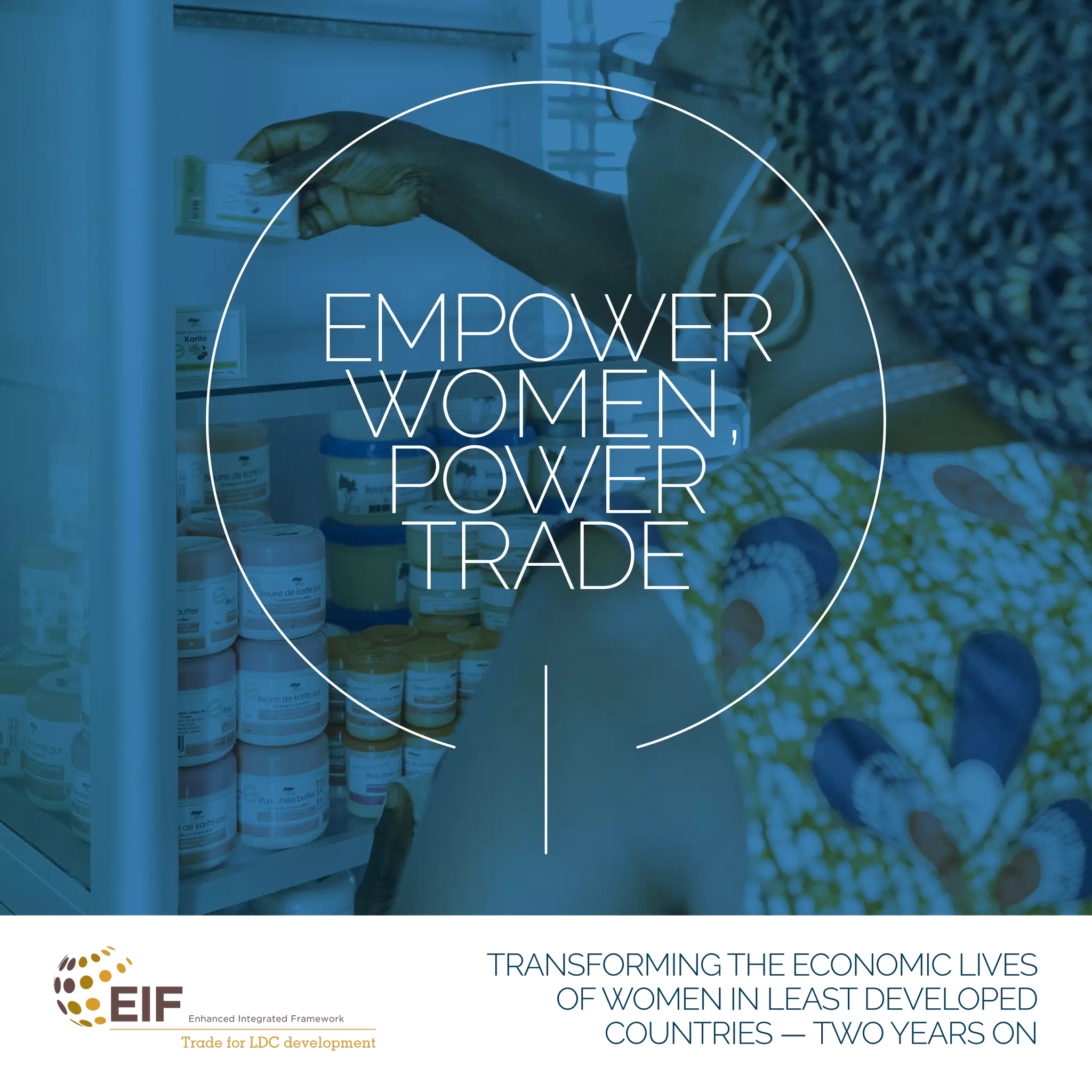
TRANSFORMING THE ECONOMIC LIVES
OFWOMEN IN LEAST DEVELOPED
COUNTRIES — TWO YEARS ON
POWER
WOMEN,
TRADE
EMPOWER
3
Launched in March 2019, the Enhanced Integrated
Framework (EIF) EMPOWER WOMEN, POWER TRADE initiative
helps to improve the policy environment, remove
barriers for women’s economic empowerment in
least developed countries (LDCs) and increase their
participation in trade.
Two years on, six projects stand under the initiative’s umbrella. The EIF
joined forces with partners on these projects, using EIF’s established
presence and connections in LDCs and leveraging the technical
expertise of partners for maximum impact.
The impacts of the initiative, however, do not limit themselves to these
six projects. Since 2019, the EIF has consciously ensured that women’s
economic empowerment is embedded in all its projects. More than
100 on-going projects now have a gender dimension. This approach
reflects the EIF’s commitment to support LDCs towards achieving
Sustainable Development Goal 5 on gender equality.
THE INITIATIVE —
TWOYEARS ON
©Ollivier Girard/EIF
ZIKORA family business.
Processing shea to produce
butter, soaps and cream.
COVID-19 IMPACTS
The roll-out of the initiative took place
during the COVID-19 pandemic. This
posed challenges but also created
opportunities for EIF's projects:
•	 In-person trainings transitioned to
virtual trainings. Projects were able
to include more participants which
means more women benefited
from them.
•	 Faced with travel restrictions,
projects turned to Train the
Trainer models which empowered
regional and national partners.
•	 For some projects, the COVID-19
pandemic only served to
emphasise the fundamental
importance of digital skill building
in women.
4
2019-2021
HIGHLIGHTS
FROM ACROSS THE EIF PROJECT PORTFOLIO
88,000 women were trained in value chain practices to grow their business
and access new markets
10,000 women adopted new technologies to increase the quantity and
quality of their products
809 women participated in trade fairs with EIF support contributing towards
more than US$400 million in export orders
17 gender sensitive trade- and investment-related policies
were developed in LDCs
75% of trade dialogues reported in 2020 included women's groups, ensuring the inclusion
of gender considerations in policy formulation and implementation processes
in co-funding leveraged for the initiative's projects
US$1M
OVER
5
EMPOWERWOMEN,
POWERTRADE PROJECTS
•	 COVID-19 recovery through digitalisation and
market access for women horticulture producers
in The Gambia with the International Trade Centre's
SheTrades Initative
•	 Promoting gender-responsive trade policy in the
LDCs with the United Nations Conference on Trade
and Development
•	 Gender Sensitive, Climate Resilient International
Market Access through Fairtrade in Timor-Leste
and Ethiopia with Fairtrade Australia and New Zealand
•	 Enhancing the Digital Ecosystem and Digital Skills
for the economic empowerment of women in LDCs
with the International Telecommunication Union
•	 Generating increased pricing and new markets for
the women engaged in the shea butter value chains
of South Sudan and Uganda with the East African
Women in Business Platform
•	 E-commerce capacity‑building for women-led micro‑,
small‑ and medium‑sized enterprises (MSMEs) in
South Asia, with the United Nations Economic and
Social Commission for Asia and the Pacific (UNESCAP)
©EIF
6
EMPOWERINGWOMEN
ONTHE GROUND...
A few examples of how Empower Women, Power Trade principles are
applied across all EIF projects and directly impacting women in LDCs.
… in Burkina Faso with the project Support for
the Competitiveness of the Shea Sector
The Network of Women Shea Butter Producers
of Hauts Bassins and Cascades has over 10,000
members. With the help of trainings and new
material, the network increased the quality and
quantity of their shea butter production. Since
2018, their total production increased from 400 to
1000 tonnes of shea butter per year. As a result,
their annual revenue is more than US$ 2 million.
These positive impacts have allowed them to
improve working conditions for their members
through renovated premises, longer employment
contracts and increased salaries. They also
created 200 jobs for young women and built
schools and wells in communities where they work.
GSA
The EIF partners with the Global Shea Alliance
on projects aiming to improve the export and
competitiveness of shea products, increase
the income of shea workers and create
jobs for women and youth. The shea sector
overwhelmingly employs women throughout its
value chain which makes it an excellent sector to
target for women’s economic empowerment.
7
… in the Gambia with the SheTrades initiative
A frequent swimmer, Ndey Fatou Njie noticed there were no locally made
swimwear in the Gambia. She found the leisurewear company Tiga in 2016,
using vibrant African colours and designs. She joined the SheTrades Gambia
initiative as a participant in 2019, learning about quality control, packaging
and labelling. This helped her company build a strong foundation and access
new markets. Now, Tiga has 11 employees and actively uses e-commerce,
attracting customers from outside the Gambia. Since the COVID-19 pandemic
started, Njie saw a business opportunity in face masks and Tiga soon started
manufacturing cloth face masks for Gambians.
ITC's SheTrades Initiative
Through the SheTrades Initiative, the EIF is working with the International
Trade Centre in the Gambia, Rwanda and Zambia to help women
entrepreneurs strengthen their businesses through trainings, connect with
other entrepreneurs and grow their markets by participating to events such
as trade fairs.
©Ollivier Girard/EIF
… in Lao PDR with the project Promotion of Export Competitiveness and
Sustainability Support to Public Private Dialogue in Northern Lao PDR
Women in Mang village in the Oudomxay province of Lao PDR have exquisite
skills in weaving and embroidery. They produce textiles and handbags
featuring traditional Laotian design. Through a project with the Lao PDR
Ministry of Industry and Commerce, they partner with the textile-focused
social enterprise Ock Pop Tok to learn how to optimize their resources and
skills. Following trainings on natural dying techniques, product costing and
marketing, they were able to sell their products at a price that reflects the
quality of their products. At the 2020 Lao Handicraft Festival in Vientiane, a
bag made from jungle vine and rattan produced by Mang village won first
prize in quality.
The EIF works with the Lao PDR Ministry of Industry and Commerce to help
women in three provinces in Northern Lao PDR to sell their products at higher
prices and access more buyers through trade fairs and partnerships with
textile companies. This contributes to increase the income of rural women
and position Lao PDR’s handicrafts in the competitive global market for ethical
and sustainably sourced, artisanal goods.
The Enhanced Integrated Framework brings together partners
and resources to support the Least Developed Countries
in using trade for poverty reduction, inclusive growth and
sustainable development.
EIF Trust Fund Donors
EIF Partner Agencies
EIF Trust Fund Manager
International Monetary Fund (IMF)
International Trade Centre (ITC)
United Nations Conference on Trade
and Development (UNCTAD)
United Nations Development
Programme (UNDP)
World Bank Group (WB)
World Trade Organization (WTO)
United Nations Industrial Development
Organization (UNIDO)
World Tourism Organization (UNWTO)
United Nations Office for Project Services (UNOPS)
Cover Image: ©Ollivier Girard/EIF
 @EIF4LDCs
 facebook.com/eif4ldcs
enhancedif.org
youtube.com/user/EIF4LDCs
 flickr.com/photos/152818923@N04/
 linkedin.com/company/11161784/
Executive Secretariat for the EIF at the WTO
Rue de Lausanne 154
CH-1211 Geneva 2
Switzerland
	 +41 (0)22 739 6650
	eif.secretariat@wto.org



empower_women_power_trade_eng_final-pages.pdf

  • 1.
    TRANSFORMING THE ECONOMICLIVES OFWOMEN IN LEAST DEVELOPED COUNTRIES — TWO YEARS ON POWER WOMEN, TRADE EMPOWER
  • 3.
    3 Launched in March2019, the Enhanced Integrated Framework (EIF) EMPOWER WOMEN, POWER TRADE initiative helps to improve the policy environment, remove barriers for women’s economic empowerment in least developed countries (LDCs) and increase their participation in trade. Two years on, six projects stand under the initiative’s umbrella. The EIF joined forces with partners on these projects, using EIF’s established presence and connections in LDCs and leveraging the technical expertise of partners for maximum impact. The impacts of the initiative, however, do not limit themselves to these six projects. Since 2019, the EIF has consciously ensured that women’s economic empowerment is embedded in all its projects. More than 100 on-going projects now have a gender dimension. This approach reflects the EIF’s commitment to support LDCs towards achieving Sustainable Development Goal 5 on gender equality. THE INITIATIVE — TWOYEARS ON ©Ollivier Girard/EIF ZIKORA family business. Processing shea to produce butter, soaps and cream. COVID-19 IMPACTS The roll-out of the initiative took place during the COVID-19 pandemic. This posed challenges but also created opportunities for EIF's projects: • In-person trainings transitioned to virtual trainings. Projects were able to include more participants which means more women benefited from them. • Faced with travel restrictions, projects turned to Train the Trainer models which empowered regional and national partners. • For some projects, the COVID-19 pandemic only served to emphasise the fundamental importance of digital skill building in women.
  • 4.
    4 2019-2021 HIGHLIGHTS FROM ACROSS THEEIF PROJECT PORTFOLIO 88,000 women were trained in value chain practices to grow their business and access new markets 10,000 women adopted new technologies to increase the quantity and quality of their products 809 women participated in trade fairs with EIF support contributing towards more than US$400 million in export orders 17 gender sensitive trade- and investment-related policies were developed in LDCs 75% of trade dialogues reported in 2020 included women's groups, ensuring the inclusion of gender considerations in policy formulation and implementation processes in co-funding leveraged for the initiative's projects US$1M OVER
  • 5.
    5 EMPOWERWOMEN, POWERTRADE PROJECTS • COVID-19recovery through digitalisation and market access for women horticulture producers in The Gambia with the International Trade Centre's SheTrades Initative • Promoting gender-responsive trade policy in the LDCs with the United Nations Conference on Trade and Development • Gender Sensitive, Climate Resilient International Market Access through Fairtrade in Timor-Leste and Ethiopia with Fairtrade Australia and New Zealand • Enhancing the Digital Ecosystem and Digital Skills for the economic empowerment of women in LDCs with the International Telecommunication Union • Generating increased pricing and new markets for the women engaged in the shea butter value chains of South Sudan and Uganda with the East African Women in Business Platform • E-commerce capacity‑building for women-led micro‑, small‑ and medium‑sized enterprises (MSMEs) in South Asia, with the United Nations Economic and Social Commission for Asia and the Pacific (UNESCAP) ©EIF
  • 6.
    6 EMPOWERINGWOMEN ONTHE GROUND... A fewexamples of how Empower Women, Power Trade principles are applied across all EIF projects and directly impacting women in LDCs. … in Burkina Faso with the project Support for the Competitiveness of the Shea Sector The Network of Women Shea Butter Producers of Hauts Bassins and Cascades has over 10,000 members. With the help of trainings and new material, the network increased the quality and quantity of their shea butter production. Since 2018, their total production increased from 400 to 1000 tonnes of shea butter per year. As a result, their annual revenue is more than US$ 2 million. These positive impacts have allowed them to improve working conditions for their members through renovated premises, longer employment contracts and increased salaries. They also created 200 jobs for young women and built schools and wells in communities where they work. GSA The EIF partners with the Global Shea Alliance on projects aiming to improve the export and competitiveness of shea products, increase the income of shea workers and create jobs for women and youth. The shea sector overwhelmingly employs women throughout its value chain which makes it an excellent sector to target for women’s economic empowerment.
  • 7.
    7 … in theGambia with the SheTrades initiative A frequent swimmer, Ndey Fatou Njie noticed there were no locally made swimwear in the Gambia. She found the leisurewear company Tiga in 2016, using vibrant African colours and designs. She joined the SheTrades Gambia initiative as a participant in 2019, learning about quality control, packaging and labelling. This helped her company build a strong foundation and access new markets. Now, Tiga has 11 employees and actively uses e-commerce, attracting customers from outside the Gambia. Since the COVID-19 pandemic started, Njie saw a business opportunity in face masks and Tiga soon started manufacturing cloth face masks for Gambians. ITC's SheTrades Initiative Through the SheTrades Initiative, the EIF is working with the International Trade Centre in the Gambia, Rwanda and Zambia to help women entrepreneurs strengthen their businesses through trainings, connect with other entrepreneurs and grow their markets by participating to events such as trade fairs. ©Ollivier Girard/EIF … in Lao PDR with the project Promotion of Export Competitiveness and Sustainability Support to Public Private Dialogue in Northern Lao PDR Women in Mang village in the Oudomxay province of Lao PDR have exquisite skills in weaving and embroidery. They produce textiles and handbags featuring traditional Laotian design. Through a project with the Lao PDR Ministry of Industry and Commerce, they partner with the textile-focused social enterprise Ock Pop Tok to learn how to optimize their resources and skills. Following trainings on natural dying techniques, product costing and marketing, they were able to sell their products at a price that reflects the quality of their products. At the 2020 Lao Handicraft Festival in Vientiane, a bag made from jungle vine and rattan produced by Mang village won first prize in quality. The EIF works with the Lao PDR Ministry of Industry and Commerce to help women in three provinces in Northern Lao PDR to sell their products at higher prices and access more buyers through trade fairs and partnerships with textile companies. This contributes to increase the income of rural women and position Lao PDR’s handicrafts in the competitive global market for ethical and sustainably sourced, artisanal goods.
  • 8.
    The Enhanced IntegratedFramework brings together partners and resources to support the Least Developed Countries in using trade for poverty reduction, inclusive growth and sustainable development. EIF Trust Fund Donors EIF Partner Agencies EIF Trust Fund Manager International Monetary Fund (IMF) International Trade Centre (ITC) United Nations Conference on Trade and Development (UNCTAD) United Nations Development Programme (UNDP) World Bank Group (WB) World Trade Organization (WTO) United Nations Industrial Development Organization (UNIDO) World Tourism Organization (UNWTO) United Nations Office for Project Services (UNOPS) Cover Image: ©Ollivier Girard/EIF  @EIF4LDCs  facebook.com/eif4ldcs enhancedif.org youtube.com/user/EIF4LDCs  flickr.com/photos/152818923@N04/  linkedin.com/company/11161784/ Executive Secretariat for the EIF at the WTO Rue de Lausanne 154 CH-1211 Geneva 2 Switzerland +41 (0)22 739 6650 eif.secretariat@wto.org  