#AfriCommerce
WHAT’S TRADING IN
French-speaking Africa?
From EIF and partners, where trade support
to least developed countries is going —
and where it’s needed
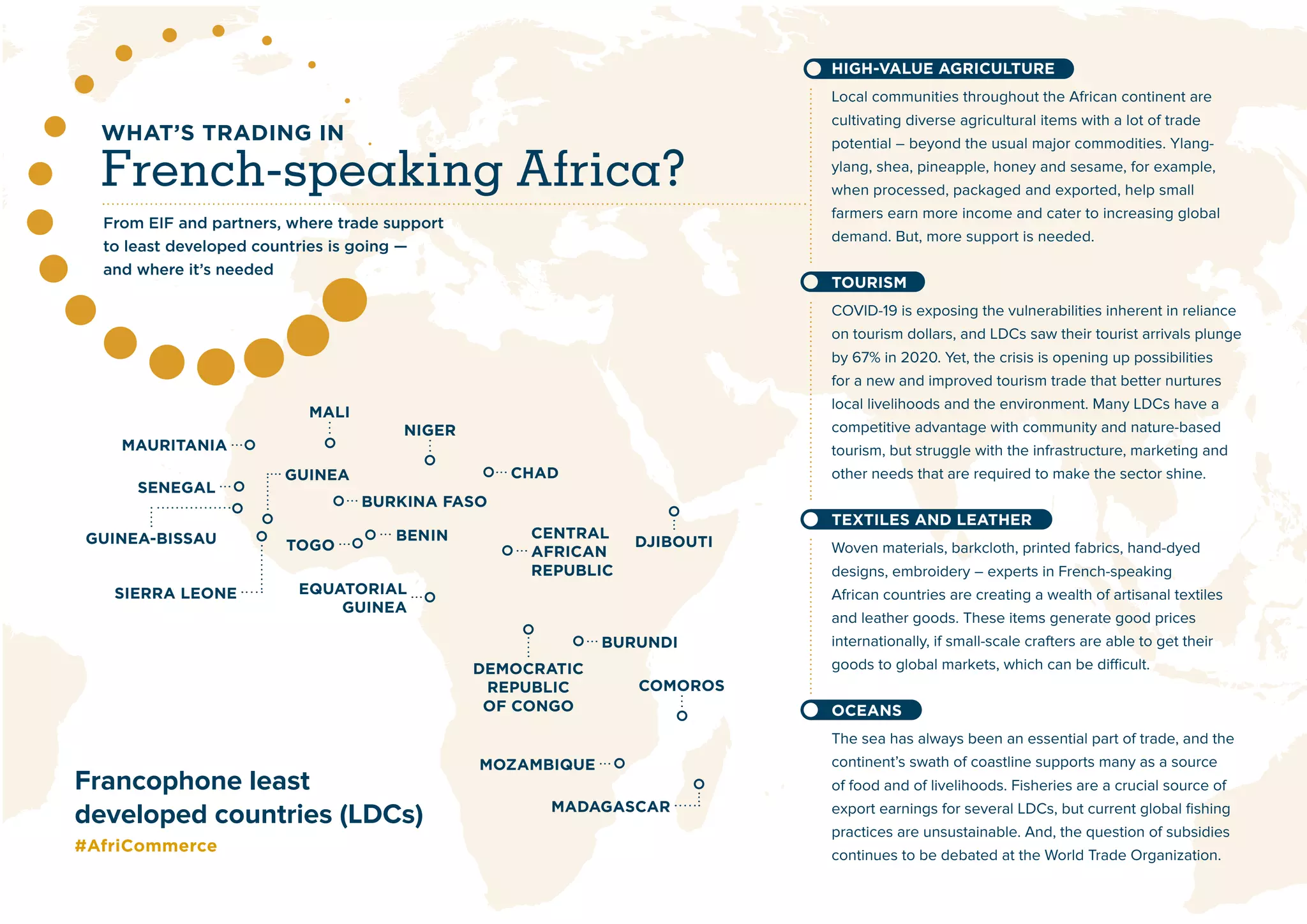
Francophone least
developed countries (LDCs)
HIGH-VALUE AGRICULTURE
Local communities throughout the African continent are
cultivating diverse agricultural items with a lot of trade
potential – beyond the usual major commodities. Ylang-
ylang, shea, pineapple, honey and sesame, for example,
when processed, packaged and exported, help small
farmers earn more income and cater to increasing global
demand. But, more support is needed.
TOURISM
COVID-19 is exposing the vulnerabilities inherent in reliance
on tourism dollars, and LDCs saw their tourist arrivals plunge
by 67% in 2020. Yet, the crisis is opening up possibilities
for a new and improved tourism trade that better nurtures
local livelihoods and the environment. Many LDCs have a
competitive advantage with community and nature-based
tourism, but struggle with the infrastructure, marketing and
other needs that are required to make the sector shine.
TEXTILES AND LEATHER
Woven materials, barkcloth, printed fabrics, hand-dyed
designs, embroidery – experts in French-speaking
African countries are creating a wealth of artisanal textiles
and leather goods. These items generate good prices
internationally, if small-scale crafters are able to get their
goods to global markets, which can be difficult.
OCEANS
The sea has always been an essential part of trade, and the
continent’s swath of coastline supports many as a source
of food and of livelihoods. Fisheries are a crucial source of
export earnings for several LDCs, but current global fishing
practices are unsustainable. And, the question of subsidies
continues to be debated at the World Trade Organization.
BENIN
SENEGAL
BURKINA FASO
CENTRAL
AFRICAN
REPUBLIC
EQUATORIAL
GUINEA
MOZAMBIQUE
TOGO
GUINEA
GUINEA-BISSAU
BURUNDI
MADAGASCAR
DEMOCRATIC
REPUBLIC
OF CONGO
DJIBOUTI
NIGER
MALI
SIERRA LEONE
COMOROS
CHAD
MAURITANIA
US$43.1 million
Agriculture
US$3.7 million
Textiles and leather
BURUNDI
Aiming to address the trade imbalance and reduce poverty,
the country is working with development partners to boost
certain sectors with export potential. One of these is honey,
and EIF has played a big role, through the financing provided,
in getting Burundi beekeeping from a peripheral practice
to a profit-making enterprise. This includes helping to train
beekeepers with the Federation of Beekeepers of Bubanza,
who were given 200 modern beehives alongside other
needed equipment, and they are now producing 7,000 more
kilograms of honey per year. With 1 kg of honey worth 5,000
BIF (approximately US$2.50), the new hives are generating
about US$100 in additional income per beekeeper per year.
Burundi honey is also reaching new export markets in the
Democratic Republic of Congo, Japan, Kenya and Tanzania
following EIF-supported trainings for small honey businesses
in processing, packaging and marketing. And, assistance was
provided to obtain export permits – setting the stage for even
more buyers and markets.
CHAD
The country has one of the largest cattle populations
in Africa, and therefore could sell a lot of leather. But
leather production, and the creation of sandals and
other value-added products, is largely informal and
limited, and it is therefore difficult to establish export
markets. Support from EIF and the International Trade
Centre (ITC) is helping Chad to leverage leather as a
resource, having trained local craftspeople in shoe
design and production, created links with an Italian
leather association and worked with butcheries
and tanneries so raw materials are of better quality.
Recently, a tannery for artisans producing handmade
items was established in Dourbali, individuals involved
in the hides and skins sector formed their own
association, and a guide to working with leather was
developed and used to train 61 tannery workers in best
practices and standards, and 30 how to optimally treat
hides and skins.
81+9+7+3S
EIF FUNDING IN
FRANCOPHONE AFRICA
TOTAL
US$52.8 MILLION
US$1.5 million
Fisheries
US$4.5 million
Tourism
©Olliver Girard • EIF
TOGO
The Togolese shea sector produces 20,000-25,000
tons of kernels per year, but this could be scaled up
considerably, as could the profits of rural women who
collect shea nuts, extract the kernels and produce
shea butter. Groups such as the Global Shea Alliance
(GSA) are leading initiatives to improve the sector by
harnessing the power of cooperatives and improving
the infrastructure for the shea trade. Alongside
partners like EIF, recent efforts have resulted in the
building of 13 warehouses with a combined capacity of
1,300 tons. Having storage facilities helps cooperatives
aggregate their harvests, and women can earn 30-
50% more as a result. Enhancements like this along
the value chain, including from trainings, making links
to markets and providing pre-financing, helps to bring
more income to the rural people who need it most.
SENEGAL
Exporters of tropical fruits need to meet international
standards, including maximum residue limits for
pesticides, to effectively trade. The Standards
and Trade Development Facility worked with the
Government of Senegal to conduct pesticide residue
studies that helped to identify new, lower-risk options
to control pests affecting mango production, and to
improve compliance with standards and open up
new markets. In 2015, EIF started working to support
standards compliance, providing trainings to farmers
in harvesting methods and techniques to combat
mango pests, so the fruit can access outside markets.
In recently years, the country has become the second
most important West African source of mangoes after
Côte d’Ivoire, but more support to roll out improved
crop protection tools and build laboratory capacity will
improve human health and facilitate trade, as well as
helping to protect the environment.
GUINEA-BISSAU
Guinea-Bissau's waters are believed to be one of the
wealthiest biodiversity zones in West Africa, home to
an estimated one million tons of fisheries resources.
The fisheries sector, consisting of both industrial and
artisanal fishing, is a big contributor to the economy
and food security. But the declining availability of
fish is impacting those working at smaller scales
especially hard. Most fisheries actors in Guinea-Bissau
work via sailboats without motors, and live with much
income uncertainty. A new EIF project is looking to
help formalize the sector, by organizing the scattered
fishermen so they are better able to access support
and improve their practices, including reducing post-
harvest fish losses.
DJIBOUTI
Tourism is a priority sector in Djibouti’s strategy for
economic development, “Djibouti Vision 2035”. The
country has been working with EIF since 2017 to
improve their tourism offerings and create more visibility
for Djibouti as a destination. This includes teaching
English to taxi drivers, tour guides and other front-facing
tourism workers, and identifying locations with potential
as UNESCO heritage sites. The country pivoted when
the pandemic struck, marketing domestic tourism and
continuing to work to develop the sector while waiting
for international tourists to return.
©Olliver Girard • EIF
©Mali • EIF
©Olliver Girard • EIF
WEST AFRICA
Trade in the region has not achieved its full potential. Most activity is highly
local, with countries exporting mining commodities like oil and minerals,
agricultural items, textiles and fisheries products. But this has so far been
insufficient in reducing poverty levels and generating needed development.
Striving to spur more trade competitiveness in West Africa, ITC’s SheTrades
initiative, EIF and institutions like the GSA, and the West Africa Trade 
Investment Hub are working to develop important value chains. The SheTrades
West Africa project in Côte d’Ivoire, Guinea, Liberia and Sierra Leone, funded
by the Korea International Cooperation Agency, is aiming to improve the
livelihoods of 10,000 women working in the cashew, cassava and shea sectors.
The project is working directly with SMEs and women farmers in the four
countries to improve product quality, create new links to markets and generate
more profits. With a strong gender transformative approach, SheTrades West
Africa works closely with business support organizations and the private sector
to increase access to trainings, needed materials like seeds and fertilizers,
and market information for women farmers and SMEs, and to address gender
imbalances across the value chain. EIF and the GSA’s work in the region with
shea has a strong focus on women, as they are the primary collectors of shea
kernels and processors of shea butter.
enhancedif.org
Executive Secretariat for the EIF at the WTO
Rue de Lausanne
154 CH-1211 Geneva 2
Switzerland
+41 (0)22 739 6650
eif.secretariat@wto.org
facebook.com/eif4ldcs
@EIF4LDCs
The Enhanced Integrated Framework brings together
partners and resources to support the Least Developed
Countries in using trade for poverty reduction,
inclusive growth and sustainable development.

trade_in_french-speaking_africa_flyer (1).pdf

  • 1.
    #AfriCommerce WHAT’S TRADING IN French-speakingAfrica? From EIF and partners, where trade support to least developed countries is going — and where it’s needed Francophone least developed countries (LDCs) HIGH-VALUE AGRICULTURE Local communities throughout the African continent are cultivating diverse agricultural items with a lot of trade potential – beyond the usual major commodities. Ylang- ylang, shea, pineapple, honey and sesame, for example, when processed, packaged and exported, help small farmers earn more income and cater to increasing global demand. But, more support is needed. TOURISM COVID-19 is exposing the vulnerabilities inherent in reliance on tourism dollars, and LDCs saw their tourist arrivals plunge by 67% in 2020. Yet, the crisis is opening up possibilities for a new and improved tourism trade that better nurtures local livelihoods and the environment. Many LDCs have a competitive advantage with community and nature-based tourism, but struggle with the infrastructure, marketing and other needs that are required to make the sector shine. TEXTILES AND LEATHER Woven materials, barkcloth, printed fabrics, hand-dyed designs, embroidery – experts in French-speaking African countries are creating a wealth of artisanal textiles and leather goods. These items generate good prices internationally, if small-scale crafters are able to get their goods to global markets, which can be difficult. OCEANS The sea has always been an essential part of trade, and the continent’s swath of coastline supports many as a source of food and of livelihoods. Fisheries are a crucial source of export earnings for several LDCs, but current global fishing practices are unsustainable. And, the question of subsidies continues to be debated at the World Trade Organization. BENIN SENEGAL BURKINA FASO CENTRAL AFRICAN REPUBLIC EQUATORIAL GUINEA MOZAMBIQUE TOGO GUINEA GUINEA-BISSAU BURUNDI MADAGASCAR DEMOCRATIC REPUBLIC OF CONGO DJIBOUTI NIGER MALI SIERRA LEONE COMOROS CHAD MAURITANIA
  • 2.
    US$43.1 million Agriculture US$3.7 million Textilesand leather BURUNDI Aiming to address the trade imbalance and reduce poverty, the country is working with development partners to boost certain sectors with export potential. One of these is honey, and EIF has played a big role, through the financing provided, in getting Burundi beekeeping from a peripheral practice to a profit-making enterprise. This includes helping to train beekeepers with the Federation of Beekeepers of Bubanza, who were given 200 modern beehives alongside other needed equipment, and they are now producing 7,000 more kilograms of honey per year. With 1 kg of honey worth 5,000 BIF (approximately US$2.50), the new hives are generating about US$100 in additional income per beekeeper per year. Burundi honey is also reaching new export markets in the Democratic Republic of Congo, Japan, Kenya and Tanzania following EIF-supported trainings for small honey businesses in processing, packaging and marketing. And, assistance was provided to obtain export permits – setting the stage for even more buyers and markets. CHAD The country has one of the largest cattle populations in Africa, and therefore could sell a lot of leather. But leather production, and the creation of sandals and other value-added products, is largely informal and limited, and it is therefore difficult to establish export markets. Support from EIF and the International Trade Centre (ITC) is helping Chad to leverage leather as a resource, having trained local craftspeople in shoe design and production, created links with an Italian leather association and worked with butcheries and tanneries so raw materials are of better quality. Recently, a tannery for artisans producing handmade items was established in Dourbali, individuals involved in the hides and skins sector formed their own association, and a guide to working with leather was developed and used to train 61 tannery workers in best practices and standards, and 30 how to optimally treat hides and skins. 81+9+7+3S EIF FUNDING IN FRANCOPHONE AFRICA TOTAL US$52.8 MILLION US$1.5 million Fisheries US$4.5 million Tourism ©Olliver Girard • EIF
  • 3.
    TOGO The Togolese sheasector produces 20,000-25,000 tons of kernels per year, but this could be scaled up considerably, as could the profits of rural women who collect shea nuts, extract the kernels and produce shea butter. Groups such as the Global Shea Alliance (GSA) are leading initiatives to improve the sector by harnessing the power of cooperatives and improving the infrastructure for the shea trade. Alongside partners like EIF, recent efforts have resulted in the building of 13 warehouses with a combined capacity of 1,300 tons. Having storage facilities helps cooperatives aggregate their harvests, and women can earn 30- 50% more as a result. Enhancements like this along the value chain, including from trainings, making links to markets and providing pre-financing, helps to bring more income to the rural people who need it most. SENEGAL Exporters of tropical fruits need to meet international standards, including maximum residue limits for pesticides, to effectively trade. The Standards and Trade Development Facility worked with the Government of Senegal to conduct pesticide residue studies that helped to identify new, lower-risk options to control pests affecting mango production, and to improve compliance with standards and open up new markets. In 2015, EIF started working to support standards compliance, providing trainings to farmers in harvesting methods and techniques to combat mango pests, so the fruit can access outside markets. In recently years, the country has become the second most important West African source of mangoes after Côte d’Ivoire, but more support to roll out improved crop protection tools and build laboratory capacity will improve human health and facilitate trade, as well as helping to protect the environment. GUINEA-BISSAU Guinea-Bissau's waters are believed to be one of the wealthiest biodiversity zones in West Africa, home to an estimated one million tons of fisheries resources. The fisheries sector, consisting of both industrial and artisanal fishing, is a big contributor to the economy and food security. But the declining availability of fish is impacting those working at smaller scales especially hard. Most fisheries actors in Guinea-Bissau work via sailboats without motors, and live with much income uncertainty. A new EIF project is looking to help formalize the sector, by organizing the scattered fishermen so they are better able to access support and improve their practices, including reducing post- harvest fish losses. DJIBOUTI Tourism is a priority sector in Djibouti’s strategy for economic development, “Djibouti Vision 2035”. The country has been working with EIF since 2017 to improve their tourism offerings and create more visibility for Djibouti as a destination. This includes teaching English to taxi drivers, tour guides and other front-facing tourism workers, and identifying locations with potential as UNESCO heritage sites. The country pivoted when the pandemic struck, marketing domestic tourism and continuing to work to develop the sector while waiting for international tourists to return. ©Olliver Girard • EIF ©Mali • EIF
  • 4.
    ©Olliver Girard •EIF WEST AFRICA Trade in the region has not achieved its full potential. Most activity is highly local, with countries exporting mining commodities like oil and minerals, agricultural items, textiles and fisheries products. But this has so far been insufficient in reducing poverty levels and generating needed development. Striving to spur more trade competitiveness in West Africa, ITC’s SheTrades initiative, EIF and institutions like the GSA, and the West Africa Trade Investment Hub are working to develop important value chains. The SheTrades West Africa project in Côte d’Ivoire, Guinea, Liberia and Sierra Leone, funded by the Korea International Cooperation Agency, is aiming to improve the livelihoods of 10,000 women working in the cashew, cassava and shea sectors. The project is working directly with SMEs and women farmers in the four countries to improve product quality, create new links to markets and generate more profits. With a strong gender transformative approach, SheTrades West Africa works closely with business support organizations and the private sector to increase access to trainings, needed materials like seeds and fertilizers, and market information for women farmers and SMEs, and to address gender imbalances across the value chain. EIF and the GSA’s work in the region with shea has a strong focus on women, as they are the primary collectors of shea kernels and processors of shea butter. enhancedif.org Executive Secretariat for the EIF at the WTO Rue de Lausanne 154 CH-1211 Geneva 2 Switzerland +41 (0)22 739 6650 eif.secretariat@wto.org facebook.com/eif4ldcs @EIF4LDCs The Enhanced Integrated Framework brings together partners and resources to support the Least Developed Countries in using trade for poverty reduction, inclusive growth and sustainable development.