SUBJECT TEACHER;
 Respected Sir,
Umair Masood Memon
Khalil ur Rehman dawar
L-14CE-55
Topic to be present;
QuickSand
condtions in soil
Quick sand condition or boiling
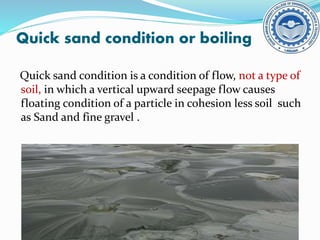
Quick sand condition is a condition of flow, not a type of
soil, in which a vertical upward seepage flow causes
floating condition of a particle in cohesion less soil such
as Sand and fine gravel .
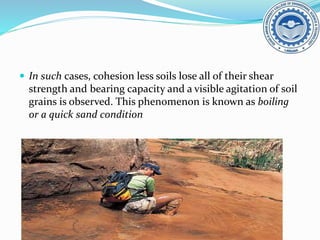
 In such cases, cohesion less soils lose all of their shear
strength and bearing capacity and a visible agitation of soil
grains is observed. This phenomenon is known as boiling
or a quick sand condition
When occur such condition ..?
 When seepage flow takes place in an upward direction, the
seepage pressure also acts in the upwards direction and the
effective pressure is reduced.
 There is also a pressure in downward direction due to
submerged weight of soil.
 If seepage pressure becomes equal to the pressure due to
submerged weight of soil, the effective pressure is reduced
to zero.
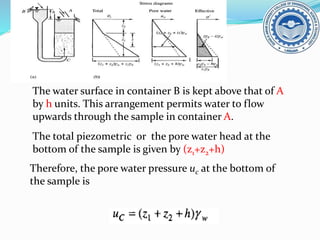
The water surface in container B is kept above that of A
by h units. This arrangement permits water to flow
upwards through the sample in container A.
The total piezometric or the pore water head at the
bottom of the sample is given by (z1+z2+h)
Therefore, the pore water pressure uc at the bottom of
the sample is
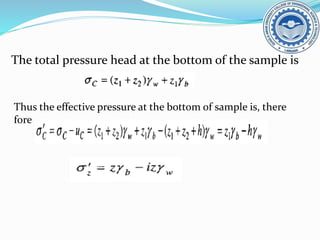
The total pressure head at the bottom of the sample is
Thus the effective pressure at the bottom of sample is, there
fore
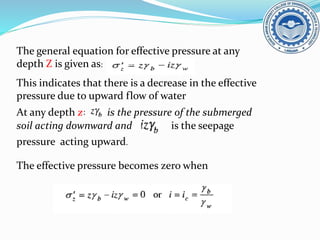
The general equation for effective pressure at any
depth Z is given as:
This indicates that there is a decrease in the effective
pressure due to upward flow of water
At any depth z: is the pressure of the submerged
soil acting downward and is the seepage
pressure acting upward.
The effective pressure becomes zero when
It indicates that the effective pressure reduces to
zero when the hydraulic gradient attains a
maximum value which is equal to the ratio of the
submerged unit weight of soil and the unit weight
of water.
This gradient is known as the critical hydraulic
gradient ic.
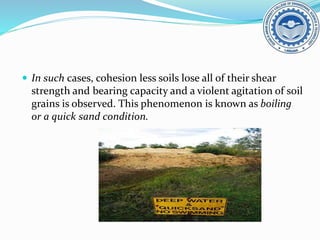
 In such cases, cohesion less soils lose all of their shear
strength and bearing capacity and a violent agitation of soil
grains is observed. This phenomenon is known as boiling
or a quick sand condition.
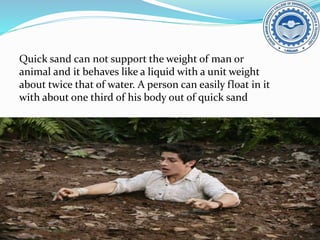
Quick sand can not support the weight of man or
animal and it behaves like a liquid with a unit weight
about twice that of water. A person can easily float in it
with about one third of his body out of quick sand
Why quick sand condition not
occurs in cohesive soil and in
gravel soil …?
In clays the shear strength of soil does not get
reduced to zero even when the effective stress
becomes zero, due to its cohesion. Hence,
quicksand condition does not occur in clays
As the pressure of the escaping water exceeds
the weight of the soil and the sand grains are
forced apart. The result is that the sandu soil
has no capability to support the load.
BUT
Pebbles or gravelly soils cannot have because it
has to exceed the self weight than those of
escaping water weights.
Quick sand condation

Quick sand condation

  • 2.
    SUBJECT TEACHER;  RespectedSir, Umair Masood Memon
  • 3.
    Khalil ur Rehmandawar L-14CE-55
  • 4.
    Topic to bepresent; QuickSand condtions in soil
  • 5.
    Quick sand conditionor boiling Quick sand condition is a condition of flow, not a type of soil, in which a vertical upward seepage flow causes floating condition of a particle in cohesion less soil such as Sand and fine gravel .
  • 6.
     In suchcases, cohesion less soils lose all of their shear strength and bearing capacity and a visible agitation of soil grains is observed. This phenomenon is known as boiling or a quick sand condition
  • 7.
    When occur suchcondition ..?  When seepage flow takes place in an upward direction, the seepage pressure also acts in the upwards direction and the effective pressure is reduced.  There is also a pressure in downward direction due to submerged weight of soil.  If seepage pressure becomes equal to the pressure due to submerged weight of soil, the effective pressure is reduced to zero.
  • 8.
    The water surfacein container B is kept above that of A by h units. This arrangement permits water to flow upwards through the sample in container A. The total piezometric or the pore water head at the bottom of the sample is given by (z1+z2+h) Therefore, the pore water pressure uc at the bottom of the sample is
  • 9.
    The total pressurehead at the bottom of the sample is Thus the effective pressure at the bottom of sample is, there fore
  • 10.
    The general equationfor effective pressure at any depth Z is given as: This indicates that there is a decrease in the effective pressure due to upward flow of water At any depth z: is the pressure of the submerged soil acting downward and is the seepage pressure acting upward. The effective pressure becomes zero when
  • 11.
    It indicates thatthe effective pressure reduces to zero when the hydraulic gradient attains a maximum value which is equal to the ratio of the submerged unit weight of soil and the unit weight of water. This gradient is known as the critical hydraulic gradient ic.
  • 12.
     In suchcases, cohesion less soils lose all of their shear strength and bearing capacity and a violent agitation of soil grains is observed. This phenomenon is known as boiling or a quick sand condition.
  • 13.
    Quick sand cannot support the weight of man or animal and it behaves like a liquid with a unit weight about twice that of water. A person can easily float in it with about one third of his body out of quick sand
  • 14.
    Why quick sandcondition not occurs in cohesive soil and in gravel soil …?
  • 15.
    In clays theshear strength of soil does not get reduced to zero even when the effective stress becomes zero, due to its cohesion. Hence, quicksand condition does not occur in clays
  • 16.
    As the pressureof the escaping water exceeds the weight of the soil and the sand grains are forced apart. The result is that the sandu soil has no capability to support the load. BUT Pebbles or gravelly soils cannot have because it has to exceed the self weight than those of escaping water weights.