Blockchain &
The Hollywood
Supply Chain
The Entertainment Technology Center
vNAB Innovation Conference
Steve Wong, Director of Business Development
March 20, 2017
Goal of today:
Confidential 2
Start a conversation about the possibilities for Blockchain in Hollywood.
Who in the audience knows the term Blockchain?
Confidential 3
Has anyone in the audience done a transaction paying with bitcoin?
Confidential 4
Is anyone a Bitcoin miner in the audience?
Confidential 5
What the Internet did for information,
Blockchain will do for transactions
Confidential 6
“Blockchain allows for one Internet user to transfer a
unique piece of digital property to another Internet user
such that the transfer is guaranteed to be safe and
secure... The consequences of this breakthrough are
hard to overstate.”
Confidential 7
- Marc L. Andreessen, Co-founder Andreessen Horowitz & HPE Board of Directors
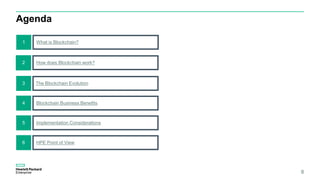
Agenda
8
2
3
5 Implementation Considerations
6 HPE Point of View
4 Blockchain Business Benefits
1 What is Blockchain?
The Blockchain Evolution
2 How does Blockchain work?
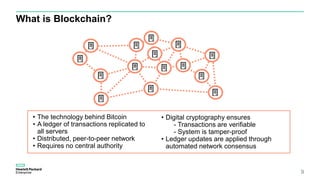
What is Blockchain?
9
• The technology behind Bitcoin
• A ledger of transactions replicated to
all servers
• Distributed, peer-to-peer network
• Requires no central authority
• Digital cryptography ensures
- Transactions are verifiable
- System is tamper-proof
• Ledger updates are applied through
automated network consensus
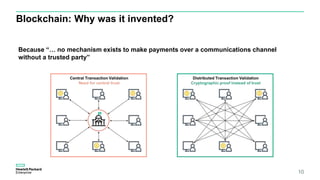
Blockchain: Why was it invented?
10
Because “… no mechanism exists to make payments over a communications channel
without a trusted party”
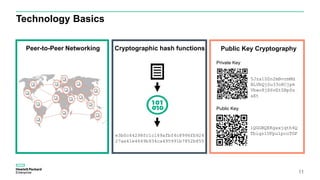
Technology Basics
11
Public Key Cryptography
1QGGBQEKgxxjqth4Q
Tbiqz1UFpu1pcoTGF
Public Key
Private Key
5Jza1DZn2mBvrmMd
BLVbQjSu33oKCjpk
Vbwo8jX6vEtZBpSs
aEt
Peer-to-Peer Networking Cryptographic hash functions
e3b0c44298fc1c149afbf4c8996fb924
27ae41e4649b934ca495991b7852b855
How does Blockchain work?
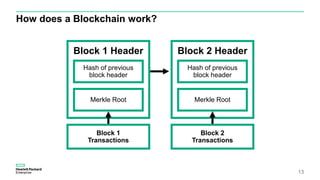
Block 1 Header
Hash of previous
block header
Merkle Root
Block 1
Transactions
Block 2 Header
Hash of previous
block header
Merkle Root
Block 2
Transactions
How does a Blockchain work?
13
Where is Blockchain right now?
Confidential 14
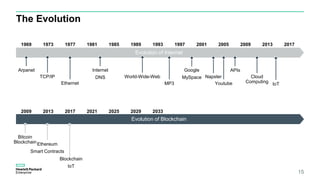
The Evolution
Evolution of Internet
Arpanet
15
TCP/IP
1969 20171973 1977 1981 1985 1989 1993 1997 2001 2005 2009 2013
Ethernet
Internet
DNS World-Wide-Web
MP3
Google
MySpace Napster
Youtube
APIs
Cloud
Computing
IoT
Evolution of Blockchain
2009 2013 2017 2021 2025 2029 2033
Bitcoin
BlockchainEthereum
Smart Contracts
Blockchain
IoT
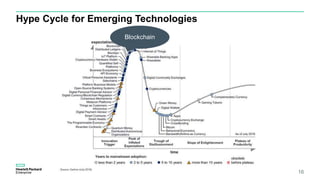
Hype Cycle for Emerging Technologies
16
Blockchain
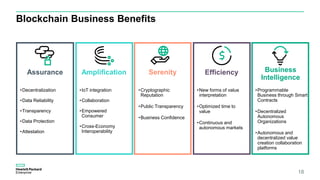
Blockchain Business Benefits
18
Efficiency
•Decentralization
•Data Reliability
•Transparency
•Data Protection
•Attestation
•IoT integration
•Collaboration
•Empowered
Consumer
•Cross-Economy
Interoperability
•Cryptographic
Reputation
•Public Transparency
•Business Confidence
•New forms of value
interpretation
•Optimized time to
value
•Continuous and
autonomous markets
Assurance Amplification Serenity Business
Intelligence
•Programmable
Business through Smart
Contracts
•Decentralized
Autonomous
Organizations
•Autonomous and
decentralized value
creation collaboration
platforms
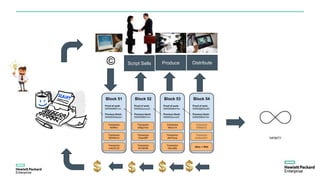
Script Sells Produce Distribute
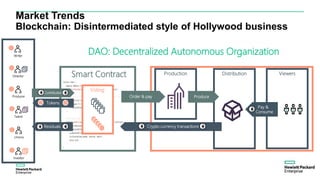
Market Trends
Blockchain: Disintermediated style of Hollywood business
Investor
Unions
Writer
Talent
Producer
Director Smart Contract
Voting
Production Distribution
Produce
Crypto currency transactions
Viewers
Contribution
Tokens
Residuals
Order & pay
Pay &
Consume
DAO: Decentralized Autonomous Organization
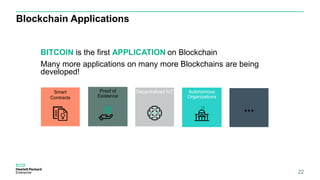
Blockchain Applications
BITCOIN is the first APPLICATION on Blockchain
Many more applications on many more Blockchains are being
developed!
Proof of
Existence
Decentralized IoT Autonomous
Organizations
...
Smart
Contracts
22
Blockchain Implementation
Considerations
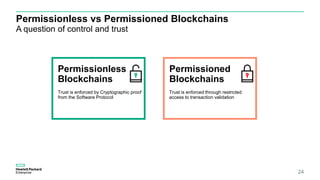
Permissionless vs Permissioned Blockchains
A question of control and trust
Permissionless
Blockchains
Trust is enforced by Cryptographic proof
from the Software Protocol
Permissioned
Blockchains
Trust is enforced through restricted
access to transaction validation
24
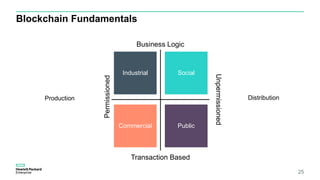
Blockchain Fundamentals
25
Industrial
Commercial
Social
Public
Business Logic
Transaction Based
Permissioned
Unpermissioned
Production Distribution
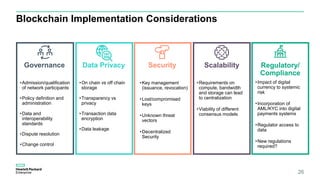
Blockchain Implementation Considerations
26
Scalability
•Admission/qualification
of network participants
•Policy definition and
administration
•Data and
interoperability
standards
•Dispute resolution
•Change control
•On chain vs off chain
storage
•Transparency vs
privacy
•Transaction data
encryption
•Data leakage
•Key management
(issuance, revocation)
•Lost/compromised
keys
•Unknown threat
vectors
•Decentralized
Security
•Requirements on
compute, bandwidth
and storage can lead
to centralization
•Viability of different
consensus models
Governance Data Privacy Security Regulatory/
Compliance
•Impact of digital
currency to systemic
risk
•Incorporation of
AML/KYC into digital
payments systems
•Regulator access to
data
•New regulations
required?
HPE Point of View
Confidential 27
Node n
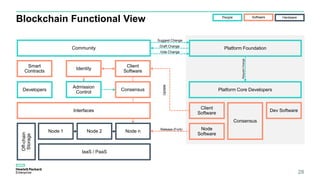
Blockchain Functional View
28
IaaS / PaaS
Node 2
Client
Software
Platform Foundation
Platform Core Developers
Node 1
Admission
Control
Community
Identity
Node
Software
Dev Software
Consensus
Client
Software
Suggest Change
Draft Change
Vote Change
RequestChange
Release (Fork)
Update
Smart
Contracts
Developers
People Software Hardware
Consensus
Off-chain
Storage
Interfaces
Thank you for your time!
Steve Wong, Director of Business Development
Steve.Wong@hpe.com @SteveWongLA

BLOCKCHAIN & THE HOLLYWOOD SUPPLY CHAIN

  • 1.
    Blockchain & The Hollywood SupplyChain The Entertainment Technology Center vNAB Innovation Conference Steve Wong, Director of Business Development March 20, 2017
  • 2.
    Goal of today: Confidential2 Start a conversation about the possibilities for Blockchain in Hollywood.
  • 3.
    Who in theaudience knows the term Blockchain? Confidential 3
  • 4.
    Has anyone inthe audience done a transaction paying with bitcoin? Confidential 4
  • 5.
    Is anyone aBitcoin miner in the audience? Confidential 5
  • 6.
    What the Internetdid for information, Blockchain will do for transactions Confidential 6
  • 7.
    “Blockchain allows forone Internet user to transfer a unique piece of digital property to another Internet user such that the transfer is guaranteed to be safe and secure... The consequences of this breakthrough are hard to overstate.” Confidential 7 - Marc L. Andreessen, Co-founder Andreessen Horowitz & HPE Board of Directors
  • 8.
    Agenda 8 2 3 5 Implementation Considerations 6HPE Point of View 4 Blockchain Business Benefits 1 What is Blockchain? The Blockchain Evolution 2 How does Blockchain work?
  • 9.
    What is Blockchain? 9 •The technology behind Bitcoin • A ledger of transactions replicated to all servers • Distributed, peer-to-peer network • Requires no central authority • Digital cryptography ensures - Transactions are verifiable - System is tamper-proof • Ledger updates are applied through automated network consensus
  • 10.
    Blockchain: Why wasit invented? 10 Because “… no mechanism exists to make payments over a communications channel without a trusted party”
  • 11.
    Technology Basics 11 Public KeyCryptography 1QGGBQEKgxxjqth4Q Tbiqz1UFpu1pcoTGF Public Key Private Key 5Jza1DZn2mBvrmMd BLVbQjSu33oKCjpk Vbwo8jX6vEtZBpSs aEt Peer-to-Peer Networking Cryptographic hash functions e3b0c44298fc1c149afbf4c8996fb924 27ae41e4649b934ca495991b7852b855
  • 12.
  • 13.
    Block 1 Header Hashof previous block header Merkle Root Block 1 Transactions Block 2 Header Hash of previous block header Merkle Root Block 2 Transactions How does a Blockchain work? 13
  • 14.
    Where is Blockchainright now? Confidential 14
  • 15.
    The Evolution Evolution ofInternet Arpanet 15 TCP/IP 1969 20171973 1977 1981 1985 1989 1993 1997 2001 2005 2009 2013 Ethernet Internet DNS World-Wide-Web MP3 Google MySpace Napster Youtube APIs Cloud Computing IoT Evolution of Blockchain 2009 2013 2017 2021 2025 2029 2033 Bitcoin BlockchainEthereum Smart Contracts Blockchain IoT
  • 16.
    Hype Cycle forEmerging Technologies 16 Blockchain
  • 17.
  • 18.
    Blockchain Business Benefits 18 Efficiency •Decentralization •DataReliability •Transparency •Data Protection •Attestation •IoT integration •Collaboration •Empowered Consumer •Cross-Economy Interoperability •Cryptographic Reputation •Public Transparency •Business Confidence •New forms of value interpretation •Optimized time to value •Continuous and autonomous markets Assurance Amplification Serenity Business Intelligence •Programmable Business through Smart Contracts •Decentralized Autonomous Organizations •Autonomous and decentralized value creation collaboration platforms
  • 19.
  • 20.
    Market Trends Blockchain: Disintermediatedstyle of Hollywood business Investor Unions Writer Talent Producer Director Smart Contract Voting Production Distribution Produce Crypto currency transactions Viewers Contribution Tokens Residuals Order & pay Pay & Consume DAO: Decentralized Autonomous Organization
  • 21.
  • 22.
    Blockchain Applications BITCOIN isthe first APPLICATION on Blockchain Many more applications on many more Blockchains are being developed! Proof of Existence Decentralized IoT Autonomous Organizations ... Smart Contracts 22
  • 23.
  • 24.
    Permissionless vs PermissionedBlockchains A question of control and trust Permissionless Blockchains Trust is enforced by Cryptographic proof from the Software Protocol Permissioned Blockchains Trust is enforced through restricted access to transaction validation 24
  • 25.
  • 26.
    Blockchain Implementation Considerations 26 Scalability •Admission/qualification ofnetwork participants •Policy definition and administration •Data and interoperability standards •Dispute resolution •Change control •On chain vs off chain storage •Transparency vs privacy •Transaction data encryption •Data leakage •Key management (issuance, revocation) •Lost/compromised keys •Unknown threat vectors •Decentralized Security •Requirements on compute, bandwidth and storage can lead to centralization •Viability of different consensus models Governance Data Privacy Security Regulatory/ Compliance •Impact of digital currency to systemic risk •Incorporation of AML/KYC into digital payments systems •Regulator access to data •New regulations required?
  • 27.
    HPE Point ofView Confidential 27
  • 28.
    Node n Blockchain FunctionalView 28 IaaS / PaaS Node 2 Client Software Platform Foundation Platform Core Developers Node 1 Admission Control Community Identity Node Software Dev Software Consensus Client Software Suggest Change Draft Change Vote Change RequestChange Release (Fork) Update Smart Contracts Developers People Software Hardware Consensus Off-chain Storage Interfaces
  • 29.
    Thank you foryour time! Steve Wong, Director of Business Development Steve.Wong@hpe.com @SteveWongLA

Editor's Notes

  • #10 Blockchain is the underlying technology platform behind Bitcoin. Bitcoin is a digital currency that permits real-time value transfer between participants. Valid transactions are immediate and irreversible. It should be made clear however, that Bitcoin and blockchain are two separate things. Bitcoin is the digital currency that is enabled by blockchain, which is a technology platform. As such blockchain can be applied to other business applications. Blockchain is a Peer-to-peer computer network that shares a Ledger of Valid Network Transactions. It is organized as a chronological chain of valid blocks, where every Network Peer holds a full copy of the same ledger. Therefore every Network Peer holds the same complete Network Transaction History. Valid Network Transactions are aggregated into logical Blocks. Valid Blocks are chronologically linked together. Invalid Blocks are being discarded. The great innovation in Blockchain is a Mechanism to reach Network Consensus in a Peer to Peer Network about what Blocks are valid and which ones are not. The Blockchain provides proof of who owns what at any given time.
  • #11 Why is traditionally a trusted third party needed in a payment transaction? And the answer is: To enforce trust in a transaction -> meaning: To make sure, that the sender does not spend what the sender does not own: The so called Double Spend problem. And the only way to enforce trust in a transaction (until Blockchain) was through a trusted third party. Central Transaction Validation Systems enforce trust through restricted access to a transaction validation entity, lets say a Bank. Under this model, and because of the nature of self-interest, the more people or entities that have access to transaction validation, the greater the risk to the network. Self interest is a threat. Rules for people and entities with access to transaction validation are defined and enforced by regulators. A Distributed Transaction Validation System uses the opposite model: It is open for everyone to directly send and validate transactions. No trust in a validating third party is needed because trust is enforced through a cryptographic proof mechanism embedded within a software. Because of game-theoretical incentive-mechanisms, self-interest is the basis of security. For every network participant, it is financially more attractive to play by the rules, meaning correctly validating transactions, than to cheat the system. Distributed Transaction Validation Systems rely on the pursuit of self-interest in order to secure the network, because it is exponentially harder to attack a distributed network the bigger it gets. Blockchain is the underlying technology platform behind Bitcoin. Bitcoin is a digital currency that permits real-time value transfer between participants. Valid transactions are immediate and irreversible. It should be made clear however, that Bitcoin and blockchain are two separate things. Bitcoin is the digital currency that is enabled by blockchain, which is a technology platform. As such blockchain can be applied to other business applications. Blockchain is a Peer-to-peer computer network that shares a Ledger of Valid Network Transactions. It is organized as a chronological chain of valid blocks, where every Network Peer holds a full copy of the same ledger. Therefore every Network Peer holds the same complete Network Transaction History. Valid Network Transactions are aggregated into logical Blocks. Valid Blocks are chronologically linked together. Invalid Blocks are being discarded. The great innovation in Blockchain is a Mechanism to reach Network Consensus in a Peer to Peer Network about what Blocks are valid and which ones are not. The Blockchain provides proof of who owns what at any given time.
  • #14  At the beginning of Bitcoin, every person who wanted to participate in the network had to operate a network node. This is different now. Service Providers (so called Exchanges or Wallet Providers) offer these Services so that People who want to join the Network do not have to operate a Network Node any more. For the purpose of this presentation, lets assume that every Network Participant operates a Network Node. Every Network Node holds a full copy of the Blockchain. Therefore EVERYBODY knows the transaction history of every bitcoin in circulation. It is like a USD Note where every Person that had the Note in possession had to sign it. The Bitcoin Blockchain provides public accessible proof of who owns what at any given time. The Magazine “economist” called the Bitcoin Blockchain it a 2015 release “the truth machine”.
  • #23 Bitcoin the Currency was the first Application on the Blockchain. What could be other applications on the Blockchain? Because no trust is needed between transacting entities, Permissionless Blockchains enable humans, organizations or things to directely communicate and transact with one another. Therefore any business construct where trust in form of an intermediary is implemented, is a possible application. In this respect, Permissionless Blockchains are disintermediating technologies that eliminate friction in value exchange over the internet. Permissionless Blockchains replaces middlemen Therefore new Business Models, Process and workflows, Self Executing Contracts or even Decentralized Autonomous Organizations are possible Applications.
  • #25 After Bitcoin, other Blockchains have emerged. Blockchains can now be classified in Permissioned and Permissionless Blockchains. The difference between the both is a philosophical one, namely, what person or entity has the right to validate transacions within the network. Permissioned Blockchains are more like Transaction Validation Networks, where access to Transaction Validation, Insight and Control is limited to Trusted Participants. Trust is enforced by limiting access to the Network. Permissioned Blockchains are currently under development by an Industry & Banking Consortuim in order to improve and speed up internal processes like Clearinghouse or Settlement. Permissionless Blockchains in contrast are truely open and distributed Transaction Validation Networks. Open means, open for everyone to participate, open for everyone to validate transactions and open to have insight and control over the complete transaction history of the Network. No trusted third parties are needed. Trust is enforced through Cryptography by the Blockchains Software Protocol. Permissionless Blockchains have in common, that they need an Internal Unit of Account, a Network Token to incentivice for transaction verification efforts.