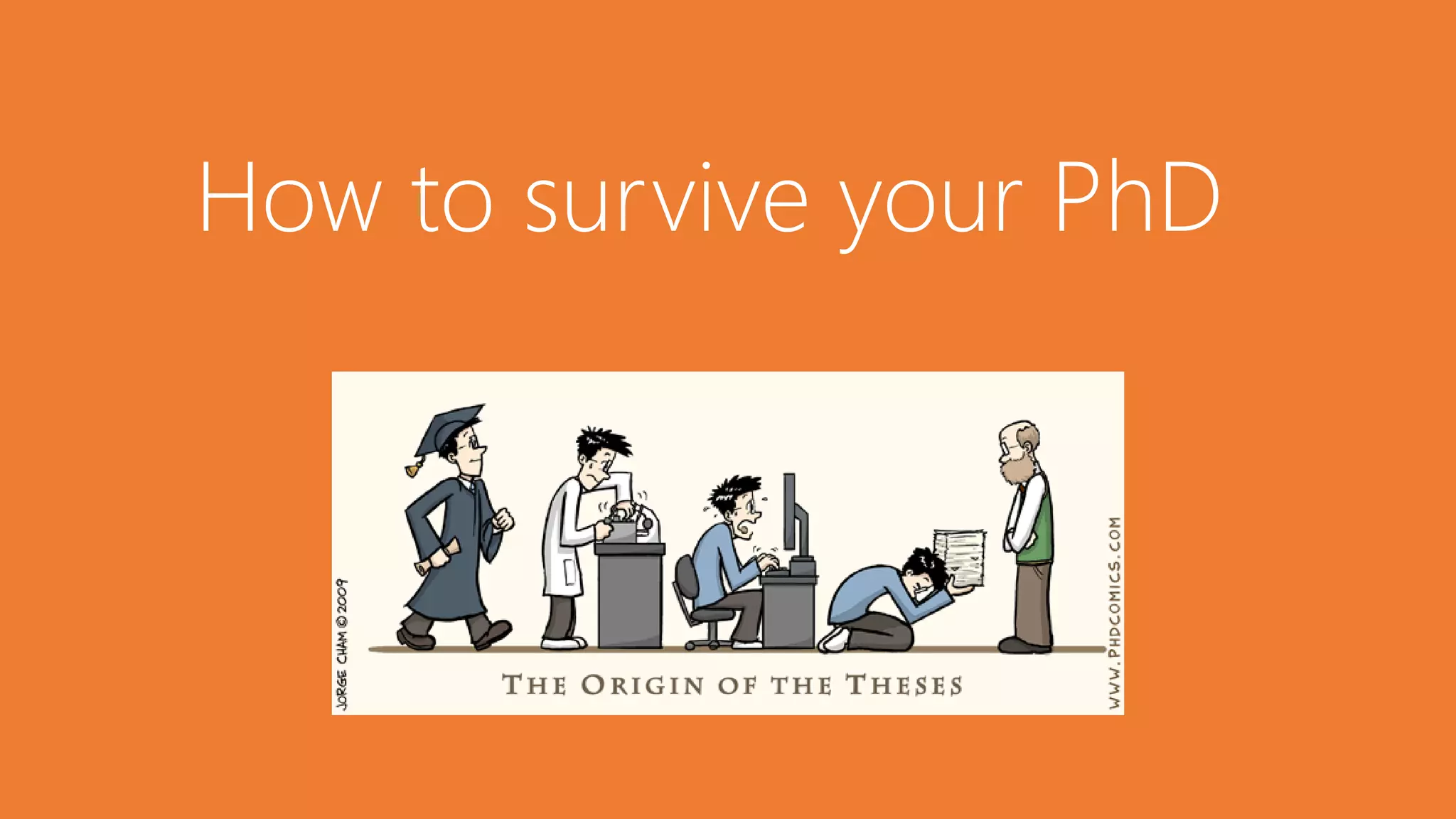
How to survive your PhD
Tips and triks
Record:
Male: 2:20:56 (1996)
Female: 2:38:22 (2001)
Midnight sun
marathon
Our marathon
• 1980-1981: 42 %
• 2002-2003: 76 %
• Average race time: 5.5 years
• Lately possibly less: 5.1 years (class of 2011)
Start Defence
What is a PhD? / Who are you?
• Research?
• You are a scientist
• Original, extensive, autonomous/limited assistance?
• Creative
• Training, “school”?
• You are a student
• Original, but not necessarily groundbreaking
• Organized, not creative?
• Skill development for future career
• Learning within a research community
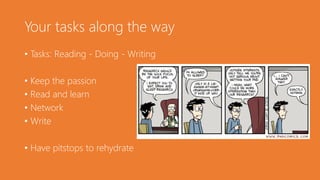
Your tasks along the way
• Tasks: Reading - Doing - Writing
• Keep the passion
• Read and learn
• Network
• Write
• Have pitstops to rehydrate
You - Key academic skills
• Review and discover your
research field
• Write, write, write and publish
• Practice presenting your work
• Complete courses
• Help yourself by loving statistics
• Good tools:
• Make a system with litterature:
Endnote with PDFs
• New litterature:
Google Alerts
• Use time to illustrate your
work: Figures and power point
• …..
You - Key personal skills
• Perseverance
• Self motivation
• Stay sane!
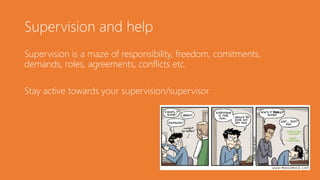
Supervision and help
Supervision is a maze of responsibility, freedom, comitments,
demands, roles, agreements, conflicts etc.
Stay active towards your supervision/supervisor
Who/what is your supervisor?
• Administrator
• Academic advisor
• Personal relation
• What does s/he want? Motivation of the supervisor.
• Importance of the research group
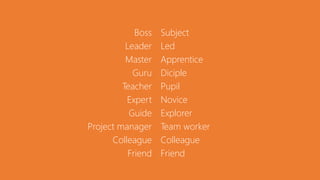
Boss
Leader
Master
Guru
Teacher
Expert
Guide
Project manager
Colleague
Friend
Subject
Led
Apprentice
Diciple
Pupil
Novice
Explorer
Team worker
Colleague
Friend
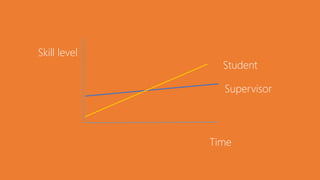
Skill level
Time
Student
Supervisor
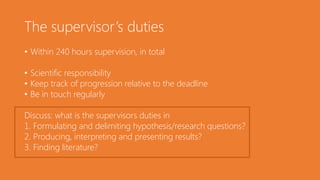
The supervisor’s duties
• Within 240 hours supervision, in total
• Scientific responsibility
• Keep track of progression relative to the deadline
• Be in touch regularly
Discuss: what is the supervisors duties in
1. Formulating and delimiting hypothesis/research questions?
2. Producing, interpreting and presenting results?
3. Finding literature?
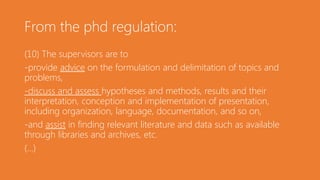
From the phd regulation:
(10) The supervisors are to
-provide advice on the formulation and delimitation of topics and
problems,
-discuss and assess hypotheses and methods, results and their
interpretation, conception and implementation of presentation,
including organization, language, documentation, and so on,
-and assist in finding relevant literature and data such as available
through libraries and archives, etc.
(...)
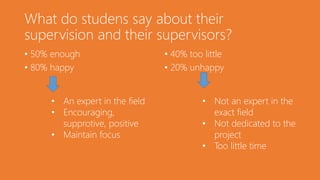
What do studens say about their
supervision and their supervisors?
• 50% enough
• 80% happy
• 40% too little
• 20% unhappy
• Not an expert in the
exact field
• Not dedicated to the
project
• Too little time
• An expert in the field
• Encouraging,
supprotive, positive
• Maintain focus
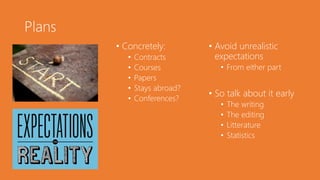
Plans
• Concretely:
• Contracts
• Courses
• Papers
• Stays abroad?
• Conferences?
• Avoid unrealistic
expectations
• From either part
• So talk about it early
• The writing
• The editing
• Litterature
• Statistics
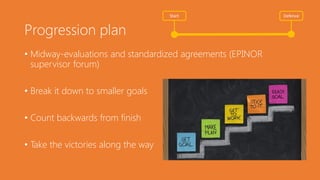
Progression plan
• Midway-evaluations and standardized agreements (EPINOR
supervisor forum)
• Break it down to smaller goals
• Count backwards from finish
• Take the victories along the way
Start Defence
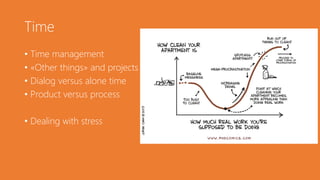
Time
• Time management
• «Other things» and projects
• Dialog versus alone time
• Product versus process
• Dealing with stress
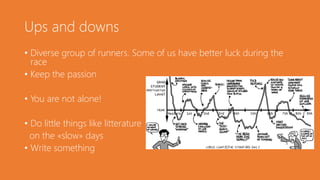
Ups and downs
• Diverse group of runners. Some of us have better luck during the
race
• Keep the passion
• You are not alone!
• Do little things like litterature
on the «slow» days
• Write something
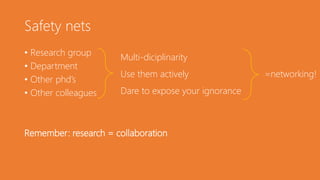
Safety nets
• Research group
• Department
• Other phd’s
• Other colleagues
Remember: research = collaboration
Multi-diciplinarity
Use them actively =networking!
Dare to expose your ignorance
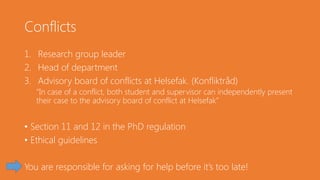
Conflicts
1. Research group leader
2. Head of department
3. Advisory board of conflicts at Helsefak. (Konfliktråd)
“In case of a conflict, both student and supervisor can independently present
their case to the advisory board of conflict at Helsefak”
• Section 11 and 12 in the PhD regulation
• Ethical guidelines
You are responsible for asking for help before it’s too late!
The thesis
• Start early thinking of the disposition of the thesis and collect
background material
• Tip: Left over documents
• Keep thinking of the finishing line
• Ref: Bent-Martin
Some advice
• Use a progression report actively
• Expose your ignorance (quote:
Eiliv Lund), ask for help=
networking
• Involve others early in problems
• Act proffesionally and do not
lash out in e-mails
• You are your own project
manager
• Think constructively and self-
motivate
• You are privileged to have time
to focus
If it was easy, anyone could do it
KEEP PUSHING

Presentation EPINOR-lunsj

  • 1.
    How to surviveyour PhD Tips and triks
  • 2.
    Record: Male: 2:20:56 (1996) Female:2:38:22 (2001) Midnight sun marathon
  • 3.
    Our marathon • 1980-1981:42 % • 2002-2003: 76 % • Average race time: 5.5 years • Lately possibly less: 5.1 years (class of 2011) Start Defence
  • 4.
    What is aPhD? / Who are you? • Research? • You are a scientist • Original, extensive, autonomous/limited assistance? • Creative • Training, “school”? • You are a student • Original, but not necessarily groundbreaking • Organized, not creative? • Skill development for future career • Learning within a research community
  • 5.
    Your tasks alongthe way • Tasks: Reading - Doing - Writing • Keep the passion • Read and learn • Network • Write • Have pitstops to rehydrate
  • 6.
    You - Keyacademic skills • Review and discover your research field • Write, write, write and publish • Practice presenting your work • Complete courses • Help yourself by loving statistics • Good tools: • Make a system with litterature: Endnote with PDFs • New litterature: Google Alerts • Use time to illustrate your work: Figures and power point • …..
  • 7.
    You - Keypersonal skills • Perseverance • Self motivation • Stay sane!
  • 8.
    Supervision and help Supervisionis a maze of responsibility, freedom, comitments, demands, roles, agreements, conflicts etc. Stay active towards your supervision/supervisor
  • 9.
    Who/what is yoursupervisor? • Administrator • Academic advisor • Personal relation • What does s/he want? Motivation of the supervisor. • Importance of the research group
  • 10.
  • 11.
  • 12.
    The supervisor’s duties •Within 240 hours supervision, in total • Scientific responsibility • Keep track of progression relative to the deadline • Be in touch regularly Discuss: what is the supervisors duties in 1. Formulating and delimiting hypothesis/research questions? 2. Producing, interpreting and presenting results? 3. Finding literature?
  • 13.
    From the phdregulation: (10) The supervisors are to -provide advice on the formulation and delimitation of topics and problems, -discuss and assess hypotheses and methods, results and their interpretation, conception and implementation of presentation, including organization, language, documentation, and so on, -and assist in finding relevant literature and data such as available through libraries and archives, etc. (...)
  • 14.
    What do studenssay about their supervision and their supervisors? • 50% enough • 80% happy • 40% too little • 20% unhappy • Not an expert in the exact field • Not dedicated to the project • Too little time • An expert in the field • Encouraging, supprotive, positive • Maintain focus
  • 15.
    Plans • Concretely: • Contracts •Courses • Papers • Stays abroad? • Conferences? • Avoid unrealistic expectations • From either part • So talk about it early • The writing • The editing • Litterature • Statistics
  • 16.
    Progression plan • Midway-evaluationsand standardized agreements (EPINOR supervisor forum) • Break it down to smaller goals • Count backwards from finish • Take the victories along the way Start Defence
  • 17.
    Time • Time management •«Other things» and projects • Dialog versus alone time • Product versus process • Dealing with stress
  • 18.
    Ups and downs •Diverse group of runners. Some of us have better luck during the race • Keep the passion • You are not alone! • Do little things like litterature on the «slow» days • Write something
  • 19.
    Safety nets • Researchgroup • Department • Other phd’s • Other colleagues Remember: research = collaboration Multi-diciplinarity Use them actively =networking! Dare to expose your ignorance
  • 20.
    Conflicts 1. Research groupleader 2. Head of department 3. Advisory board of conflicts at Helsefak. (Konfliktråd) “In case of a conflict, both student and supervisor can independently present their case to the advisory board of conflict at Helsefak” • Section 11 and 12 in the PhD regulation • Ethical guidelines You are responsible for asking for help before it’s too late!
  • 21.
    The thesis • Startearly thinking of the disposition of the thesis and collect background material • Tip: Left over documents • Keep thinking of the finishing line • Ref: Bent-Martin
  • 22.
    Some advice • Usea progression report actively • Expose your ignorance (quote: Eiliv Lund), ask for help= networking • Involve others early in problems • Act proffesionally and do not lash out in e-mails • You are your own project manager • Think constructively and self- motivate • You are privileged to have time to focus
  • 23.
    If it waseasy, anyone could do it KEEP PUSHING