ROUND TABLE
Design webinar week
Thursday 18th April 2019
Tiberio Feliz Murias (UNED)
HOW DOES EACH EXAMPLE FROM
WEDNESDAY RELATE TO THE QA
FRAMEWORK?
• International framework
• Supranational interests
• Participatory for institutions and companies external
to the university
• External evaluation for funding
• Plurality of cultures and legislations
• Seeking cohesion and progress
WHAT IS THE ROLE OF EXTERNAL
STAKEHOLDERS IN THE MOOC DESIGN
PROCESS?
• Experience
• Competence
• Transfer
• Professionalism
WHAT ARE THE OPPORTUNITIES FOR
GAMIFICATION IN MOOCS? (1)
• Macrolevel (stakeholders and international institutions)
• Management
• Openness
• Transfer
• Mesolevel (HEI)
• Management
• Innovation
• Transfer
• Microlevel (Specific MOOCs)
WHAT ARE THE OPPORTUNITIES FOR
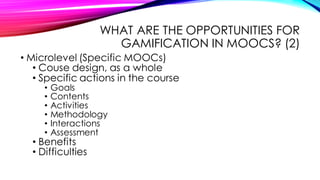
GAMIFICATION IN MOOCS? (2)
• Microlevel (Specific MOOCs)
• Couse design, as a whole
• Specific actions in the course
• Goals
• Contents
• Activities
• Methodology
• Interactions
• Assessment
• Benefits
• Difficulties
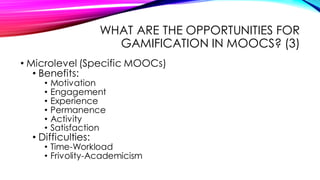
WHAT ARE THE OPPORTUNITIES FOR
GAMIFICATION IN MOOCS? (3)
• Microlevel (Specific MOOCs)
• Benefits:
• Motivation
• Engagement
• Experience
• Permanence
• Activity
• Satisfaction
• Difficulties:
• Time-Workload
• Frivolity-Academicism
SHOULD WE ALWAYS DESIGN FOR
COLLABORATION / SOCIAL
LEARNING? [PATRICIA & ANA]
• We have to consider different:
• Personality traits: sociability
• Learning styles: impulsive or reflective
• Available time
• Type of task
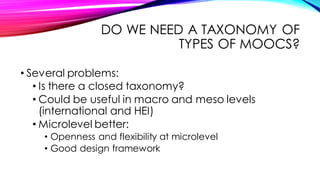
DO WE NEED A TAXONOMY OF
TYPES OF MOOCS?
• Several problems:
• Is there a closed taxonomy?
• Could be useful in macro and meso levels
(international and HEI)
• Microlevel better:
• Openness and flexibility at microlevel
• Good design framework
See
you!

Roundtable Design webinar week

  • 1.
    ROUND TABLE Design webinarweek Thursday 18th April 2019 Tiberio Feliz Murias (UNED)
  • 2.
    HOW DOES EACHEXAMPLE FROM WEDNESDAY RELATE TO THE QA FRAMEWORK? • International framework • Supranational interests • Participatory for institutions and companies external to the university • External evaluation for funding • Plurality of cultures and legislations • Seeking cohesion and progress
  • 3.
    WHAT IS THEROLE OF EXTERNAL STAKEHOLDERS IN THE MOOC DESIGN PROCESS? • Experience • Competence • Transfer • Professionalism
  • 4.
    WHAT ARE THEOPPORTUNITIES FOR GAMIFICATION IN MOOCS? (1) • Macrolevel (stakeholders and international institutions) • Management • Openness • Transfer • Mesolevel (HEI) • Management • Innovation • Transfer • Microlevel (Specific MOOCs)
  • 5.
    WHAT ARE THEOPPORTUNITIES FOR GAMIFICATION IN MOOCS? (2) • Microlevel (Specific MOOCs) • Couse design, as a whole • Specific actions in the course • Goals • Contents • Activities • Methodology • Interactions • Assessment • Benefits • Difficulties
  • 6.
    WHAT ARE THEOPPORTUNITIES FOR GAMIFICATION IN MOOCS? (3) • Microlevel (Specific MOOCs) • Benefits: • Motivation • Engagement • Experience • Permanence • Activity • Satisfaction • Difficulties: • Time-Workload • Frivolity-Academicism
  • 7.
    SHOULD WE ALWAYSDESIGN FOR COLLABORATION / SOCIAL LEARNING? [PATRICIA & ANA] • We have to consider different: • Personality traits: sociability • Learning styles: impulsive or reflective • Available time • Type of task
  • 8.
    DO WE NEEDA TAXONOMY OF TYPES OF MOOCS? • Several problems: • Is there a closed taxonomy? • Could be useful in macro and meso levels (international and HEI) • Microlevel better: • Openness and flexibility at microlevel • Good design framework
  • 9.