Joint curricula and integrated mobility:
Master’s Degree Programme in Comparative
Social Policy and Welfare (COSOPO)
Eveliina Permi
Study specialist
Faculty of Social Sciences
Tampere University
Building the joint programme
• Originally three partner universities: Tampere University TAU (Finland), Johannes Kepler
University Linz (Austria), Mykolas Romeris University (Lithuania).
• Co-operation started as Erasmus teacher exchange.
• Erasmus curriculum development funding in 2006 for building the joint curriculum and for the
development of on-line learning.
• First cohort of students started their studies in 2008, admission every second year.
• Erasmus Intensive programme funding to cover the costs of the physical mobility.
Possibility to receive a double degree
18.6.2020 | 2
18.6.2020 | 3
• From autumn 2020 the programme will run by Tampere University and Johannes
Kepler Univeristy Linz.
• Partner universities have jointly agreed admission requirements but separate
admission procedures.
• International admission, not limited to students coming from the partner
universities.
• Students are registered in both partner universities.
• Joint degree has been an aim but so far not possible due to national legislations.
• Students receive a national degree, partner university and joint programme are
mentioned in the graduation documents. Possibility to receive a double degree.
A joint study path
• All students follow the same curriculum, only minor differences in the individual study
plans.
• Each semester contains study units from both partner universities.
• 4th semester is dedicated to the Master’s thesis, possibility to receive supervision from
both universities.
• Some elective/optional elements > students can make individual choices from a list of
courses provided. In these elective studies, there is a possibility to complete studies from
other (mainly Finnish) virtual learning networks.
• Some study units are organized locally (fully or party): Scientific Writing, Internship and
Thesis seminar.
18.6.2020 | 4
18.6.2020 | 5
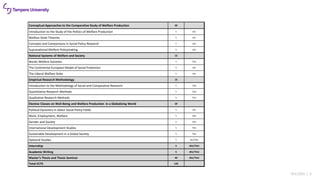
Conceptual Approaches to the Comparative Study of Welfare Production 20
Introduction to the Study of the Politics of Welfare Production 5 JKU
Welfare State Theories 5 JKU
Concepts and Comparisons in Social Policy Research 5 JKU
Supranational Welfare Policymaking 5 JKU
National Systems of Welfare and Society 15
Nordic Welfare Societies 5 TAU
The Continental European Model of Social Protection 5 JKU
The Liberal Welfare State 5 JKU
Empirical Research Methodology 15
Introduction to the Methodology of Social and Comparative Research 5 TAU
Quantitative Research Methods 5 TAU
Qualitative Research Methods 5 TAU
Elective Classes on Well-Being and Welfare Production in a Globalizing World 20
Political Dynamics in Select Social Policy Fields 5 JKU
Work, Employment, Welfare 5 TAU
Gender and Society 5 TAU
International Development Studies 5 TAU
Sustainable Development in a Global Society 5 TAU
Optional Studies 5 JKU/TAU
Internship 5 JKU/TAU
Academic Writing 5 JKU/TAU
Master’s Thesis and Thesis Seminar 40 JKU/TAU
Total ECTS 120
Physical mobility
• During the two year programme period, students and teacher’s meet face-to-face 3-4
times in Intensive Programmes (IP) which are 1-2 weeks each
• IP at the beginning of each semester: introductory lectures for the courses of that
semester and guidelines for the on-line work. Social programme is also included.
• The IPs of the second year of study also include joint Master’s thesis seminars.
• IPs are planned jointly but universities take turns in organizing them > host university
provides all the necessary services for the in-coming teachers and students.
• Expenses are covered by several means: Erasmus+ teacher exhange funding, Erasmus+
internship funding, students’ own funding, university scholarship and travel grants.
• possibility also for ”traditional” student exchange between the universities.
18.6.2020 | 6
Virtual mobility
• After each Intensive Programme teaching and studying continues on-line in Moodle on-
line learning environment.
• All students and teachers use one Moodle environment (Tampere University’s TUNI
Moodle).
• Some course are fully on-line without any face-to-face introductory sessions.
• Various teaching & learning methods, for example: streamed and/or recorded lectures,
weekly discussions, individual and group work, peer reviews, learning diaries, on-line
exams, essays.
18.6.2020 | 7
Conclusions
• Virtual mobility and on-line learning give students more freedom to schedule their studies
individually.
• Participation in the IPs is compulsory but other than that studies are not tied to a specific
place.
• With freedom comes responsibility: COSOPO is a full-time study programme and studies
must be completed on time.
• Physical mobility is an important element for the joint programme. Students are more
committed when they know who they are working with.
• Some courses are being offered also to other degree students in the partner universities.
This allows the students to network with a larger student community.
18.6.2020 | 8
18.6.2020 | 9
• Students might need quite a lot of support and study guidance especially at the
beginning of the studies as they are not necessarily very familiar with virtual studies.
• In addition to the on-line discussion forums during virtual mobility, it is also good to
have regular local meetings between the students and staff.
• Regular meetings (both physical and virtual) among staff are also a key element in
building a high quality programme. In COSOPO, there is a face-to-face meeting during
every IP.
• During the implementation of the programme there has been a great deal of
knowledge exhange between teachers as well as joint development of virtual mobility
and pedagogical solutions for on-line teaching.
Thank you!
More information:
eveliina.permi@tuni.fi
18.6.2020| 10

[EADTU OPEN VM WEBINAR] Presentation Eveliina Permi

  • 1.
    Joint curricula andintegrated mobility: Master’s Degree Programme in Comparative Social Policy and Welfare (COSOPO) Eveliina Permi Study specialist Faculty of Social Sciences Tampere University
  • 2.
    Building the jointprogramme • Originally three partner universities: Tampere University TAU (Finland), Johannes Kepler University Linz (Austria), Mykolas Romeris University (Lithuania). • Co-operation started as Erasmus teacher exchange. • Erasmus curriculum development funding in 2006 for building the joint curriculum and for the development of on-line learning. • First cohort of students started their studies in 2008, admission every second year. • Erasmus Intensive programme funding to cover the costs of the physical mobility. Possibility to receive a double degree 18.6.2020 | 2
  • 3.
    18.6.2020 | 3 •From autumn 2020 the programme will run by Tampere University and Johannes Kepler Univeristy Linz. • Partner universities have jointly agreed admission requirements but separate admission procedures. • International admission, not limited to students coming from the partner universities. • Students are registered in both partner universities. • Joint degree has been an aim but so far not possible due to national legislations. • Students receive a national degree, partner university and joint programme are mentioned in the graduation documents. Possibility to receive a double degree.
  • 4.
    A joint studypath • All students follow the same curriculum, only minor differences in the individual study plans. • Each semester contains study units from both partner universities. • 4th semester is dedicated to the Master’s thesis, possibility to receive supervision from both universities. • Some elective/optional elements > students can make individual choices from a list of courses provided. In these elective studies, there is a possibility to complete studies from other (mainly Finnish) virtual learning networks. • Some study units are organized locally (fully or party): Scientific Writing, Internship and Thesis seminar. 18.6.2020 | 4
  • 5.
    18.6.2020 | 5 ConceptualApproaches to the Comparative Study of Welfare Production 20 Introduction to the Study of the Politics of Welfare Production 5 JKU Welfare State Theories 5 JKU Concepts and Comparisons in Social Policy Research 5 JKU Supranational Welfare Policymaking 5 JKU National Systems of Welfare and Society 15 Nordic Welfare Societies 5 TAU The Continental European Model of Social Protection 5 JKU The Liberal Welfare State 5 JKU Empirical Research Methodology 15 Introduction to the Methodology of Social and Comparative Research 5 TAU Quantitative Research Methods 5 TAU Qualitative Research Methods 5 TAU Elective Classes on Well-Being and Welfare Production in a Globalizing World 20 Political Dynamics in Select Social Policy Fields 5 JKU Work, Employment, Welfare 5 TAU Gender and Society 5 TAU International Development Studies 5 TAU Sustainable Development in a Global Society 5 TAU Optional Studies 5 JKU/TAU Internship 5 JKU/TAU Academic Writing 5 JKU/TAU Master’s Thesis and Thesis Seminar 40 JKU/TAU Total ECTS 120
  • 6.
    Physical mobility • Duringthe two year programme period, students and teacher’s meet face-to-face 3-4 times in Intensive Programmes (IP) which are 1-2 weeks each • IP at the beginning of each semester: introductory lectures for the courses of that semester and guidelines for the on-line work. Social programme is also included. • The IPs of the second year of study also include joint Master’s thesis seminars. • IPs are planned jointly but universities take turns in organizing them > host university provides all the necessary services for the in-coming teachers and students. • Expenses are covered by several means: Erasmus+ teacher exhange funding, Erasmus+ internship funding, students’ own funding, university scholarship and travel grants. • possibility also for ”traditional” student exchange between the universities. 18.6.2020 | 6
  • 7.
    Virtual mobility • Aftereach Intensive Programme teaching and studying continues on-line in Moodle on- line learning environment. • All students and teachers use one Moodle environment (Tampere University’s TUNI Moodle). • Some course are fully on-line without any face-to-face introductory sessions. • Various teaching & learning methods, for example: streamed and/or recorded lectures, weekly discussions, individual and group work, peer reviews, learning diaries, on-line exams, essays. 18.6.2020 | 7
  • 8.
    Conclusions • Virtual mobilityand on-line learning give students more freedom to schedule their studies individually. • Participation in the IPs is compulsory but other than that studies are not tied to a specific place. • With freedom comes responsibility: COSOPO is a full-time study programme and studies must be completed on time. • Physical mobility is an important element for the joint programme. Students are more committed when they know who they are working with. • Some courses are being offered also to other degree students in the partner universities. This allows the students to network with a larger student community. 18.6.2020 | 8
  • 9.
    18.6.2020 | 9 •Students might need quite a lot of support and study guidance especially at the beginning of the studies as they are not necessarily very familiar with virtual studies. • In addition to the on-line discussion forums during virtual mobility, it is also good to have regular local meetings between the students and staff. • Regular meetings (both physical and virtual) among staff are also a key element in building a high quality programme. In COSOPO, there is a face-to-face meeting during every IP. • During the implementation of the programme there has been a great deal of knowledge exhange between teachers as well as joint development of virtual mobility and pedagogical solutions for on-line teaching.
  • 10.