
Recovery & Resilience International in partnership with AllCEUs.com
Co-Occurring Disorders Recovery Coaching Curriculum
Co-Dependency
Dr. Dawn-Elise Snipes PhD, LPC-MHSP, LMHC, NCC
Executive Director, AllCEUs.com
Recovery & Resilience International in partnership with AllCEUs.com
Co-Occurring Disorders Recovery Coaching Curriculum
Objectives
 Define codependency
 Identify characteristics of the codependent
relationship
 Explore the motivations for these behaviors
 Hypothesize alternate, healthier behaviors
Recovery & Resilience International in partnership with AllCEUs.com
Co-Occurring Disorders Recovery Coaching Curriculum
Why I Care/How It Impacts Recovery
 Co-dependency can serve as an alternate
addiction or distraction
 Co-Dependents may use relationships to try to
deal with depression or anxiety
 Ultimately codependency is self-defeating
because one of the few things that cannot be
controlled is the will of another person.
Recovery & Resilience International in partnership with AllCEUs.com
Co-Occurring Disorders Recovery Coaching Curriculum
Definition
 Codependency describes a type of relationship in
which
 One partner defines his or her worth or goodness based
on someone else
 The codependent person often chooses relationships in
which the other person needs to be rescued, thereby
making himself or herself indispensable.
Recovery & Resilience International in partnership with AllCEUs.com
Co-Occurring Disorders Recovery Coaching Curriculum
The Mantras
 “I don’t understand why she refuses to change. I
have done everything for her.”
 “Helping someone who doesn’t want help is an
exercise in futility, but what are you supposed to
do if you don’t help?”
Recovery & Resilience International in partnership with AllCEUs.com
Co-Occurring Disorders Recovery Coaching Curriculum
Co-Dependency as an Addiction
 Tolerance
 Need more of the same substance/activity
In a codependent relationship, as time passes, the
codependent’s identity becomes increasingly defined by
the relationship with the other person
 Withdrawal
 Not getting the substance, being around the person
results in physical or psychological withdrawals
When apart from or unable to control the other person,
the codependent experiences extreme anxiety and/or
depression
Recovery & Resilience International in partnership with AllCEUs.com
Co-Occurring Disorders Recovery Coaching Curriculum
Co-Dependency as an Addiction
 Spending more time thinking about, engaging in
or recovering from the behavior
 Co-dependents are always hypervigilant to other
peoples behavior, and obsessing about what they are or
are not doing
 Co-dependents spend large amounts of time rescuing or
covering up for the other person “fixing it”
 The codependent gets exhausted taking care of the
other person, but cannot stop because they rely on the
other person to tell them
Recovery & Resilience International in partnership with AllCEUs.com
Co-Occurring Disorders Recovery Coaching Curriculum
Co-Dependency as an Addiction
 Foregoing other interests in order to maintain the
addiction
 The relationship is the “drug” of choice in the
codependents’ lives
 Having that person in their life makes them feel “okay”
or “whole”
 The relationship takes the place of self-love
Recovery & Resilience International in partnership with AllCEUs.com
Co-Occurring Disorders Recovery Coaching Curriculum
Co-Dependency as an Addiction
 Continuing the addiction/relationship despite
negative consequences
 Emotional (depression, anxiety, anger, resentment)
 Social (Loss of other friends)
 Physical (stress-related physical issues)
 Occupational (poor job performance)
Recovery & Resilience International in partnership with AllCEUs.com
Co-Occurring Disorders Recovery Coaching Curriculum
Addicts and Codependents
 Low self esteem
 Depression, anxiety
 Need to control
 Fear of abandonment
 Relationship comforts/numbs
 Relationship becomes the addict’s primary focus
 Minimizing, denying, blaming to protect the relationship
 Stinkin’ Thinkin’
Recovery & Resilience International in partnership with AllCEUs.com
Co-Occurring Disorders Recovery Coaching Curriculum
 Have difficulty identifying what they are feeling.
 Lack empathy for the feelings and needs of others.
 Mask pain in various ways such as anger, humor, or isolation.
 Experience significant aggression/resentment and negativity
Recovery & Resilience International in partnership with AllCEUs.com
Co-Occurring Disorders Recovery Coaching Curriculum
Addicts and Codependents
 Have difficulty making decisions.
 Judge what they think, say, or do harshly, as never good enough.
 Value others’ approval of their thinking, feelings, and behavior
over their own.
 Do not perceive themselves as lovable or worthwhile persons
 Seek recognition and praise to overcome feeling less than.
 Have difficulty admitting a mistake.
 Need to appear to be right, and may even lie to look good.
 Are unable to identify or ask for what they need and want.
 Have trouble setting healthy priorities and boundaries.
Recovery & Resilience International in partnership with AllCEUs.com
Co-Occurring Disorders Recovery Coaching Curriculum
Addicts and Codependents
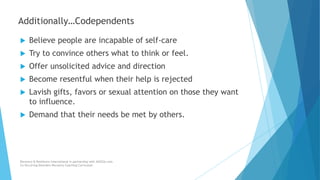
 Believe people are incapable of self-care
 Try to convince others what to think or feel.
 Offer unsolicited advice and direction
 Become resentful when their help is rejected
 Lavish gifts, favors or sexual attention on those they want
to influence.
 Demand that their needs be met by others.
Recovery & Resilience International in partnership with AllCEUs.com
Co-Occurring Disorders Recovery Coaching Curriculum
Additionally…Codependents
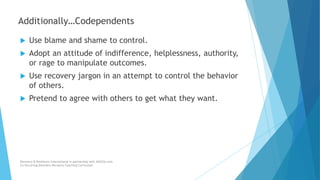
 Use blame and shame to control.
 Adopt an attitude of indifference, helplessness, authority,
or rage to manipulate outcomes.
 Use recovery jargon in an attempt to control the behavior
of others.
 Pretend to agree with others to get what they want.
Recovery & Resilience International in partnership with AllCEUs.com
Co-Occurring Disorders Recovery Coaching Curriculum
Additionally…Codependents
Interventions
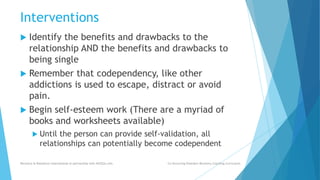
 Identify the benefits and drawbacks to the
relationship AND the benefits and drawbacks to
being single
 Remember that codependency, like other
addictions is used to escape, distract or avoid
pain.
 Begin self-esteem work (There are a myriad of
books and worksheets available)
 Until the person can provide self-validation, all
relationships can potentially become codependent
Recovery & Resilience International in partnership with AllCEUs.com Co-Occurring Disorders Recovery Coaching Curriculum
Apply It
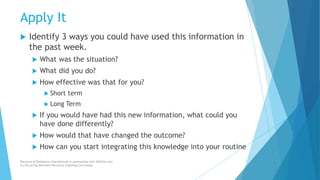
 Identify 3 ways you could have used this information in
the past week.
 What was the situation?
 What did you do?
 How effective was that for you?
 Short term
 Long Term
 If you would have had this new information, what could you
have done differently?
 How would that have changed the outcome?
 How can you start integrating this knowledge into your routine
Recovery & Resilience International in partnership with AllCEUs.com
Co-Occurring Disorders Recovery Coaching Curriculum
Summary
 Codependents generally get in relationships with
addicts or others who need to be “rescued.”
 This need to rescue (be indispensable) often stems
from:
 Not feeling good enough (low self-esteem, need for external
validation)
 Fear of abandonment
 Codependents do not feel worthy or lovable. They
need someone else to validate them
 The codependent derives his or her “goodness” from
the success or failure of the other person in the
relationship.
Recovery & Resilience International in partnership with AllCEUs.com
Co-Occurring Disorders Recovery Coaching Curriculum
Summary
 Recovery involves
 Developing a sense of self-worth
 Addressing the issues that are causing depression and
anxiety
 Grief over prior lost relationships
 Helplessness to change another person
 Fears of rejection, isolation, failure, loss of control and the
unknown
 Learning about and creating a network of healthy
relationships with self and others
 Setting healthy boundaries
 Learning to accept multiple perspectives
Recovery & Resilience International in partnership with AllCEUs.com
Co-Occurring Disorders Recovery Coaching Curriculum

Co-Dependency and the Addiction Recovery Process

  • 1.
    Recovery & ResilienceInternational in partnership with AllCEUs.com Co-Occurring Disorders Recovery Coaching Curriculum
  • 2.
    Co-Dependency Dr. Dawn-Elise SnipesPhD, LPC-MHSP, LMHC, NCC Executive Director, AllCEUs.com Recovery & Resilience International in partnership with AllCEUs.com Co-Occurring Disorders Recovery Coaching Curriculum
  • 3.
    Objectives  Define codependency Identify characteristics of the codependent relationship  Explore the motivations for these behaviors  Hypothesize alternate, healthier behaviors Recovery & Resilience International in partnership with AllCEUs.com Co-Occurring Disorders Recovery Coaching Curriculum
  • 4.
    Why I Care/HowIt Impacts Recovery  Co-dependency can serve as an alternate addiction or distraction  Co-Dependents may use relationships to try to deal with depression or anxiety  Ultimately codependency is self-defeating because one of the few things that cannot be controlled is the will of another person. Recovery & Resilience International in partnership with AllCEUs.com Co-Occurring Disorders Recovery Coaching Curriculum
  • 5.
    Definition  Codependency describesa type of relationship in which  One partner defines his or her worth or goodness based on someone else  The codependent person often chooses relationships in which the other person needs to be rescued, thereby making himself or herself indispensable. Recovery & Resilience International in partnership with AllCEUs.com Co-Occurring Disorders Recovery Coaching Curriculum
  • 6.
    The Mantras  “Idon’t understand why she refuses to change. I have done everything for her.”  “Helping someone who doesn’t want help is an exercise in futility, but what are you supposed to do if you don’t help?” Recovery & Resilience International in partnership with AllCEUs.com Co-Occurring Disorders Recovery Coaching Curriculum
  • 7.
    Co-Dependency as anAddiction  Tolerance  Need more of the same substance/activity In a codependent relationship, as time passes, the codependent’s identity becomes increasingly defined by the relationship with the other person  Withdrawal  Not getting the substance, being around the person results in physical or psychological withdrawals When apart from or unable to control the other person, the codependent experiences extreme anxiety and/or depression Recovery & Resilience International in partnership with AllCEUs.com Co-Occurring Disorders Recovery Coaching Curriculum
  • 8.
    Co-Dependency as anAddiction  Spending more time thinking about, engaging in or recovering from the behavior  Co-dependents are always hypervigilant to other peoples behavior, and obsessing about what they are or are not doing  Co-dependents spend large amounts of time rescuing or covering up for the other person “fixing it”  The codependent gets exhausted taking care of the other person, but cannot stop because they rely on the other person to tell them Recovery & Resilience International in partnership with AllCEUs.com Co-Occurring Disorders Recovery Coaching Curriculum
  • 9.
    Co-Dependency as anAddiction  Foregoing other interests in order to maintain the addiction  The relationship is the “drug” of choice in the codependents’ lives  Having that person in their life makes them feel “okay” or “whole”  The relationship takes the place of self-love Recovery & Resilience International in partnership with AllCEUs.com Co-Occurring Disorders Recovery Coaching Curriculum
  • 10.
    Co-Dependency as anAddiction  Continuing the addiction/relationship despite negative consequences  Emotional (depression, anxiety, anger, resentment)  Social (Loss of other friends)  Physical (stress-related physical issues)  Occupational (poor job performance) Recovery & Resilience International in partnership with AllCEUs.com Co-Occurring Disorders Recovery Coaching Curriculum
  • 11.
    Addicts and Codependents Low self esteem  Depression, anxiety  Need to control  Fear of abandonment  Relationship comforts/numbs  Relationship becomes the addict’s primary focus  Minimizing, denying, blaming to protect the relationship  Stinkin’ Thinkin’ Recovery & Resilience International in partnership with AllCEUs.com Co-Occurring Disorders Recovery Coaching Curriculum
  • 12.
     Have difficultyidentifying what they are feeling.  Lack empathy for the feelings and needs of others.  Mask pain in various ways such as anger, humor, or isolation.  Experience significant aggression/resentment and negativity Recovery & Resilience International in partnership with AllCEUs.com Co-Occurring Disorders Recovery Coaching Curriculum Addicts and Codependents
  • 13.
     Have difficultymaking decisions.  Judge what they think, say, or do harshly, as never good enough.  Value others’ approval of their thinking, feelings, and behavior over their own.  Do not perceive themselves as lovable or worthwhile persons  Seek recognition and praise to overcome feeling less than.  Have difficulty admitting a mistake.  Need to appear to be right, and may even lie to look good.  Are unable to identify or ask for what they need and want.  Have trouble setting healthy priorities and boundaries. Recovery & Resilience International in partnership with AllCEUs.com Co-Occurring Disorders Recovery Coaching Curriculum Addicts and Codependents
  • 14.
     Believe peopleare incapable of self-care  Try to convince others what to think or feel.  Offer unsolicited advice and direction  Become resentful when their help is rejected  Lavish gifts, favors or sexual attention on those they want to influence.  Demand that their needs be met by others. Recovery & Resilience International in partnership with AllCEUs.com Co-Occurring Disorders Recovery Coaching Curriculum Additionally…Codependents
  • 15.
     Use blameand shame to control.  Adopt an attitude of indifference, helplessness, authority, or rage to manipulate outcomes.  Use recovery jargon in an attempt to control the behavior of others.  Pretend to agree with others to get what they want. Recovery & Resilience International in partnership with AllCEUs.com Co-Occurring Disorders Recovery Coaching Curriculum Additionally…Codependents
  • 16.
    Interventions  Identify thebenefits and drawbacks to the relationship AND the benefits and drawbacks to being single  Remember that codependency, like other addictions is used to escape, distract or avoid pain.  Begin self-esteem work (There are a myriad of books and worksheets available)  Until the person can provide self-validation, all relationships can potentially become codependent Recovery & Resilience International in partnership with AllCEUs.com Co-Occurring Disorders Recovery Coaching Curriculum
  • 17.
    Apply It  Identify3 ways you could have used this information in the past week.  What was the situation?  What did you do?  How effective was that for you?  Short term  Long Term  If you would have had this new information, what could you have done differently?  How would that have changed the outcome?  How can you start integrating this knowledge into your routine Recovery & Resilience International in partnership with AllCEUs.com Co-Occurring Disorders Recovery Coaching Curriculum
  • 18.
    Summary  Codependents generallyget in relationships with addicts or others who need to be “rescued.”  This need to rescue (be indispensable) often stems from:  Not feeling good enough (low self-esteem, need for external validation)  Fear of abandonment  Codependents do not feel worthy or lovable. They need someone else to validate them  The codependent derives his or her “goodness” from the success or failure of the other person in the relationship. Recovery & Resilience International in partnership with AllCEUs.com Co-Occurring Disorders Recovery Coaching Curriculum
  • 19.
    Summary  Recovery involves Developing a sense of self-worth  Addressing the issues that are causing depression and anxiety  Grief over prior lost relationships  Helplessness to change another person  Fears of rejection, isolation, failure, loss of control and the unknown  Learning about and creating a network of healthy relationships with self and others  Setting healthy boundaries  Learning to accept multiple perspectives Recovery & Resilience International in partnership with AllCEUs.com Co-Occurring Disorders Recovery Coaching Curriculum