Trigonometry
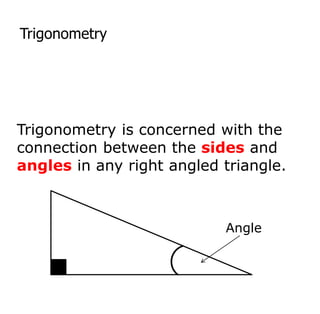
Trigonometry is concerned with the
connection between the sides and
angles in any right angled triangle.
Angle
A
A
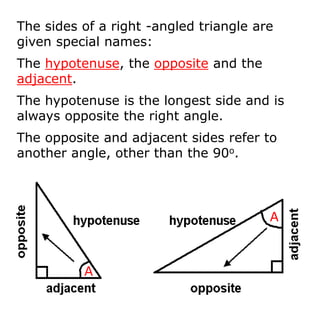
The sides of a right -angled triangle are
given special names:
The hypotenuse, the opposite and the
adjacent.
The hypotenuse is the longest side and is
always opposite the right angle.
The opposite and adjacent sides refer to
another angle, other than the 90o.
The Trigonometric
Functions we will be
looking at
SINE
COSINE
TANGENT
The Trigonometric
Functions
SINE
COSINE
TANGENT
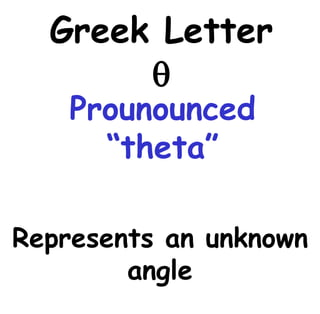
Prounounced
“theta”
Greek Letter
q
Represents an unknown
angle
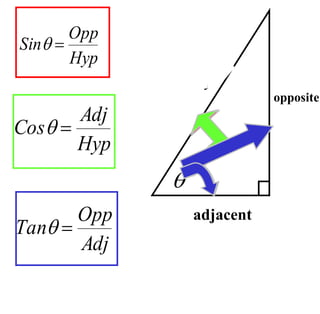
q
opposit
hypotenuse
adjacent
hypotenuse
opposite
adjacent
Hyp
Opp
Sin 
q
Hyp
Adj
Cos 
q
Adj
Opp
Tan 
q
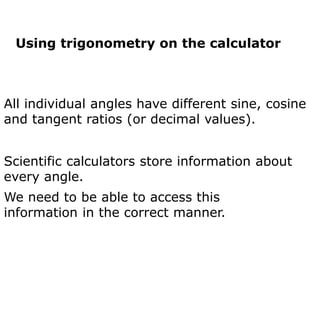
Using trigonometry on the calculator
All individual angles have different sine, cosine
and tangent ratios (or decimal values).
Scientific calculators store information about
every angle.
We need to be able to access this
information in the correct manner.
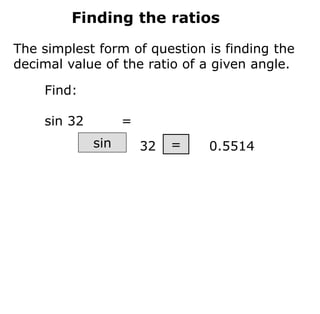
Finding the ratios
The simplest form of question is finding the
decimal value of the ratio of a given angle.
Find:
sin 32 =
sin 32 = 0.5514
Using ratios to find angles
We have just found that a scientific
calculator holds the ratio information
for sine (sin), cosine (cos) and
tangent (tan) for all angles.
It can also be used in reverse, finding
an angle from a ratio.
To do this we use the sin-1, cos-1 and
tan-1 function keys.
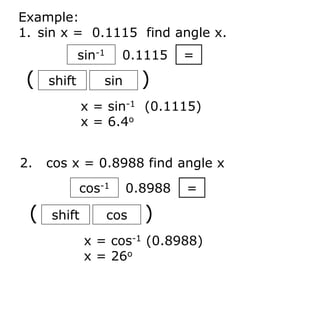
Example:
1. sin x = 0.1115 find angle x.
x = sin-1 (0.1115)
x = 6.4o
2. cos x = 0.8988 find angle x
x = cos-1 (0.8988)
x = 26o
sin-1 0.1115 =
shift sin
( )
cos-1 0.8988 =
shift cos
( )
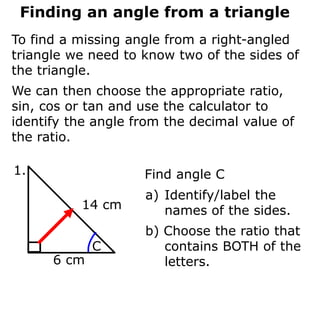
Finding an angle from a triangle
To find a missing angle from a right-angled
triangle we need to know two of the sides of
the triangle.
We can then choose the appropriate ratio,
sin, cos or tan and use the calculator to
identify the angle from the decimal value of
the ratio.
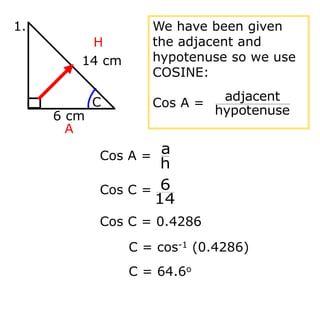
Find angle C
a) Identify/label the
names of the sides.
b) Choose the ratio that
contains BOTH of the
letters.
14 cm
6 cm
C
1.
C = cos-1 (0.4286)
C = 64.6o
14 cm
6 cm
C
1.
H
A
We have been given
the adjacent and
hypotenuse so we use
COSINE:
Cos A =
hypotenuse
adjacent
Cos A =
h
a
Cos C =
14
6
Cos C = 0.4286
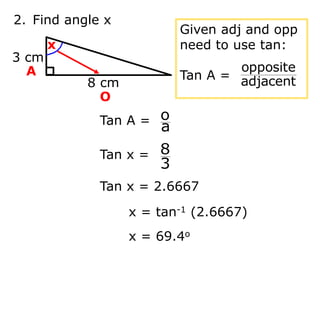
Find angle x
2.
8 cm
3 cm
x
A
O
Given adj and opp
need to use tan:
Tan A = adjacent
opposite
x = tan-1 (2.6667)
x = 69.4o
Tan A =
a
o
Tan x =
3
8
Tan x = 2.6667
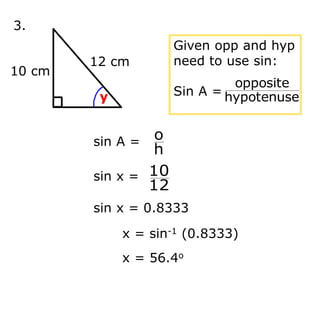
3.
12 cm
10 cm
y
Given opp and hyp
need to use sin:
Sin A = hypotenuse
opposite
x = sin-1 (0.8333)
x = 56.4o
sin A =
h
o
sin x =
12
10
sin x = 0.8333
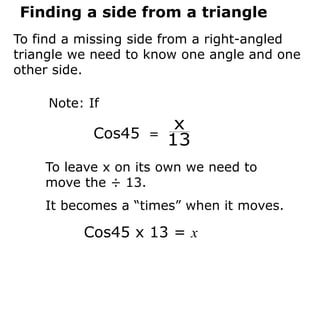
Finding a side from a triangle
To find a missing side from a right-angled
triangle we need to know one angle and one
other side.
Cos45 =
13
x
To leave x on its own we need to
move the ÷ 13.
It becomes a “times” when it moves.
Note: If
Cos45 x 13 = x
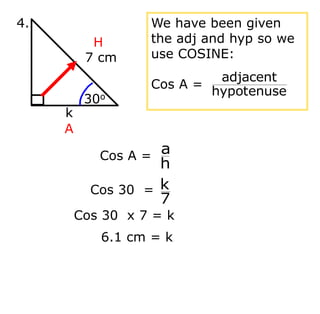
Cos 30 x 7 = k
6.1 cm = k
7 cm
k
30o
4.
H
A
We have been given
the adj and hyp so we
use COSINE:
Cos A =
hypotenuse
adjacent
Cos A =
h
a
Cos 30 =
7
k
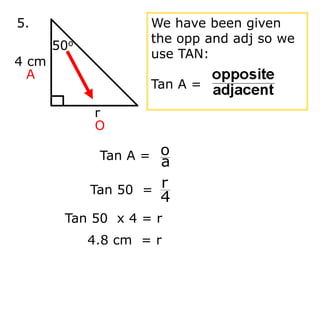
Tan 50 x 4 = r
4.8 cm = r
4 cm
r
50o
5.
A
O
Tan A =
a
o
Tan 50 =
4
r
We have been given
the opp and adj so we
use TAN:
Tan A =
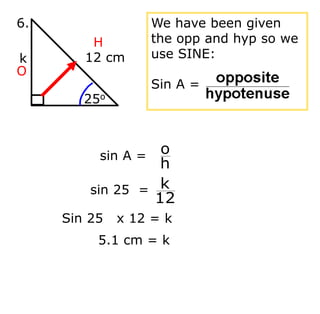
Sin 25 x 12 = k
5.1 cm = k
12 cm
k
25o
6.
H
O
sin A =
h
o
sin 25 =
12
k
We have been given
the opp and hyp so we
use SINE:
Sin A =
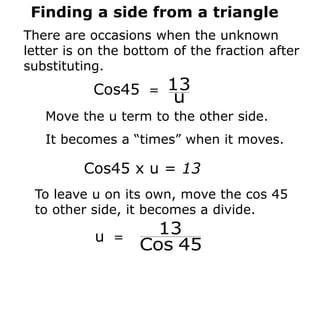
Finding a side from a triangle
There are occasions when the unknown
letter is on the bottom of the fraction after
substituting.
Cos45 =
u
13
Move the u term to the other side.
It becomes a “times” when it moves.
Cos45 x u = 13
To leave u on its own, move the cos 45
to other side, it becomes a divide.
u =
45
Cos
13
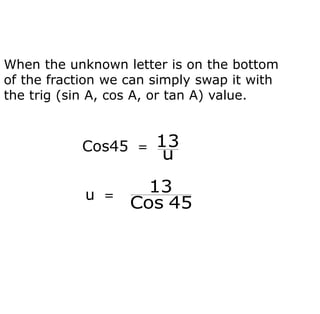
When the unknown letter is on the bottom
of the fraction we can simply swap it with
the trig (sin A, cos A, or tan A) value.
Cos45 =
u
13
u =
45
Cos
13
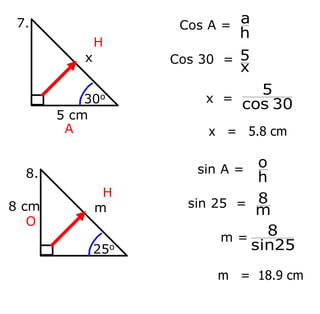
x =
x
5 cm
30o
7.
H
A
Cos A =
h
a
Cos 30 =
x
5
30
cos
5
m
8 cm
25o
8.
H
O
m =
sin A =
h
o
sin 25 =
m
8
sin25
8
x = 5.8 cm
m = 18.9 cm
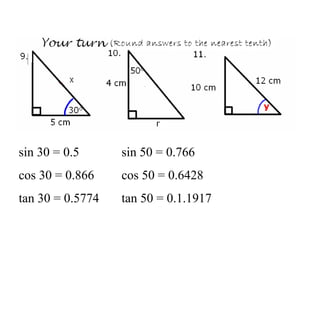
sin 30 = 0.5
cos 30 = 0.866
tan 30 = 0.5774
sin 50 = 0.766
cos 50 = 0.6428
tan 50 = 0.1.1917

Triangle Trigonometry.ppt

  • 1.
    Trigonometry Trigonometry is concernedwith the connection between the sides and angles in any right angled triangle. Angle
  • 2.
    A A The sides ofa right -angled triangle are given special names: The hypotenuse, the opposite and the adjacent. The hypotenuse is the longest side and is always opposite the right angle. The opposite and adjacent sides refer to another angle, other than the 90o.
  • 3.
    The Trigonometric Functions wewill be looking at SINE COSINE TANGENT
  • 4.
  • 5.
  • 6.
  • 7.
    Using trigonometry onthe calculator All individual angles have different sine, cosine and tangent ratios (or decimal values). Scientific calculators store information about every angle. We need to be able to access this information in the correct manner.
  • 8.
    Finding the ratios Thesimplest form of question is finding the decimal value of the ratio of a given angle. Find: sin 32 = sin 32 = 0.5514
  • 9.
    Using ratios tofind angles We have just found that a scientific calculator holds the ratio information for sine (sin), cosine (cos) and tangent (tan) for all angles. It can also be used in reverse, finding an angle from a ratio. To do this we use the sin-1, cos-1 and tan-1 function keys.
  • 10.
    Example: 1. sin x= 0.1115 find angle x. x = sin-1 (0.1115) x = 6.4o 2. cos x = 0.8988 find angle x x = cos-1 (0.8988) x = 26o sin-1 0.1115 = shift sin ( ) cos-1 0.8988 = shift cos ( )
  • 11.
    Finding an anglefrom a triangle To find a missing angle from a right-angled triangle we need to know two of the sides of the triangle. We can then choose the appropriate ratio, sin, cos or tan and use the calculator to identify the angle from the decimal value of the ratio. Find angle C a) Identify/label the names of the sides. b) Choose the ratio that contains BOTH of the letters. 14 cm 6 cm C 1.
  • 12.
    C = cos-1(0.4286) C = 64.6o 14 cm 6 cm C 1. H A We have been given the adjacent and hypotenuse so we use COSINE: Cos A = hypotenuse adjacent Cos A = h a Cos C = 14 6 Cos C = 0.4286
  • 13.
    Find angle x 2. 8cm 3 cm x A O Given adj and opp need to use tan: Tan A = adjacent opposite x = tan-1 (2.6667) x = 69.4o Tan A = a o Tan x = 3 8 Tan x = 2.6667
  • 14.
    3. 12 cm 10 cm y Givenopp and hyp need to use sin: Sin A = hypotenuse opposite x = sin-1 (0.8333) x = 56.4o sin A = h o sin x = 12 10 sin x = 0.8333
  • 15.
    Finding a sidefrom a triangle To find a missing side from a right-angled triangle we need to know one angle and one other side. Cos45 = 13 x To leave x on its own we need to move the ÷ 13. It becomes a “times” when it moves. Note: If Cos45 x 13 = x
  • 16.
    Cos 30 x7 = k 6.1 cm = k 7 cm k 30o 4. H A We have been given the adj and hyp so we use COSINE: Cos A = hypotenuse adjacent Cos A = h a Cos 30 = 7 k
  • 17.
    Tan 50 x4 = r 4.8 cm = r 4 cm r 50o 5. A O Tan A = a o Tan 50 = 4 r We have been given the opp and adj so we use TAN: Tan A =
  • 18.
    Sin 25 x12 = k 5.1 cm = k 12 cm k 25o 6. H O sin A = h o sin 25 = 12 k We have been given the opp and hyp so we use SINE: Sin A =
  • 19.
    Finding a sidefrom a triangle There are occasions when the unknown letter is on the bottom of the fraction after substituting. Cos45 = u 13 Move the u term to the other side. It becomes a “times” when it moves. Cos45 x u = 13 To leave u on its own, move the cos 45 to other side, it becomes a divide. u = 45 Cos 13
  • 20.
    When the unknownletter is on the bottom of the fraction we can simply swap it with the trig (sin A, cos A, or tan A) value. Cos45 = u 13 u = 45 Cos 13
  • 21.
    x = x 5 cm 30o 7. H A CosA = h a Cos 30 = x 5 30 cos 5 m 8 cm 25o 8. H O m = sin A = h o sin 25 = m 8 sin25 8 x = 5.8 cm m = 18.9 cm
  • 22.
    sin 30 =0.5 cos 30 = 0.866 tan 30 = 0.5774 sin 50 = 0.766 cos 50 = 0.6428 tan 50 = 0.1.1917