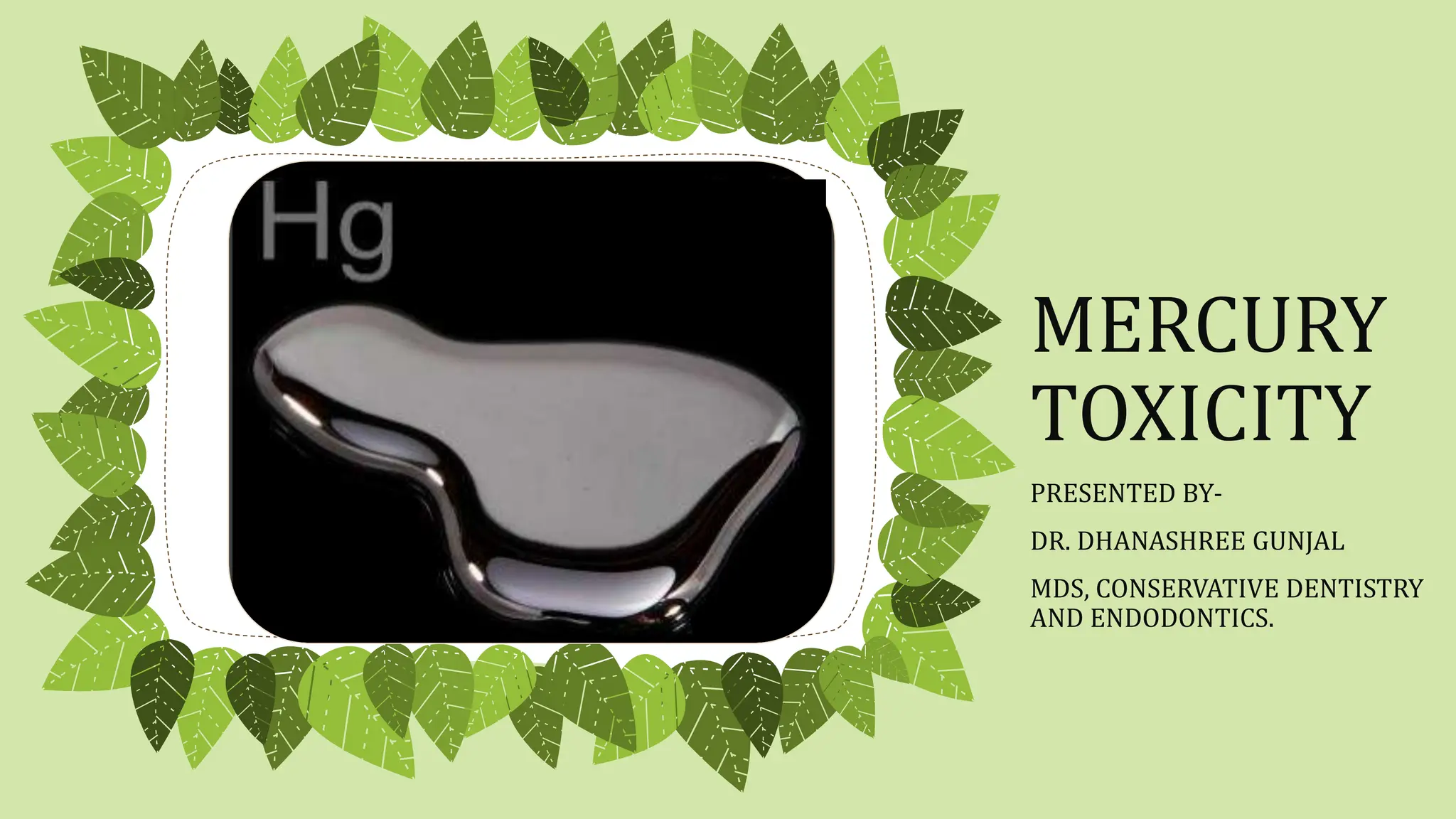
MERCURY
TOXICITY
PRESENTED BY-
DR. DHANASHREE GUNJAL
MDS, CONSERVATIVE DENTISTRY
AND ENDODONTICS.
Introduction
History
Chemical Forms Of Mercury
Sources Of Mercury Exposure
Pathways
Side effects of mercury
Mercury Hygiene
Safe Mercury Amalgam Removal Technique (SMART)
CONTENT
DR. DHANASHREE GUNJAL 2
Introduction
Mercury is a known toxic,
bio-accumulative substance.
It often finds its way into the body
through dental amalgam, which is used
to restore cavitated tooth.
Mercury release in body and shows
negative affect on the lungs, nervous
system, kidney etc.
DR. DHANASHREE GUNJAL 3
Definitions
An amalgam is an alloy that contains mercury as one of its constituents.
PHILLIP’S SCIENCE OF DENTAL MATREIALS 11TH EDITION
Dental amalgam is an alloy made by mixing mercury with a silver-tin dental
amalgam alloy.
STURDEVANT’S ART AND SCIENCE OF OPERATIVE DENTISTRY 5TH EDITION
DR. DHANASHREE GUNJAL 4
Amalgam Wars
• In 1841, the American
Society of Dental
Surgeons declared that
“the use of amalgam
constitutes
malpractice”
• Amalgam use declined
SECOND AMALGAM WAR
FIRST AMALGAM WAR THIRD AMALGAM WAR
• In mid 1920's a German
dentist, Professor A. Stock
started the "second
amalgam war".
• He claimed to have
evidence showing that
mercury could be absorbed
from dental amalgam,
which leads to serious
health problems.
• In 1981, the Neurobiologist
Mats Hanson, Assosiate
professor in physiology in
Sweden started the war.
• He was convinced that
mercury released from
dental amalgam was
responsible for human
diseases affecting the
cardiovascular system and
nervous system
DR. DHANASHREE GUNJAL 5
CHEMICAL FORMS
OF MERCURY
ELEMENTAL MERCURY
Most volatile
Exist in liquid/vapor form-
Inhaled and absorbed into lungs
(80%) and GIT (0.01%)
Most common form amalgam
restoration.
Exposure to this form can occur
due to accidental spillage of
mercury in dental office
DR. DHANASHREE GUNJAL 6
Relative Sources Of Mercury Exposure
DR. DHANASHREE GUNJAL 7
Sources Of Mercury Exposure In Dental Clinic
• Amalgam raw material being stored in use
• During trituration , insertion & condensation
• Amalgam scrap
• During finishing & polishing
• Removal of old restoration
• Hg concentration in whole
blood is ↓10 μg/L,
• 20 μg/L / ↓ is normal.
• Blood Hg concentration can rise
to 35 μg/L after long-term
exposure to mercury vapor
DR. DHANASHREE GUNJAL 8
Hg released from
amalgam & inhaled with
80% uptake in the lung
Hg distributes
throughout cell and
tissue
By peroxidase oxidation Hg
breaks down to inorganic
mercury
Hg accumulates in the
nervous system, GIT,
liver and kidney
Hg excreted through
urine and faeces.
DR. DHANASHREE GUNJAL 9
Mechanism of mercury toxicity in the cell
DR. DHANASHREE GUNJAL 10
DR. DHANASHREE GUNJAL 11
Amount of Hg vapor released
• Trituration = 1-2 µg
• Condensation = 6-8 µg
• Dry polishing = 44 µg
• Wet polishing = 2-4 µg
• Removal of amalgam restoration under water
spray and high volume suction = 15-20µg
Threshold Limit Value(TLV) of mercury vapor in
workplace –50μg
DR. DHANASHREE GUNJAL 12
SIDE EFFECTS OF MERCURY
MERCURY
ALLERGY
MERCURY
TOXICITY
DR. DHANASHREE GUNJAL 13
Contact dermatitis or Comb's type IV hypersensitivity reaction
represents side effect to dental amalgam.
Allergy responses represent an antigen-antibody reaction
marked by
itching,
rashes,
sneezing,
erythematous lesions,
severe burning and
difficulty in breathing.
MERCURY ALLERGY
DR. DHANASHREE GUNJAL 14
Erythematous lesion on right buccal
mucosa in vicinity of amalgam
restorations.
Rashes on vermillion border of lower
lip, angle of mouth and cheek.
DR. DHANASHREE GUNJAL 15
• Immediate Hs reaction associated with the mercury
component of amalgam restoration induces an acute reaction.
• Skin patch test results indicated a very strong positive
reaction to mercury.
• Amalgam restorations should be replaced with composite
filling material.
MERCURY ALLERGY
DR. DHANASHREE GUNJAL 16
MERCURY TOXICITY
TOXIC EFFECTS OF MERCURY DEPEND UPON
Amount of exposure
Length of exposure
Length of mercury accumulation in body
Amount of accumulated mercury
Overall health of the patient (for detoxification)
DR. DHANASHREE GUNJAL 17
LEVELS OF MERCURY TOXICITY
DR. DHANASHREE GUNJAL 18
MERCURY
SYMPTOMS
ON ORAL
CAVITY
Tissue
pigmentation
Ulceration of
gingiva, palate
tongue
Bleeding
gums
Alveolar
bone loss
Loosening
of teeth
Foul breath
Metallic
taste
Stomatitis
Burning
sensation,
with
tingling of
lips, face
Excessive
salivation
DR. DHANASHREE GUNJAL 19
DR. DHANASHREE GUNJAL 20
TOXIC EFFECT OF MERCURY ON THE BODY
• Cramps
• Inflamed colon
• Diarrhea
G.IT PROBLEMS
• Weak pulse
• Increase B.P
• Chest pain/feeling of pressure.
• In the chest area
C.V.S
PROMBLEMS
• Weakness
• Emphysema
• Persistent cough
RESPIRATORY
PROMBLEMS
NEUROLOGICAL
PROBLEMS
• Headaches
• Vertigo
• Tinnitus
• Twitching
DR. DHANASHREE GUNJAL 21
Hg damaged development of CNS in the foetus during
prenatal period
DR. DHANASHREE GUNJAL 22
Classic symptoms:
tremor,
gingivitis,
Renal & CNS damage
Minamata disease
Mercury
Poisoning
Acute
effect
Chronic
effect
By ingestion:
local corrosive effects
nausea, vomiting,
severe abdominal pain,
chemical colitis, renal damage.
By inhalation:
chemical pneumonitis,
pulmonary edema
DR. DHANASHREE GUNJAL 23
• Erythema of the palms soles
• Edema of hand and feet
• Desquamating rash
• Hair loss
• Diaphoresis
• Tachycardia
• Photophobia
• Irritability- Constipation/Diarrhea
• Anorexia
• Insomnia
• Poor muscle tone
ACRODYNIA (PINK DISEASE)
DR. DHANASHREE GUNJAL 24
Caused by methylmercury poisoning
•Paraesthesia
•Visual field constriction
•Ataxia
• Impaired hearing & speech.
HUNTER RUSSELL SYNDROME
DR. DHANASHREE GUNJAL 25
MINAMATA DISEASE
DR. DHANASHREE GUNJAL 26
1.Ataxic gait
2.Convulsions
3.Numbness in mouth & limbs
4.Constriction in the visual field
5.Difficulty in speaking.
MINAMATA DISEASE
DR. DHANASHREE GUNJAL 27
Ventilation
Monitor office
Monitor
personnel
Office design
• Proper ventilation by having
fresh air exchanges and
periodic replacement of
filters.
• Monitor the Hg vapor level
in the office periodically.
• Monitor office by periodic
analysis
• Use proper work area
design to facilitate spill
containment and clean up.
SAFE MERCURY AMALGAM REMOVAL TECHNIQUE
DR. DHANASHREE GUNJAL 28
Pre-capsulated
alloys
Amalgamator
cover
Evacuation
systems
• Use pre-capsulated Alloy.
Eliminate the possibility
of a bulk Hg Spill
• Use an amalgamator
fitted with a cover.
Use high volume
evacuation when finishing/
removing amalgam. It has
the traps/ filter.
DR. DHANASHREE GUNJAL 29
Masks
Contaminated
items
Spills
Select an
appropriate alloy
• Change mask as necessary
when removing amalgam
restoration.
• Dispose in sealed bags
according to applicable
regulation
• Clean up Hg properly by
using bottle tapes.
• To pick- up amalgam
droplets use clean up kits.
Proper Hg: alloy ratio to
avoid the need to remove
excess Hg before packing.
DR. DHANASHREE GUNJAL 30
Recyling
Clothing
Avoid carpet/floor
coverings in dental
office
• store amalgam scrap under
radiographic fixer solution in
covered container.
• Recycle amalgam scraps through
refiners
• Wear professional clothing
only in dental operatory.
• floor coverings should be
easy to clean, nonabsorbent
and seamless.
Use rubber dam during insertion, condensation and
polishing of amalgam
DR. DHANASHREE GUNJAL 31
DR. DHANASHREE GUNJAL 32
Gallium based alloy:-
Gallium was discovered in 1875.
It is metal with similar atomic structure and characteristics to mercury
Melting temp of 29°C.
By 1928, Puttkammer suggested Gallium as a substitute for mercury.
It is available as
1. Gallium Alloy
2. Galloy
Disadvatages:
Handling characteristics of alloy not favourable
High level of corrosion is seen which causes loss of strength marginal
disintegration and marginal fracture in chunks.
Poor biocompatibility. Costly.
TO REDUCE MERCURY HAZARDS:MERCURY FREE ALLOYS
DR. DHANASHREE GUNJAL 33
CHELATION THERAPY
•Chelation therapy is the administration of chelating agents remove
heavy metals from the body.
• A chelating agent could be given orally, I.M, I.V
• FDA approved use in children for treating Hg toxicity
2,3-dimercapto-1 propanesulfonicacid (DMPS)
D-Pencillamine (DPCN)
Dimercaprol (BAL)
DR. DHANASHREE GUNJAL 34
• Phillips Science Of Dental Material 10th & 11th Edition
• Sturdevant s The Art and Science of Operative Dentistry, Fifth Edition
• Syed M, Chopra R, Sachdev V. Allergic Reactions to Dental Materials-A Systematic
Review. J Clin Diagn Res. 2015 Oct;9(10):ZE04
• Ryo Sasaki DDS PhD, Sekiko Taneda, Toshihha, Gingival amalgam tattoo,
CMAJ 2023 August 21;195:E1083-4.
• Rhythm Bains1, Kapil Loomba1 and Anju Loomba, Allergy to Mercury from
Dental Amalgam: A Case Report, Asian Journal of Oral Health & Allied Sciences
2012, Volume 2, Issue 2
• Dack K, Fell M, Taylor CM, Havdahl A, Lewis SJ. Prenatal Mercury Exposure and
Neurodevelopment up to the Age of 5 Years: A Systematic Review. Int J Environ
Res Public Health. 2022;19(4):1976.
REFERENCES
DR. DHANASHREE GUNJAL 35

MERCURY TOXICITY

  • 1.
    MERCURY TOXICITY PRESENTED BY- DR. DHANASHREEGUNJAL MDS, CONSERVATIVE DENTISTRY AND ENDODONTICS.
  • 2.
    Introduction History Chemical Forms OfMercury Sources Of Mercury Exposure Pathways Side effects of mercury Mercury Hygiene Safe Mercury Amalgam Removal Technique (SMART) CONTENT DR. DHANASHREE GUNJAL 2
  • 3.
    Introduction Mercury is aknown toxic, bio-accumulative substance. It often finds its way into the body through dental amalgam, which is used to restore cavitated tooth. Mercury release in body and shows negative affect on the lungs, nervous system, kidney etc. DR. DHANASHREE GUNJAL 3
  • 4.
    Definitions An amalgam isan alloy that contains mercury as one of its constituents. PHILLIP’S SCIENCE OF DENTAL MATREIALS 11TH EDITION Dental amalgam is an alloy made by mixing mercury with a silver-tin dental amalgam alloy. STURDEVANT’S ART AND SCIENCE OF OPERATIVE DENTISTRY 5TH EDITION DR. DHANASHREE GUNJAL 4
  • 5.
    Amalgam Wars • In1841, the American Society of Dental Surgeons declared that “the use of amalgam constitutes malpractice” • Amalgam use declined SECOND AMALGAM WAR FIRST AMALGAM WAR THIRD AMALGAM WAR • In mid 1920's a German dentist, Professor A. Stock started the "second amalgam war". • He claimed to have evidence showing that mercury could be absorbed from dental amalgam, which leads to serious health problems. • In 1981, the Neurobiologist Mats Hanson, Assosiate professor in physiology in Sweden started the war. • He was convinced that mercury released from dental amalgam was responsible for human diseases affecting the cardiovascular system and nervous system DR. DHANASHREE GUNJAL 5
  • 6.
    CHEMICAL FORMS OF MERCURY ELEMENTALMERCURY Most volatile Exist in liquid/vapor form- Inhaled and absorbed into lungs (80%) and GIT (0.01%) Most common form amalgam restoration. Exposure to this form can occur due to accidental spillage of mercury in dental office DR. DHANASHREE GUNJAL 6
  • 7.
    Relative Sources OfMercury Exposure DR. DHANASHREE GUNJAL 7
  • 8.
    Sources Of MercuryExposure In Dental Clinic • Amalgam raw material being stored in use • During trituration , insertion & condensation • Amalgam scrap • During finishing & polishing • Removal of old restoration • Hg concentration in whole blood is ↓10 μg/L, • 20 μg/L / ↓ is normal. • Blood Hg concentration can rise to 35 μg/L after long-term exposure to mercury vapor DR. DHANASHREE GUNJAL 8
  • 9.
    Hg released from amalgam& inhaled with 80% uptake in the lung Hg distributes throughout cell and tissue By peroxidase oxidation Hg breaks down to inorganic mercury Hg accumulates in the nervous system, GIT, liver and kidney Hg excreted through urine and faeces. DR. DHANASHREE GUNJAL 9
  • 10.
    Mechanism of mercurytoxicity in the cell DR. DHANASHREE GUNJAL 10
  • 11.
  • 12.
    Amount of Hgvapor released • Trituration = 1-2 µg • Condensation = 6-8 µg • Dry polishing = 44 µg • Wet polishing = 2-4 µg • Removal of amalgam restoration under water spray and high volume suction = 15-20µg Threshold Limit Value(TLV) of mercury vapor in workplace –50μg DR. DHANASHREE GUNJAL 12
  • 13.
    SIDE EFFECTS OFMERCURY MERCURY ALLERGY MERCURY TOXICITY DR. DHANASHREE GUNJAL 13
  • 14.
    Contact dermatitis orComb's type IV hypersensitivity reaction represents side effect to dental amalgam. Allergy responses represent an antigen-antibody reaction marked by itching, rashes, sneezing, erythematous lesions, severe burning and difficulty in breathing. MERCURY ALLERGY DR. DHANASHREE GUNJAL 14
  • 15.
    Erythematous lesion onright buccal mucosa in vicinity of amalgam restorations. Rashes on vermillion border of lower lip, angle of mouth and cheek. DR. DHANASHREE GUNJAL 15
  • 16.
    • Immediate Hsreaction associated with the mercury component of amalgam restoration induces an acute reaction. • Skin patch test results indicated a very strong positive reaction to mercury. • Amalgam restorations should be replaced with composite filling material. MERCURY ALLERGY DR. DHANASHREE GUNJAL 16
  • 17.
    MERCURY TOXICITY TOXIC EFFECTSOF MERCURY DEPEND UPON Amount of exposure Length of exposure Length of mercury accumulation in body Amount of accumulated mercury Overall health of the patient (for detoxification) DR. DHANASHREE GUNJAL 17
  • 18.
    LEVELS OF MERCURYTOXICITY DR. DHANASHREE GUNJAL 18
  • 19.
    MERCURY SYMPTOMS ON ORAL CAVITY Tissue pigmentation Ulceration of gingiva,palate tongue Bleeding gums Alveolar bone loss Loosening of teeth Foul breath Metallic taste Stomatitis Burning sensation, with tingling of lips, face Excessive salivation DR. DHANASHREE GUNJAL 19
  • 20.
  • 21.
    TOXIC EFFECT OFMERCURY ON THE BODY • Cramps • Inflamed colon • Diarrhea G.IT PROBLEMS • Weak pulse • Increase B.P • Chest pain/feeling of pressure. • In the chest area C.V.S PROMBLEMS • Weakness • Emphysema • Persistent cough RESPIRATORY PROMBLEMS NEUROLOGICAL PROBLEMS • Headaches • Vertigo • Tinnitus • Twitching DR. DHANASHREE GUNJAL 21
  • 22.
    Hg damaged developmentof CNS in the foetus during prenatal period DR. DHANASHREE GUNJAL 22
  • 23.
    Classic symptoms: tremor, gingivitis, Renal &CNS damage Minamata disease Mercury Poisoning Acute effect Chronic effect By ingestion: local corrosive effects nausea, vomiting, severe abdominal pain, chemical colitis, renal damage. By inhalation: chemical pneumonitis, pulmonary edema DR. DHANASHREE GUNJAL 23
  • 24.
    • Erythema ofthe palms soles • Edema of hand and feet • Desquamating rash • Hair loss • Diaphoresis • Tachycardia • Photophobia • Irritability- Constipation/Diarrhea • Anorexia • Insomnia • Poor muscle tone ACRODYNIA (PINK DISEASE) DR. DHANASHREE GUNJAL 24
  • 25.
    Caused by methylmercurypoisoning •Paraesthesia •Visual field constriction •Ataxia • Impaired hearing & speech. HUNTER RUSSELL SYNDROME DR. DHANASHREE GUNJAL 25
  • 26.
  • 27.
    1.Ataxic gait 2.Convulsions 3.Numbness inmouth & limbs 4.Constriction in the visual field 5.Difficulty in speaking. MINAMATA DISEASE DR. DHANASHREE GUNJAL 27
  • 28.
    Ventilation Monitor office Monitor personnel Office design •Proper ventilation by having fresh air exchanges and periodic replacement of filters. • Monitor the Hg vapor level in the office periodically. • Monitor office by periodic analysis • Use proper work area design to facilitate spill containment and clean up. SAFE MERCURY AMALGAM REMOVAL TECHNIQUE DR. DHANASHREE GUNJAL 28
  • 29.
    Pre-capsulated alloys Amalgamator cover Evacuation systems • Use pre-capsulatedAlloy. Eliminate the possibility of a bulk Hg Spill • Use an amalgamator fitted with a cover. Use high volume evacuation when finishing/ removing amalgam. It has the traps/ filter. DR. DHANASHREE GUNJAL 29
  • 30.
    Masks Contaminated items Spills Select an appropriate alloy •Change mask as necessary when removing amalgam restoration. • Dispose in sealed bags according to applicable regulation • Clean up Hg properly by using bottle tapes. • To pick- up amalgam droplets use clean up kits. Proper Hg: alloy ratio to avoid the need to remove excess Hg before packing. DR. DHANASHREE GUNJAL 30
  • 31.
    Recyling Clothing Avoid carpet/floor coverings indental office • store amalgam scrap under radiographic fixer solution in covered container. • Recycle amalgam scraps through refiners • Wear professional clothing only in dental operatory. • floor coverings should be easy to clean, nonabsorbent and seamless. Use rubber dam during insertion, condensation and polishing of amalgam DR. DHANASHREE GUNJAL 31
  • 32.
  • 33.
    Gallium based alloy:- Galliumwas discovered in 1875. It is metal with similar atomic structure and characteristics to mercury Melting temp of 29°C. By 1928, Puttkammer suggested Gallium as a substitute for mercury. It is available as 1. Gallium Alloy 2. Galloy Disadvatages: Handling characteristics of alloy not favourable High level of corrosion is seen which causes loss of strength marginal disintegration and marginal fracture in chunks. Poor biocompatibility. Costly. TO REDUCE MERCURY HAZARDS:MERCURY FREE ALLOYS DR. DHANASHREE GUNJAL 33
  • 34.
    CHELATION THERAPY •Chelation therapyis the administration of chelating agents remove heavy metals from the body. • A chelating agent could be given orally, I.M, I.V • FDA approved use in children for treating Hg toxicity 2,3-dimercapto-1 propanesulfonicacid (DMPS) D-Pencillamine (DPCN) Dimercaprol (BAL) DR. DHANASHREE GUNJAL 34
  • 35.
    • Phillips ScienceOf Dental Material 10th & 11th Edition • Sturdevant s The Art and Science of Operative Dentistry, Fifth Edition • Syed M, Chopra R, Sachdev V. Allergic Reactions to Dental Materials-A Systematic Review. J Clin Diagn Res. 2015 Oct;9(10):ZE04 • Ryo Sasaki DDS PhD, Sekiko Taneda, Toshihha, Gingival amalgam tattoo, CMAJ 2023 August 21;195:E1083-4. • Rhythm Bains1, Kapil Loomba1 and Anju Loomba, Allergy to Mercury from Dental Amalgam: A Case Report, Asian Journal of Oral Health & Allied Sciences 2012, Volume 2, Issue 2 • Dack K, Fell M, Taylor CM, Havdahl A, Lewis SJ. Prenatal Mercury Exposure and Neurodevelopment up to the Age of 5 Years: A Systematic Review. Int J Environ Res Public Health. 2022;19(4):1976. REFERENCES DR. DHANASHREE GUNJAL 35

Editor's Notes

  • #6 1826 first dental amalgam used by Tavuea in USA and France 2. He also expressed concerns over health of dentists, stating that nearly all dentists had excess mercury in their urine 3. It began in 1980, through the seminars and writings of Dr.Huggins, a practicing dentist in Colorado. Also stated that patients claimed recoveries from multiple sclerosis, and other diseases as a result of removing their dental amalgam fillings.
  • #8 Vaccines- rabies vaccine and influenza vaccine Sea food- tuna, shark, mackerel,swordfish.
  • #11 sulfhydryl group
  • #12 Amalgam remnants in dental clinic
  • #16 A systemically healthy, non smoker, 23 year, female patient reported with the chief complaint of an ulceration on her right buccal mucosa and itching and rashes around the corner of her lips since two days. Clinical examination showed class I silver amalgam restorations on 47, 48.
  • #17 Small percent age of people are allergic to mercury. silicone polymer, dimethaosne (Dermashield) can be applied over exposed areas of skin. Antihistaminics, topical glucocorticoids such as clobestol proprionate may be useful
  • #18 Small percent age of people are allergic to mercury,
  • #20 Small percent age of people are allergic to mercury,
  • #21 73-year-old man with an amalgam tattoo black and blue-grey lesion along the gingiva adjacent to a porcelain tooth fused to a metal bridge 40 years . biopsy of the lesion showed black granules in the connective tissue. erbium-doped yttrium aluminum garnet laser is less invasive and easier than removal with free gingival grafts,
  • #22 When mercury enters the body, it distributes to the soft tissues and then to the brain. Hg binds to hemoglobin and passes easily through the blood-brain barrier.
  • #23 It also easily crosses the placental barrier in pregnant women and can pass through the breast milk. Image depicts to the neurons of a developing fetus when the mother consumes methylmercury affects growth cones of fetus. Cognitive thinking, fine motor and visual spatial skills hamper
  • #25 Correcting fluid and electrolyte losses and rectifying any nutritional imbalances (vitamin-rich diet, B complex) chelating therapy Diaphoresis- excessive sweating due to an underlying health condition Anorexia- eating disorder that causes people to weigh less 
  • #26 The term Hunter-Russell syndrome derives from a study of mercury poisoning among workers in a seed packing factory in Norwich, England in the late 1930s who breathed methyl mercury that was being used as a seed disinfectant and preservative.
  • #27 In 1952 Minamata Japan
  • #28 1971 Iraq poison grain disaster was a mass methylmercury poisoning incident 
  • #29  International Academy of Oral Medicine and Toxicology protocol IAOMT Office- This may be done by using dosimeter badges & vapor analyzer
  • #34 1971 Iraq poison grain disaster was a mass methylmercury poisoning incident