GANDHINAGAR INSTITUTE OF
TECHNOLOGY
Electrical Power System- 1 (2150908)
TOPIC: SAG CALCULATION
GUIDED BY: Prof. Yogesh Patel
BRANCH: Electrical
BATCH: B-2
GROUP MEMBERS
NAME ENROLLMENT NO.
Patel Ashutosh 140120109029
Patel Krupal 140120109034
Raval Vrajesh 140120109047
Shah Darshil 140120109050
CONTENTS
 Introduction
 About SAG
 Different types of SAG
 Calculation of SAG
 Why SAG in Transmission Lines??
 Advantage and Disadvantage of SAG
 References
 Conclusion
INTRODUCTION
 In India and another foreign countries have referred the Overhead
Transmission Lines for maintaining the Power Supply to the distributed
areas.
 Sag is a fundamental content of the Overhead Lines. Also, overhead
transmission lines has very economical and has better safety rather than
Underground Cables.
ABOUT SAG
 While talking about Overhead Lines, it is very important that conductors
are under safe tension. If, conductors are too much stretched between
the supports, stress may reach in unsafe values and certain cases
conductor may break due to excessive tension.
 In order to permit the safe tension in conductors, they are not fully
stretched but have a Dip or Sag.
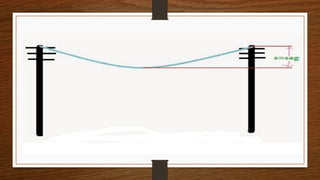
 SAG: The difference in level between points of supports and the lowest
point of conductor called SAG.
ABOUT SAG (Cont..)

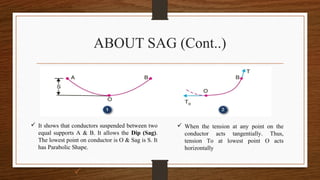
 It shows that conductors suspended between two
equal supports A & B. It allows the Dip (Sag).
The lowest point on conductor is O & Sag is S. It
has Parabolic Shape.
 When the tension at any point on the
conductor acts tangentially. Thus,
tension To at lowest point O acts
horizontally
DIFFERENT TYPES OF SAG
 There are basically 2 types of Sag are available:
1. When supports are at Equal levels,
2. When supports are at Unequal levels.
 Low conductor tension and minimum sag are not possible. Because, low
Sag means a tight wire and high tension, whereas low Tension means a
loose wire and increased Sag.
CALCULATION OF SAG
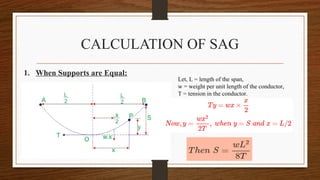
1. When Supports are Equal:
Let, L = length of the span,
w = weight per unit length of the conductor,
T = tension in the conductor.
CALCULATION OF SAG (Cont..)
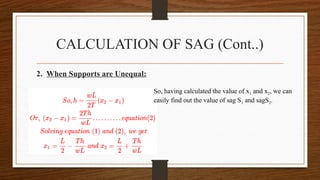
2. When Supports are Unequal: L = Span of the conductor,
h = difference in height level between two supports,
x1 = distance of support at the lower level point A from O,
x2 = distance of support at the upper level point B from O,
T = tension of the conductor,
w = weight per unit length of the conductor.
CALCULATION OF SAG (Cont..)
2. When Supports are Unequal:
So, having calculated the value of x1 and x2, we can
easily find out the value of sag S1 and sagS2.
ICE AND WIND LOADING
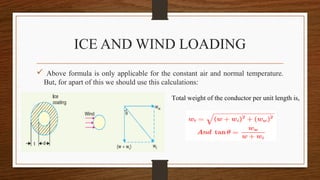
 Above formula is only applicable for the constant air and normal temperature.
But, for apart of this we should use this calculations:
Total weight of the conductor per unit length is,
ICE AND WIND LOADING (Cont..)
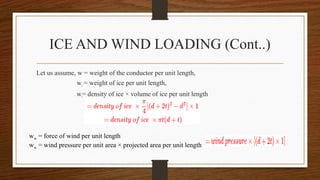
Let us assume, w = weight of the conductor per unit length,
wi = weight of ice per unit length,
wi= density of ice × volume of ice per unit length
ww = force of wind per unit length
ww = wind pressure per unit area × projected area per unit length
ICE AND WIND LOADING (Cont..)
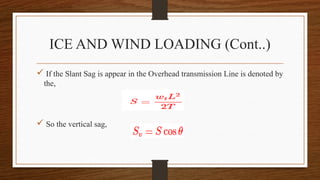
 If the Slant Sag is appear in the Overhead transmission Line is denoted by
the,
 So the vertical sag,
EFFECT OF ICE & WIND LOADING
 Effect as follows:
 The weight per unit length of the conductor is changed when wind blows at a certain force on the
conductor and ice accumulate around the conductor.
 Wind force acts on a conductors to change the conductor self weight per unit length horizontally in
direction of the air flow.
 Ice loading acts on the conductors to change the conductor self weight per unit length vertically in
direction of the air flow. Resulting weight is all then downward directions.
WHY SAG IN TRANSMISSION LINES??
 The Sag is as a result of the Tensioning of the line and must not be too low otherwise the
safety clearances may not be met. Also, it has effects of Ice, Wind or Temperature on it.
 If the Sag is large, and the line becomes heavily loaded, then the sag will further increase
and breach the safety clearances. Similarly, if the Sag is low, then when the line contracts in
the winter, low sag will indicate a high tension, and as a result of this contraction, the line
may snap.
 So, Sag is inversely proportional to Tension.
 STRINGING CHARGE: It is the proportional ratio of the Temperature and Depth of
Sag.
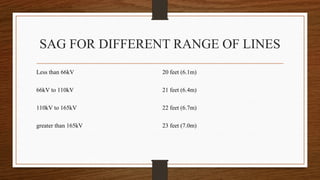
SAG FOR DIFFERENT RANGE OF LINES
Less than 66kV 20 feet (6.1m)
66kV to 110kV 21 feet (6.4m)
110kV to 165kV 22 feet (6.7m)
greater than 165kV 23 feet (7.0m)
ADVANTAGE & DISADVANTAGE OF
SAG
 ADVANTAGES OF SAG:
 Sag determines the value of safe working tension and the minimum clearance of
the conductor with respect to ground.
 The conductor sag should be kept to a minimum in order to reduce the conductor
material required and to avoid extra pole height for sufficient clearance above
ground level.
 DISADVANTAGE OF SAG:
 If the Sag is too small then the Tension between two supports will increases so,
it leads to break the conductors.
REFERENCES
 www.Wikipedia.org/Sag
 http://www.electrical4u.com/sag-in-overhead-conductor
 www.electricaledition.com/sag-and-tension
CONCLUSION
 By refer this theory, we are come on that point to understand and get
importance about the SAG in Overhead Transmission Lines. It is one of
the necessary part among that all.
 If, any of the lines doesn’t have the SAG in it, it may be break out or may
be falls out with the poles in any time.
Sag calculation

Sag calculation

  • 1.
    GANDHINAGAR INSTITUTE OF TECHNOLOGY ElectricalPower System- 1 (2150908) TOPIC: SAG CALCULATION GUIDED BY: Prof. Yogesh Patel BRANCH: Electrical BATCH: B-2
  • 3.
    GROUP MEMBERS NAME ENROLLMENTNO. Patel Ashutosh 140120109029 Patel Krupal 140120109034 Raval Vrajesh 140120109047 Shah Darshil 140120109050
  • 4.
    CONTENTS  Introduction  AboutSAG  Different types of SAG  Calculation of SAG  Why SAG in Transmission Lines??  Advantage and Disadvantage of SAG  References  Conclusion
  • 5.
    INTRODUCTION  In Indiaand another foreign countries have referred the Overhead Transmission Lines for maintaining the Power Supply to the distributed areas.  Sag is a fundamental content of the Overhead Lines. Also, overhead transmission lines has very economical and has better safety rather than Underground Cables.
  • 6.
    ABOUT SAG  Whiletalking about Overhead Lines, it is very important that conductors are under safe tension. If, conductors are too much stretched between the supports, stress may reach in unsafe values and certain cases conductor may break due to excessive tension.  In order to permit the safe tension in conductors, they are not fully stretched but have a Dip or Sag.  SAG: The difference in level between points of supports and the lowest point of conductor called SAG.
  • 7.
    ABOUT SAG (Cont..)  It shows that conductors suspended between two equal supports A & B. It allows the Dip (Sag). The lowest point on conductor is O & Sag is S. It has Parabolic Shape.  When the tension at any point on the conductor acts tangentially. Thus, tension To at lowest point O acts horizontally
  • 8.
    DIFFERENT TYPES OFSAG  There are basically 2 types of Sag are available: 1. When supports are at Equal levels, 2. When supports are at Unequal levels.  Low conductor tension and minimum sag are not possible. Because, low Sag means a tight wire and high tension, whereas low Tension means a loose wire and increased Sag.
  • 9.
    CALCULATION OF SAG 1.When Supports are Equal: Let, L = length of the span, w = weight per unit length of the conductor, T = tension in the conductor.
  • 10.
    CALCULATION OF SAG(Cont..) 2. When Supports are Unequal: L = Span of the conductor, h = difference in height level between two supports, x1 = distance of support at the lower level point A from O, x2 = distance of support at the upper level point B from O, T = tension of the conductor, w = weight per unit length of the conductor.
  • 11.
    CALCULATION OF SAG(Cont..) 2. When Supports are Unequal: So, having calculated the value of x1 and x2, we can easily find out the value of sag S1 and sagS2.
  • 12.
    ICE AND WINDLOADING  Above formula is only applicable for the constant air and normal temperature. But, for apart of this we should use this calculations: Total weight of the conductor per unit length is,
  • 13.
    ICE AND WINDLOADING (Cont..) Let us assume, w = weight of the conductor per unit length, wi = weight of ice per unit length, wi= density of ice × volume of ice per unit length ww = force of wind per unit length ww = wind pressure per unit area × projected area per unit length
  • 14.
    ICE AND WINDLOADING (Cont..)  If the Slant Sag is appear in the Overhead transmission Line is denoted by the,  So the vertical sag,
  • 15.
    EFFECT OF ICE& WIND LOADING  Effect as follows:  The weight per unit length of the conductor is changed when wind blows at a certain force on the conductor and ice accumulate around the conductor.  Wind force acts on a conductors to change the conductor self weight per unit length horizontally in direction of the air flow.  Ice loading acts on the conductors to change the conductor self weight per unit length vertically in direction of the air flow. Resulting weight is all then downward directions.
  • 16.
    WHY SAG INTRANSMISSION LINES??  The Sag is as a result of the Tensioning of the line and must not be too low otherwise the safety clearances may not be met. Also, it has effects of Ice, Wind or Temperature on it.  If the Sag is large, and the line becomes heavily loaded, then the sag will further increase and breach the safety clearances. Similarly, if the Sag is low, then when the line contracts in the winter, low sag will indicate a high tension, and as a result of this contraction, the line may snap.  So, Sag is inversely proportional to Tension.  STRINGING CHARGE: It is the proportional ratio of the Temperature and Depth of Sag.
  • 17.
    SAG FOR DIFFERENTRANGE OF LINES Less than 66kV 20 feet (6.1m) 66kV to 110kV 21 feet (6.4m) 110kV to 165kV 22 feet (6.7m) greater than 165kV 23 feet (7.0m)
  • 18.
    ADVANTAGE & DISADVANTAGEOF SAG  ADVANTAGES OF SAG:  Sag determines the value of safe working tension and the minimum clearance of the conductor with respect to ground.  The conductor sag should be kept to a minimum in order to reduce the conductor material required and to avoid extra pole height for sufficient clearance above ground level.  DISADVANTAGE OF SAG:  If the Sag is too small then the Tension between two supports will increases so, it leads to break the conductors.
  • 19.
  • 20.
    CONCLUSION  By referthis theory, we are come on that point to understand and get importance about the SAG in Overhead Transmission Lines. It is one of the necessary part among that all.  If, any of the lines doesn’t have the SAG in it, it may be break out or may be falls out with the poles in any time.