June 6/13/05 IEEE TP&C Tutorial
Sag-tension Calculations
A Tutorial Developed for the IEEE
TP&C Line Design Subcommittee
Based on a CIGRE WG B2.12 Technical
Brochure under Development
Dale Douglass June, 2005
June 6/13/05 IEEE TP&C Tutorial
CIGRE & IEEE Websites
• CIGRE WG B2.12 – Electrical Effects in Lines
http://www.geocities.com/wg_12/index.htm
– Technical Brochure 244 – Conductors for Uprating of
Existing Lines
– Probabilistic Ratings & Joints
• IEEE Towers Poles & Conductors
http://www.geocities.com/ieee_tpc/index.htm
– IEEE Standard 738 – 1993
– Panel Sessions Jan 28 (Las Vegas) June 4 (SF)
June 6/13/05 IEEE TP&C Tutorial
Sag-tension Envelope
GROUND LEVEL
Minimum Electrical
Clearance
Initial Installed Sag @15C
Final Unloaded Sag @15C
Sag @ Max Ice/Wind Load
Sag @ Max Electrical
Load, Tmax
Span Length
June 6/13/05 IEEE TP&C Tutorial
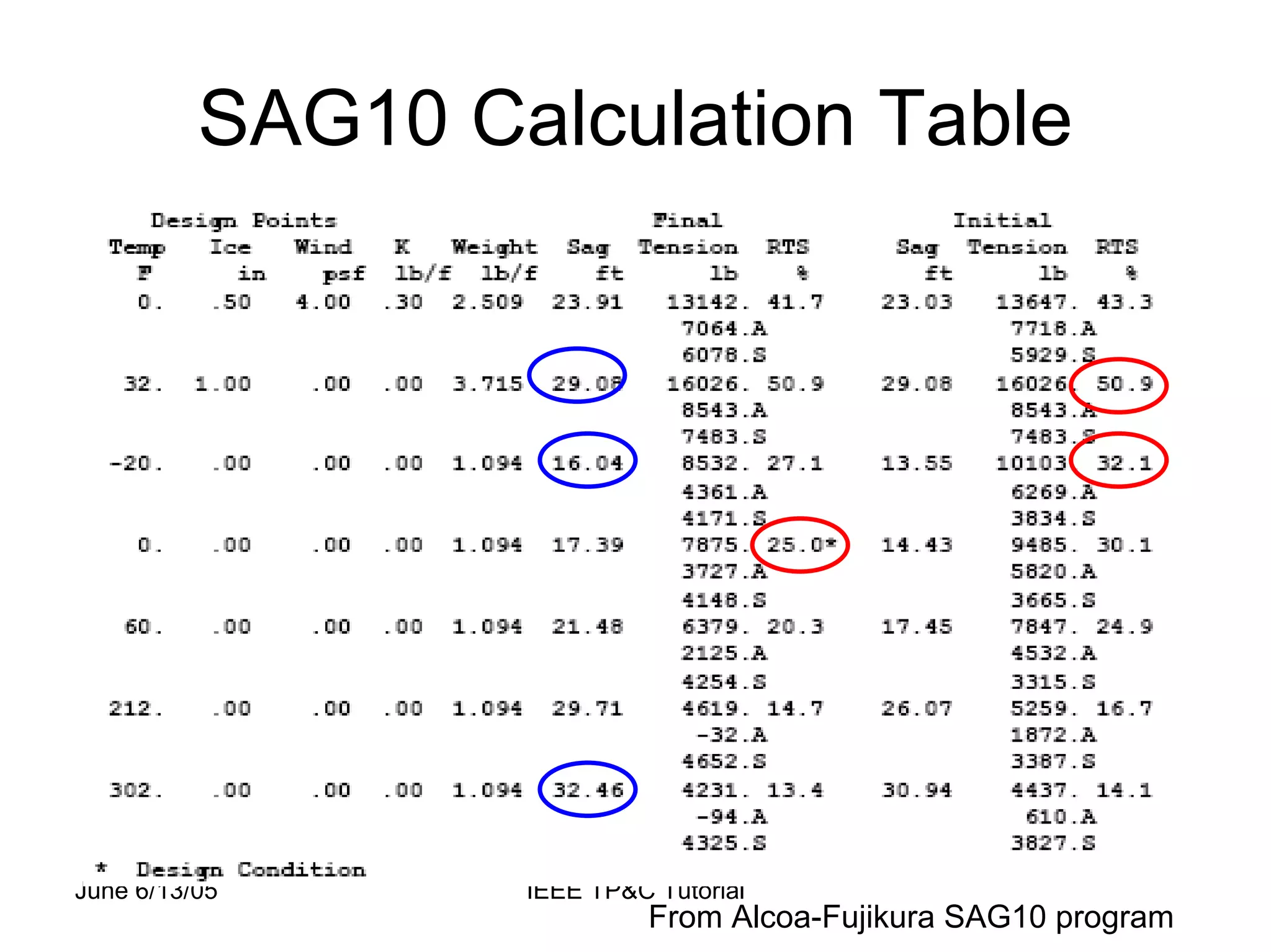
SAG10 Calculation Table
From Alcoa-Fujikura SAG10 program
June 6/13/05 IEEE TP&C Tutorial
A Bit of Perspective
IPC measurements, 1997
10
15
20
25
30
35
40
45
50
55
60
1 2 3 4 5 6 7 8 9 10 11 12 13
measurement number
degC
Tcdr (IEEE)
Tcdr (meas)
Tcdr (H) - AW eq1
Tcdr (H) - AW eq2
Tcdr_measured is
much higher than
predicted with
alumoweld model (H-
based) or weather
based model for these
3 points. Why?
data_during_tempmeas.xls
?
10C-15C Uncertainty
June 6/13/05 IEEE TP&C Tutorial
Some Questions
• Why can we do calculations for a single
span and use for an entire line section?
• How are initial and final conditions
defined?
• Why not run the maximum tension to 60%
as the NESC Code allows?
• Why do I see negative tensions
(compression) in aluminum at high
temperature?
June 6/13/05 IEEE TP&C Tutorial
The Catenary Curve
• HyperbolicFunctions & Parabolas
• Sag vs weight & tension
• Length between supports
• What is Slack?
• What if the span isn’t level?
June 6/13/05 IEEE TP&C Tutorial
The Catenary – Level Span
H
xw
H
xw
w
H
xy
⋅
⋅
⎥
⎦
⎤
⎢
⎣
⎡
−⎟
⎠
⎞
⎜
⎝
⎛ ⋅
⋅= ≅
2
2
1cosh)(
H
Sw
H
Sw
w
H
D
⋅
⋅
≅
⎭
⎬
⎫
⎩
⎨
⎧
−⎟
⎠
⎞
⎜
⎝
⎛
⋅
⋅
⋅=
8
1
2
cosh
2
⎟⎟
⎠
⎞
⎜⎜
⎝
⎛
≅⎟
⎠
⎞
⎜
⎝
⎛
⎟
⎠
⎞
⎜
⎝
⎛
H24
wS+1S
2H
Sw
sinh
w
2H
=L 2
22
June 6/13/05 IEEE TP&C Tutorial
Catenary Sample Calcs
for Drake ACSR
m)(2.38ft7.8=D 731
63002
600094.1
cosh
094.1
6300
=⎥
⎦
⎤
⎢
⎣
⎡
⎟
⎠
⎞
⎜
⎝
⎛
⋅
⋅
m)(182.96ft600.27==L 32
6300*2
600*094.1
sinh
094.1
6300*2
⎟
⎠
⎞
⎜
⎝
⎛
- 1.094 lbs/ft Bare Weight
- 31,500 lbs Rated Breaking Strength
- 600 ft span
June 6/13/05 IEEE TP&C Tutorial
Catenary Calculations
What Happens when the weight of
the conductor changes
June 6/13/05 IEEE TP&C Tutorial
Ice & Wind Loading
• Radial ice (Quebec)
• Wind Pressure (Florida)
• Wind & Ice Combined (Illinois)
June 6/13/05 IEEE TP&C Tutorial
What about changes in loading?
June 6/13/05 IEEE TP&C Tutorial
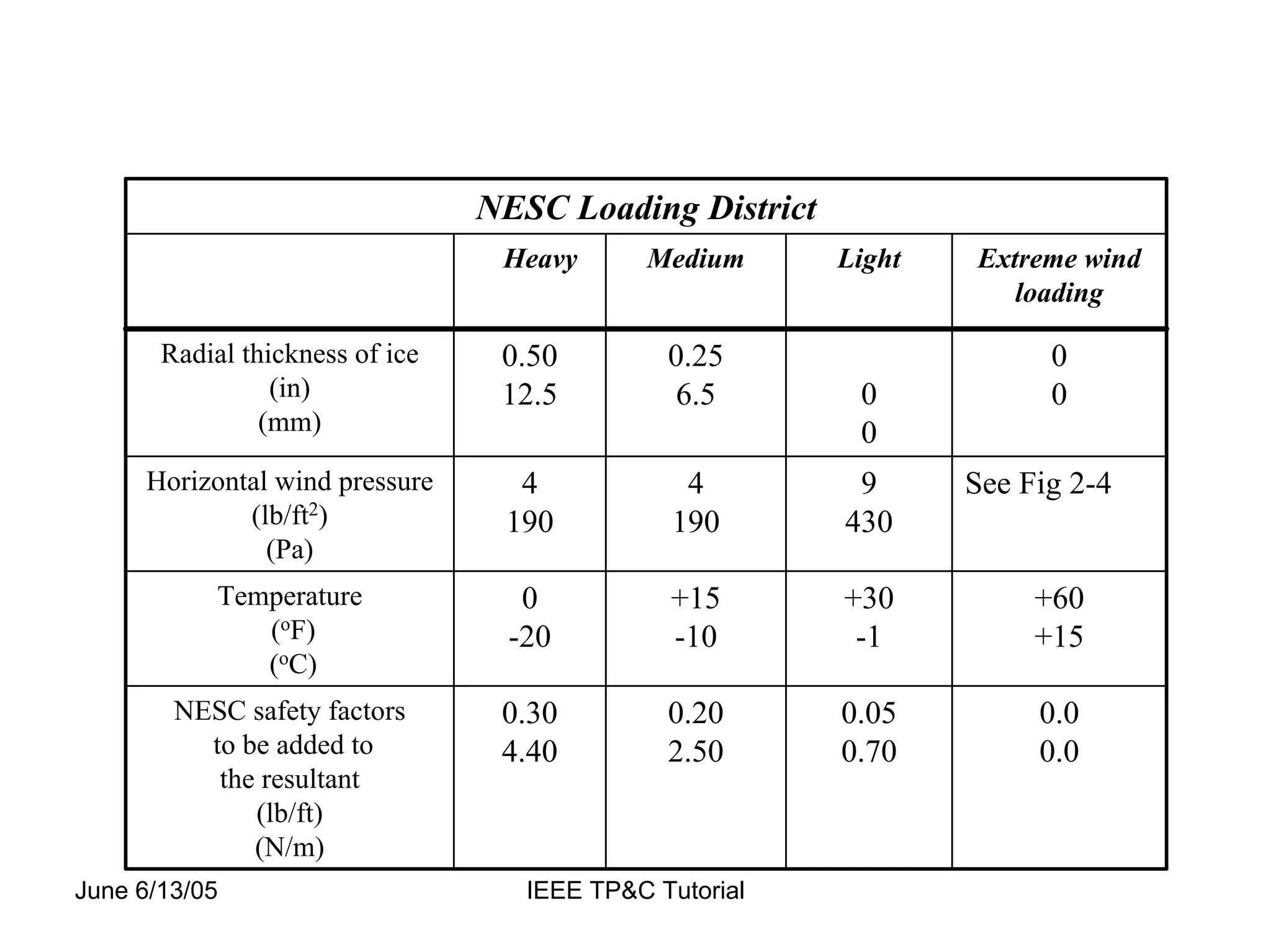
NESC Loading District
Heavy Medium Light Extreme wind
loading
Radial thickness of ice
(in)
(mm)
0.50
12.5
0.25
6.5 0
0
0
0
Horizontal wind pressure
(lb/ft2)
(Pa)
4
190
4
190
9
430
See Fig 2-4
Temperature
(oF)
(oC)
0
-20
+15
-10
+30
-1
+60
+15
NESC safety factors
to be added to
the resultant
(lb/ft)
(N/m)
0.30
4.40
0.20
2.50
0.05
0.70
0.0
0.0
June 6/13/05 IEEE TP&C Tutorial
Iced Conductor Weight
ACSR
Conductor
Dc,
in
wbare,
lb/ft
wice,
lb/ft
wbare + wice
wbare
#1/0 AWG -6/1
“Raven”
0.398 0.1452 0.559 4.8
477 kcmil-26/7
“Hawk”
0.858 0.6570 0.845 2.3
1590 kcmil-54/19
“Falcon"
1.545 2.044 1.272 1.6
)t+D(1.244t=w cice
June 6/13/05 IEEE TP&C Tutorial
What happens when the conductor
weight changes?
• Bare weight of Drake ACSR is 1.094 lb/ft
• Iced weight is:
– 1.094 + 1.244*1.0*(1.108+1.0) = 3.60 lb/ft
• Tension increases by a factor of 3.6
unless the length of the conductor
changes.
June 6/13/05 IEEE TP&C Tutorial
SAG10 Calculation Table
From Alcoa-Fujikura SAG10 program
June 6/13/05 IEEE TP&C Tutorial
Conductor tension limits
• Avoiding tension failure (Safety factor)
• Limiting vibration (H/w, %RBS)
• Designing with less sag
June 6/13/05 IEEE TP&C Tutorial
Tension Limits and Sag
Tension at 15C
unloaded initial
- %RTS
Tension at max
ice and wind
load - %RTS
Tension at max
ice and wind
load - kN
Initial Sag at
100C - meters
Final Sag at
100C - meters
10 22.6 31.6 14.6 14.6
15 31.7 44.4 10.9 11.0
20 38.4 53.8 9.0 9.4
25 43.5 61.0 7.8 8.4
June 6/13/05 IEEE TP&C Tutorial
Conductor Elongation
• Elastic elongation (springs)
• Settlement & Short-term creep (before
sagging)
• Thermal elongation
• Long term creep (After sagging, over
the life of the line)
June 6/13/05 IEEE TP&C Tutorial
Conductor Elongation
Manufactured Length
Thermal
Strain
Elastic
Strain
Long-time
Creep
Strain
Settlement
&1-hr
creep
Strain
June 6/13/05 IEEE TP&C Tutorial
Thermal Elongation
International
Annealed Copper
Standard
Commercial
Hard-Drawn
Copper Wire
Standard
1350-H19
Aluminum
Wire
Galv.
Steel Core
Wire
Conductivity,
% IACS @ 20o
C
100.00 97.00 61.2 8.0
Coefficient of
Linear Expansion
10-6
per o
F
9.4 9.4 12.8 6.4
June 6/13/05 IEEE TP&C Tutorial
5,000
10,000
15,000
20,000
25,000
30,000
35,000
40,000
45,000
0.000 0.050 0.100 0.150 0.200 0.250 0.300 0.350 0.400 0.450
% Strain
5,000
10,000
15,000
20,000
25,000
30,000
35,000
40,000
45,000
0.000 0.050 0.100 0.150 0.200 0.250 0.300 0.350 0.400 0.450
100
200
300
0.000 0.050 0.100 0.150 0.200 0.250 0.300 0.350 0.400 0.450
Stress
[MPa]
% Strain
Stress-Strain Test
30% RBS30% RBS
50% RBS50% RBS
70% RBS70% RBS
One Hour
Modulus
Final
Modulus
Initial
Modulus
0
Courtesy of Southwire Corp.
June 6/13/05 IEEE TP&C Tutorial
Stress-strain & creep elongation curves for 37 strand A1 conductor
0
20000
40000
60000
80000
100000
120000
140000
-0.05 0 0.05 0.1 0.15 0.2 0.25 0.3 0.35 0.4 0.45
Percent Elongation
Stress-kPa
Initial "1-hour"
Aluminum
Final Alum after
load to 122 MPa
6 mo
creep
12 mo
creep
10 yr
creep
Linear Modulus
70% RBS
50% RBS
30% RBS
June 6/13/05 IEEE TP&C Tutorial
Conductor Elongation
• Elastic elongation (reversible)
• Settlement & Short-term creep
(permanent)
• Thermal elongation (reversible)
• Long term creep (permanent after
years or high loads)
June 6/13/05 IEEE TP&C Tutorial
100
80
60
40
20
0
%ofTensileStrength
% Increase in Length
0.10 0.30 0.40 0.500.200.05 0.15 0.25 0.35 0.45
Initial
Settlement
Creep for 1
year
Plastic Elong at
High Tension
June 6/13/05 IEEE TP&C Tutorial
SAG10 Calculation Table
From Alcoa-Fujikura SAG10 program
June 6/13/05 IEEE TP&C Tutorial
What is a ruling span?
June 6/13/05 IEEE TP&C Tutorial
Hspan1 Hspan2
Wspan1
Wspan2Winsul
Pivot
Attachment
Point
Insulator
Length, Li
Tilt
Angle
T
Tension equalization
at suspension points.
The basis of the
ruling span concept.
June 6/13/05 IEEE TP&C Tutorial
The “Ruling Span”
S+----+S+S
S+----+S+S
=RS
n21
3
n
3
2
3
1
• Based on Tension equalization
• Used for Stringing sags
• Sag = (w/8H)*S2
ft
++
++
=RS
333
745
600900600
600900600
=
June 6/13/05 IEEE TP&C Tutorial
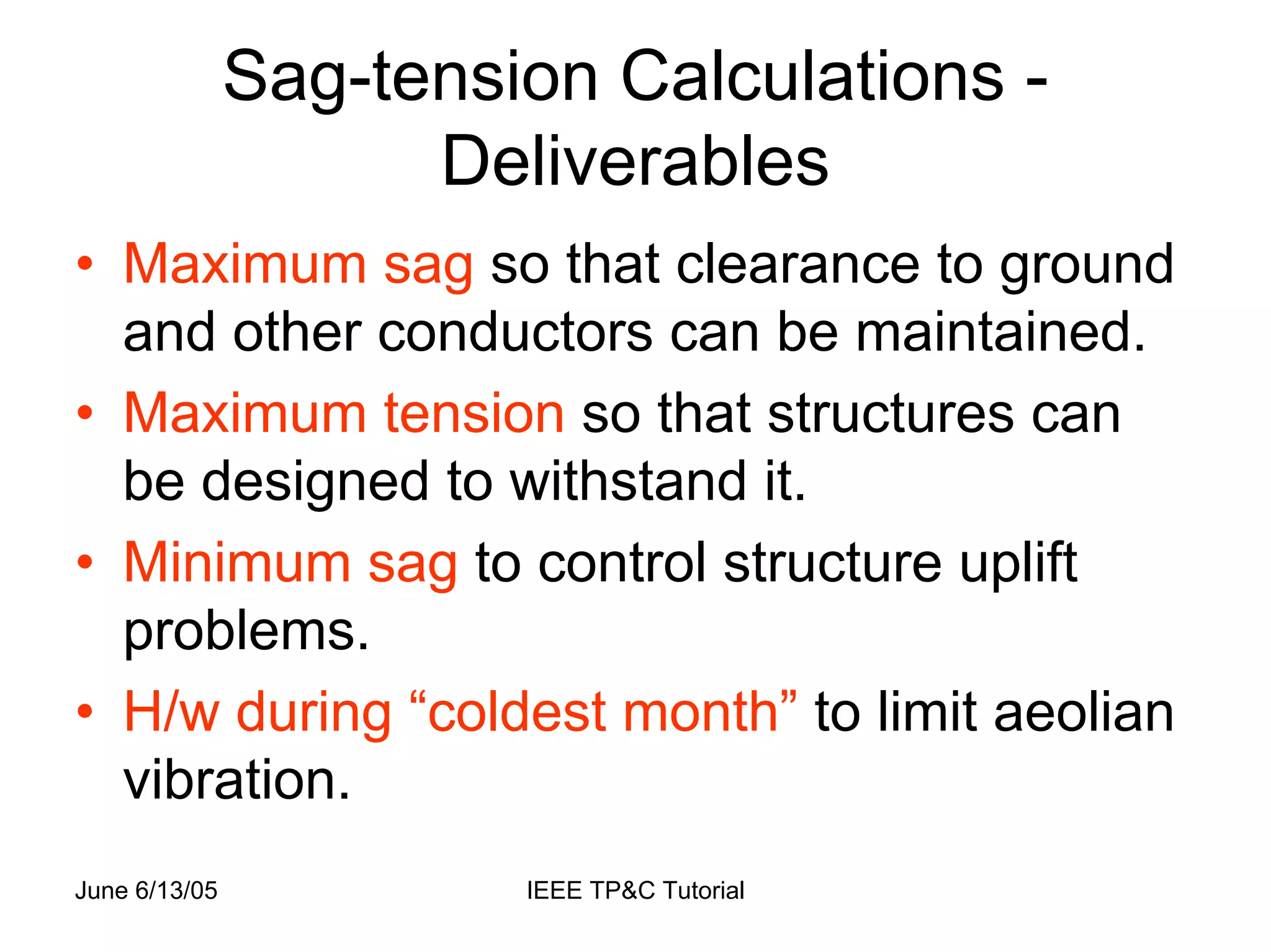
Sag-tension Calculations -
Deliverables
• Maximum sag so that clearance to ground
and other conductors can be maintained.
• Maximum tension so that structures can
be designed to withstand it.
• Minimum sag to control structure uplift
problems.
• H/w during “coldest month” to limit aeolian
vibration.
June 6/13/05 IEEE TP&C Tutorial
Summary of Some Key Points
• Tension equalization between suspension spans
allows use of the ruling span
• Initial and final conditions occur at sagging and
after high loads and multiple years
• For large conductors, max tension is typically
below 60% in order to limit wind vibration & uplift
• Negative tensions (compression) in aluminum
occur at high temperature for ACSR because of
the 2:1 diff in thermal elongation between alum
& steel
June 6/13/05 IEEE TP&C Tutorial
General Sag-Ten References
• Aluminum Association Aluminum Electrical Conductor Handbook Publication No. ECH-56"
• Southwire Company "Overhead Conductor Manual“
• Barrett, JS, Dutta S., and Nigol, O., A New Computer Model of A1/S1A (ACSR) Conductors, IEEE Trans., Vol.
PAS-102, No. 3, March 1983, pp 614-621.
• Varney T., Aluminum Company of America, “Graphic Method for Sag Tension Calculations for A1/S1A (ACSR)
and Other Conductors.”, Pittsburg, 1927
• Winkelman, P.F., “Sag-Tension Computations and Field Measurements of Bonneville Power Administration, AIEE
Paper 59-900, June 1959.
• IEEE Working Group, “Limitations of the Ruling Span Method for Overhead Line Conductors at High Operating
Temperatures”. Report of IEEE WG on Thermal Aspects of Conductors, IEEE WPM 1998, Tampa, FL, Feb. 3,
1998
• Thayer, E.S., “Computing tensions in transmission lines”, Electrical World, Vol.84, no.2, July 12, 1924
• Aluminum Association, “Stress-Strain-Creep Curves for Aluminum Overhead Electrical Conductors,” Published
7/15/74.
• Barrett, JS, and Nigol, O., Characteristics of A1/S1A (ACSR) Conductors as High Temperatures and Stresses,
IEEE Trans., Vol. PAS-100, No. 2, February 1981, pp 485-493
• Electrical Technical Committee of the Aluminum Association, “A Method of Stress-Strain Testing of Aluminum
Conductor and ACSR” and “A Test Method for Determining the Long Time Tensile Creep of Aluminum Conductors
in Overhead Lines”, January, 1999, The aluminum Association, Washington, DC 20006, USA.
• Harvey, JR and Larson RE. Use of Elevated Temperature Creep Data in Sag-Tension Calculations. IEEE Trans.,
Vol. PAS-89, No. 3, pp. 380-386, March 1970
• Rawlins, C.B., “Some Effects of Mill Practice on the Stress-Strain Behaviour of ACSR”, IEEE WPM 1998, Tampa,
FL, Feb. 1998.
June 6/13/05 IEEE TP&C Tutorial
The End
A Sag-tension Tutorial
Prepared for the IEEE TP&C
Subcommittee by Dale Douglass

Sag tension calculations-a_tutorial_deve

  • 1.
    June 6/13/05 IEEETP&C Tutorial Sag-tension Calculations A Tutorial Developed for the IEEE TP&C Line Design Subcommittee Based on a CIGRE WG B2.12 Technical Brochure under Development Dale Douglass June, 2005
  • 2.
    June 6/13/05 IEEETP&C Tutorial CIGRE & IEEE Websites • CIGRE WG B2.12 – Electrical Effects in Lines http://www.geocities.com/wg_12/index.htm – Technical Brochure 244 – Conductors for Uprating of Existing Lines – Probabilistic Ratings & Joints • IEEE Towers Poles & Conductors http://www.geocities.com/ieee_tpc/index.htm – IEEE Standard 738 – 1993 – Panel Sessions Jan 28 (Las Vegas) June 4 (SF)
  • 3.
    June 6/13/05 IEEETP&C Tutorial Sag-tension Envelope GROUND LEVEL Minimum Electrical Clearance Initial Installed Sag @15C Final Unloaded Sag @15C Sag @ Max Ice/Wind Load Sag @ Max Electrical Load, Tmax Span Length
  • 4.
    June 6/13/05 IEEETP&C Tutorial SAG10 Calculation Table From Alcoa-Fujikura SAG10 program
  • 5.
    June 6/13/05 IEEETP&C Tutorial A Bit of Perspective IPC measurements, 1997 10 15 20 25 30 35 40 45 50 55 60 1 2 3 4 5 6 7 8 9 10 11 12 13 measurement number degC Tcdr (IEEE) Tcdr (meas) Tcdr (H) - AW eq1 Tcdr (H) - AW eq2 Tcdr_measured is much higher than predicted with alumoweld model (H- based) or weather based model for these 3 points. Why? data_during_tempmeas.xls ? 10C-15C Uncertainty
  • 6.
    June 6/13/05 IEEETP&C Tutorial Some Questions • Why can we do calculations for a single span and use for an entire line section? • How are initial and final conditions defined? • Why not run the maximum tension to 60% as the NESC Code allows? • Why do I see negative tensions (compression) in aluminum at high temperature?
  • 7.
    June 6/13/05 IEEETP&C Tutorial The Catenary Curve • HyperbolicFunctions & Parabolas • Sag vs weight & tension • Length between supports • What is Slack? • What if the span isn’t level?
  • 8.
    June 6/13/05 IEEETP&C Tutorial The Catenary – Level Span H xw H xw w H xy ⋅ ⋅ ⎥ ⎦ ⎤ ⎢ ⎣ ⎡ −⎟ ⎠ ⎞ ⎜ ⎝ ⎛ ⋅ ⋅= ≅ 2 2 1cosh)( H Sw H Sw w H D ⋅ ⋅ ≅ ⎭ ⎬ ⎫ ⎩ ⎨ ⎧ −⎟ ⎠ ⎞ ⎜ ⎝ ⎛ ⋅ ⋅ ⋅= 8 1 2 cosh 2 ⎟⎟ ⎠ ⎞ ⎜⎜ ⎝ ⎛ ≅⎟ ⎠ ⎞ ⎜ ⎝ ⎛ ⎟ ⎠ ⎞ ⎜ ⎝ ⎛ H24 wS+1S 2H Sw sinh w 2H =L 2 22
  • 9.
    June 6/13/05 IEEETP&C Tutorial Catenary Sample Calcs for Drake ACSR m)(2.38ft7.8=D 731 63002 600094.1 cosh 094.1 6300 =⎥ ⎦ ⎤ ⎢ ⎣ ⎡ ⎟ ⎠ ⎞ ⎜ ⎝ ⎛ ⋅ ⋅ m)(182.96ft600.27==L 32 6300*2 600*094.1 sinh 094.1 6300*2 ⎟ ⎠ ⎞ ⎜ ⎝ ⎛ - 1.094 lbs/ft Bare Weight - 31,500 lbs Rated Breaking Strength - 600 ft span
  • 10.
    June 6/13/05 IEEETP&C Tutorial Catenary Calculations What Happens when the weight of the conductor changes
  • 11.
    June 6/13/05 IEEETP&C Tutorial Ice & Wind Loading • Radial ice (Quebec) • Wind Pressure (Florida) • Wind & Ice Combined (Illinois)
  • 12.
    June 6/13/05 IEEETP&C Tutorial What about changes in loading?
  • 13.
    June 6/13/05 IEEETP&C Tutorial NESC Loading District Heavy Medium Light Extreme wind loading Radial thickness of ice (in) (mm) 0.50 12.5 0.25 6.5 0 0 0 0 Horizontal wind pressure (lb/ft2) (Pa) 4 190 4 190 9 430 See Fig 2-4 Temperature (oF) (oC) 0 -20 +15 -10 +30 -1 +60 +15 NESC safety factors to be added to the resultant (lb/ft) (N/m) 0.30 4.40 0.20 2.50 0.05 0.70 0.0 0.0
  • 14.
    June 6/13/05 IEEETP&C Tutorial Iced Conductor Weight ACSR Conductor Dc, in wbare, lb/ft wice, lb/ft wbare + wice wbare #1/0 AWG -6/1 “Raven” 0.398 0.1452 0.559 4.8 477 kcmil-26/7 “Hawk” 0.858 0.6570 0.845 2.3 1590 kcmil-54/19 “Falcon" 1.545 2.044 1.272 1.6 )t+D(1.244t=w cice
  • 15.
    June 6/13/05 IEEETP&C Tutorial What happens when the conductor weight changes? • Bare weight of Drake ACSR is 1.094 lb/ft • Iced weight is: – 1.094 + 1.244*1.0*(1.108+1.0) = 3.60 lb/ft • Tension increases by a factor of 3.6 unless the length of the conductor changes.
  • 16.
    June 6/13/05 IEEETP&C Tutorial SAG10 Calculation Table From Alcoa-Fujikura SAG10 program
  • 17.
    June 6/13/05 IEEETP&C Tutorial Conductor tension limits • Avoiding tension failure (Safety factor) • Limiting vibration (H/w, %RBS) • Designing with less sag
  • 18.
    June 6/13/05 IEEETP&C Tutorial Tension Limits and Sag Tension at 15C unloaded initial - %RTS Tension at max ice and wind load - %RTS Tension at max ice and wind load - kN Initial Sag at 100C - meters Final Sag at 100C - meters 10 22.6 31.6 14.6 14.6 15 31.7 44.4 10.9 11.0 20 38.4 53.8 9.0 9.4 25 43.5 61.0 7.8 8.4
  • 19.
    June 6/13/05 IEEETP&C Tutorial Conductor Elongation • Elastic elongation (springs) • Settlement & Short-term creep (before sagging) • Thermal elongation • Long term creep (After sagging, over the life of the line)
  • 20.
    June 6/13/05 IEEETP&C Tutorial Conductor Elongation Manufactured Length Thermal Strain Elastic Strain Long-time Creep Strain Settlement &1-hr creep Strain
  • 21.
    June 6/13/05 IEEETP&C Tutorial Thermal Elongation International Annealed Copper Standard Commercial Hard-Drawn Copper Wire Standard 1350-H19 Aluminum Wire Galv. Steel Core Wire Conductivity, % IACS @ 20o C 100.00 97.00 61.2 8.0 Coefficient of Linear Expansion 10-6 per o F 9.4 9.4 12.8 6.4
  • 22.
    June 6/13/05 IEEETP&C Tutorial 5,000 10,000 15,000 20,000 25,000 30,000 35,000 40,000 45,000 0.000 0.050 0.100 0.150 0.200 0.250 0.300 0.350 0.400 0.450 % Strain 5,000 10,000 15,000 20,000 25,000 30,000 35,000 40,000 45,000 0.000 0.050 0.100 0.150 0.200 0.250 0.300 0.350 0.400 0.450 100 200 300 0.000 0.050 0.100 0.150 0.200 0.250 0.300 0.350 0.400 0.450 Stress [MPa] % Strain Stress-Strain Test 30% RBS30% RBS 50% RBS50% RBS 70% RBS70% RBS One Hour Modulus Final Modulus Initial Modulus 0 Courtesy of Southwire Corp.
  • 23.
    June 6/13/05 IEEETP&C Tutorial Stress-strain & creep elongation curves for 37 strand A1 conductor 0 20000 40000 60000 80000 100000 120000 140000 -0.05 0 0.05 0.1 0.15 0.2 0.25 0.3 0.35 0.4 0.45 Percent Elongation Stress-kPa Initial "1-hour" Aluminum Final Alum after load to 122 MPa 6 mo creep 12 mo creep 10 yr creep Linear Modulus 70% RBS 50% RBS 30% RBS
  • 24.
    June 6/13/05 IEEETP&C Tutorial Conductor Elongation • Elastic elongation (reversible) • Settlement & Short-term creep (permanent) • Thermal elongation (reversible) • Long term creep (permanent after years or high loads)
  • 25.
    June 6/13/05 IEEETP&C Tutorial 100 80 60 40 20 0 %ofTensileStrength % Increase in Length 0.10 0.30 0.40 0.500.200.05 0.15 0.25 0.35 0.45 Initial Settlement Creep for 1 year Plastic Elong at High Tension
  • 26.
    June 6/13/05 IEEETP&C Tutorial SAG10 Calculation Table From Alcoa-Fujikura SAG10 program
  • 27.
    June 6/13/05 IEEETP&C Tutorial What is a ruling span?
  • 28.
    June 6/13/05 IEEETP&C Tutorial Hspan1 Hspan2 Wspan1 Wspan2Winsul Pivot Attachment Point Insulator Length, Li Tilt Angle T Tension equalization at suspension points. The basis of the ruling span concept.
  • 29.
    June 6/13/05 IEEETP&C Tutorial The “Ruling Span” S+----+S+S S+----+S+S =RS n21 3 n 3 2 3 1 • Based on Tension equalization • Used for Stringing sags • Sag = (w/8H)*S2 ft ++ ++ =RS 333 745 600900600 600900600 =
  • 30.
    June 6/13/05 IEEETP&C Tutorial Sag-tension Calculations - Deliverables • Maximum sag so that clearance to ground and other conductors can be maintained. • Maximum tension so that structures can be designed to withstand it. • Minimum sag to control structure uplift problems. • H/w during “coldest month” to limit aeolian vibration.
  • 31.
    June 6/13/05 IEEETP&C Tutorial Summary of Some Key Points • Tension equalization between suspension spans allows use of the ruling span • Initial and final conditions occur at sagging and after high loads and multiple years • For large conductors, max tension is typically below 60% in order to limit wind vibration & uplift • Negative tensions (compression) in aluminum occur at high temperature for ACSR because of the 2:1 diff in thermal elongation between alum & steel
  • 32.
    June 6/13/05 IEEETP&C Tutorial General Sag-Ten References • Aluminum Association Aluminum Electrical Conductor Handbook Publication No. ECH-56" • Southwire Company "Overhead Conductor Manual“ • Barrett, JS, Dutta S., and Nigol, O., A New Computer Model of A1/S1A (ACSR) Conductors, IEEE Trans., Vol. PAS-102, No. 3, March 1983, pp 614-621. • Varney T., Aluminum Company of America, “Graphic Method for Sag Tension Calculations for A1/S1A (ACSR) and Other Conductors.”, Pittsburg, 1927 • Winkelman, P.F., “Sag-Tension Computations and Field Measurements of Bonneville Power Administration, AIEE Paper 59-900, June 1959. • IEEE Working Group, “Limitations of the Ruling Span Method for Overhead Line Conductors at High Operating Temperatures”. Report of IEEE WG on Thermal Aspects of Conductors, IEEE WPM 1998, Tampa, FL, Feb. 3, 1998 • Thayer, E.S., “Computing tensions in transmission lines”, Electrical World, Vol.84, no.2, July 12, 1924 • Aluminum Association, “Stress-Strain-Creep Curves for Aluminum Overhead Electrical Conductors,” Published 7/15/74. • Barrett, JS, and Nigol, O., Characteristics of A1/S1A (ACSR) Conductors as High Temperatures and Stresses, IEEE Trans., Vol. PAS-100, No. 2, February 1981, pp 485-493 • Electrical Technical Committee of the Aluminum Association, “A Method of Stress-Strain Testing of Aluminum Conductor and ACSR” and “A Test Method for Determining the Long Time Tensile Creep of Aluminum Conductors in Overhead Lines”, January, 1999, The aluminum Association, Washington, DC 20006, USA. • Harvey, JR and Larson RE. Use of Elevated Temperature Creep Data in Sag-Tension Calculations. IEEE Trans., Vol. PAS-89, No. 3, pp. 380-386, March 1970 • Rawlins, C.B., “Some Effects of Mill Practice on the Stress-Strain Behaviour of ACSR”, IEEE WPM 1998, Tampa, FL, Feb. 1998.
  • 33.
    June 6/13/05 IEEETP&C Tutorial The End A Sag-tension Tutorial Prepared for the IEEE TP&C Subcommittee by Dale Douglass