CDCMALARIA VECTOR CONTROL
Team 09 | Melina Azzouz, Gustavo Gonzalez, Yoonhye Jang,
Daniel Kurniawan, David Lee, Anubhav Nayak, Shubham Shah,
Indira Wildschut
CDC Project Sponsors | Brian Gurbaxani, Julie Thwing
Advisor| Pinar Keskinocak
This document has been created in the framework of a student design project,
and the Georgia Institute of Technology does not officially sanction its content.
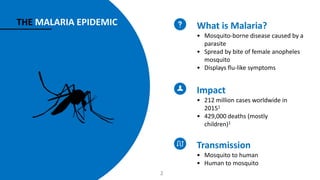
THE MALARIA EPIDEMIC What is Malaria?
• Mosquito-borne disease caused by a
parasite
• Spread by bite of female anopheles
mosquito
• Displays flu-like symptoms
• 212 million cases worldwide in
20151
• 429,000 deaths (mostly
children)1
• Mosquito to human
• Human to mosquito
Impact
Transmission
2
THE CLIENT
Who
Division
Impact
Federal agency dedicated to protecting
health and quality of life
6.8 million lives saved and death rates in
Africa cut in half through CDC collaboration
efforts1
Strategic Applied Science Unit - Malaria Branch
Office of the Associate Director for Science
Founded in 1941 to aid in malaria control efforts2
3
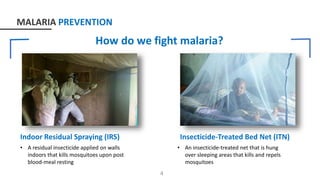
MALARIA PREVENTION
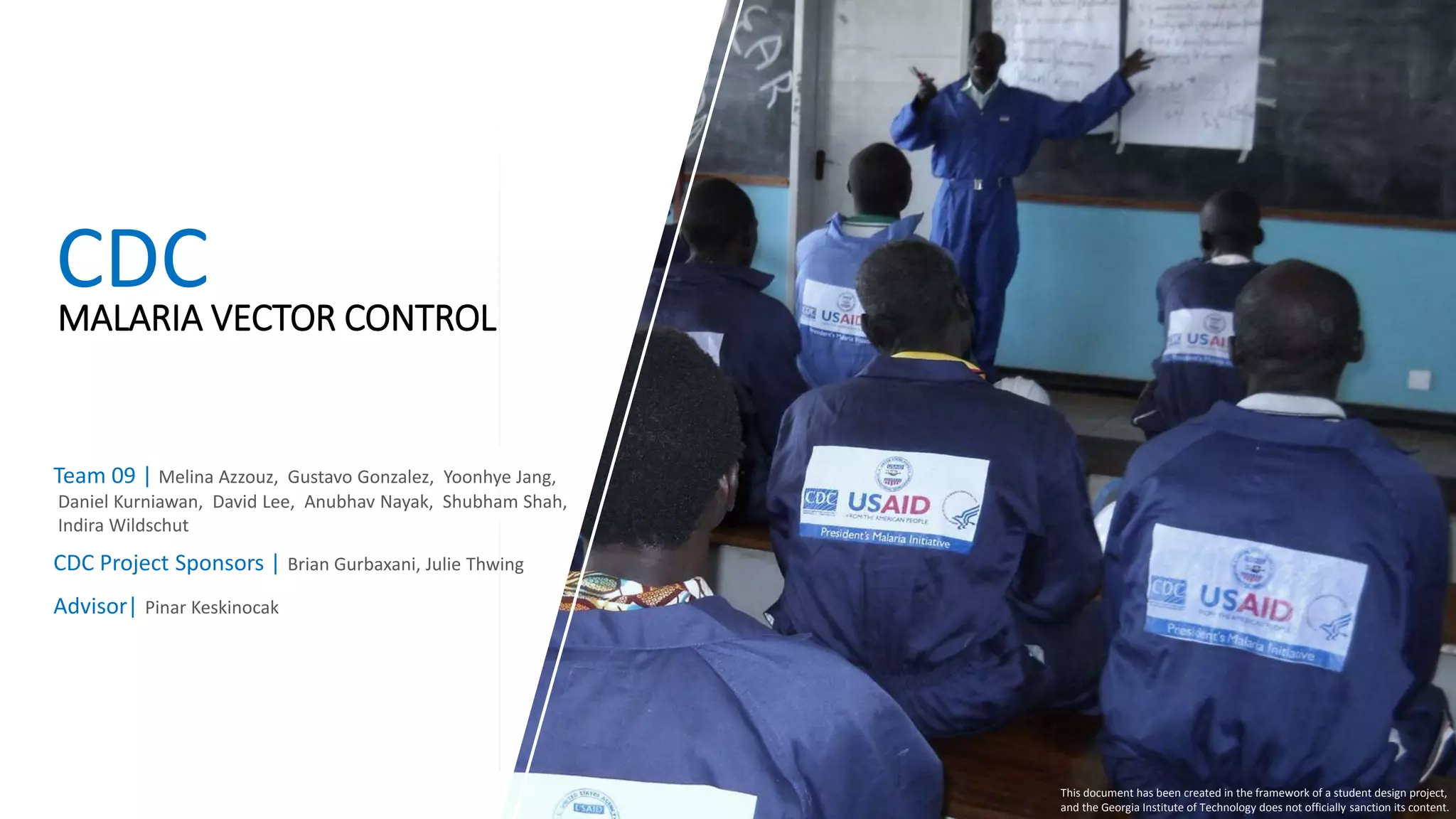
Figure 2: IRS Training
Indoor Residual Spraying (IRS)
• A residual insecticide applied on walls
indoors that kills mosquitoes upon post
blood-meal resting
Insecticide-Treated Bed Net (ITN)
• An insecticide-treated net that is hung
over sleeping areas that kills and repels
mosquitoes
4
How do we fight malaria?
PROJECT OVERVIEW
Problem
Uncertainty surrounding the
effect of current malaria
prevention methods
Focus
Quantify the cost effectiveness
of Indoor Residual Spraying (IRS)
Goal
Aid malaria program managers
in assessing where to implement
IRS and ITNs
5
INDOOR RESIDUAL SPRAYING
Challenges
Figure 2: IRS Training
• Resource-intensive process:
• Labor
• Equipment
• Time
Effectiveness
• Lasts for 2 to 6 months (degrades over time)
• Most effective with high density application,
(>80%)1 before the rainy season
Usage
• 2010: 185 million people protected
worldwide
• 19 countries in Africa
6
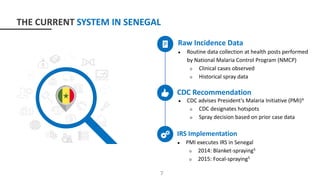
THE CURRENT SYSTEM IN SENEGAL
Raw Incidence Data
● Routine data collection at health posts performed
by National Malaria Control Program (NMCP)
○ Clinical cases observed
○ Historical spray data
● CDC advises President’s Malaria Initiative (PMI)4
○ CDC designates hotspots
○ Spray decision based on prior case data
● PMI executes IRS in Senegal
○ 2014: Blanket-spraying5
○ 2015: Focal-spraying5
IRS Implementation
CDC Recommendation
7
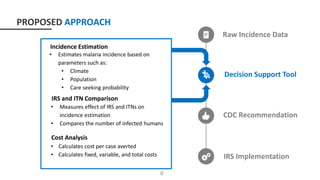
PROPOSED APPROACH
Raw Incidence Data
CDC Recommendation
IRS Implementation
Incidence Estimation
• Estimates malaria incidence based on
parameters such as:
• Climate
• Population
• Care seeking probability
Decision Support Tool
Cost Analysis
• Calculates cost per case averted
• Calculates fixed, variable, and total costs
IRS and ITN Comparison
• Measures effect of IRS and ITNs on
incidence estimation
• Compares the number of infected humans
8
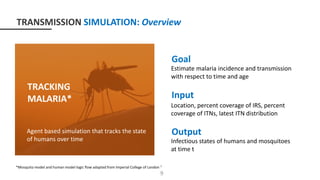
*Mosquito model and human model logic flow adapted from Imperial College of London 7
TRANSMISSION SIMULATION: Overview
Goal
Estimate malaria incidence and transmission
with respect to time and age
Input
Output
Location, percent coverage of IRS, percent
coverage of ITNs, latest ITN distribution
TRACKING
MALARIA*
Agent based simulation that tracks the state
of humans over time Infectious states of humans and mosquitoes
at time t
9
10
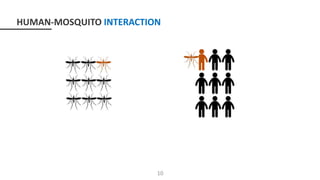
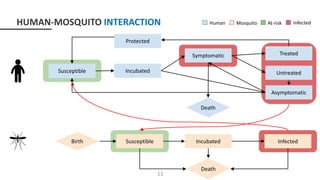
HUMAN-MOSQUITO INTERACTION
Susceptible Incubated Infected
Death
Birth
InfectedHuman Mosquito At-risk
Symptomatic
Susceptible
Protected
Untreated
Treated
Asymptomatic
Incubated
Death
HUMAN-MOSQUITO INTERACTION
11
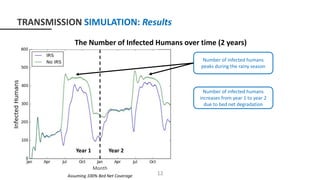
TRANSMISSION SIMULATION: Results
12Assuming 100% Bed Net Coverage
The Number of Infected Humans over time (2 years)
Number of infected humans
increases from year 1 to year 2
due to bed net degradation
Number of infected humans
peaks during the rainy season
Year 1 Year 2
Month
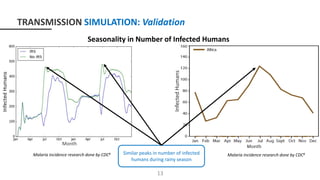
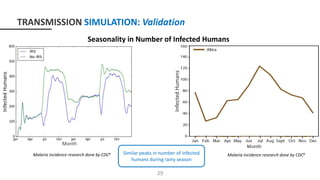
TRANSMISSION SIMULATION: Validation
13
Malaria incidence research done by CDC8
Month
Seasonality in Number of Infected Humans
InfectedHumans
Similar peaks in number of infected
humans during rainy season
Malaria incidence research done by CDC8
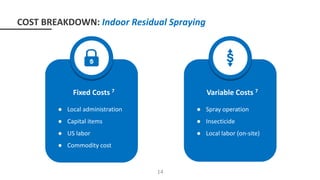
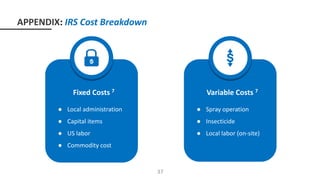
COST BREAKDOWN: Indoor Residual Spraying
Fixed Costs 7
● Local administration
● Capital items
● US labor
● Commodity cost
Variable Costs
Variable Costs 7
● Spray operation
● Insecticide
● Local labor (on-site)
14
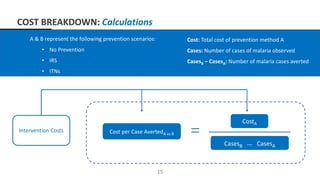
Intervention Costs Cost per Case AvertedA vs B
CostA
CasesB CasesA
A & B represent the following prevention scenarios:
• No Prevention
• IRS
• ITNs
15
Cost: Total cost of prevention method A
Cases: Number of cases of malaria observed
CasesB – CasesA: Number of malaria cases averted
COST BREAKDOWN: Calculations
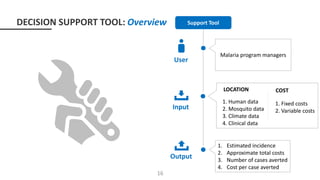
Support Tool
User
Input
Output
Malaria program managers
1. Estimated incidence
2. Approximate total costs
3. Number of cases averted
4. Cost per case averted
LOCATION COST
1. Human data
2. Mosquito data
3. Climate data
4. Clinical data
1. Fixed costs
2. Variable costs
16
DECISION SUPPORT TOOL: Overview
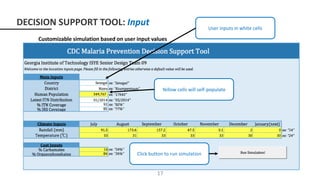
Customizable simulation based on user input values
17
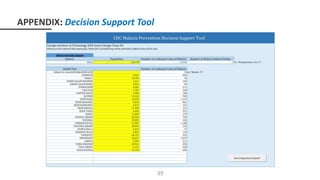
DECISION SUPPORT TOOL: Input User inputs in white cells
Yellow cells will self-populate
Click button to run simulation
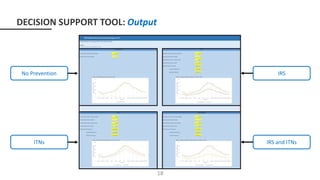
DECISION SUPPORT TOOL: Output
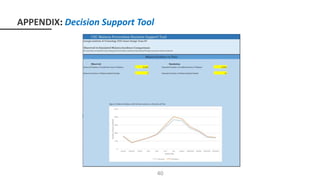
No Prevention
ITNs
IRS
IRS and ITNs
18
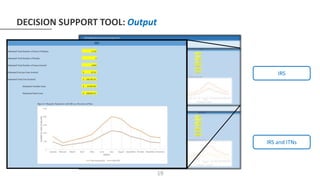
DECISION SUPPORT TOOL: Output
19
No Prevention
ITNs
IRS
IRS and ITNs
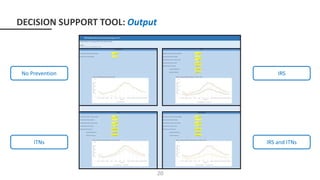
DECISION SUPPORT TOOL: Output
No Prevention
ITNs
IRS
IRS and ITNs
20
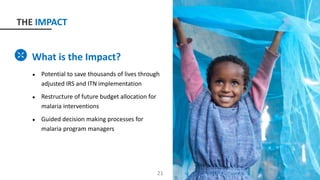
What is the Impact?
● Potential to save thousands of lives through
adjusted IRS and ITN implementation
● Restructure of future budget allocation for
malaria interventions
● Guided decision making processes for
malaria program managers
21
THE IMPACT
1. https://www.cdc.gov/malaria/resources/pdf/fsp/cdc_m
alaria_program_508.pdf
2. https://www.cdc.gov/about/history/ourstory.htm
3. http://apps.who.int/iris/bitstream/10665/69386/1/WH
O_HTM_MAL_2006.1112_eng.pdf
4. https://www.pmi.gov/docs/default-source/default-
document-library/implementing-partner-
reports/senegal-end-of-spray-report-2015.pdf
5. Thwing, Julie (personal communication, August 2, 2017
6. http://journals.plos.org/plosmedicine/article?id=10.137
1/journal.pmed.1000324
7. https://www.pmi.gov/docs/default-source/default-
document-library/implementing-partner-reports/africa-
indoor-residual-spraying-project-pmi-irs-country-
programs-2015-comparative-cost-analysis.pdf?sfvrsn=4
8. https://www.cdc.gov/mmwr/preview/mmwrhtml/ss610
2a1.htm
APPENDIX: Resources
22
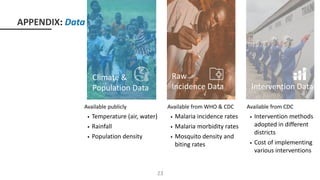
Intervention Data
Raw
Incidence Data
Available publicly
• Temperature (air, water)
• Rainfall
• Population density
Available from WHO & CDC
• Malaria incidence rates
• Malaria morbidity rates
• Mosquito density and
biting rates
Available from CDC
• Intervention methods
adopted in different
districts
• Cost of implementing
various interventions
Climate &
Population Data
APPENDIX: Data
23
Parameter Description Value
H: Relative biting rate [1] The number of bites per human per
day relative to rest of population
Lognormal distribution(1,1.127)
H: Status of Infection [1] Infection status of human at time t Infected, uninfected, protected,
incubated, asymptomatic, dead
H: Probability of Immunity The probability that a human will be
immune to malaria
Normal distribution (max 0.88, min
0.05)
H: Probability of death The probability that a human will die
from malaria
Normal distribution similar to
immunity
H: Probability of death after symptom The probability that a human will die
after showing symptom
0.001
H: Death time Time it takes for a human to die from
malaria
1 -5 days
H: Recovery rate [2] Time it takes for a human to recover
from malaria
Normal(14)
H: Incubation period [3] 𝑛 𝑏 Normal(14)
APPENDIX: Parameters
24
Parameter Description Value
H: Infectious period[3] r 100 days
H: Care seeking probability[4] The probability that a human will visit
a health post
0.4894
H: Initial effect of human biting rate The probability that human biting rate
is effective initially
0.75
H: Age distribution The distribution of human age 0.45 (Under 15)
0.55 (15 - 64)
H: asymptomatic from infected The probability that an infected
human will be asymptomatic
0.75
H: Infectious from asymptomatic The probability that an asymptomatic
human will be infectious
0.80
H: reduction of human biting rate The probability that human biting rate
will be reduced due to ITN
0.90
APPENDIX: Parameters
25
Parameter Description Value
M: Feeding rate a 2-3 bites per day
M: Number of mosquitoes at time 0[5] Initial mosquito population 25 * number of humans in simulation
M: Number of infected mosquitoes at
time 0[5]
Initial infected mosquito population 0.03 * number of mosquitoes
M: Mosquito death rate[6] Death rate based on temperature Discrete distribution
M: Lifespan of mosquitoes 1/g 10 days
M: Feeding probability The probability that a mosquito feeds
on any given day
0.33
ITN Mortality rate The probability that an ITN kills a
mosquito that flies on it
0.30  0.05 (linear decrease)
APPENDIX: Parameters
26
[1] http://journals.plos.org/plosmedicine/article?id=10.1371%2Fjournal.pmed.1000324#s3
[2] https://www.medicinenet.com/is_malaria_contagious/article.htm#what_is_the_incubation_period_for_malaria
[3] https://malariajournal.biomedcentral.com/articles/10.1186/1475-2875-3-13
[4] Calculated using data from CDC(RM NATIONALE PPS DISTRICT_EPS 2014 VINALE.xlsx)
[5] https://www.ncbi.nlm.nih.gov/books/NBK2286/
[6] http://journals.plos.org/plosone/article?id=10.1371/journal.pone.0079276
APPENDIX: Parameter Resources
27
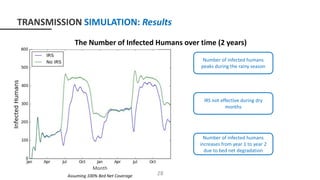
TRANSMISSION SIMULATION: Results
28
IRS not effective during dry
months
Assuming 100% Bed Net Coverage
The Number of Infected Humans over time (2 years)
Number of infected humans
increases from year 1 to year 2
due to bed net degradation
Number of infected humans
peaks during the rainy season
Month
TRANSMISSION SIMULATION: Validation
29
Malaria incidence research done by CDC8
Month
Seasonality in Number of Infected Humans
InfectedHumans
Similar peaks in number of infected
humans during rainy season
Malaria incidence research done by CDC8
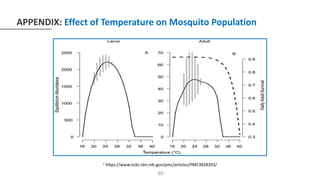
APPENDIX: Effect of Temperature on Mosquito Population
1 https://www.ncbi.nlm.nih.gov/pmc/articles/PMC3828393/
30
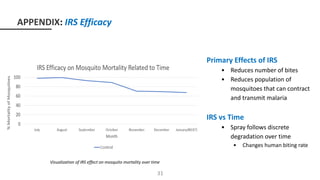
APPENDIX: IRS Efficacy
Primary Effects of IRS
• Reduces number of bites
• Reduces population of
mosquitoes that can contract
and transmit malaria
IRS vs Time
• Spray follows discrete
degradation over time
• Changes human biting rate
Visualization of IRS effect on mosquito mortality over time
31
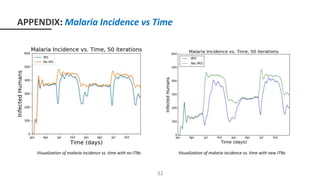
APPENDIX: Malaria Incidence vs Time
Visualization of malaria incidence vs. time with no ITNs
32
Visualization of malaria incidence vs. time with new ITNs
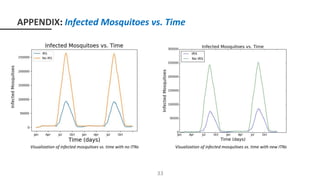
APPENDIX: Infected Mosquitoes vs. Time
Visualization of infected mosquitoes vs. time with no ITNs Visualization of infected mosquitoes vs. time with new ITNs
33
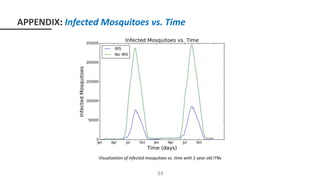
APPENDIX: Infected Mosquitoes vs. Time
Visualization of infected mosquitoes vs. time with 1-year old ITNs
34
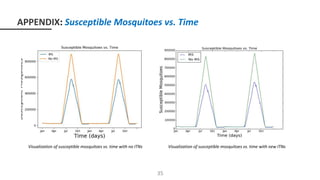
APPENDIX: Susceptible Mosquitoes vs. Time
Visualization of susceptible mosquitoes vs. time with no ITNs Visualization of susceptible mosquitoes vs. time with new ITNs
35
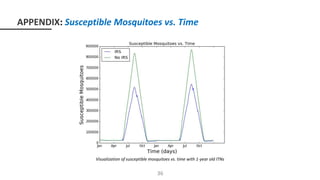
APPENDIX: Susceptible Mosquitoes vs. Time
Visualization of susceptible mosquitoes vs. time with 1-year old ITNs
36
Fixed Costs 7
● Local administration
● Capital items
● US labor
● Commodity cost
Variable Costs
Variable Costs 7
● Spray operation
● Insecticide
● Local labor (on-site)
37
APPENDIX: IRS Cost Breakdown
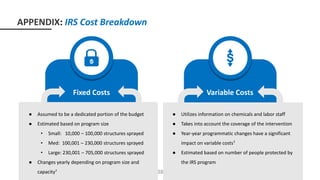
Fixed Costs
● Local administration
● Capital item
● US labor
● Commodity cost
Variable Costs
Variable Costs
● Spray operation
● Insecticide
● Local labor (on-site)
● Assumed to be a dedicated portion of the budget
● Estimated based on program size
• Small: 10,000 – 100,000 structures sprayed
• Med: 100,001 – 230,000 structures sprayed
• Large: 230,001 – 705,000 structures sprayed
● Changes yearly depending on program size and
capacity7
● Utilizes information on chemicals and labor staff
● Takes into account the coverage of the intervention
● Year-year programmatic changes have a significant
impact on variable costs7
● Estimated based on number of people protected by
the IRS program
38
APPENDIX: IRS Cost Breakdown
APPENDIX: Decision Support Tool
39
APPENDIX: Decision Support Tool
40

CDC Malaria Vector Control

  • 1.
    CDCMALARIA VECTOR CONTROL Team09 | Melina Azzouz, Gustavo Gonzalez, Yoonhye Jang, Daniel Kurniawan, David Lee, Anubhav Nayak, Shubham Shah, Indira Wildschut CDC Project Sponsors | Brian Gurbaxani, Julie Thwing Advisor| Pinar Keskinocak This document has been created in the framework of a student design project, and the Georgia Institute of Technology does not officially sanction its content.
  • 2.
    THE MALARIA EPIDEMICWhat is Malaria? • Mosquito-borne disease caused by a parasite • Spread by bite of female anopheles mosquito • Displays flu-like symptoms • 212 million cases worldwide in 20151 • 429,000 deaths (mostly children)1 • Mosquito to human • Human to mosquito Impact Transmission 2
  • 3.
    THE CLIENT Who Division Impact Federal agencydedicated to protecting health and quality of life 6.8 million lives saved and death rates in Africa cut in half through CDC collaboration efforts1 Strategic Applied Science Unit - Malaria Branch Office of the Associate Director for Science Founded in 1941 to aid in malaria control efforts2 3
  • 4.
    MALARIA PREVENTION Figure 2:IRS Training Indoor Residual Spraying (IRS) • A residual insecticide applied on walls indoors that kills mosquitoes upon post blood-meal resting Insecticide-Treated Bed Net (ITN) • An insecticide-treated net that is hung over sleeping areas that kills and repels mosquitoes 4 How do we fight malaria?
  • 5.
    PROJECT OVERVIEW Problem Uncertainty surroundingthe effect of current malaria prevention methods Focus Quantify the cost effectiveness of Indoor Residual Spraying (IRS) Goal Aid malaria program managers in assessing where to implement IRS and ITNs 5
  • 6.
    INDOOR RESIDUAL SPRAYING Challenges Figure2: IRS Training • Resource-intensive process: • Labor • Equipment • Time Effectiveness • Lasts for 2 to 6 months (degrades over time) • Most effective with high density application, (>80%)1 before the rainy season Usage • 2010: 185 million people protected worldwide • 19 countries in Africa 6
  • 7.
    THE CURRENT SYSTEMIN SENEGAL Raw Incidence Data ● Routine data collection at health posts performed by National Malaria Control Program (NMCP) ○ Clinical cases observed ○ Historical spray data ● CDC advises President’s Malaria Initiative (PMI)4 ○ CDC designates hotspots ○ Spray decision based on prior case data ● PMI executes IRS in Senegal ○ 2014: Blanket-spraying5 ○ 2015: Focal-spraying5 IRS Implementation CDC Recommendation 7
  • 8.
    PROPOSED APPROACH Raw IncidenceData CDC Recommendation IRS Implementation Incidence Estimation • Estimates malaria incidence based on parameters such as: • Climate • Population • Care seeking probability Decision Support Tool Cost Analysis • Calculates cost per case averted • Calculates fixed, variable, and total costs IRS and ITN Comparison • Measures effect of IRS and ITNs on incidence estimation • Compares the number of infected humans 8
  • 9.
    *Mosquito model andhuman model logic flow adapted from Imperial College of London 7 TRANSMISSION SIMULATION: Overview Goal Estimate malaria incidence and transmission with respect to time and age Input Output Location, percent coverage of IRS, percent coverage of ITNs, latest ITN distribution TRACKING MALARIA* Agent based simulation that tracks the state of humans over time Infectious states of humans and mosquitoes at time t 9
  • 10.
  • 11.
    Susceptible Incubated Infected Death Birth InfectedHumanMosquito At-risk Symptomatic Susceptible Protected Untreated Treated Asymptomatic Incubated Death HUMAN-MOSQUITO INTERACTION 11
  • 12.
    TRANSMISSION SIMULATION: Results 12Assuming100% Bed Net Coverage The Number of Infected Humans over time (2 years) Number of infected humans increases from year 1 to year 2 due to bed net degradation Number of infected humans peaks during the rainy season Year 1 Year 2 Month
  • 13.
    TRANSMISSION SIMULATION: Validation 13 Malariaincidence research done by CDC8 Month Seasonality in Number of Infected Humans InfectedHumans Similar peaks in number of infected humans during rainy season Malaria incidence research done by CDC8
  • 14.
    COST BREAKDOWN: IndoorResidual Spraying Fixed Costs 7 ● Local administration ● Capital items ● US labor ● Commodity cost Variable Costs Variable Costs 7 ● Spray operation ● Insecticide ● Local labor (on-site) 14
  • 15.
    Intervention Costs Costper Case AvertedA vs B CostA CasesB CasesA A & B represent the following prevention scenarios: • No Prevention • IRS • ITNs 15 Cost: Total cost of prevention method A Cases: Number of cases of malaria observed CasesB – CasesA: Number of malaria cases averted COST BREAKDOWN: Calculations
  • 16.
    Support Tool User Input Output Malaria programmanagers 1. Estimated incidence 2. Approximate total costs 3. Number of cases averted 4. Cost per case averted LOCATION COST 1. Human data 2. Mosquito data 3. Climate data 4. Clinical data 1. Fixed costs 2. Variable costs 16 DECISION SUPPORT TOOL: Overview
  • 17.
    Customizable simulation basedon user input values 17 DECISION SUPPORT TOOL: Input User inputs in white cells Yellow cells will self-populate Click button to run simulation
  • 18.
    DECISION SUPPORT TOOL:Output No Prevention ITNs IRS IRS and ITNs 18
  • 19.
    DECISION SUPPORT TOOL:Output 19 No Prevention ITNs IRS IRS and ITNs
  • 20.
    DECISION SUPPORT TOOL:Output No Prevention ITNs IRS IRS and ITNs 20
  • 21.
    What is theImpact? ● Potential to save thousands of lives through adjusted IRS and ITN implementation ● Restructure of future budget allocation for malaria interventions ● Guided decision making processes for malaria program managers 21 THE IMPACT
  • 22.
    1. https://www.cdc.gov/malaria/resources/pdf/fsp/cdc_m alaria_program_508.pdf 2. https://www.cdc.gov/about/history/ourstory.htm 3.http://apps.who.int/iris/bitstream/10665/69386/1/WH O_HTM_MAL_2006.1112_eng.pdf 4. https://www.pmi.gov/docs/default-source/default- document-library/implementing-partner- reports/senegal-end-of-spray-report-2015.pdf 5. Thwing, Julie (personal communication, August 2, 2017 6. http://journals.plos.org/plosmedicine/article?id=10.137 1/journal.pmed.1000324 7. https://www.pmi.gov/docs/default-source/default- document-library/implementing-partner-reports/africa- indoor-residual-spraying-project-pmi-irs-country- programs-2015-comparative-cost-analysis.pdf?sfvrsn=4 8. https://www.cdc.gov/mmwr/preview/mmwrhtml/ss610 2a1.htm APPENDIX: Resources 22
  • 23.
    Intervention Data Raw Incidence Data Availablepublicly • Temperature (air, water) • Rainfall • Population density Available from WHO & CDC • Malaria incidence rates • Malaria morbidity rates • Mosquito density and biting rates Available from CDC • Intervention methods adopted in different districts • Cost of implementing various interventions Climate & Population Data APPENDIX: Data 23
  • 24.
    Parameter Description Value H:Relative biting rate [1] The number of bites per human per day relative to rest of population Lognormal distribution(1,1.127) H: Status of Infection [1] Infection status of human at time t Infected, uninfected, protected, incubated, asymptomatic, dead H: Probability of Immunity The probability that a human will be immune to malaria Normal distribution (max 0.88, min 0.05) H: Probability of death The probability that a human will die from malaria Normal distribution similar to immunity H: Probability of death after symptom The probability that a human will die after showing symptom 0.001 H: Death time Time it takes for a human to die from malaria 1 -5 days H: Recovery rate [2] Time it takes for a human to recover from malaria Normal(14) H: Incubation period [3] 𝑛 𝑏 Normal(14) APPENDIX: Parameters 24
  • 25.
    Parameter Description Value H:Infectious period[3] r 100 days H: Care seeking probability[4] The probability that a human will visit a health post 0.4894 H: Initial effect of human biting rate The probability that human biting rate is effective initially 0.75 H: Age distribution The distribution of human age 0.45 (Under 15) 0.55 (15 - 64) H: asymptomatic from infected The probability that an infected human will be asymptomatic 0.75 H: Infectious from asymptomatic The probability that an asymptomatic human will be infectious 0.80 H: reduction of human biting rate The probability that human biting rate will be reduced due to ITN 0.90 APPENDIX: Parameters 25
  • 26.
    Parameter Description Value M:Feeding rate a 2-3 bites per day M: Number of mosquitoes at time 0[5] Initial mosquito population 25 * number of humans in simulation M: Number of infected mosquitoes at time 0[5] Initial infected mosquito population 0.03 * number of mosquitoes M: Mosquito death rate[6] Death rate based on temperature Discrete distribution M: Lifespan of mosquitoes 1/g 10 days M: Feeding probability The probability that a mosquito feeds on any given day 0.33 ITN Mortality rate The probability that an ITN kills a mosquito that flies on it 0.30  0.05 (linear decrease) APPENDIX: Parameters 26
  • 27.
    [1] http://journals.plos.org/plosmedicine/article?id=10.1371%2Fjournal.pmed.1000324#s3 [2] https://www.medicinenet.com/is_malaria_contagious/article.htm#what_is_the_incubation_period_for_malaria [3]https://malariajournal.biomedcentral.com/articles/10.1186/1475-2875-3-13 [4] Calculated using data from CDC(RM NATIONALE PPS DISTRICT_EPS 2014 VINALE.xlsx) [5] https://www.ncbi.nlm.nih.gov/books/NBK2286/ [6] http://journals.plos.org/plosone/article?id=10.1371/journal.pone.0079276 APPENDIX: Parameter Resources 27
  • 28.
    TRANSMISSION SIMULATION: Results 28 IRSnot effective during dry months Assuming 100% Bed Net Coverage The Number of Infected Humans over time (2 years) Number of infected humans increases from year 1 to year 2 due to bed net degradation Number of infected humans peaks during the rainy season Month
  • 29.
    TRANSMISSION SIMULATION: Validation 29 Malariaincidence research done by CDC8 Month Seasonality in Number of Infected Humans InfectedHumans Similar peaks in number of infected humans during rainy season Malaria incidence research done by CDC8
  • 30.
    APPENDIX: Effect ofTemperature on Mosquito Population 1 https://www.ncbi.nlm.nih.gov/pmc/articles/PMC3828393/ 30
  • 31.
    APPENDIX: IRS Efficacy PrimaryEffects of IRS • Reduces number of bites • Reduces population of mosquitoes that can contract and transmit malaria IRS vs Time • Spray follows discrete degradation over time • Changes human biting rate Visualization of IRS effect on mosquito mortality over time 31
  • 32.
    APPENDIX: Malaria Incidencevs Time Visualization of malaria incidence vs. time with no ITNs 32 Visualization of malaria incidence vs. time with new ITNs
  • 33.
    APPENDIX: Infected Mosquitoesvs. Time Visualization of infected mosquitoes vs. time with no ITNs Visualization of infected mosquitoes vs. time with new ITNs 33
  • 34.
    APPENDIX: Infected Mosquitoesvs. Time Visualization of infected mosquitoes vs. time with 1-year old ITNs 34
  • 35.
    APPENDIX: Susceptible Mosquitoesvs. Time Visualization of susceptible mosquitoes vs. time with no ITNs Visualization of susceptible mosquitoes vs. time with new ITNs 35
  • 36.
    APPENDIX: Susceptible Mosquitoesvs. Time Visualization of susceptible mosquitoes vs. time with 1-year old ITNs 36
  • 37.
    Fixed Costs 7 ●Local administration ● Capital items ● US labor ● Commodity cost Variable Costs Variable Costs 7 ● Spray operation ● Insecticide ● Local labor (on-site) 37 APPENDIX: IRS Cost Breakdown
  • 38.
    Fixed Costs ● Localadministration ● Capital item ● US labor ● Commodity cost Variable Costs Variable Costs ● Spray operation ● Insecticide ● Local labor (on-site) ● Assumed to be a dedicated portion of the budget ● Estimated based on program size • Small: 10,000 – 100,000 structures sprayed • Med: 100,001 – 230,000 structures sprayed • Large: 230,001 – 705,000 structures sprayed ● Changes yearly depending on program size and capacity7 ● Utilizes information on chemicals and labor staff ● Takes into account the coverage of the intervention ● Year-year programmatic changes have a significant impact on variable costs7 ● Estimated based on number of people protected by the IRS program 38 APPENDIX: IRS Cost Breakdown
  • 39.
  • 40.