Spiking Neural Network (SNN):
A Introduction I
Learning Group (29/Jun/2018)
Dalin Zhang
1
2
3
Spiking Neural Network
Recall
Outline
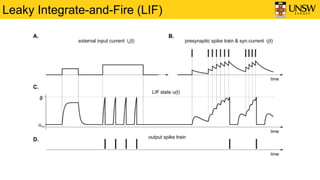
Leaky Integrate-and-Fire (LIF)
4 Encoding Approaches
Recall
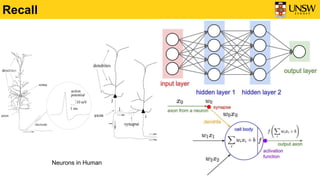
Neurons in Human
Recall
Problem:
• Temporal Information
Recall
Problem:
• React only when receiving a pulse
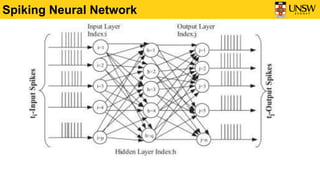
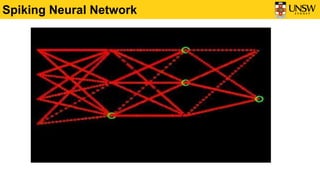
Spiking Neural Network
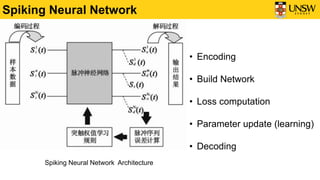
Spiking Neural Network Architecture
• Encoding
• Build Network
• Loss computation
• Parameter update (learning)
• Decoding
Spiking Neural Network
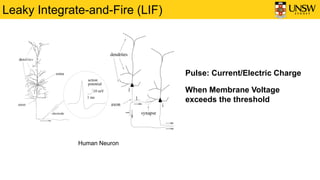
Leaky Integrate-and-Fire (LIF)
Pulse: Current/Electric Charge
When Membrane Voltage
exceeds the threshold
Human Neuron
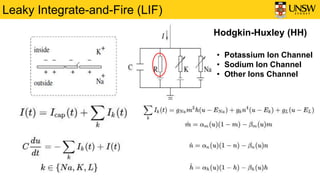
Leaky Integrate-and-Fire (LIF)
• Potassium Ion Channel
• Sodium Ion Channel
• Other Ions Channel
Hodgkin-Huxley (HH)
Leaky Integrate-and-Fire (LIF)
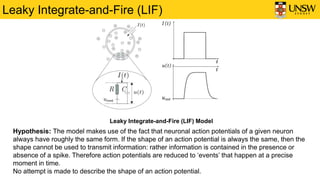
Leaky Integrate-and-Fire (LIF) Model
Hypothesis: The model makes use of the fact that neuronal action potentials of a given neuron
always have roughly the same form. If the shape of an action potential is always the same, then the
shape cannot be used to transmit information: rather information is contained in the presence or
absence of a spike. Therefore action potentials are reduced to ‘events’ that happen at a precise
moment in time.
No attempt is made to describe the shape of an action potential.
Leaky Integrate-and-Fire (LIF)
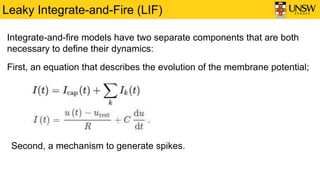
Integrate-and-fire models have two separate components that are both
necessary to define their dynamics:
First, an equation that describes the evolution of the membrane potential;
Second, a mechanism to generate spikes.
Leaky Integrate-and-Fire (LIF)
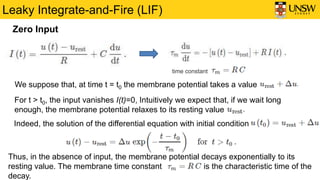
time constant
We suppose that, at time t = t0 the membrane potential takes a value
For t > t0, the input vanishes I(t)=0, Intuitively we expect that, if we wait long
enough, the membrane potential relaxes to its resting value
Indeed, the solution of the differential equation with initial condition
Thus, in the absence of input, the membrane potential decays exponentially to its
resting value. The membrane time constant is the characteristic time of the
decay.
Zero Input
Leaky Integrate-and-Fire (LIF)
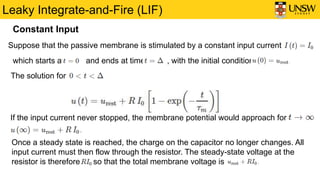
Constant Input
Suppose that the passive membrane is stimulated by a constant input current
which starts at and ends at time , with the initial condition
The solution for
If the input current never stopped, the membrane potential would approach for
Once a steady state is reached, the charge on the capacitor no longer changes. All
input current must then flow through the resistor. The steady-state voltage at the
resistor is therefore so that the total membrane voltage is
Leaky Integrate-and-Fire (LIF)
Pulse Input
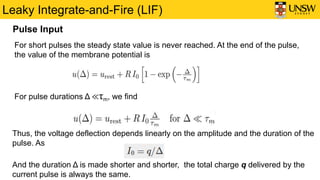
For short pulses the steady state value is never reached. At the end of the pulse,
the value of the membrane potential is
For pulse durations Δ ≪τm, we find
Thus, the voltage deflection depends linearly on the amplitude and the duration of the
pulse. As
And the duration Δ is made shorter and shorter, the total charge q delivered by the
current pulse is always the same.
Leaky Integrate-and-Fire (LIF)
Pulse Input
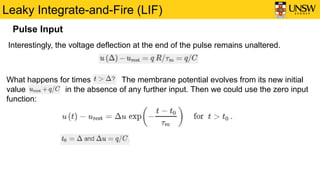
Interestingly, the voltage deflection at the end of the pulse remains unaltered.
What happens for times The membrane potential evolves from its new initial
value in the absence of any further input. Then we could use the zero input
function:
Leaky Integrate-and-Fire (LIF)
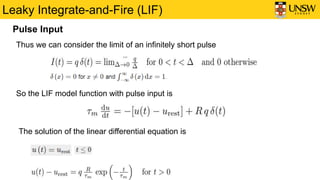
So the LIF model function with pulse input is
The solution of the linear differential equation is
Thus we can consider the limit of an infinitely short pulse
Pulse Input
Leaky Integrate-and-Fire (LIF)
Spike Generation
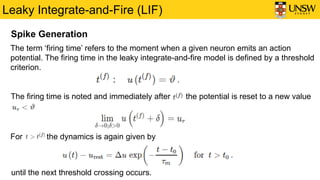
The term ‘firing time’ refers to the moment when a given neuron emits an action
potential. The firing time in the leaky integrate-and-fire model is defined by a threshold
criterion.
The firing time is noted and immediately after the potential is reset to a new value
For the dynamics is again given by
until the next threshold crossing occurs.
Leaky Integrate-and-Fire (LIF)
Encoding Approaches
Rate Encoding
The rate coding model of neuronal firing communication states that as the intensity
of a stimulus increases, the frequency or rate of action potentials, or "spike firing",
increases.
Example:
Figures with 28x28 size, greyscale ([0 255]).
Pixel value as stimuli frequency
Present for 500ms
Pixel with value 20 as 20Hz generates 10 spikes during present duration.
Encoding Approaches
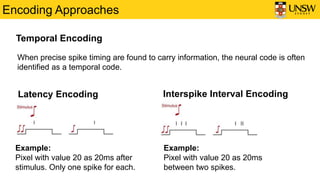
Temporal Encoding
When precise spike timing are found to carry information, the neural code is often
identified as a temporal code.
Latency Encoding
Example:
Pixel with value 20 as 20ms after
stimulus. Only one spike for each.
Interspike Interval Encoding
Example:
Pixel with value 20 as 20ms
between two spikes.
Encoding Approaches
Population Encoding
Population coding is a method to represent stimuli by using the joint activities of a
number of neurons. In population coding, each neuron has a distribution of
responses over some set of inputs, and the responses of many neurons may be
combined to determine some value about the inputs.
Encode an input variable using multiple overlapping Gaussian Receptive Fields
(RF). Gaussian RF are used to generate firing times from real values.
Encoding Approaches
Population Encoding
Encode an input variable using multiple overlapping Gaussian Receptive Fields
(RF). Gaussian RF are used to generate firing times from real values. For a range
[IMax..IMin] of a variable, which is also called the coding interval, a set of m Gaussian
RF neurons are used.
The center Ci and the width σi of each RF neuron i are determined by the
following equations:
Where m is number of receptive fields in each population and γ is a constant
variable usually 1.5.
Encoding Approaches
While converting the activation values of RF into firing times, a threshold ϑ has
been imposed on the activation value. A receptive field that gives an activation
value less than this threshold will be marked as not-firing and the corresponding
input neuron will not contribute to the post-synaptic potential.
Encoding Approaches
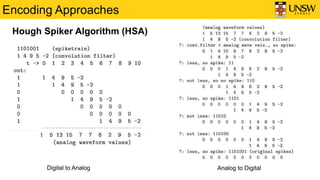
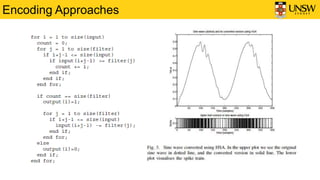
Hough Spiker Algorithm (HSA)
Digital to Analog Analog to Digital
Encoding Approaches
29/06/2018
THANK
YOU

Spiking neural network: an introduction I

  • 1.
    Spiking Neural Network(SNN): A Introduction I Learning Group (29/Jun/2018) Dalin Zhang
  • 2.
    1 2 3 Spiking Neural Network Recall Outline LeakyIntegrate-and-Fire (LIF) 4 Encoding Approaches
  • 3.
  • 4.
  • 5.
    Recall Problem: • React onlywhen receiving a pulse
  • 6.
    Spiking Neural Network SpikingNeural Network Architecture • Encoding • Build Network • Loss computation • Parameter update (learning) • Decoding
  • 7.
  • 8.
  • 9.
    Leaky Integrate-and-Fire (LIF) Pulse:Current/Electric Charge When Membrane Voltage exceeds the threshold Human Neuron
  • 10.
    Leaky Integrate-and-Fire (LIF) •Potassium Ion Channel • Sodium Ion Channel • Other Ions Channel Hodgkin-Huxley (HH)
  • 11.
    Leaky Integrate-and-Fire (LIF) LeakyIntegrate-and-Fire (LIF) Model Hypothesis: The model makes use of the fact that neuronal action potentials of a given neuron always have roughly the same form. If the shape of an action potential is always the same, then the shape cannot be used to transmit information: rather information is contained in the presence or absence of a spike. Therefore action potentials are reduced to ‘events’ that happen at a precise moment in time. No attempt is made to describe the shape of an action potential.
  • 12.
    Leaky Integrate-and-Fire (LIF) Integrate-and-firemodels have two separate components that are both necessary to define their dynamics: First, an equation that describes the evolution of the membrane potential; Second, a mechanism to generate spikes.
  • 13.
    Leaky Integrate-and-Fire (LIF) timeconstant We suppose that, at time t = t0 the membrane potential takes a value For t > t0, the input vanishes I(t)=0, Intuitively we expect that, if we wait long enough, the membrane potential relaxes to its resting value Indeed, the solution of the differential equation with initial condition Thus, in the absence of input, the membrane potential decays exponentially to its resting value. The membrane time constant is the characteristic time of the decay. Zero Input
  • 14.
    Leaky Integrate-and-Fire (LIF) ConstantInput Suppose that the passive membrane is stimulated by a constant input current which starts at and ends at time , with the initial condition The solution for If the input current never stopped, the membrane potential would approach for Once a steady state is reached, the charge on the capacitor no longer changes. All input current must then flow through the resistor. The steady-state voltage at the resistor is therefore so that the total membrane voltage is
  • 15.
    Leaky Integrate-and-Fire (LIF) PulseInput For short pulses the steady state value is never reached. At the end of the pulse, the value of the membrane potential is For pulse durations Δ ≪τm, we find Thus, the voltage deflection depends linearly on the amplitude and the duration of the pulse. As And the duration Δ is made shorter and shorter, the total charge q delivered by the current pulse is always the same.
  • 16.
    Leaky Integrate-and-Fire (LIF) PulseInput Interestingly, the voltage deflection at the end of the pulse remains unaltered. What happens for times The membrane potential evolves from its new initial value in the absence of any further input. Then we could use the zero input function:
  • 17.
    Leaky Integrate-and-Fire (LIF) Sothe LIF model function with pulse input is The solution of the linear differential equation is Thus we can consider the limit of an infinitely short pulse Pulse Input
  • 18.
    Leaky Integrate-and-Fire (LIF) SpikeGeneration The term ‘firing time’ refers to the moment when a given neuron emits an action potential. The firing time in the leaky integrate-and-fire model is defined by a threshold criterion. The firing time is noted and immediately after the potential is reset to a new value For the dynamics is again given by until the next threshold crossing occurs.
  • 19.
  • 20.
    Encoding Approaches Rate Encoding Therate coding model of neuronal firing communication states that as the intensity of a stimulus increases, the frequency or rate of action potentials, or "spike firing", increases. Example: Figures with 28x28 size, greyscale ([0 255]). Pixel value as stimuli frequency Present for 500ms Pixel with value 20 as 20Hz generates 10 spikes during present duration.
  • 21.
    Encoding Approaches Temporal Encoding Whenprecise spike timing are found to carry information, the neural code is often identified as a temporal code. Latency Encoding Example: Pixel with value 20 as 20ms after stimulus. Only one spike for each. Interspike Interval Encoding Example: Pixel with value 20 as 20ms between two spikes.
  • 22.
    Encoding Approaches Population Encoding Populationcoding is a method to represent stimuli by using the joint activities of a number of neurons. In population coding, each neuron has a distribution of responses over some set of inputs, and the responses of many neurons may be combined to determine some value about the inputs. Encode an input variable using multiple overlapping Gaussian Receptive Fields (RF). Gaussian RF are used to generate firing times from real values.
  • 23.
    Encoding Approaches Population Encoding Encodean input variable using multiple overlapping Gaussian Receptive Fields (RF). Gaussian RF are used to generate firing times from real values. For a range [IMax..IMin] of a variable, which is also called the coding interval, a set of m Gaussian RF neurons are used. The center Ci and the width σi of each RF neuron i are determined by the following equations: Where m is number of receptive fields in each population and γ is a constant variable usually 1.5.
  • 24.
    Encoding Approaches While convertingthe activation values of RF into firing times, a threshold ϑ has been imposed on the activation value. A receptive field that gives an activation value less than this threshold will be marked as not-firing and the corresponding input neuron will not contribute to the post-synaptic potential.
  • 25.
    Encoding Approaches Hough SpikerAlgorithm (HSA) Digital to Analog Analog to Digital
  • 26.
  • 27.