HARVEST INDICES FOR
FRUITS
V DIVYADHARSHINI
2015006012
MATURITY INDICES
• Maturity indices are the sign or indication the
readiness of the commodity for harvest.
• It is the basis for determining harvest date.
MATURITY
• The maturity of harvested perishable commodities
has an important bearing on their storage life and
quality and may affect the way they are handled,
transported, and marketed.
Types of maturity
• Horticultural maturity:
• Horticultural maturity is the stage of development
at which a plant or plant part possesses the
prerequisites for use by consumers for a particular
purpose.
• Physiological maturity:
• It refers to the stage in the development of the
fruits and vegetables when maximum growth and
maturation has occurred.
Assessing maturity
• According to Reid (2002), the methods of
determining harvest maturity are as follows
• Physical methods: Size, shape, colour, texture etc.
• Chemical methods: Total Soluble Solids (TSS),
acidity etc.
• Physiological methods: Respiration and ethylene
production.
Some measures of maturity...
• Peel colour - citrus, papaya, pineapple, grapes ,
mango, strawberry.
• Pulp colour - Mango, apple
• Size - citrus, apple , pear
• Shape - banana, pineapple, litchi, mango
• Drying of plant parts - banana
• Surface characteristics - melon, mango
• Ease of separation from plants - musk melon, grape
, mango(tapka stage)
• Tapping - watermelon
• Aroma - jackfruit
• Specific gravity - Mango, pineapple, guava
• Firmness - Melons, apple, pear
• Sugars - Melon and grapes
• TSS - Grapes, sweet orange, papaya
• Acidity - Citrus, mango, pineapple
• Starch index - apple, pear, banana
• Juice content - Citrus
• Heat units - Mango, grape, apple , pear
• Days from anthesis - Melons, pineapple
• Days from full bloom - mango, citrus, apple, pear
• Days from fruit set - banana, mango
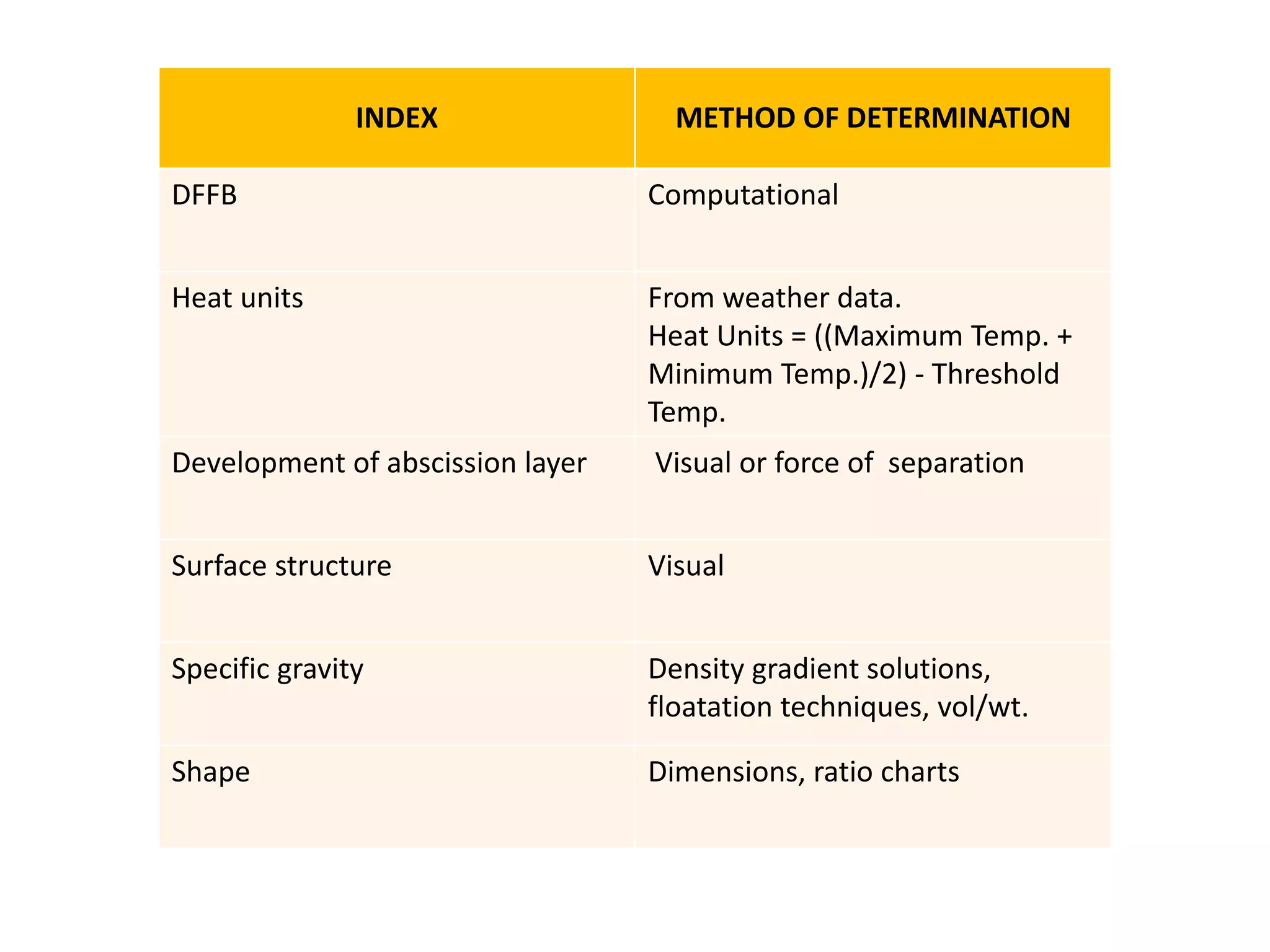
INDEX METHOD OF DETERMINATION
DFFB Computational
Heat units From weather data.
Heat Units = ((Maximum Temp. +
Minimum Temp.)/2) - Threshold
Temp.
Development of abscission layer Visual or force of separation
Surface structure Visual
Specific gravity Density gradient solutions,
floatation techniques, vol/wt.
Shape Dimensions, ratio charts
Textural properties
Firmness Firmness tester
Tenderness Tendrometer
Toughness fibrometer ( also chemical
methods for determining
polysaccharides)
Colour external Light reflectance, visual colour
charts
Internal colour Light transmittance, visual
examination
Compositional factors
Starch content KI test
Sugar content Hand refractometer, chemical test
Acid content Titration, chemical test
Juice content
Oil content
Extraction
Extraction, chemical test
Tannin content Ferric chloride test, lead acetate
test
Internal ethylene Gas chromatography
Electrical Characteristics Peach (unripe 550,ripe150 Hertz)
Electormagnetic – Nuclear magnetic
resonance (NMR)
Apple, banana, avocado peach, pear,
onion
Near-Infrared reflectance (400-2500
nm)
Mango, pineapple
Firmness tester
Handheld refractometer
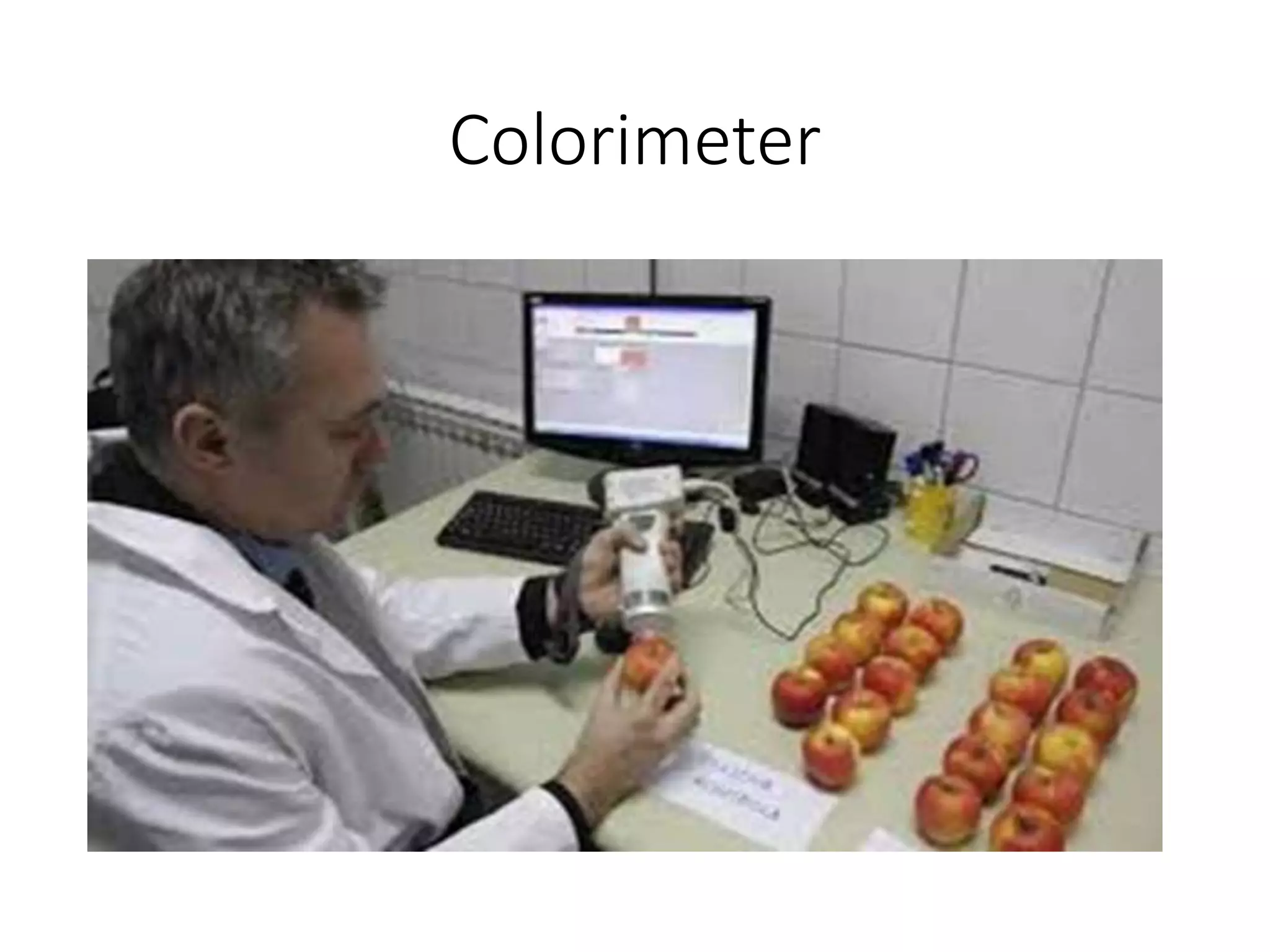
Colorimeter
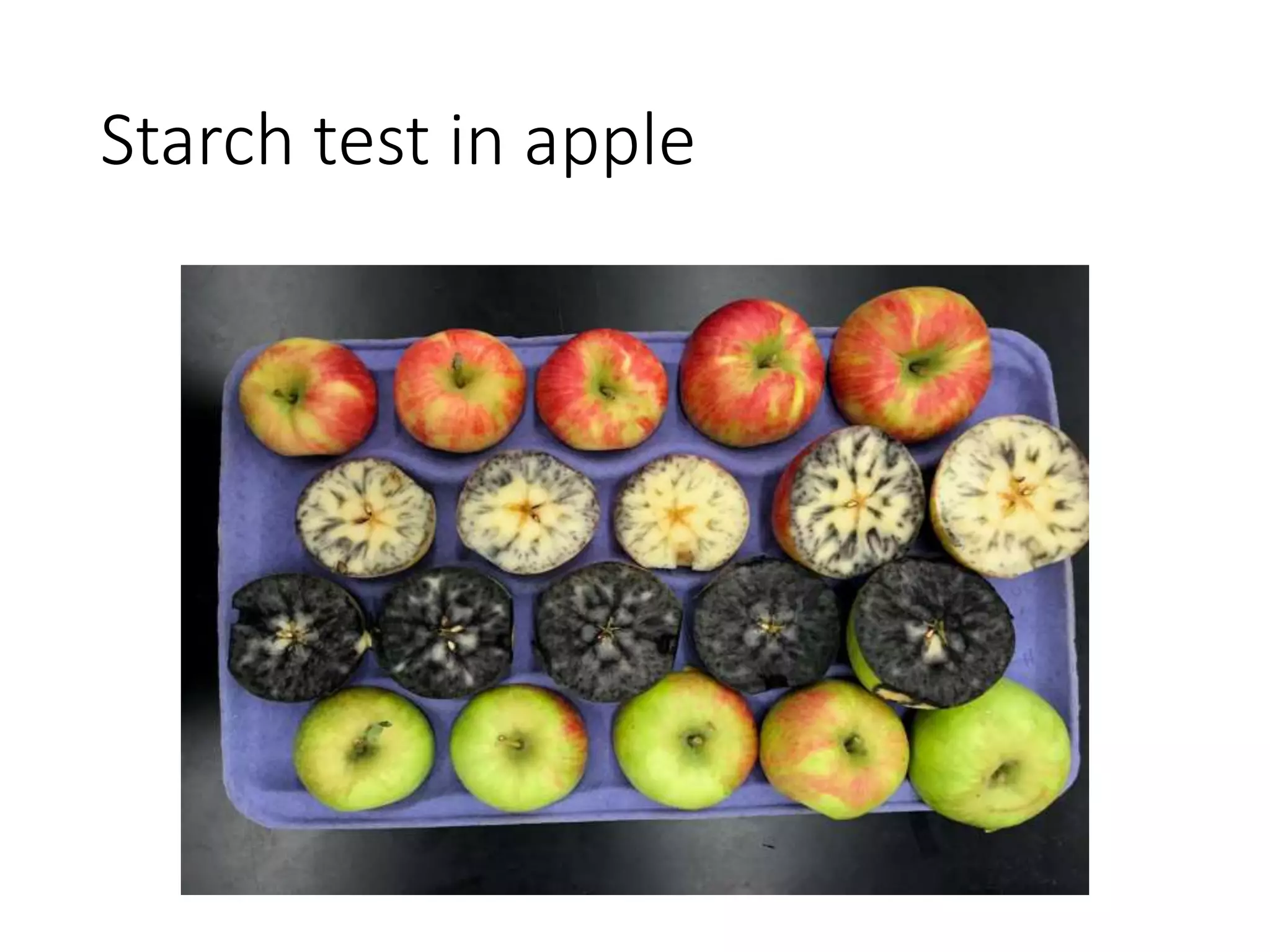
Iodine test in apple
GRAPES
• Harvested based on texture of the pulp, peel, colour.
• Easy separation of berries from the bunches & the
characteristic aroma.
• In seeded grapes, seeds become dark brown when they
fully ripe, while in seedless varieties, characteristic berry
colour develops fully.
• TSS
• Bangalore blue : 12 - 14%
• Anab-- e-shahi :14 - 16%
• Thompson seedless and selection-7 : 19 - 20%
Grapes harvest index
MANGO
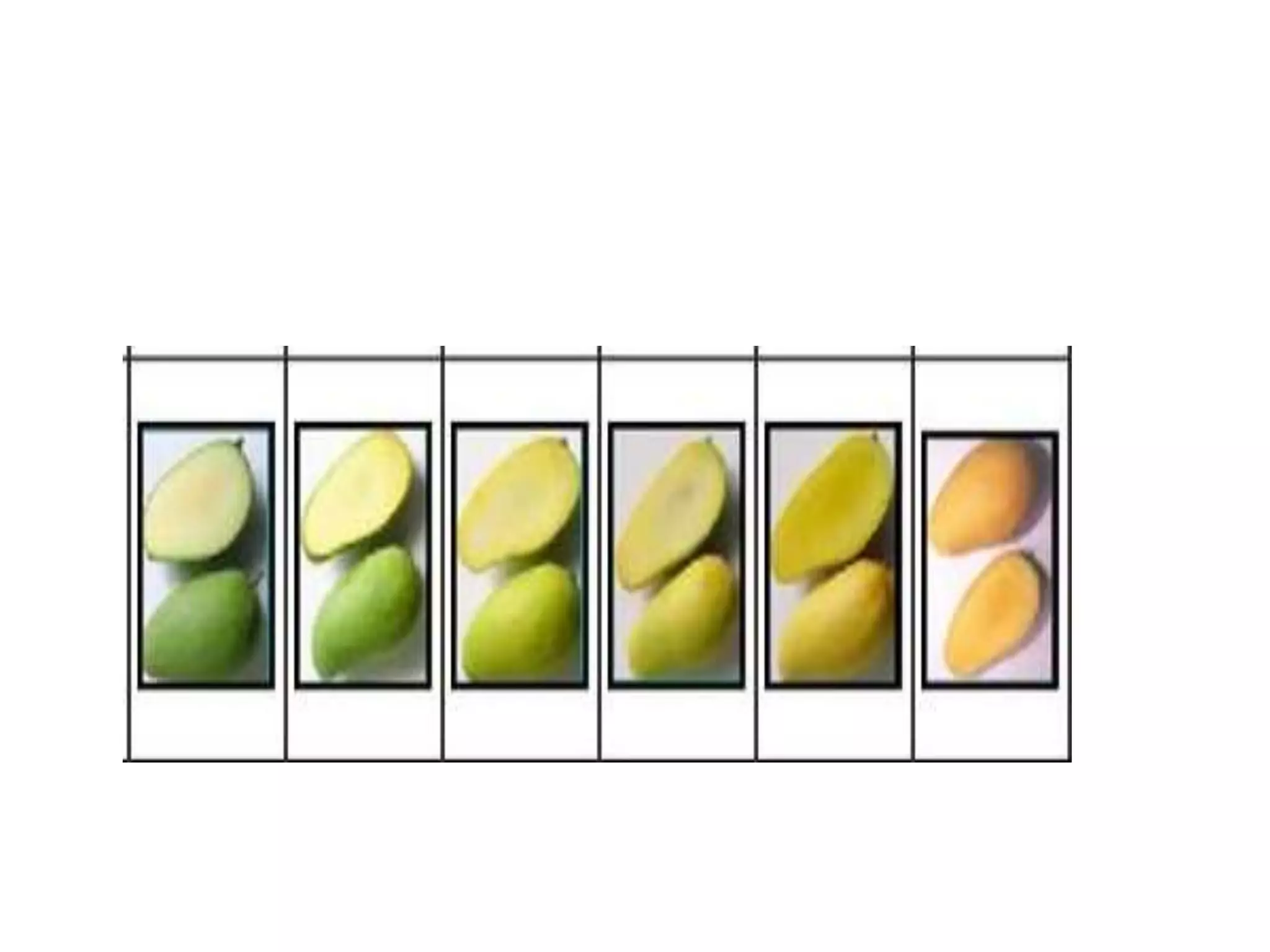
• Change in fruit shape ( fullness of cheeks)
• Change in skin colour from dark green to light green to yellow.
• Change in flesh colour from greenish yellow to yellow to orange.
• Fruits generally require 95 to 115 days to mature after flowering.
• Days from fruit set - 110 to 125 days for Alphonso and pairi
• White powdery appearance on fruit surface.
• Tapka stage
• Decreased acidity, increased aroma and volatile compounds.
• TSS : 12 -15%
• Specific gravity:
• Alphonso : 1-1.02
• Dashehari : <1
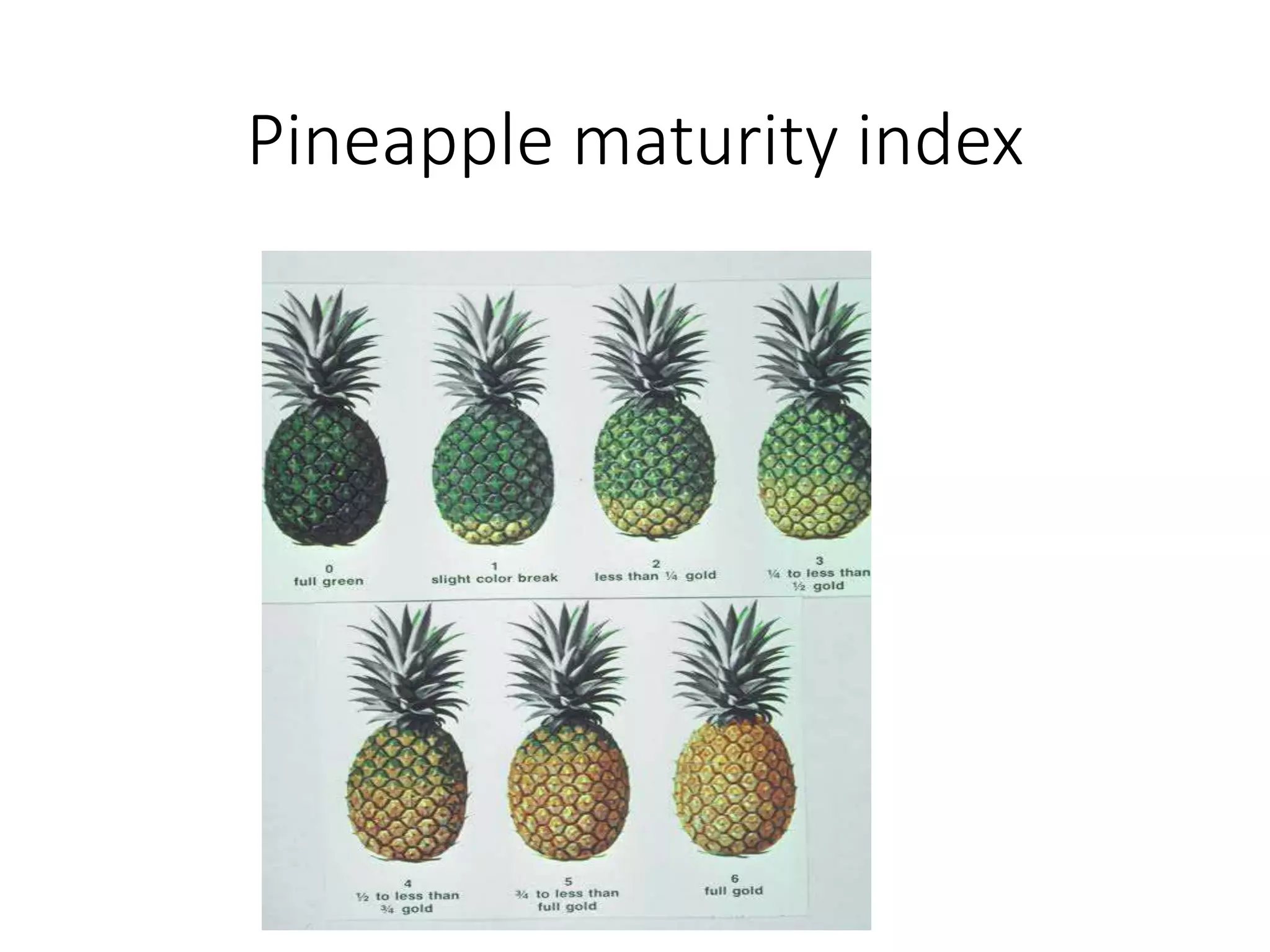
PINEAPPLE
• Flattening of eyes with slight hollow at centre.
• Change of shell colour from green to yellow from
base of the fruits.
• Specific gravity : 0.92-1.02%
• TSS: 12 - 14%
• Acidity : 1%
Pineapple maturity index
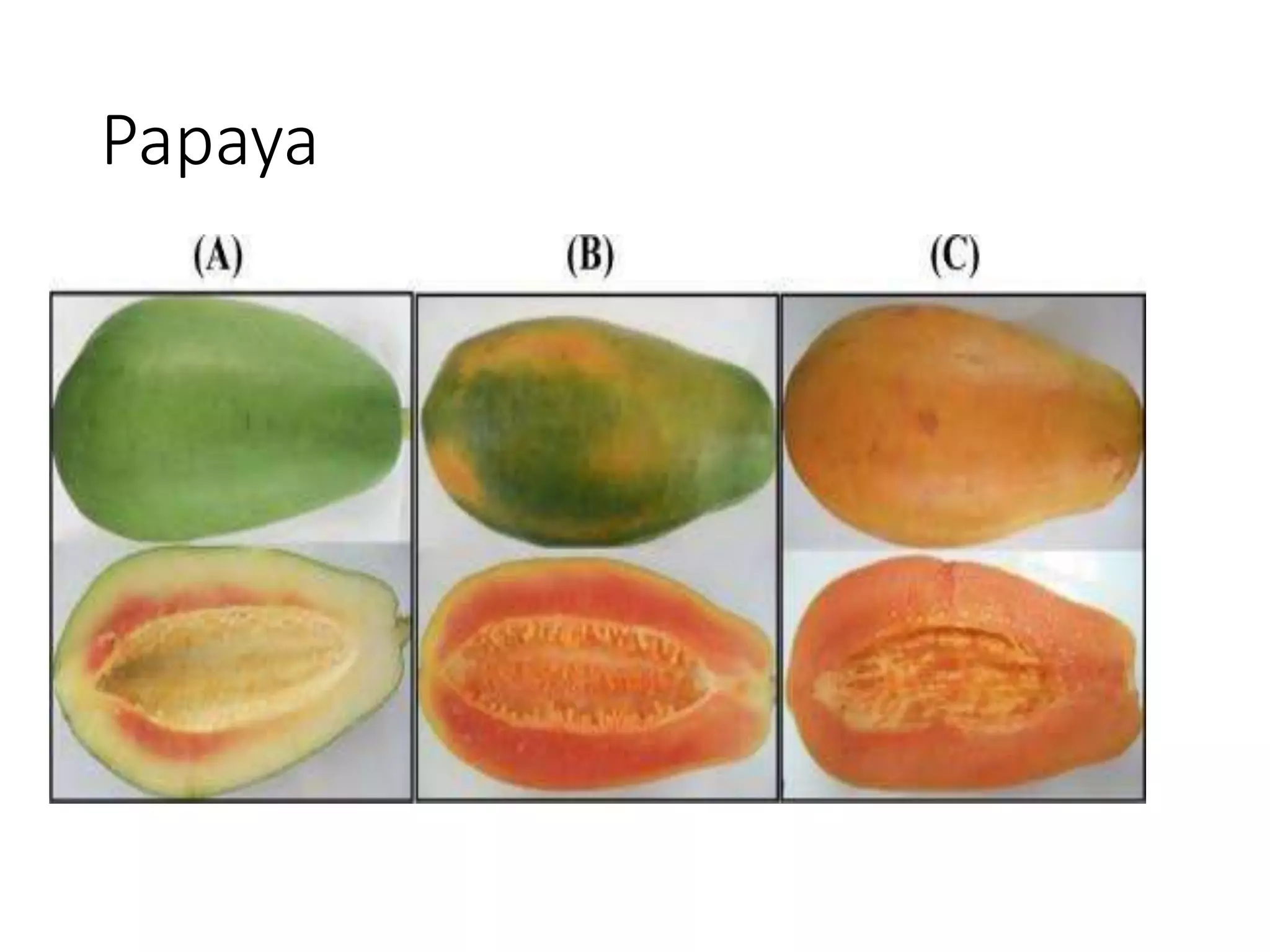
PAPAYA
• Fruits require 125 to 140 days from flowering to
maturity.
• Colour of fruit changes from green to pale green or
yellowish at blossom end.
• Usually harvested at 1/4th yellow for export or at 1/2
to 3/4th yellow for local markets.
• Portion of fruit exposed to sunlight becomes dark
yellow in colour.
• The latex of fruits becomes watery.
• T.S.S at harvest should be minimum 6%.
Papaya
APPLE
• Based on colour(external and internal), flesh firmness,
composition (starch, sugar acid).
• Change in seed colour to light brown.
• For storage and processing have pressure above 15lbs.
• Ease of separation from spurs
• A starch reading of 5-6 on 1-8 scale is suitable for
consumption.
• DFFB : 135-150days.
• 20-40% of cortex clear of starch
Starch test in apple
PEAR
• Pears are picked unripe.
• Determined by fruit firmness and soluble solids
content.
• Fruit size and skin colour.
• DFFB : 120-150Days
PLUM
• Skin colour changes (varies with cultivar)
• Colour chip guide
• 3 tier maturity system:
• Less mature
• Well mature
• Tree ripe
• Fruit firmness
Plum
PEACH & NECTARINE
• Skin ground colour: green to yellow
• Freeness of pit
• DFFB : 86 - 127 Days
• Colour chip guide
• 2 tier system is used:
• US mature
• Well mature/ tree mature
• Fruit firmness
IMMATURE
MATURE
POMEGRANATE
• 120 - 130 days after fruit set
• Calyx at the distal end gets closed on maturity.
• Distinct sound of grains cracking inside
• Turn to yellowish red and get suppressed on sides.
• Red colour of arils.
• Acidity of juice below 1.85%.
• pH 3.5
• Brix 16.9°
Pomegranate maturity index
BANANA
• No. of days from fruit set: 90 days
• Pulp:peel ratio = 1.3 to 1.4
• Disappearance of angles
• Brittleness of floral remnants and their natural
shedding.
• Dullness of fruit skin colour and odour
• Drying of plant part.
• 75 - 80% maturity
Banana maturity index
JACKFRUIT
• Colour change from green to yellow to brown.
• .Optimum maturity for jackfruit ranges between 12
and 16 weeks after flower anthesis.
• sound hollow when it is tapped
• Leaf near peduncle starts yellowing.
• Widening of spines and flattening.
• Colour change of carpels.
• Aroma
Immature Mature
SAPOTA
• Fruit with 80% maturity.
• Takes 7-10 1/2 months for anthesis to maturity.
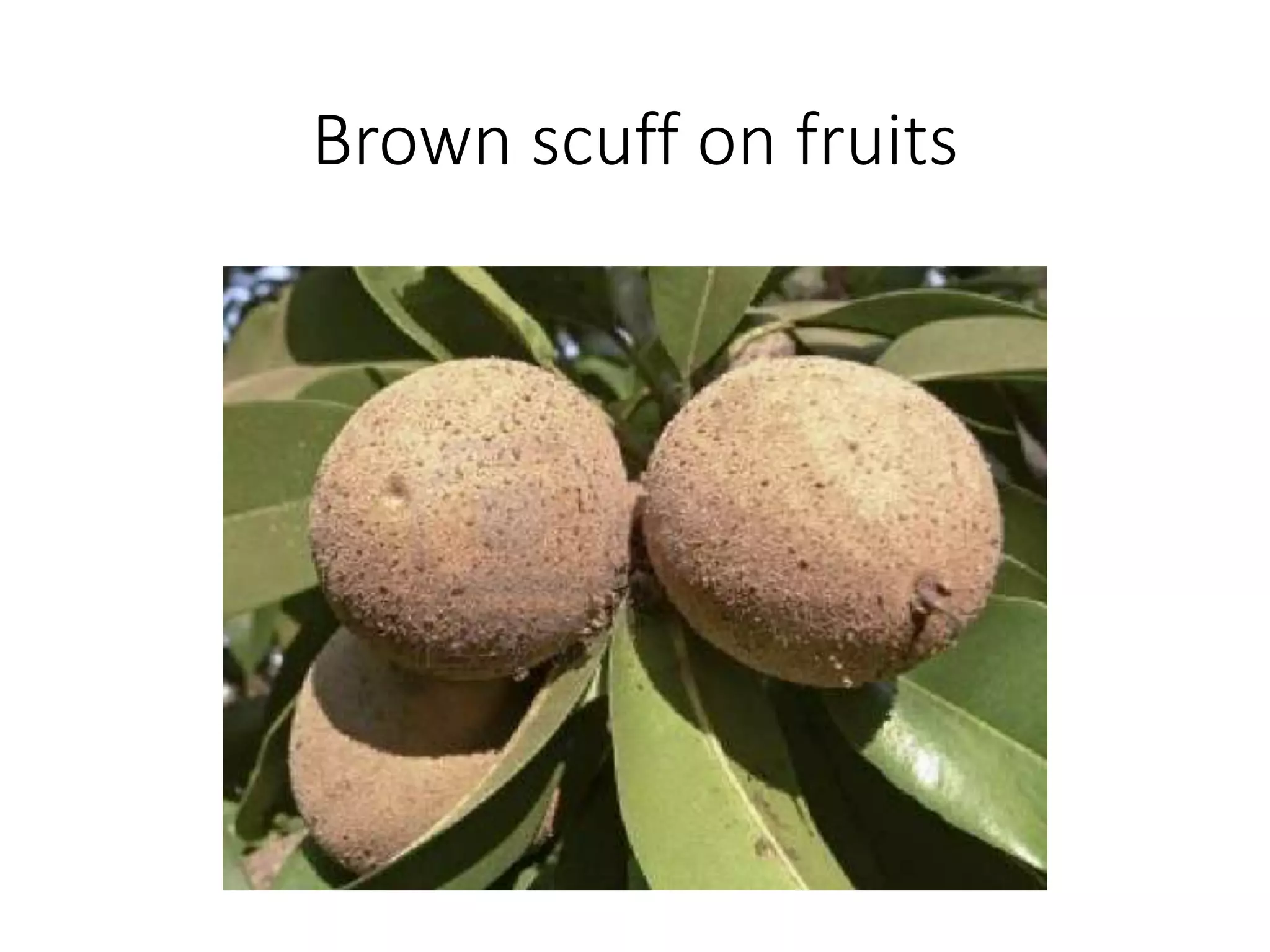
• Ease with which brown scuff gets off the fruit
surface.
• Development of yellowish tinge intermixed with
corky brown colour on fruit surface.
• No green tissue / milky latex on scratching with
nails.
Immature vs Mature sapota
Brown scuff on fruits
DATES
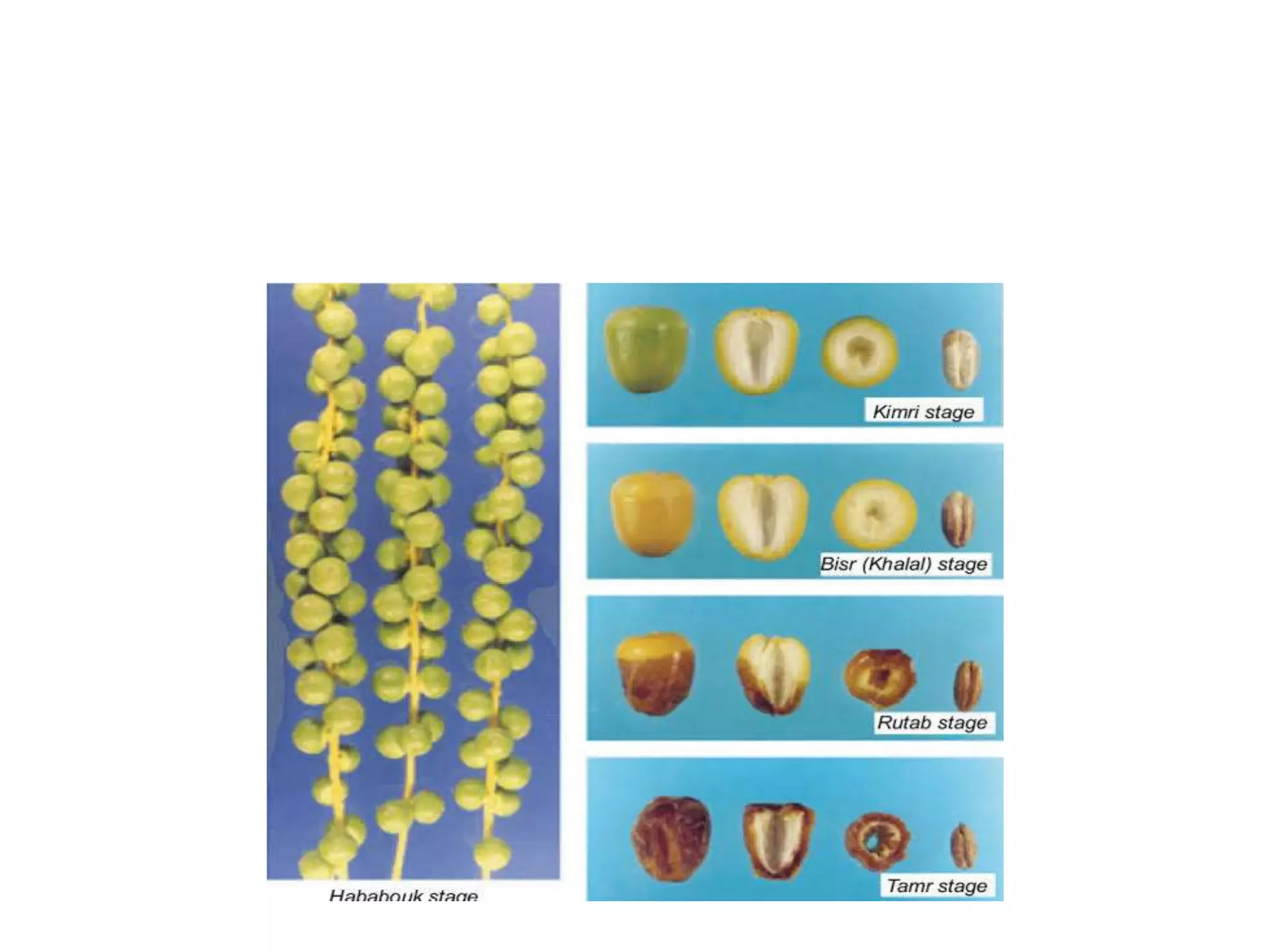
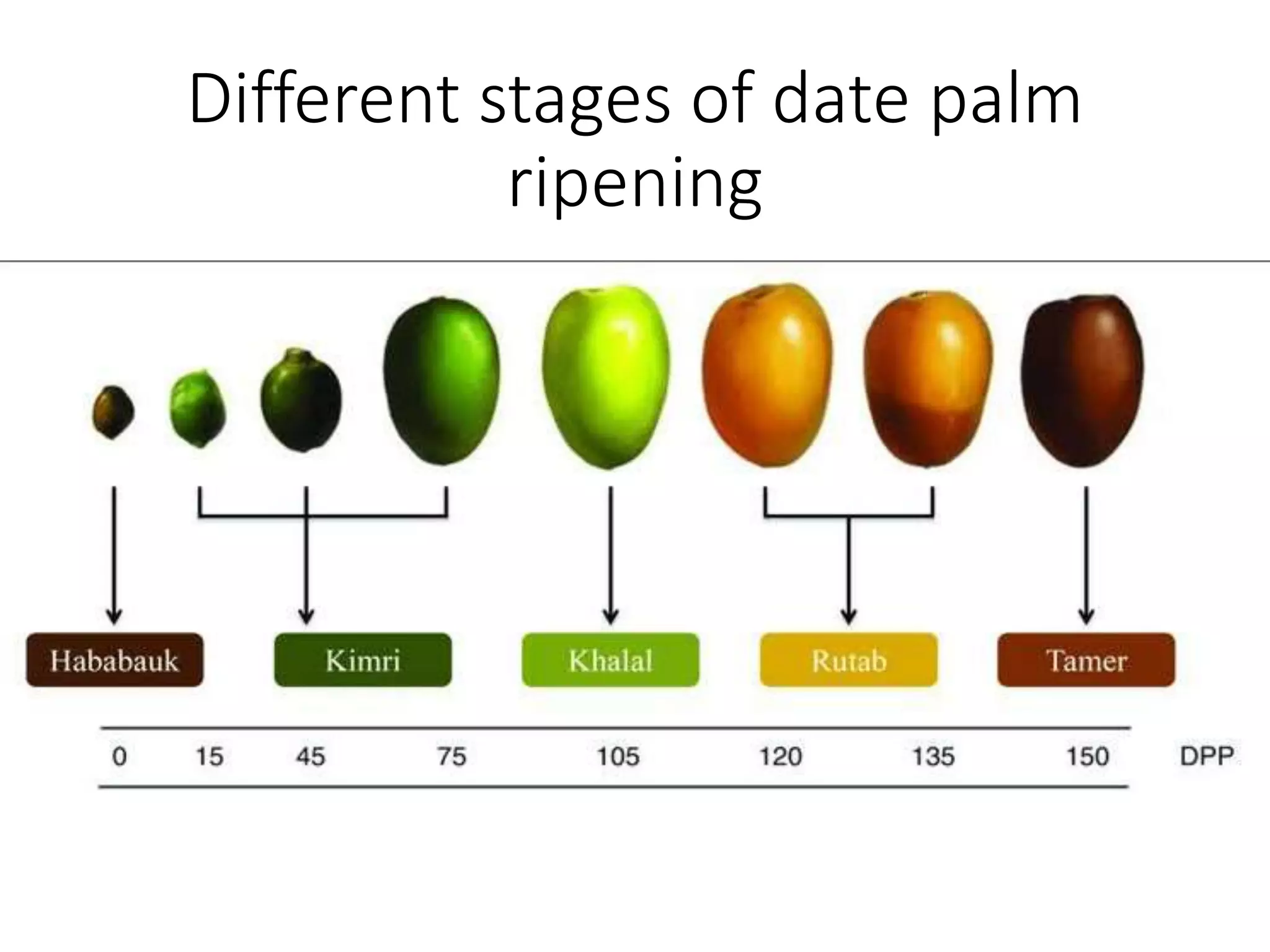
• Maturity stages of dates include
• Hababouk"(earliest stage of development),
• khimri
• khalal
• rutab
• Tamar
• Most dates are harvested at the fully-ripe "Rutab" (light-brown
and soft) and "Tamar" (dark brown and soft, semidry, or dry)
stages, when they have much greater levels of sugars, lower
contents of moisture and tannins (disappearance of
astringency), and are softer than the "Khalal" stage dates.
Different stages
• KHALAL
• With a firm green skin, these young dates are often quite bitter due to their high
tannin content.
• BESSAR
• The firm skin changes to bright yellow or red depending on the variety. Despite
higher sugar content the strong tannins can be overpowering.
• ROTAB
• At this stage fresh dates are at their best. The hard skin begins to soften at the
tip and turn brown, moving up the fruit as they continue to ripen. As the fruit
softens, the tannins break down and the dates become juicier and sweeter.
Many people prefer the half-soft, half-firm stage as it gives a combination of
sweet juiciness with a slightly crunchy texture.
• TAMAR
• Fully ripe and dried dates that are very sweet and juicy.
Different stages of date palm
ripening
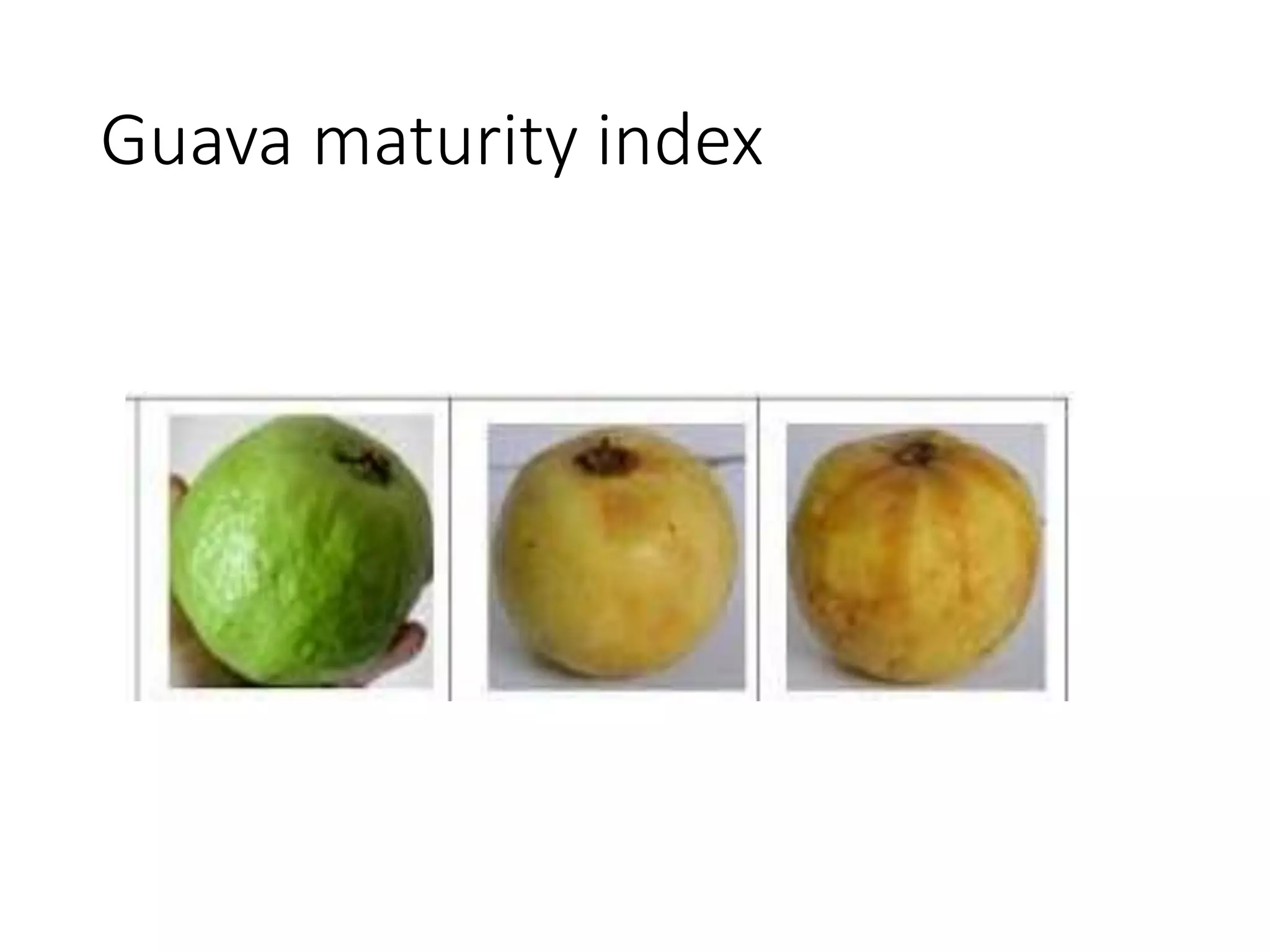
GUAVA
• Picked at mature green stage (colour change from
dark green to light green colour)
• Specific gravity - 1.00
• 120 - 150 days after flowering
• TSS 12- 14%
Guava maturity index
CITRUS
• Colour (yellow, orange, red) on 75% of fruit surface .
• Sugar:acid blend
• Mandarin 12 - 14°B
• Sweet orange -12°B
• Acidity:
• Mandarin - 0.4%
• Sweet orange - 0.3%
• Juice content - 35-50%
Citrus maturity index
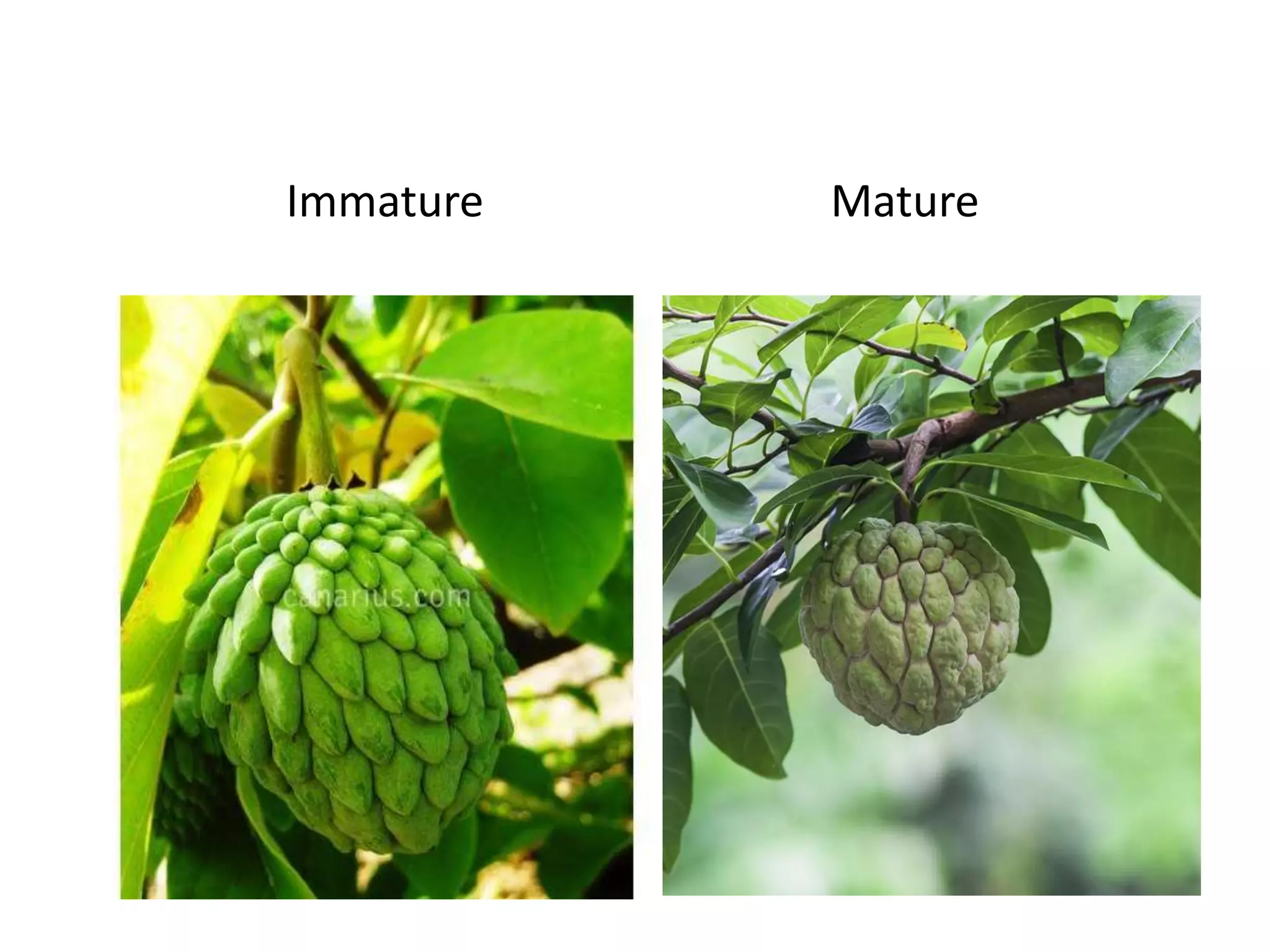
Annona
• harvested when they are mature, firm and plumpy,
on maturity, fruit turn light green.
• The inter aereolar space widens the fruits turn
creamy white, the skin between the segments or
tubercles turn into light yellow colour.
• For transporting over distant market, the fruits are
to be picked before full ripening.
• DFFB: 100-115 Days
Immature Mature
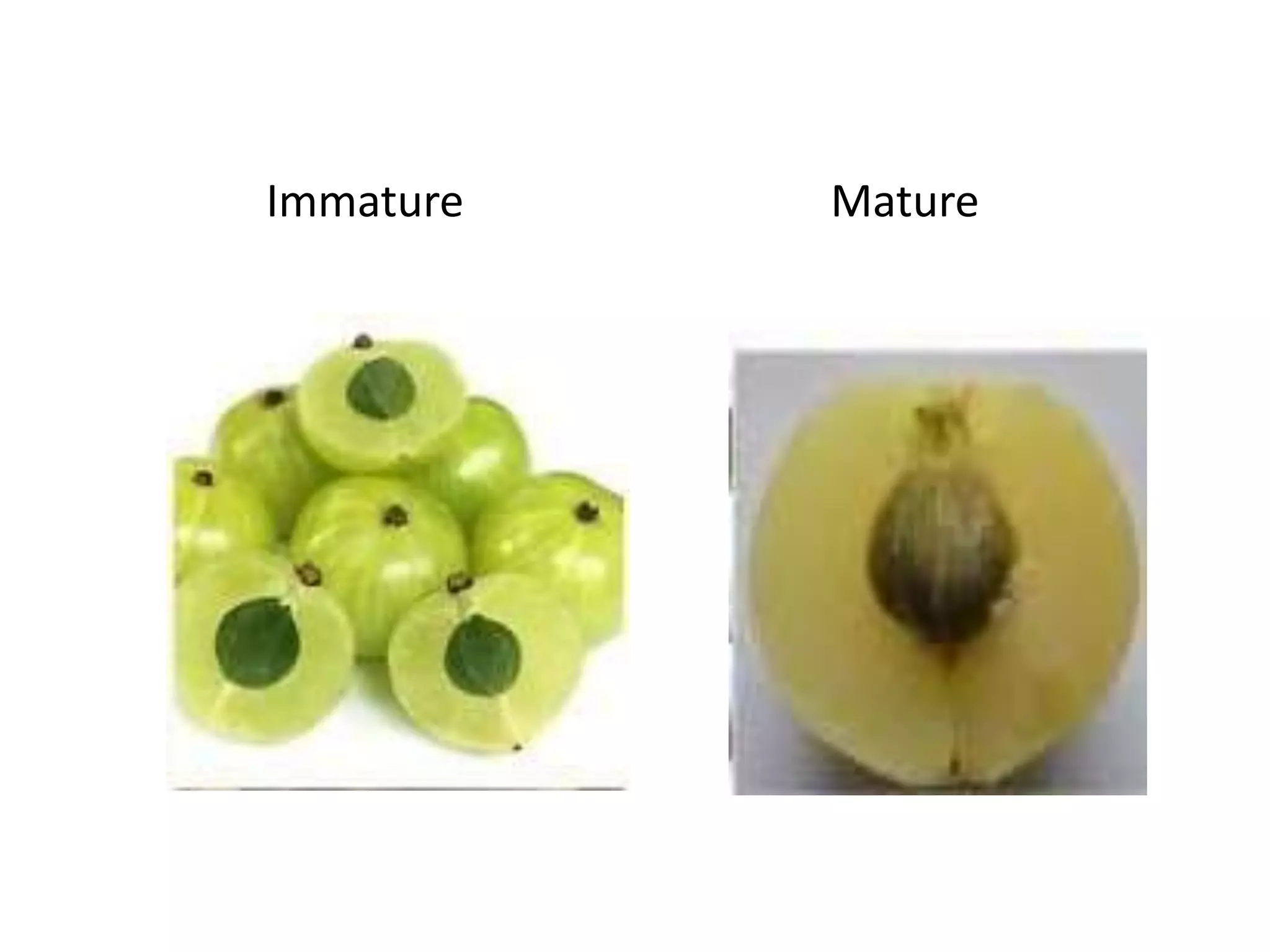
AONLA
• Colour of the fruit changes from green to greenish
yellow.
• Size and weight of the fruits attains it maximum.
• Change in seed colour from creamy-white to brown
is an indicator of fruit maturity
Immature Mature
AVOCADO
• Changes in fruit colour, fruit size and sometimes oil
content.
• In purple variety, fruits are plucked when they show a
purplish blush.
• Green type - when they develop yellow tinge and once
glossy shine diminishes.
• The area of the stem nearest the fruit changes from a
green to brown or black colour when the fruit is mature
and ready for harvest.
• The seedcoat typically turns brown when the fruit is
sufficiently mature for harvest.
Immature Mature
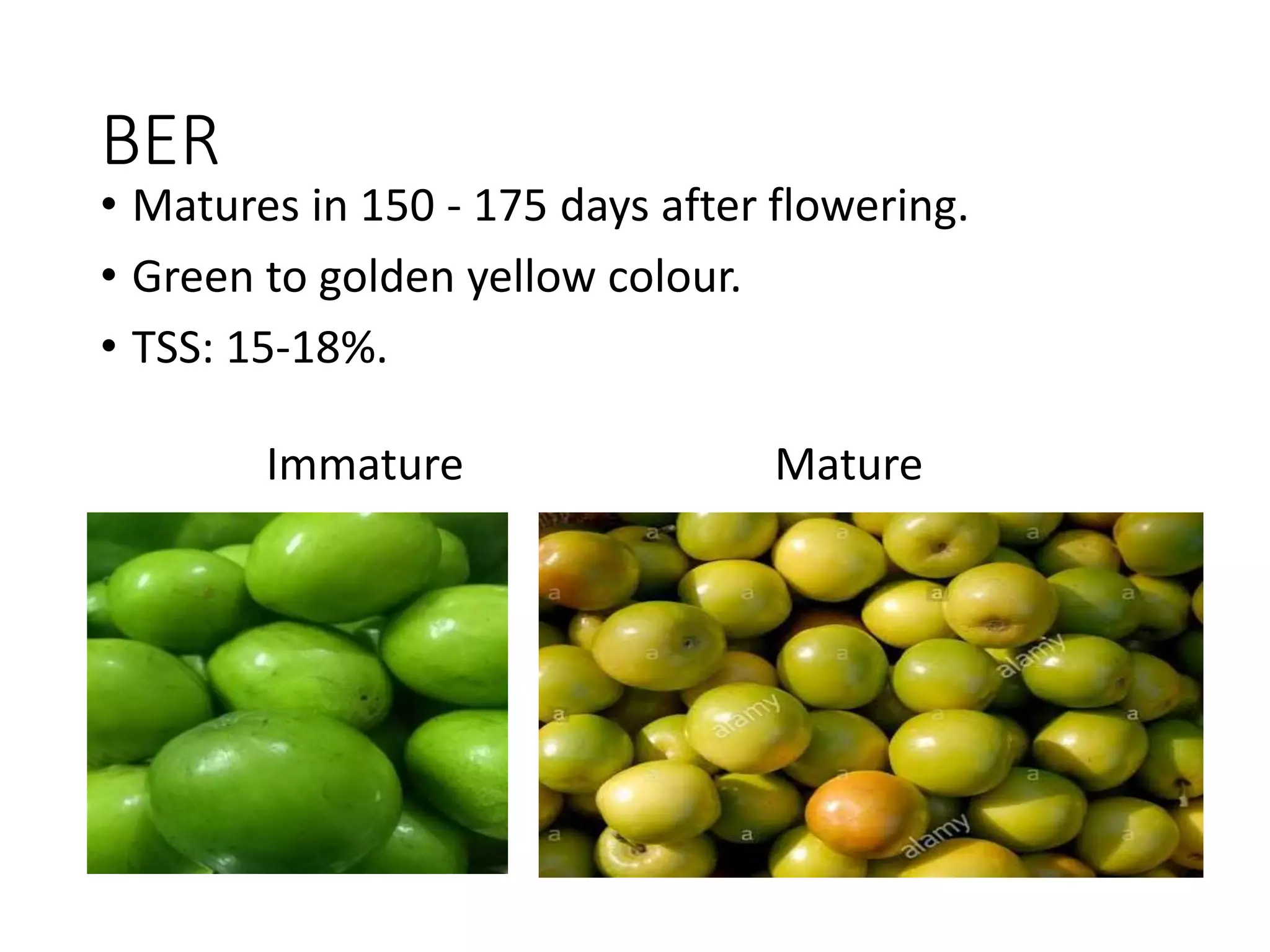
BER
• Matures in 150 - 175 days after flowering.
• Green to golden yellow colour.
• TSS: 15-18%.
Immature Mature
REFERENCES
• Hui.Y.H.2006,Handbook of Fruits and Fruit
Processing.
• Chada.K.L.2003.Handbook of horticulture
• http://ecoursesonline.iasri.res.in
• https://www.biotecharticles.com/Agriculture-
Article/Maturity-Indices-and-Quality-
Characteristics-of-Fruit-Crops-3510.html
• https://www.academia.edu/11875654/Maturity_in
dices_of_fruits_and_vegetables

Maturity indices for harvesting fruits

  • 1.
    HARVEST INDICES FOR FRUITS VDIVYADHARSHINI 2015006012
  • 2.
    MATURITY INDICES • Maturityindices are the sign or indication the readiness of the commodity for harvest. • It is the basis for determining harvest date.
  • 3.
    MATURITY • The maturityof harvested perishable commodities has an important bearing on their storage life and quality and may affect the way they are handled, transported, and marketed.
  • 4.
    Types of maturity •Horticultural maturity: • Horticultural maturity is the stage of development at which a plant or plant part possesses the prerequisites for use by consumers for a particular purpose. • Physiological maturity: • It refers to the stage in the development of the fruits and vegetables when maximum growth and maturation has occurred.
  • 5.
    Assessing maturity • Accordingto Reid (2002), the methods of determining harvest maturity are as follows • Physical methods: Size, shape, colour, texture etc. • Chemical methods: Total Soluble Solids (TSS), acidity etc. • Physiological methods: Respiration and ethylene production.
  • 6.
    Some measures ofmaturity... • Peel colour - citrus, papaya, pineapple, grapes , mango, strawberry. • Pulp colour - Mango, apple • Size - citrus, apple , pear • Shape - banana, pineapple, litchi, mango • Drying of plant parts - banana • Surface characteristics - melon, mango • Ease of separation from plants - musk melon, grape , mango(tapka stage)
  • 7.
    • Tapping -watermelon • Aroma - jackfruit • Specific gravity - Mango, pineapple, guava • Firmness - Melons, apple, pear • Sugars - Melon and grapes • TSS - Grapes, sweet orange, papaya • Acidity - Citrus, mango, pineapple • Starch index - apple, pear, banana • Juice content - Citrus • Heat units - Mango, grape, apple , pear • Days from anthesis - Melons, pineapple • Days from full bloom - mango, citrus, apple, pear • Days from fruit set - banana, mango
  • 8.
    INDEX METHOD OFDETERMINATION DFFB Computational Heat units From weather data. Heat Units = ((Maximum Temp. + Minimum Temp.)/2) - Threshold Temp. Development of abscission layer Visual or force of separation Surface structure Visual Specific gravity Density gradient solutions, floatation techniques, vol/wt. Shape Dimensions, ratio charts
  • 9.
    Textural properties Firmness Firmnesstester Tenderness Tendrometer Toughness fibrometer ( also chemical methods for determining polysaccharides) Colour external Light reflectance, visual colour charts Internal colour Light transmittance, visual examination
  • 10.
    Compositional factors Starch contentKI test Sugar content Hand refractometer, chemical test Acid content Titration, chemical test Juice content Oil content Extraction Extraction, chemical test Tannin content Ferric chloride test, lead acetate test Internal ethylene Gas chromatography
  • 11.
    Electrical Characteristics Peach(unripe 550,ripe150 Hertz) Electormagnetic – Nuclear magnetic resonance (NMR) Apple, banana, avocado peach, pear, onion Near-Infrared reflectance (400-2500 nm) Mango, pineapple
  • 12.
  • 13.
  • 14.
  • 15.
  • 16.
    GRAPES • Harvested basedon texture of the pulp, peel, colour. • Easy separation of berries from the bunches & the characteristic aroma. • In seeded grapes, seeds become dark brown when they fully ripe, while in seedless varieties, characteristic berry colour develops fully. • TSS • Bangalore blue : 12 - 14% • Anab-- e-shahi :14 - 16% • Thompson seedless and selection-7 : 19 - 20%
  • 17.
  • 18.
    MANGO • Change infruit shape ( fullness of cheeks) • Change in skin colour from dark green to light green to yellow. • Change in flesh colour from greenish yellow to yellow to orange. • Fruits generally require 95 to 115 days to mature after flowering. • Days from fruit set - 110 to 125 days for Alphonso and pairi • White powdery appearance on fruit surface. • Tapka stage • Decreased acidity, increased aroma and volatile compounds. • TSS : 12 -15% • Specific gravity: • Alphonso : 1-1.02 • Dashehari : <1
  • 20.
    PINEAPPLE • Flattening ofeyes with slight hollow at centre. • Change of shell colour from green to yellow from base of the fruits. • Specific gravity : 0.92-1.02% • TSS: 12 - 14% • Acidity : 1%
  • 21.
  • 22.
    PAPAYA • Fruits require125 to 140 days from flowering to maturity. • Colour of fruit changes from green to pale green or yellowish at blossom end. • Usually harvested at 1/4th yellow for export or at 1/2 to 3/4th yellow for local markets. • Portion of fruit exposed to sunlight becomes dark yellow in colour. • The latex of fruits becomes watery. • T.S.S at harvest should be minimum 6%.
  • 23.
  • 24.
    APPLE • Based oncolour(external and internal), flesh firmness, composition (starch, sugar acid). • Change in seed colour to light brown. • For storage and processing have pressure above 15lbs. • Ease of separation from spurs • A starch reading of 5-6 on 1-8 scale is suitable for consumption. • DFFB : 135-150days. • 20-40% of cortex clear of starch
  • 25.
  • 26.
    PEAR • Pears arepicked unripe. • Determined by fruit firmness and soluble solids content. • Fruit size and skin colour. • DFFB : 120-150Days
  • 27.
    PLUM • Skin colourchanges (varies with cultivar) • Colour chip guide • 3 tier maturity system: • Less mature • Well mature • Tree ripe • Fruit firmness
  • 28.
  • 29.
    PEACH & NECTARINE •Skin ground colour: green to yellow • Freeness of pit • DFFB : 86 - 127 Days • Colour chip guide • 2 tier system is used: • US mature • Well mature/ tree mature • Fruit firmness
  • 30.
  • 31.
    POMEGRANATE • 120 -130 days after fruit set • Calyx at the distal end gets closed on maturity. • Distinct sound of grains cracking inside • Turn to yellowish red and get suppressed on sides. • Red colour of arils. • Acidity of juice below 1.85%. • pH 3.5 • Brix 16.9°
  • 32.
  • 33.
    BANANA • No. ofdays from fruit set: 90 days • Pulp:peel ratio = 1.3 to 1.4 • Disappearance of angles • Brittleness of floral remnants and their natural shedding. • Dullness of fruit skin colour and odour • Drying of plant part. • 75 - 80% maturity
  • 34.
  • 35.
    JACKFRUIT • Colour changefrom green to yellow to brown. • .Optimum maturity for jackfruit ranges between 12 and 16 weeks after flower anthesis. • sound hollow when it is tapped • Leaf near peduncle starts yellowing. • Widening of spines and flattening. • Colour change of carpels. • Aroma
  • 36.
  • 37.
    SAPOTA • Fruit with80% maturity. • Takes 7-10 1/2 months for anthesis to maturity. • Ease with which brown scuff gets off the fruit surface. • Development of yellowish tinge intermixed with corky brown colour on fruit surface. • No green tissue / milky latex on scratching with nails.
  • 38.
  • 39.
  • 40.
    DATES • Maturity stagesof dates include • Hababouk"(earliest stage of development), • khimri • khalal • rutab • Tamar • Most dates are harvested at the fully-ripe "Rutab" (light-brown and soft) and "Tamar" (dark brown and soft, semidry, or dry) stages, when they have much greater levels of sugars, lower contents of moisture and tannins (disappearance of astringency), and are softer than the "Khalal" stage dates.
  • 41.
    Different stages • KHALAL •With a firm green skin, these young dates are often quite bitter due to their high tannin content. • BESSAR • The firm skin changes to bright yellow or red depending on the variety. Despite higher sugar content the strong tannins can be overpowering. • ROTAB • At this stage fresh dates are at their best. The hard skin begins to soften at the tip and turn brown, moving up the fruit as they continue to ripen. As the fruit softens, the tannins break down and the dates become juicier and sweeter. Many people prefer the half-soft, half-firm stage as it gives a combination of sweet juiciness with a slightly crunchy texture. • TAMAR • Fully ripe and dried dates that are very sweet and juicy.
  • 43.
    Different stages ofdate palm ripening
  • 44.
    GUAVA • Picked atmature green stage (colour change from dark green to light green colour) • Specific gravity - 1.00 • 120 - 150 days after flowering • TSS 12- 14%
  • 45.
  • 46.
    CITRUS • Colour (yellow,orange, red) on 75% of fruit surface . • Sugar:acid blend • Mandarin 12 - 14°B • Sweet orange -12°B • Acidity: • Mandarin - 0.4% • Sweet orange - 0.3% • Juice content - 35-50%
  • 47.
  • 48.
    Annona • harvested whenthey are mature, firm and plumpy, on maturity, fruit turn light green. • The inter aereolar space widens the fruits turn creamy white, the skin between the segments or tubercles turn into light yellow colour. • For transporting over distant market, the fruits are to be picked before full ripening. • DFFB: 100-115 Days
  • 49.
  • 50.
    AONLA • Colour ofthe fruit changes from green to greenish yellow. • Size and weight of the fruits attains it maximum. • Change in seed colour from creamy-white to brown is an indicator of fruit maturity
  • 51.
  • 52.
    AVOCADO • Changes infruit colour, fruit size and sometimes oil content. • In purple variety, fruits are plucked when they show a purplish blush. • Green type - when they develop yellow tinge and once glossy shine diminishes. • The area of the stem nearest the fruit changes from a green to brown or black colour when the fruit is mature and ready for harvest. • The seedcoat typically turns brown when the fruit is sufficiently mature for harvest.
  • 53.
  • 54.
    BER • Matures in150 - 175 days after flowering. • Green to golden yellow colour. • TSS: 15-18%. Immature Mature
  • 55.
    REFERENCES • Hui.Y.H.2006,Handbook ofFruits and Fruit Processing. • Chada.K.L.2003.Handbook of horticulture • http://ecoursesonline.iasri.res.in • https://www.biotecharticles.com/Agriculture- Article/Maturity-Indices-and-Quality- Characteristics-of-Fruit-Crops-3510.html • https://www.academia.edu/11875654/Maturity_in dices_of_fruits_and_vegetables