A 60sec intro to web 2.0…
(embedded below, a longer overview by Michael Wesch
(2007): video intro to web 2.0)
Web 2.0Web 2.0:
throwing
down the
Gauntlett &
living the life
of
O’Reilly…
the story of
We Media
trumping
Big Media
Web 2.0 denotes a profound shift
from top-down, static corporate
producer audience/consumer
to a blurring of the lines between
audience/producer.
Convergence!
Web 2.0Web 2.0:
throwing
down the
Gauntlett &
living the life
of
O’Reilly…
the story of
We Media
trumping
Big Media
2017:
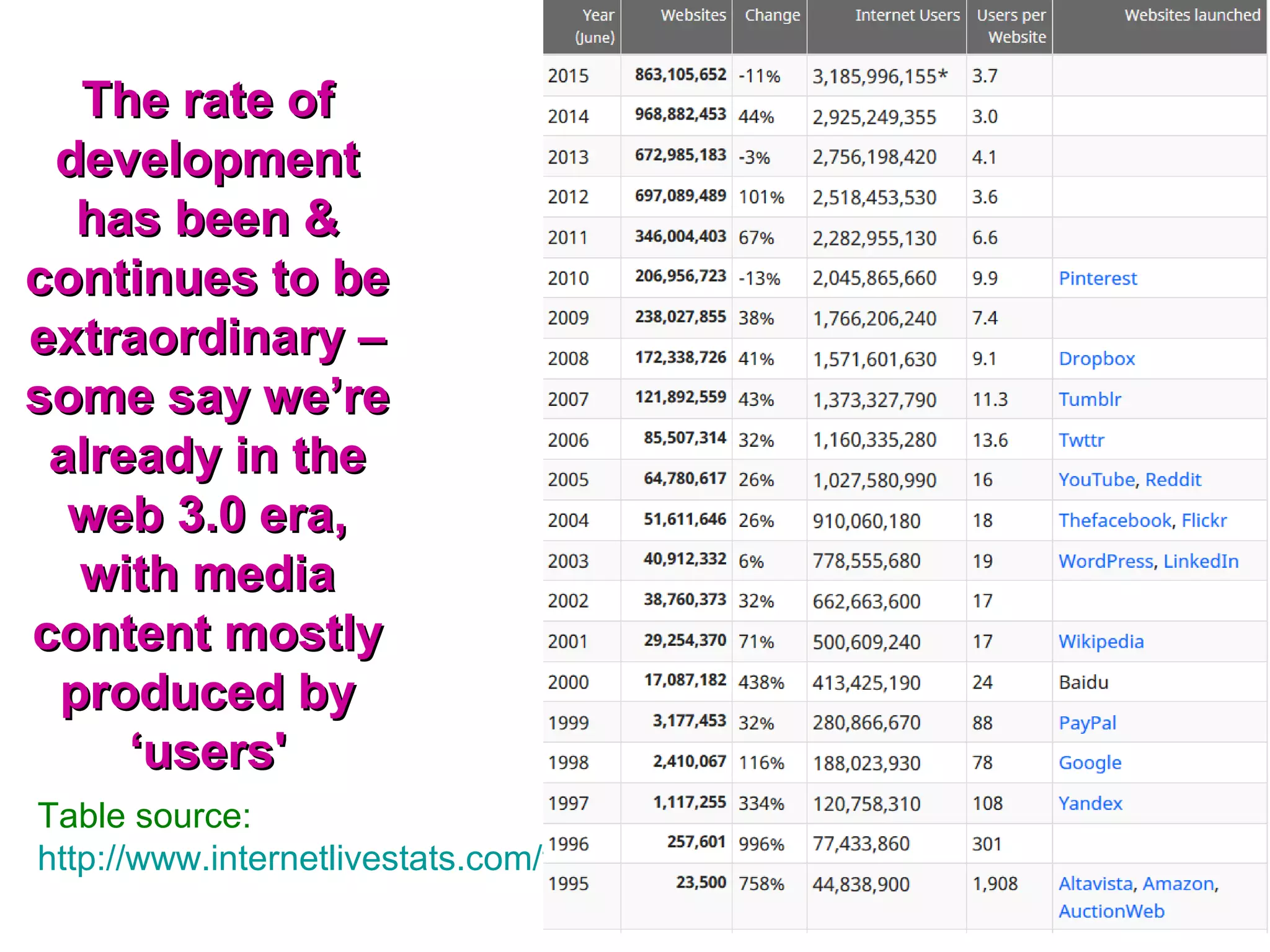
3.5bn
global users
1.1bn websites
– see live count
@
internetlivestats.com
The rate ofThe rate of
developmentdevelopment
has been &has been &
continues to becontinues to be
extraordinary –extraordinary –
some say we’resome say we’re
already in thealready in the
web 3.0 era,web 3.0 era,
with mediawith media
content mostlycontent mostly
produced byproduced by
‘users'‘users'
Table source:
http://www.internetlivestats.com/total-number-of-websites/
Academic analyses of web 2.0
Featuring…
• Tim O’Reilly (coined term, 2004)
• Dan Gillmor (“the former audience” v “Big Media dinosaurs”, “we
media” 2004; 2011’s Mediactive: dystopian pessimism?)
• Henry Jenkins (Convergence Culture, 2006)
• John McMuria (global village meme is a myth: US corporate
dominance: YouTube (2006))
• Chris Anderson (The Long Tail theory, 2004/6, widely accepted
by economists now)
• David Gauntlett (media 2.0 (2007) + “the end of audience
studies” in The Make & Connect Agenda (2011)) [also his def of
web 1.0]
• Critiques of web 2.0 optimism
• See http://www.shambles.net/web2/ for huge categorised list of
web 2.0ALWAYS acknowledge your sources: Adapted/added to from resources found on Slideshare: Charis Creber on Gauntlett; & same on Media Theory.
Tim O’Reilly & Web 2.0
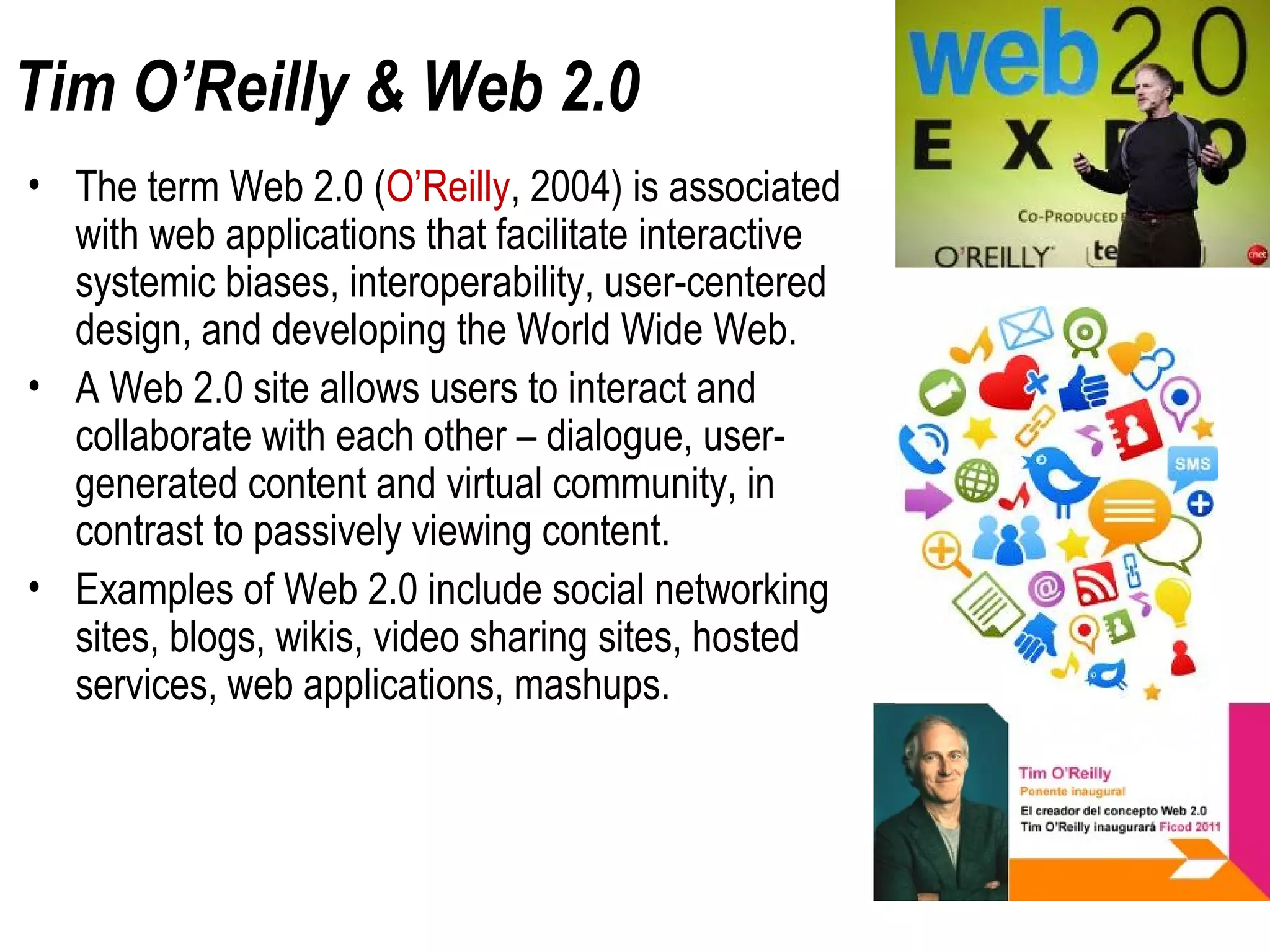
• The term Web 2.0 (O’Reilly, 2004) is associated
with web applications that facilitate interactive
systemic biases, interoperability, user-centered
design, and developing the World Wide Web.
• A Web 2.0 site allows users to interact and
collaborate with each other – dialogue, user-
generated content and virtual community, in
contrast to passively viewing content.
• Examples of Web 2.0 include social networking
sites, blogs, wikis, video sharing sites, hosted
services, web applications, mashups.
Tim O’Reilly & Web 2.0
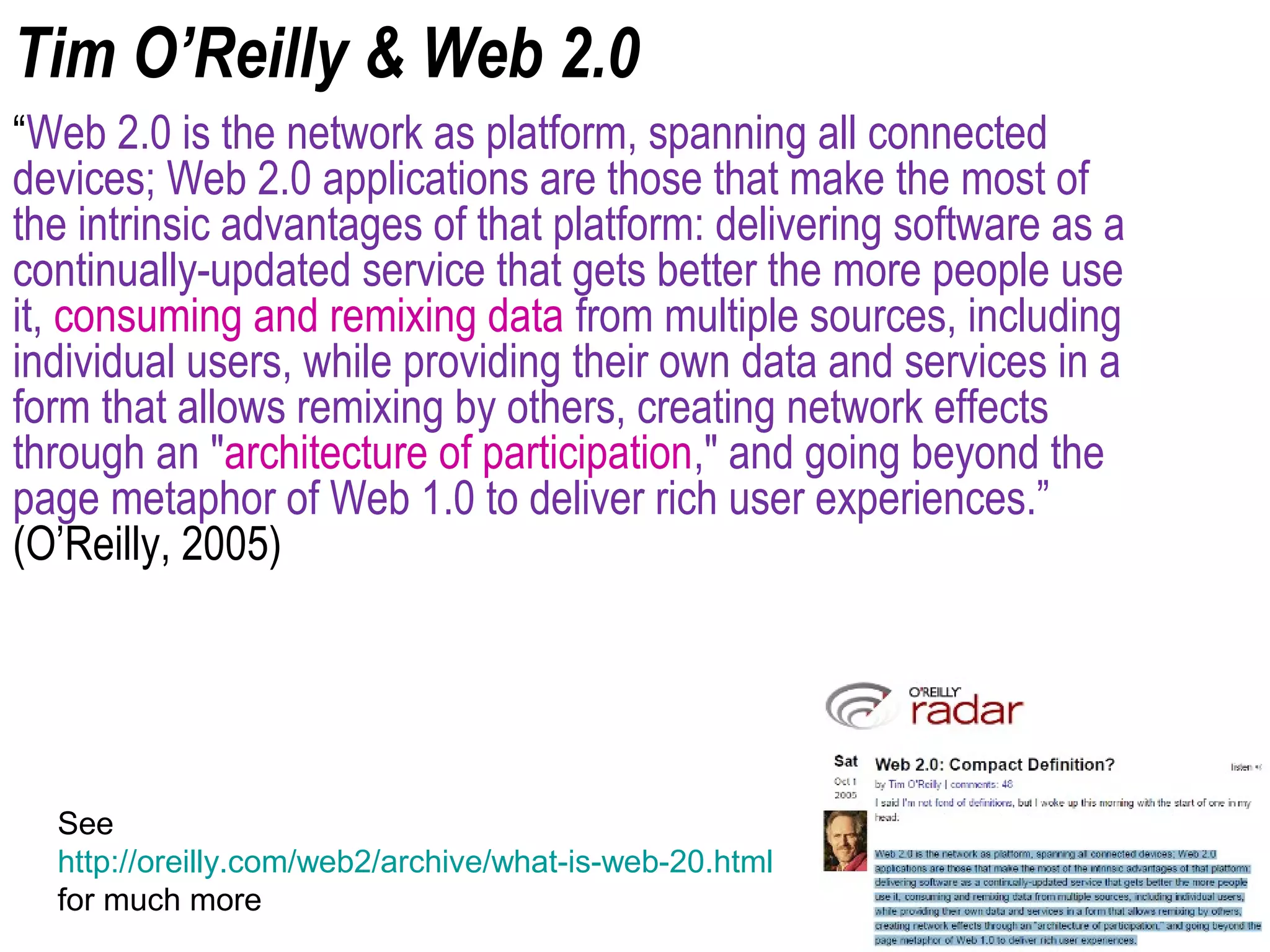
“Web 2.0 is the network as platform, spanning all connected
devices; Web 2.0 applications are those that make the most of
the intrinsic advantages of that platform: delivering software as a
continually-updated service that gets better the more people use
it, consuming and remixing data from multiple sources, including
individual users, while providing their own data and services in a
form that allows remixing by others, creating network effects
through an "architecture of participation," and going beyond the
page metaphor of Web 1.0 to deliver rich user experiences.”
(O’Reilly, 2005)
See
http://oreilly.com/web2/archive/what-is-web-20.html
for much more
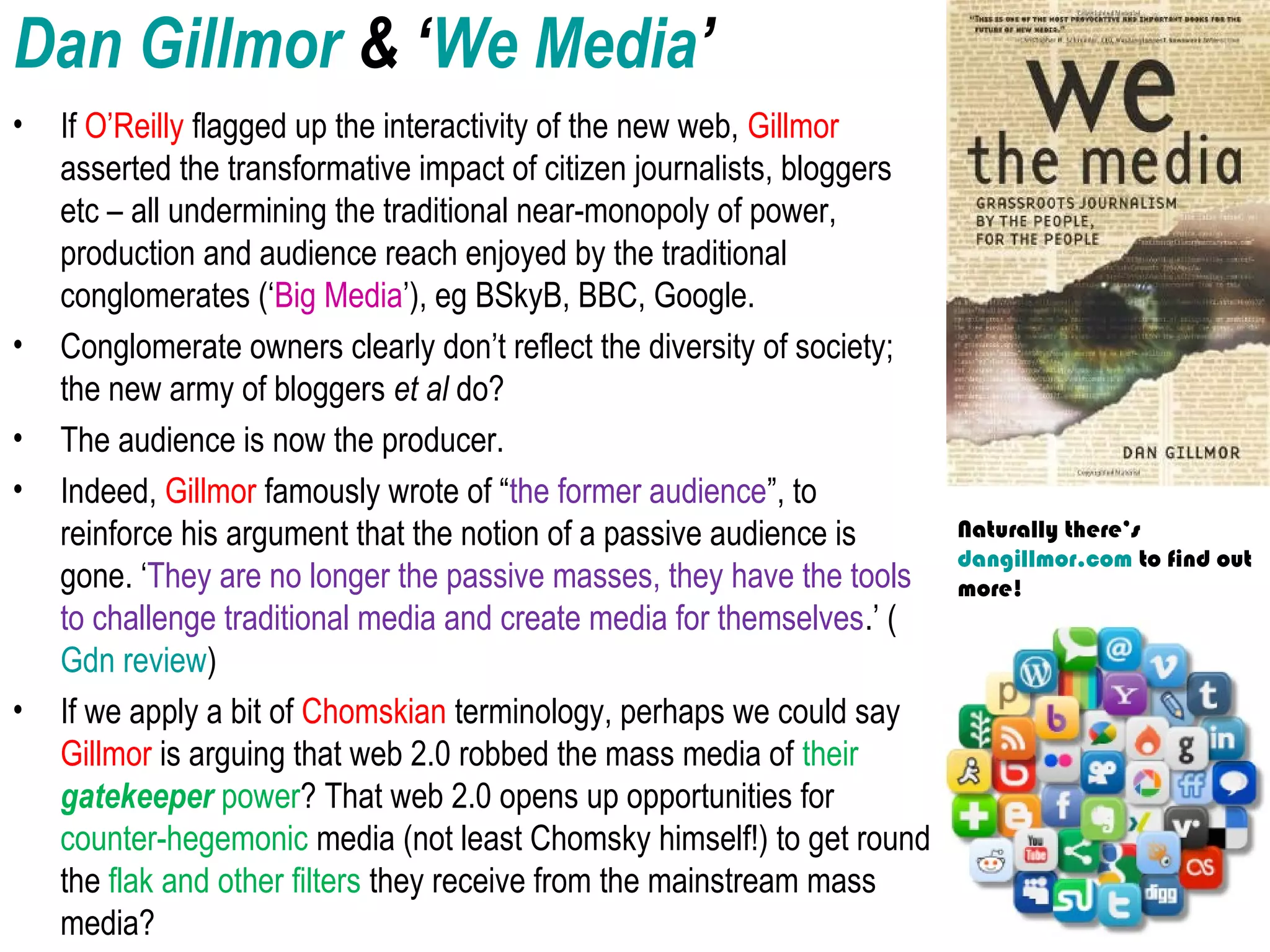
Dan Gillmor & ‘We Media’
• If O’Reilly flagged up the interactivity of the new web, Gillmor
asserted the transformative impact of citizen journalists, bloggers
etc – all undermining the traditional near-monopoly of power,
production and audience reach enjoyed by the traditional
conglomerates (‘Big Media’), eg BSkyB, BBC, Google.
• Conglomerate owners clearly don’t reflect the diversity of society;
the new army of bloggers et al do?
• The audience is now the producer.
• Indeed, Gillmor famously wrote of “the former audience”, to
reinforce his argument that the notion of a passive audience is
gone. ‘They are no longer the passive masses, they have the tools
to challenge traditional media and create media for themselves.’ (
Gdn review)
• If we apply a bit of Chomskian terminology, perhaps we could say
Gillmor is arguing that web 2.0 robbed the mass media of their
gatekeeper power? That web 2.0 opens up opportunities for
counter-hegemonic media (not least Chomsky himself!) to get round
the flak and other filters they receive from the mainstream mass
media?
Naturally there’s
dangillmor.com to find out
more!
Dan Gillmor & ‘We Media’
• The book itself reflects Gillmor’s idea about “the former audience”: he posted
chapters and got detailed, red-inked feedback from readers (who’s the producer
or audience here?!)
• His thesis is also very relevant for media regulation: ‘"Big media ... treated the
news as a lecture. … Tomorrow's news reporting and production will be more of
a conversation or a seminar. The lines will blur between producers and
consumers, changing the role of both in ways we're only beginning to grasp. The
communication network itself will be a medium for everyone's voice, not just the
few who can afford to buy multimillion-dollar printing presses, launch satellites,
or win the government's permission to squat on the public airways."
• "If today's Big Media is a dinosaur," he writes, "it won't die off quietly. It will, with
the government's help, try to control new media, rather than see its business
models eroded by it."
• In particular, he cites the over-aggressive use of copyright law in the US as a
tool to stifle innovation and creativity. Proving his point again with an act of
masochism, Gillmor and his publishers have made the full text available free
online, using a "Creative Commons" licence, which means anyone can re-use it
for non-commercial purposes.’ [Guardian review]
John McMuria & YouTube
• McMuria, like Jenkins (and Gillmor’s later [Mediactive, 2011] writing),
critiques conglomerate control
• McMuria (2006): a young academic whose writings popularized by Henry
Jenkins including them in his 2007
Nine Propositions Towards a Cultural Theory of YouTube.
• McMuria’s content analysis of YouTube content reveals that what Gillmor
calls “Big Media” remain dominant, with the further issues of lack of diverse
representation this implies (sample quote in next slide)
• A participatory culture is not necessarily a diverse culture.
• Minorities are grossly under-represented - the most heavily viewed videos on
YouTube tend to come from white middle class males.
• If we want to see a more "democratic" culture, we need to explore what
mechanisms might encourage greater diversity in who participates, whose
work gets seen, and what gets valued within the new participatory culture.
• Is he (still) right? Here’s the top 10 most-viewed on UK YouTube, 2013 (
BBC on YT in 2013, most-subbed channels). Globally ‘the top 25 YouTube
channels earned 144B views, 520M comments, and 1B likes’ … of the top
25, ‘almost none of them are big brand names or major media corporations’ [
Venturebeat]
John McMuria & YouTube
“A glance at the top 100 rated, viewed and disused videos, and most
subscribed channels reveals far less racial diversity than broadcast
network television. Most were US uploads with some non-US sports and
Japanese popular culture...While Google's acquisition of YouTube and
its deals with old media corporations including CBS, Universal Music
Group, Sony BMG Music Entertainment, NBC Universal and Warner
Music Group have meant that, in the words of one active video maker,
"the Wild West feel of YouTube is already slipping away," we might also
recognize that just as the democratic frontier myth of America's Wild
West has obfuscated the exploitations upon which the nation was born,
the mythic idealizations of electronic frontiers such as YouTube also
obfuscate the ways in which video culture has reproduced, or at least
has failed to excite a concerted challenge to, the inequalities that persist
in our American culture. Perhaps we might think about the difference
between what it means to be a YouTube community and what it would
take to use the YouTube video sharing technologies to help expand the
movement for racial and economic justice.” [cited by Jenkins, 2006,
http://www.convergenceculture.org/weblog/2006/11/taking_the_you_out_of_youtube.html]
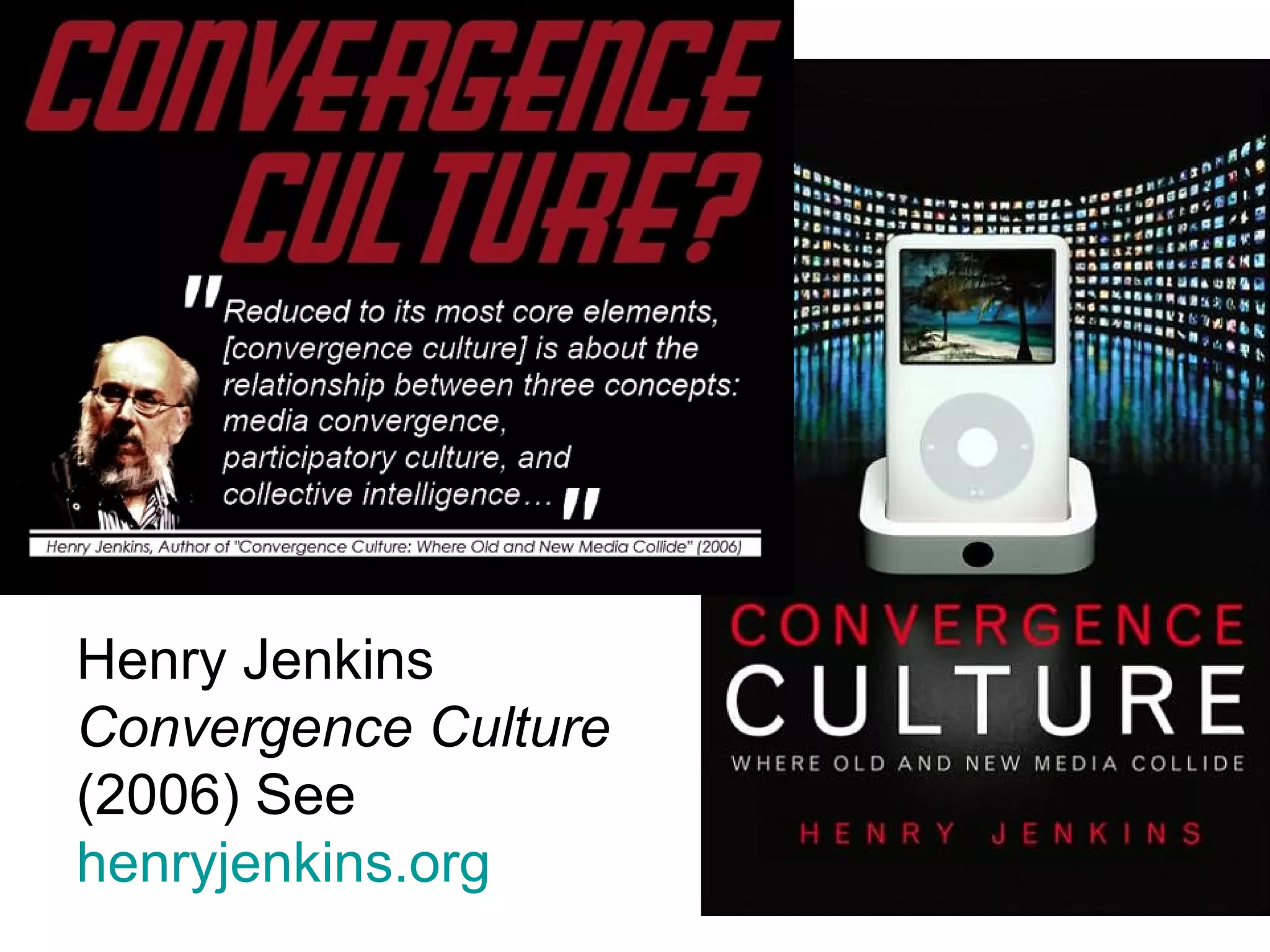
Henry Jenkins
Convergence Culture
(2006) See
henryjenkins.org
Henry Jenkins & Convergence Culture
• Convergence - the flow of content across multiple media platforms, the
cooperation between multiple media industries, and the migratory
behaviour of media audiences who would go almost anywhere in search of
the kinds of entertainment experiences they wanted. Convergence is a
word that manages to describe technological, industrial, cultural, and
social changes
• Participatory culture - circulation of media content depends heavily on
the active participation of the consumer.
• Collective intelligence – combining skills and resources (just like We-
Think), which is enabled by convergence.
If analysing genre or genre conventions (think Eval Q1…), consider this quote:
Convergence does not occur through media appliances – however sophisticated they
may become. Convergence occurs within the brains of individual consumers. Yet, each
of us constructs our own personal mythology from bits and fragments of information we
have extracted from the ongoing flow of media around us and transformed into
resources through which we make sense of our everyday lives. (henryjenkins.org)
Sample quote from Jenkins
• By convergenceconvergence, I mean the flow of content across multiple media
platforms, the cooperation between multiple media industries, and the
migratory behavior of media audiences who would go almost
anywhere in search of the kinds of entertainment experiences they
wanted. Convergence is a word that manages to describe
technological, industrial, cultural, and social changes, depending on
who’s speaking and what they think they are talking about. …
• This circulation of media content – across different media systems,
competing media economies, and national borders – depends heavily
on the active participation of the consumer. I will argue here against
the idea that convergence can be understood primarily as a
technological process – the bringing together of multiple media
functions within the same gadgets and devices. Instead, I want to
argue that convergence represents a shift in cultural logic, whereby
consumers are encouraged to seek out new information and make
connections between dispersed media content. The term,
participatory cultureparticipatory culture, is intended to contrast with older notions of
media spectatorship. In this emerging media system, what might
traditionally be understood as media producers and consumers are
transformed into participants who are expected to interact with each
other according to a new set of rules which none of us fully
understands.
Chris Anderson &‘The Long Tail’
• A 2004 Wired feature that became a hit, highly influential 2006 book (
updated 2009) & made Anderson a much sought-after commentator
• This is very relevant for grasping how digitisation is changing Cinema, but
likewise the music industry: the A2 music brief, typically centred on an older,
back-catalogue track, is perfectly realistic for a music industry that relies ever
more on repackaged re-releases and the zero-cost distribution of iTunes etc
producing payments most often without the need for marketing
• The internet has transformed economics, commerce and consumption.
• As broadband internet allows more people to look for and share or buy a
wider variety of material and products, what happens is that people buy less
of more. Niche is no longer an expensive luxury. (see graph on next slide)
• “The theory of the Long Tail can be boiled down to this: Our culture and
economy are increasingly shifting away from a focus on a relatively small
number of hits (mainstream products and markets) at the head of the demand
curve, and moving toward a huge number of niches in the tail. In an era
without the constraints of physical shelf space and other bottlenecks of
distribution, narrowly targeted goods and services can be as economically
attractive as mainstream fare.”
Media 1.0
• Fetishises 'experts'
• Celebrates key texts produced by media moguls
• Otional extra of giving attention to famous 'avant garde' works produced by
artists recognised in the traditional sense, and which are seen as especially
'challenging'
• A belief that students should be taught how to 'read' the media in an
appropriate 'critical' style
• A focus on Western mainstream traditional media
• Vague recognition of internet and new digital media, as an 'add on' to the
traditional media
• A preference for conventional research methods where most people are
treated as non-expert audience 'receivers', or, if they are part of the formal
media industries, as expert 'producers'.
David Gauntlett (theory.org.uk), 2007
Wiki on DG is packed with links
This 2min vid, using Lego, is a nice intro to
his central thesis…
Media 2.0
• Focus on everyday meanings produced by the diverse array of audience
members
• Interest in the massive 'long tail' of independent media projects such as
those found on YouTube and many other websites, mobile devices, and
other forms of DIY media
• Attempt to embrace the truly international dimensions of Media Studies –
including a recognition not only of the processes of globalization, but also of
the diverse perspectives on media and society being worked on around the
world
• recognition that internet and digital media have fundamentally changed the
ways in which we engage with all media
• media audiences seen as extremely capable interpreters of media content,
with a critical eye and an understanding of contemporary media techniques,
thanks in large part to the large amount of coverage of this in popular media
David Gauntlett (theory.org.uk), 2007
What is media 2.0?
Media 1.0 was about FIND. Media 2.0 is about FILTER
Throwing down the Gauntlett: what
he means + his call to action
• Web 2.0 allows faster, more collaborative creativity
• Creativity linked with desire to be connected
• Is New Media transforming culture?
• Shift from consumer to prosumer
• Audience shift from passive to active
• Digital Immigrants,
Google Generation, Screenagers
• End of the artefact as a finished construct?
– Mash-ups, etc
• He goes a step further with 2011’s The Make &
Connect Agenda, effectively his personal manifesto
for a more activist citizenry, employing web 2.0 tools
“the end of
audience studies”
• THE END OF AUDIENCE STUDIES: Media audience studies had
value in the twentieth century, primarily as a riposte to 'high culture'
critics who suggested that people were passive consumers of
meaningless media. Having shown that this is not the case, the work
of old-style 'audience studies' is largely done; and meanwhile, the
notion of 'audience' is collapsing as people become producers as well
as consumers of media. Precisely what 'audience studies' is replaced
with remains an open question – the answer is perhaps simply a
return to a broad sociology which considers people's lives and the
place of media – giving and receiving – within that.
• Doesn't traditional media still matter? Traditional media still exists,
and may be popular; and audiences may still use it in traditional
ways. But audience studies does not generally have anything new
and interesting to say about this, and is perhaps retreating into a
rather servile and hopeless defence of the traditional media
industries.
See http://www.theory.org.uk/david/makeandconnect.htm for
more, incl. vids
See http://www.theory.org.uk/david/makeandconnect.htm for
more, incl. vids. Theory from 2008, book 2011
Counter – arguments
• Some critics – e.g. (David Buckingham) think Gauntlett goes
too far.
• Celebrates the “power of active users”, ignoring the
commercial structures that help to shape those powers
• Andrew Keen [musividz tag] is a notable critic of the hidden
corporate power behind these seemingly freedom-creating
tools
• Gauntlett is wrongly accused of claiming power has shifted
entirely to the prosumer – he acknowledges the hybridity
between old and new, just like Henry Jenkins does.
• Ignores real material and cultural constraints?
– Gender inequality?
– Poverty?
– Who’s online?
Mediactive (2011): Gillmor’s
optimism wanes? Dystopia?
Sample quotes from interview on Mediactive:
The bottom line is, above all, persuading passive
consumers to be active users of media, both in the
reading (used in the broadest sense of the word) and
in the creation process. …
[We the Media was a] pretty optimistic book. … I
started realizing that we have a number of issues to
work on to make the possibilities for democratized
media into realities that would, first of all, encourage
creation of media by everyone; and, second, find
ways to make what we all create trustworthy and
reliable. …
In a world with almost infinite choices, we all have
amazing opportunities but also some responsibilities.
We have to understand ourselves as participants in
media, not just distant observers — and our
participation at various levels, if we do it right, will
help create an ecosystem of information we can
Dan Gillmor
Polarised views on social media
Pessimistic Utopian
Banal and trivial, replacing “real”
human contact
We’re living in a golden age – we can
do almost anything
Shaping people in narcissistic and
inarticulate ways
Increased communication – the global
village
Erosion between the traditionally
private and public
Potential for political, charitable, arts
and protest collaborative action
Computer games to blame for violence
and cruelty
Remember this?
http://www.youtube.com/watch?
v=nGeKSiCQkPw
Where would you place yourself on this scale?
1)This is a text worthy of study. It is as important as a
novel by Dickens or any other ‘text’.
5) Things like this are worthy of study, but only when
looked at in context. It is made more worthy of study
because of how many people have viewed it.
10) This is silly, and not worthy of study at all.
Choose your place on the scale. Be prepared to defend your position, and
refer to at least one theorist who would / would not agree with you.

Web 2 0 theories

  • 1.
    A 60sec introto web 2.0… (embedded below, a longer overview by Michael Wesch (2007): video intro to web 2.0)
  • 2.
    Web 2.0Web 2.0: throwing downthe Gauntlett & living the life of O’Reilly… the story of We Media trumping Big Media Web 2.0 denotes a profound shift from top-down, static corporate producer audience/consumer to a blurring of the lines between audience/producer. Convergence!
  • 3.
    Web 2.0Web 2.0: throwing downthe Gauntlett & living the life of O’Reilly… the story of We Media trumping Big Media 2017: 3.5bn global users 1.1bn websites – see live count @ internetlivestats.com
  • 4.
    The rate ofTherate of developmentdevelopment has been &has been & continues to becontinues to be extraordinary –extraordinary – some say we’resome say we’re already in thealready in the web 3.0 era,web 3.0 era, with mediawith media content mostlycontent mostly produced byproduced by ‘users'‘users' Table source: http://www.internetlivestats.com/total-number-of-websites/
  • 6.
    Academic analyses ofweb 2.0 Featuring… • Tim O’Reilly (coined term, 2004) • Dan Gillmor (“the former audience” v “Big Media dinosaurs”, “we media” 2004; 2011’s Mediactive: dystopian pessimism?) • Henry Jenkins (Convergence Culture, 2006) • John McMuria (global village meme is a myth: US corporate dominance: YouTube (2006)) • Chris Anderson (The Long Tail theory, 2004/6, widely accepted by economists now) • David Gauntlett (media 2.0 (2007) + “the end of audience studies” in The Make & Connect Agenda (2011)) [also his def of web 1.0] • Critiques of web 2.0 optimism • See http://www.shambles.net/web2/ for huge categorised list of web 2.0ALWAYS acknowledge your sources: Adapted/added to from resources found on Slideshare: Charis Creber on Gauntlett; & same on Media Theory.
  • 7.
    Tim O’Reilly &Web 2.0 • The term Web 2.0 (O’Reilly, 2004) is associated with web applications that facilitate interactive systemic biases, interoperability, user-centered design, and developing the World Wide Web. • A Web 2.0 site allows users to interact and collaborate with each other – dialogue, user- generated content and virtual community, in contrast to passively viewing content. • Examples of Web 2.0 include social networking sites, blogs, wikis, video sharing sites, hosted services, web applications, mashups.
  • 8.
    Tim O’Reilly &Web 2.0 “Web 2.0 is the network as platform, spanning all connected devices; Web 2.0 applications are those that make the most of the intrinsic advantages of that platform: delivering software as a continually-updated service that gets better the more people use it, consuming and remixing data from multiple sources, including individual users, while providing their own data and services in a form that allows remixing by others, creating network effects through an "architecture of participation," and going beyond the page metaphor of Web 1.0 to deliver rich user experiences.” (O’Reilly, 2005) See http://oreilly.com/web2/archive/what-is-web-20.html for much more
  • 9.
    Dan Gillmor &‘We Media’ • If O’Reilly flagged up the interactivity of the new web, Gillmor asserted the transformative impact of citizen journalists, bloggers etc – all undermining the traditional near-monopoly of power, production and audience reach enjoyed by the traditional conglomerates (‘Big Media’), eg BSkyB, BBC, Google. • Conglomerate owners clearly don’t reflect the diversity of society; the new army of bloggers et al do? • The audience is now the producer. • Indeed, Gillmor famously wrote of “the former audience”, to reinforce his argument that the notion of a passive audience is gone. ‘They are no longer the passive masses, they have the tools to challenge traditional media and create media for themselves.’ ( Gdn review) • If we apply a bit of Chomskian terminology, perhaps we could say Gillmor is arguing that web 2.0 robbed the mass media of their gatekeeper power? That web 2.0 opens up opportunities for counter-hegemonic media (not least Chomsky himself!) to get round the flak and other filters they receive from the mainstream mass media? Naturally there’s dangillmor.com to find out more!
  • 10.
    Dan Gillmor &‘We Media’ • The book itself reflects Gillmor’s idea about “the former audience”: he posted chapters and got detailed, red-inked feedback from readers (who’s the producer or audience here?!) • His thesis is also very relevant for media regulation: ‘"Big media ... treated the news as a lecture. … Tomorrow's news reporting and production will be more of a conversation or a seminar. The lines will blur between producers and consumers, changing the role of both in ways we're only beginning to grasp. The communication network itself will be a medium for everyone's voice, not just the few who can afford to buy multimillion-dollar printing presses, launch satellites, or win the government's permission to squat on the public airways." • "If today's Big Media is a dinosaur," he writes, "it won't die off quietly. It will, with the government's help, try to control new media, rather than see its business models eroded by it." • In particular, he cites the over-aggressive use of copyright law in the US as a tool to stifle innovation and creativity. Proving his point again with an act of masochism, Gillmor and his publishers have made the full text available free online, using a "Creative Commons" licence, which means anyone can re-use it for non-commercial purposes.’ [Guardian review]
  • 11.
    John McMuria &YouTube • McMuria, like Jenkins (and Gillmor’s later [Mediactive, 2011] writing), critiques conglomerate control • McMuria (2006): a young academic whose writings popularized by Henry Jenkins including them in his 2007 Nine Propositions Towards a Cultural Theory of YouTube. • McMuria’s content analysis of YouTube content reveals that what Gillmor calls “Big Media” remain dominant, with the further issues of lack of diverse representation this implies (sample quote in next slide) • A participatory culture is not necessarily a diverse culture. • Minorities are grossly under-represented - the most heavily viewed videos on YouTube tend to come from white middle class males. • If we want to see a more "democratic" culture, we need to explore what mechanisms might encourage greater diversity in who participates, whose work gets seen, and what gets valued within the new participatory culture. • Is he (still) right? Here’s the top 10 most-viewed on UK YouTube, 2013 ( BBC on YT in 2013, most-subbed channels). Globally ‘the top 25 YouTube channels earned 144B views, 520M comments, and 1B likes’ … of the top 25, ‘almost none of them are big brand names or major media corporations’ [ Venturebeat]
  • 12.
    John McMuria &YouTube “A glance at the top 100 rated, viewed and disused videos, and most subscribed channels reveals far less racial diversity than broadcast network television. Most were US uploads with some non-US sports and Japanese popular culture...While Google's acquisition of YouTube and its deals with old media corporations including CBS, Universal Music Group, Sony BMG Music Entertainment, NBC Universal and Warner Music Group have meant that, in the words of one active video maker, "the Wild West feel of YouTube is already slipping away," we might also recognize that just as the democratic frontier myth of America's Wild West has obfuscated the exploitations upon which the nation was born, the mythic idealizations of electronic frontiers such as YouTube also obfuscate the ways in which video culture has reproduced, or at least has failed to excite a concerted challenge to, the inequalities that persist in our American culture. Perhaps we might think about the difference between what it means to be a YouTube community and what it would take to use the YouTube video sharing technologies to help expand the movement for racial and economic justice.” [cited by Jenkins, 2006, http://www.convergenceculture.org/weblog/2006/11/taking_the_you_out_of_youtube.html]
  • 13.
  • 14.
    Henry Jenkins &Convergence Culture • Convergence - the flow of content across multiple media platforms, the cooperation between multiple media industries, and the migratory behaviour of media audiences who would go almost anywhere in search of the kinds of entertainment experiences they wanted. Convergence is a word that manages to describe technological, industrial, cultural, and social changes • Participatory culture - circulation of media content depends heavily on the active participation of the consumer. • Collective intelligence – combining skills and resources (just like We- Think), which is enabled by convergence. If analysing genre or genre conventions (think Eval Q1…), consider this quote: Convergence does not occur through media appliances – however sophisticated they may become. Convergence occurs within the brains of individual consumers. Yet, each of us constructs our own personal mythology from bits and fragments of information we have extracted from the ongoing flow of media around us and transformed into resources through which we make sense of our everyday lives. (henryjenkins.org)
  • 15.
    Sample quote fromJenkins • By convergenceconvergence, I mean the flow of content across multiple media platforms, the cooperation between multiple media industries, and the migratory behavior of media audiences who would go almost anywhere in search of the kinds of entertainment experiences they wanted. Convergence is a word that manages to describe technological, industrial, cultural, and social changes, depending on who’s speaking and what they think they are talking about. … • This circulation of media content – across different media systems, competing media economies, and national borders – depends heavily on the active participation of the consumer. I will argue here against the idea that convergence can be understood primarily as a technological process – the bringing together of multiple media functions within the same gadgets and devices. Instead, I want to argue that convergence represents a shift in cultural logic, whereby consumers are encouraged to seek out new information and make connections between dispersed media content. The term, participatory cultureparticipatory culture, is intended to contrast with older notions of media spectatorship. In this emerging media system, what might traditionally be understood as media producers and consumers are transformed into participants who are expected to interact with each other according to a new set of rules which none of us fully understands.
  • 16.
    Chris Anderson &‘TheLong Tail’ • A 2004 Wired feature that became a hit, highly influential 2006 book ( updated 2009) & made Anderson a much sought-after commentator • This is very relevant for grasping how digitisation is changing Cinema, but likewise the music industry: the A2 music brief, typically centred on an older, back-catalogue track, is perfectly realistic for a music industry that relies ever more on repackaged re-releases and the zero-cost distribution of iTunes etc producing payments most often without the need for marketing • The internet has transformed economics, commerce and consumption. • As broadband internet allows more people to look for and share or buy a wider variety of material and products, what happens is that people buy less of more. Niche is no longer an expensive luxury. (see graph on next slide) • “The theory of the Long Tail can be boiled down to this: Our culture and economy are increasingly shifting away from a focus on a relatively small number of hits (mainstream products and markets) at the head of the demand curve, and moving toward a huge number of niches in the tail. In an era without the constraints of physical shelf space and other bottlenecks of distribution, narrowly targeted goods and services can be as economically attractive as mainstream fare.”
  • 18.
    Media 1.0 • Fetishises'experts' • Celebrates key texts produced by media moguls • Otional extra of giving attention to famous 'avant garde' works produced by artists recognised in the traditional sense, and which are seen as especially 'challenging' • A belief that students should be taught how to 'read' the media in an appropriate 'critical' style • A focus on Western mainstream traditional media • Vague recognition of internet and new digital media, as an 'add on' to the traditional media • A preference for conventional research methods where most people are treated as non-expert audience 'receivers', or, if they are part of the formal media industries, as expert 'producers'. David Gauntlett (theory.org.uk), 2007 Wiki on DG is packed with links This 2min vid, using Lego, is a nice intro to his central thesis…
  • 19.
    Media 2.0 • Focuson everyday meanings produced by the diverse array of audience members • Interest in the massive 'long tail' of independent media projects such as those found on YouTube and many other websites, mobile devices, and other forms of DIY media • Attempt to embrace the truly international dimensions of Media Studies – including a recognition not only of the processes of globalization, but also of the diverse perspectives on media and society being worked on around the world • recognition that internet and digital media have fundamentally changed the ways in which we engage with all media • media audiences seen as extremely capable interpreters of media content, with a critical eye and an understanding of contemporary media techniques, thanks in large part to the large amount of coverage of this in popular media David Gauntlett (theory.org.uk), 2007
  • 20.
    What is media2.0? Media 1.0 was about FIND. Media 2.0 is about FILTER
  • 21.
    Throwing down theGauntlett: what he means + his call to action • Web 2.0 allows faster, more collaborative creativity • Creativity linked with desire to be connected • Is New Media transforming culture? • Shift from consumer to prosumer • Audience shift from passive to active • Digital Immigrants, Google Generation, Screenagers • End of the artefact as a finished construct? – Mash-ups, etc • He goes a step further with 2011’s The Make & Connect Agenda, effectively his personal manifesto for a more activist citizenry, employing web 2.0 tools
  • 22.
    “the end of audiencestudies” • THE END OF AUDIENCE STUDIES: Media audience studies had value in the twentieth century, primarily as a riposte to 'high culture' critics who suggested that people were passive consumers of meaningless media. Having shown that this is not the case, the work of old-style 'audience studies' is largely done; and meanwhile, the notion of 'audience' is collapsing as people become producers as well as consumers of media. Precisely what 'audience studies' is replaced with remains an open question – the answer is perhaps simply a return to a broad sociology which considers people's lives and the place of media – giving and receiving – within that. • Doesn't traditional media still matter? Traditional media still exists, and may be popular; and audiences may still use it in traditional ways. But audience studies does not generally have anything new and interesting to say about this, and is perhaps retreating into a rather servile and hopeless defence of the traditional media industries. See http://www.theory.org.uk/david/makeandconnect.htm for more, incl. vids See http://www.theory.org.uk/david/makeandconnect.htm for more, incl. vids. Theory from 2008, book 2011
  • 23.
    Counter – arguments •Some critics – e.g. (David Buckingham) think Gauntlett goes too far. • Celebrates the “power of active users”, ignoring the commercial structures that help to shape those powers • Andrew Keen [musividz tag] is a notable critic of the hidden corporate power behind these seemingly freedom-creating tools • Gauntlett is wrongly accused of claiming power has shifted entirely to the prosumer – he acknowledges the hybridity between old and new, just like Henry Jenkins does. • Ignores real material and cultural constraints? – Gender inequality? – Poverty? – Who’s online?
  • 24.
    Mediactive (2011): Gillmor’s optimismwanes? Dystopia? Sample quotes from interview on Mediactive: The bottom line is, above all, persuading passive consumers to be active users of media, both in the reading (used in the broadest sense of the word) and in the creation process. … [We the Media was a] pretty optimistic book. … I started realizing that we have a number of issues to work on to make the possibilities for democratized media into realities that would, first of all, encourage creation of media by everyone; and, second, find ways to make what we all create trustworthy and reliable. … In a world with almost infinite choices, we all have amazing opportunities but also some responsibilities. We have to understand ourselves as participants in media, not just distant observers — and our participation at various levels, if we do it right, will help create an ecosystem of information we can Dan Gillmor
  • 25.
    Polarised views onsocial media Pessimistic Utopian Banal and trivial, replacing “real” human contact We’re living in a golden age – we can do almost anything Shaping people in narcissistic and inarticulate ways Increased communication – the global village Erosion between the traditionally private and public Potential for political, charitable, arts and protest collaborative action Computer games to blame for violence and cruelty
  • 26.
    Remember this? http://www.youtube.com/watch? v=nGeKSiCQkPw Where wouldyou place yourself on this scale? 1)This is a text worthy of study. It is as important as a novel by Dickens or any other ‘text’. 5) Things like this are worthy of study, but only when looked at in context. It is made more worthy of study because of how many people have viewed it. 10) This is silly, and not worthy of study at all. Choose your place on the scale. Be prepared to defend your position, and refer to at least one theorist who would / would not agree with you.