Prepared By,
Ms.Chithra.A.Valsan
I Year Msc Nursing
THE NEUMAN SYSTEMS
MODEL:
BETTYNEUMAN
INTRODUCTION
 BettyNeuman wasbornin1924inOhio.
 Graduation Peoples hospital,SONinOhioin1947.
 Baccalaureate degreeinpublichealthandpsychology
in1957.
 M.scinmental health,publichealthconsultationin
1966fromUniversityofCalifornia –LosAngeles.
 DoctoraldegreeinclinicalpsychologyatPacific
WesternUniversityin1985.
INTRODUCTION (cont’d…)
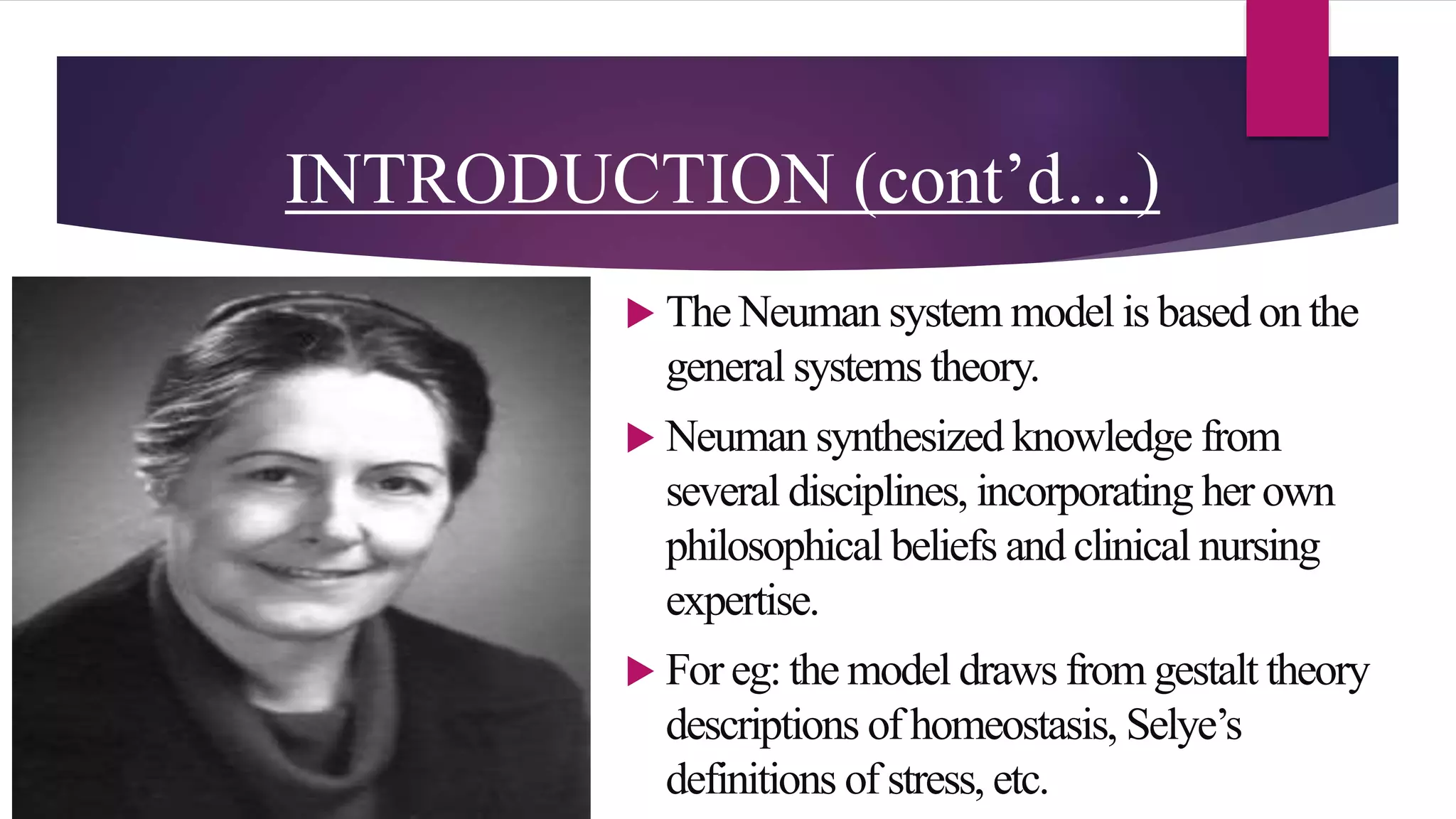
 The Neuman system model is based on the
general systems theory.
 Neuman synthesized knowledge from
several disciplines, incorporating her own
philosophical beliefs and clinical nursing
expertise.
 Foreg: the model draws from gestalt theory
descriptions of homeostasis, Selye’s
definitions of stress, etc.
OVERVIEW OF THE
NEUMAN SYSTEM
MODEL
OVERVIEW OF THE NEUMAN
SYSTEM MODEL
 According to Neuman, “The Neuman system model is the unique
system based perspectives that provides a unifying focus for
approaching a wide range of nursing concerns.”
 In this model, the client system in interaction with the environment is
the domain of nursing concern.
 The client system can be defined as a single client, a group, a number of
groups, or a social issue.
OVERVIEW (cont’d…)
This model is a wellness model based on the general system
theory in which the client system is exposed to the environment
stressors from within and without the system.
The focus is on the client system in relationship to the
environmental stressors.
The client system is protected by a circular series of buffers
known as lines of defense that minimize the effects of stressors.
OVERVIEW (cont’d…)
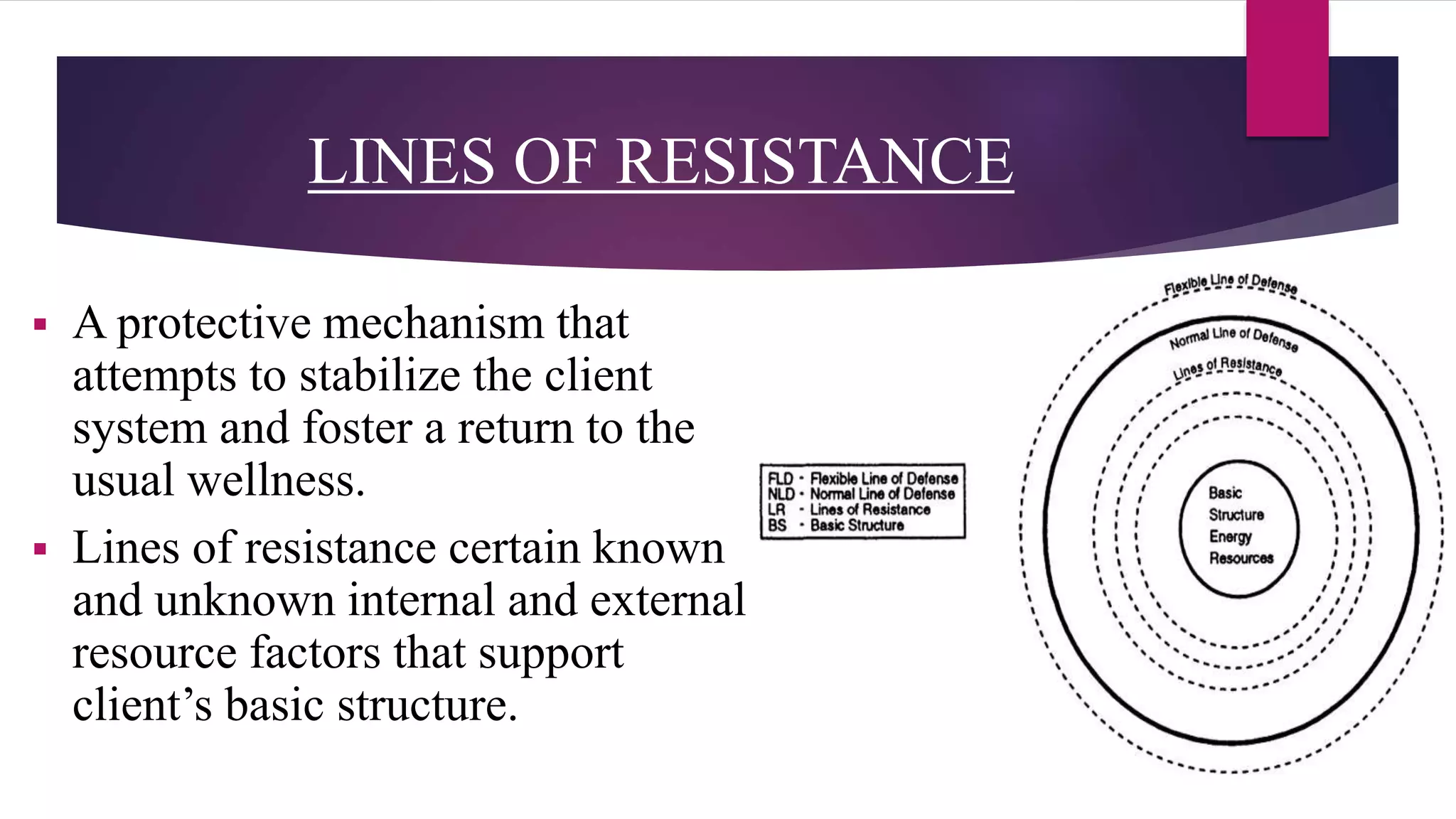
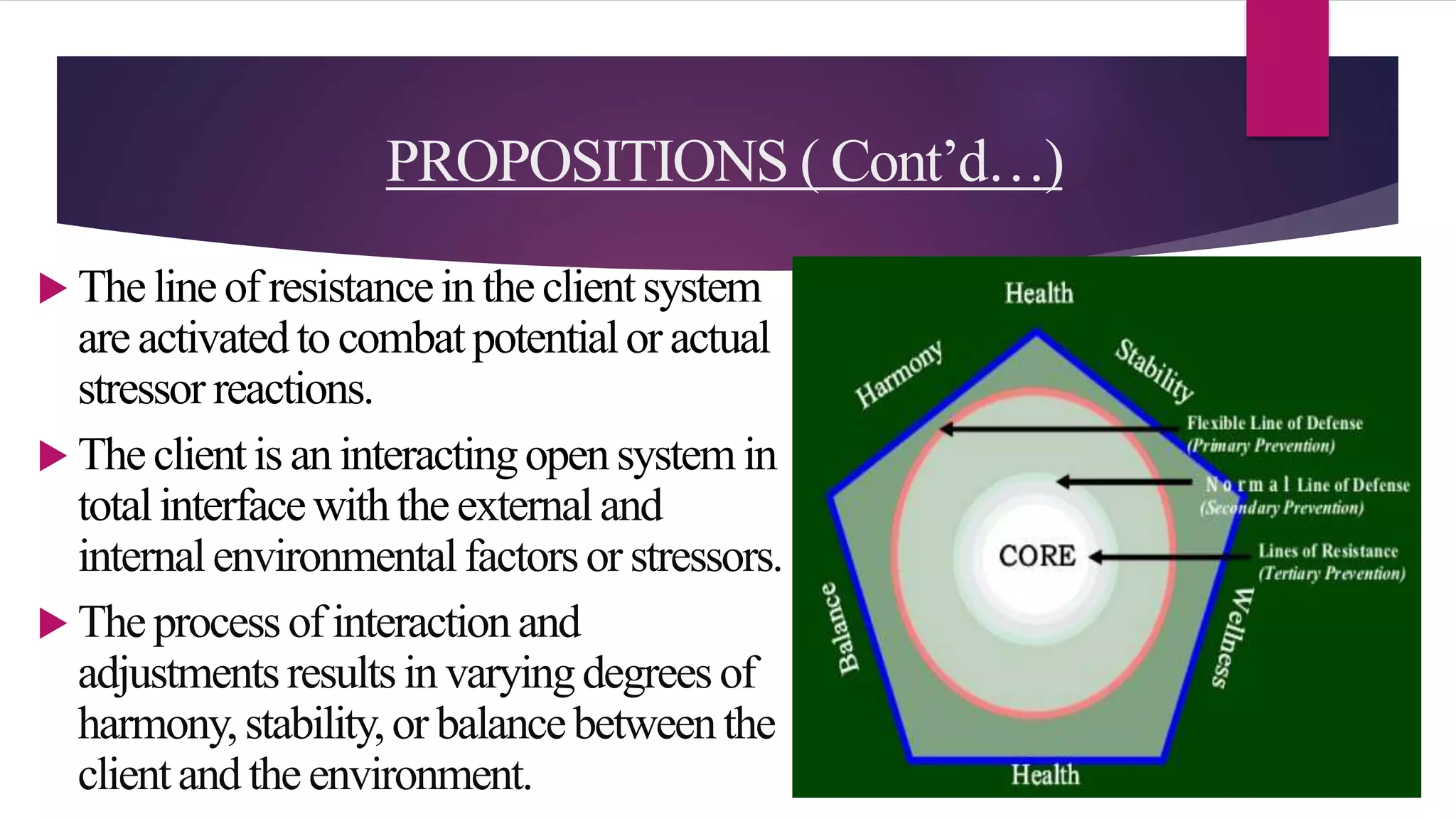
 Progressinginward,3 linesof
defenseareencountered,the
flexiblelineof defense,the
normallineof defense,andlines
of resistance.
 Thegreaterqualityof theclient
system’shealth,thegreaterthe
levelsof protectionprovidedby
thevariouslinesof defense.
CENTRAL CORE
 The central core structure consists of
basic survival factors (normal
temperature, genetic structure,
response pattern, organ strength
/weakness , ego structure)
 That are surrounded by :
 Several lines of resistance
 The normal line of defense
 The flexible line of defense
LINES OF RESISTANCE
 A protective mechanism that
attempts to stabilize the client
system and foster a return to the
usual wellness.
 Lines of resistance certain known
and unknown internal and external
resource factors that support
client’s basic structure.
NORMAL LINE OF DEFENSE
 The client / client system
normal or usual wellness level.
 This line represents what the
client has become evolved
over time.
 This normal defense line is the
standard against determining
any variance from wellness.
FLEXIBLE LINE OF DEFENSE
 Forms the outer boundary of the
defined client system.
 Act as a protective buffer
system for the client’s normal
line of defense or wellness state.
METAPARADIGM CONCEPTS AS DEFINED
IN NEUMAN’S MODEL
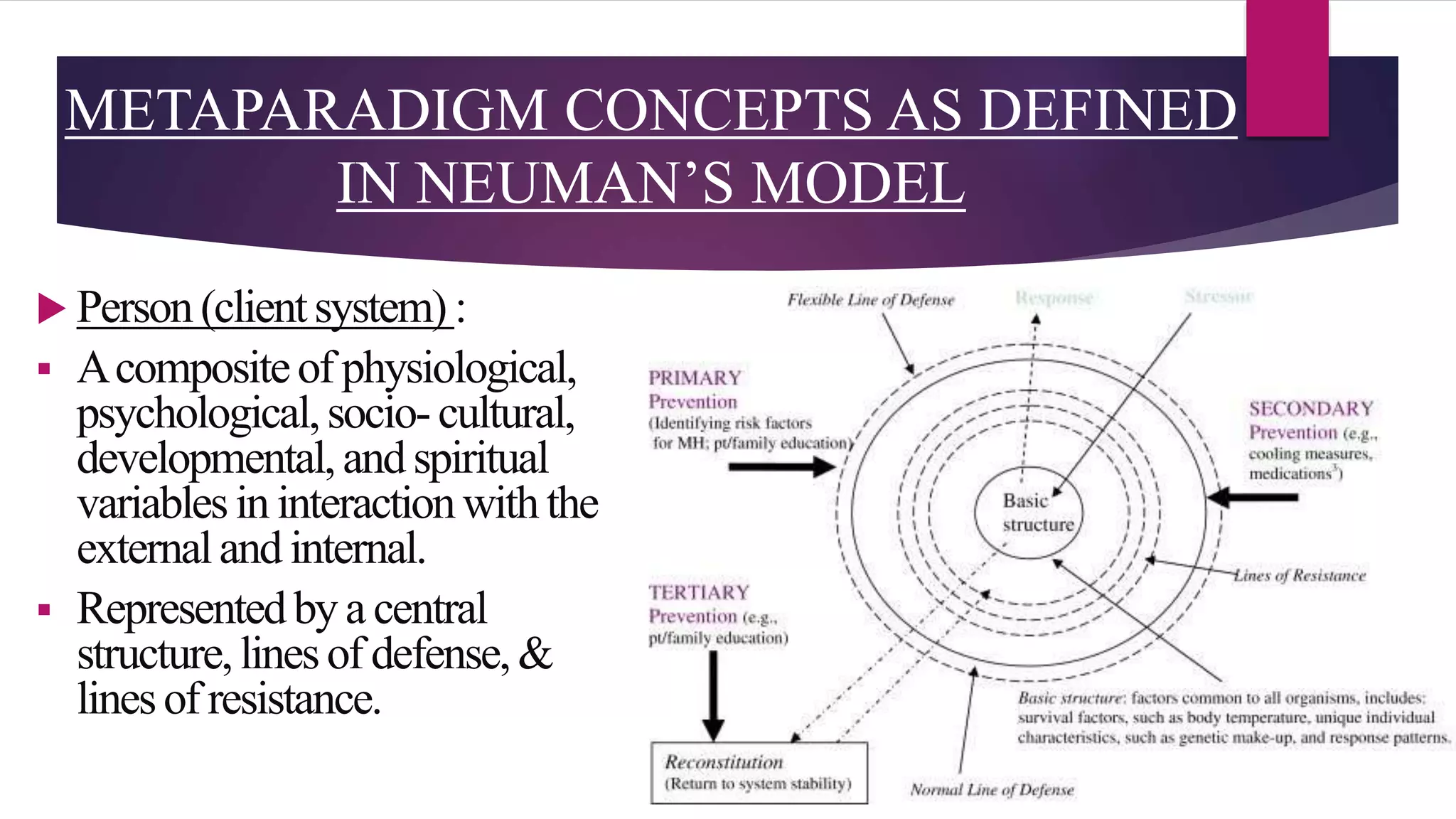
 Person (clientsystem) :
 Acompositeof physiological,
psychological,socio-cultural,
developmental,andspiritual
variablesin interactionwiththe
externaland internal.
 Representedby a central
structure,linesof defense,&
linesof resistance.
CLIENTS VARIABLE
METAPARADIGM CONCEPTS (cont’d…)
 Environment :
 All external and internal factors influences the surrounding, the client
system.
 Three relevant environments identified are the internal environment, the
external environment, and the created environment.
METAPARADIGM CONCEPTS (cont’d…)
 Health :health is equated with
the optimal system stability, it is
viewed on a continuum of
wellness to illness.
 Nursing : prevention as
intervention, concerned with the
all potential stressors.
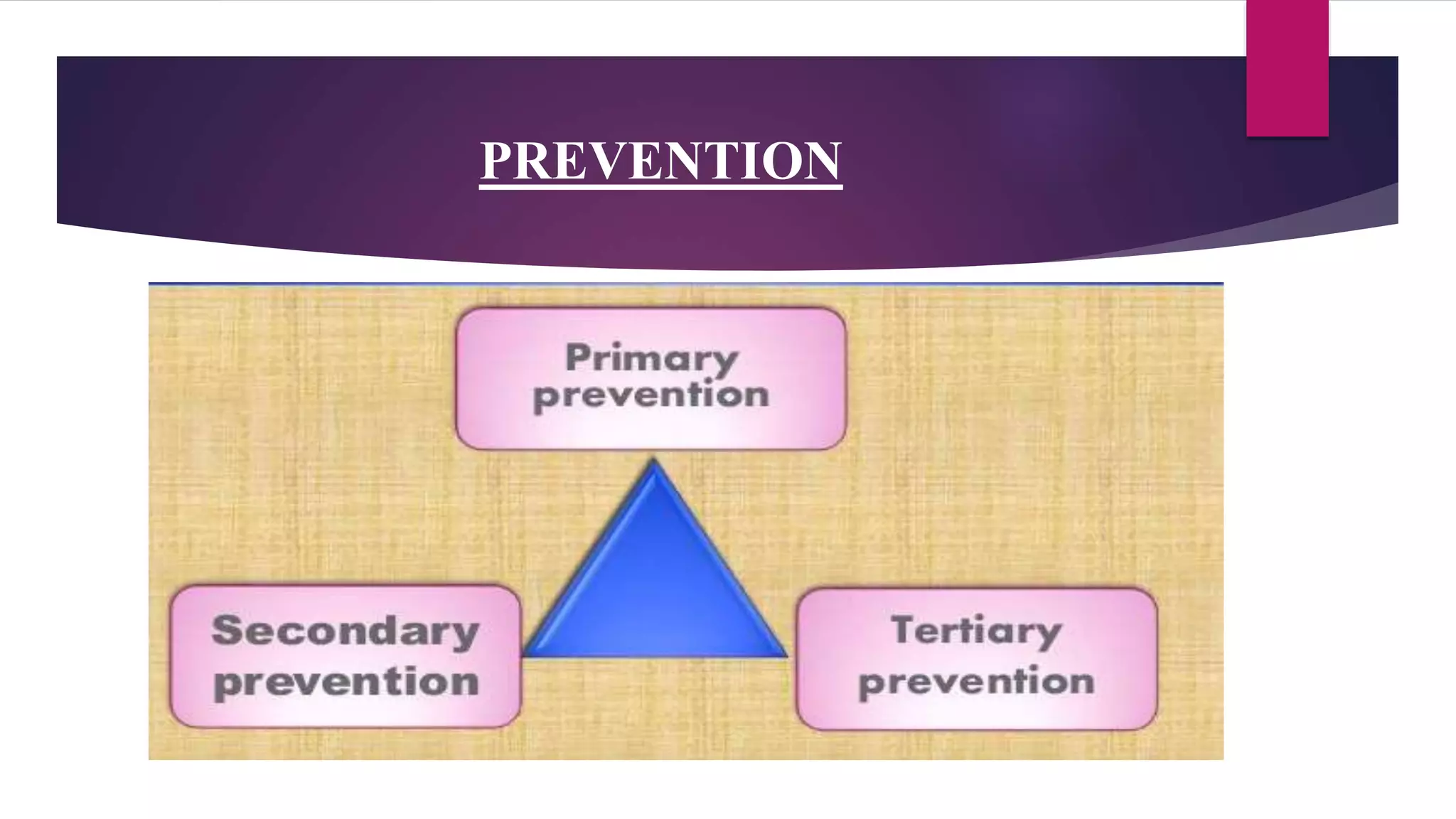
PREVENTION
ANALYSIS OF NEUMAN’S SYSTEM MODEL
ASSUMPTIONS OFTHE NEUMAN’S SYSTEM MODEL
 Provided support factors are in place, the client system constantly monitors
self by making adjustments as needed to retain, attain, and maintain
stability for an optimal health state.
 The client is an open system that interacts with the environment, so as to
promote harmony and balance between the internal and external
environments.
ASSUMPTIONS (Cont’d...)
 The client is a composite of physiological, psychological, socio- cultural,
developmental,and spiritual variables that are viewed as parts of the whole.
 Each client system is unique. Each system is a composite of common
known factors or innate characteristics within a normal, given range of
response, contained within a basic structure.
ASSUMPTIONS (Cont’d...)
 Each person is born with a spiritual energy force or seed within the spiritual
variable, as identified in the basic structure of the client system.
 The spiritual development in varying degree empowers the client system
toward the well- being by positively directing spiritual energy for use first
by the mind and then by the body.
ASSUMPTIONS (Cont’d...)
 The environment contains both the external and internal stressors and
resistace factors.
 Stressors are considered neutral, the client encounter determines whether
the outcome is beneficial or noxious.
 The client engages in a constant, dynamic energy exchange with the
environment.
PROPOSITIONS OF THE NEUMAN’S SYSTEM MODEL
 Propositions of the Neuman’s system model as presented by Fawcett.
 The client is system capable of input and output related to
interpersonal, intrapersonal, and extrapersonal environmental
influences , interacting with the environment by adjusting to it or
adjusting the environment to itself.
 Input, output and feedback between the client and the environment are
circular in nature.
PROPOSITIONS ( Cont’d…)
 Many known, unknown, and universal environmental stressors exist.
 Each stressors differs in its potential for disturbing a client’s usual level of
stability or normal line of defense.
 When cushioning effect of the flexible line of defense is no longer capable of
protecting the client system against an environmental stresssors, the stressor
breaks through the normal line of defense.
PROPOSITIONS ( Cont’d…)
 Thelineof resistancein theclientsystem
areactivatedto combatpotentialor actual
stressor reactions.
 Theclientis an interactingopensystem in
totalinterfacewiththeexternaland
internalenvironmentalfactorsor stressors.
 Theprocessof interactionand
adjustmentsresultsin varyingdegreesof
harmony,stability,or balancebetweenthe
clientand theenvironment.
PROPOSITIONS ( Cont’d…)
 The major concern for nursing is keeping the client
system stable by accurately assessing the current
effects and possible effects of environmental
stressors and assisting the client in making the
adjustments required for an optimal level of
wellness.
 In keeping the system stable, the nurse creates
linkage among the client, environment, health and
nursing.
BRIEF CRITIQUE OFTHE NEUMAN SYSTEMS MODEL
 The Neuman systems model is a comprehensive conceptual model that
clearly operationalizes the concepts that are relevant to nursing.
 The model is complex, yet organized in a logical manner.
 It is easy for nurses to understand for use in practice and research.
 The scope of model is broad, allowing for its use for individuals, families,
groups or communities.
 Neuman’s model also incorporates the concepts of levels of prevention.
THE NEUMAN SYSTEMS MODELASAFRAMEWORK
FOR NURSING PRACTICE
 Using the Neuman systems model as a framework for providing nursing
care involves intervention at 3 levels of prevention : primary prevention
intervention ,secondary prevention intervention and tertiary prevention
intervention.
 The prevention as intervention format or mode identifies the entry point
condition of the client system. It also indicates the general type of
intervention or action required.
FRAMEWORK FOR NURSING PRACTICE
FRAMEWORK FOR NURSING PRACTICE (Cont’d..)
 Primary prevention as intervention is used for primary prevention as
wellness retention –that is to protect the client system’s normal line of
defense or usual wellness state by strengthening the flexible line of
defense.
 The goal is to promote wellness by stress prevention and reduction of
risk factors.
FRAMEWORK FOR NURSING PRACTICE (Cont’d..)
 The secondary prevention as intervention is used to protect the basic
structure by strengthening the internal lines of resistance.
 The goal is to provide appropriate treatment of symptoms, to achieve
optimal client system stability or wellness and energy conservation.
 The reconstitution is the determined energy increase related to the degree of
reaction and is identified as beginning at any point following treatment.
FRAMEWORK FOR NURSING PRACTICE (Cont’d..)
 The tertiary prevention as intervention modality is used for tertiary
prevention as wellness maintenance, to protect the client system’s
reconstitution or return to wellness following treatment.
THE NURSING PROCESSAND THE NEUMAN
SYSTEMS MODEL
 The Neuman systems model nursing process format has been
designed for use with the Neuman systems model.
 This nursing process has been developed, so that it applies to 3
categories : nursing diagnosis, nursing goals, and nursing outcomes.
NURSING DIAGNOSIS CATEGORY(ASSESSMENT)
 The Nurse – patient relationships begins with the initial contact and
is perceived as a partnership.
 Systemic data collection through physical assessment and interview
process.
 Assessment includes physiological, psychological, developmental,
socio-cultural , and spiritual variables
NURSING DIAGNOSIS (Cont’d..)
 Based on the assessment variances from wellness are identified and
diagnoses are identified and prioritized.
 The guidelines for the use of the Neuman system model in practice
stipulate that the diagnostic taxonomy employed reflects the
following categories.
NURSING DIAGNOSIS (Cont’d..)
 Taxonomy employed reflects the following categories :
Client system ( individual, family, group, or community)
Response level ( primary, secondary or tertiary)
Subsystem response (five variables)
Stressor source ( intra system,inter system or extra system)
Stressor type (five variables)
NURSING GOALS
(PLANNINGAND IMPLEMENTATION
 Goals and interventions are developed in partnership with the client
specific outcome goals, along with primary prevention as intervention
,secondary prevention as intervention and tertiary prevention as
intervention, modalities are developed to promote optimal client system
stability.
NURSING OUTCOMES
(IMPLEMENTATIONAND EVALUATION)
 The Nurse implements the planned interventions (primary, secondary,
or tertiary) in this phase.
 The Nurse evaluates and modifies these interventions as necessary,
working in partnership with the client, based on the client system
stability.
THENURSINGPROCESSANDTHENEUMANSYSTEMSMODEL
Variances
from wellness
are identified
and diagnoses
are identified
and prioritized Goals and
interventions are
developed in
partnership with the
client to promote
optimal client
system stability
Nursing outcomes
( implementation
and Evaluation)
Implements prevention
as intervention
modalities and working
in partnership with the
client modifies
interventions as
necessary based upon
client system stability
Nursing Goals
(Planning and
Implementation)
Nursing
diagnosis
category
(Assessment)
SCENARIO : Illustrating Nursing Care Framed by the
NEUMAN Systems Model Utilizing the NEUMAN Systems
Model Nursing Process Format
 The following scenario illustrates nursing care of the patient relative to one
identified nursing problem framed by the Neuman systems model.
 This scenario is not intended to cover all aspects care, but rather is
intended to stimulate thinking about how specific care might be
approached using this theory as a framework for practice.
SCENARIO : Illustrating Nursing Care Framed by the
NEUMAN Systems Model Utilizing the NEUMAN Systems
Model Nursing Process Format
 Ms.B,isa32-year-old,obesesinglemotherofthreewhopresentstotheclinic.Systemic
datacollection occursthroughphysicalassessmentandinterviewwithMs.B.
 Theassessmentincludesphysiological,psychological,developmental,sociocultural,and
spiritualvariables;basicstructure,function,strengths,andresourcesavailabletoMs.B.;
potentialandactualenvironmentalstressors;andcharacteristicsofMs.B'sflexibleand
normallinesofdefense,linesofresistance,degreeofreaction,andreconstitution.
 Basedontheassessment,itisdeterminedthatMs.B.isexperiencinganactualnutritional
imbalance-morethanbodyrequirements--relatedtofamilyandenvironmentalstressors.
SCENARIO : Illustrating Nursing Care Framed by the
NEUMAN Systems Model Utilizing the NEUMAN Systems
Model Nursing Process Format
 The nurse, in partnership with Ms. B., develops goals and interventions. Specific
outcome for Ms. B.include secondary prevention-as-intervention modalities to assist
Ms. B.in addressing current family and environmental stressors as well as
interventions aimed at expanding her flexible line of defense so as to promote
system stability.
 In addition, if any other nursing problems are uncovered in more variables; basic
structure, function, strengths, and resources; stressors; or lines of defense during the
assessment, the nurse addresses those problems simultaneously using the process
described and incorporating best practices to provide appropriate nursing care.
The Betty Neuman theory - Easy to understand ,The Neuman Systems Model

The Betty Neuman theory - Easy to understand ,The Neuman Systems Model

  • 2.
    Prepared By, Ms.Chithra.A.Valsan I YearMsc Nursing THE NEUMAN SYSTEMS MODEL: BETTYNEUMAN
  • 3.
    INTRODUCTION  BettyNeuman wasbornin1924inOhio. Graduation Peoples hospital,SONinOhioin1947.  Baccalaureate degreeinpublichealthandpsychology in1957.  M.scinmental health,publichealthconsultationin 1966fromUniversityofCalifornia –LosAngeles.  DoctoraldegreeinclinicalpsychologyatPacific WesternUniversityin1985.
  • 4.
    INTRODUCTION (cont’d…)  TheNeuman system model is based on the general systems theory.  Neuman synthesized knowledge from several disciplines, incorporating her own philosophical beliefs and clinical nursing expertise.  Foreg: the model draws from gestalt theory descriptions of homeostasis, Selye’s definitions of stress, etc.
  • 5.
  • 6.
    OVERVIEW OF THENEUMAN SYSTEM MODEL  According to Neuman, “The Neuman system model is the unique system based perspectives that provides a unifying focus for approaching a wide range of nursing concerns.”  In this model, the client system in interaction with the environment is the domain of nursing concern.  The client system can be defined as a single client, a group, a number of groups, or a social issue.
  • 8.
    OVERVIEW (cont’d…) This modelis a wellness model based on the general system theory in which the client system is exposed to the environment stressors from within and without the system. The focus is on the client system in relationship to the environmental stressors. The client system is protected by a circular series of buffers known as lines of defense that minimize the effects of stressors.
  • 9.
    OVERVIEW (cont’d…)  Progressinginward,3linesof defenseareencountered,the flexiblelineof defense,the normallineof defense,andlines of resistance.  Thegreaterqualityof theclient system’shealth,thegreaterthe levelsof protectionprovidedby thevariouslinesof defense.
  • 10.
    CENTRAL CORE  Thecentral core structure consists of basic survival factors (normal temperature, genetic structure, response pattern, organ strength /weakness , ego structure)  That are surrounded by :  Several lines of resistance  The normal line of defense  The flexible line of defense
  • 11.
    LINES OF RESISTANCE A protective mechanism that attempts to stabilize the client system and foster a return to the usual wellness.  Lines of resistance certain known and unknown internal and external resource factors that support client’s basic structure.
  • 12.
    NORMAL LINE OFDEFENSE  The client / client system normal or usual wellness level.  This line represents what the client has become evolved over time.  This normal defense line is the standard against determining any variance from wellness.
  • 13.
    FLEXIBLE LINE OFDEFENSE  Forms the outer boundary of the defined client system.  Act as a protective buffer system for the client’s normal line of defense or wellness state.
  • 17.
    METAPARADIGM CONCEPTS ASDEFINED IN NEUMAN’S MODEL  Person (clientsystem) :  Acompositeof physiological, psychological,socio-cultural, developmental,andspiritual variablesin interactionwiththe externaland internal.  Representedby a central structure,linesof defense,& linesof resistance.
  • 18.
  • 19.
    METAPARADIGM CONCEPTS (cont’d…) Environment :  All external and internal factors influences the surrounding, the client system.  Three relevant environments identified are the internal environment, the external environment, and the created environment.
  • 20.
    METAPARADIGM CONCEPTS (cont’d…) Health :health is equated with the optimal system stability, it is viewed on a continuum of wellness to illness.  Nursing : prevention as intervention, concerned with the all potential stressors.
  • 21.
  • 22.
  • 23.
    ASSUMPTIONS OFTHE NEUMAN’SSYSTEM MODEL  Provided support factors are in place, the client system constantly monitors self by making adjustments as needed to retain, attain, and maintain stability for an optimal health state.  The client is an open system that interacts with the environment, so as to promote harmony and balance between the internal and external environments.
  • 24.
    ASSUMPTIONS (Cont’d...)  Theclient is a composite of physiological, psychological, socio- cultural, developmental,and spiritual variables that are viewed as parts of the whole.  Each client system is unique. Each system is a composite of common known factors or innate characteristics within a normal, given range of response, contained within a basic structure.
  • 25.
    ASSUMPTIONS (Cont’d...)  Eachperson is born with a spiritual energy force or seed within the spiritual variable, as identified in the basic structure of the client system.  The spiritual development in varying degree empowers the client system toward the well- being by positively directing spiritual energy for use first by the mind and then by the body.
  • 26.
    ASSUMPTIONS (Cont’d...)  Theenvironment contains both the external and internal stressors and resistace factors.  Stressors are considered neutral, the client encounter determines whether the outcome is beneficial or noxious.  The client engages in a constant, dynamic energy exchange with the environment.
  • 27.
    PROPOSITIONS OF THENEUMAN’S SYSTEM MODEL  Propositions of the Neuman’s system model as presented by Fawcett.  The client is system capable of input and output related to interpersonal, intrapersonal, and extrapersonal environmental influences , interacting with the environment by adjusting to it or adjusting the environment to itself.  Input, output and feedback between the client and the environment are circular in nature.
  • 28.
    PROPOSITIONS ( Cont’d…) Many known, unknown, and universal environmental stressors exist.  Each stressors differs in its potential for disturbing a client’s usual level of stability or normal line of defense.  When cushioning effect of the flexible line of defense is no longer capable of protecting the client system against an environmental stresssors, the stressor breaks through the normal line of defense.
  • 29.
    PROPOSITIONS ( Cont’d…) Thelineof resistancein theclientsystem areactivatedto combatpotentialor actual stressor reactions.  Theclientis an interactingopensystem in totalinterfacewiththeexternaland internalenvironmentalfactorsor stressors.  Theprocessof interactionand adjustmentsresultsin varyingdegreesof harmony,stability,or balancebetweenthe clientand theenvironment.
  • 30.
    PROPOSITIONS ( Cont’d…) The major concern for nursing is keeping the client system stable by accurately assessing the current effects and possible effects of environmental stressors and assisting the client in making the adjustments required for an optimal level of wellness.  In keeping the system stable, the nurse creates linkage among the client, environment, health and nursing.
  • 31.
    BRIEF CRITIQUE OFTHENEUMAN SYSTEMS MODEL  The Neuman systems model is a comprehensive conceptual model that clearly operationalizes the concepts that are relevant to nursing.  The model is complex, yet organized in a logical manner.  It is easy for nurses to understand for use in practice and research.  The scope of model is broad, allowing for its use for individuals, families, groups or communities.  Neuman’s model also incorporates the concepts of levels of prevention.
  • 32.
    THE NEUMAN SYSTEMSMODELASAFRAMEWORK FOR NURSING PRACTICE
  • 33.
     Using theNeuman systems model as a framework for providing nursing care involves intervention at 3 levels of prevention : primary prevention intervention ,secondary prevention intervention and tertiary prevention intervention.  The prevention as intervention format or mode identifies the entry point condition of the client system. It also indicates the general type of intervention or action required. FRAMEWORK FOR NURSING PRACTICE
  • 34.
    FRAMEWORK FOR NURSINGPRACTICE (Cont’d..)  Primary prevention as intervention is used for primary prevention as wellness retention –that is to protect the client system’s normal line of defense or usual wellness state by strengthening the flexible line of defense.  The goal is to promote wellness by stress prevention and reduction of risk factors.
  • 35.
    FRAMEWORK FOR NURSINGPRACTICE (Cont’d..)  The secondary prevention as intervention is used to protect the basic structure by strengthening the internal lines of resistance.  The goal is to provide appropriate treatment of symptoms, to achieve optimal client system stability or wellness and energy conservation.  The reconstitution is the determined energy increase related to the degree of reaction and is identified as beginning at any point following treatment.
  • 36.
    FRAMEWORK FOR NURSINGPRACTICE (Cont’d..)  The tertiary prevention as intervention modality is used for tertiary prevention as wellness maintenance, to protect the client system’s reconstitution or return to wellness following treatment.
  • 38.
    THE NURSING PROCESSANDTHE NEUMAN SYSTEMS MODEL  The Neuman systems model nursing process format has been designed for use with the Neuman systems model.  This nursing process has been developed, so that it applies to 3 categories : nursing diagnosis, nursing goals, and nursing outcomes.
  • 39.
    NURSING DIAGNOSIS CATEGORY(ASSESSMENT) The Nurse – patient relationships begins with the initial contact and is perceived as a partnership.  Systemic data collection through physical assessment and interview process.  Assessment includes physiological, psychological, developmental, socio-cultural , and spiritual variables
  • 40.
    NURSING DIAGNOSIS (Cont’d..) Based on the assessment variances from wellness are identified and diagnoses are identified and prioritized.  The guidelines for the use of the Neuman system model in practice stipulate that the diagnostic taxonomy employed reflects the following categories.
  • 41.
    NURSING DIAGNOSIS (Cont’d..) Taxonomy employed reflects the following categories : Client system ( individual, family, group, or community) Response level ( primary, secondary or tertiary) Subsystem response (five variables) Stressor source ( intra system,inter system or extra system) Stressor type (five variables)
  • 42.
    NURSING GOALS (PLANNINGAND IMPLEMENTATION Goals and interventions are developed in partnership with the client specific outcome goals, along with primary prevention as intervention ,secondary prevention as intervention and tertiary prevention as intervention, modalities are developed to promote optimal client system stability.
  • 43.
    NURSING OUTCOMES (IMPLEMENTATIONAND EVALUATION) The Nurse implements the planned interventions (primary, secondary, or tertiary) in this phase.  The Nurse evaluates and modifies these interventions as necessary, working in partnership with the client, based on the client system stability.
  • 44.
    THENURSINGPROCESSANDTHENEUMANSYSTEMSMODEL Variances from wellness are identified anddiagnoses are identified and prioritized Goals and interventions are developed in partnership with the client to promote optimal client system stability Nursing outcomes ( implementation and Evaluation) Implements prevention as intervention modalities and working in partnership with the client modifies interventions as necessary based upon client system stability Nursing Goals (Planning and Implementation) Nursing diagnosis category (Assessment)
  • 46.
    SCENARIO : IllustratingNursing Care Framed by the NEUMAN Systems Model Utilizing the NEUMAN Systems Model Nursing Process Format  The following scenario illustrates nursing care of the patient relative to one identified nursing problem framed by the Neuman systems model.  This scenario is not intended to cover all aspects care, but rather is intended to stimulate thinking about how specific care might be approached using this theory as a framework for practice.
  • 47.
    SCENARIO : IllustratingNursing Care Framed by the NEUMAN Systems Model Utilizing the NEUMAN Systems Model Nursing Process Format  Ms.B,isa32-year-old,obesesinglemotherofthreewhopresentstotheclinic.Systemic datacollection occursthroughphysicalassessmentandinterviewwithMs.B.  Theassessmentincludesphysiological,psychological,developmental,sociocultural,and spiritualvariables;basicstructure,function,strengths,andresourcesavailabletoMs.B.; potentialandactualenvironmentalstressors;andcharacteristicsofMs.B'sflexibleand normallinesofdefense,linesofresistance,degreeofreaction,andreconstitution.  Basedontheassessment,itisdeterminedthatMs.B.isexperiencinganactualnutritional imbalance-morethanbodyrequirements--relatedtofamilyandenvironmentalstressors.
  • 48.
    SCENARIO : IllustratingNursing Care Framed by the NEUMAN Systems Model Utilizing the NEUMAN Systems Model Nursing Process Format  The nurse, in partnership with Ms. B., develops goals and interventions. Specific outcome for Ms. B.include secondary prevention-as-intervention modalities to assist Ms. B.in addressing current family and environmental stressors as well as interventions aimed at expanding her flexible line of defense so as to promote system stability.  In addition, if any other nursing problems are uncovered in more variables; basic structure, function, strengths, and resources; stressors; or lines of defense during the assessment, the nurse addresses those problems simultaneously using the process described and incorporating best practices to provide appropriate nursing care.