Understanding SQL Trace, TKPROF and
Execution Plan for beginners
Carlos Sierra
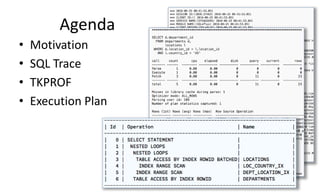
Agenda
• Motivation
• SQL Trace
• TKPROF
• Execution Plan
Motivation
• My report is taking too long…
• One Materialize View is sudently hanging...
• This page is taking long since last upgrade...
• It runs faster on my development instance...
• Everything is slow, then the DBA has to fix it...
• Where to start?
SQL Trace
• Performance information on individual SQL
• CPU and Elapsed Time
• Wait Events
• Execution Plan
• Rows processed
• Call count (parse, execute and fetch)
• Physical and Logical reads
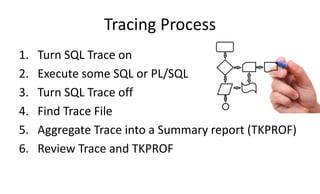
Tracing Process
1. Turn SQL Trace on
2. Execute some SQL or PL/SQL
3. Turn SQL Trace off
4. Find Trace File
5. Aggregate Trace into a Summary report (TKPROF)
6. Review Trace and TKPROF
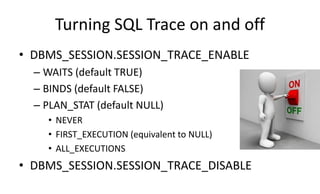
Turning SQL Trace on and off
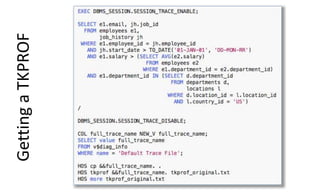
• DBMS_SESSION.SESSION_TRACE_ENABLE
– WAITS (default TRUE)
– BINDS (default FALSE)
– PLAN_STAT (default NULL)
• NEVER
• FIRST_EXECUTION (equivalent to NULL)
• ALL_EXECUTIONS
• DBMS_SESSION.SESSION_TRACE_DISABLE
Other ways to turn Trace on and off
• DBMS_SESSION.SET_SQL_TRACE(TRUE|FALSE)
• ALTER SESSION SET SQL_TRACE = TRUE|FALSE
• ALTER SESSION SET EVENT 10046
• DBMS_MONITOR.SESSION_TRACE_ENABLE or DIS
• ALTER SYSTEM SET EVENTS 'sql_trace [sql:&&sql_id]
bind=true, wait=true';
• ORADEBUG
• Oracle Enterprise Manager (OEM)
Alter Session
• ALTER SESSION SET
– SQL_TRACE = [ TRUE | FALSE ]
– EVENTS ‘10046 trace name context forever, level N’
• N = 1: all executions (10g-) or 1st execution (11g+)
• N = 4: Binds
• N = 8: Waits
• N = 12 = 4 + 8
• N = 16: each execution (11g+)
• N = 64: 1st + each where DB time > 1min (11.2.0.2+)
Finding SQL Trace
• Get Trace Filename from V$DIAG_INFO (11g+)
• Get Trace Directory from USER_DUMP_DEST (10g-)
– Use V$DIAG_INFO on 11g and 12c
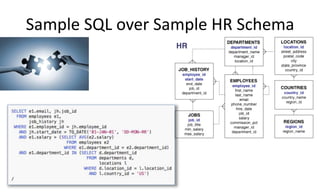
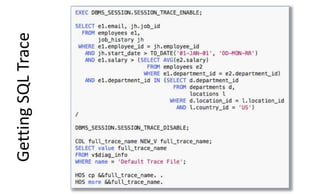
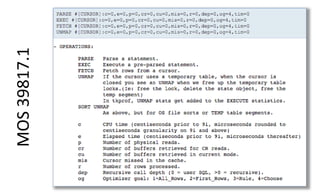
Sample SQL over Sample HR Schema
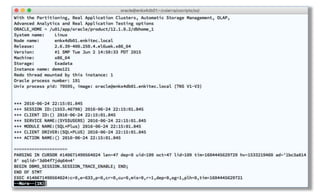
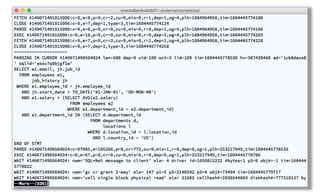
GettingSQLTrace
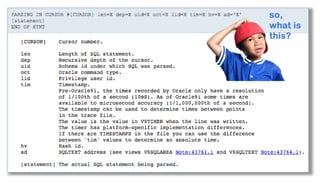
MOS39817.1
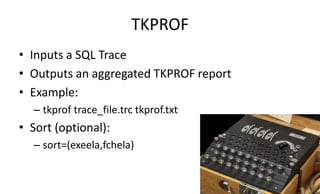
TKPROF
• Inputs a SQL Trace
• Outputs an aggregated TKPROF report
• Example:
– tkprof trace_file.trc tkprof.txt
• Sort (optional):
– sort=(exeela,fchela)
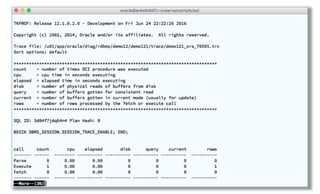
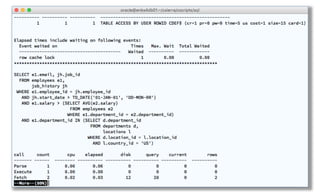
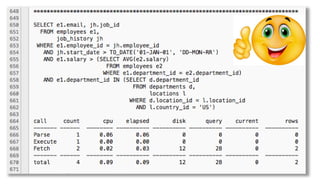
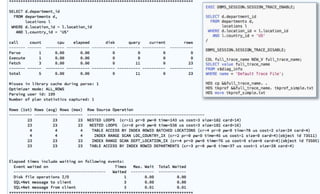
GettingaTKPROF
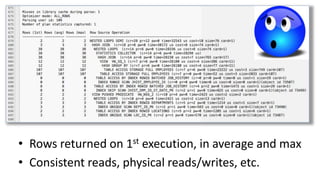
• Rows returned on 1st execution, in average and max
• Consistent reads, physical reads/writes, etc.
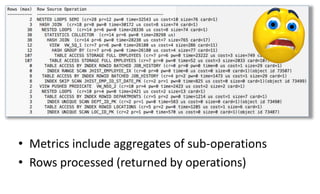
• Metrics include aggregates of sub-operations
• Rows processed (returned by operations)
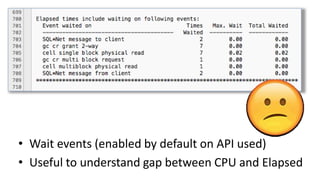
• Wait events (enabled by default on API used)
• Useful to understand gap between CPU and Elapsed
Execution Plan
• Set of steps to execute a SQL statement
– Mostly Access Operations and Joins
• Better understood by correlating Plan to SQL
• Hard to read without predicate information
• Column projection also eases understanding
• Figuring out execution order can be a challenge!
Common Access Operations
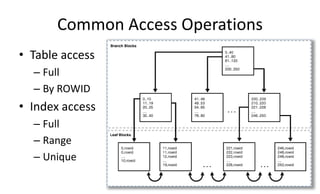
• Table access
– Full
– By ROWID
• Index access
– Full
– Range
– Unique
Join Types
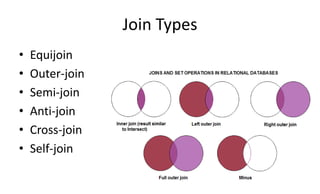
• Equijoin
• Outer-join
• Semi-join
• Anti-join
• Cross-join
• Self-join
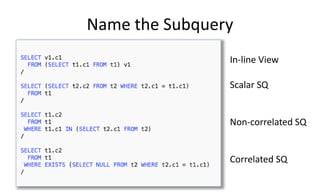
Name the Subquery
In-line View
Scalar SQ
Non-correlated SQ
Correlated SQ
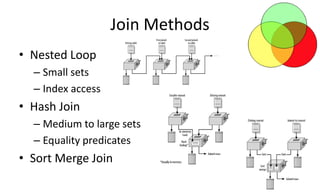
Join Methods
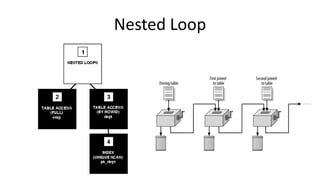
• Nested Loop
– Small sets
– Index access
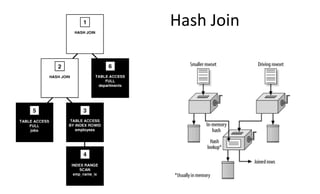
• Hash Join
– Medium to large sets
– Equality predicates
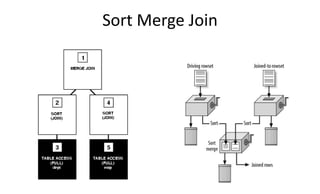
• Sort Merge Join
Nested Loop
Hash Join
Sort Merge Join
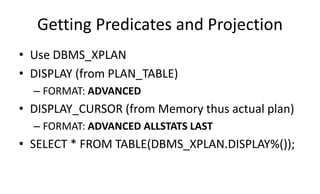
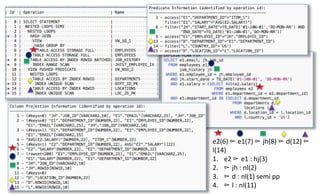
Getting Predicates and Projection
• Use DBMS_XPLAN
• DISPLAY (from PLAN_TABLE)
– FORMAT: ADVANCED
• DISPLAY_CURSOR (from Memory thus actual plan)
– FORMAT: ADVANCED ALLSTATS LAST
• SELECT * FROM TABLE(DBMS_XPLAN.DISPLAY%());
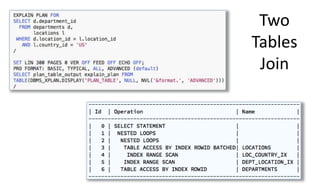
Two
Tables
Join
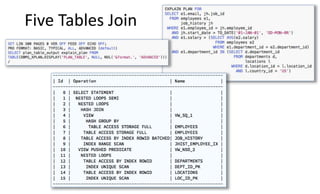
Five Tables Join
e2(6) ▻ e1(7) ▻ jh(8) ▻ d(12) ▻
l(14)
1. e2 ▻ e1 : hj(3)
2. ▻ jh : nl(2)
3. ▻ d : nl(1) semi pp
4. ▻ l : nl(11)
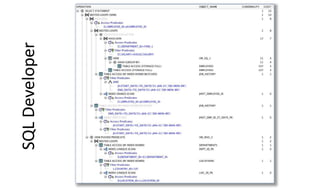
SQLDeveloper
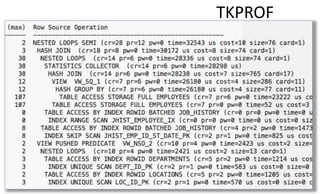
TKPROF
Summary
• Trace shows performance information per SQL
• Trace and TKPROF do not require additional license
• Trace includes Execution Plan when Cursor closes
• DBMS_XPLAN provides Predicates and Projection
• Understand first what the SQL does
• Then correlate SQL to Execution Plan
• Focus where the Time is spent!
References
• My Oracle Support (MOS)
– 39817.1 Interpreting Raw SQL_TRACE output
– 376442.1 How to Collect 10046 Trace (SQL_TRACE)
Diagnostics for Performance Issues
• https://oracle-base.com/articles/misc/sql-trace-
10046-trcsess-and-tkprof
• Oracle Documentation
• Google
Questions
The End
• http://carlos-sierra.net/
– Blog and downloads
• carlos.sierra.usa@gmail.com
– Questions and follow-up
• Keep learning!

Understanding SQL Trace, TKPROF and Execution Plan for beginners

  • 1.
    Understanding SQL Trace,TKPROF and Execution Plan for beginners Carlos Sierra
  • 2.
    Agenda • Motivation • SQLTrace • TKPROF • Execution Plan
  • 3.
    Motivation • My reportis taking too long… • One Materialize View is sudently hanging... • This page is taking long since last upgrade... • It runs faster on my development instance... • Everything is slow, then the DBA has to fix it... • Where to start?
  • 4.
    SQL Trace • Performanceinformation on individual SQL • CPU and Elapsed Time • Wait Events • Execution Plan • Rows processed • Call count (parse, execute and fetch) • Physical and Logical reads
  • 5.
    Tracing Process 1. TurnSQL Trace on 2. Execute some SQL or PL/SQL 3. Turn SQL Trace off 4. Find Trace File 5. Aggregate Trace into a Summary report (TKPROF) 6. Review Trace and TKPROF
  • 6.
    Turning SQL Traceon and off • DBMS_SESSION.SESSION_TRACE_ENABLE – WAITS (default TRUE) – BINDS (default FALSE) – PLAN_STAT (default NULL) • NEVER • FIRST_EXECUTION (equivalent to NULL) • ALL_EXECUTIONS • DBMS_SESSION.SESSION_TRACE_DISABLE
  • 7.
    Other ways toturn Trace on and off • DBMS_SESSION.SET_SQL_TRACE(TRUE|FALSE) • ALTER SESSION SET SQL_TRACE = TRUE|FALSE • ALTER SESSION SET EVENT 10046 • DBMS_MONITOR.SESSION_TRACE_ENABLE or DIS • ALTER SYSTEM SET EVENTS 'sql_trace [sql:&&sql_id] bind=true, wait=true'; • ORADEBUG • Oracle Enterprise Manager (OEM)
  • 8.
    Alter Session • ALTERSESSION SET – SQL_TRACE = [ TRUE | FALSE ] – EVENTS ‘10046 trace name context forever, level N’ • N = 1: all executions (10g-) or 1st execution (11g+) • N = 4: Binds • N = 8: Waits • N = 12 = 4 + 8 • N = 16: each execution (11g+) • N = 64: 1st + each where DB time > 1min (11.2.0.2+)
  • 9.
    Finding SQL Trace •Get Trace Filename from V$DIAG_INFO (11g+) • Get Trace Directory from USER_DUMP_DEST (10g-) – Use V$DIAG_INFO on 11g and 12c
  • 10.
    Sample SQL overSample HR Schema
  • 11.
  • 15.
  • 16.
    TKPROF • Inputs aSQL Trace • Outputs an aggregated TKPROF report • Example: – tkprof trace_file.trc tkprof.txt • Sort (optional): – sort=(exeela,fchela)
  • 17.
  • 21.
    • Rows returnedon 1st execution, in average and max • Consistent reads, physical reads/writes, etc.
  • 22.
    • Metrics includeaggregates of sub-operations • Rows processed (returned by operations)
  • 23.
    • Wait events(enabled by default on API used) • Useful to understand gap between CPU and Elapsed
  • 24.
    Execution Plan • Setof steps to execute a SQL statement – Mostly Access Operations and Joins • Better understood by correlating Plan to SQL • Hard to read without predicate information • Column projection also eases understanding • Figuring out execution order can be a challenge!
  • 25.
    Common Access Operations •Table access – Full – By ROWID • Index access – Full – Range – Unique
  • 26.
    Join Types • Equijoin •Outer-join • Semi-join • Anti-join • Cross-join • Self-join
  • 27.
    Name the Subquery In-lineView Scalar SQ Non-correlated SQ Correlated SQ
  • 28.
    Join Methods • NestedLoop – Small sets – Index access • Hash Join – Medium to large sets – Equality predicates • Sort Merge Join
  • 29.
  • 30.
  • 31.
  • 32.
    Getting Predicates andProjection • Use DBMS_XPLAN • DISPLAY (from PLAN_TABLE) – FORMAT: ADVANCED • DISPLAY_CURSOR (from Memory thus actual plan) – FORMAT: ADVANCED ALLSTATS LAST • SELECT * FROM TABLE(DBMS_XPLAN.DISPLAY%());
  • 33.
  • 35.
  • 36.
    e2(6) ▻ e1(7)▻ jh(8) ▻ d(12) ▻ l(14) 1. e2 ▻ e1 : hj(3) 2. ▻ jh : nl(2) 3. ▻ d : nl(1) semi pp 4. ▻ l : nl(11)
  • 37.
  • 38.
  • 39.
    Summary • Trace showsperformance information per SQL • Trace and TKPROF do not require additional license • Trace includes Execution Plan when Cursor closes • DBMS_XPLAN provides Predicates and Projection • Understand first what the SQL does • Then correlate SQL to Execution Plan • Focus where the Time is spent!
  • 40.
    References • My OracleSupport (MOS) – 39817.1 Interpreting Raw SQL_TRACE output – 376442.1 How to Collect 10046 Trace (SQL_TRACE) Diagnostics for Performance Issues • https://oracle-base.com/articles/misc/sql-trace- 10046-trcsess-and-tkprof • Oracle Documentation • Google
  • 41.
  • 42.
    The End • http://carlos-sierra.net/ –Blog and downloads • carlos.sierra.usa@gmail.com – Questions and follow-up • Keep learning!

Editor's Notes

  • #39 NSO: Nested Subquery Optimization