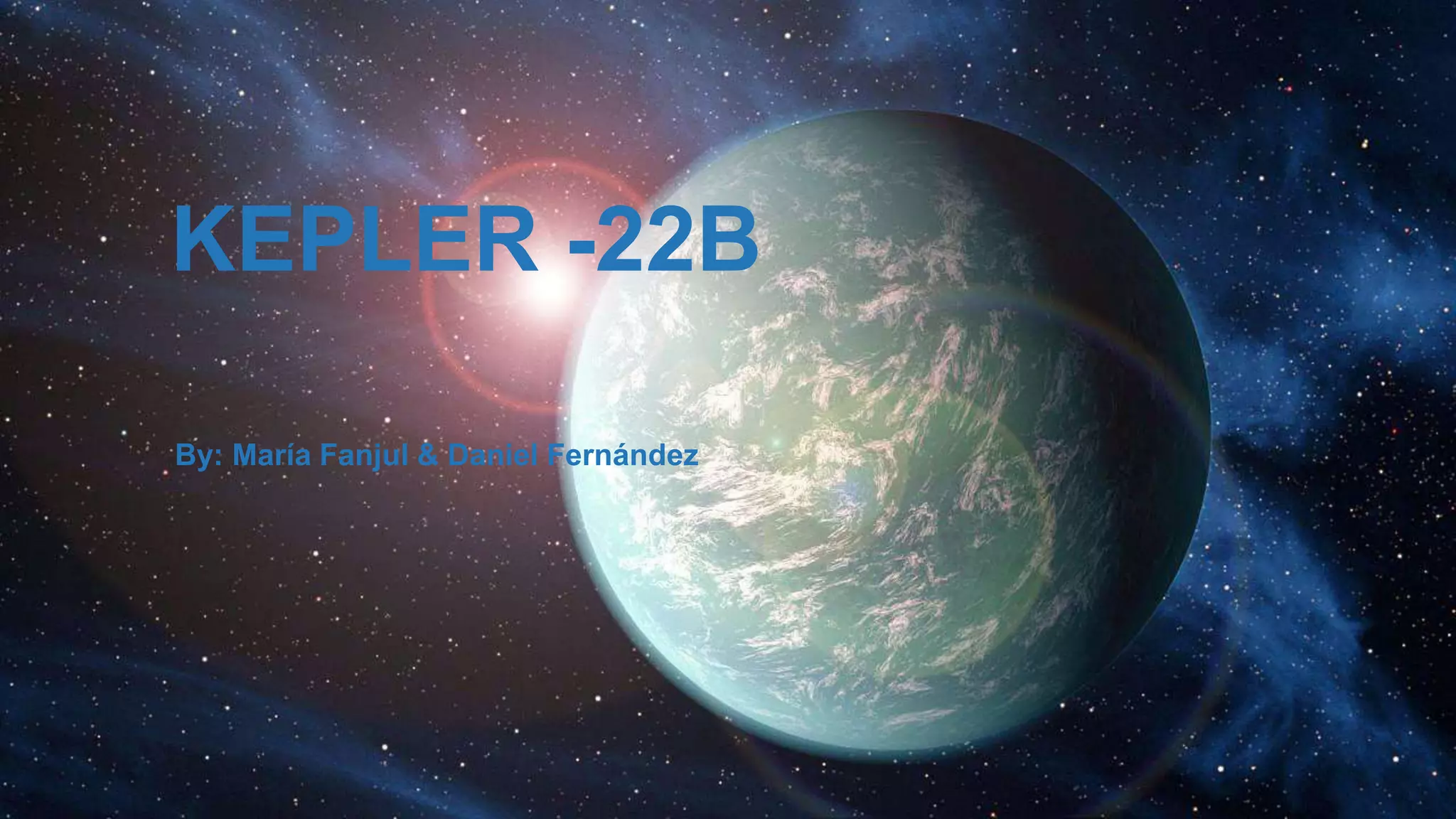
KEPLER -22B
By: María Fanjul & Daniel Fernández
WHAT´S KEPLER-22B?
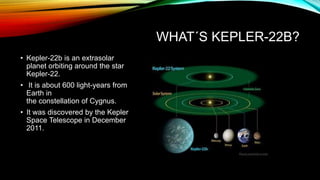
• Kepler-22b is an extrasolar
planet orbiting around the star
Kepler-22.
• It is about 600 light-years from
Earth in
the constellation of Cygnus.
• It was discovered by the Kepler
Space Telescope in December
2011.
WHAT ABOUT ITS (POSSIBLE)
CLIMATE?• Scientists can estimate the possible surface
conditions as follows:
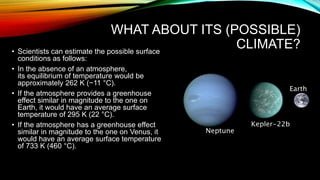
• In the absence of an atmosphere,
its equilibrium of temperature would be
approximately 262 K (−11 °C).
• If the atmosphere provides a greenhouse
effect similar in magnitude to the one on
Earth, it would have an average surface
temperature of 295 K (22 °C).
• If the atmosphere has a greenhouse effect
similar in magnitude to the one on Venus, it
would have an average surface temperature
of 733 K (460 °C).
WHY IS IT SO IMPORTANT?
• It´s the first exoplanet that has been
discovered.
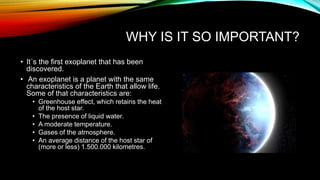
• An exoplanet is a planet with the same
characteristics of the Earth that allow life.
Some of that characteristics are:
• Greenhouse effect, which retains the heat
of the host star.
• The presence of liquid water.
• A moderate temperature.
• Gases of the atmosphere.
• An average distance of the host star of
(more or less) 1.500.000 kilometres.
HOW DID THE NASA DISCOVER
IT?
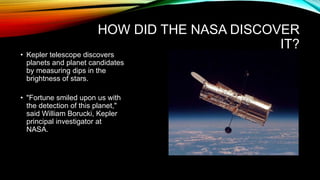
• Kepler telescope discovers
planets and planet candidates
by measuring dips in the
brightness of stars.
• "Fortune smiled upon us with
the detection of this planet,"
said William Borucki, Kepler
principal investigator at
NASA.
GLOSSARY
Extrasolar: extrasolar
Surface conditions: condiciones de la superficie
Absence: ausencia
Magnitude: magnitud
Greenhouse effect: efecto invernadero
Host star: estrella anfitriona
Exoplanet: exoplaneta
Allows life: permite la vida
Dips: depresiones
Planet candidates: posibles planetas
Brightness: brillo
Transit: tránsito
Verify: verificar

2

  • 1.
    KEPLER -22B By: MaríaFanjul & Daniel Fernández
  • 2.
    WHAT´S KEPLER-22B? • Kepler-22bis an extrasolar planet orbiting around the star Kepler-22. • It is about 600 light-years from Earth in the constellation of Cygnus. • It was discovered by the Kepler Space Telescope in December 2011.
  • 3.
    WHAT ABOUT ITS(POSSIBLE) CLIMATE?• Scientists can estimate the possible surface conditions as follows: • In the absence of an atmosphere, its equilibrium of temperature would be approximately 262 K (−11 °C). • If the atmosphere provides a greenhouse effect similar in magnitude to the one on Earth, it would have an average surface temperature of 295 K (22 °C). • If the atmosphere has a greenhouse effect similar in magnitude to the one on Venus, it would have an average surface temperature of 733 K (460 °C).
  • 4.
    WHY IS ITSO IMPORTANT? • It´s the first exoplanet that has been discovered. • An exoplanet is a planet with the same characteristics of the Earth that allow life. Some of that characteristics are: • Greenhouse effect, which retains the heat of the host star. • The presence of liquid water. • A moderate temperature. • Gases of the atmosphere. • An average distance of the host star of (more or less) 1.500.000 kilometres.
  • 5.
    HOW DID THENASA DISCOVER IT? • Kepler telescope discovers planets and planet candidates by measuring dips in the brightness of stars. • "Fortune smiled upon us with the detection of this planet," said William Borucki, Kepler principal investigator at NASA.
  • 7.
    GLOSSARY Extrasolar: extrasolar Surface conditions:condiciones de la superficie Absence: ausencia Magnitude: magnitud Greenhouse effect: efecto invernadero Host star: estrella anfitriona Exoplanet: exoplaneta Allows life: permite la vida Dips: depresiones Planet candidates: posibles planetas Brightness: brillo Transit: tránsito Verify: verificar