LEARNING OBJECTIVES
 To be able to get knowledge about “Sun” as the main source of
energy
 To be able to analyse the factors responsible for varying rates of
surface insolation
LEARNING OUTCOMES
ALL: Students will be able to reason out how the rates of insolation
decreases with latitude from equator to poles.
MOST: Students will be able to differentiate between the patterns of
sun radiations at the equator and at poles
SOME: Students will be able to evaluate and justify the impact of
different factors acting on the climatic condition of the place.
Insolation
 Insolation is the solar radiation that reaches the earth's surface.
 Insolation affects temperature. The more the insolation, the higher the
temperature.
 Rates of insolation vary greatly from place to place. The main control is the
latitude.
Factors affecting insolation
 Distance between the sun and the earth
 Angle of the Sun
 Duration of the day light
Effects of Latitude on Temperature
 The Sun's rays travel a short distance through the atmosphere
 Less heat is lost to the atmosphere
 More of the Sun's rays reach the Earth's surface
 Sun's rays pass through a longer
distance in the atmosphere
 More heat is lost in the
atmosphere
 More of the Sun’s rays disperse
Effect of Latitude on Temperature
EFFECTS OF ALTITUDE ON TEMPERATURE
 The Earth's surface absorbs most of the heat.
 As, the Earth's surface warms up, the heat diffuses into
the lower layers of the atmosphere and warming it.
 This in turn transfers some of the heat to the upper
layers of the atmosphere.
 The layers of atmosphere closest to the Earth's surface receive
the most heat from the Earth's surface.
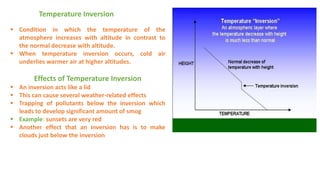
Temperature Inversion
 Condition in which the temperature of the
atmosphere increases with altitude in contrast to
the normal decrease with altitude.
 When temperature inversion occurs, cold air
underlies warmer air at higher altitudes.
Effects of Temperature Inversion
 An inversion acts like a lid
 This can cause several weather-related effects
 Trapping of pollutants below the inversion which
leads to develop significant amount of smog
 Example: sunsets are very red
 Another effect that an inversion has is to make
clouds just below the inversion
Temperature Inversion in Mexico City
Material on word doc
Strategies made in Mexico
http://www.dw.de/fighting-the-smog-in-mexico-city/a-17786567
Home Task
Study climate graphs in atlases for four cities in different latitudes and
relate temperatures to latitude.

Insolation2

  • 1.
    LEARNING OBJECTIVES  Tobe able to get knowledge about “Sun” as the main source of energy  To be able to analyse the factors responsible for varying rates of surface insolation
  • 2.
    LEARNING OUTCOMES ALL: Studentswill be able to reason out how the rates of insolation decreases with latitude from equator to poles. MOST: Students will be able to differentiate between the patterns of sun radiations at the equator and at poles SOME: Students will be able to evaluate and justify the impact of different factors acting on the climatic condition of the place.
  • 3.
    Insolation  Insolation isthe solar radiation that reaches the earth's surface.  Insolation affects temperature. The more the insolation, the higher the temperature.  Rates of insolation vary greatly from place to place. The main control is the latitude.
  • 4.
    Factors affecting insolation Distance between the sun and the earth  Angle of the Sun  Duration of the day light
  • 6.
    Effects of Latitudeon Temperature
  • 7.
     The Sun'srays travel a short distance through the atmosphere  Less heat is lost to the atmosphere  More of the Sun's rays reach the Earth's surface  Sun's rays pass through a longer distance in the atmosphere  More heat is lost in the atmosphere  More of the Sun’s rays disperse Effect of Latitude on Temperature
  • 8.
    EFFECTS OF ALTITUDEON TEMPERATURE  The Earth's surface absorbs most of the heat.  As, the Earth's surface warms up, the heat diffuses into the lower layers of the atmosphere and warming it.  This in turn transfers some of the heat to the upper layers of the atmosphere.  The layers of atmosphere closest to the Earth's surface receive the most heat from the Earth's surface.
  • 11.
    Temperature Inversion  Conditionin which the temperature of the atmosphere increases with altitude in contrast to the normal decrease with altitude.  When temperature inversion occurs, cold air underlies warmer air at higher altitudes. Effects of Temperature Inversion  An inversion acts like a lid  This can cause several weather-related effects  Trapping of pollutants below the inversion which leads to develop significant amount of smog  Example: sunsets are very red  Another effect that an inversion has is to make clouds just below the inversion
  • 12.
    Temperature Inversion inMexico City Material on word doc Strategies made in Mexico http://www.dw.de/fighting-the-smog-in-mexico-city/a-17786567 Home Task Study climate graphs in atlases for four cities in different latitudes and relate temperatures to latitude.