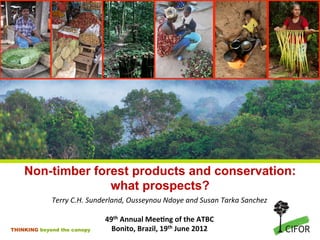
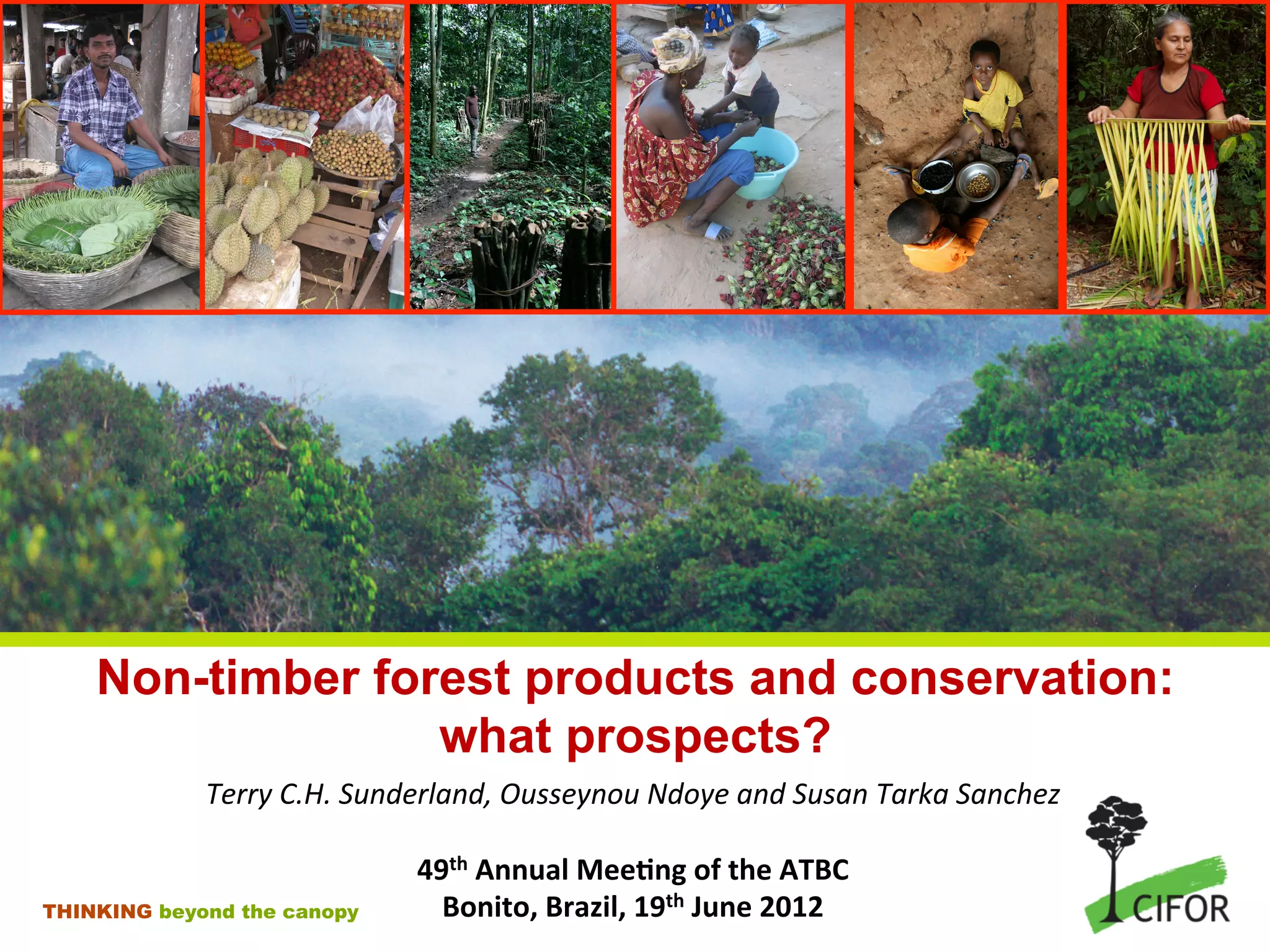
Non-timber forest products and conservation:
                   what prospects?
             Terry	
  C.H.	
  Sunderland,	
  Ousseynou	
  Ndoye	
  and	
  Susan	
  Tarka	
  Sanchez	


                                   49th	
  Annual	
  Mee-ng	
  of	
  the	
  ATBC	
  	
  
THINKING beyond the canopy           Bonito,	
  Brazil,	
  19th	
  June	
  2012	
  	
  
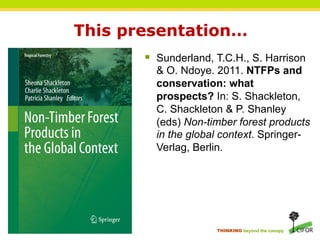
This presentation…
       §  Sunderland, T.C.H., S. Harrison
         & O. Ndoye. 2011. NTFPs and
         conservation: what
         prospects? In: S. Shackleton,
         C. Shackleton & P. Shanley
         (eds) Non-timber forest products
         in the global context. Springer-
         Verlag, Berlin.


                      THINKING beyond the canopy
Summary


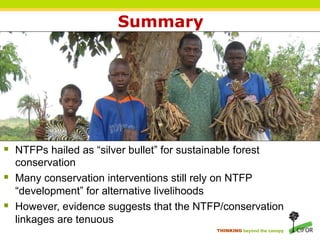
§  NTFPs hailed as “silver bullet” for sustainable forest
    conservation
§  Many conservation interventions still rely on NTFP
    “development” for alternative livelihoods
§  However, evidence suggests that the NTFP/conservation
    linkages are tenuous
                                                THINKING beyond the canopy
Brief history of NTFP/conservation
              paradigm
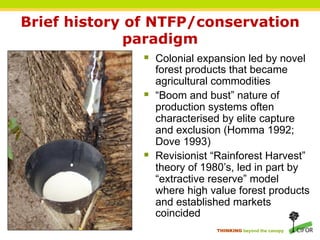
              §  Colonial expansion led by novel
                  forest products that became
                  agricultural commodities
              §  “Boom and bust” nature of
                  production systems often
                  characterised by elite capture
                  and exclusion (Homma 1992;
                  Dove 1993)
              §  Revisionist “Rainforest Harvest”
                  theory of 1980’s, led in part by
                  “extractive reserve” model
                  where high value forest products
                  and established markets
                  coincided
                             THINKING beyond the canopy
NTFP’s and rural livelihoods
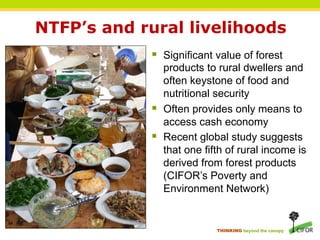
            §  Significant value of forest
                products to rural dwellers and
                often keystone of food and
                nutritional security
            §  Often provides only means to
                access cash economy
            §  Recent global study suggests
                that one fifth of rural income is
                derived from forest products
                (CIFOR’s Poverty and
                Environment Network)


                           THINKING beyond the canopy
Is NTFP harvesting sustainable?
§  It depends….
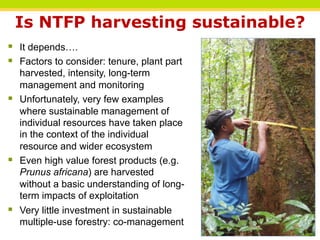
§  Factors to consider: tenure, plant part
    harvested, intensity, long-term
    management and monitoring
§  Unfortunately, very few examples
    where sustainable management of
    individual resources have taken place
    in the context of the individual
    resource and wider ecosystem
§  Even high value forest products (e.g.
    Prunus africana) are harvested
    without a basic understanding of long-
    term impacts of exploitation
§  Very little investment in sustainable
    multiple-use forestry: co-management
                                              THINKING beyond the canopy
NTFPs and protected areas (PA’s)


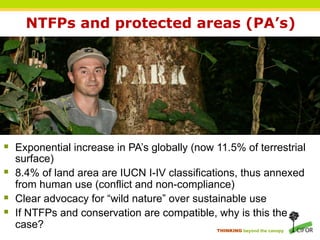
§  Exponential increase in PA’s globally (now 11.5% of terrestrial
    surface)
§  8.4% of land area are IUCN I-IV classifications, thus annexed
    from human use (conflict and non-compliance)
§  Clear advocacy for “wild nature” over sustainable use
§  If NTFPs and conservation are compatible, why is this the
    case?                                       THINKING beyond the canopy
Transition from natural forests to
             “domestic” forests


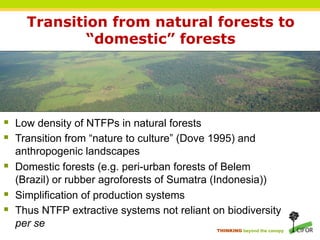
§  Low density of NTFPs in natural forests
§  Transition from “nature to culture” (Dove 1995) and
    anthropogenic landscapes
§  Domestic forests (e.g. peri-urban forests of Belem
    (Brazil) or rubber agroforests of Sumatra (Indonesia))
§  Simplification of production systems
§  Thus NTFP extractive systems not reliant on biodiversity
    per se
                                              THINKING beyond the canopy
Constraints to NTFP contribution to
    biodiversity conservation
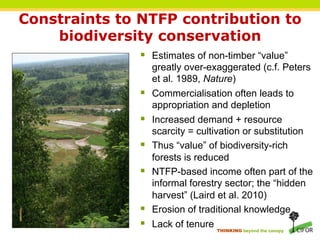
               §  Estimates of non-timber “value”
                   greatly over-exaggerated (c.f. Peters
                   et al. 1989, Nature)
               §  Commercialisation often leads to
                   appropriation and depletion
               §  Increased demand + resource
                     scarcity = cultivation or substitution
               §    Thus “value” of biodiversity-rich
                     forests is reduced
               §    NTFP-based income often part of the
                     informal forestry sector; the “hidden
                     harvest” (Laird et al. 2010)
               §    Erosion of traditional knowledge
               §    Lack of tenure
                                    THINKING beyond the canopy
PEN: A global study of NTFPs


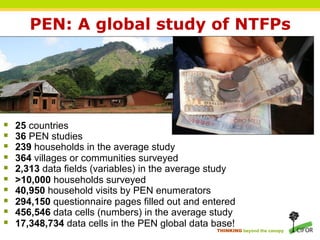
§    25 countries
§    36 PEN studies
§    239 households in the average study
§    364 villages or communities surveyed
§    2,313 data fields (variables) in the average study
§    >10,000 households surveyed
§    40,950 household visits by PEN enumerators
§    294,150 questionnaire pages filled out and entered
§    456,546 data cells (numbers) in the average study
§    17,348,734 data cells in the PEN global data base!
                                                   THINKING beyond the canopy
Value of NTFPs to livelihoods?


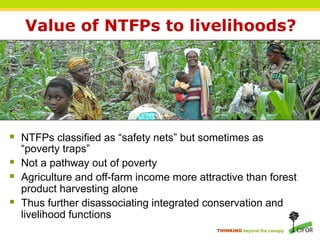
§  NTFPs classified as “safety nets” but sometimes as
    “poverty traps”
§  Not a pathway out of poverty
§  Agriculture and off-farm income more attractive than forest
    product harvesting alone
§  Thus further disassociating integrated conservation and
    livelihood functions
                                             THINKING beyond the canopy
In summary


§  Links between NTFPs and biodiversity conservation have
    been based on simplistic assumptions and generalisations
§  Further hindered by separation of protection and
    sustainable use
§  Multiple-use sustainable forestry requires long-term
    investments and complex co-management approaches
                                           THINKING beyond the canopy
www.cifor.org	
  
t.sunderland@cgiar.org	


                         THINKING beyond the canopy

Non-timber forest products and conservation: what prospects?

  • 1.
    Non-timber forest productsand conservation: what prospects? Terry  C.H.  Sunderland,  Ousseynou  Ndoye  and  Susan  Tarka  Sanchez     49th  Annual  Mee-ng  of  the  ATBC     THINKING beyond the canopy Bonito,  Brazil,  19th  June  2012    
  • 2.
    This presentation… §  Sunderland, T.C.H., S. Harrison & O. Ndoye. 2011. NTFPs and conservation: what prospects? In: S. Shackleton, C. Shackleton & P. Shanley (eds) Non-timber forest products in the global context. Springer- Verlag, Berlin. THINKING beyond the canopy
  • 3.
    Summary §  NTFPs hailedas “silver bullet” for sustainable forest conservation §  Many conservation interventions still rely on NTFP “development” for alternative livelihoods §  However, evidence suggests that the NTFP/conservation linkages are tenuous THINKING beyond the canopy
  • 4.
    Brief history ofNTFP/conservation paradigm §  Colonial expansion led by novel forest products that became agricultural commodities §  “Boom and bust” nature of production systems often characterised by elite capture and exclusion (Homma 1992; Dove 1993) §  Revisionist “Rainforest Harvest” theory of 1980’s, led in part by “extractive reserve” model where high value forest products and established markets coincided THINKING beyond the canopy
  • 5.
    NTFP’s and rurallivelihoods §  Significant value of forest products to rural dwellers and often keystone of food and nutritional security §  Often provides only means to access cash economy §  Recent global study suggests that one fifth of rural income is derived from forest products (CIFOR’s Poverty and Environment Network) THINKING beyond the canopy
  • 6.
    Is NTFP harvestingsustainable? §  It depends…. §  Factors to consider: tenure, plant part harvested, intensity, long-term management and monitoring §  Unfortunately, very few examples where sustainable management of individual resources have taken place in the context of the individual resource and wider ecosystem §  Even high value forest products (e.g. Prunus africana) are harvested without a basic understanding of long- term impacts of exploitation §  Very little investment in sustainable multiple-use forestry: co-management THINKING beyond the canopy
  • 7.
    NTFPs and protectedareas (PA’s) §  Exponential increase in PA’s globally (now 11.5% of terrestrial surface) §  8.4% of land area are IUCN I-IV classifications, thus annexed from human use (conflict and non-compliance) §  Clear advocacy for “wild nature” over sustainable use §  If NTFPs and conservation are compatible, why is this the case? THINKING beyond the canopy
  • 8.
    Transition from naturalforests to “domestic” forests §  Low density of NTFPs in natural forests §  Transition from “nature to culture” (Dove 1995) and anthropogenic landscapes §  Domestic forests (e.g. peri-urban forests of Belem (Brazil) or rubber agroforests of Sumatra (Indonesia)) §  Simplification of production systems §  Thus NTFP extractive systems not reliant on biodiversity per se THINKING beyond the canopy
  • 9.
    Constraints to NTFPcontribution to biodiversity conservation §  Estimates of non-timber “value” greatly over-exaggerated (c.f. Peters et al. 1989, Nature) §  Commercialisation often leads to appropriation and depletion §  Increased demand + resource scarcity = cultivation or substitution §  Thus “value” of biodiversity-rich forests is reduced §  NTFP-based income often part of the informal forestry sector; the “hidden harvest” (Laird et al. 2010) §  Erosion of traditional knowledge §  Lack of tenure THINKING beyond the canopy
  • 10.
    PEN: A globalstudy of NTFPs §  25 countries §  36 PEN studies §  239 households in the average study §  364 villages or communities surveyed §  2,313 data fields (variables) in the average study §  >10,000 households surveyed §  40,950 household visits by PEN enumerators §  294,150 questionnaire pages filled out and entered §  456,546 data cells (numbers) in the average study §  17,348,734 data cells in the PEN global data base! THINKING beyond the canopy
  • 11.
    Value of NTFPsto livelihoods? §  NTFPs classified as “safety nets” but sometimes as “poverty traps” §  Not a pathway out of poverty §  Agriculture and off-farm income more attractive than forest product harvesting alone §  Thus further disassociating integrated conservation and livelihood functions THINKING beyond the canopy
  • 12.
    In summary §  Linksbetween NTFPs and biodiversity conservation have been based on simplistic assumptions and generalisations §  Further hindered by separation of protection and sustainable use §  Multiple-use sustainable forestry requires long-term investments and complex co-management approaches THINKING beyond the canopy
  • 13.
    www.cifor.org   t.sunderland@cgiar.org     THINKING beyond the canopy