Food Informatics: Sharing Food Knowledge for Research & Development Nicole Koenderink , Lars Hulzebos, Hajo Rijgersberg, Jan Top [email_address] Agrotechnology & Food Innovations Wageningen UR, The Netherlands
Custard Why does custard taste so creamy? AOS Workshop - Use of Ontologies in Applications – Nicole Koenderink  Movement of tongue Percentage of  fat particles Bite size Oral texture Perception  of thickness Temperature Colour Odour Amount of saliva
Outline Problem & Purpose Approach First Results Conclusion & Future Work Problem & Purpose AOS Workshop - Use of Ontologies in Applications – Nicole Koenderink
Problem & Purpose – Food Informatics Goal:  make food-related information available  for food researchers. Pay attention to: Relevance Reliability/Quality Timeliness AOS Workshop - Use of Ontologies in Applications – Nicole Koenderink
Problem & Purpose – Food Informatics Food Informatics:  develop tools and technologies to enable application of ontologies for knowledge sharing Collaboration between: Research  IT partners  Business AOS Workshop - Use of Ontologies in Applications – Nicole Koenderink
Problem & Purpose – Food Informatics However…. only few ontologies exist dedicated to the field of food. Our first purpose: collect “structured” knowledge on the field of food support users in creating relevant food ontologies AOS Workshop - Use of Ontologies in Applications – Nicole Koenderink
Outline Problem & Purpose Approach First Results Conclusion & Future Work Approach AOS Workshop - Use of Ontologies in Applications – Nicole Koenderink
Approach – relevant knowledge Ontology contains domain knowledge Without defined  purpose  it is impossible to determine which knowledge is  relevant  and thus which knowledge should be added to ontology Traditionally: (purpose) independent representation of domain knowledge AOS Workshop - Use of Ontologies in Applications – Nicole Koenderink
Approach – knowledge acquisition Complete oral K.A. process: Tedious & time-consuming for expert Complete text mining process: Too generic for purpose-oriented ontology Our approach AOS Workshop - Use of Ontologies in Applications – Nicole Koenderink  Interviews, Oral K.A. Text mining automation
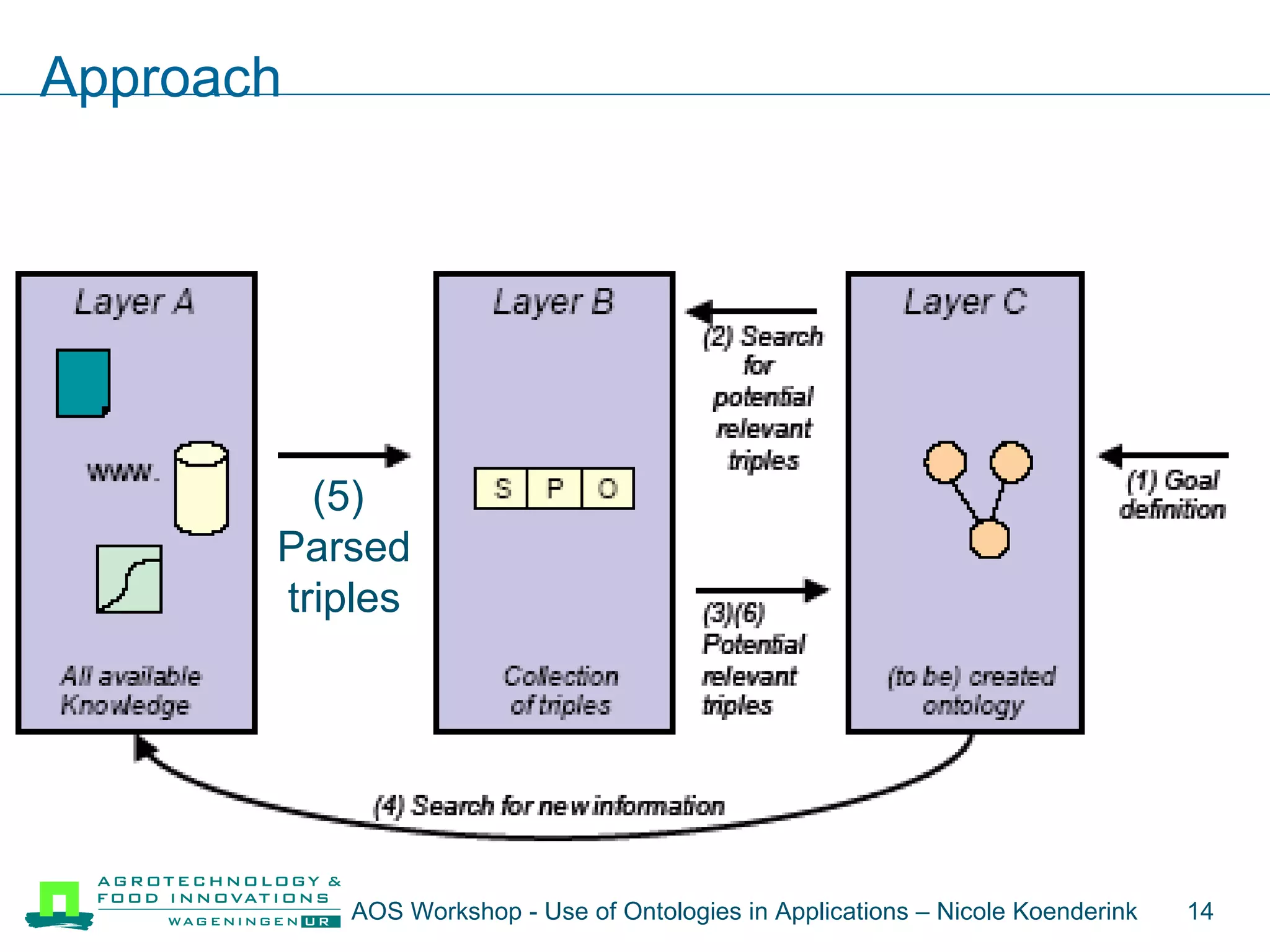
Approach (1) Goal definition AOS Workshop - Use of Ontologies in Applications – Nicole Koenderink
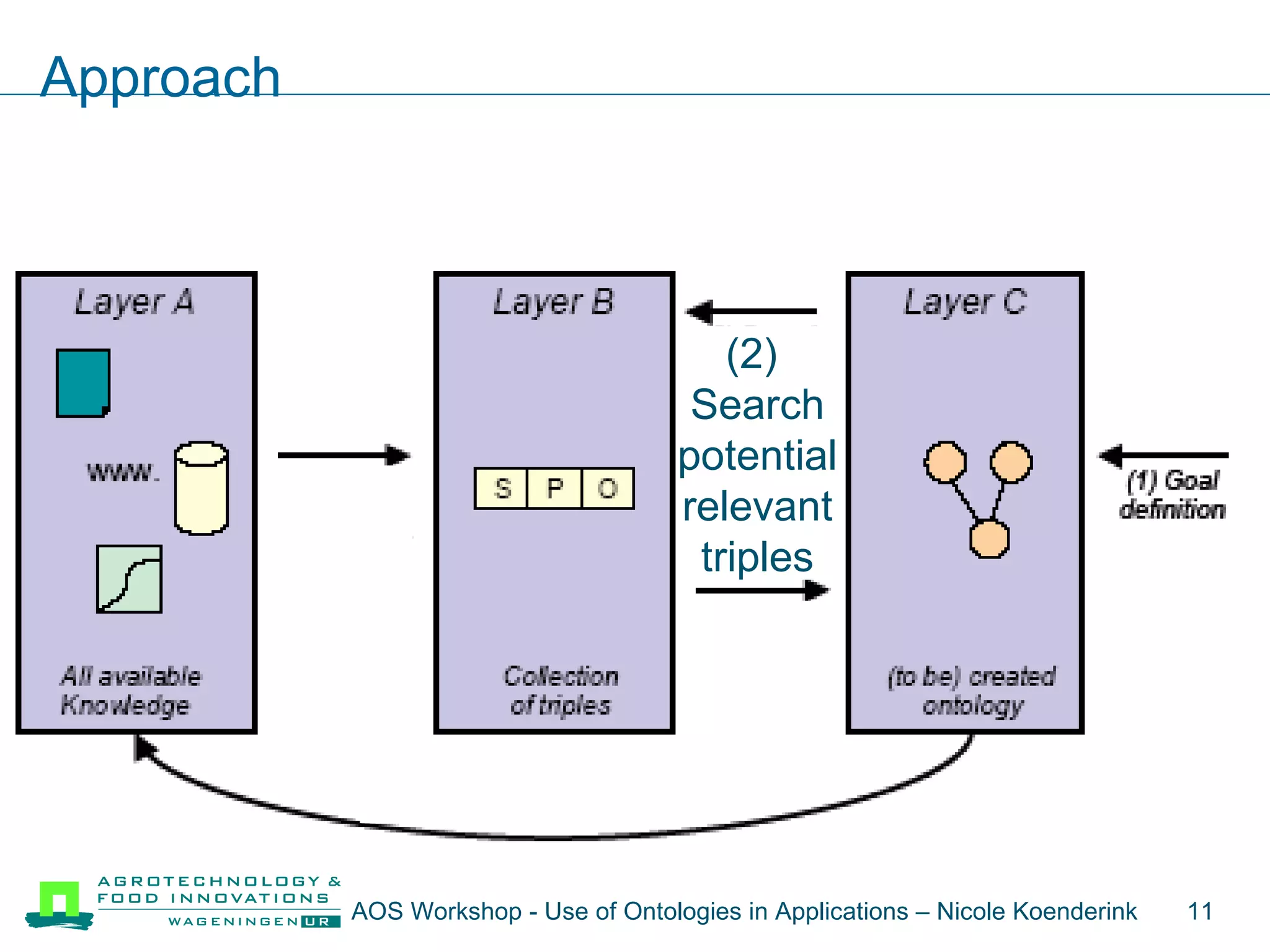
Approach (2)  Search potential relevant triples AOS Workshop - Use of Ontologies in Applications – Nicole Koenderink
Approach (3) & (6)  Potential relevant triples AOS Workshop - Use of Ontologies in Applications – Nicole Koenderink
Approach (4) Search new information AOS Workshop - Use of Ontologies in Applications – Nicole Koenderink
Approach (5)  Parsed triples AOS Workshop - Use of Ontologies in Applications – Nicole Koenderink
Outline Problem & Purpose Approach First Results Conclusion & Future Work First Results AOS Workshop - Use of Ontologies in Applications – Nicole Koenderink
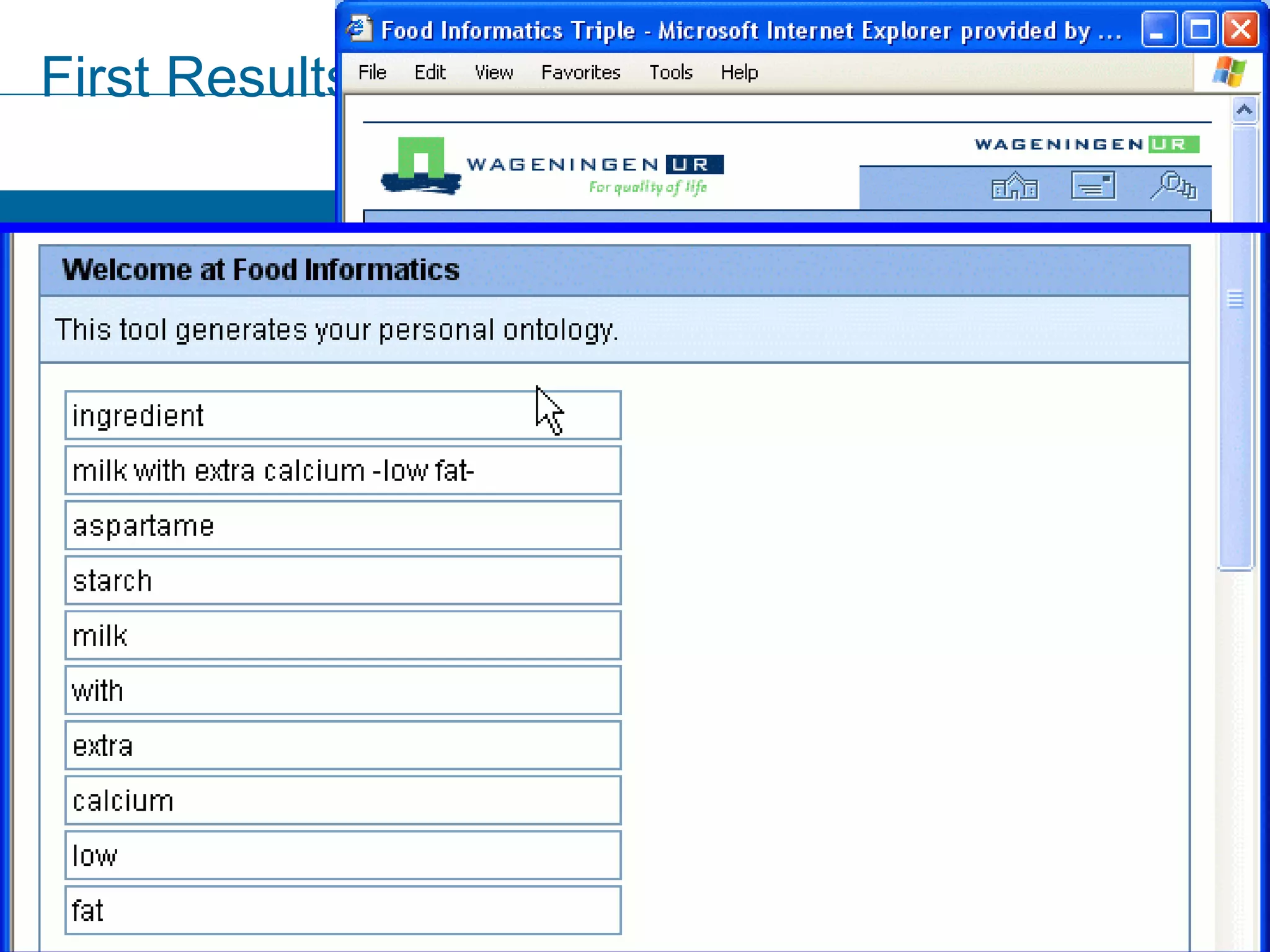
First Results Case study: Research Management System  catalogue food according to properties of ingredients Needed: ontology of food ingredients AOS Workshop - Use of Ontologies in Applications – Nicole Koenderink
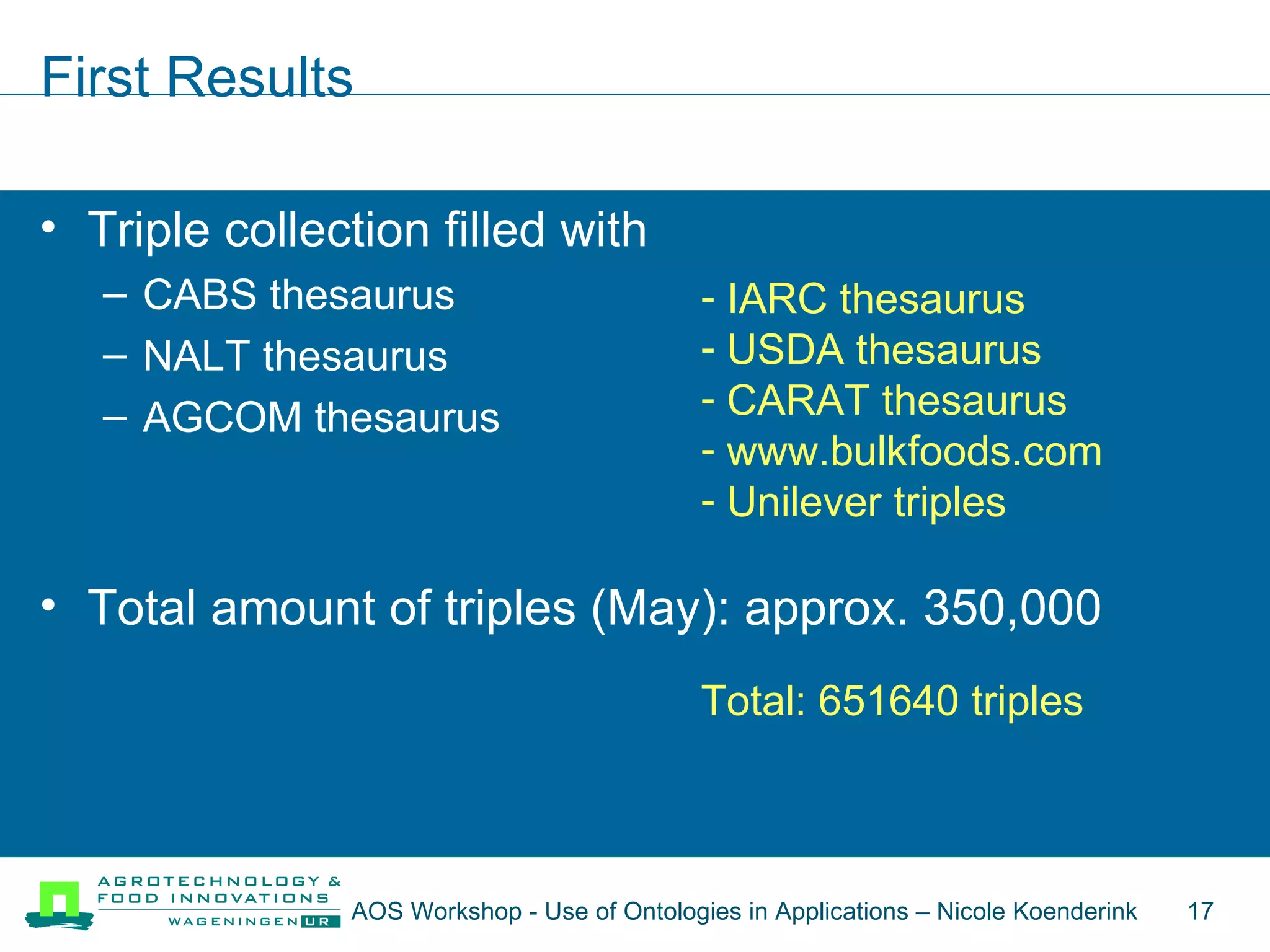
Triple collection filled with  CABS thesaurus NALT thesaurus AGCOM thesaurus Total amount of triples (May): approx. 350,000 First Results AOS Workshop - Use of Ontologies in Applications – Nicole Koenderink  Total: 651640 triples IARC thesaurus USDA thesaurus CARAT thesaurus www.bulkfoods.com Unilever triples
First Results 6th AOS Workshop - Use of Ontologies in Applications
First Results
First Results
First Results - 0 0 30,796 12 50% 3 6 30,791 11 13% 8 62 30,764 10 24% 36 152 30,523 9 28% 150 532 29,783 8 17% 392 2,274 27,183 7 27% 775 2,831 19,660 6 52% 1,001 1,934 9,548 5 55% 552 1,004 3,505 4 57% 182 319 885 3 67% 55 83 181 2 100% 7 7 - 1 % relevant new concepts # of relevant new concepts # of new concepts cumulative # proposed triples step
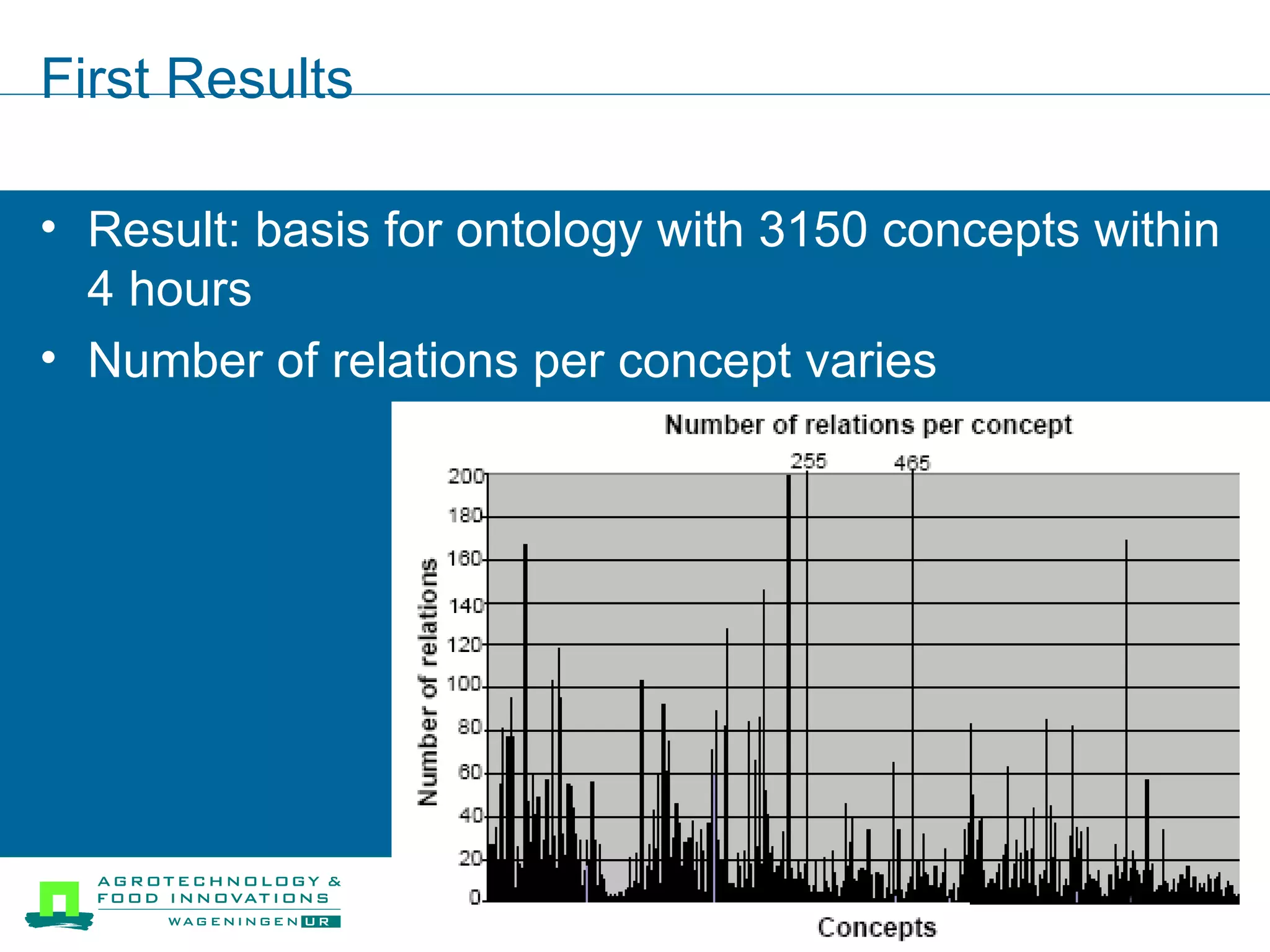
First Results Result: basis for ontology with 3150 concepts within 4 hours Number of relations per concept varies
Conclusions Purpose is necessary to define  relevant  knowledge; ontology is purpose-dependent. With the proposed semi-automatic knowledge acquisition method, the expert decides which knowledge is relevant Observation: it is difficult for an expert to stay focused on the objective of the ontology. AOS Workshop - Use of Ontologies in Applications – Nicole Koenderink
Conclusions The proposed two-step approach has as advantage that in a short period many possibly relevant concepts are indicated A drawback of this method is that the expert has to assess each time a huge amount of triples Future work: the method needs a “filter routine” to assist the expert in this process. AOS Workshop - Use of Ontologies in Applications – Nicole Koenderink
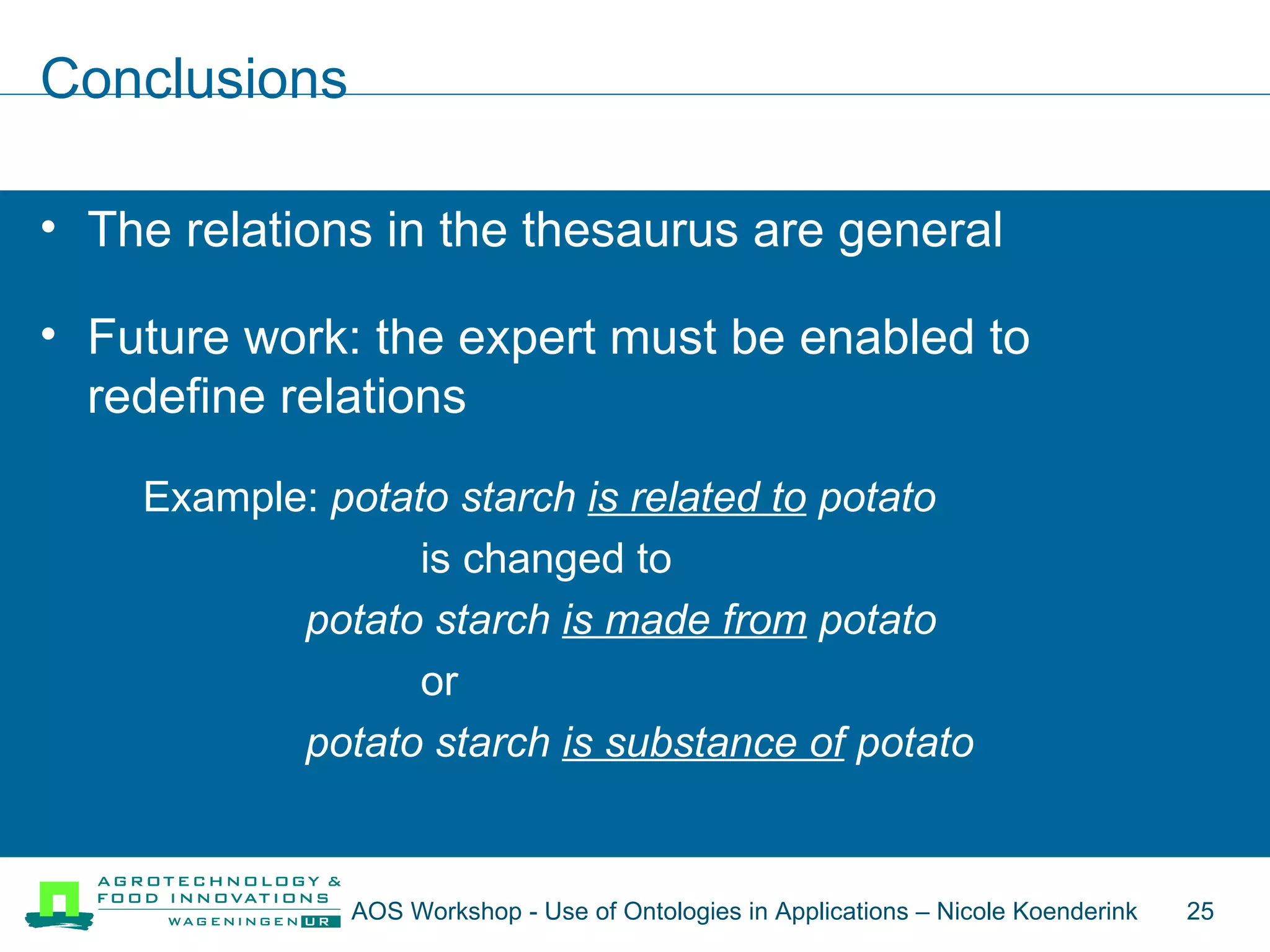
Conclusions The relations in the thesaurus are general Future work: the expert must be enabled to redefine relations Example:  potato starch  is related to  potato is changed to   potato starch  is made from  potato or   potato starch  is substance of  potato AOS Workshop - Use of Ontologies in Applications – Nicole Koenderink
Future Work Design filter routine Implement redefinition support Expand the triple collection with triples obtained from less structured documents Next step: transform the found collection of   concepts and relations to an ontology AOS Workshop - Use of Ontologies in Applications – Nicole Koenderink
Acknowledgements Thanks to:  Jannie van Beek  Remco van Brakel the Dutch Ministry of Education, Culture and Science the Dutch Ministry of Economic Affairs the Ministry of Agriculture Questions? [email_address] AOS Workshop - Use of Ontologies in Applications – Nicole Koenderink
 
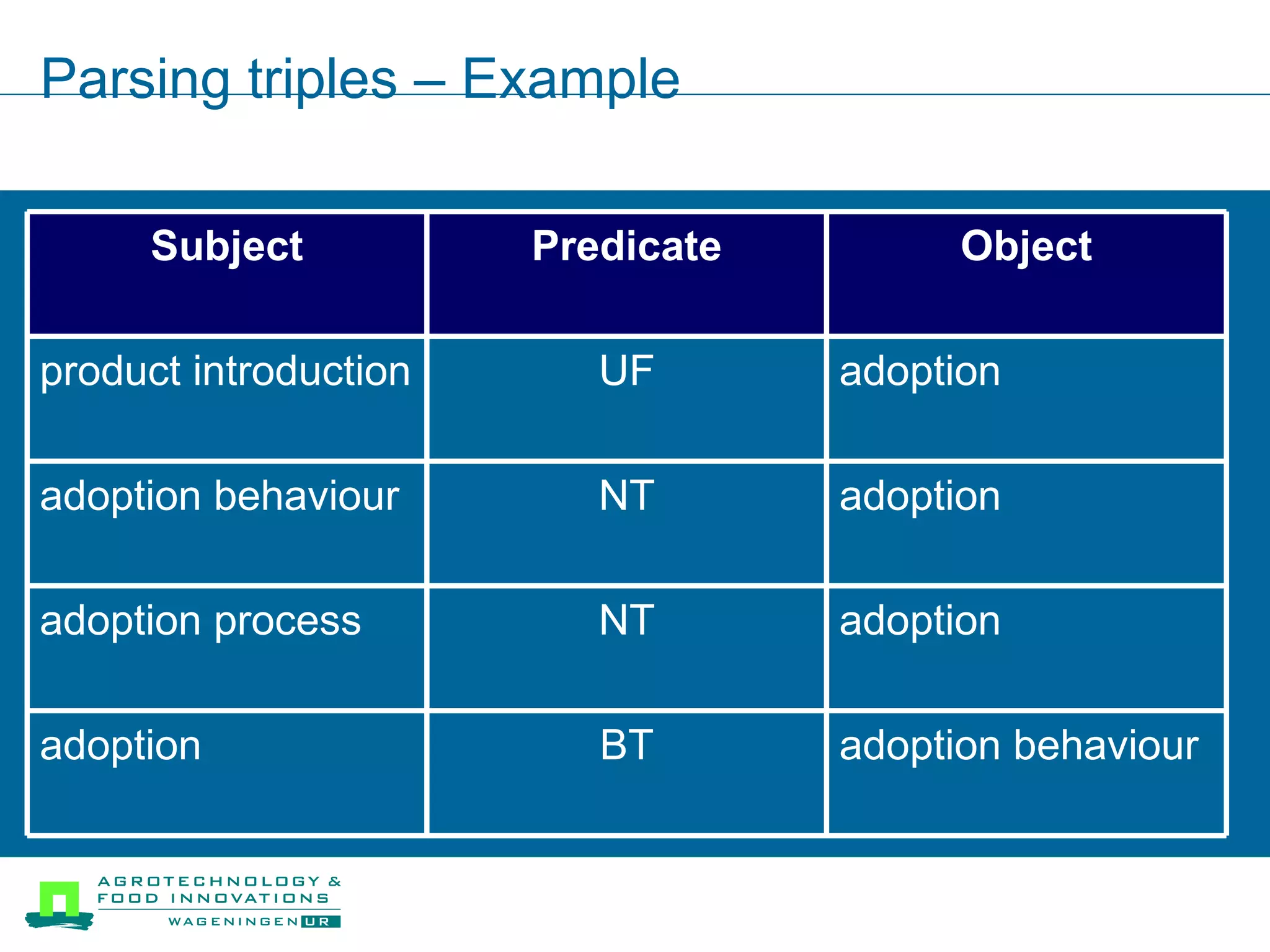
Parsing triples – Example  adoption UF:  product introduction NT:  adoption behaviour adoption process adoption behaviour BT:  adoption behaviour adoption process BT: adoption
Parsing triples – Example  <TERM>  := [A-z]1* <RELATION> := [A-z]1* + “:” <BLANK>  := empty line <TERM> [ <RELATION> [ <TERM>]1* ]1* <BLANK> <OBJECT> <PREDICATE> <SUBJECT> 1 1* 1*
Parsing triples – Example  adoption behaviour BT adoption adoption NT adoption process adoption NT adoption behaviour adoption UF product introduction Object Predicate Subject

Food Informatics-Sharing Food

  • 1.
    Food Informatics: SharingFood Knowledge for Research & Development Nicole Koenderink , Lars Hulzebos, Hajo Rijgersberg, Jan Top [email_address] Agrotechnology & Food Innovations Wageningen UR, The Netherlands
  • 2.
    Custard Why doescustard taste so creamy? AOS Workshop - Use of Ontologies in Applications – Nicole Koenderink Movement of tongue Percentage of fat particles Bite size Oral texture Perception of thickness Temperature Colour Odour Amount of saliva
  • 3.
    Outline Problem &Purpose Approach First Results Conclusion & Future Work Problem & Purpose AOS Workshop - Use of Ontologies in Applications – Nicole Koenderink
  • 4.
    Problem & Purpose– Food Informatics Goal: make food-related information available for food researchers. Pay attention to: Relevance Reliability/Quality Timeliness AOS Workshop - Use of Ontologies in Applications – Nicole Koenderink
  • 5.
    Problem & Purpose– Food Informatics Food Informatics: develop tools and technologies to enable application of ontologies for knowledge sharing Collaboration between: Research IT partners Business AOS Workshop - Use of Ontologies in Applications – Nicole Koenderink
  • 6.
    Problem & Purpose– Food Informatics However…. only few ontologies exist dedicated to the field of food. Our first purpose: collect “structured” knowledge on the field of food support users in creating relevant food ontologies AOS Workshop - Use of Ontologies in Applications – Nicole Koenderink
  • 7.
    Outline Problem &Purpose Approach First Results Conclusion & Future Work Approach AOS Workshop - Use of Ontologies in Applications – Nicole Koenderink
  • 8.
    Approach – relevantknowledge Ontology contains domain knowledge Without defined purpose it is impossible to determine which knowledge is relevant and thus which knowledge should be added to ontology Traditionally: (purpose) independent representation of domain knowledge AOS Workshop - Use of Ontologies in Applications – Nicole Koenderink
  • 9.
    Approach – knowledgeacquisition Complete oral K.A. process: Tedious & time-consuming for expert Complete text mining process: Too generic for purpose-oriented ontology Our approach AOS Workshop - Use of Ontologies in Applications – Nicole Koenderink Interviews, Oral K.A. Text mining automation
  • 10.
    Approach (1) Goaldefinition AOS Workshop - Use of Ontologies in Applications – Nicole Koenderink
  • 11.
    Approach (2) Search potential relevant triples AOS Workshop - Use of Ontologies in Applications – Nicole Koenderink
  • 12.
    Approach (3) &(6) Potential relevant triples AOS Workshop - Use of Ontologies in Applications – Nicole Koenderink
  • 13.
    Approach (4) Searchnew information AOS Workshop - Use of Ontologies in Applications – Nicole Koenderink
  • 14.
    Approach (5) Parsed triples AOS Workshop - Use of Ontologies in Applications – Nicole Koenderink
  • 15.
    Outline Problem &Purpose Approach First Results Conclusion & Future Work First Results AOS Workshop - Use of Ontologies in Applications – Nicole Koenderink
  • 16.
    First Results Casestudy: Research Management System catalogue food according to properties of ingredients Needed: ontology of food ingredients AOS Workshop - Use of Ontologies in Applications – Nicole Koenderink
  • 17.
    Triple collection filledwith CABS thesaurus NALT thesaurus AGCOM thesaurus Total amount of triples (May): approx. 350,000 First Results AOS Workshop - Use of Ontologies in Applications – Nicole Koenderink Total: 651640 triples IARC thesaurus USDA thesaurus CARAT thesaurus www.bulkfoods.com Unilever triples
  • 18.
    First Results 6thAOS Workshop - Use of Ontologies in Applications
  • 19.
  • 20.
  • 21.
    First Results -0 0 30,796 12 50% 3 6 30,791 11 13% 8 62 30,764 10 24% 36 152 30,523 9 28% 150 532 29,783 8 17% 392 2,274 27,183 7 27% 775 2,831 19,660 6 52% 1,001 1,934 9,548 5 55% 552 1,004 3,505 4 57% 182 319 885 3 67% 55 83 181 2 100% 7 7 - 1 % relevant new concepts # of relevant new concepts # of new concepts cumulative # proposed triples step
  • 22.
    First Results Result:basis for ontology with 3150 concepts within 4 hours Number of relations per concept varies
  • 23.
    Conclusions Purpose isnecessary to define relevant knowledge; ontology is purpose-dependent. With the proposed semi-automatic knowledge acquisition method, the expert decides which knowledge is relevant Observation: it is difficult for an expert to stay focused on the objective of the ontology. AOS Workshop - Use of Ontologies in Applications – Nicole Koenderink
  • 24.
    Conclusions The proposedtwo-step approach has as advantage that in a short period many possibly relevant concepts are indicated A drawback of this method is that the expert has to assess each time a huge amount of triples Future work: the method needs a “filter routine” to assist the expert in this process. AOS Workshop - Use of Ontologies in Applications – Nicole Koenderink
  • 25.
    Conclusions The relationsin the thesaurus are general Future work: the expert must be enabled to redefine relations Example: potato starch is related to potato is changed to potato starch is made from potato or potato starch is substance of potato AOS Workshop - Use of Ontologies in Applications – Nicole Koenderink
  • 26.
    Future Work Designfilter routine Implement redefinition support Expand the triple collection with triples obtained from less structured documents Next step: transform the found collection of concepts and relations to an ontology AOS Workshop - Use of Ontologies in Applications – Nicole Koenderink
  • 27.
    Acknowledgements Thanks to: Jannie van Beek Remco van Brakel the Dutch Ministry of Education, Culture and Science the Dutch Ministry of Economic Affairs the Ministry of Agriculture Questions? [email_address] AOS Workshop - Use of Ontologies in Applications – Nicole Koenderink
  • 28.
  • 29.
    Parsing triples –Example adoption UF: product introduction NT: adoption behaviour adoption process adoption behaviour BT: adoption behaviour adoption process BT: adoption
  • 30.
    Parsing triples –Example <TERM> := [A-z]1* <RELATION> := [A-z]1* + “:” <BLANK> := empty line <TERM> [ <RELATION> [ <TERM>]1* ]1* <BLANK> <OBJECT> <PREDICATE> <SUBJECT> 1 1* 1*
  • 31.
    Parsing triples –Example adoption behaviour BT adoption adoption NT adoption process adoption NT adoption behaviour adoption UF product introduction Object Predicate Subject

Editor's Notes

  • #3 fyisisch, chemisch, sensorisch
  • #5 Much food-related knowledge is available in various research fields Much food-related knowledge is available in various research fields
  • #6 Research: Wageningen UR, TNO, Vrije Universiteit Amsterdam, University of Amsterdam IT partners: IBM Business: Unilever, Friesland Foods