Europeana Archaeology is funded by the European Commission’s Connecting Europe Facility (CEF) Telecom programme
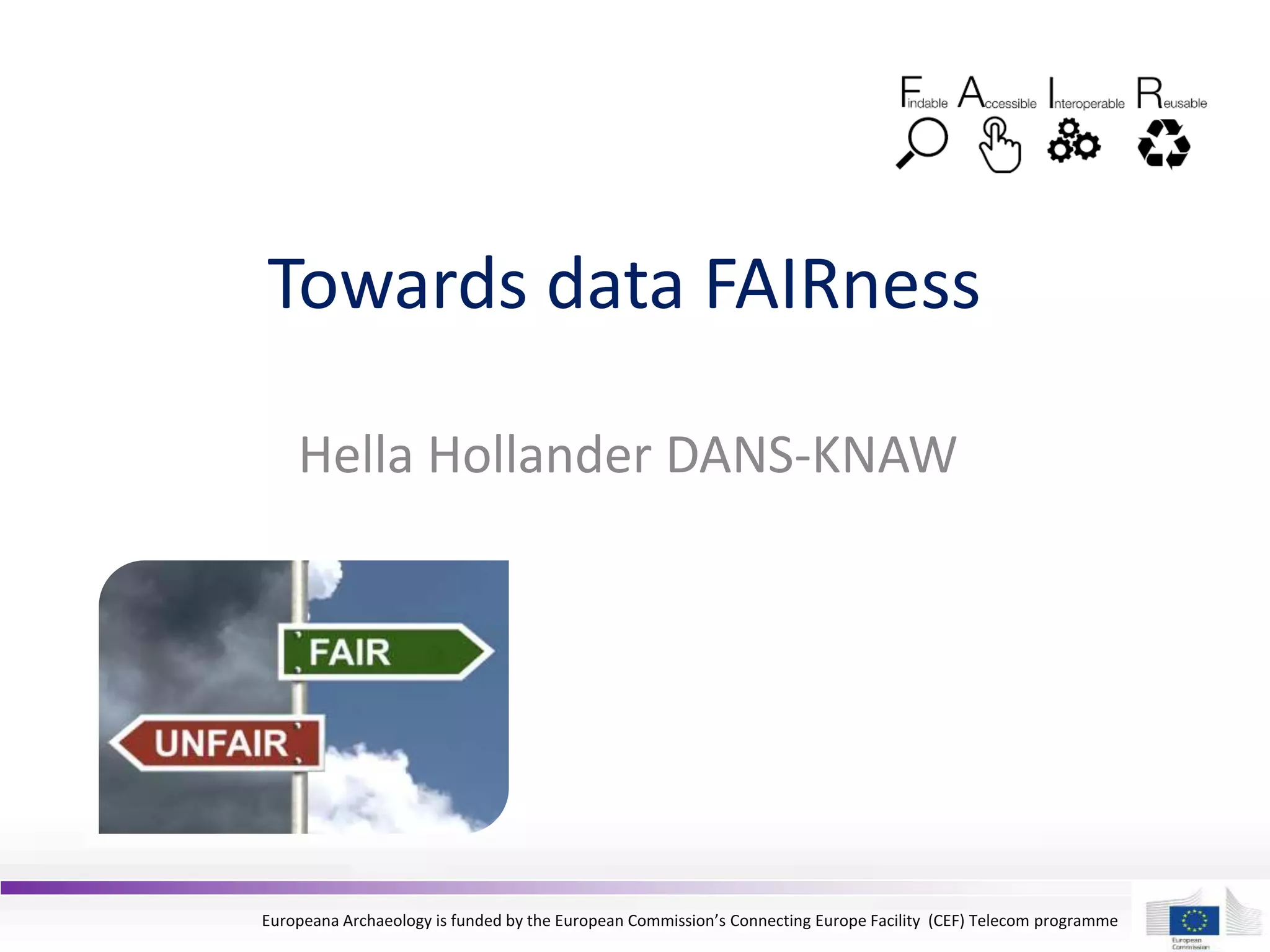
Towards data FAIRness
Hella Hollander DANS-KNAW
OBJECTIVES:
• Support the creation of FAIR data in the archaeological
sector
• Define and spread guidelines to good practices in
archaeological data management
• Adapt standard quality criteria for datasets and data to
the archaeological case, and support their
implementation among users
Introduction to FAIR principles
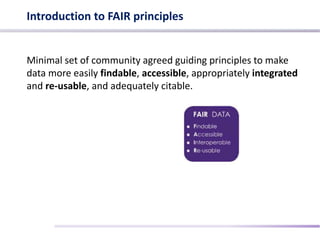
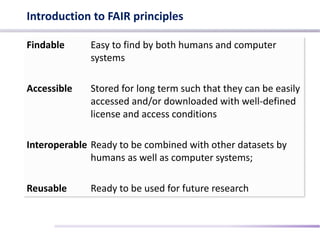
Minimal set of community agreed guiding principles to make
data more easily findable, accessible, appropriately integrated
and re-usable, and adequately citable.
Introduction to FAIR principles
Findable Easy to find by both humans and computer
systems
Accessible Stored for long term such that they can be easily
accessed and/or downloaded with well-defined
license and access conditions
Interoperable Ready to be combined with other datasets by
humans as well as computer systems;
Reusable Ready to be used for future research
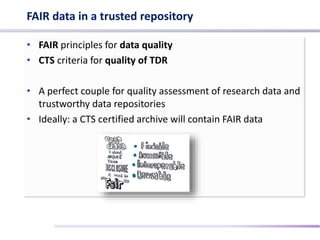
FAIR data in a trusted repository
• FAIR principles for data quality
• CTS criteria for quality of TDR
• A perfect couple for quality assessment of research data and
trustworthy data repositories
• Ideally: a CTS certified archive will contain FAIR data
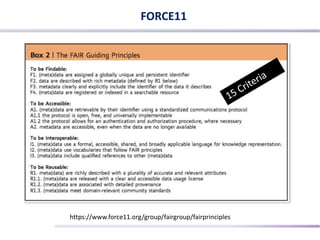
FORCE11
https://www.force11.org/group/fairgroup/fairprinciples
Everybody loves FAIR!
Everybody wants to be FAIR… But what does that mean?
How to put the principles into practice?
PARTHENOS GUIDELINES to
FAIRify YOUR DATA MANAGEMENT
https://www.parthenos-project.eu/portal/policies_guidelines
https://zenodo.org/record/3368858#.X4A1Iy8RqqR
Work done in Parthenos
• Interviews with humanities researchers, including
archaeologists within the Parthenos project and
external between 2016-2018
• Survey
• Literature review
Aim and Users
• 20 guidelines structured around the letters of FAIR
• Users are both data producers/researchers who need clear
and simple guidelines on how to start with Research Data
Management (RDM) + Research Institutions and Data Archives
• This is thought as a first entry point for good RDM practices
• The guidelines are online available via the Parthenos Training
Suite
• It was thought for humanities researchers but can be used
broadly
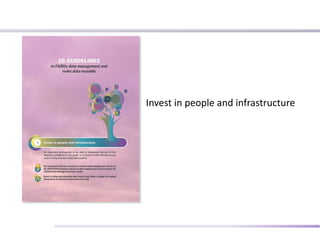
Invest in people and infrastructure
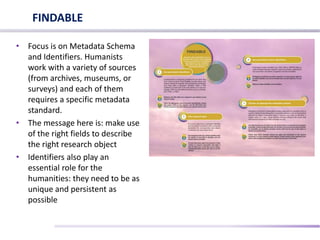
• Focus is on Metadata Schema
and Identifiers. Humanists
work with a variety of sources
(from archives, museums, or
surveys) and each of them
requires a specific metadata
standard.
• The message here is: make use
of the right fields to describe
the right research object
• Identifiers also play an
essential role for the
humanities: they need to be as
unique and persistent as
possible
FINDABLE
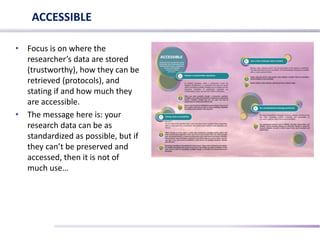
• Focus is on where the
researcher’s data are stored
(trustworthy), how they can be
retrieved (protocols), and
stating if and how much they
are accessible.
• The message here is: your
research data can be as
standardized as possible, but if
they can’t be preserved and
accessed, then it is not of
much use…
ACCESSIBLE
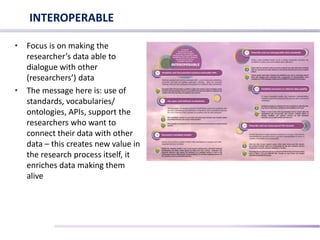
• Focus is on making the
researcher’s data able to
dialogue with other
(researchers’) data
• The message here is: use of
standards, vocabularies/
ontologies, APIs, support the
researchers who want to
connect their data with other
data – this creates new value in
the research process itself, it
enriches data making them
alive
INTEROPERABLE
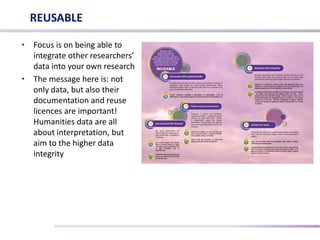
• Focus is on being able to
integrate other researchers’
data into your own research
• The message here is: not
only data, but also their
documentation and reuse
licences are important!
Humanities data are all
about interpretation, but
aim to the higher data
integrity
REUSABLE
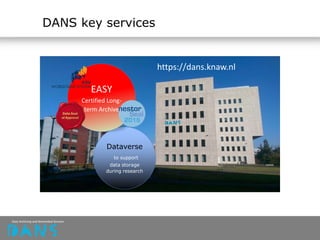
Dataverse
to support
data storage
during research
EASY
Certified Long-
term Archive
DANS key services
https://dans.knaw.nl
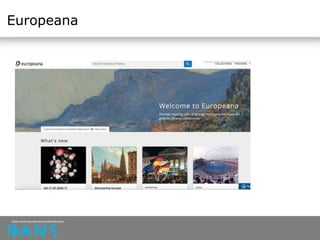
Europeana
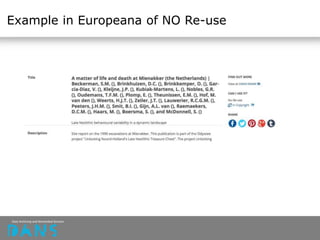
Example in Europeana of NO Re-use
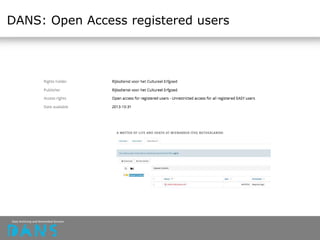
DANS: Open Access registered users
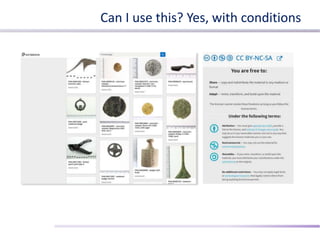
Can I use this? Yes, with conditions
THANK YOU!
Contact: hella.hollander@dans.knaw.nl
www.dans.knaw.nl
These training materials were developed in collaboration with the Europeana Archaeology
project and with funding by the European Commission under the
Connecting Europe Facility (CEF) Telecom Programme

Towards data FAIRness

  • 1.
    Europeana Archaeology isfunded by the European Commission’s Connecting Europe Facility (CEF) Telecom programme Towards data FAIRness Hella Hollander DANS-KNAW
  • 2.
    OBJECTIVES: • Support thecreation of FAIR data in the archaeological sector • Define and spread guidelines to good practices in archaeological data management • Adapt standard quality criteria for datasets and data to the archaeological case, and support their implementation among users
  • 3.
    Introduction to FAIRprinciples Minimal set of community agreed guiding principles to make data more easily findable, accessible, appropriately integrated and re-usable, and adequately citable.
  • 4.
    Introduction to FAIRprinciples Findable Easy to find by both humans and computer systems Accessible Stored for long term such that they can be easily accessed and/or downloaded with well-defined license and access conditions Interoperable Ready to be combined with other datasets by humans as well as computer systems; Reusable Ready to be used for future research
  • 5.
    FAIR data ina trusted repository • FAIR principles for data quality • CTS criteria for quality of TDR • A perfect couple for quality assessment of research data and trustworthy data repositories • Ideally: a CTS certified archive will contain FAIR data
  • 6.
  • 7.
    Everybody loves FAIR! Everybodywants to be FAIR… But what does that mean? How to put the principles into practice?
  • 8.
    PARTHENOS GUIDELINES to FAIRifyYOUR DATA MANAGEMENT https://www.parthenos-project.eu/portal/policies_guidelines https://zenodo.org/record/3368858#.X4A1Iy8RqqR
  • 9.
    Work done inParthenos • Interviews with humanities researchers, including archaeologists within the Parthenos project and external between 2016-2018 • Survey • Literature review
  • 10.
    Aim and Users •20 guidelines structured around the letters of FAIR • Users are both data producers/researchers who need clear and simple guidelines on how to start with Research Data Management (RDM) + Research Institutions and Data Archives • This is thought as a first entry point for good RDM practices • The guidelines are online available via the Parthenos Training Suite • It was thought for humanities researchers but can be used broadly
  • 11.
    Invest in peopleand infrastructure
  • 12.
    • Focus ison Metadata Schema and Identifiers. Humanists work with a variety of sources (from archives, museums, or surveys) and each of them requires a specific metadata standard. • The message here is: make use of the right fields to describe the right research object • Identifiers also play an essential role for the humanities: they need to be as unique and persistent as possible FINDABLE
  • 13.
    • Focus ison where the researcher’s data are stored (trustworthy), how they can be retrieved (protocols), and stating if and how much they are accessible. • The message here is: your research data can be as standardized as possible, but if they can’t be preserved and accessed, then it is not of much use… ACCESSIBLE
  • 14.
    • Focus ison making the researcher’s data able to dialogue with other (researchers’) data • The message here is: use of standards, vocabularies/ ontologies, APIs, support the researchers who want to connect their data with other data – this creates new value in the research process itself, it enriches data making them alive INTEROPERABLE
  • 15.
    • Focus ison being able to integrate other researchers’ data into your own research • The message here is: not only data, but also their documentation and reuse licences are important! Humanities data are all about interpretation, but aim to the higher data integrity REUSABLE
  • 16.
    Dataverse to support data storage duringresearch EASY Certified Long- term Archive DANS key services https://dans.knaw.nl
  • 17.
  • 18.
  • 19.
    DANS: Open Accessregistered users
  • 20.
    Can I usethis? Yes, with conditions
  • 21.
    THANK YOU! Contact: hella.hollander@dans.knaw.nl www.dans.knaw.nl Thesetraining materials were developed in collaboration with the Europeana Archaeology project and with funding by the European Commission under the Connecting Europe Facility (CEF) Telecom Programme