Developing and Assessing
 Teacher Effectiveness


          Getting Teacher
          Evaluation Right
Policy Context
 Focusing on teacher effectiveness is seen as
  a promising path for education policy
 New teacher evaluation systems, and
  especially, “Value Added Models” (VAMs) are
  promoted as tools to accomplish this goal
 Policy makers can benefit from research
  about what various models actually can and
  cannot do
Professional Consensus
 The research base is currently insufficient to
  support the use of VAM for high-stakes
  decisions about individual teachers or
  schools.
                 –RAND Corporation, 2005
Professional Consensus
  VAM estimates of teacher effectiveness …
   should not used to make operational
   decisions because such estimates are far
   too unstable to be considered fair or
   reliable.
   – 2009 Letter Report from the
       Board on Testing and Assessment,
       National Research Council
Concerns Raised about
         Value-Added Measures
Studies find that teachers’ value-added
  “effectiveness” is highly variable & influenced by:
 The measure of achievement used
 The effectiveness of peers
 Class size, curriculum, instructional supports,
  and time spent with students
 Tutoring and out-of-school learning
 Student characteristics and attendance
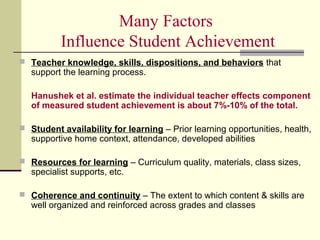
Many Factors
          Influence Student Achievement
 Teacher knowledge, skills, dispositions, and behaviors that
   support the learning process.

   Hanushek et al. estimate the individual teacher effects component
   of measured student achievement is about 7%-10% of the total.

 Student availability for learning – Prior learning opportunities, health,
   supportive home context, attendance, developed abilities

 Resources for learning – Curriculum quality, materials, class sizes,
   specialist supports, etc.

 Coherence and continuity – The extent to which content & skills are
   well organized and reinforced across grades and classes
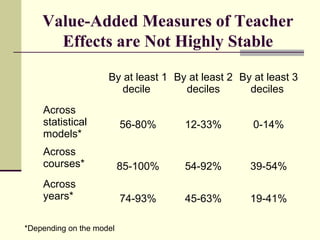
Value-Added Measures of Teacher
      Effects are Not Highly Stable

                     By at least 1 By at least 2 By at least 3
                        decile       deciles       deciles
    Across
    statistical           56-80%     12-33%         0-14%
    models*
    Across
    courses*              85-100%    54-92%        39-54%
    Across
    years*                74-93%     45-63%        19-41%

*Depending on the model
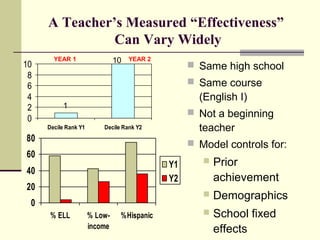
A Teacher’s Measured “Effectiveness”
               Can Vary Widely
       YEAR 1                  10   YEAR 2
10                                                 Same high school
 8
 6                                                 Same course
 4                                                  (English I)
 2        1
                                                   Not a beginning
 0
     Decile Rank Y1       Decile Rank Y2            teacher
80
                                                   Model controls for:
60
                                             Y1         Prior
40
                                             Y2          achievement
20
                                                        Demographics
 0
      % ELL           % Low-    %Hispanic               School fixed
                      income                             effects
The Unintended Effects of VA Teacher
Evaluation in Houston: Three Cases in Point
 In spring of 2011, a number of HISD
  teachers’ contracts were not renewed, largely
  due to:
     “a significant lack of student progress attributable
      to the educator,” and
     “insufficient student academic growth reflected by
      [EVAAS] value-added scores.”
 These teachers filed wrongful termination
  appeals.
 Let’s take a look at the EVAAS data for 3 of
  them                                                       9
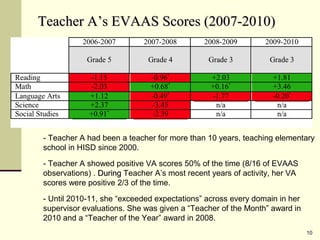
Teacher A’s EVAAS Scores (2007-2010)


- Teacher A had been a teacher for more than 10 years, teaching elementary
school in HISD since 2000.

- Teacher A showed positive VA scores 50% of the time (8/16 of EVAAS
observations) . During Teacher A’s most recent years of activity, her VA
scores were positive 2/3 of the time.

- Until 2010-11, she “exceeded expectations” across every domain in her
supervisor evaluations. She was given a “Teacher of the Month” award in
2010 and a “Teacher of the Year” award in 2008.
                                                                           10
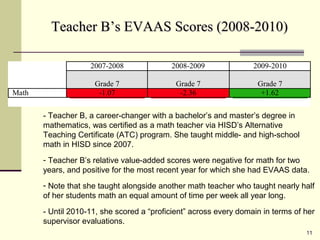
Teacher B’s EVAAS Scores (2008-2010)


- Teacher B, a career-changer with a bachelor’s and master’s degree in
mathematics, was certified as a math teacher via HISD’s Alternative
Teaching Certificate (ATC) program. She taught middle- and high-school
math in HISD since 2007.
- Teacher B’s relative value-added scores were negative for math for two
years, and positive for the most recent year for which she had EVAAS data.
- Note that she taught alongside another math teacher who taught nearly half
of her students math an equal amount of time per week all year long.

- Until 2010-11, she scored a “proficient” across every domain in terms of her
supervisor evaluations.
                                                                           11
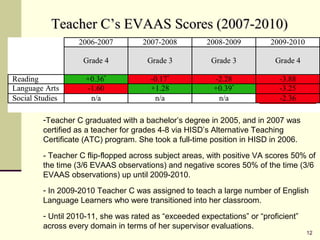
Teacher C’s EVAAS Scores (2007-2010)


-Teacher C graduated with a bachelor’s degree in 2005, and in 2007 was
certified as a teacher for grades 4-8 via HISD’s Alternative Teaching
Certificate (ATC) program. She took a full-time position in HISD in 2006.

- Teacher C flip-flopped across subject areas, with positive VA scores 50% of
the time (3/6 EVAAS observations) and negative scores 50% of the time (3/6
EVAAS observations) up until 2009-2010.
- In 2009-2010 Teacher C was assigned to teach a large number of English
Language Learners who were transitioned into her classroom.
- Until 2010-11, she was rated as “exceeded expectations” or “proficient”
across every domain in terms of her supervisor evaluations.
                                                                            12
The Unintended Effects of the EVAAS:
     Student Characteristics Affect Teachers’ VA
   Teachers teaching in grades in which English
    Language Learners (ELLs) are transitioned into
    mainstreamed classrooms are the least likely to show
    “added value.”
   Teachers teaching larger numbers of special education
    students in mainstreamed classrooms are also found
    to have lower “value-added” scores.
   Teachers teaching students in consecutive years
    report receiving bonuses for the first year and nothing
    the next, as they “max out” on growth.
   Teachers teaching gifted students have small gains
    because their students are near the top.                  13
UNINTENDED EFFECTS
“The most pernicious effect of these [test-
based accountability] systems is to cause
teachers to resent the children who don’t
score well.”


         —Anonymous teacher,
          in a workshop many years ago
How Can We Evaluate and
Develop Effective Teaching
    for Every Child?
What Do Effective and Equitable
   Teachers Know and Do?
Effective Teachers…
 Engage students in active learning
 Create intellectually ambitious tasks
 Use a variety of teaching strategies
 Assess student learning
  continuously and adapt
  teaching to student needs
 Create effective scaffolds and supports
 Provide clear standards, constant feedback, and
  opportunities for revising work
 Develop and effectively manage a collaborative
  classroom in which all students have membership.
These Qualities are Embedded in
        Standards for Teaching
 National Board for Professional Teaching
 Standards (1987)
 -- Portfolio used to certify accomplished teaching
 Interstate New Teacher Assessment and
 Support Consortium (INTASC) (1990)
 -- Adopted in > 40 states including California (CSTP)
 -- Basis of new licensing assessments
 -- Recently revised to reflect Common Core Standards
 Standards-based Teacher Evaluation
 Instruments used in many districts
Standards-Based Evaluations
 Use structured observations of teaching,
  based on professional standards, along with
  other evidence of practice (e.g. lesson
  plans, student work)
 Offer stable evidence over time
 Are related to student learning gains
 Help teachers become more effective when
  they are the source of continuous feedback
  (Milanowski, Kimball, & White, 2004).
Examples
 Evaluation systems in San Mateo, Poway,
  San Francisco, Cincinnati, Denver,
  Rochester, New Mexico, as well as
  Singapore, Netherlands, and elsewhere
 A number of systems incorporate evidence
  of student learning drawn from classroom
  work and classroom / school / district
  assessments in an integrated fashion
1) Start with Standards and
         Build a Unified System
 Build on CA Standards for the Teaching
  Profession
 Create Standards-Based Approaches to state
  licensure assessment and advanced certification
 Use the same standards to shape teacher
  evaluation tool(s) for local evaluation
 Infuse into principal preparation, licensure, and
  evaluation the ability to evaluate and support
  teachers based on standards
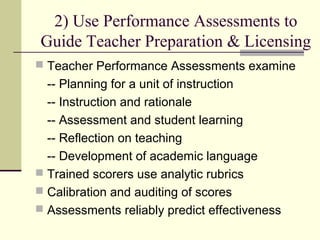
2) Use Performance Assessments to
Guide Teacher Preparation & Licensing
 Teacher Performance Assessments examine
  -- Planning for a unit of instruction
  -- Instruction and rationale
  -- Assessment and student learning
  -- Reflection on teaching
  -- Development of academic language
 Trained scorers use analytic rubrics
 Calibration and auditing of scores
 Assessments reliably predict effectiveness
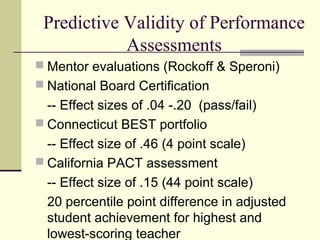
Predictive Validity of Performance
            Assessments
 Mentor evaluations (Rockoff & Speroni)
 National Board Certification
  -- Effect sizes of .04 -.20 (pass/fail)
 Connecticut BEST portfolio
  -- Effect size of .46 (4 point scale)
 California PACT assessment
  -- Effect size of .15 (44 point scale)
  20 percentile point difference in adjusted
  student achievement for highest and
  lowest-scoring teacher
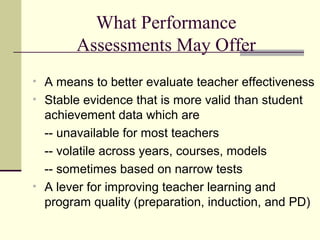
What Performance
       Assessments May Offer
• A means to better evaluate teacher effectiveness
• Stable evidence that is more valid than student
  achievement data which are
  -- unavailable for most teachers
  -- volatile across years, courses, models
  -- sometimes based on narrow tests
• A lever for improving teacher learning and
  program quality (preparation, induction, and PD)
Teacher Candidates Learn

I think for me the most valuable thing was the
   sequencing of the lessons, teaching the
   lesson, and evaluating what the kids were
   getting, what the kids weren’t getting, and
   having that be reflected in my next
   lesson...the ‘teach-assess-teach-assess-
   teach-assess’ process. And so you’re
   constantly changing – you may have a plan
   or a framework that you have together, but
   knowing that that’s flexible and that it has to
   be flexible, based on what the children learn
   that day.
Teacher Educators Learn
This [scoring] experience…has forced me to
  revisit the question of what really matters in
  the assessment of teachers, which – in turn –
  means revisiting the question of what really
  matters in the preparation of teachers.
Cooperating Teachers
          Reflect on Practice
[The scoring process] forces you to be clear
  about “good teaching;” what it looks like,
  sounds like. It enables you to look at your
  own practice critically/with new eyes.
Induction Programs Learn

As an induction program coordinator, I have a
  much clearer picture of what credential holders
  will bring to us and of what they’ll be required
  to do. We can build on this.
3) Build Annual Evaluation Tools Based on
           the Same Standards
  Combine Evidence of Practice, Performance, and
  Outcomes in an Integrated Evaluation System that
  looks at

     Teaching practice in relation to standards,
      curriculum goals, and student needs
     Contributions to colleagues and the school, and

     Student learning in relation to teaching practices,
      curriculum goals, and student needs.

     Accomplishment of individual and group goals
4) Use Multiple Data Sources to
   Reflect Practice and Learning
 Standards-based observation (in person or video) by
  experts trained in evaluation and, ideally, the content area

 Examination of curriculum plans, assignments, and
  student work samples

 Evidence of practices that support student learning both in
  and outside of the classroom (including work with parents
  & colleagues)

 Evidence of student learning measured in a variety of
  ways (e.g. work samples, learning progressions, pre- and
  post-measures tied to curriculum, exhibitions of mastery,
  as well as annual tests)
6) Develop Evaluation
        Expertise and Systems
 Train evaluators
 Release and fund expert mentors to offer
  assistance
  -- to beginners
  -- to teachers who need additional coaching
 Create evaluation panels and processes for
  making decisions about tenure and
  continuation in cases of intervention (e.g.
  Peer Assistance and Review systems)
7) Integrate Systems
 Link the implementation of common core
  standards to educator support and evaluation
 Train and assess prospective and current
  principals for teacher evaluation and support
 Introduce performance-based licensure for
  leaders based on understanding teaching
 Use professional development policies and
  compensation to support assessment
 Involve senior teachers, mentors, principals,
  and teacher educators as assessors
After Evaluation, Then What?
How Do we Develop Effective
          Teaching?
8) Create policies that support the
         development of expertise
Research finds that student learning gains are related to:
 Strong academic background
 Quality preparation prior to entry
 Certification in the field taught
 Experience (> 3 years)
 National Board Certification


In combination, these predict more of the difference in
   student learning gains than race & parent education
   combined (Clotfelter, Ladd, & Vigdor, 2008).
Policies should strengthen & equalize these features.
Expand High-Quality
            Pathways to Teaching
 Evaluate all preparation and induction
  programs based on results of
  -- teacher performance assessments (TPA)
  -- graduates’ contributions to student learning
  -- retention rates in teaching
 Use results in program approval / accreditation
  decisions
 Study features of successful programs & create
  incentives for other programs to adopt these features
 Expand successful programs and eliminate those
  that don’t improve
9) Deepen Professional Learning
Create a strong infrastructure for professional
learning that is:
   Responsive to teacher and principal needs
   Sustained and readily available
   Grounded in curriculum content
   Supportive of diverse learners
   Supported by coaching
   Connected to collaborative work in
    professional learning communities
   Integrated into school and classroom planning around
    curriculum, instruction, and assessment
What Research Tells Us

Well-designed professional development can
improve practice and increase student
achievement.
  A review of high-quality experimental studies
  found that among programs offering extended
  PD (49 hours on average over 6 to 12 months),
  student achievement increased by 21
  percentile points. (Yoon et al., 2007)
One-shot workshops do not have positive
effects.
The Status of Professional
     Development in the United States
   Effective professional development is better
    understood but still relatively rare in the U.S.
   Most teachers (>90%) participate in 1 to 2 day
    workshops and conferences.
   Well under half get sustained PD, get mentoring
    or coaching, or observe other classrooms.
   Only 17% of U.S. teachers reported a great deal
    of cooperative effort among staff members in
    2004. This percentage shrank to 15% in 2008.
Professional Learning Opportunities
   in High-Achieving Nations Abroad
High-achieving nations in Europe and Asia:
    Ensure extensive (3-4 year) initial preparation
     that includes clinical training in model schools
    Provide beginners with intensive mentoring.
    Offer extensive, sustained learning opportunities
     embedded in practice:
         Teachers have 15-25 hours a week for collaboration
          plus 100 hours a year for professional learning
         Most engage regularly in Lesson Study, Action
          Research, and Peer Observation and Coaching to
          evaluate and improve practice.
(10) Address other Influences on
        Teaching Effectiveness
 Mentoring and professional development
 Curriculum and assessments that support
  meaningful instruction
 Collaborative planning that builds knowledge
  & creates coherence
 Personalization
 Availability of high-quality materials
 Administrative supports for instruction
A Smart System Would…
1. Adopt teaching standards that are coherent across the career
2. Use Performance Assessments for initial licensure, professional
   licensure, & advanced certification
   -- scored by practicing educators / teacher educators
   -- used to evaluate and accredit programs
3. Develop local teacher evaluation based on the same
   professional standards
4. Combine multi-faceted evidence about practice, professional
   contributions, and student learning in an integrated model
5. Build expertise and professional support for evaluation by
   focusing on principal knowledge and skills as well
6. Leverage changes in preparation, induction, and professional
   development based on what features produce results.
7. Equalize access to teachers who are prepared and certified
   based on these stronger measures.

Developing and Assessing Teacher Effectiveness

  • 1.
    Developing and Assessing Teacher Effectiveness Getting Teacher Evaluation Right
  • 2.
    Policy Context  Focusingon teacher effectiveness is seen as a promising path for education policy  New teacher evaluation systems, and especially, “Value Added Models” (VAMs) are promoted as tools to accomplish this goal  Policy makers can benefit from research about what various models actually can and cannot do
  • 3.
    Professional Consensus  Theresearch base is currently insufficient to support the use of VAM for high-stakes decisions about individual teachers or schools. –RAND Corporation, 2005
  • 4.
    Professional Consensus VAM estimates of teacher effectiveness … should not used to make operational decisions because such estimates are far too unstable to be considered fair or reliable. – 2009 Letter Report from the Board on Testing and Assessment, National Research Council
  • 5.
    Concerns Raised about Value-Added Measures Studies find that teachers’ value-added “effectiveness” is highly variable & influenced by:  The measure of achievement used  The effectiveness of peers  Class size, curriculum, instructional supports, and time spent with students  Tutoring and out-of-school learning  Student characteristics and attendance
  • 6.
    Many Factors Influence Student Achievement  Teacher knowledge, skills, dispositions, and behaviors that support the learning process. Hanushek et al. estimate the individual teacher effects component of measured student achievement is about 7%-10% of the total.  Student availability for learning – Prior learning opportunities, health, supportive home context, attendance, developed abilities  Resources for learning – Curriculum quality, materials, class sizes, specialist supports, etc.  Coherence and continuity – The extent to which content & skills are well organized and reinforced across grades and classes
  • 7.
    Value-Added Measures ofTeacher Effects are Not Highly Stable By at least 1 By at least 2 By at least 3 decile deciles deciles Across statistical 56-80% 12-33% 0-14% models* Across courses* 85-100% 54-92% 39-54% Across years* 74-93% 45-63% 19-41% *Depending on the model
  • 8.
    A Teacher’s Measured“Effectiveness” Can Vary Widely YEAR 1 10 YEAR 2 10  Same high school 8 6  Same course 4 (English I) 2 1  Not a beginning 0 Decile Rank Y1 Decile Rank Y2 teacher 80  Model controls for: 60 Y1  Prior 40 Y2 achievement 20  Demographics 0 % ELL % Low- %Hispanic  School fixed income effects
  • 9.
    The Unintended Effectsof VA Teacher Evaluation in Houston: Three Cases in Point  In spring of 2011, a number of HISD teachers’ contracts were not renewed, largely due to:  “a significant lack of student progress attributable to the educator,” and  “insufficient student academic growth reflected by [EVAAS] value-added scores.”  These teachers filed wrongful termination appeals.  Let’s take a look at the EVAAS data for 3 of them 9
  • 10.
    Teacher A’s EVAASScores (2007-2010) - Teacher A had been a teacher for more than 10 years, teaching elementary school in HISD since 2000. - Teacher A showed positive VA scores 50% of the time (8/16 of EVAAS observations) . During Teacher A’s most recent years of activity, her VA scores were positive 2/3 of the time. - Until 2010-11, she “exceeded expectations” across every domain in her supervisor evaluations. She was given a “Teacher of the Month” award in 2010 and a “Teacher of the Year” award in 2008. 10
  • 11.
    Teacher B’s EVAASScores (2008-2010) - Teacher B, a career-changer with a bachelor’s and master’s degree in mathematics, was certified as a math teacher via HISD’s Alternative Teaching Certificate (ATC) program. She taught middle- and high-school math in HISD since 2007. - Teacher B’s relative value-added scores were negative for math for two years, and positive for the most recent year for which she had EVAAS data. - Note that she taught alongside another math teacher who taught nearly half of her students math an equal amount of time per week all year long. - Until 2010-11, she scored a “proficient” across every domain in terms of her supervisor evaluations. 11
  • 12.
    Teacher C’s EVAASScores (2007-2010) -Teacher C graduated with a bachelor’s degree in 2005, and in 2007 was certified as a teacher for grades 4-8 via HISD’s Alternative Teaching Certificate (ATC) program. She took a full-time position in HISD in 2006. - Teacher C flip-flopped across subject areas, with positive VA scores 50% of the time (3/6 EVAAS observations) and negative scores 50% of the time (3/6 EVAAS observations) up until 2009-2010. - In 2009-2010 Teacher C was assigned to teach a large number of English Language Learners who were transitioned into her classroom. - Until 2010-11, she was rated as “exceeded expectations” or “proficient” across every domain in terms of her supervisor evaluations. 12
  • 13.
    The Unintended Effectsof the EVAAS: Student Characteristics Affect Teachers’ VA  Teachers teaching in grades in which English Language Learners (ELLs) are transitioned into mainstreamed classrooms are the least likely to show “added value.”  Teachers teaching larger numbers of special education students in mainstreamed classrooms are also found to have lower “value-added” scores.  Teachers teaching students in consecutive years report receiving bonuses for the first year and nothing the next, as they “max out” on growth.  Teachers teaching gifted students have small gains because their students are near the top. 13
  • 14.
    UNINTENDED EFFECTS “The mostpernicious effect of these [test- based accountability] systems is to cause teachers to resent the children who don’t score well.” —Anonymous teacher, in a workshop many years ago
  • 15.
    How Can WeEvaluate and Develop Effective Teaching for Every Child?
  • 16.
    What Do Effectiveand Equitable Teachers Know and Do?
  • 17.
    Effective Teachers…  Engagestudents in active learning  Create intellectually ambitious tasks  Use a variety of teaching strategies  Assess student learning continuously and adapt teaching to student needs  Create effective scaffolds and supports  Provide clear standards, constant feedback, and opportunities for revising work  Develop and effectively manage a collaborative classroom in which all students have membership.
  • 18.
    These Qualities areEmbedded in Standards for Teaching  National Board for Professional Teaching Standards (1987) -- Portfolio used to certify accomplished teaching  Interstate New Teacher Assessment and Support Consortium (INTASC) (1990) -- Adopted in > 40 states including California (CSTP) -- Basis of new licensing assessments -- Recently revised to reflect Common Core Standards  Standards-based Teacher Evaluation Instruments used in many districts
  • 19.
    Standards-Based Evaluations  Usestructured observations of teaching, based on professional standards, along with other evidence of practice (e.g. lesson plans, student work)  Offer stable evidence over time  Are related to student learning gains  Help teachers become more effective when they are the source of continuous feedback (Milanowski, Kimball, & White, 2004).
  • 20.
    Examples  Evaluation systemsin San Mateo, Poway, San Francisco, Cincinnati, Denver, Rochester, New Mexico, as well as Singapore, Netherlands, and elsewhere  A number of systems incorporate evidence of student learning drawn from classroom work and classroom / school / district assessments in an integrated fashion
  • 21.
    1) Start withStandards and Build a Unified System  Build on CA Standards for the Teaching Profession  Create Standards-Based Approaches to state licensure assessment and advanced certification  Use the same standards to shape teacher evaluation tool(s) for local evaluation  Infuse into principal preparation, licensure, and evaluation the ability to evaluate and support teachers based on standards
  • 22.
    2) Use PerformanceAssessments to Guide Teacher Preparation & Licensing  Teacher Performance Assessments examine -- Planning for a unit of instruction -- Instruction and rationale -- Assessment and student learning -- Reflection on teaching -- Development of academic language  Trained scorers use analytic rubrics  Calibration and auditing of scores  Assessments reliably predict effectiveness
  • 24.
    Predictive Validity ofPerformance Assessments  Mentor evaluations (Rockoff & Speroni)  National Board Certification -- Effect sizes of .04 -.20 (pass/fail)  Connecticut BEST portfolio -- Effect size of .46 (4 point scale)  California PACT assessment -- Effect size of .15 (44 point scale) 20 percentile point difference in adjusted student achievement for highest and lowest-scoring teacher
  • 25.
    What Performance Assessments May Offer • A means to better evaluate teacher effectiveness • Stable evidence that is more valid than student achievement data which are -- unavailable for most teachers -- volatile across years, courses, models -- sometimes based on narrow tests • A lever for improving teacher learning and program quality (preparation, induction, and PD)
  • 26.
    Teacher Candidates Learn Ithink for me the most valuable thing was the sequencing of the lessons, teaching the lesson, and evaluating what the kids were getting, what the kids weren’t getting, and having that be reflected in my next lesson...the ‘teach-assess-teach-assess- teach-assess’ process. And so you’re constantly changing – you may have a plan or a framework that you have together, but knowing that that’s flexible and that it has to be flexible, based on what the children learn that day.
  • 27.
    Teacher Educators Learn This[scoring] experience…has forced me to revisit the question of what really matters in the assessment of teachers, which – in turn – means revisiting the question of what really matters in the preparation of teachers.
  • 28.
    Cooperating Teachers Reflect on Practice [The scoring process] forces you to be clear about “good teaching;” what it looks like, sounds like. It enables you to look at your own practice critically/with new eyes.
  • 29.
    Induction Programs Learn Asan induction program coordinator, I have a much clearer picture of what credential holders will bring to us and of what they’ll be required to do. We can build on this.
  • 30.
    3) Build AnnualEvaluation Tools Based on the Same Standards Combine Evidence of Practice, Performance, and Outcomes in an Integrated Evaluation System that looks at  Teaching practice in relation to standards, curriculum goals, and student needs  Contributions to colleagues and the school, and  Student learning in relation to teaching practices, curriculum goals, and student needs.  Accomplishment of individual and group goals
  • 31.
    4) Use MultipleData Sources to Reflect Practice and Learning  Standards-based observation (in person or video) by experts trained in evaluation and, ideally, the content area  Examination of curriculum plans, assignments, and student work samples  Evidence of practices that support student learning both in and outside of the classroom (including work with parents & colleagues)  Evidence of student learning measured in a variety of ways (e.g. work samples, learning progressions, pre- and post-measures tied to curriculum, exhibitions of mastery, as well as annual tests)
  • 32.
    6) Develop Evaluation Expertise and Systems  Train evaluators  Release and fund expert mentors to offer assistance -- to beginners -- to teachers who need additional coaching  Create evaluation panels and processes for making decisions about tenure and continuation in cases of intervention (e.g. Peer Assistance and Review systems)
  • 33.
    7) Integrate Systems Link the implementation of common core standards to educator support and evaluation  Train and assess prospective and current principals for teacher evaluation and support  Introduce performance-based licensure for leaders based on understanding teaching  Use professional development policies and compensation to support assessment  Involve senior teachers, mentors, principals, and teacher educators as assessors
  • 34.
    After Evaluation, ThenWhat? How Do we Develop Effective Teaching?
  • 35.
    8) Create policiesthat support the development of expertise Research finds that student learning gains are related to:  Strong academic background  Quality preparation prior to entry  Certification in the field taught  Experience (> 3 years)  National Board Certification In combination, these predict more of the difference in student learning gains than race & parent education combined (Clotfelter, Ladd, & Vigdor, 2008). Policies should strengthen & equalize these features.
  • 36.
    Expand High-Quality Pathways to Teaching  Evaluate all preparation and induction programs based on results of -- teacher performance assessments (TPA) -- graduates’ contributions to student learning -- retention rates in teaching  Use results in program approval / accreditation decisions  Study features of successful programs & create incentives for other programs to adopt these features  Expand successful programs and eliminate those that don’t improve
  • 37.
    9) Deepen ProfessionalLearning Create a strong infrastructure for professional learning that is:  Responsive to teacher and principal needs  Sustained and readily available  Grounded in curriculum content  Supportive of diverse learners  Supported by coaching  Connected to collaborative work in professional learning communities  Integrated into school and classroom planning around curriculum, instruction, and assessment
  • 38.
    What Research TellsUs Well-designed professional development can improve practice and increase student achievement. A review of high-quality experimental studies found that among programs offering extended PD (49 hours on average over 6 to 12 months), student achievement increased by 21 percentile points. (Yoon et al., 2007) One-shot workshops do not have positive effects.
  • 39.
    The Status ofProfessional Development in the United States  Effective professional development is better understood but still relatively rare in the U.S.  Most teachers (>90%) participate in 1 to 2 day workshops and conferences.  Well under half get sustained PD, get mentoring or coaching, or observe other classrooms.  Only 17% of U.S. teachers reported a great deal of cooperative effort among staff members in 2004. This percentage shrank to 15% in 2008.
  • 40.
    Professional Learning Opportunities in High-Achieving Nations Abroad High-achieving nations in Europe and Asia:  Ensure extensive (3-4 year) initial preparation that includes clinical training in model schools  Provide beginners with intensive mentoring.  Offer extensive, sustained learning opportunities embedded in practice:  Teachers have 15-25 hours a week for collaboration plus 100 hours a year for professional learning  Most engage regularly in Lesson Study, Action Research, and Peer Observation and Coaching to evaluate and improve practice.
  • 41.
    (10) Address otherInfluences on Teaching Effectiveness  Mentoring and professional development  Curriculum and assessments that support meaningful instruction  Collaborative planning that builds knowledge & creates coherence  Personalization  Availability of high-quality materials  Administrative supports for instruction
  • 42.
    A Smart SystemWould… 1. Adopt teaching standards that are coherent across the career 2. Use Performance Assessments for initial licensure, professional licensure, & advanced certification -- scored by practicing educators / teacher educators -- used to evaluate and accredit programs 3. Develop local teacher evaluation based on the same professional standards 4. Combine multi-faceted evidence about practice, professional contributions, and student learning in an integrated model 5. Build expertise and professional support for evaluation by focusing on principal knowledge and skills as well 6. Leverage changes in preparation, induction, and professional development based on what features produce results. 7. Equalize access to teachers who are prepared and certified based on these stronger measures.

Editor's Notes

  • #3 Value-added models are designed to quantify the amount of achievement “value” teachers add to their students over the course of a school year. There are some old ideas here, but with some new vocabulary and some new statistical twists.
  • #4 In a 2003 RAND research report, McCaffrey, Koretz, Lockwood, and Hamilton had this to say.
  • #5 In 2009, the NRC’s Board on Testing and Assessment issued a letter report directed to Education Secretary Arne Duncan, commenting on the Department’s proposal on the Race to the Top Fund. That letter included strong cautions concerning value-added models, and strongly urged further research and pilot studies before mandating any operational use of these models. Since then, the evidence has continued to accumulate that these models have serious problems.
  • #10 Click to add notes
  • #11 Introduction: The score of interest here was the gain score index comparing each individual teacher to other similar teachers across the district. This is the score that is used by HISD for determining ASPIRE awards. - Because comparisons are made based on one standard error, teachers with a score above 1.0 are deemed as adding value, and teachers scoring between 1.0 and -1.0 are deemed as Not Detectably Different (NDD) from other like teachers across the district. These numbers are noted with asterisks. Notes: - Teacher A’s EVAAS performance is really no different than the flip of a coin. - Whether she demonstrated “a significant lack of EVAAS growth” is debatable. -“Exceeding Expectations” is the best score one can receive. Outcome: -- Teacher A decided to quit teaching in HISD and did not pursue a wrongful termination hearing.
  • #12 Notes: - Teacher B’s most recent year was purportedly her best. -- Whether Teacher B can be held responsible for 100% of her students’ math value-added scores across all three of these years, given her purported losses and gains alike, is debatable. Outcome: -- Teacher B decided to quit teaching in HISD and did not pursue a wrongful termination hearing.
  • #13 Notes: -- Like Teacher A, no different than the flip of a coin. -- Teacher C said: “I went to a transition classroom, and now there’s a red flag next to my name. I guess now I’m an ineffective teacher? I keep getting letters from the district, saying “You’ve been recognized as an outstanding teacher”…this, this, and that. But now because I teach English Language Learners who “transition in,” my scores drop? And I get a flag next to my name for not teaching them well?” - Teachers in Houston generally note that teachers who teach ELLs in transition are the least likely to show growth across grade levels. Outcome: -- Teacher C decided to quit teaching in HISD and did not pursue a wrongful termination hearing. .
  • #14 Bullet 1: One teacher noted: “I’m scared to teach in the 4 th grade. I’m scared I might lose my job if I teach in an [ELL] transition grade level, because I’m scared my scores are going to drop, and I’m going to get fired because there’s probably going to be no growth.” Another teacher noted: “When they say nobody wants to do 4 th grade – nobody wants to do 4 th grade! Nobody.” Bullet 3: A teacher noted: “I found out that I [have been] competing with myself.” Bullet 4: A gifted teacher noted: “Every year I have the highest test scores, I have fellow teachers that come up to me when they get their bonuses…One recently came up to me [and] literally cried - ‘I’m so sorry.’… I’m like, don’t be sorry…It’s not your fault. Here I am…with the highest test scores and I’m getting $0 in bonuses. It makes no sense year to year how this works…. How do I, how do I… you know… I don’t know what to do. I don’t know how to get higher than a 100%.” Another gifted teacher noted, “I have students [in a 5 th grade gifted reading class] who score at the 6 th 7 th 8 th -grade levels in reading. But I’m like please babies, score at the 9 th grade level, cause if you don’t score at the 9 th or 10 th grade or higher in 5 th grade with me, I’m going to show negative growth. Even though you, you’re gifted and you’re talented, and you’re high! I can only push you so much higher when you are already so high. I’m scared.”
  • #15 I can still hear a teacher I met over 20 years ago saying these words. I have a great fear that thoughtless implementation of score-based teacher evaluation models may undermine the education of our most vulnerable children.