Genesis of Maternal Mortality
Surveillance and Response in the
Rohingya Refugee Crisis – A Case Study
Sayantan Chowdhury and Endang Handzel
Background
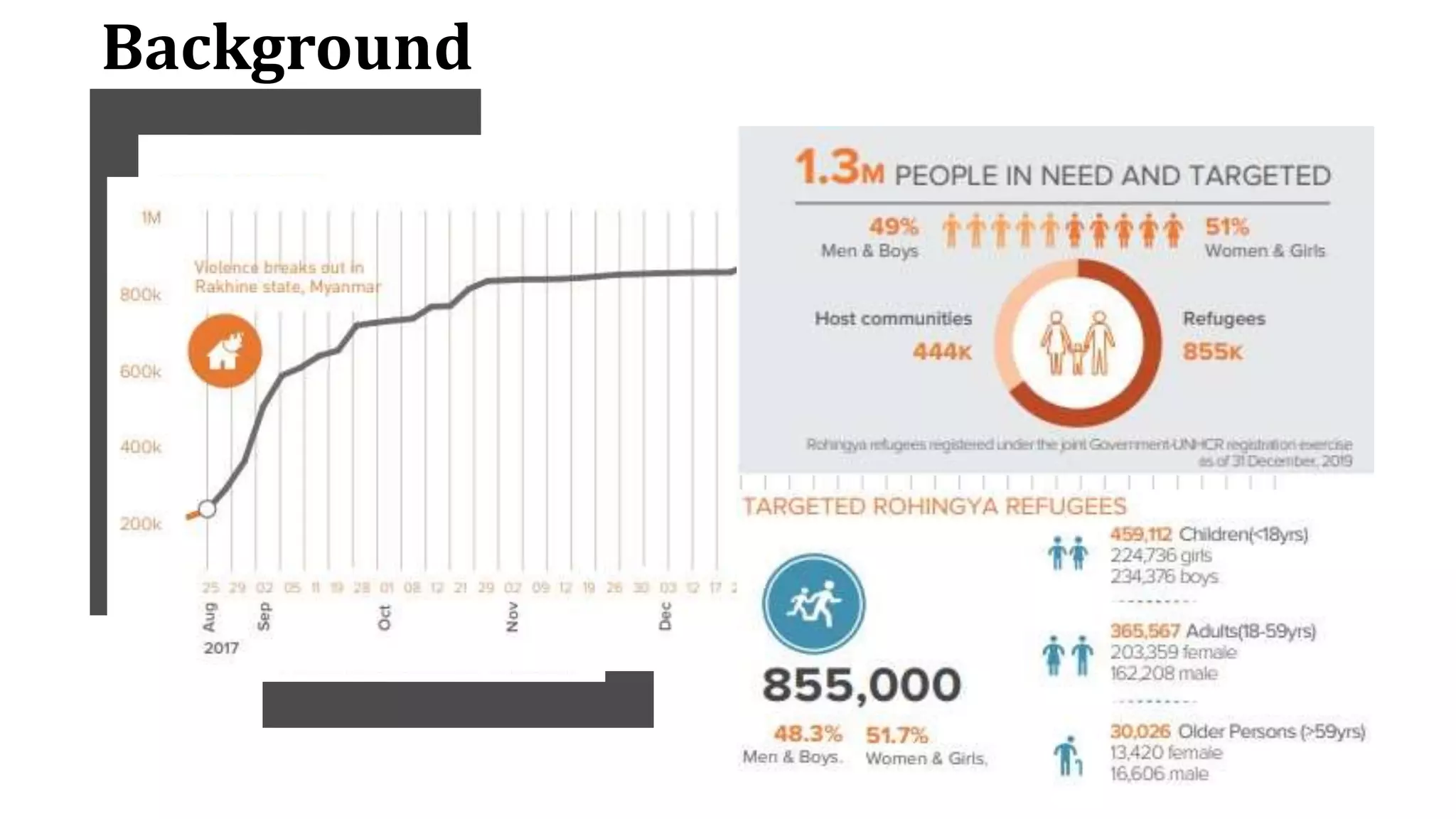
Background
• In order to reduce the mortality of this
vulnerable population, local and international
non-governmental organizations (NGO) built
capacity for basic public health infrastructure
including mortality surveillance.
• So it was interesting to know the
development and establishment of the
maternal and perinatal mortality surveillance
system in the Rohingya Refugee camps
Objective
To understand the establishment, development
and implementation process of Maternal and
Perinatal Mortality Surveillance and Response
system (MPMSR) in the Rohingya refugee crisis
Case
Description
• Methods:
• The case study included the operational area of
MPMSR in the refugee camps.
• Data were obtained through key informant interviews
and systematic document review from 2017–2019.
• Study site:
• All the 34 refugee camps in Ukiya & Teknaf sub-
districts in Cox’s Bazar
• Facilities providing SRHR services to the refugees
• Data collection:
• A total 18 KII was done with Implementers at different
level (community and facility), MPMSR committee
members, researchers using a interview guideline
• Document reviews (Meeting minutes, Reports,
Bulletins)
• Data Analysis:
• Inductive qualitative content analysis
Findings
1. Establishment and development of
MPMSR
2. Implementation process of MPMSR
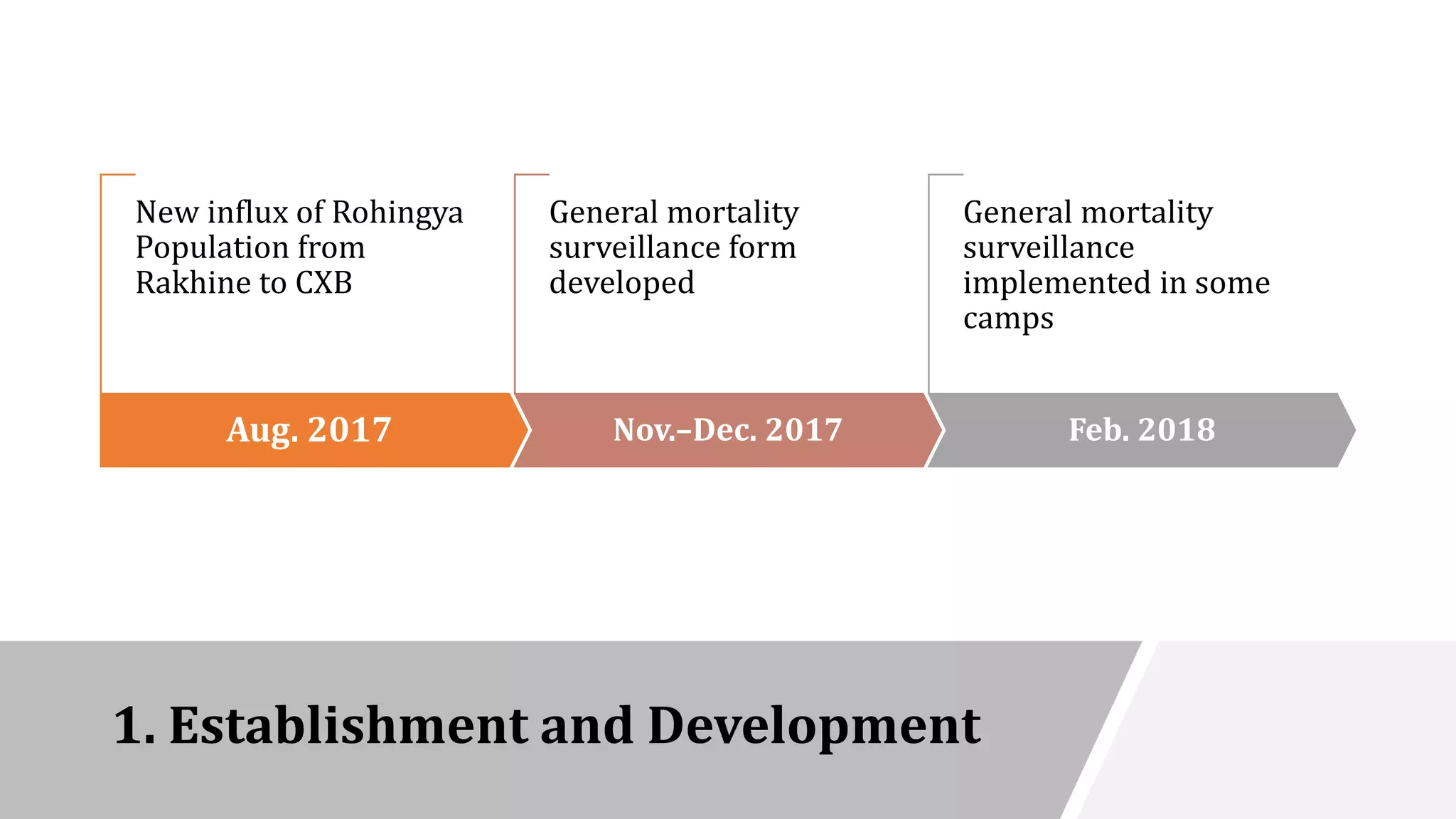
1. Establishment and Development
Aug. 2017
New influx of Rohingya
Population from
Rakhine to CXB
Nov.–Dec. 2017
General mortality
surveillance form
developed
Feb. 2018
General mortality
surveillance
implemented in some
camps
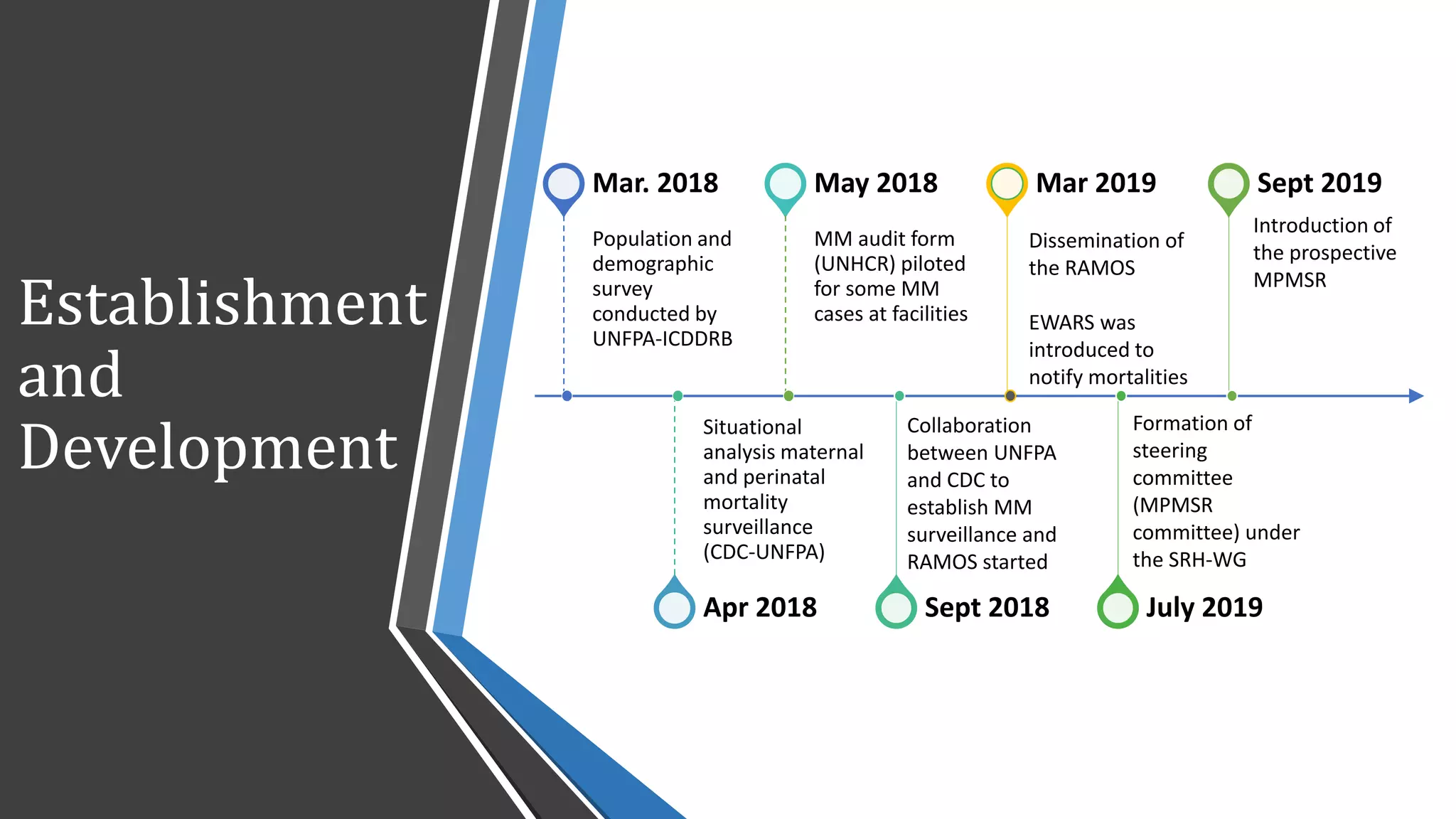
Establishment
and
Development
Population and
demographic
survey
conducted by
UNFPA-ICDDRB
Mar. 2018
Situational
analysis maternal
and perinatal
mortality
surveillance
(CDC-UNFPA)
Apr 2018
MM audit form
(UNHCR) piloted
for some MM
cases at facilities
May 2018
Sept 2018
Mar 2019
July 2019
Sept 2019
Collaboration
between UNFPA
and CDC to
establish MM
surveillance and
RAMOS started
Dissemination of
the RAMOS
EWARS was
introduced to
notify mortalities
Formation of
steering
committee
(MPMSR
committee) under
the SRH-WG
Introduction of
the prospective
MPMSR
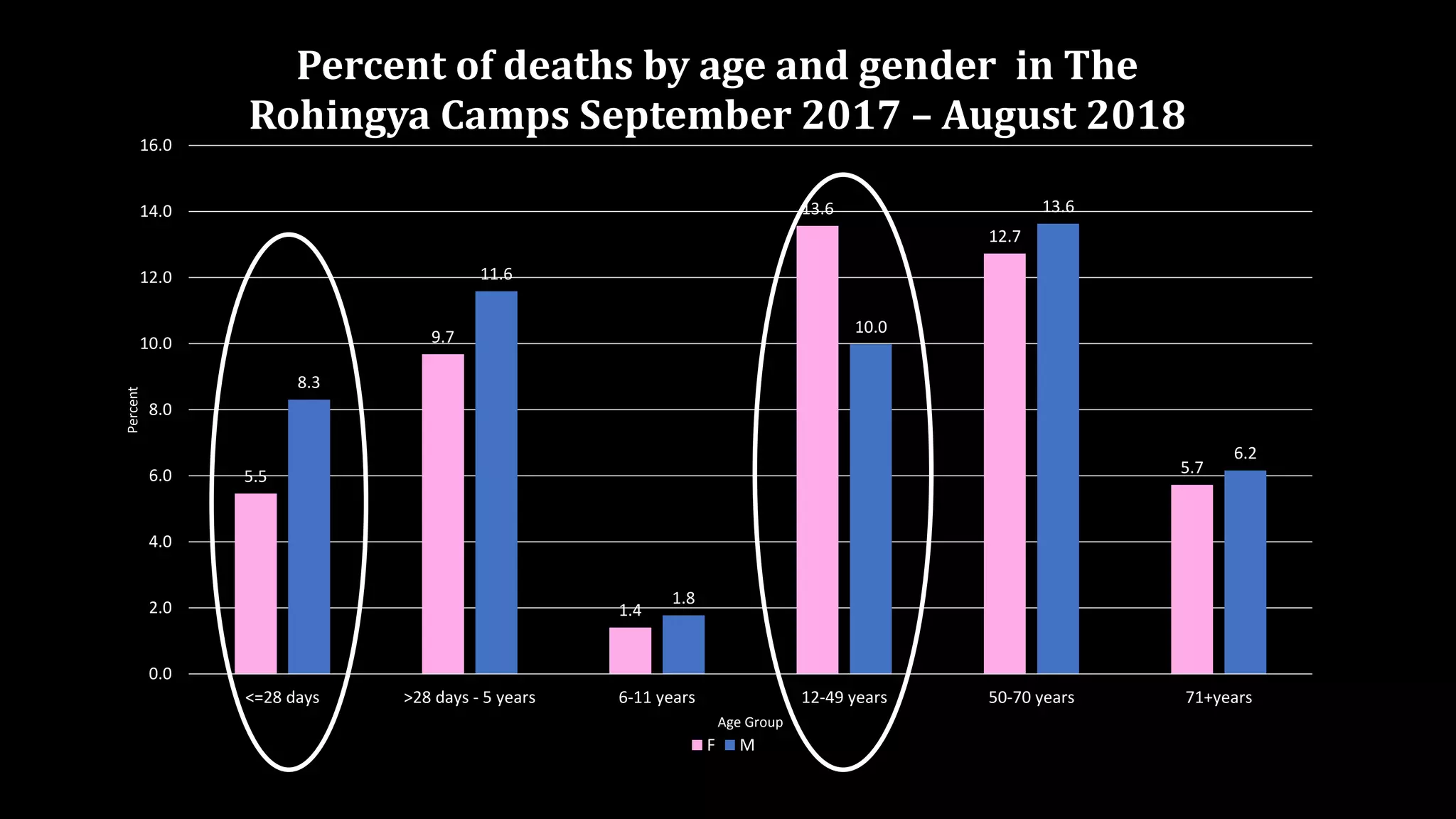
5.5
9.7
1.4
13.6
12.7
5.7
8.3
11.6
1.8
10.0
13.6
6.2
0.0
2.0
4.0
6.0
8.0
10.0
12.0
14.0
16.0
<=28 days >28 days - 5 years 6-11 years 12-49 years 50-70 years 71+years
Percent
Age Group
Percent of deaths by age and gender in The
Rohingya Camps September 2017 – August 2018
F M
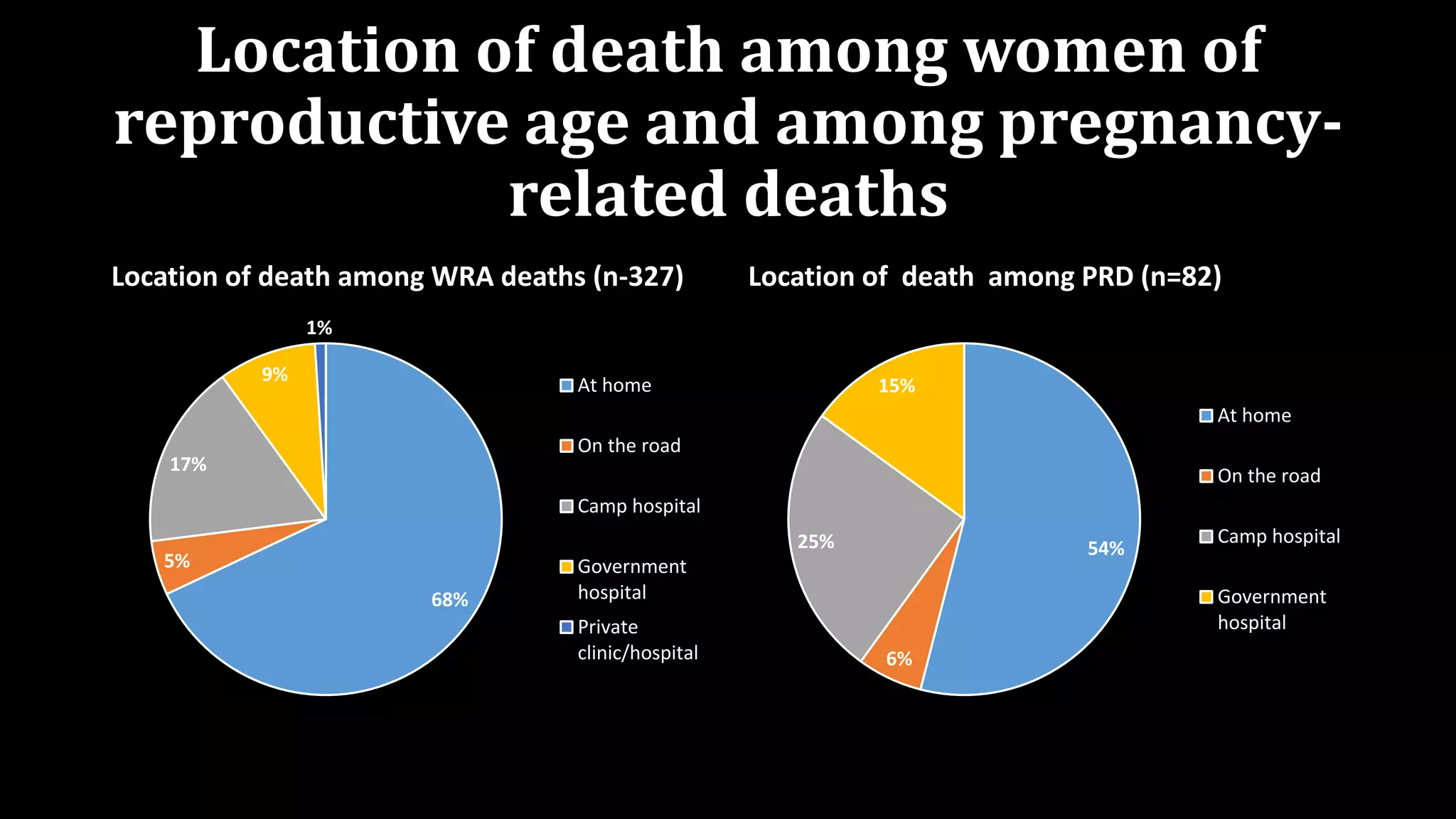
Location of death among women of
reproductive age and among pregnancy-
related deaths
Location of death among WRA deaths (n-327) Location of death among PRD (n=82)
68%
5%
17%
9%
1%
At home
On the road
Camp hospital
Government
hospital
Private
clinic/hospital
54%
6%
25%
15%
At home
On the road
Camp hospital
Government
hospital
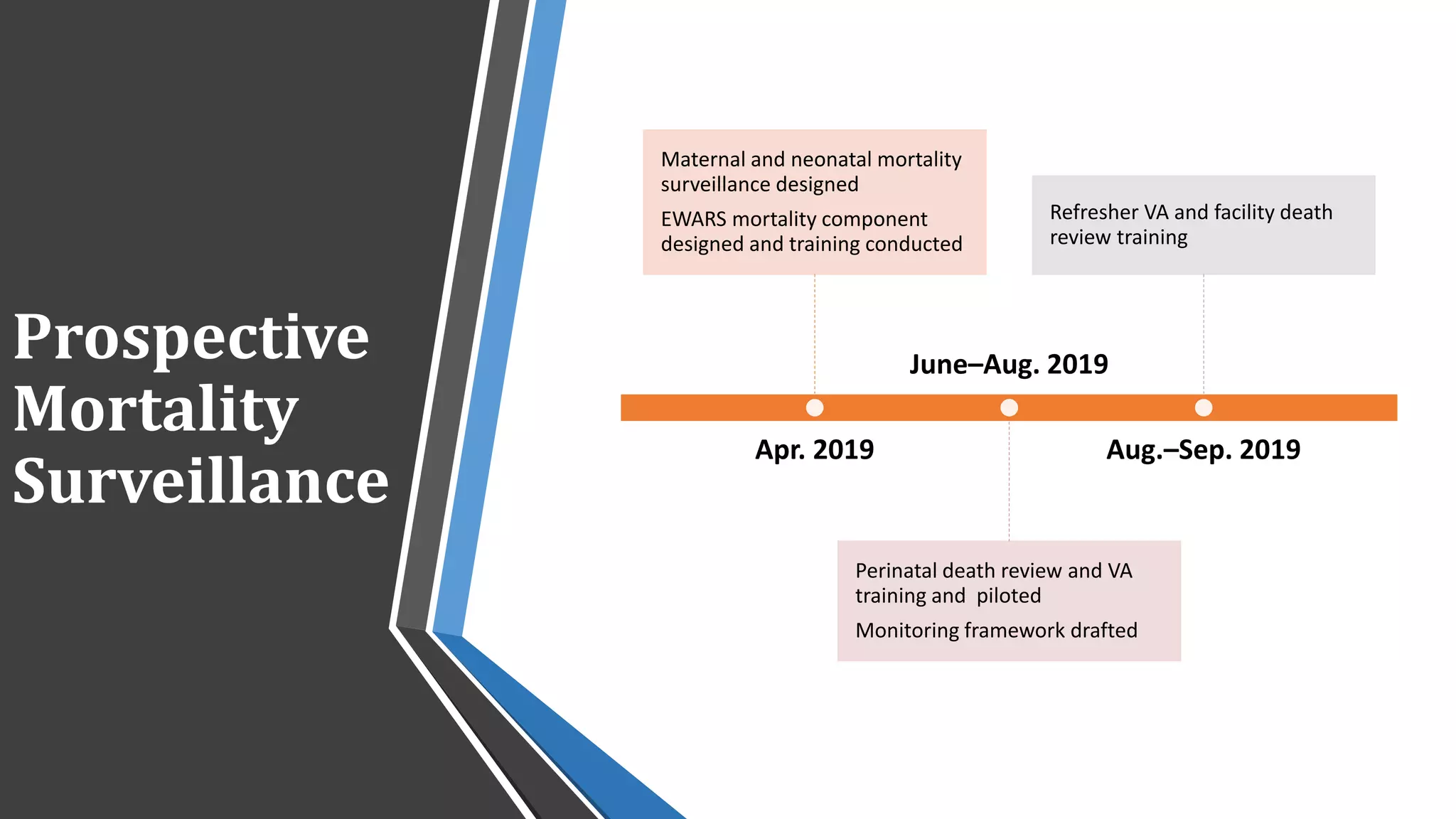
Prospective
Mortality
Surveillance
Apr. 2019
Maternal and neonatal mortality
surveillance designed
EWARS mortality component
designed and training conducted
June–Aug. 2019
Perinatal death review and VA
training and piloted
Monitoring framework drafted
Aug.–Sep. 2019
Refresher VA and facility death
review training
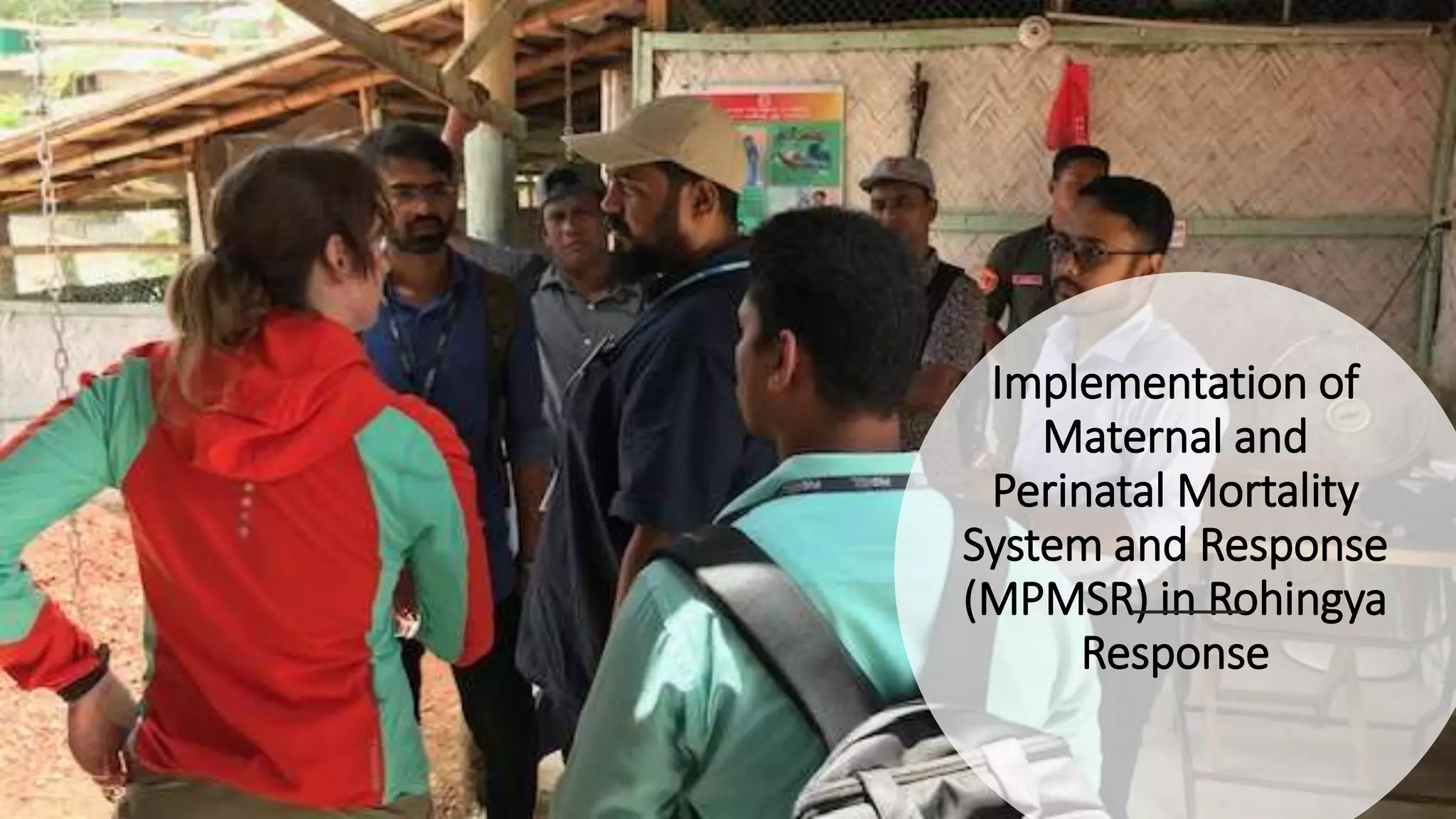
Implementation of
Maternal and
Perinatal Mortality
System and Response
(MPMSR) in Rohingya
Response
Implementation
of the Maternal
Mortality
Surveillance
2.1 Coordination Mechanism
2.2 Maternal and Perinatal Mortality
Surveillance System
Health Sector (cluster) Coordination in Rohingya
Response
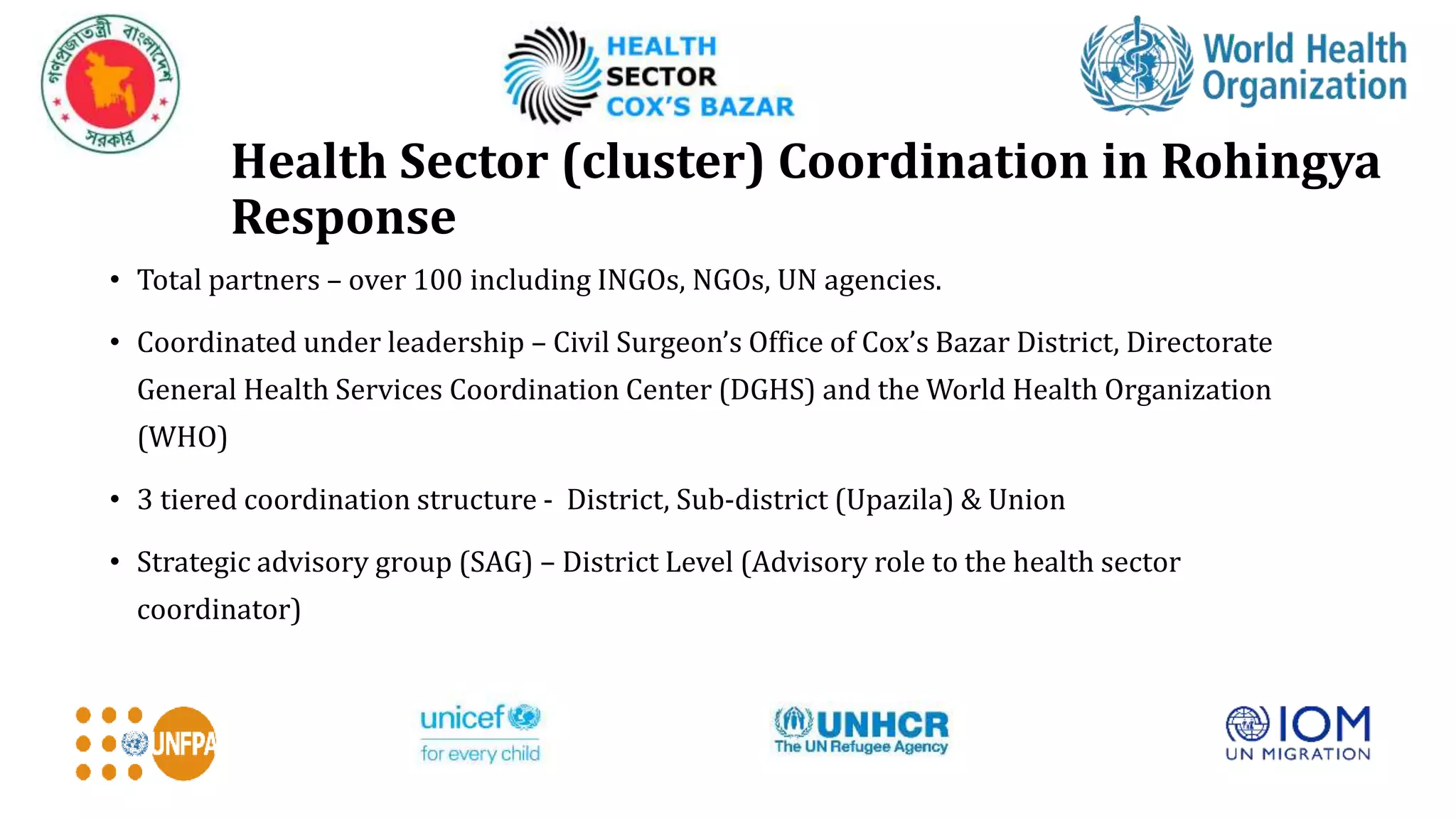
• Total partners – over 100 including INGOs, NGOs, UN agencies.
• Coordinated under leadership – Civil Surgeon’s Office of Cox’s Bazar District, Directorate
General Health Services Coordination Center (DGHS) and the World Health Organization
(WHO)
• 3 tiered coordination structure - District, Sub-district (Upazila) & Union
• Strategic advisory group (SAG) – District Level (Advisory role to the health sector
coordinator)
Working Groups for Health Coordination
(2019) in Rohingya Response
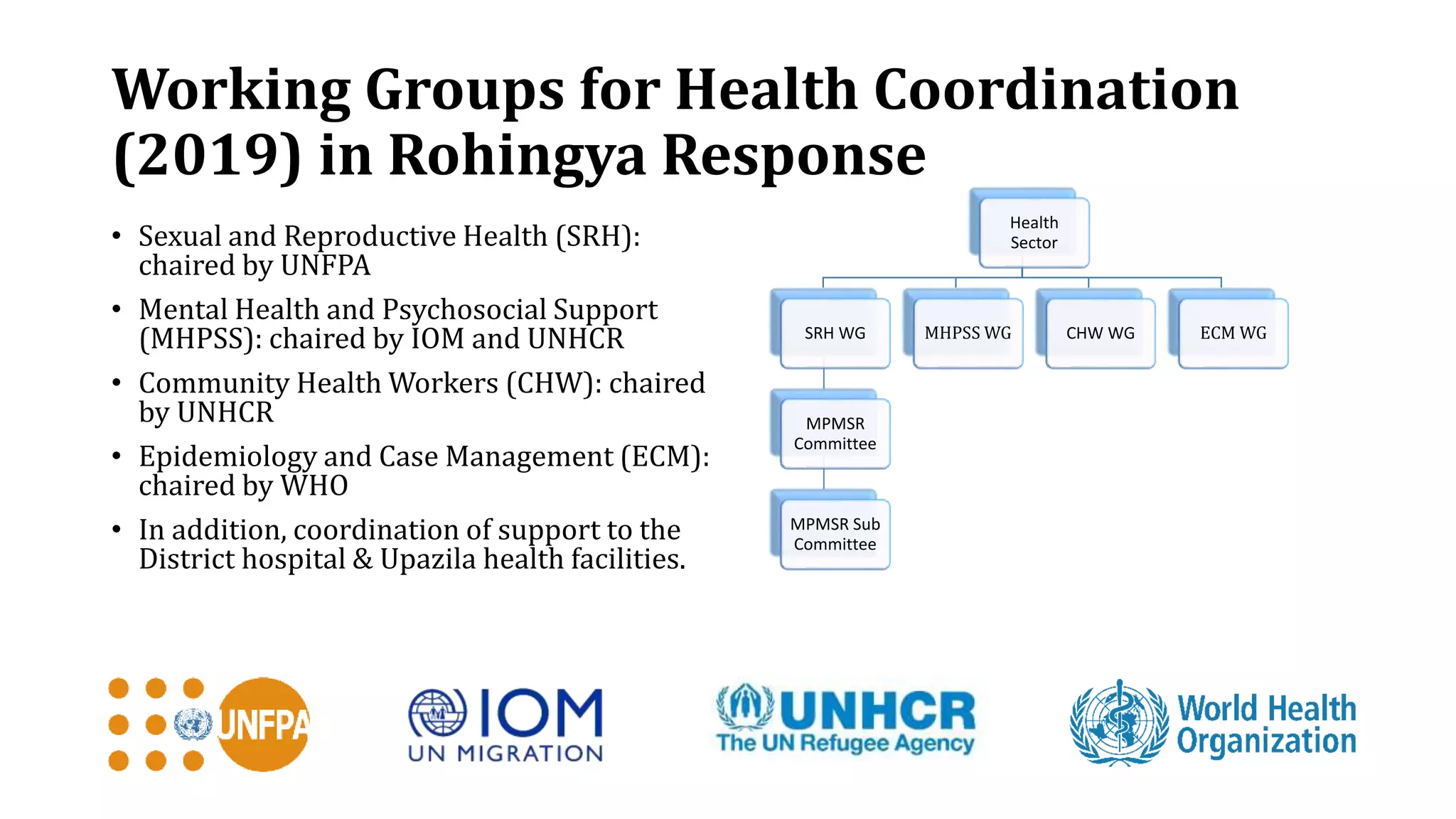
• Sexual and Reproductive Health (SRH):
chaired by UNFPA
• Mental Health and Psychosocial Support
(MHPSS): chaired by IOM and UNHCR
• Community Health Workers (CHW): chaired
by UNHCR
• Epidemiology and Case Management (ECM):
chaired by WHO
• In addition, coordination of support to the
District hospital & Upazila health facilities.
Health
Sector
SRH WG
MPMSR
Committee
MPMSR Sub
Committee
MHPSS WG CHW WG ECM WG
MPMSR System
Facility
Death
review
Facility
Death
Audits
Community Mortality
Surveillance – Reporting
through EWARS
WRA
Verbal
Autopsies
MPMSR committee
Healthcare
Providers
MPMSR Sub-
committee
CHWs in the camps
WHO-epi team
VA Team
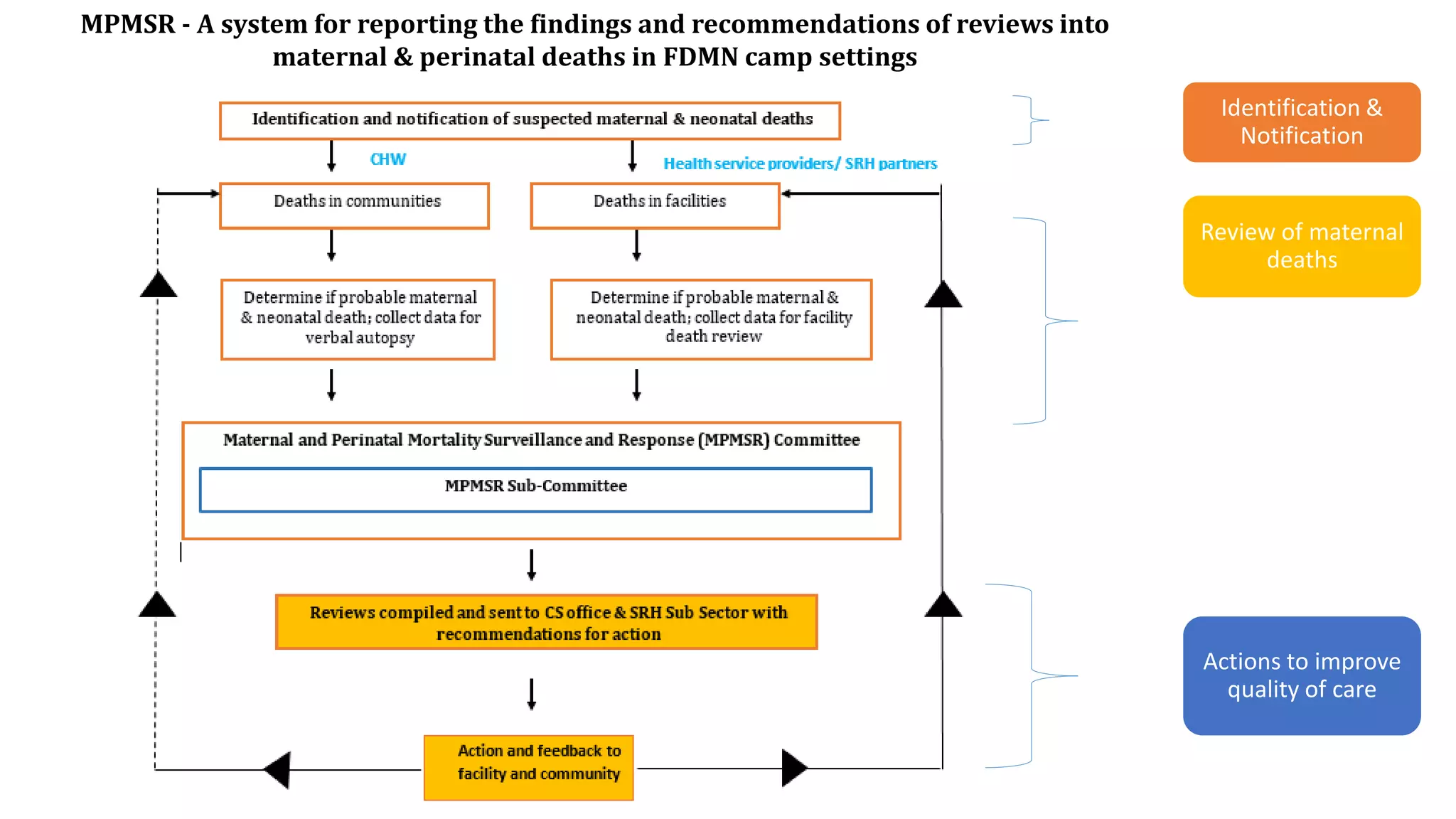
MPMSR - A system for reporting the findings and recommendations of reviews into
maternal & perinatal deaths in FDMN camp settings
Identification &
Notification
Review of maternal
deaths
Actions to improve
quality of care
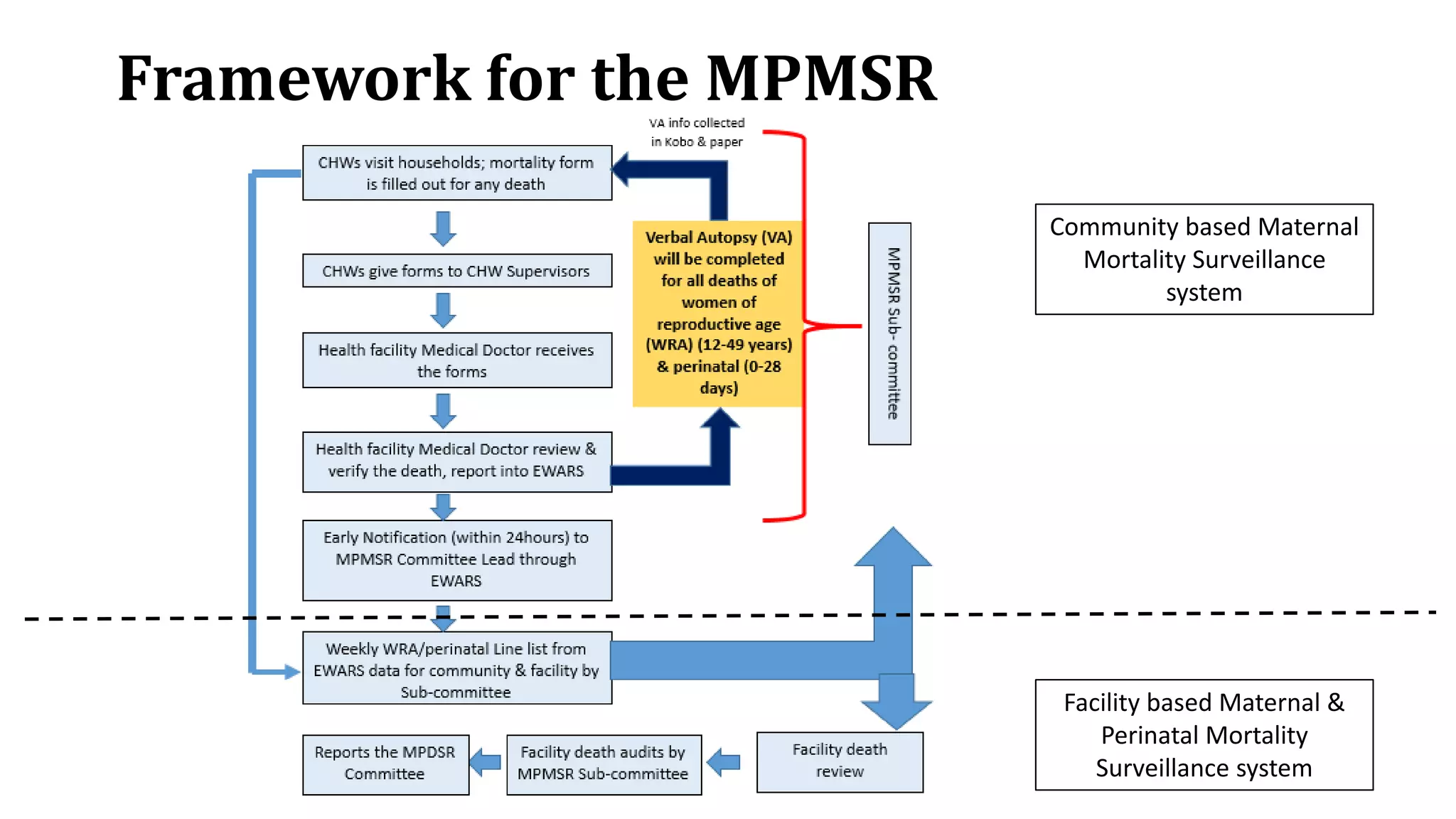
Framework for the MPMSR
Community based Maternal
Mortality Surveillance
system
Facility based Maternal &
Perinatal Mortality
Surveillance system
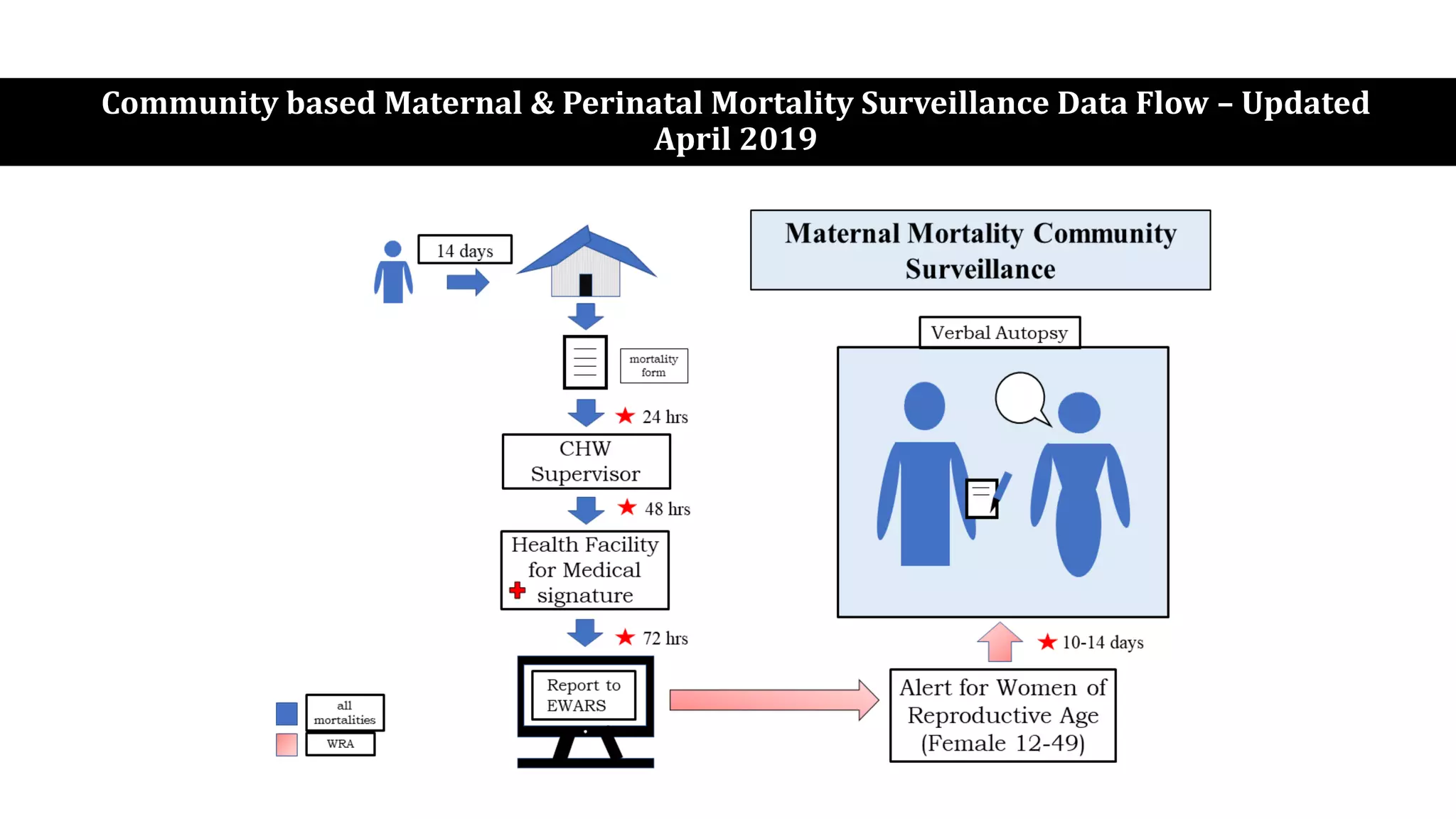
Community based Maternal & Perinatal Mortality Surveillance Data Flow – Updated
April 2019
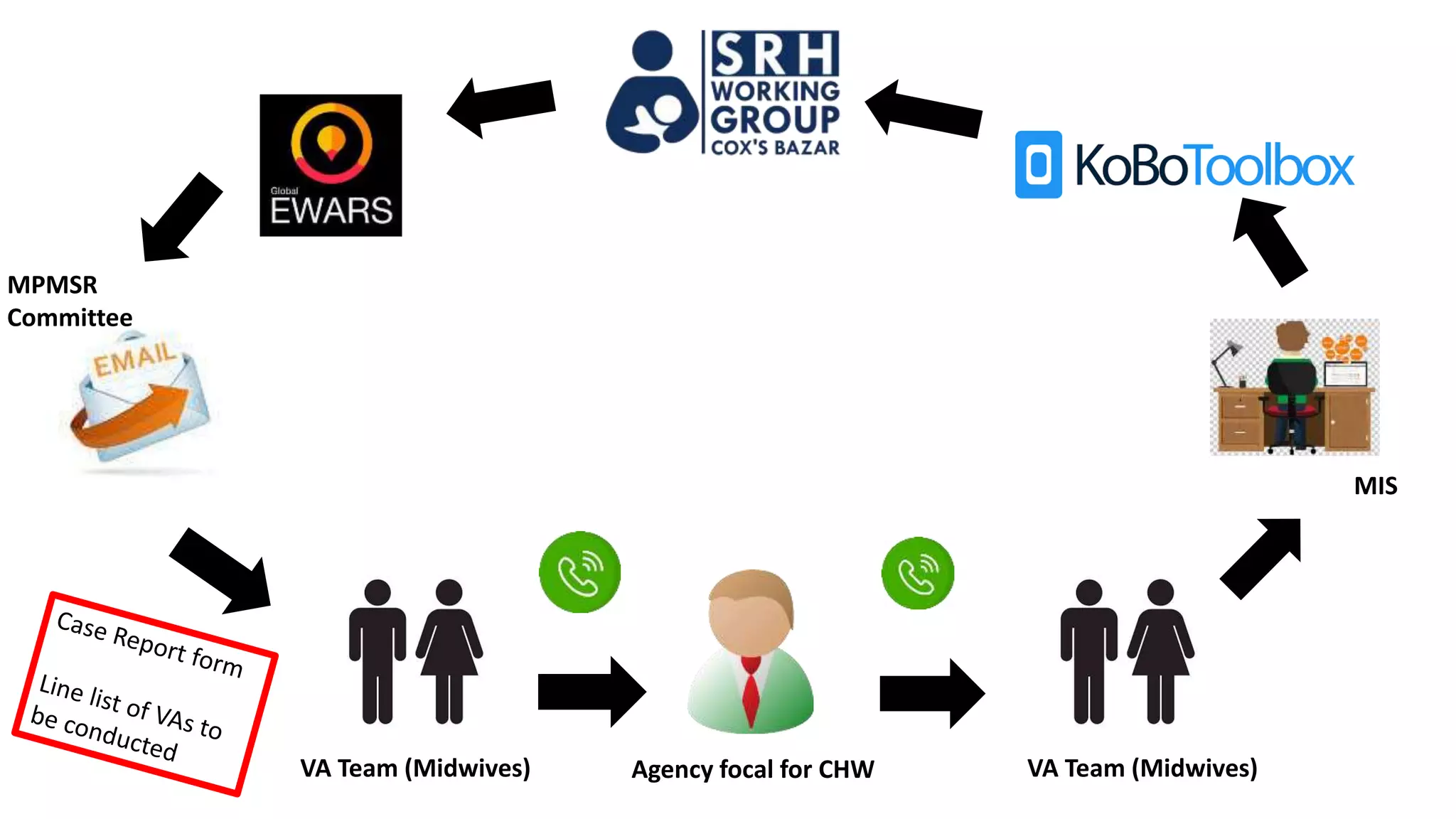
Agency focal for CHWVA Team (Midwives)
MPMSR
Committee
MIS
VA Team (Midwives)
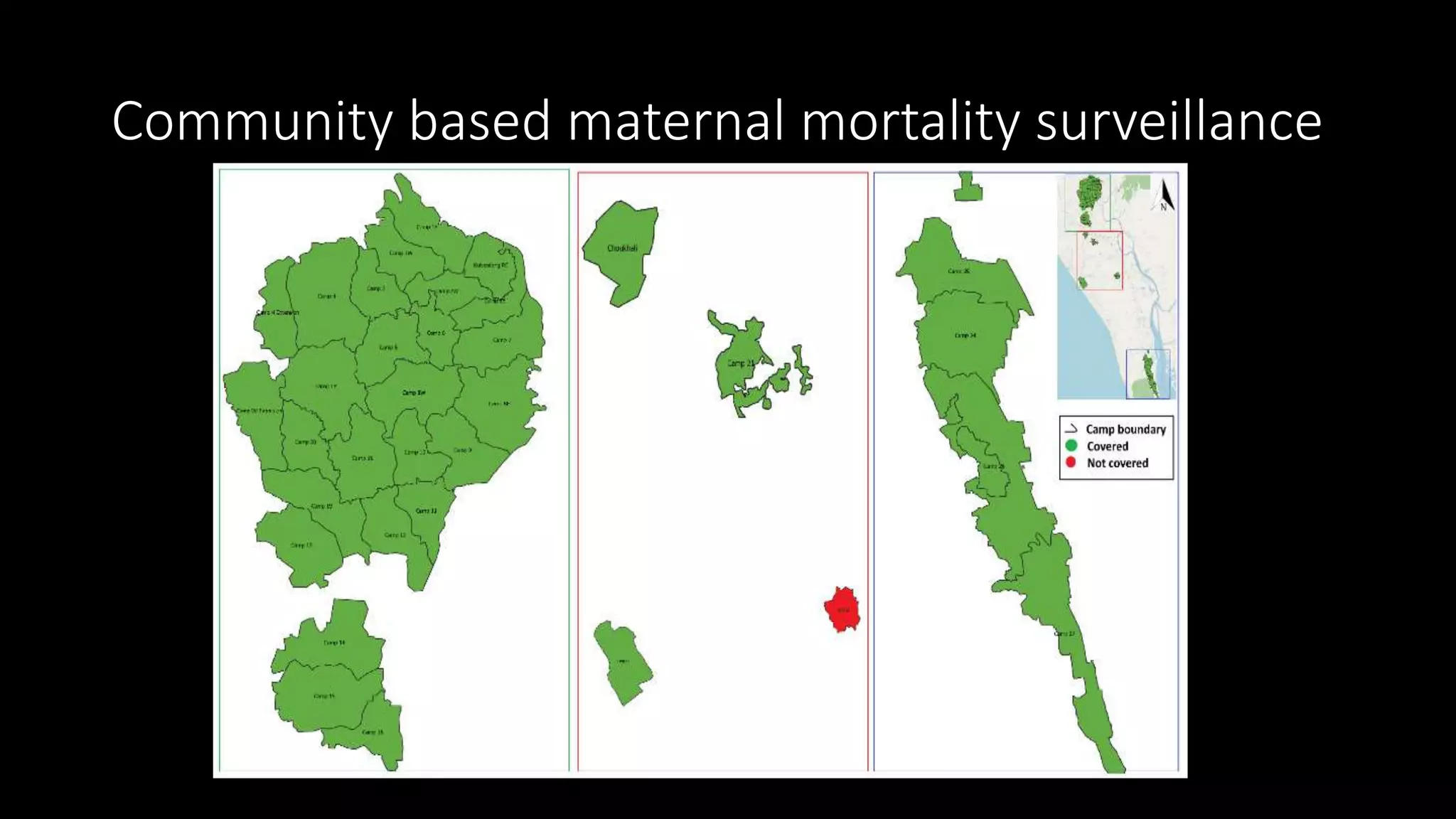
Community based maternal mortality surveillance
Conclusion
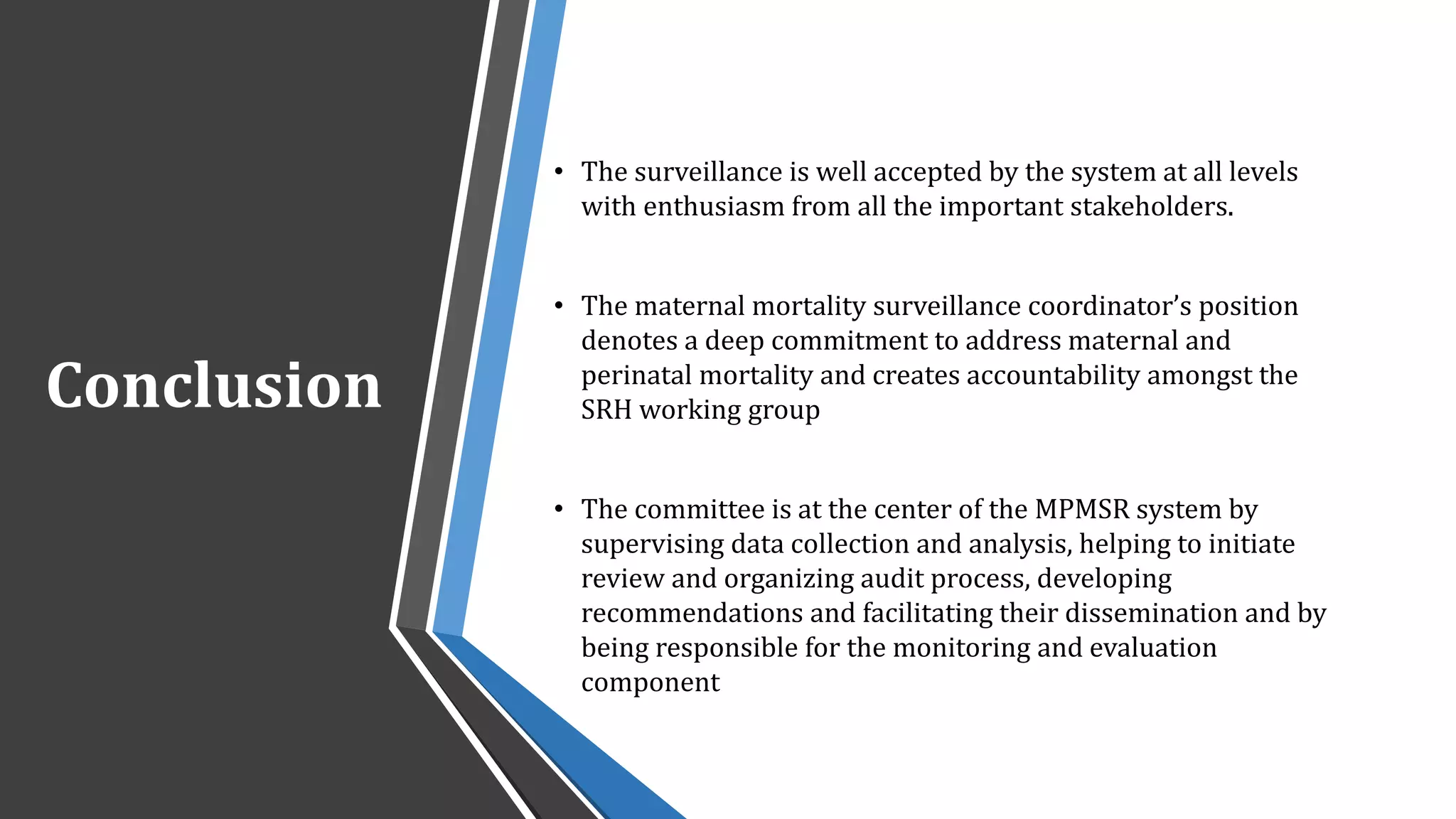
• The surveillance is well accepted by the system at all levels
with enthusiasm from all the important stakeholders.
• The maternal mortality surveillance coordinator’s position
denotes a deep commitment to address maternal and
perinatal mortality and creates accountability amongst the
SRH working group
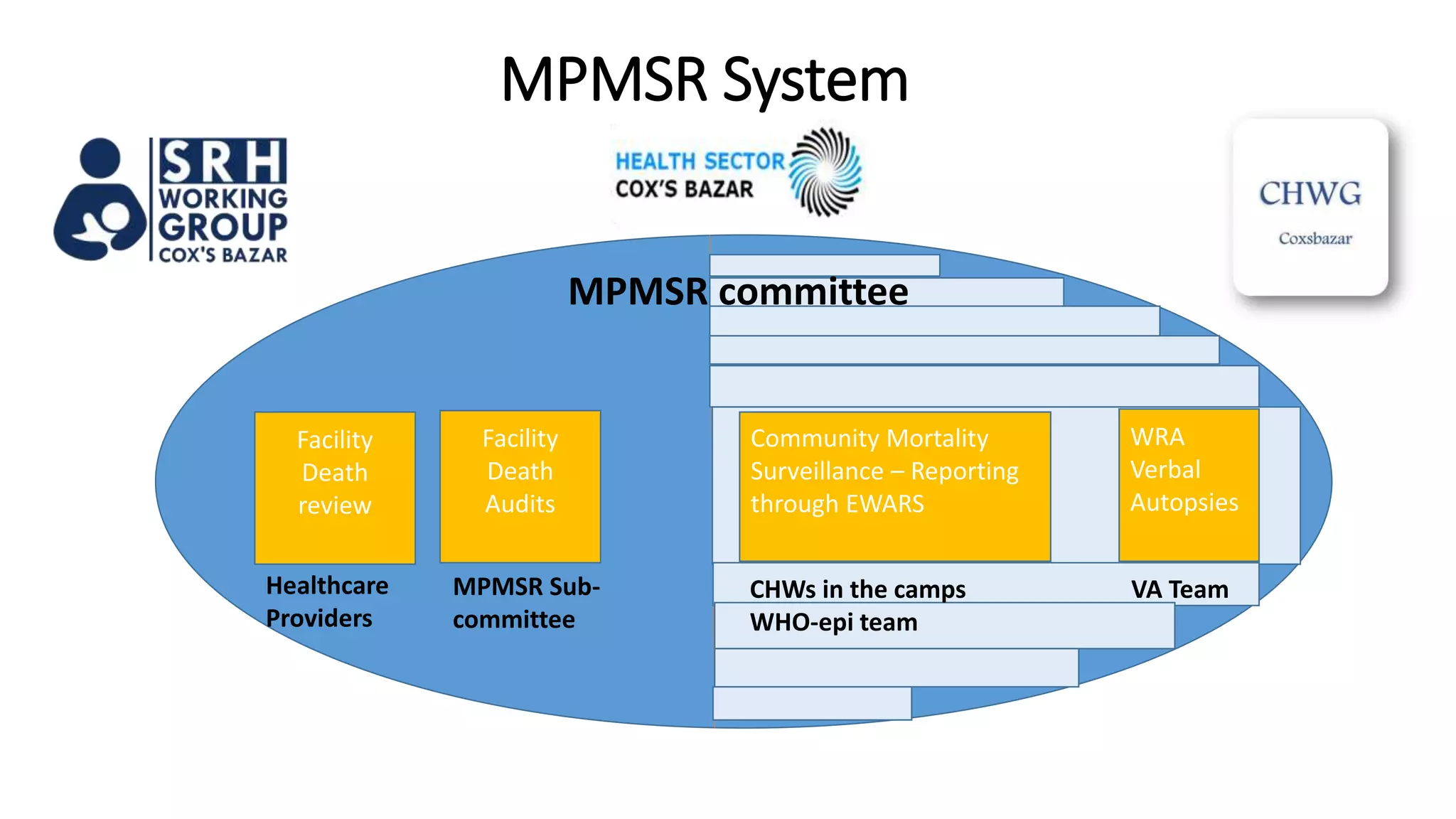
• The committee is at the center of the MPMSR system by
supervising data collection and analysis, helping to initiate
review and organizing audit process, developing
recommendations and facilitating their dissemination and by
being responsible for the monitoring and evaluation
component
Conclusion
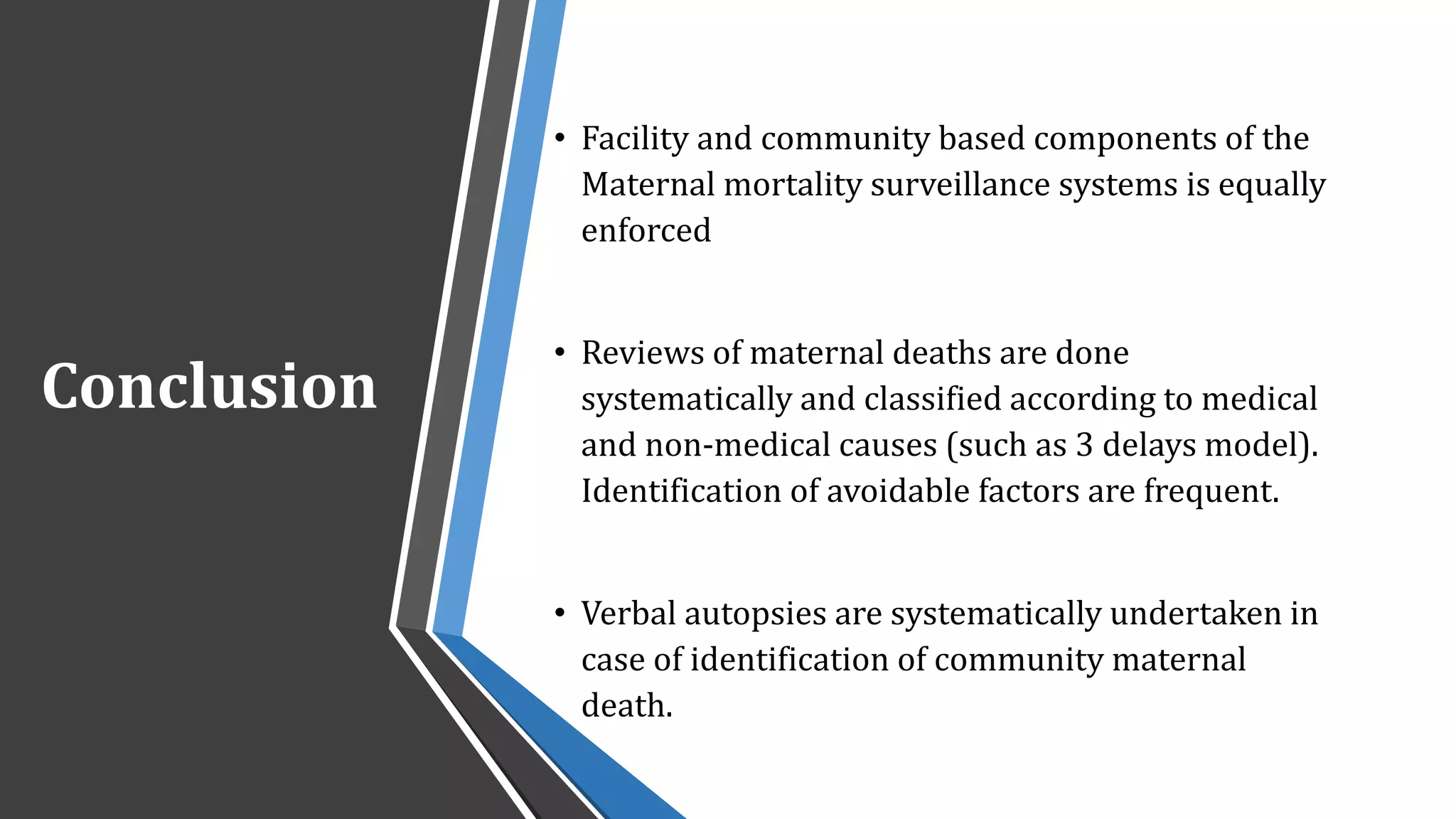
• Facility and community based components of the
Maternal mortality surveillance systems is equally
enforced
• Reviews of maternal deaths are done
systematically and classified according to medical
and non-medical causes (such as 3 delays model).
Identification of avoidable factors are frequent.
• Verbal autopsies are systematically undertaken in
case of identification of community maternal
death.
Conclusion
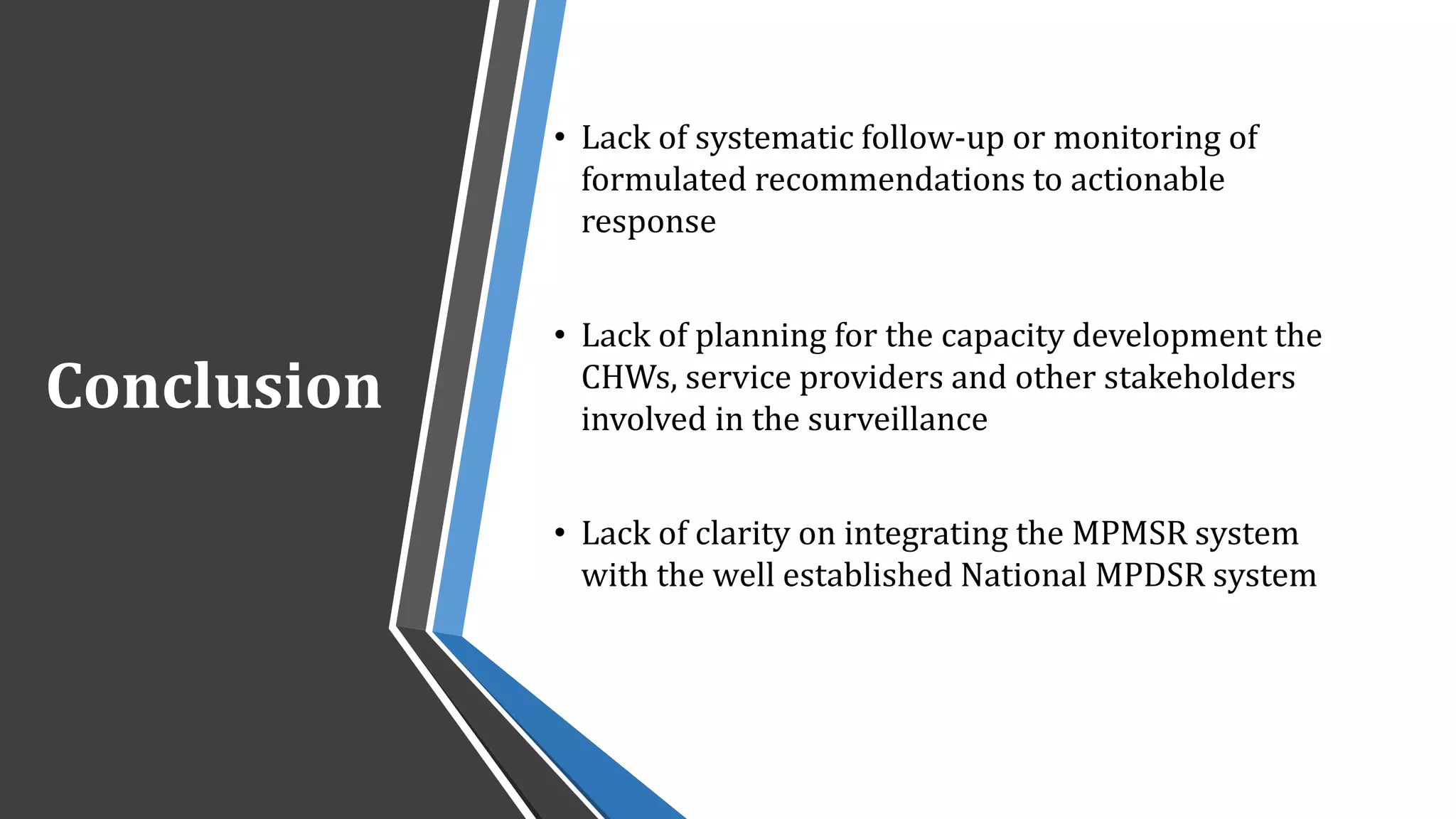
• Lack of systematic follow-up or monitoring of
formulated recommendations to actionable
response
• Lack of planning for the capacity development the
CHWs, service providers and other stakeholders
involved in the surveillance
• Lack of clarity on integrating the MPMSR system
with the well established National MPDSR system
Anek Dhonnobadh – Many Thanks

APCRSHR10 Virtual abstract presentation of Sayantan Chowdhury

  • 1.
    Genesis of MaternalMortality Surveillance and Response in the Rohingya Refugee Crisis – A Case Study Sayantan Chowdhury and Endang Handzel
  • 2.
  • 3.
    Background • In orderto reduce the mortality of this vulnerable population, local and international non-governmental organizations (NGO) built capacity for basic public health infrastructure including mortality surveillance. • So it was interesting to know the development and establishment of the maternal and perinatal mortality surveillance system in the Rohingya Refugee camps
  • 4.
    Objective To understand theestablishment, development and implementation process of Maternal and Perinatal Mortality Surveillance and Response system (MPMSR) in the Rohingya refugee crisis
  • 5.
    Case Description • Methods: • Thecase study included the operational area of MPMSR in the refugee camps. • Data were obtained through key informant interviews and systematic document review from 2017–2019. • Study site: • All the 34 refugee camps in Ukiya & Teknaf sub- districts in Cox’s Bazar • Facilities providing SRHR services to the refugees • Data collection: • A total 18 KII was done with Implementers at different level (community and facility), MPMSR committee members, researchers using a interview guideline • Document reviews (Meeting minutes, Reports, Bulletins) • Data Analysis: • Inductive qualitative content analysis
  • 6.
    Findings 1. Establishment anddevelopment of MPMSR 2. Implementation process of MPMSR
  • 7.
    1. Establishment andDevelopment Aug. 2017 New influx of Rohingya Population from Rakhine to CXB Nov.–Dec. 2017 General mortality surveillance form developed Feb. 2018 General mortality surveillance implemented in some camps
  • 8.
    Establishment and Development Population and demographic survey conducted by UNFPA-ICDDRB Mar.2018 Situational analysis maternal and perinatal mortality surveillance (CDC-UNFPA) Apr 2018 MM audit form (UNHCR) piloted for some MM cases at facilities May 2018 Sept 2018 Mar 2019 July 2019 Sept 2019 Collaboration between UNFPA and CDC to establish MM surveillance and RAMOS started Dissemination of the RAMOS EWARS was introduced to notify mortalities Formation of steering committee (MPMSR committee) under the SRH-WG Introduction of the prospective MPMSR
  • 9.
    5.5 9.7 1.4 13.6 12.7 5.7 8.3 11.6 1.8 10.0 13.6 6.2 0.0 2.0 4.0 6.0 8.0 10.0 12.0 14.0 16.0 <=28 days >28days - 5 years 6-11 years 12-49 years 50-70 years 71+years Percent Age Group Percent of deaths by age and gender in The Rohingya Camps September 2017 – August 2018 F M
  • 10.
    Location of deathamong women of reproductive age and among pregnancy- related deaths Location of death among WRA deaths (n-327) Location of death among PRD (n=82) 68% 5% 17% 9% 1% At home On the road Camp hospital Government hospital Private clinic/hospital 54% 6% 25% 15% At home On the road Camp hospital Government hospital
  • 11.
    Prospective Mortality Surveillance Apr. 2019 Maternal andneonatal mortality surveillance designed EWARS mortality component designed and training conducted June–Aug. 2019 Perinatal death review and VA training and piloted Monitoring framework drafted Aug.–Sep. 2019 Refresher VA and facility death review training
  • 12.
    Implementation of Maternal and PerinatalMortality System and Response (MPMSR) in Rohingya Response
  • 13.
    Implementation of the Maternal Mortality Surveillance 2.1Coordination Mechanism 2.2 Maternal and Perinatal Mortality Surveillance System
  • 14.
    Health Sector (cluster)Coordination in Rohingya Response • Total partners – over 100 including INGOs, NGOs, UN agencies. • Coordinated under leadership – Civil Surgeon’s Office of Cox’s Bazar District, Directorate General Health Services Coordination Center (DGHS) and the World Health Organization (WHO) • 3 tiered coordination structure - District, Sub-district (Upazila) & Union • Strategic advisory group (SAG) – District Level (Advisory role to the health sector coordinator)
  • 15.
    Working Groups forHealth Coordination (2019) in Rohingya Response • Sexual and Reproductive Health (SRH): chaired by UNFPA • Mental Health and Psychosocial Support (MHPSS): chaired by IOM and UNHCR • Community Health Workers (CHW): chaired by UNHCR • Epidemiology and Case Management (ECM): chaired by WHO • In addition, coordination of support to the District hospital & Upazila health facilities. Health Sector SRH WG MPMSR Committee MPMSR Sub Committee MHPSS WG CHW WG ECM WG
  • 16.
    MPMSR System Facility Death review Facility Death Audits Community Mortality Surveillance– Reporting through EWARS WRA Verbal Autopsies MPMSR committee Healthcare Providers MPMSR Sub- committee CHWs in the camps WHO-epi team VA Team
  • 17.
    MPMSR - Asystem for reporting the findings and recommendations of reviews into maternal & perinatal deaths in FDMN camp settings Identification & Notification Review of maternal deaths Actions to improve quality of care
  • 18.
    Framework for theMPMSR Community based Maternal Mortality Surveillance system Facility based Maternal & Perinatal Mortality Surveillance system
  • 19.
    Community based Maternal& Perinatal Mortality Surveillance Data Flow – Updated April 2019
  • 20.
    Agency focal forCHWVA Team (Midwives) MPMSR Committee MIS VA Team (Midwives)
  • 21.
    Community based maternalmortality surveillance
  • 22.
    Conclusion • The surveillanceis well accepted by the system at all levels with enthusiasm from all the important stakeholders. • The maternal mortality surveillance coordinator’s position denotes a deep commitment to address maternal and perinatal mortality and creates accountability amongst the SRH working group • The committee is at the center of the MPMSR system by supervising data collection and analysis, helping to initiate review and organizing audit process, developing recommendations and facilitating their dissemination and by being responsible for the monitoring and evaluation component
  • 23.
    Conclusion • Facility andcommunity based components of the Maternal mortality surveillance systems is equally enforced • Reviews of maternal deaths are done systematically and classified according to medical and non-medical causes (such as 3 delays model). Identification of avoidable factors are frequent. • Verbal autopsies are systematically undertaken in case of identification of community maternal death.
  • 24.
    Conclusion • Lack ofsystematic follow-up or monitoring of formulated recommendations to actionable response • Lack of planning for the capacity development the CHWs, service providers and other stakeholders involved in the surveillance • Lack of clarity on integrating the MPMSR system with the well established National MPDSR system
  • 25.

Editor's Notes

  • #9 Result from ICDDRB report - Situation analysis report In September 2018, UNFPA with technical support from CDC collaborated to establish a maternal mortality surveillance system on the model of accepted standards for maternal mortality surveillance systems with adaptions for an emergency humanitarian context. A retrospective analysis of data of one year was done to establish a baseline. The lessons learned during the study helped to establish key components for a robust surveillance system and helped to further shape the community health worker mortality reporting. In April 2019, WHO and collaborating partners implemented the Early Warning, Alert and Response System (EWARS) as a electronic notification system to notify mortalities of all ages and enable mer verbal autopsy teams of WRA mortalities. In July 2019 the steering commiee named "Maternal and Perinatal mortality surveillance and response (MPMSR)" commiee under the SRH Working Group was established. This committee is have been established to facilitate the audit of maternal deaths, to develop recommendations and to ensure and monitor their implementation.
  • #10 When you see this graph, lead for general death, other de WRA death 13.6 Neonates : 13.8
  • #18 It is a tool for reporting the findings and recommendations of investigations into maternal deaths in refugee settings Every maternal death (a refugee or a national) that occurs within a camp setting (at home or a health center or during referral) should be systematically reviewed Collected information and decisions taken are reported Maternal mortality review process will be undertaken at two levels: Community level Facility level MPDSR system by supervising data collection and analysis, helping to initiate review and organizing audit process, developing recommendations and facilitating their dissemination