VALUE
VALUE
by
Bernard E. Richardson
Master Teacher|Visual Arts Educator|2022
E L E M E N T O F A R T
What is Value?
VALUE is one of the seven elements of Art and design (next to line, shape,
space, form, colour and texture.
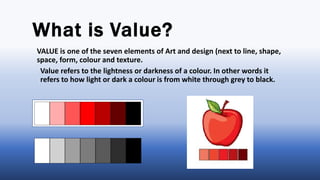
Value refers to the lightness or darkness of a colour. In other words it
refers to how light or dark a colour is from white through grey to black.
Value Scale
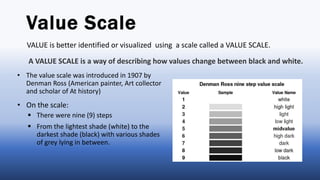
VALUE is better identified or visualized using a scale called a VALUE SCALE.
• On the scale:
 There were nine (9) steps
 From the lightest shade (white) to the
darkest shade (black) with various shades
of grey lying in between.
A VALUE SCALE is a way of describing how values change between black and white.
• The value scale was introduced in 1907 by
Denman Ross (American painter, Art collector
and scholar of At history)
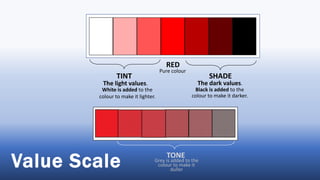
RED
SHADE
TINT
Pure colour
TONE
Grey is added to the
colour to make it
duller
The light values.
White is added to the
colour to make it lighter.
The dark values.
Black is added to the
colour to make it darker.
Value Scale
What does Value do?
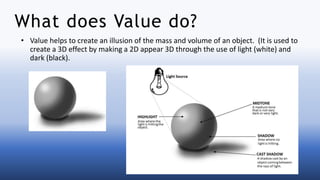
• Value helps to create an illusion of the mass and volume of an object. (It is used to
create a 3D effect by making a 2D appear 3D through the use of light (white) and
dark (black).
It shows
What does Value do?
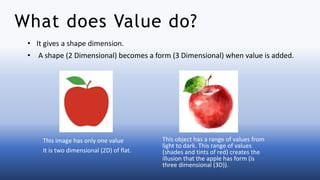
This image has only one value
It is two dimensional (2D) of flat.
• It gives a shape dimension.
• A shape (2 Dimensional) becomes a form (3 Dimensional) when value is added.
This object has a range of values from
light to dark. This range of values
(shades and tints of red) creates the
illusion that the apple has form (is
three dimensional (3D)).
Value can be created by using drawing and painting techniques with various mark making
tools.
Creating Value
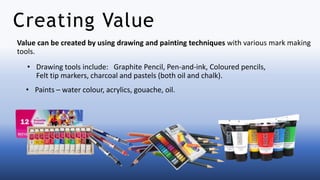
• Drawing tools include: Graphite Pencil, Pen-and-ink, Coloured pencils,
Felt tip markers, charcoal and pastels (both oil and chalk).
• Paints – water colour, acrylics, gouache, oil.
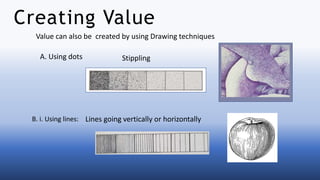
Value can also be created by using Drawing techniques
A. Using dots
B. i. Using lines: Lines going vertically or horizontally
Stippling
Creating Value
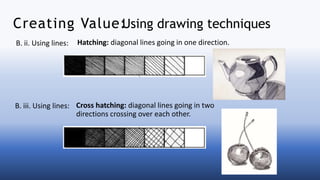
B. ii. Using lines: Hatching: diagonal lines going in one direction.
Cross hatching: diagonal lines going in two
directions crossing over each other.
B. iii. Using lines:
Creating Value:
Using drawing techniques
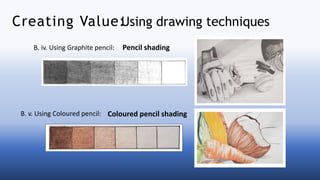
B. iv. Using Graphite pencil: Pencil shading
B. v. Using Coloured pencil: Coloured pencil shading
Creating Value:
Using drawing techniques
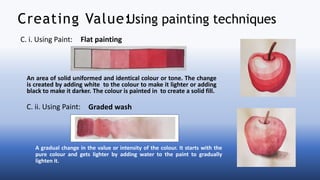
C. i. Using Paint: Flat painting
C. ii. Using Paint: Graded wash
A gradual change in the value or intensity of the colour. It starts with the
pure colour and gets lighter by adding water to the paint to gradually
lighten it.
An area of solid uniformed and identical colour or tone. The change
is created by adding white to the colour to make it lighter or adding
black to make it darker. The colour is painted in to create a solid fill.
Creating Value:
Using painting techniques
Image Courtesies
• https://e8ufb9jkjvf.exactdn.com/wp-content/uploads/2022/06/Brittany-Cartie.webp?strip=all&lossy=1&ssl=1
• https://i.pinimg.com/474x/f5/41/c4/f541c468271a2a4613528129b8baf81e.jpg
• http://2.bp.blogspot.com/-
yMaCc7x6Sxs/U76ChMQOqPI/AAAAAAAABVU/_n1SttbqYjQ/s1600/teapot+crosshatching.jpg
References
• The Arty Teacher, 2022. Colour theory in art – learning about colour theory,
https://theartyteacher.com/color-theory-in-art/
THE END

ELEMENT OF ART - VALUE.pptx

  • 1.
    VALUE VALUE by Bernard E. Richardson MasterTeacher|Visual Arts Educator|2022 E L E M E N T O F A R T
  • 2.
    What is Value? VALUEis one of the seven elements of Art and design (next to line, shape, space, form, colour and texture. Value refers to the lightness or darkness of a colour. In other words it refers to how light or dark a colour is from white through grey to black.
  • 3.
    Value Scale VALUE isbetter identified or visualized using a scale called a VALUE SCALE. • On the scale:  There were nine (9) steps  From the lightest shade (white) to the darkest shade (black) with various shades of grey lying in between. A VALUE SCALE is a way of describing how values change between black and white. • The value scale was introduced in 1907 by Denman Ross (American painter, Art collector and scholar of At history)
  • 4.
    RED SHADE TINT Pure colour TONE Grey isadded to the colour to make it duller The light values. White is added to the colour to make it lighter. The dark values. Black is added to the colour to make it darker. Value Scale
  • 5.
    What does Valuedo? • Value helps to create an illusion of the mass and volume of an object. (It is used to create a 3D effect by making a 2D appear 3D through the use of light (white) and dark (black). It shows
  • 6.
    What does Valuedo? This image has only one value It is two dimensional (2D) of flat. • It gives a shape dimension. • A shape (2 Dimensional) becomes a form (3 Dimensional) when value is added. This object has a range of values from light to dark. This range of values (shades and tints of red) creates the illusion that the apple has form (is three dimensional (3D)).
  • 7.
    Value can becreated by using drawing and painting techniques with various mark making tools. Creating Value • Drawing tools include: Graphite Pencil, Pen-and-ink, Coloured pencils, Felt tip markers, charcoal and pastels (both oil and chalk). • Paints – water colour, acrylics, gouache, oil.
  • 8.
    Value can alsobe created by using Drawing techniques A. Using dots B. i. Using lines: Lines going vertically or horizontally Stippling Creating Value
  • 9.
    B. ii. Usinglines: Hatching: diagonal lines going in one direction. Cross hatching: diagonal lines going in two directions crossing over each other. B. iii. Using lines: Creating Value: Using drawing techniques
  • 10.
    B. iv. UsingGraphite pencil: Pencil shading B. v. Using Coloured pencil: Coloured pencil shading Creating Value: Using drawing techniques
  • 11.
    C. i. UsingPaint: Flat painting C. ii. Using Paint: Graded wash A gradual change in the value or intensity of the colour. It starts with the pure colour and gets lighter by adding water to the paint to gradually lighten it. An area of solid uniformed and identical colour or tone. The change is created by adding white to the colour to make it lighter or adding black to make it darker. The colour is painted in to create a solid fill. Creating Value: Using painting techniques
  • 12.
    Image Courtesies • https://e8ufb9jkjvf.exactdn.com/wp-content/uploads/2022/06/Brittany-Cartie.webp?strip=all&lossy=1&ssl=1 •https://i.pinimg.com/474x/f5/41/c4/f541c468271a2a4613528129b8baf81e.jpg • http://2.bp.blogspot.com/- yMaCc7x6Sxs/U76ChMQOqPI/AAAAAAAABVU/_n1SttbqYjQ/s1600/teapot+crosshatching.jpg References • The Arty Teacher, 2022. Colour theory in art – learning about colour theory, https://theartyteacher.com/color-theory-in-art/ THE END