 The structure of the rooms division will vary from
hotel to hotel.
 These variations can be caused by differences in
the size of hotels, the types and level of services,
and the organization preferences of management.
 The major departments in the rooms division are
front office and housekeeping. A few hotel may
also include security.
 These departments come under the control of the
Rooms Division Manager or Director of rooms.
 The front office is the nerve centre of hotel
operations
 Hotel personnel are there to serve guests
 An important aspect of this is providing a good first
impression of the establishment to guests.
 People are involved in serving guests are :
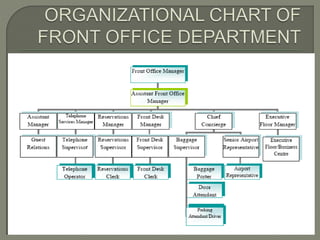
Reception (Front Desk Clerk, Front Office
Agent, Receptionist)
Reservations Clerk
Concierge
Bell (Porter)
Airport Representative
Telephone Operator
 Selling hotel rooms to the guests.
 Reserve rooms for guests prior to their arrival
 Register guests on arrival
 Assign rooms
 Coordinate with other departments as
housekeeping, maintenance, food and beverage
service etc.
 Control guest room keys
 Provide information about hotel and facilities
 Provide information about city, sightseeing etc
 Maintain accurate room status information
 Maintain guest accounts and settle bills accurately
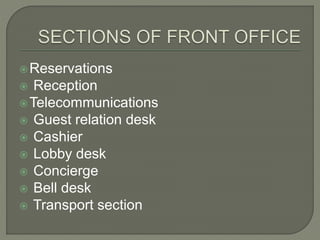
Reservations
 Reception
Telecommunications
 Guest relation desk
 Cashier
 Lobby desk
 Concierge
 Bell desk
 Transport section
 Book rooms in advance, through CRS(
central reservation system)
 Assist guests to choose the best rooms
suitable
 Up selling the rooms, if guests are booking
deluxe room , convince them to book suite
room.
 Process, properly document, store and
retrieve the booking/reservation information
for guest arrival and smooth check in
 To welcome the guest
 Complete registration , fill registration form, take
photocopy of valid ID like driving license, adhar
card, passport, visa etc.
 Check billing information, take advance payment
 After registration , allot room to the guests and
issue keys,
 Give information to guests about hotel facilities and
city , if required,
 Handle mail and messages of guests
 In smaller hotels also handle telephone, make bills
, take payment and settle bills
Handle telephone and telecom systems
 Internal as well a external calls handling
Give information about the hotel and hotel
services to the future guests on phone
Guest relation executive ensures comfort
and convenience of guests.
Take care of VIP arrivals and amenities
Maintain guest history cards manually/
electronically.
 Take guest feedback on guest comment
card.
Maintain guest accounts during his stay.
Monitor credit limit of guests.
 Prepare and Settle bills by cash / credit ,
then only guest can check out
 Maintain a cash bank for small
expenditures
 Provide foreign currency exchange
services to the foreigners.
Smooth movement of guest luggage and
baggages on arrival and departure
Fill errand cards
On arrival of guests, after allotment of
room number, put a tag on guest luggage
Handle left luggage
Distribution of newspapers
Maintain the first aid kid and assist
Provide information to guests about the
city, its places of tourist interest,
sightseeing.
 Plan tour and make a schedule/ itenary for
the guest
Book taxi for local sight seeing or
excursions.
Book rail , air, ticket, transportation on the
guest request.
Equipment means computers, telephone, fax,
machine, intercom, reception counter, stapler,
photo copy machine, credit card validator,
calculator, daily miscellaneous supplies( like
pen, pencil, paper, rubber, fevi stick, white
tape, voucher etc.), chairs, tables and similar
items used in the operation of an establishment.
Front office equipments are classified as
follows:
Manual Equipments( Non-Automated)
Mechanical Equipments( Semi and fully
automated)
Room Rack
 A card index system that is constantly updated to
reflect occupied and vacant rooms.
 In the evening, the room rack contains forms for
only those registered guests who are remaining for
the night and to be charged for the rooms.
 A daily room report can be prepared from the
room rack.
 Some other information are as follows:
 Room is board with a drop pocket for each guest
room bearing the corresponding room number.
Its purpose is to provide a visible index of the
exact status of each guest room as regards
present and future occupancy, as well as
anticipate daily movements.
For each hotel room there is a separate pocket
bearing the room number on it.
The various status of room indicates by
different colour of strips which are inserted in
the pocket of the room rack.
It is a rack which presents the visible
alphabetic index of guest name; it is also
called as “Alphabetical Index” which
consists of two removable pockets.
All the information relating to guest can be
obtained at a glance at one place like:
Name of the guest
Room number and type of room occupied
Date and time of arrival and expected
departures
Number of person in a room
Billing
It is easy to handle the enquiry regarding
any guest and track out the various in-
house hotel guest with the of information
rack.
Usually it is a wooden rack with various
pigeonholes which are used to store various in-
house guest mails and messages.
After the guest mail is separated, it is directly
sent to the in-house guest rooms, if he/she is
not present in the room , it is placed in the
room rack against his/her room number.
If the mail is for the expected guest it is
attached with the reservation or registration
card.
It is usually in the form of wooden frame
work and containing an array of slots in
which the various guest rooms are kept in
sequential order.
The front desk maintains key rack where
metal or hard keys are used. Now a day,
Electronic Key are mostly used which kept
secretly.
The folio well or bucket is device that holds
the individual guest folio and city ledger.
It contains large number of slots where the
folios are arranged in sequence according
to the room number.
It also helps in avoiding the problem of
mixing of various folios (because there is
separate slot for separate rooms).
 Now a day, it is widely used equipment or
machine, which executes a program, stored in its
memory to process data fed to it and produces the
desired results.
 It systematically store and quickly retrieve the data.
 It assists in all the task of front office like
reservation, guest billing, making various reports
etc.
 More instructions are carried out obediently without
asking any question.
 Instructions are carried out without any mistakes.
 Fax machine is an equipment for facsimile
reproduction via telephone line.
 The full form of FAX is “Facsimile Automated
Xerox” machine.
 While sending any message through the fax
machine, the operator has to check the status of
destination fax machine (it is on or off with the
help of call ring) then insert the message slip in
the machine , the copy of original message slip is
automatically produced by the destination fax
machine.
 A system that is part of telephone that prices
telephone calls made by hotel guests and
sends the information to the property
management system(pms) for billing.
 It is widely known as Electronic Private
Automated Branch Exchange ( EPABX ). It
automatically traced the and prepare the bill
of all out- going calls made by the guest.
 The device is fully computerized telephone
system, so there are fewer chances of wrong
practices by the staff.
The NCR machine is used to transfer or
recording different types of accounts like
posting transactions into guest’s weekly
bills and recording the daily sales.
It is usually used in large accommodation
establishment where the guest turnover is
maximum and many bills are prepared on
the daily basis or shift basis.
It is operated manually, so the chances of
mistakes are more.
 It is semi- automatic or non-automated front office
device that is used to give alarm to the guest to
awakened the guest at their requested time with the
aid of telephone.
 There are two types of wake up device, i.e.:
Semi or Non- Automated: The staffs give the wake-up.
Guest request for wake- up call is recorded in a wake
up sheet or register along with guest name, room
number, wake- up call time.
Fully Automated: The telephone exchange
automatically place the wake- up call request of the
guest with the aid of Automatic Voice Recorder.
Traditional equipments that are hardly to find
in today’s hotel industry especially in front
office.
It is semi-automatic equipment that is used to
prepare various documents related to the front
office operations like:
1.Preparing reservation confirmation letter
2.Guest registration card and
3.Other word processing jobs of the front office
Computerized system that retails outlets such
as restaurants, gift shops, etc, used to enter
orders and maintaining various accounting
information.
The POS generally interfaces with the property
management system (PMS).
A computerized front desk system that
manages hotel room inventory, guest billing
and interfaces with various other systems other
than telephone, call accounting, point of sale
(POS),entertainment, etc.
A rooms division manager has the following duties:
 Responsible for the supervision of employees
engaged in the operation of the front areas of the
hotel
 Coordinates with other departments in the hotel
and maintains open communications with them to
find better ways to serve the guests
 Maintains responsibility for staffing, purchasing,
and budgeting
 Supervises the rooms division payroll, availability
controls, and monthly plans
 Creates plans to maximize the average daily
rate and percentage of occupancy.
 Handles customer complaints and
suggestions.
 Stays up to date with events taking place in
the market, in market segments, and in the
competition.
 Rooms division manager’s knowledge
includes a complete understanding of hotel
operations, specifically those operations
involving the front office, housekeeping and
basic accounting procedures.
 It is the basic function of the front office
manager to directly supervise the front desk,
reservations, concierge and PABX.
 He/She is also assists the rooms division
manager in compiling information for reports.
 Assists in the training and cross-training of
front office employees.
 Prepares monthly reports.
 Assists the rooms division manager in
formulation and implementation of front office
policies and procedures.
 Reviews and approves all room moves and
room rate changes to ensure they were
necessary
 Handles guest complaints and follows them
up to reduce future complaints
 Assists the rooms division manager in
forecasting room availability to ensure that
the optimal level of occupancy is attained.
 Is available to work in the front office area
where there may be a shortage of staff.
 Maintains the necessary stock of supplies in
all front office areas, while controlling costs in
these areas
The front desk supervisor performs thefollowing duties:
 It is the front desk supervisor’s basic function to directly
supervise the front desk procedures that include check-in
and check-out.
 Trains and cross-trains front desk personnel in the tasks
of registration, mail handling, information services, and
check-in and checkout procedures.
 Regulates the service given in the front desk
 Acts as a liaison between the guests and management,
particularly with regard to problem-solving activities
 Is responsible for seeing that daily and hourly computer
reports are run and distributed
 Assigns VIP rooms to ensure guest satisfaction
 Resolves room discrepancy report
Prepares the weekly/monthly schedule of
employees
Assist the group coordinator with all group
arrivals, either directly or through the
delegation of this duty to other front desk
staff
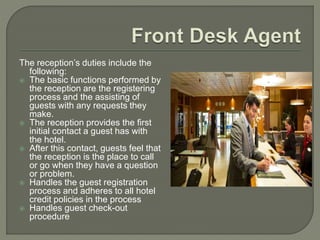
The reception’s duties include the
following:
 The basic functions performed by
the reception are the registering
process and the assisting of
guests with any requests they
make.
 The reception provides the first
initial contact a guest has with
the hotel.
 After this contact, guests feel that
the reception is the place to call
or go when they have a question
or problem.
 Handles the guest registration
process and adheres to all hotel
credit policies in the process
 Handles guest check-out
procedure
• Handles guest mail and reservations when the reservations
department is closed
• Always answers the front desk phone with three rings or
less
• Attempts to sell up guest rooms, and informs and sells the
guest on all hotel services and facilities
• Is aware of all daily events in the hotel and local area
• Coordinates room status updates with housekeeping
department
• Ensure completion of guest registration card
• Identifies guests’ length of stay requirement
• Coordinates maintenance work with the engineering and
maintenance division
• Maintains guestroom key storage
 The reservations manager’s basic functions are to supervise
and oversee all the operations of the reservations area.
 He or she must assure that all reservations, both group and
individual, are recorded and followed up on as necessary.
 Making sure proper telephone etiquette is used and correct
information is being given to potential guest
 Being sure that personal service is stressed and that sales
techniques are being used appropriately
 Following up on tentative booking, watching cut-off dates, and
monitoring group tour business accounts blocks for productivity
 Training reservation agents and setting up cross-training
programs
 Reviewing all VIP reservations and working with the rooms
division manager and the front office manager on assignments
OPreparing and distributing reports to
concerned departments a weekly, monthly
reservations and revenue forecast
OHandling requests for reservation information
and room rates
ODeveloping and maintaining a solid working
relationship with the central reservations office
and travel agents
Duties performed by reservations clerk
includes:
• Answering all reservation phone calls, taking
reservations, and dealing with reservations
correspondence.
• Dealing with group bookings such as
cancellations, changes, and rooming lists
• Checking to see that all equipment is working
properly and that the needed amount of supplies
is on hand
• Conducting telemarketing under the direction of
the director of sales and marketing
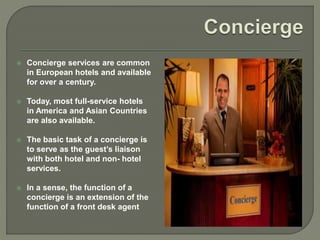
 Concierge services are common
in European hotels and available
for over a century.
 Today, most full-service hotels
in America and Asian Countries
are also available.
 The basic task of a concierge is
to serve as the guest’s liaison
with both hotel and non- hotel
services.
 In a sense, the function of a
concierge is an extension of the
function of a front desk agent
 Typical guest requests handled by
a concierge include:
• Providing directions and
information
• Making airplane, theater, train
ticket
• Reservations for dining
• Arranging for secretarial
services
• Handling mail and parcel
services
• Arranging sightseeing tours
• Transportation arrangement
• Limousine services
 A concierge must be resourceful
and knowledgeable about the
hotel and the surrounding
community. Regardless of
whether concern in-hotel or off-
premises attractions, facilities,
services, or activities, a
concierge specializes in
providing assistance to guests.
 Assist during the time of departure of the guests.
 Greet hotel guests at airport
 Arrange taxis from airport
 Take hotel bookings
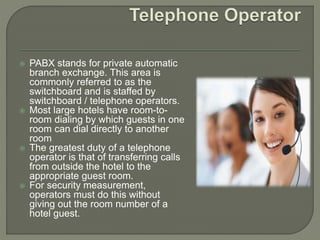
 PABX stands for private automatic
branch exchange. This area is
commonly referred to as the
switchboard and is staffed by
switchboard / telephone operators.
 Most large hotels have room-to-
room dialing by which guests in one
room can dial directly to another
room
 The greatest duty of a telephone
operator is that of transferring calls
from outside the hotel to the
appropriate guest room.
 For security measurement,
operators must do this without
giving out the room number of a
hotel guest.
 Answers incoming calls.
 Directs calls to guestrooms through the switchboard /
PABX system.
 Provides information on guest services
 Processes guest wake-up calls
 Answers inquiries about hotel facilities and events
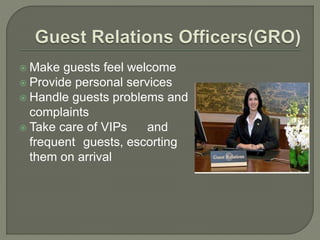
 Make guests feel welcome
 Provide personal services
 Handle guests problems and
complaints
 Take care of VIPs and
frequent guests, escorting
them on arrival
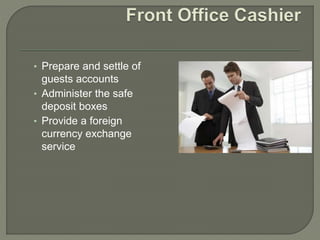
• Prepare and settle of
guests accounts
• Administer the safe
deposit boxes
• Provide a foreign
currency exchange
service
• Checking and completion of guest and hotel
accounts, audit revenue and payments
• Producing statistics, room tax posted and
summaries of revenue , reports record, track
occupancy percentage
BHAVVESH JOSHI
ASSISTANT PROFESSOR
BHIKAJI CAMA COLLEGE OF HOTEL
MANAGEMENT
SWAMI VIVEKANAND SUBHARTI UNIVERSITY

Front office organization

  • 2.
     The structureof the rooms division will vary from hotel to hotel.  These variations can be caused by differences in the size of hotels, the types and level of services, and the organization preferences of management.  The major departments in the rooms division are front office and housekeeping. A few hotel may also include security.  These departments come under the control of the Rooms Division Manager or Director of rooms.
  • 3.
     The frontoffice is the nerve centre of hotel operations  Hotel personnel are there to serve guests  An important aspect of this is providing a good first impression of the establishment to guests.  People are involved in serving guests are : Reception (Front Desk Clerk, Front Office Agent, Receptionist) Reservations Clerk Concierge Bell (Porter) Airport Representative Telephone Operator
  • 4.
     Selling hotelrooms to the guests.  Reserve rooms for guests prior to their arrival  Register guests on arrival  Assign rooms  Coordinate with other departments as housekeeping, maintenance, food and beverage service etc.  Control guest room keys  Provide information about hotel and facilities  Provide information about city, sightseeing etc  Maintain accurate room status information  Maintain guest accounts and settle bills accurately
  • 5.
    Reservations  Reception Telecommunications  Guestrelation desk  Cashier  Lobby desk  Concierge  Bell desk  Transport section
  • 6.
     Book roomsin advance, through CRS( central reservation system)  Assist guests to choose the best rooms suitable  Up selling the rooms, if guests are booking deluxe room , convince them to book suite room.  Process, properly document, store and retrieve the booking/reservation information for guest arrival and smooth check in
  • 7.
     To welcomethe guest  Complete registration , fill registration form, take photocopy of valid ID like driving license, adhar card, passport, visa etc.  Check billing information, take advance payment  After registration , allot room to the guests and issue keys,  Give information to guests about hotel facilities and city , if required,  Handle mail and messages of guests  In smaller hotels also handle telephone, make bills , take payment and settle bills
  • 8.
    Handle telephone andtelecom systems  Internal as well a external calls handling Give information about the hotel and hotel services to the future guests on phone
  • 9.
    Guest relation executiveensures comfort and convenience of guests. Take care of VIP arrivals and amenities Maintain guest history cards manually/ electronically.  Take guest feedback on guest comment card.
  • 10.
    Maintain guest accountsduring his stay. Monitor credit limit of guests.  Prepare and Settle bills by cash / credit , then only guest can check out  Maintain a cash bank for small expenditures  Provide foreign currency exchange services to the foreigners.
  • 11.
    Smooth movement ofguest luggage and baggages on arrival and departure Fill errand cards On arrival of guests, after allotment of room number, put a tag on guest luggage Handle left luggage Distribution of newspapers Maintain the first aid kid and assist
  • 12.
    Provide information toguests about the city, its places of tourist interest, sightseeing.  Plan tour and make a schedule/ itenary for the guest Book taxi for local sight seeing or excursions. Book rail , air, ticket, transportation on the guest request.
  • 14.
    Equipment means computers,telephone, fax, machine, intercom, reception counter, stapler, photo copy machine, credit card validator, calculator, daily miscellaneous supplies( like pen, pencil, paper, rubber, fevi stick, white tape, voucher etc.), chairs, tables and similar items used in the operation of an establishment.
  • 15.
    Front office equipmentsare classified as follows: Manual Equipments( Non-Automated) Mechanical Equipments( Semi and fully automated)
  • 16.
    Room Rack  Acard index system that is constantly updated to reflect occupied and vacant rooms.  In the evening, the room rack contains forms for only those registered guests who are remaining for the night and to be charged for the rooms.  A daily room report can be prepared from the room rack.  Some other information are as follows:  Room is board with a drop pocket for each guest room bearing the corresponding room number.
  • 17.
    Its purpose isto provide a visible index of the exact status of each guest room as regards present and future occupancy, as well as anticipate daily movements. For each hotel room there is a separate pocket bearing the room number on it. The various status of room indicates by different colour of strips which are inserted in the pocket of the room rack.
  • 18.
    It is arack which presents the visible alphabetic index of guest name; it is also called as “Alphabetical Index” which consists of two removable pockets. All the information relating to guest can be obtained at a glance at one place like: Name of the guest Room number and type of room occupied
  • 19.
    Date and timeof arrival and expected departures Number of person in a room Billing It is easy to handle the enquiry regarding any guest and track out the various in- house hotel guest with the of information rack.
  • 20.
    Usually it isa wooden rack with various pigeonholes which are used to store various in- house guest mails and messages. After the guest mail is separated, it is directly sent to the in-house guest rooms, if he/she is not present in the room , it is placed in the room rack against his/her room number. If the mail is for the expected guest it is attached with the reservation or registration card.
  • 21.
    It is usuallyin the form of wooden frame work and containing an array of slots in which the various guest rooms are kept in sequential order. The front desk maintains key rack where metal or hard keys are used. Now a day, Electronic Key are mostly used which kept secretly.
  • 22.
    The folio wellor bucket is device that holds the individual guest folio and city ledger. It contains large number of slots where the folios are arranged in sequence according to the room number. It also helps in avoiding the problem of mixing of various folios (because there is separate slot for separate rooms).
  • 24.
     Now aday, it is widely used equipment or machine, which executes a program, stored in its memory to process data fed to it and produces the desired results.  It systematically store and quickly retrieve the data.  It assists in all the task of front office like reservation, guest billing, making various reports etc.  More instructions are carried out obediently without asking any question.  Instructions are carried out without any mistakes.
  • 25.
     Fax machineis an equipment for facsimile reproduction via telephone line.  The full form of FAX is “Facsimile Automated Xerox” machine.  While sending any message through the fax machine, the operator has to check the status of destination fax machine (it is on or off with the help of call ring) then insert the message slip in the machine , the copy of original message slip is automatically produced by the destination fax machine.
  • 26.
     A systemthat is part of telephone that prices telephone calls made by hotel guests and sends the information to the property management system(pms) for billing.  It is widely known as Electronic Private Automated Branch Exchange ( EPABX ). It automatically traced the and prepare the bill of all out- going calls made by the guest.  The device is fully computerized telephone system, so there are fewer chances of wrong practices by the staff.
  • 27.
    The NCR machineis used to transfer or recording different types of accounts like posting transactions into guest’s weekly bills and recording the daily sales. It is usually used in large accommodation establishment where the guest turnover is maximum and many bills are prepared on the daily basis or shift basis. It is operated manually, so the chances of mistakes are more.
  • 28.
     It issemi- automatic or non-automated front office device that is used to give alarm to the guest to awakened the guest at their requested time with the aid of telephone.  There are two types of wake up device, i.e.: Semi or Non- Automated: The staffs give the wake-up. Guest request for wake- up call is recorded in a wake up sheet or register along with guest name, room number, wake- up call time. Fully Automated: The telephone exchange automatically place the wake- up call request of the guest with the aid of Automatic Voice Recorder.
  • 29.
    Traditional equipments thatare hardly to find in today’s hotel industry especially in front office. It is semi-automatic equipment that is used to prepare various documents related to the front office operations like: 1.Preparing reservation confirmation letter 2.Guest registration card and 3.Other word processing jobs of the front office
  • 30.
    Computerized system thatretails outlets such as restaurants, gift shops, etc, used to enter orders and maintaining various accounting information. The POS generally interfaces with the property management system (PMS).
  • 31.
    A computerized frontdesk system that manages hotel room inventory, guest billing and interfaces with various other systems other than telephone, call accounting, point of sale (POS),entertainment, etc.
  • 34.
    A rooms divisionmanager has the following duties:  Responsible for the supervision of employees engaged in the operation of the front areas of the hotel  Coordinates with other departments in the hotel and maintains open communications with them to find better ways to serve the guests  Maintains responsibility for staffing, purchasing, and budgeting  Supervises the rooms division payroll, availability controls, and monthly plans
  • 35.
     Creates plansto maximize the average daily rate and percentage of occupancy.  Handles customer complaints and suggestions.  Stays up to date with events taking place in the market, in market segments, and in the competition.  Rooms division manager’s knowledge includes a complete understanding of hotel operations, specifically those operations involving the front office, housekeeping and basic accounting procedures.
  • 36.
     It isthe basic function of the front office manager to directly supervise the front desk, reservations, concierge and PABX.  He/She is also assists the rooms division manager in compiling information for reports.  Assists in the training and cross-training of front office employees.  Prepares monthly reports.  Assists the rooms division manager in formulation and implementation of front office policies and procedures.
  • 37.
     Reviews andapproves all room moves and room rate changes to ensure they were necessary  Handles guest complaints and follows them up to reduce future complaints  Assists the rooms division manager in forecasting room availability to ensure that the optimal level of occupancy is attained.  Is available to work in the front office area where there may be a shortage of staff.  Maintains the necessary stock of supplies in all front office areas, while controlling costs in these areas
  • 38.
    The front desksupervisor performs thefollowing duties:  It is the front desk supervisor’s basic function to directly supervise the front desk procedures that include check-in and check-out.  Trains and cross-trains front desk personnel in the tasks of registration, mail handling, information services, and check-in and checkout procedures.  Regulates the service given in the front desk  Acts as a liaison between the guests and management, particularly with regard to problem-solving activities  Is responsible for seeing that daily and hourly computer reports are run and distributed  Assigns VIP rooms to ensure guest satisfaction  Resolves room discrepancy report
  • 39.
    Prepares the weekly/monthlyschedule of employees Assist the group coordinator with all group arrivals, either directly or through the delegation of this duty to other front desk staff
  • 40.
    The reception’s dutiesinclude the following:  The basic functions performed by the reception are the registering process and the assisting of guests with any requests they make.  The reception provides the first initial contact a guest has with the hotel.  After this contact, guests feel that the reception is the place to call or go when they have a question or problem.  Handles the guest registration process and adheres to all hotel credit policies in the process  Handles guest check-out procedure
  • 41.
    • Handles guestmail and reservations when the reservations department is closed • Always answers the front desk phone with three rings or less • Attempts to sell up guest rooms, and informs and sells the guest on all hotel services and facilities • Is aware of all daily events in the hotel and local area • Coordinates room status updates with housekeeping department • Ensure completion of guest registration card • Identifies guests’ length of stay requirement • Coordinates maintenance work with the engineering and maintenance division • Maintains guestroom key storage
  • 42.
     The reservationsmanager’s basic functions are to supervise and oversee all the operations of the reservations area.  He or she must assure that all reservations, both group and individual, are recorded and followed up on as necessary.  Making sure proper telephone etiquette is used and correct information is being given to potential guest  Being sure that personal service is stressed and that sales techniques are being used appropriately  Following up on tentative booking, watching cut-off dates, and monitoring group tour business accounts blocks for productivity  Training reservation agents and setting up cross-training programs  Reviewing all VIP reservations and working with the rooms division manager and the front office manager on assignments
  • 43.
    OPreparing and distributingreports to concerned departments a weekly, monthly reservations and revenue forecast OHandling requests for reservation information and room rates ODeveloping and maintaining a solid working relationship with the central reservations office and travel agents
  • 44.
    Duties performed byreservations clerk includes: • Answering all reservation phone calls, taking reservations, and dealing with reservations correspondence. • Dealing with group bookings such as cancellations, changes, and rooming lists • Checking to see that all equipment is working properly and that the needed amount of supplies is on hand • Conducting telemarketing under the direction of the director of sales and marketing
  • 45.
     Concierge servicesare common in European hotels and available for over a century.  Today, most full-service hotels in America and Asian Countries are also available.  The basic task of a concierge is to serve as the guest’s liaison with both hotel and non- hotel services.  In a sense, the function of a concierge is an extension of the function of a front desk agent
  • 46.
     Typical guestrequests handled by a concierge include: • Providing directions and information • Making airplane, theater, train ticket • Reservations for dining • Arranging for secretarial services • Handling mail and parcel services • Arranging sightseeing tours • Transportation arrangement • Limousine services  A concierge must be resourceful and knowledgeable about the hotel and the surrounding community. Regardless of whether concern in-hotel or off- premises attractions, facilities, services, or activities, a concierge specializes in providing assistance to guests.
  • 47.
     Assist duringthe time of departure of the guests.  Greet hotel guests at airport  Arrange taxis from airport  Take hotel bookings
  • 48.
     PABX standsfor private automatic branch exchange. This area is commonly referred to as the switchboard and is staffed by switchboard / telephone operators.  Most large hotels have room-to- room dialing by which guests in one room can dial directly to another room  The greatest duty of a telephone operator is that of transferring calls from outside the hotel to the appropriate guest room.  For security measurement, operators must do this without giving out the room number of a hotel guest.
  • 49.
     Answers incomingcalls.  Directs calls to guestrooms through the switchboard / PABX system.  Provides information on guest services  Processes guest wake-up calls  Answers inquiries about hotel facilities and events
  • 50.
     Make guestsfeel welcome  Provide personal services  Handle guests problems and complaints  Take care of VIPs and frequent guests, escorting them on arrival
  • 51.
    • Prepare andsettle of guests accounts • Administer the safe deposit boxes • Provide a foreign currency exchange service
  • 52.
    • Checking andcompletion of guest and hotel accounts, audit revenue and payments • Producing statistics, room tax posted and summaries of revenue , reports record, track occupancy percentage
  • 53.
    BHAVVESH JOSHI ASSISTANT PROFESSOR BHIKAJICAMA COLLEGE OF HOTEL MANAGEMENT SWAMI VIVEKANAND SUBHARTI UNIVERSITY