PHYSIOLOGY
EDETH NOVIA TUBAL
OF AQUATIC
ORGANISMS
FISH 1 (3 UNITS)
PHYSIOLOGY OF A FISH
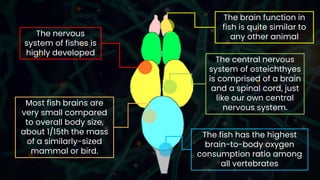
The nervous
system of fishes is
highly developed
Most fish brains are
very small compared
to overall body size,
about 1/15th the mass
of a similarly-sized
mammal or bird.
The brain function in
fish is quite similar to
any other animal
The central nervous
system of osteichthyes
is comprised of a brain
and a spinal cord, just
like our own central
nervous system.
The fish has the highest
brain-to-body oxygen
consumption ratio among
all vertebrates
SIGNS OF INTELLIGENCE IN FISH
1. THEY ARE SMART
-Published Article: “Adult Cleaner Wrasse Outperform
Capuchin Monkeys, Chimpanzees and Orangutans in a
Complex Foraging Task Derived from Cleaner – Client
Reef Fish Cooperation”
2. THEY HAVE A MEMORY
- In an experiment, goldfish could remember a food
dispenser’s color even after a year of not seeing it
- A Red Clownfish can recognize its mate after being
separated for 30 days
CLEANER WRASSE
SIGNS OF INTELLIGENCE IN FISH
3. THEY CAN FEEL PAIN
- fish possess nerves called “pain receptors” that convey pain.
- In an experiment, fish were injected with acetic acid or bee
venom on the lips. They began rubbing their lips to the
aquarium corners or gravel and breathing faster.
4. THEY CAN FEEL STRESS
- fluctuations in water parameters and many other factors
can stress fish out and will lead to diseases
- They usually exhibit odd swimming, change in physical
appearance, anorexia and etc.
SIGNS OF INTELLIGENCE IN FISH
5. THEY EXHIBIT SOCIAL INTELLIGENCE
- the fish who live in a community and social group can
identify each other.
- Some fish such as Fighting Fish shows territorial behavior
6. THEY EXHIBIT DECEPTION
- Some fish can be deceptive and trick other fish, especially
their predators
- Some exhibit camouflage such as Stonefish and etc.
STONE FISH
SIGNS OF INTELLIGENCE IN FISH
7. THEY USE THEIR BODY AS TOOLS
- Some fishes use their body parts as tools for their feeding.
For example, some Wrasse species can hold bivalves or sea
urchins with their mouths while banging them against rocks
to break them up.
- Many fish can build nests on their own by excavating and
drilling into the sand or piling up sand and coral pieces to
make a mound.
BLUE SPOT JAWFISH
SIGNS OF INTELLIGENCE IN FISH
8. THEY COMMUNICATE WITH EACH
OTHER
- For attracting mates, scaring off predators or orienting
themselves. (https://www.youtube.com/watch?v=p1PID91sEW8)
- Fish communicate by gesture and motion or low-frequency
sounds like squeaks and squeals
- Some species use electrical pulses as signals or
bioluminescence
- Some kinds of fish also release chemicals that can be
sensed by smell or taste.
SIGNS OF INTELLIGENCE IN FISH
9. THEY EXHIBIT COOPERATION
- Fish evolved to swim in schools to better protect themselves
from predators, improve their foraging and swim more
efficiently.
- schooling requires coordinated body positions and
synchronized movement.
- Many fish species will call each other for help when they
want to attack their prey.
BLUE SPOT JAWFISH
SIGNS OF INTELLIGENCE IN FISH
10. THEY PLAY
- For example, when cichlids see a bouncy ball or a floating
thermometer, they start playing with it to make it wobble.
11. SOME CAN RECOGNIZE HUMAN FACE
- Scientists from the University of Oxford in the UK and the
University of Queensland in Australia who analyzed a species
called archerfish found that, when they're kept as pets, they
can tell a familiar face from dozens of new faces with
surprising accuracy.
ARCHERFISH
SIGNS OF INTELLIGENCE IN FISH
12. THEY HAVE EMOTIONS
- For example, zebrafishes have something called “Emotional
Fever”, which is a physical fever triggered by a stressful situation.
Their body temperature increases 2 to 4°C when they were left in
confinement during short periods.
13. SOME ARE THOUGHTFUL PARENTS
- Some species exhibit parental care wherein they take care of
their young until they hatch or grow
- For example, oral breeding in Tilapia and the paternal care
of male Seahorse
ZEBRAFISH
MOUTHBROODING
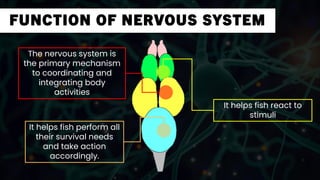
The nervous system is
the primary mechanism
to coordinating and
integrating body
activities
It helps fish perform all
their survival needs
and take action
accordingly.
It helps fish react to
stimuli
FUNCTION OF NERVOUS SYSTEM
PREDATOR
Eyes (which is a
sensory organ)
sees a predator
The brain will interpret
this information
FISH WILL
MOVE AWAY
FROM THE
PREDATOR
3
DIVISION
OF
NERVOUS
SYSTEM
1. CENTRAL
NERVOUS
SYTEM
2. PERIPHERAL
NERVOUS
SYTEM
3. AUTONOMIC
NERVOUS
SYTEM
BRAIN
SPINAL CORD
CRANIAL
NERVES
SPINAL
NERVES
SYMPATHETIC
PARASYMPA-
THETIC
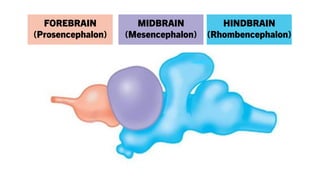
FOREBRAIN
MIDBRAIN
HINDBRAIN
3
DIVISION
OF
NERVOUS
SYSTEM
1. CENTRAL NERVOUS SYTEM
- It consists of BRAIN and SPINAL CORD
- It is the primary integrating mechanism
of the fish
- The ultra structure of CNS of fish is similar
to all vertebrates
3
DIVISION
OF
NERVOUS
SYSTEM
1. CENTRAL NERVOUS SYTEM
A. BRAIN
- It is a complex organ that controls thought, memory,
emotion, touch motor skills, vision, breathing, hunger
temperature, and every process that regulates our
body
- It is a soft and delicate organ protected by the bones
of the skull.
- It never fills the entire cavity of the skull; remaining
space is filled with gelatinous mass, generally fat
- It receives and interprets information from sense
organs that monitor conditions both within and
around the fish, then sends response commands to
the body.
3
DIVISION
OF
NERVOUS
SYSTEM
BRAIN
FOREBRAIN
(Prosencephalon)
MIDBRAIN
(Mesencephalon)
HINDBRAIN
(Rhombencephalon)
Telencephalon
Diencephalon
CEREBELLUM
(Metencephalon)
MEDULLA
OBLONGATA
(Myencephalon)
1. CENTRAL NERVOUS SYTEM
FOREBRAIN
(Prosencephalon)
MIDBRAIN
(Mesencephalon)
HINDBRAIN
(Rhombencephalon)
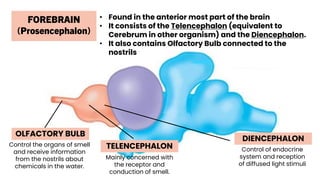
• Found in the anterior most part of the brain
• It consists of the Telencephalon (equivalent to
Cerebrum in other organism) and the Diencephalon.
• It also contains Olfactory Bulb connected to the
nostrils
FOREBRAIN
(Prosencephalon)
TELENCEPHALON
DIENCEPHALON
OLFACTORY BULB
Mainly concerned with
the receptor and
conduction of smell.
Control of endocrine
system and reception
of diffused light stimuli
Control the organs of smell
and receive information
from the nostrils about
chemicals in the water.
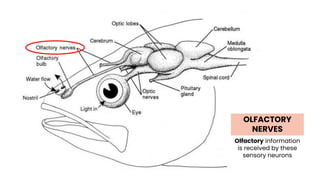
OLFACTORY
NERVES
Olfactory information
is received by these
sensory neurons
• Relatively large
• Its main function is image processing
• It consists of two Optic Lobe
OPTIC LOBE
Control the vision and is
associated with
reception
MIDBRAIN
(Mesencephalon)
OPTIC NERVES
Large nerves the
connect optic lobe to
the eyes
• Lower most region of the brain
• It consists of Cerebellum (Metencephalon) and
Medulla Oblongata (Myencephalon)
CEREBELLUM
Maintain body posture
in swimming by
coordinating
musculature activities
HINDBRAIN
(Mesencephalon)
MEDULLA OBLONGATA
It connects the brain to the spinal cord. One of
its functions is to control the flow of hormones in
the fish. It also controls the heart, the smooth
muscles of the internal organs, and the
rhythmic contraction of gill muscles in
respiration.
3
DIVISION
OF
NERVOUS
SYSTEM
1. CENTRAL NERVOUS SYTEM
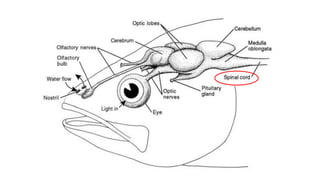
B. SPINAL CORD
- Runs through holes in the vertebrae and acts
like a communication wire.
- Composed of long nerve fibers
- It carries nerve impulses to sensory receptors
in the brain and transmits nerve impulses
from the brain to the muscles, glands, and
other tissues.
3
DIVISION
OF
NERVOUS
SYSTEM
2. PERIPHERAL NERVOUS SYTEM
- It is the network of nerves that connect
muscles and sensory organs to the central
nervous system.
- It is consist of:
A. SPINAL NERVES
- Nerves originated from the spinal cord
- Its use for muscle contraction and gland
secretion
3
DIVISION
OF
NERVOUS
SYSTEM
2. PERIPHERAL NERVOUS SYTEM
B. CRANIAL NERVES
- the nerves that originated from the brain
or brain stem.
- it can be:
1. SENSORY NERVE (carry signals to your brain
to help you touch, taste, smell and see)
2. MOTOR NERVE (carry signals to your muscles
or glands to help you move and function)
- there are ten pairs of cranial nerves
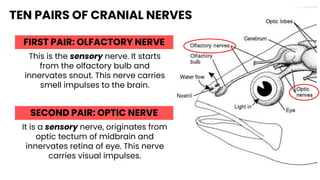
TEN PAIRS OF CRANIAL NERVES
FIRST PAIR: OLFACTORY NERVE
This is the sensory nerve. It starts
from the olfactory bulb and
innervates snout. This nerve carries
smell impulses to the brain.
SECOND PAIR: OPTIC NERVE
It is a sensory nerve, originates from
optic tectum of midbrain and
innervates retina of eye. This nerve
carries visual impulses.
TEN PAIRS OF CRANIAL NERVES
THIRD PAIR: OCULOMOTOR
It arises from optic tectum of
midbrain and supplies to superior,
inferior, anterior, rectus and inferior
oblique muscles of eyeball. It is
somatic motor nerve.
FOURTH PAIR: TROCHLEAR
Trochlear arises from dorso
lateral side of mid brain and
innervates superior oblique
muscle of the eye ball. It is
somatic motor nerve.
TEN PAIRS OF CRANIAL NERVES
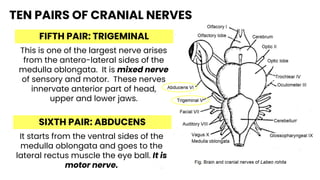
FIFTH PAIR: TRIGEMINAL
This is one of the largest nerve arises
from the antero-lateral sides of the
medulla oblongata. It is mixed nerve
of sensory and motor. These nerves
innervate anterior part of head,
upper and lower jaws.
SIXTH PAIR: ABDUCENS
It starts from the ventral sides of the
medulla oblongata and goes to the
lateral rectus muscle the eye ball. It is
motor nerve.
TEN PAIRS OF CRANIAL NERVES
SEVENTH PAIR: FACIAL
It arises from the sides of medulla
oblongata. It is truly mixed nerve and
divided into three branches, supra-orbital,
infra-orbital and the hyomandibular
EIGHTH PAIR: AUDITORY
It originates from sides of medulla and
runs behind the facial. It has two
branches which are both sensory:
1. Vestibular nerve - goes to utricular
and ampullae of internal ear.
2. Saccular nerve - goes to sacculus and
lagena.
TEN PAIRS OF CRANIAL NERVES
NINTH PAIR: GLOSSOPHARYNGEAL
It arises from the ventro-lateral side of
medulla oblongata. It is a mixed nerve and
supplies to the hyoid arch, muscles of first
gill slit and the taste bud.
TENTH PAIR: VAGUS
This is a mixed nerve, emerged from
medulla just behind the
glossopharyngeal. It divides into five
branches: (i) Supra-temporal branch;
(ii) Dorsal recurrent branch; (iii) Body
lateral line branch; (iv) Visceral branch;
and (v) Branchial branch.
3
DIVISION
OF
NERVOUS
SYSTEM
2. PERIPHERAL NERVOUS SYTEM
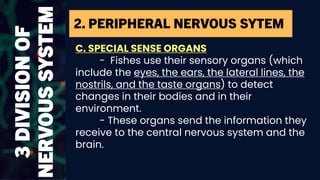
C. SPECIAL SENSE ORGANS
- Fishes use their sensory organs (which
include the eyes, the ears, the lateral lines, the
nostrils, and the taste organs) to detect
changes in their bodies and in their
environment.
- These organs send the information they
receive to the central nervous system and the
brain.
EYES
Each of these sense organs is equipped
with sensory nerve endings.
NOSTRILS LATERAL LINE
TASTE BUDS
INSIDE MOUTH
EAR FOUND
INSIDE ITS
HEAD
3
DIVISION
OF
NERVOUS
SYSTEM
3. AUTONOMIC NERVOUS SYTEM
- It is an involuntary nervous system and function
as a control
- It controls the:
1. aperture of iris
2. blood pressure
3. blood flow through gills for oxygenation
4. blood supply to various parts of the body
automatically
5. heart performance
6. gastric motility
7. function of swim bladder.
8. colour changes
3
DIVISION
OF
NERVOUS
SYSTEM
3. AUTONOMIC NERVOUS SYTEM
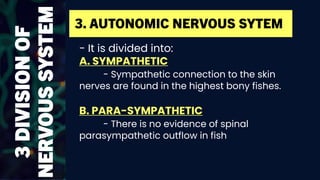
- It is divided into:
A. SYMPATHETIC
- Sympathetic connection to the skin
nerves are found in the highest bony fishes.
B. PARA-SYMPATHETIC
- There is no evidence of spinal
parasympathetic outflow in fish

FISH NERVOUS SYTEM.pdf

  • 1.
    PHYSIOLOGY EDETH NOVIA TUBAL OFAQUATIC ORGANISMS FISH 1 (3 UNITS)
  • 3.
  • 4.
    The nervous system offishes is highly developed Most fish brains are very small compared to overall body size, about 1/15th the mass of a similarly-sized mammal or bird. The brain function in fish is quite similar to any other animal The central nervous system of osteichthyes is comprised of a brain and a spinal cord, just like our own central nervous system. The fish has the highest brain-to-body oxygen consumption ratio among all vertebrates
  • 5.
    SIGNS OF INTELLIGENCEIN FISH 1. THEY ARE SMART -Published Article: “Adult Cleaner Wrasse Outperform Capuchin Monkeys, Chimpanzees and Orangutans in a Complex Foraging Task Derived from Cleaner – Client Reef Fish Cooperation” 2. THEY HAVE A MEMORY - In an experiment, goldfish could remember a food dispenser’s color even after a year of not seeing it - A Red Clownfish can recognize its mate after being separated for 30 days
  • 6.
  • 7.
    SIGNS OF INTELLIGENCEIN FISH 3. THEY CAN FEEL PAIN - fish possess nerves called “pain receptors” that convey pain. - In an experiment, fish were injected with acetic acid or bee venom on the lips. They began rubbing their lips to the aquarium corners or gravel and breathing faster. 4. THEY CAN FEEL STRESS - fluctuations in water parameters and many other factors can stress fish out and will lead to diseases - They usually exhibit odd swimming, change in physical appearance, anorexia and etc.
  • 8.
    SIGNS OF INTELLIGENCEIN FISH 5. THEY EXHIBIT SOCIAL INTELLIGENCE - the fish who live in a community and social group can identify each other. - Some fish such as Fighting Fish shows territorial behavior 6. THEY EXHIBIT DECEPTION - Some fish can be deceptive and trick other fish, especially their predators - Some exhibit camouflage such as Stonefish and etc.
  • 9.
  • 10.
    SIGNS OF INTELLIGENCEIN FISH 7. THEY USE THEIR BODY AS TOOLS - Some fishes use their body parts as tools for their feeding. For example, some Wrasse species can hold bivalves or sea urchins with their mouths while banging them against rocks to break them up. - Many fish can build nests on their own by excavating and drilling into the sand or piling up sand and coral pieces to make a mound.
  • 11.
  • 12.
    SIGNS OF INTELLIGENCEIN FISH 8. THEY COMMUNICATE WITH EACH OTHER - For attracting mates, scaring off predators or orienting themselves. (https://www.youtube.com/watch?v=p1PID91sEW8) - Fish communicate by gesture and motion or low-frequency sounds like squeaks and squeals - Some species use electrical pulses as signals or bioluminescence - Some kinds of fish also release chemicals that can be sensed by smell or taste.
  • 13.
    SIGNS OF INTELLIGENCEIN FISH 9. THEY EXHIBIT COOPERATION - Fish evolved to swim in schools to better protect themselves from predators, improve their foraging and swim more efficiently. - schooling requires coordinated body positions and synchronized movement. - Many fish species will call each other for help when they want to attack their prey.
  • 14.
  • 15.
    SIGNS OF INTELLIGENCEIN FISH 10. THEY PLAY - For example, when cichlids see a bouncy ball or a floating thermometer, they start playing with it to make it wobble. 11. SOME CAN RECOGNIZE HUMAN FACE - Scientists from the University of Oxford in the UK and the University of Queensland in Australia who analyzed a species called archerfish found that, when they're kept as pets, they can tell a familiar face from dozens of new faces with surprising accuracy.
  • 17.
  • 18.
    SIGNS OF INTELLIGENCEIN FISH 12. THEY HAVE EMOTIONS - For example, zebrafishes have something called “Emotional Fever”, which is a physical fever triggered by a stressful situation. Their body temperature increases 2 to 4°C when they were left in confinement during short periods. 13. SOME ARE THOUGHTFUL PARENTS - Some species exhibit parental care wherein they take care of their young until they hatch or grow - For example, oral breeding in Tilapia and the paternal care of male Seahorse
  • 19.
  • 20.
  • 21.
    The nervous systemis the primary mechanism to coordinating and integrating body activities It helps fish perform all their survival needs and take action accordingly. It helps fish react to stimuli FUNCTION OF NERVOUS SYSTEM
  • 22.
    PREDATOR Eyes (which isa sensory organ) sees a predator The brain will interpret this information FISH WILL MOVE AWAY FROM THE PREDATOR
  • 23.
    3 DIVISION OF NERVOUS SYSTEM 1. CENTRAL NERVOUS SYTEM 2. PERIPHERAL NERVOUS SYTEM 3.AUTONOMIC NERVOUS SYTEM BRAIN SPINAL CORD CRANIAL NERVES SPINAL NERVES SYMPATHETIC PARASYMPA- THETIC FOREBRAIN MIDBRAIN HINDBRAIN
  • 24.
    3 DIVISION OF NERVOUS SYSTEM 1. CENTRAL NERVOUSSYTEM - It consists of BRAIN and SPINAL CORD - It is the primary integrating mechanism of the fish - The ultra structure of CNS of fish is similar to all vertebrates
  • 25.
    3 DIVISION OF NERVOUS SYSTEM 1. CENTRAL NERVOUSSYTEM A. BRAIN - It is a complex organ that controls thought, memory, emotion, touch motor skills, vision, breathing, hunger temperature, and every process that regulates our body - It is a soft and delicate organ protected by the bones of the skull. - It never fills the entire cavity of the skull; remaining space is filled with gelatinous mass, generally fat - It receives and interprets information from sense organs that monitor conditions both within and around the fish, then sends response commands to the body.
  • 26.
  • 27.
  • 28.
    • Found inthe anterior most part of the brain • It consists of the Telencephalon (equivalent to Cerebrum in other organism) and the Diencephalon. • It also contains Olfactory Bulb connected to the nostrils FOREBRAIN (Prosencephalon) TELENCEPHALON DIENCEPHALON OLFACTORY BULB Mainly concerned with the receptor and conduction of smell. Control of endocrine system and reception of diffused light stimuli Control the organs of smell and receive information from the nostrils about chemicals in the water.
  • 29.
  • 30.
    • Relatively large •Its main function is image processing • It consists of two Optic Lobe OPTIC LOBE Control the vision and is associated with reception MIDBRAIN (Mesencephalon)
  • 31.
    OPTIC NERVES Large nervesthe connect optic lobe to the eyes
  • 32.
    • Lower mostregion of the brain • It consists of Cerebellum (Metencephalon) and Medulla Oblongata (Myencephalon) CEREBELLUM Maintain body posture in swimming by coordinating musculature activities HINDBRAIN (Mesencephalon) MEDULLA OBLONGATA It connects the brain to the spinal cord. One of its functions is to control the flow of hormones in the fish. It also controls the heart, the smooth muscles of the internal organs, and the rhythmic contraction of gill muscles in respiration.
  • 33.
    3 DIVISION OF NERVOUS SYSTEM 1. CENTRAL NERVOUSSYTEM B. SPINAL CORD - Runs through holes in the vertebrae and acts like a communication wire. - Composed of long nerve fibers - It carries nerve impulses to sensory receptors in the brain and transmits nerve impulses from the brain to the muscles, glands, and other tissues.
  • 35.
    3 DIVISION OF NERVOUS SYSTEM 2. PERIPHERAL NERVOUSSYTEM - It is the network of nerves that connect muscles and sensory organs to the central nervous system. - It is consist of: A. SPINAL NERVES - Nerves originated from the spinal cord - Its use for muscle contraction and gland secretion
  • 36.
    3 DIVISION OF NERVOUS SYSTEM 2. PERIPHERAL NERVOUSSYTEM B. CRANIAL NERVES - the nerves that originated from the brain or brain stem. - it can be: 1. SENSORY NERVE (carry signals to your brain to help you touch, taste, smell and see) 2. MOTOR NERVE (carry signals to your muscles or glands to help you move and function) - there are ten pairs of cranial nerves
  • 37.
    TEN PAIRS OFCRANIAL NERVES FIRST PAIR: OLFACTORY NERVE This is the sensory nerve. It starts from the olfactory bulb and innervates snout. This nerve carries smell impulses to the brain. SECOND PAIR: OPTIC NERVE It is a sensory nerve, originates from optic tectum of midbrain and innervates retina of eye. This nerve carries visual impulses.
  • 38.
    TEN PAIRS OFCRANIAL NERVES THIRD PAIR: OCULOMOTOR It arises from optic tectum of midbrain and supplies to superior, inferior, anterior, rectus and inferior oblique muscles of eyeball. It is somatic motor nerve. FOURTH PAIR: TROCHLEAR Trochlear arises from dorso lateral side of mid brain and innervates superior oblique muscle of the eye ball. It is somatic motor nerve.
  • 39.
    TEN PAIRS OFCRANIAL NERVES FIFTH PAIR: TRIGEMINAL This is one of the largest nerve arises from the antero-lateral sides of the medulla oblongata. It is mixed nerve of sensory and motor. These nerves innervate anterior part of head, upper and lower jaws. SIXTH PAIR: ABDUCENS It starts from the ventral sides of the medulla oblongata and goes to the lateral rectus muscle the eye ball. It is motor nerve.
  • 40.
    TEN PAIRS OFCRANIAL NERVES SEVENTH PAIR: FACIAL It arises from the sides of medulla oblongata. It is truly mixed nerve and divided into three branches, supra-orbital, infra-orbital and the hyomandibular EIGHTH PAIR: AUDITORY It originates from sides of medulla and runs behind the facial. It has two branches which are both sensory: 1. Vestibular nerve - goes to utricular and ampullae of internal ear. 2. Saccular nerve - goes to sacculus and lagena.
  • 41.
    TEN PAIRS OFCRANIAL NERVES NINTH PAIR: GLOSSOPHARYNGEAL It arises from the ventro-lateral side of medulla oblongata. It is a mixed nerve and supplies to the hyoid arch, muscles of first gill slit and the taste bud. TENTH PAIR: VAGUS This is a mixed nerve, emerged from medulla just behind the glossopharyngeal. It divides into five branches: (i) Supra-temporal branch; (ii) Dorsal recurrent branch; (iii) Body lateral line branch; (iv) Visceral branch; and (v) Branchial branch.
  • 42.
    3 DIVISION OF NERVOUS SYSTEM 2. PERIPHERAL NERVOUSSYTEM C. SPECIAL SENSE ORGANS - Fishes use their sensory organs (which include the eyes, the ears, the lateral lines, the nostrils, and the taste organs) to detect changes in their bodies and in their environment. - These organs send the information they receive to the central nervous system and the brain.
  • 43.
    EYES Each of thesesense organs is equipped with sensory nerve endings. NOSTRILS LATERAL LINE TASTE BUDS INSIDE MOUTH EAR FOUND INSIDE ITS HEAD
  • 44.
    3 DIVISION OF NERVOUS SYSTEM 3. AUTONOMIC NERVOUSSYTEM - It is an involuntary nervous system and function as a control - It controls the: 1. aperture of iris 2. blood pressure 3. blood flow through gills for oxygenation 4. blood supply to various parts of the body automatically 5. heart performance 6. gastric motility 7. function of swim bladder. 8. colour changes
  • 45.
    3 DIVISION OF NERVOUS SYSTEM 3. AUTONOMIC NERVOUSSYTEM - It is divided into: A. SYMPATHETIC - Sympathetic connection to the skin nerves are found in the highest bony fishes. B. PARA-SYMPATHETIC - There is no evidence of spinal parasympathetic outflow in fish