BIG Data
4 Layers Everyone Must
Know
There is still so much confusion
surrounding Big Data.
I thought it might help to clarify the 4
key layers of a big data system - i.e.
the different stages the data itself has
to pass through on its journey from raw
statistic or snippet of unstructured data
(for example, social media post) to
actionable insight.
The whole point of a big data strategy
is to develop a system which moves
data along this path – raw data to
actionable insights.
Here, I will attempt to define the basic
layers you will need to have in place, if
you are getting to grips with how big
data could help your business.
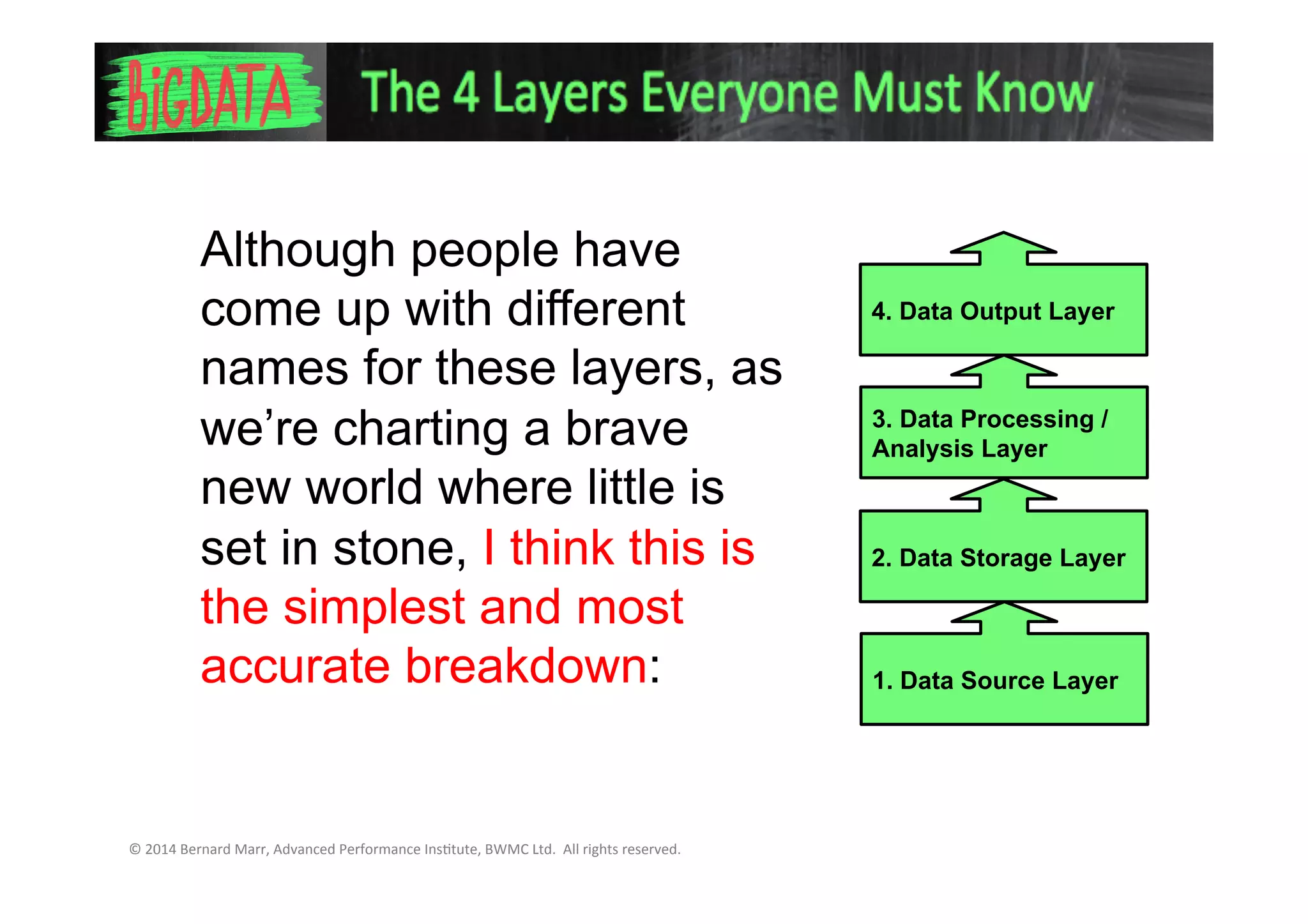
Although people have
come up with different
names for these layers,
as we’re charting a brave
new world where little is
set in stone, I think this is
the simplest and most
accurate breakdown:
1. Data Source Layer
3. Data Processing /
Analysis Layer
2. Data Storage Layer
4. Data Output Layer
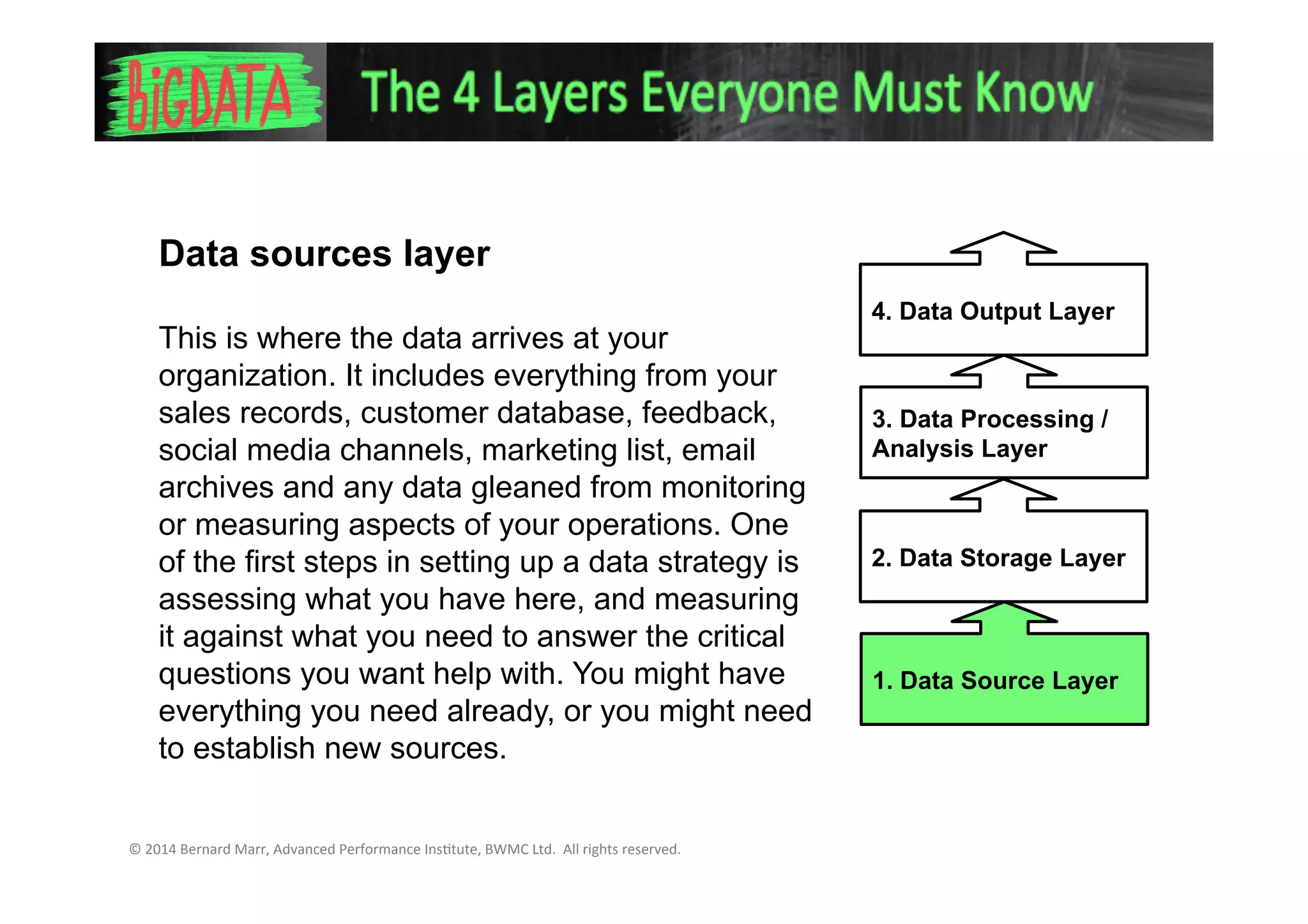
Data sources layer
This is where the data arrives at your
organization. It includes everything from
your sales records, customer database,
feedback, social media channels, marketing
list, email archives and any data gleaned
from monitoring or measuring aspects of
your operations. One of the first steps in
setting up a data strategy is assessing what
you have here, and measuring it against
what you need to answer the critical
questions you want help with. You might
have everything you need already, or you
might need to establish new sources.
1. Data Source Layer
3. Data Processing /
Analysis Layer
2. Data Storage Layer
4. Data Output Layer
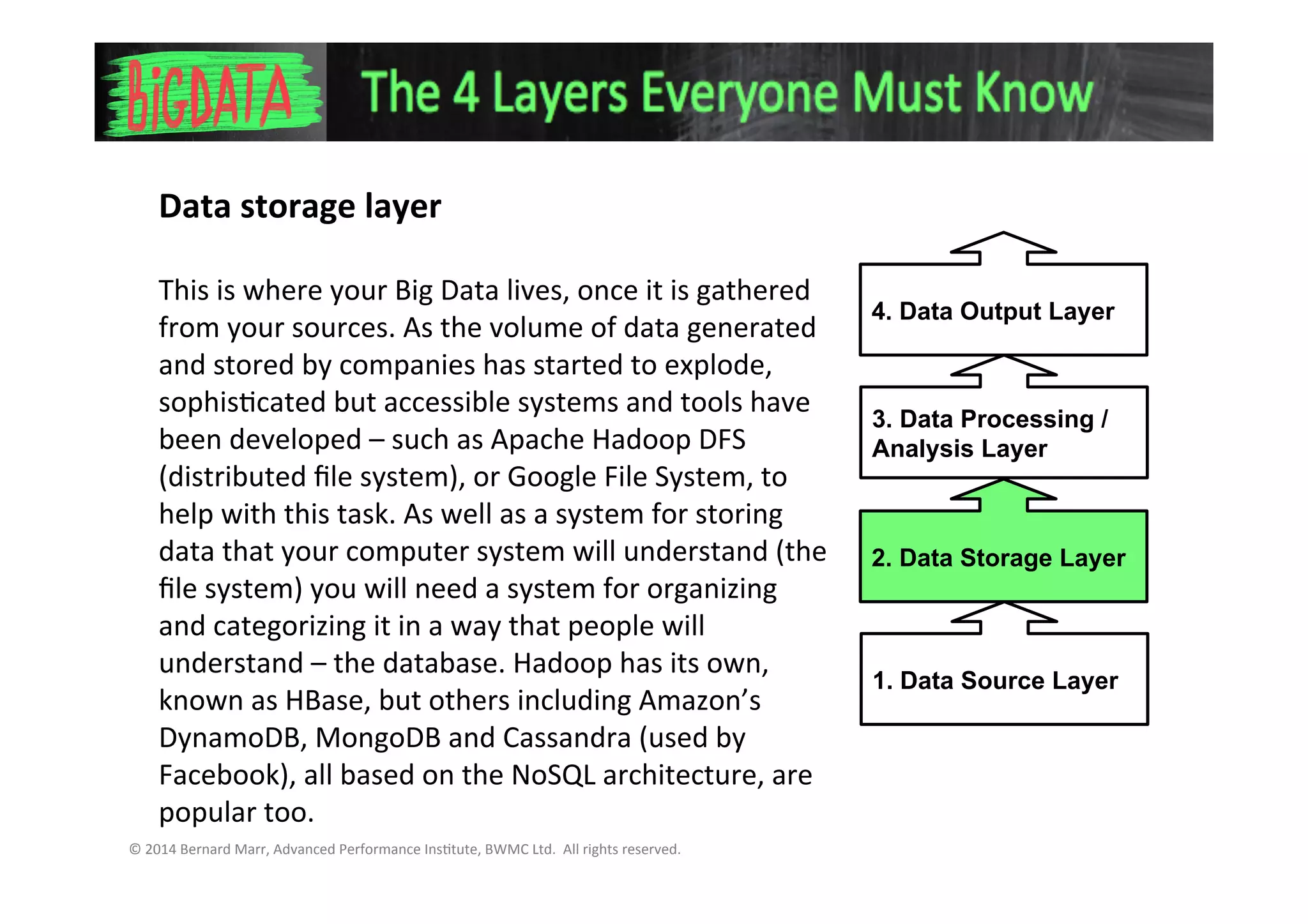
Data storage layer
This is where your Big Data lives, once it is
gathered from your sources. As the volume of
data generated and stored by companies has
started to explode, sophisticated but accessible
systems and tools have been developed – such
as Apache Hadoop DFS (distributed file system),
or Google File System, to help with this task. As
well as a system for storing data that your
computer system will understand (the file
system) you will need a system for organizing
and categorizing it in a way that people will
understand – the database. Hadoop has its own,
known as HBase, but others including Amazon’s
DynamoDB, MongoDB and Cassandra (used by
Facebook), all based on the NoSQL architecture,
are popular too.
1. Data Source Layer
3. Data Processing /
Analysis Layer
2. Data Storage Layer
4. Data Output Layer
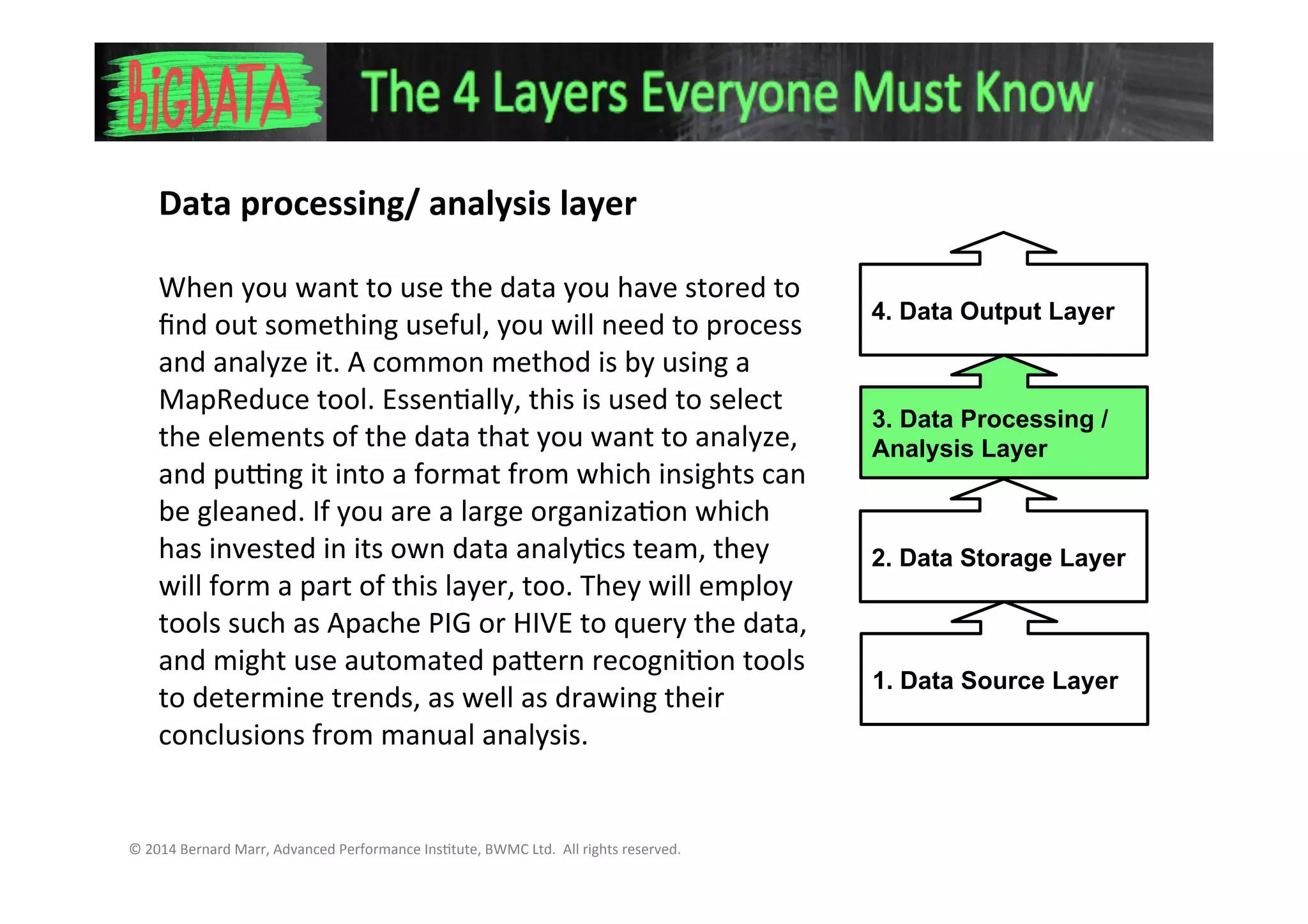
Data processing/ analysis layer
When you want to use the data you have
stored to find out something useful, you will
need to process and analyze it. A common
method is by using a MapReduce tool.
Essentially, this is used to select the elements
of the data that you want to analyze, and
putting it into a format from which insights
can be gleaned. If you are a large organization
which has invested in its own data analytics
team, they will form a part of this layer, too.
They will employ tools such as Apache PIG or
HIVE to query the data, and might use
automated pattern recognition tools to
determine trends, as well as drawing their
conclusions from manual analysis.
1. Data Source Layer
3. Data Processing /
Analysis Layer
2. Data Storage Layer
4. Data Output Layer
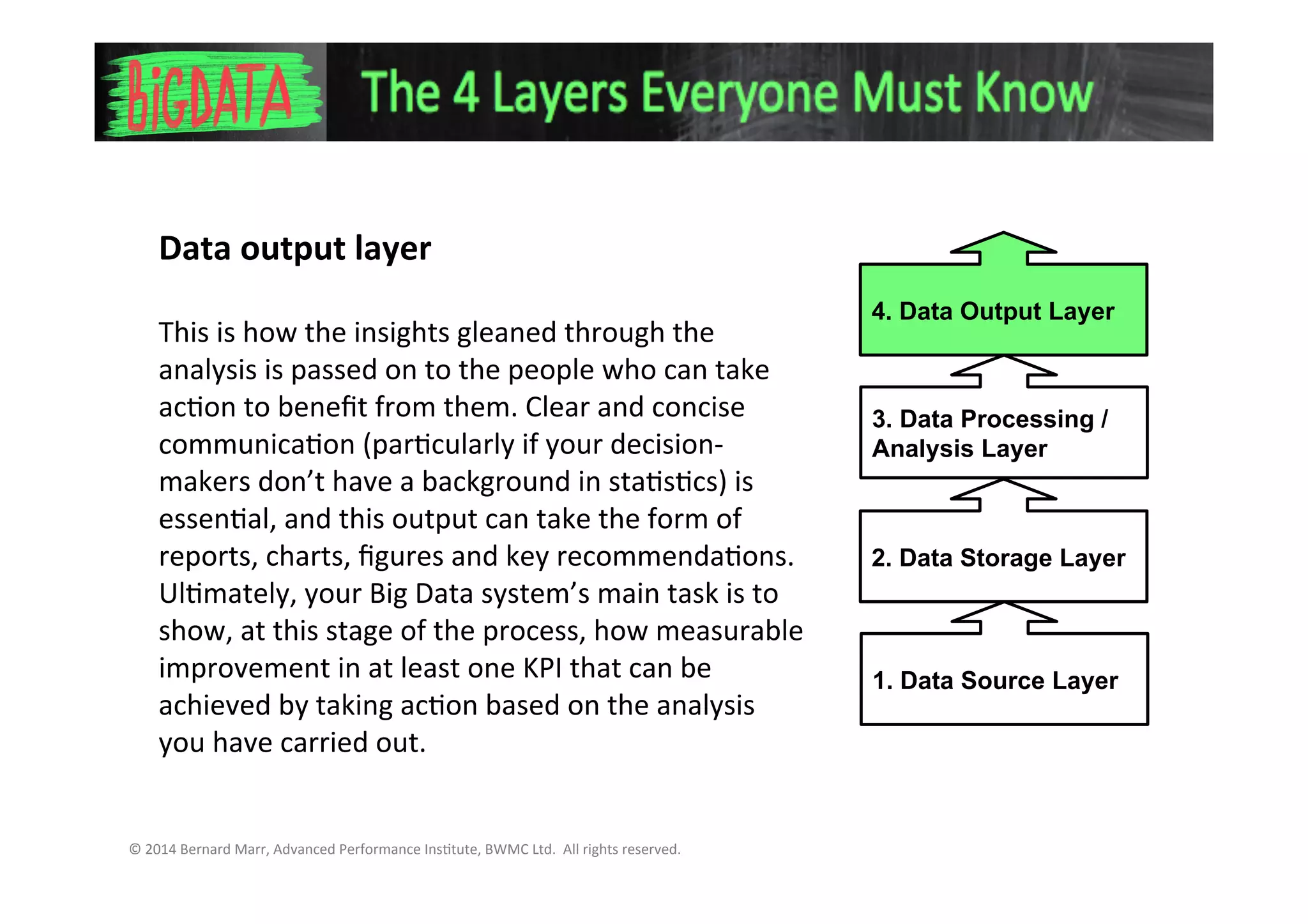
Data output layer
This is how the insights gleaned through the
analysis is passed on to the people who can
take action to benefit from them. Clear and
concise communication (particularly if your
decision-makers don’t have a background in
statistics) is essential, and this output can
take the form of reports, charts, figures and
key recommendations. Ultimately, your Big
Data system’s main task is to show, at this
stage of the process, how measurable
improvement in at least one KPI that can be
achieved by taking action based on the
analysis you have carried out.
1. Data Source Layer
3. Data Processing /
Analysis Layer
2. Data Storage Layer
4. Data Output Layer
If you set up a system which works
through all those stages to arrive at this
destination, then congratulations!
You’re in Big Data.
And hopefully, ready to start reaping the
benefits!
Big Data: The 4 Layers Everyone Must Know

Big Data: The 4 Layers Everyone Must Know

  • 1.
    BIG Data 4 LayersEveryone Must Know
  • 2.
    There is stillso much confusion surrounding Big Data. I thought it might help to clarify the 4 key layers of a big data system - i.e. the different stages the data itself has to pass through on its journey from raw statistic or snippet of unstructured data (for example, social media post) to actionable insight.
  • 3.
    The whole pointof a big data strategy is to develop a system which moves data along this path – raw data to actionable insights. Here, I will attempt to define the basic layers you will need to have in place, if you are getting to grips with how big data could help your business.
  • 4.
    Although people have comeup with different names for these layers, as we’re charting a brave new world where little is set in stone, I think this is the simplest and most accurate breakdown: 1. Data Source Layer 3. Data Processing / Analysis Layer 2. Data Storage Layer 4. Data Output Layer
  • 5.
    Data sources layer Thisis where the data arrives at your organization. It includes everything from your sales records, customer database, feedback, social media channels, marketing list, email archives and any data gleaned from monitoring or measuring aspects of your operations. One of the first steps in setting up a data strategy is assessing what you have here, and measuring it against what you need to answer the critical questions you want help with. You might have everything you need already, or you might need to establish new sources. 1. Data Source Layer 3. Data Processing / Analysis Layer 2. Data Storage Layer 4. Data Output Layer
  • 6.
    Data storage layer Thisis where your Big Data lives, once it is gathered from your sources. As the volume of data generated and stored by companies has started to explode, sophisticated but accessible systems and tools have been developed – such as Apache Hadoop DFS (distributed file system), or Google File System, to help with this task. As well as a system for storing data that your computer system will understand (the file system) you will need a system for organizing and categorizing it in a way that people will understand – the database. Hadoop has its own, known as HBase, but others including Amazon’s DynamoDB, MongoDB and Cassandra (used by Facebook), all based on the NoSQL architecture, are popular too. 1. Data Source Layer 3. Data Processing / Analysis Layer 2. Data Storage Layer 4. Data Output Layer
  • 7.
    Data processing/ analysislayer When you want to use the data you have stored to find out something useful, you will need to process and analyze it. A common method is by using a MapReduce tool. Essentially, this is used to select the elements of the data that you want to analyze, and putting it into a format from which insights can be gleaned. If you are a large organization which has invested in its own data analytics team, they will form a part of this layer, too. They will employ tools such as Apache PIG or HIVE to query the data, and might use automated pattern recognition tools to determine trends, as well as drawing their conclusions from manual analysis. 1. Data Source Layer 3. Data Processing / Analysis Layer 2. Data Storage Layer 4. Data Output Layer
  • 8.
    Data output layer Thisis how the insights gleaned through the analysis is passed on to the people who can take action to benefit from them. Clear and concise communication (particularly if your decision-makers don’t have a background in statistics) is essential, and this output can take the form of reports, charts, figures and key recommendations. Ultimately, your Big Data system’s main task is to show, at this stage of the process, how measurable improvement in at least one KPI that can be achieved by taking action based on the analysis you have carried out. 1. Data Source Layer 3. Data Processing / Analysis Layer 2. Data Storage Layer 4. Data Output Layer
  • 9.
    If you setup a system which works through all those stages to arrive at this destination, then congratulations! You’re in Big Data. And hopefully, ready to start reaping the benefits!