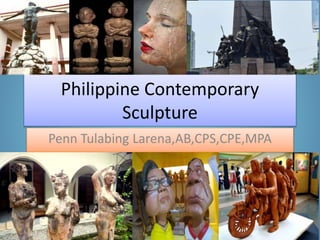
Philippine Contemporary
Sculpture
Penn Tulabing Larena,AB,CPS,CPE,MPA
Learning Objective
• Differentiate among the basic sculpture
materials and Techniques
• Describe the art styles and movements in
sculpture as they apply to give contemporary
Filipino sculpture in the different regions
• Analyze how description, analysis and
interpretation are used in a sample sculpture
Philippine Sculpture
• Philippine Sculpture is the most
familiar art forms among
Filipinos. From the transitional
carving of anitos to the santos to
Christ and down to the saints,
Filipinos find it rather not difficult
as they are already familiar with
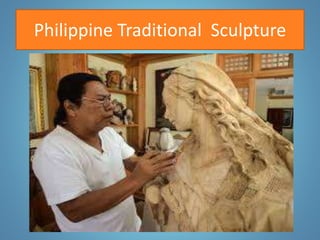
Philippine Traditional Sculpture
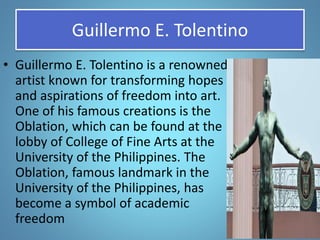
Guillermo E. Tolentino
• Guillermo E. Tolentino is a renowned
artist known for transforming hopes
and aspirations of freedom into art.
One of his famous creations is the
Oblation, which can be found at the
lobby of College of Fine Arts at the
University of the Philippines. The
Oblation, famous landmark in the
University of the Philippines, has
become a symbol of academic
freedom
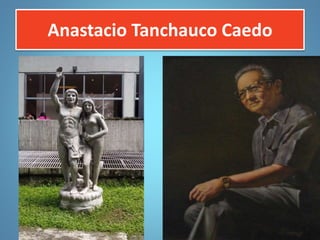
Anastacio Tanchauco Caedo
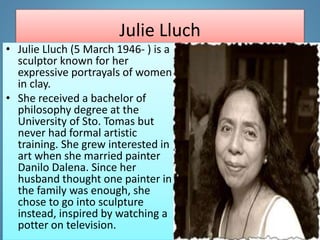
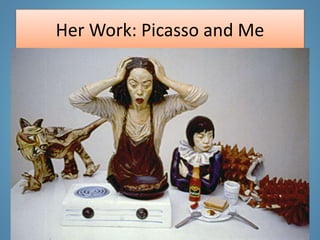
Julie Lluch
• Julie Lluch (5 March 1946- ) is a
sculptor known for her
expressive portrayals of women
in clay.
• She received a bachelor of
philosophy degree at the
University of Sto. Tomas but
never had formal artistic
training. She grew interested in
art when she married painter
Danilo Dalena. Since her
husband thought one painter in
the family was enough, she
chose to go into sculpture
instead, inspired by watching a
potter on television.
Her Work: Picasso and Me
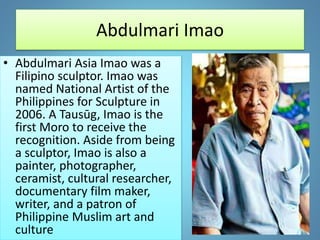
Abdulmari Imao
• Abdulmari Asia Imao was a
Filipino sculptor. Imao was
named National Artist of the
Philippines for Sculpture in
2006. A Tausūg, Imao is the
first Moro to receive the
recognition. Aside from being
a sculptor, Imao is also a
painter, photographer,
ceramist, cultural researcher,
documentary film maker,
writer, and a patron of
Philippine Muslim art and
culture
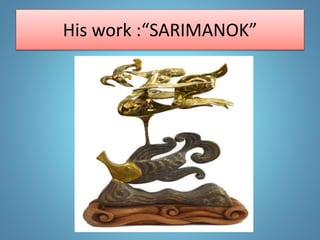
His work :“SARIMANOK”
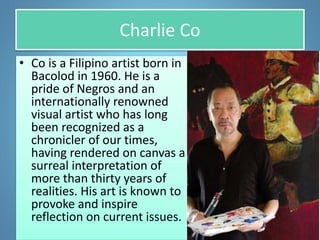
Charlie Co
• Co is a Filipino artist born in
Bacolod in 1960. He is a
pride of Negros and an
internationally renowned
visual artist who has long
been recognized as a
chronicler of our times,
having rendered on canvas a
surreal interpretation of
more than thirty years of
realities. His art is known to
provoke and inspire
reflection on current issues.
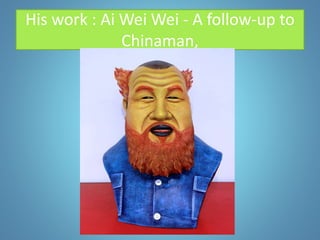
His work : Ai Wei Wei - A follow-up to
Chinaman,
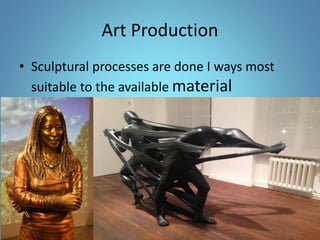
Art Production
• Sculptural processes are done I ways most
suitable to the available material
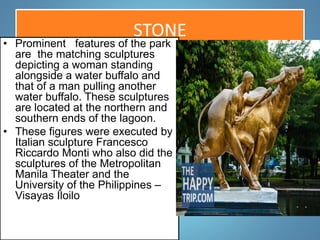
STONE
• Prominent features of the park
are the matching sculptures
depicting a woman standing
alongside a water buffalo and
that of a man pulling another
water buffalo. These sculptures
are located at the northern and
southern ends of the lagoon.
• These figures were executed by
Italian sculpture Francesco
Riccardo Monti who also did the
sculptures of the Metropolitan
Manila Theater and the
University of the Philippines –
Visayas Iloilo
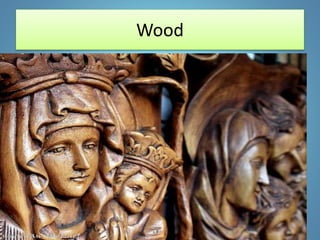
Wood
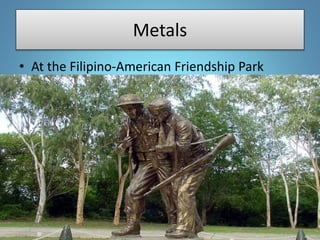
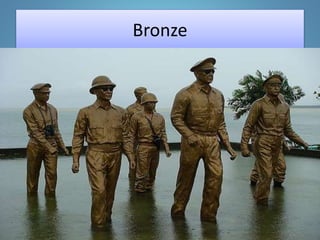
Metals
• At the Filipino-American Friendship Park
Bronze
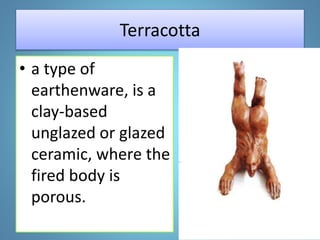
Terracotta
• a type of
earthenware, is a
clay-based
unglazed or glazed
ceramic, where the
fired body is
porous.
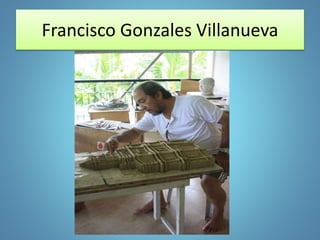
Francisco Gonzales Villanueva
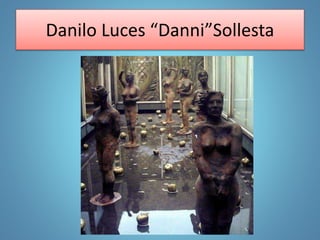
Danilo Luces “Danni”Sollesta
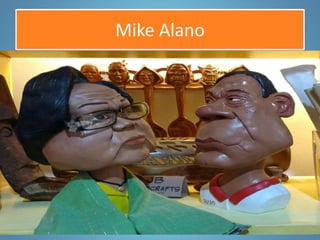
Mike Alano
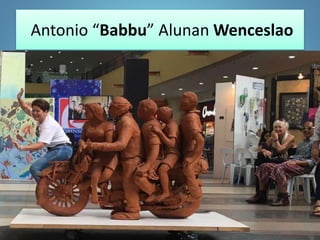
Antonio “Babbu” Alunan Wenceslao
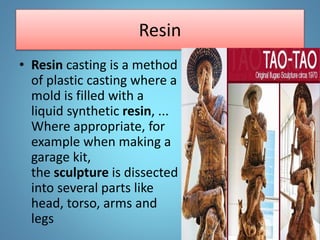
Resin
• Resin casting is a method
of plastic casting where a
mold is filled with a
liquid synthetic resin, ...
Where appropriate, for
example when making a
garage kit,
the sculpture is dissected
into several parts like
head, torso, arms and
legs
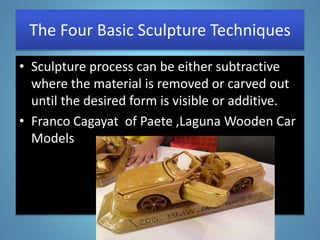
The Four Basic Sculpture Techniques
• Sculpture process can be either subtractive
where the material is removed or carved out
until the desired form is visible or additive.
• Franco Cagayat of Paete ,Laguna Wooden Car
Models
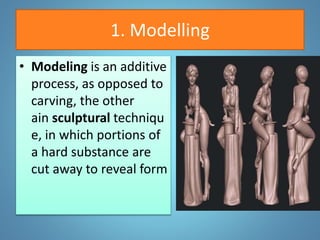
1. Modelling
• Modeling is an additive
process, as opposed to
carving, the other
ain sculptural techniqu
e, in which portions of
a hard substance are
cut away to reveal form
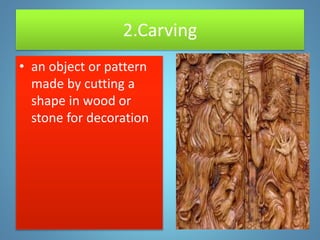
2.Carving
• an object or pattern
made by cutting a
shape in wood or
stone for decoration
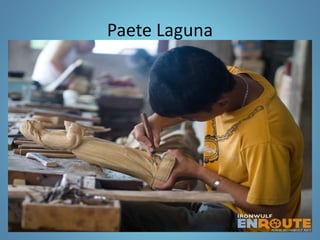
Paete Laguna
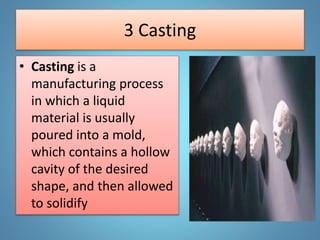
3 Casting
• Casting is a
manufacturing process
in which a liquid
material is usually
poured into a mold,
which contains a hollow
cavity of the desired
shape, and then allowed
to solidify
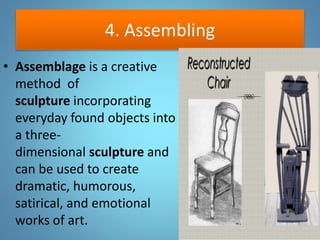
4. Assembling
• Assemblage is a creative
method of
sculpture incorporating
everyday found objects into
a three-
dimensional sculpture and
can be used to create
dramatic, humorous,
satirical, and emotional
works of art.
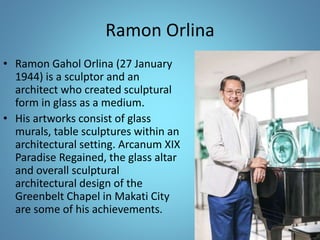
Ramon Orlina
• Ramon Gahol Orlina (27 January
1944) is a sculptor and an
architect who created sculptural
form in glass as a medium.
• His artworks consist of glass
murals, table sculptures within an
architectural setting. Arcanum XIX
Paradise Regained, the glass altar
and overall sculptural
architectural design of the
Greenbelt Chapel in Makati City
are some of his achievements.
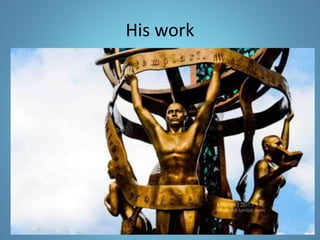
His work
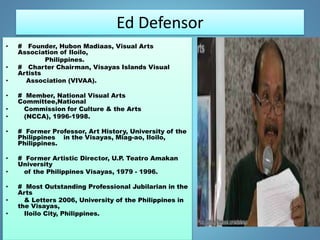
Ed Defensor
• # Founder, Hubon Madiaas, Visual Arts
Association of Iloilo,
Philippines.
• # Charter Chairman, Visayas Islands Visual
Artists
• Association (VIVAA).
• # Member, National Visual Arts
Committee,National
• Commission for Culture & the Arts
• (NCCA), 1996-1998.
• # Former Professor, Art History, University of the
Philippines in the Visayas, Miag-ao, Iloilo,
Philippines.
• # Former Artistic Director, U.P. Teatro Amakan
University
• of the Philippines Visayas, 1979 - 1996.
• # Most Outstanding Professional Jubilarian in the
Arts
• & Letters 2006, University of the Philippines in
the Visayas,
• Iloilo City, Philippines.
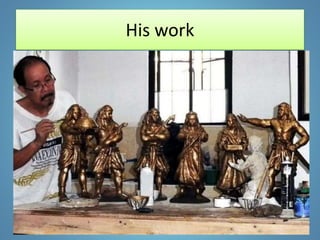
His work
Styles and Movement in Sculpture
• Technology ,modern tools and materials
generate new artistic ideas and scultural
effects that have developed into different
Styles and Movement s.
• JOSEPHINE TURALBA
• ©Copyright 2010.
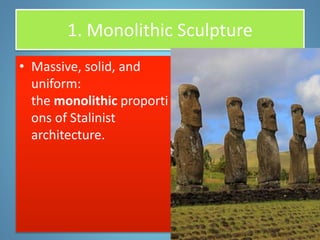
1. Monolithic Sculpture
• Massive, solid, and
uniform:
the monolithic proporti
ons of Stalinist
architecture.
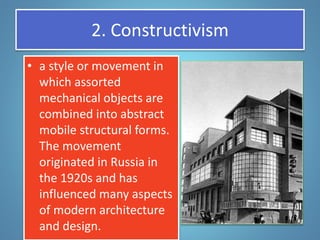
2. Constructivism
• a style or movement in
which assorted
mechanical objects are
combined into abstract
mobile structural forms.
The movement
originated in Russia in
the 1920s and has
influenced many aspects
of modern architecture
and design.
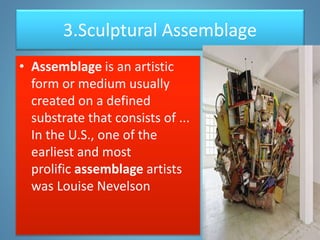
3.Sculptural Assemblage
• Assemblage is an artistic
form or medium usually
created on a defined
substrate that consists of ...
In the U.S., one of the
earliest and most
prolific assemblage artists
was Louise Nevelson
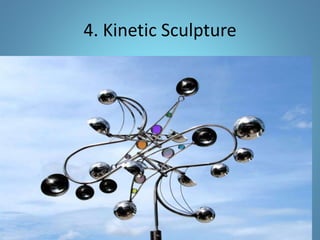
4. Kinetic Sculpture
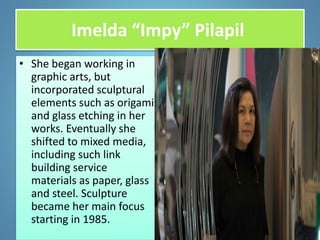
Imelda “Impy” Pilapil
• She began working in
graphic arts, but
incorporated sculptural
elements such as origami
and glass etching in her
works. Eventually she
shifted to mixed media,
including such link
building service
materials as paper, glass
and steel. Sculpture
became her main focus
starting in 1985.
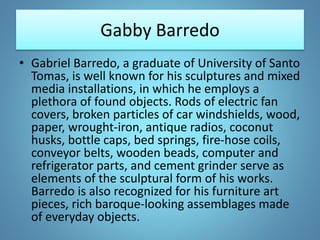
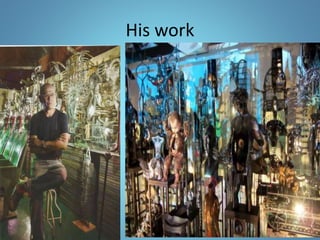
Gabby Barredo
• Gabriel Barredo, a graduate of University of Santo
Tomas, is well known for his sculptures and mixed
media installations, in which he employs a
plethora of found objects. Rods of electric fan
covers, broken particles of car windshields, wood,
paper, wrought-iron, antique radios, coconut
husks, bottle caps, bed springs, fire-hose coils,
conveyor belts, wooden beads, computer and
refrigerator parts, and cement grinder serve as
elements of the sculptural form of his works.
Barredo is also recognized for his furniture art
pieces, rich baroque-looking assemblages made
of everyday objects.
His work
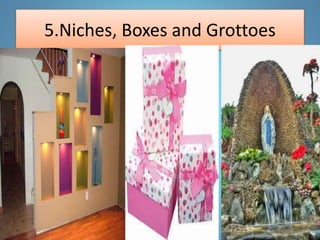
5.Niches, Boxes and Grottoes
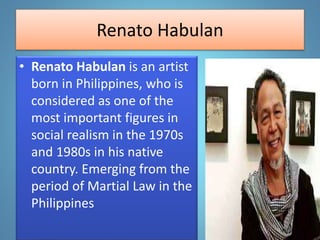
Renato Habulan
• Renato Habulan is an artist
born in Philippines, who is
considered as one of the
most important figures in
social realism in the 1970s
and 1980s in his native
country. Emerging from the
period of Martial Law in the
Philippines
His work
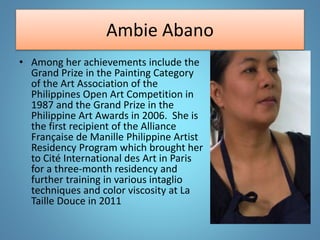
Ambie Abano
• Among her achievements include the
Grand Prize in the Painting Category
of the Art Association of the
Philippines Open Art Competition in
1987 and the Grand Prize in the
Philippine Art Awards in 2006. She is
the first recipient of the Alliance
Française de Manille Philippine Artist
Residency Program which brought her
to Cité International des Art in Paris
for a three-month residency and
further training in various intaglio
techniques and color viscosity at La
Taille Douce in 2011
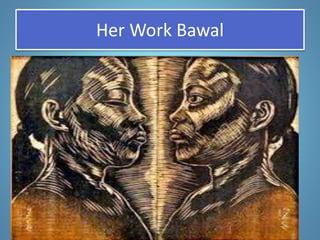
Her Work Bawal
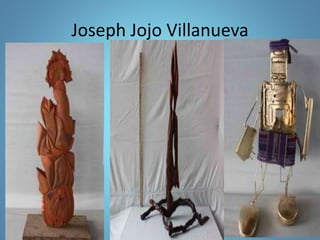
Joseph Jojo Villanueva
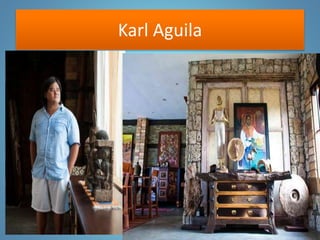
Karl Aguila
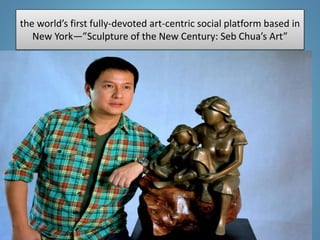
the world’s first fully-devoted art-centric social platform based in
New York—”Sculpture of the New Century: Seb Chua’s Art”
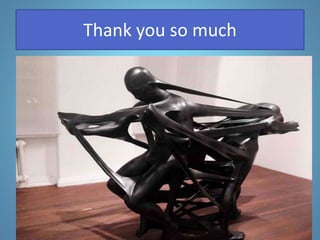
Thank you so much

Philippine Contemporary Sculpture

  • 1.
  • 2.
    Learning Objective • Differentiateamong the basic sculpture materials and Techniques • Describe the art styles and movements in sculpture as they apply to give contemporary Filipino sculpture in the different regions • Analyze how description, analysis and interpretation are used in a sample sculpture
  • 3.
    Philippine Sculpture • PhilippineSculpture is the most familiar art forms among Filipinos. From the transitional carving of anitos to the santos to Christ and down to the saints, Filipinos find it rather not difficult as they are already familiar with
  • 4.
  • 6.
    Guillermo E. Tolentino •Guillermo E. Tolentino is a renowned artist known for transforming hopes and aspirations of freedom into art. One of his famous creations is the Oblation, which can be found at the lobby of College of Fine Arts at the University of the Philippines. The Oblation, famous landmark in the University of the Philippines, has become a symbol of academic freedom
  • 7.
  • 8.
    Julie Lluch • JulieLluch (5 March 1946- ) is a sculptor known for her expressive portrayals of women in clay. • She received a bachelor of philosophy degree at the University of Sto. Tomas but never had formal artistic training. She grew interested in art when she married painter Danilo Dalena. Since her husband thought one painter in the family was enough, she chose to go into sculpture instead, inspired by watching a potter on television.
  • 9.
  • 10.
    Abdulmari Imao • AbdulmariAsia Imao was a Filipino sculptor. Imao was named National Artist of the Philippines for Sculpture in 2006. A Tausūg, Imao is the first Moro to receive the recognition. Aside from being a sculptor, Imao is also a painter, photographer, ceramist, cultural researcher, documentary film maker, writer, and a patron of Philippine Muslim art and culture
  • 11.
  • 12.
    Charlie Co • Cois a Filipino artist born in Bacolod in 1960. He is a pride of Negros and an internationally renowned visual artist who has long been recognized as a chronicler of our times, having rendered on canvas a surreal interpretation of more than thirty years of realities. His art is known to provoke and inspire reflection on current issues.
  • 13.
    His work :Ai Wei Wei - A follow-up to Chinaman,
  • 14.
    Art Production • Sculpturalprocesses are done I ways most suitable to the available material
  • 15.
    STONE • Prominent featuresof the park are the matching sculptures depicting a woman standing alongside a water buffalo and that of a man pulling another water buffalo. These sculptures are located at the northern and southern ends of the lagoon. • These figures were executed by Italian sculpture Francesco Riccardo Monti who also did the sculptures of the Metropolitan Manila Theater and the University of the Philippines – Visayas Iloilo
  • 16.
  • 17.
    Metals • At theFilipino-American Friendship Park
  • 18.
  • 19.
    Terracotta • a typeof earthenware, is a clay-based unglazed or glazed ceramic, where the fired body is porous.
  • 20.
  • 21.
  • 22.
  • 23.
  • 24.
    Resin • Resin castingis a method of plastic casting where a mold is filled with a liquid synthetic resin, ... Where appropriate, for example when making a garage kit, the sculpture is dissected into several parts like head, torso, arms and legs
  • 25.
    The Four BasicSculpture Techniques • Sculpture process can be either subtractive where the material is removed or carved out until the desired form is visible or additive. • Franco Cagayat of Paete ,Laguna Wooden Car Models
  • 26.
    1. Modelling • Modelingis an additive process, as opposed to carving, the other ain sculptural techniqu e, in which portions of a hard substance are cut away to reveal form
  • 27.
    2.Carving • an objector pattern made by cutting a shape in wood or stone for decoration
  • 28.
  • 29.
    3 Casting • Castingis a manufacturing process in which a liquid material is usually poured into a mold, which contains a hollow cavity of the desired shape, and then allowed to solidify
  • 30.
    4. Assembling • Assemblageis a creative method of sculpture incorporating everyday found objects into a three- dimensional sculpture and can be used to create dramatic, humorous, satirical, and emotional works of art.
  • 31.
    Ramon Orlina • RamonGahol Orlina (27 January 1944) is a sculptor and an architect who created sculptural form in glass as a medium. • His artworks consist of glass murals, table sculptures within an architectural setting. Arcanum XIX Paradise Regained, the glass altar and overall sculptural architectural design of the Greenbelt Chapel in Makati City are some of his achievements.
  • 32.
  • 33.
    Ed Defensor • #Founder, Hubon Madiaas, Visual Arts Association of Iloilo, Philippines. • # Charter Chairman, Visayas Islands Visual Artists • Association (VIVAA). • # Member, National Visual Arts Committee,National • Commission for Culture & the Arts • (NCCA), 1996-1998. • # Former Professor, Art History, University of the Philippines in the Visayas, Miag-ao, Iloilo, Philippines. • # Former Artistic Director, U.P. Teatro Amakan University • of the Philippines Visayas, 1979 - 1996. • # Most Outstanding Professional Jubilarian in the Arts • & Letters 2006, University of the Philippines in the Visayas, • Iloilo City, Philippines.
  • 34.
  • 35.
    Styles and Movementin Sculpture • Technology ,modern tools and materials generate new artistic ideas and scultural effects that have developed into different Styles and Movement s. • JOSEPHINE TURALBA • ©Copyright 2010.
  • 36.
    1. Monolithic Sculpture •Massive, solid, and uniform: the monolithic proporti ons of Stalinist architecture.
  • 37.
    2. Constructivism • astyle or movement in which assorted mechanical objects are combined into abstract mobile structural forms. The movement originated in Russia in the 1920s and has influenced many aspects of modern architecture and design.
  • 38.
    3.Sculptural Assemblage • Assemblageis an artistic form or medium usually created on a defined substrate that consists of ... In the U.S., one of the earliest and most prolific assemblage artists was Louise Nevelson
  • 39.
  • 40.
    Imelda “Impy” Pilapil •She began working in graphic arts, but incorporated sculptural elements such as origami and glass etching in her works. Eventually she shifted to mixed media, including such link building service materials as paper, glass and steel. Sculpture became her main focus starting in 1985.
  • 41.
    Gabby Barredo • GabrielBarredo, a graduate of University of Santo Tomas, is well known for his sculptures and mixed media installations, in which he employs a plethora of found objects. Rods of electric fan covers, broken particles of car windshields, wood, paper, wrought-iron, antique radios, coconut husks, bottle caps, bed springs, fire-hose coils, conveyor belts, wooden beads, computer and refrigerator parts, and cement grinder serve as elements of the sculptural form of his works. Barredo is also recognized for his furniture art pieces, rich baroque-looking assemblages made of everyday objects.
  • 42.
  • 43.
  • 44.
    Renato Habulan • RenatoHabulan is an artist born in Philippines, who is considered as one of the most important figures in social realism in the 1970s and 1980s in his native country. Emerging from the period of Martial Law in the Philippines
  • 45.
  • 46.
    Ambie Abano • Amongher achievements include the Grand Prize in the Painting Category of the Art Association of the Philippines Open Art Competition in 1987 and the Grand Prize in the Philippine Art Awards in 2006. She is the first recipient of the Alliance Française de Manille Philippine Artist Residency Program which brought her to Cité International des Art in Paris for a three-month residency and further training in various intaglio techniques and color viscosity at La Taille Douce in 2011
  • 47.
  • 48.
  • 49.
  • 50.
    the world’s firstfully-devoted art-centric social platform based in New York—”Sculpture of the New Century: Seb Chua’s Art”
  • 52.